How can hospitals weather the financial storms of 2021?

Patient volumes were uneven in 2020, and a new report shows volumes will likely remain below pre-pandemic levels in 2021. This indicates challenges for hospitals looking to stabilize their finances — but there are some key strategies that can help.

Though hospital finances recovered to some extent by the end of 2020, the industry is not out of the woods yet. However, with strategic investments, especially in outpatient care and technology, hospitals and health systems can help buoy their finances in this challenging time, industry observers said.

Patient volumes have fluctuated wildly after the Covid-19 pandemic hit as Covid-19 patients flocked to hospitals and those needing or seeking elective surgery and other care staying away. Not surprisingly, this has had a significant impact on health systems’ financial health.

But outpatient settings and digital solutions offer some revenue-generating opportunities for hospitals.

“A number of the major players and some of the bigger regional systems in the country now are in a place where they get more of their revenue from the outpatient side as opposed to the inpatient side,” said Dr. Sanjay Saxena, global healthcare leader, Payers, Providers, Health Care Systems & Services and managing director at Boston Consulting Group, in a phone interview.

In fact, outpatient care was the only healthcare setting that saw an increase in patient volumes in 2020. Though emergency department visits and inpatient volumes were down from July to December last year compared to the same period in 2019, outpatient volumes actually increased by 5%, according to a report by consumer credit reporting agency TransUnion.

Healthcare providers that have well-established and expansive outpatient and ambulatory care businesses will be able to weather patient volume trends better in 2021 than those who do not, said Saxena.

Take HCA Healthcare, for example. The Nashville, Tennessee-based healthcare giant’s revenues jumped to $14.2 billion in the fourth quarter of last year, up from $13.5 billion in the same period in 2019. HCA’s ability to move care outside of the inpatient setting to the ambulatory environment really helped their financial performance, said Saxena.

On the other hand, smaller and more rural hospitals, which depend heavily on ED and inpatient care, may face a challenging year, he added.

Another key investment for hospitals will be in digital solutions to help them manage the ups and downs of patient volume.

Resilience as a broad topic for provider executives is absolutely top of mind,” said Gurpreet Singh, health services leader at PriceWaterhouseCoopers, in a phone interview. “And resiliency can be achieved in a number of different ways. One way is [figuring out] — can you predict demand a little bit better?”

Patient demand forecasting solutions will be popular, with 74% of health executives recently surveyed by PwC’s Health Research Institute saying their organizations would invest more in predictive modeling in 2021.

Further, hospitals will see savings in some unexpected places. For example, with an increasingly remote and mobile healthcare workforce, hospitals may see cost savings on real estate and facility leases, said Singh.

They can use these savings to invest further in telehealth and at-home care programs to expand care outside of the four walls of the hospital, he added.

The industry has to come to terms with changes brought on by the Covid-19 pandemic, including the shifts in care delivery and patient preferences.

“Some of these things are structurally significant changes,” said Saxena. “Organizations ignore these things…at their peril. Some leading organizations and systems will find a way to embrace [these changes] and leapfrog others in the market coming out of 2021.”


Tower Health to cut pay for executives, managers

Image result for tower health headquarters

Tower Health said it is cutting salaries of executives and managers amid financial losses linked to the COVID-19 pandemic.

The West Reading, Pa.-based health system has struggled financially in the last two fiscal years. It recorded an operating loss of $378.2 million in fiscal year 2020, as well as an operating deficit of $178.8 million the year prior. And last November, the health system said it would consider selling six of its Philadelphia-area hospitals, including those it has purchased since 2017 from Franklin, Tenn.-based Community Health Systems, as part of a financial turnaround plan.

To help offset the financial damage, about 400 Tower Health executives and managers will have their pay cut, beginning in their Feb. 19 paychecks, according to The Philadelphia Inquirer, which cites a letter CEO Clint Matthews wrote to staff. Executives will have their pay cut by 15 percent, and directors, senior directors and associate vice presidents will have their pay cut by 10 percent.

In a statement shared with Becker’s on Feb. 8, the health system said it “is undertaking several initiatives as part of a coordinated plan to improve operations, strengthen care delivery and address the ongoing financial impact of COVID-19.”

“These actions include compensation reductions for executives and managerial employees, along with operational improvements to reduce costs and enhance revenue,” according to the Tower Health statement.

The salary cuts will be in effect until June 30, and do not affect front-line clinical or support staff, who received merit increases in January.

Tower Health projects cost savings of about $11.6 million because of the pay cuts.  

“Reducing management compensation is a difficult but necessary decision that will stabilize and strengthen our financial performance as we continue to meet the challenges of the COVID-19 pandemic, as well as our ongoing mission of providing compassionate, accessible, high-quality, cost-effective healthcare to our communities,” the health system said.

In need of more nuanced consumer segmentation

https://mailchi.mp/85f08f5211a4/the-weekly-gist-february-5-2021?e=d1e747d2d8

Image result for Healthcare In need of more nuanced consumer segmentation

As “consumerism” becomes an ever-greater focus of health system strategy, we’ve begun to field a number of questions from leaders looking to develop a better understanding of consumers in their market.

In particular, there’s a growing desire for more sophistication around consumer segmentation—understanding how preferences and behavior differ among various kinds of patients. 

Traditional segmentation has largely been marketing-driven, helping to target advertising and patient recruitment messages to key groups. For that, the old-school marketing segments were good enough: busy professionals, the worried well, the growing family, and so forth.

But as systems begin to develop product offerings (telemedicine or home-based services, for example) for target populations, those advertising-based segments need to be supplemented with a more advanced understanding of care consumption patterns over time. Segmentation needs to be dynamic, not static—how does a person move through life stages, and across care events, over time?

A single consumer might be in different segments depending on the type of care they need: if I have a new cancer diagnosis, that matters more than whether I’m a “busy professional”, and my relevant segment might be different still if I’m just looking for a quick virtual visit.

Layered on top of demographic and clinical segments is the additional complexity of payer category—am I a Medicare Advantage enrollee or do I have a high-deductible exchange plan? 

With consumers exercising ever greater choice over where, when, and how much care to receive, understanding the interplay of these different kinds of segments is fast becoming a key skill for health systems—one that many don’t currently have.  

Humana partners with DispatchHealth for hospital at home

https://mailchi.mp/85f08f5211a4/the-weekly-gist-february-5-2021?e=d1e747d2d8

Image result for Humana partners with DispatchHealth for hospital at home

Humana, the nation’s second-largest Medicare Advantage (MA) insurer, is pushing further into home-based care, partnering with Denver-based startup DispatchHealth to offer its members—especially those with conditions like heart failure, chronic obstructive pulmonary disease, and chronic cellulitis—access to hospital-level care at home.

The service will initially be available in the Denver and Tacoma, WA markets, with plans to expand to Arizona, Nevada, and Texas across 2021. Humana members who meet hospital admission criteria will receive daily home visits from an on-call, dedicated DispatchHealth medical team, as well as 24/7 physician coverage enabled by remote monitoring and an emergency call button.

DispatchHealth will also coordinate other patient care and wraparound services in the home as needed, including pharmacy, imaging, physical therapy, durable medical equipment, and meal delivery. Dispatch’s earlier offerings centered around home-based, on-demand urgent and emergency care services, now available in at least 29 cities nationwide. 

Humana’s partnership with DispatchHealth could deliver a full care continuum of home-based services to its Medicare Advantage enrollees and has the potential to displace hospitals from at least a portion of acute care services

Post-COVID, it’s becoming increasingly clear that the nexus of care delivery has shifted even more rapidly to consumers’ homes—and traditional providers will need to rethink service strategies accordingly.

There’s (still) a fungus among us

https://mailchi.mp/2c6956b2ac0d/the-weekly-gist-january-29-2021?e=d1e747d2d8

Candida auris actively shed in the healthcare environment - Outbreak News  Today

Remember 2019, when the scariest “new” pathogen was Candida auris, a drug-resistant fungus that was creeping into hospitals and nursing homes, often proving fatal to elderly and immune-compromised patients who came in contact with it? C. auris proved difficult to eliminate from infected facilities, sometimes requiring drywall to be ripped out of patient rooms in order to fully decontaminate. 

With all of our attention focused on COVID-19, C. auris and other drug resistant bacteria and fungi have been making a resurgence, according to a recent New York Times report. In Los Angeles County alone, 250 facilities now report C. auris infection, up from just a handful before the pandemic.

Unlike COVID-19, these pathogens cling relentlessly to surfaces, so protocols allowing the reuse of protective equipment in order to conserve resources inadvertently provided a mechanism for these bugs to spread. 

Steroids used to treat COVID-19 patients suppress the immune system, making patients more vulnerable. According to one expert, the spread of these drug-resistant infections shows the danger of “seeing the world as a one-pathogen world”.

Providers have had a laser focus on preventing the aerosol spread of COVID—now is the time to double down on surface decontamination and infection mitigation procedures to make sure we don’t meet the end of the pandemic with the rise of other classes of “superbugs”.

Washington health system rebuked for offering COVID-19 vaccines to ‘major donors’

Overlake Hospital Medical Center (Bellevue, Wash.) | 100 hospitals and  health systems with great orthopedic programs 2017

Overlake Medical Center & Clinics invited about 110 donors who gave more than $10,000 to the Bellevue, Wash.-based health system to receive COVID-19 vaccines, drawing criticism from the state’s governor, according to The Seattle Times

Molly Stearns, the chief development officer at Overlake, emailed the “major donors,” as they were addressed in correspondence, about 500 open appointments in its COVID-19 clinic that were set to open Jan. 23. According to The Seattle Times, donors who received the email got an access code to register for appointments. 

The vaccination appointments weren’t exclusive to donors, but were open to some 4,000 people who were board members, some patients, volunteers, employees and retired health providers, Overlake told the newspaper. All registrants were supposed to meet state-specific eligibility requirements for the vaccine, according to The Seattle Times.

Tom DeBord, Overlake’s COO, told the newspaper that the invitation was sent after the hospital’s scheduling system stopped working properly. To speed up distribution, the system began contacting people whose emails they had access to, which included donors, retirees, some patients and board members.

“We’re under pressure to vaccinate people who are eligible and increase capacity. In hindsight, we could certainly look back and say this wasn’t the best way to do it,” Mr. DeBord told The Seattle Times.

Once Gov. Jay Inslee’s office found out about the “invite-only” appointments, the office asked Overlake to shut down the sign-ups, which the system did.

In a Jan. 27 statement posted to the health system’s website, Overlake said all communications with people invited to sign up for the vaccine “made clear that people must show proof of eligibility under current Washington State requirements to ultimately be vaccinated, no matter who they are or how they are affiliated with us. We recognize we made a mistake by including a subset of our donors and by not adopting a broader outreach strategy to fill these appointments, and we apologize. Our intent and commitment has always been to administer every vaccine made available to us safely, appropriately, and efficiently.”

Read the full report here.

Baylor Scott & White to cut, outsource 1,700 jobs

Baylor Scott & White Health To Outsource, Eliminate 1,700 Positions – CBS  Dallas / Fort Worth

Dallas-based Baylor Scott & White Health will outsource, lay off or retrain 1,700 employees who work in information technology, billing, revenue cycle management and other support services, according to The Dallas Morning News

The health system said outsourcing the finance and IT jobs and other support services will help it improve efficiencies and focus on reducing costs in noncore business areas.

About two-thirds of the 1,700 employees will be joining third-party RCM, IT, billing or support staff vendors.
About 600 to 650 positions will be eliminated. 

Baylor Scott & White said that employees whose positions are being eliminated will be invited to participate in retraining programs. 

The retraining program would allow the employees to remain employed at the health system and receive the same pay or higher, depending on their role, according to the report. Some of the retraining programs that will be available are learning to become a certified medical assistant or learning a job in patient support services.

“In no case — in no case — is anyone going to miss a paycheck,” Baylor Scott & White CEO Jim Hinton, told The Dallas Morning News. “We can afford to make these commitments, and we want to do the right thing for the great employees of Baylor, Scott & White. They’ve really done everything we’ve asked and more during this last year.”

This is the third time Baylor Scott & White has announced cost-cutting initiatives related to its workforce since the pandemic began. Last May, 930 Baylor Scott & White employees were laid off, and in December the health system said it would lay off employees and outsource 102 corporate finance jobs. 

Mr. Hinton said that Baylor Scott & White has 2,000 clinical positions open, and it is investing in a new regional medical school campus and a joint venture to improve care for the underinsured. 

“This is a transition to a new business model, a transition to a new way of working,” Mr. Hinton told The Dallas Morning News. 

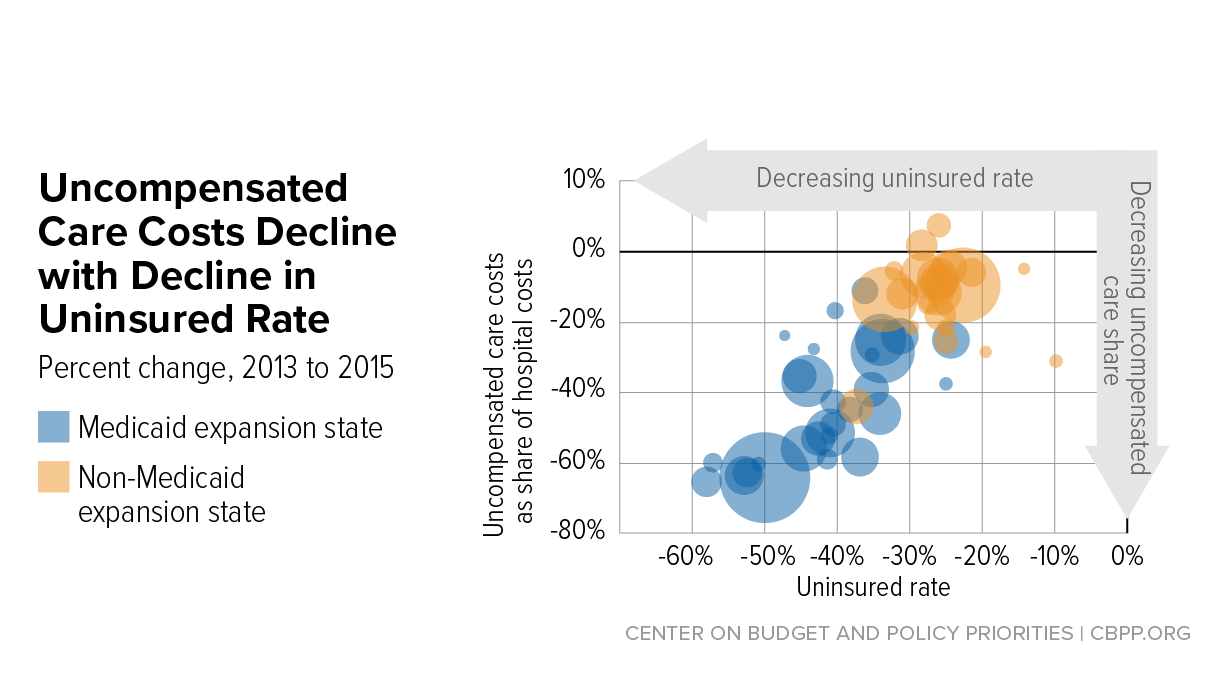
Hospital Uncompensated Care Costs Grew to $41.61B in 2019

Uncompensated Care Costs Fell in Nearly Every State as ACA's Major Coverage  Provisions Took Effect | Center on Budget and Policy Priorities

Hospital uncompensated care costs were up from $41.3B in 2018 and $38.4B in 2017, revealing an upward trend, according to AHA data.

Hospital uncompensated care costs increased right before the COVID-19 pandemic hit, according to new data from the American Hospital Association (AHA).

AHA data showed that hospitals incurred a new high of $41.61 billing in uncompensated care costs in 2019, the most recent year for which the group had complete data.

Uncompensated care costs in 2019 were up from $41.3 billion in 2018 and $38.4 billion in 2017 and were the second-highest per AHA records. Hospitals reported the most uncompensated care costs in 2013 when they incurred $46.8 billion.

Hospital uncompensated care costs decreased after the all-time high in 2013, but have recently started to tick back up after holding steady at $38.4 in 2016 and 2017.

In just the last 20 years, hospitals of all types have provided more than $660 billion in uncompensated care to patients, AHA reported. And that figure does not fully account for other ways in which provides provide financial assistance to patients of limited means, the group stated.

Each year, AHA aggregates data on uncompensated care, or care provided for which no reimbursement is received by hospitals from patients or payers. The data comes from the group’s Annual Survey of Hospitals, a comprehensive report of hospital financial data.

Uncompensated care is the sum of a hospital’s bad debt and financial assistance it provides, AHA explained.

Bad debt occurs when a hospital does not expect to obtain reimbursement for care provided, such as when patients are unable to pay their financial responsibility and do not qualify for financial assistance or are unwilling to pay their bills.

Hospitals also provide varying levels of financial assistance, AHA added. Financial assistance supports patients who cannot afford to pay and qualify for support from the hospital based on policies it has established based on the facility’s mission, financial condition, and geographic location, among other factors.

Combined, bad debt and financial assistance charges total a hospital’s uncompensated care charges, which is then multiplied by a hospital’s cost-to-charge ratio to determine total uncompensated care costs.

AHA noted that it expressed uncompensated care in costs versus charges because of significant variations in hospital payer mixes. Publishing the information as costs rather than charges enables better comparison across hospitals, the group said.

Nearly half of hospitals (48 percent) have seen bad debt and uncompensated care increase recently as a result of the ongoing COVID-19 pandemic, an analysis from consulting firm Kaufman Hall revealed.

More than 40 percent of hospitals also reported increases in percentage of uninsured or self-pay patients (44 percent) and the percentage of Medicaid patients (41 percent), which both contribute to unfunded or underfunded care at hospitals.

“The challenges brought on by the COVID-19 pandemic have affected nearly every aspect of hospital financial and clinical operations,” Lance Robinson, a managing director at Kaufman Hall, said at the time. “Organizations have responded to the challenge by adjusting their operations and strengthening important community relationships.”

Hospital uncompensated care costs – and bad debt as a result – are likely to increase in 2020 as hospitals come to terms with the impact COVID-19 has had on their financial health.

Already, hospitals have lost an estimated $323 billion in 2020 as a result of the COVID-19 pandemic, according to earlier projections from AHA.

About half of US hospitals also started the year in the red, AHA and Kaufman Hall stated in a recent report. The organizations predicted that hospital margins would sink to -7 percent in the second half of 2020 without comprehensive financial support from the government, but could decrease to a low of -11 percent if COVID-19 continued to periodically surge as it has.

Michael Dowling: No one said it would be easy

Five suggestions for technology companies, venture capitalists | Northwell  Health

Hardly one month into 2021, the pressing priorities facing healthcare leaders are abundantly clear. 

First, we will be living in a world preoccupied by COVID-19 and vaccination for many months to come. Remember: this is a marathon, not a sprint. And the stark reality is that the vaccination rollout will continue well into the summer, if not longer, while at the same time we continue to care for hundreds of thousands of Americans sickened by the virus. Despite the challenges we face now and in the coming months in treating the disease and vaccinating a U.S. population of 330 million, none of us should doubt that we will prevail. Despite the federal government’s missteps over the past year in managing and responding to this unprecedented public health crisis, historians will recognize the critical role of the nation’s healthcare community in enabling us to conquer this once-in-a-generation pandemic.

While there has been an overwhelming public demand for the vaccine during the past couple of weeks, there remains some skepticism within the communities we serve, including some of the most-vulnerable populations, so healthcare leaders will find themselves spending time and energy communicating the safety and efficacy of vaccines to those who may be hesitant. This is a good thing. It is our responsibility to share facts, further public education and influence public policy. COVID-19 has enhanced public trust in healthcare professionals, and we can maintain that trust if we keep our focus on the right things — namely, how we improve the health of our communities.

And as healthcare leaders diligently balance this work, we also have a great opportunity to reimagine what our hospitals and health systems can be as we emerge from the most trying year of our professional lifetimes. How do you want your hospital or system organized? What kind of structural changes are needed to achieve the desired results? What do you really want to focus on? Amid the pressing priorities and urgent decision-making needed to survive, it is easy to overlook the great reimagination period in front of us. The key is to forget what we were like before COVID-19 and reflect upon what we want to be after.

These changes won’t occur overnight. We’ll need patience, but here are my thoughts on five key questions we need to answer to get the right results.

1. How do you enhance productivity and become more efficient? Throughout 2021, most systems will be in recovery mode from COVID’s financial bruises. Hospitals saw double-digit declines in inpatient and outpatient volumes in 2020, and total losses for hospitals and health systems nationwide were estimated to total at least $323 billion. While federal relief offset some of our losses, most of us still took a major financial hit. As we move forward, we must reorganize to operate as efficiently as possible. Does reorganization sound daunting? If so, remember the amount of reorganization we mustered to work effectively in the early days of the pandemic. When faced with no alternative, healthcare moved heaven and earth to fulfill its mission. Crises bring with them great clarity. It’s up to leaders to keep that clarity as this tragic, exhausting and frustrating crisis gradually fades.

2. How do you accelerate digital care? COVID-19 changed our relationship with technology, personally and professionally. Look at what we accomplished and how connected we remain. We were reminded of how high-quality healthcare can go unhindered by distance, commutes and travel constraints with the right technology and telehealth programs in place. Health system leaders must decide how much of their business can be accommodated through virtual care so their organizations can best offer convenience while increasing access. Oftentimes, these conversations don’t get far before confronting doubts about reimbursement. Remember, policy change must happen before reimbursement catches up. If you wait for reimbursement before implementing progressive telehealth initiatives, you’ll fall behind. 

3. How will your organization confront healthcare inequities? In 2020, I pledged that Northwell would redouble its efforts and remain a leader in diversity and inclusion. I am taking this commitment further this year and, with the strength of our diverse workforce, will address healthcare inequities in our surrounding communities head-on. This requires new partnerships, operational changes and renewed commitments from our workforce. We need to look upstream and strengthen our reach into communities that have disparate access to healthcare, education and resources. We must push harder to transcend language barriers, and we need our physicians and medical professionals of color reinforcing key healthcare messages to the diverse communities we serve. COVID-19’s devastating effect on communities of color laid bare long-standing healthcare inequalities. They are no longer an ugly backdrop of American healthcare, but the central plot point that we can change. If more equitable healthcare is not a top priority, you may want to reconsider your mission. We need leaders whose vision, commitment and courage match this moment and the unmistakable challenge in front of us. 

4. How will you accommodate the growing portion of your workforce that will be remote? Ten to 15 percent of Northwell’s workforce will continue to work remotely this year. In the past, some managers may have correlated remote work and teams with a decline in productivity. The past year defied that assumption. Leaders now face decisions about what groups can function remotely, what groups must return on-site, and how those who continue to work from afar are overseen and managed. These decisions will affect your organizations’ culture, communications, real estate strategy and more. 

5. How do you vigorously hold onto your cultural values amid all of this change? This will remain a test through 2021 and beyond. Culture is the personality of your organization. Like many health systems and hospitals, much of Northwell’s culture of connectedness, awareness, respect and empathy was built through face-to-face interaction and relationships where we continually reinforced the organization’s mission, vision and values. With so many employees now working remotely, how can we continue to bring out the best in all of our people? We will work to answer that question every day. The work you put in to restore, strengthen and revitalize your culture this year will go a long way toward cementing how your employees, patients and community come to see your organization for years to come. Don’t underestimate the power of these seemingly simple decisions.

While we’ve been through hell and back over the past year, I’m convinced that the healthcare community can continue to strengthen the public trust and admiration we’ve built during this pandemic. However, as we slowly round the corner on COVID-19, our future success will hinge on what we as healthcare organizations do now to confront the questions above and others head-on. It won’t be quick or easy and progress will be a jagged line. Let’s resist the temptation to return to what healthcare was and instead work toward building what healthcare can be. After the crisis of a lifetime, here’s our opportunity of a lifetime. We can all be part of it. 

‘We Are Looking For Answers’: Treating The COVID Long Haulers

https://www.wnpr.org/post/we-are-looking-answers-treating-covid-long-haulers

Vic Gara, 57, at his home in West Granby Dec. 10, 2020. Gara survived COVID-19 in a hospital ICU bed on a ventilator. Months later, he discovered he was experiencing long-term complications from the virus.

In early March, Vic Gara came down with severe muscle aches, headaches and a rising blood pressure, indicators of COVID-19 that weren’t well understood early on in the pandemic.

“Taking a shower, just the water hurt my body,” he said. “I couldn’t sleep. I slowly became hypoxic. I just couldn’t breathe.” 

Eventually, he was admitted to Hartford Hospital, where he was quarantined immediately and separated from his wife, Laura. 

“My wife was walking in from after parking the car, and I saw her from maybe 15, 20 feet away and I just barely raised my hand and said goodbye to her,” Gara recalled. “And I was there for a month.”

The 57-year-old was intubated and spent 11 days on a ventilator, which helped him breathe, before he regained consciousness. Like so many others who required intensive care, Gara was first transferred to a rehabilitation hospital for a short time before he could return to his home in West Granby.

He thought the worst was behind him. But by midsummer, Gara struggled with exhaustion, his headaches returned, he had poor balance and trouble speaking and “brain fog” had set in. Then he joined an online support group for COVID-19 survivors. 

“Not until I was contacted did I find out, ‘Oh my god, there’s other people like me that are suffering almost identical situations,’” he said.

There is an untold number of COVID-19 survivors worldwide who struggle with long-term symptoms and complications from the virus. Scientists don’t yet know how common this occurs, but what they do know is symptoms can be both physical and mental in nature, and they can delay people from making a full recovery.

As the phenomenon becomes more well-known and researched, health organizations across Connecticut and the country are creating and expanding dedicated COVID-19 recovery programs to help survivors.

“We’re now seeing patients that have had some of those symptoms for eight, nine months,” said Dr. Jerry Kaplan, outpatient medical director at Gaylord Hospital in Wallingford. He runs the organization’s new COVID-19 recovery and rehabilitation program.

The hospital created an online support group over the summer for former COVID-19 rehab patients like Gara. Kaplan said that’s when patients came forward with a wide range of lingering health issues.

Gaylord opened its specialized outpatient program in early fall, and it provides COVID-19 survivors with occupational and physical therapies, nutrition education, psychological treatment and other services.

“Even if you can’t do everything you were doing before, we can get you to the highest possible functional level,” Kaplan said, “and that’s really what the program is designed to do.”

The program has picked up in the last several months as long-term complications from COVID-19 illness become more well-known.

“As we see more patients hospitalized with COVID now, we will continue to see the need for COVID recovery programs in the future,” Kaplan said.

The Post-COVID-19 Recovery Program at Yale Medicine opened several months ago as a Friday clinic with a small patient roster. Dr. Denyse Lutchmansingh said it has now expanded to three days a week as more patients and medical clinicians discover the program.

“I think early on, people would say, give it a couple of weeks and you should feel better,” she said. “And now we’re well past that give-it-a-couple-of-weeks period and people are still having symptoms.”

Lutchmansingh, a pulmonary and critical care physician who leads the Yale recovery program, said she and her colleagues initially expected that patients who had had moderate to severe COVID-19 illness, like Gara, would be the ones needing long-term recovery services the most.

That’s only been partly true.

“Patients who were classified as mild disease have also had persistent symptoms almost as severe as a patient who was hospitalized in an intensive care unit, and that has been quite eye-opening,” she said.

Lutchmansingh said the clinic is also seeing a surprisingly young population. She has patients in their 30s and 40s who were runners, athletically inclined, or generally in good health prior to getting a mild case of COVID-19 “who now struggle to walk up a flight of stairs.”

It’s some of these patients that Lutchmansingh has seen struggle the most mentally with their persistent symptoms.

“Because they expected to recover very quickly and move on,” she said.  

Dr. Serena Spudich is the division chief of neurological infections and global neurology at Yale School of Medicine and leads a designated neuro-COVID clinic, which opened in October.

Her team collaborates with Lutchmansingh and other clinicians in the greater community to get referrals for COVID-19 survivors suffering with tingling and numbness, loss or impaired senses of smell, taste and hearing, headaches, cognitive impairment and other complications.

Many of these patients were never hospitalized or never required intensive care for COVID-19.             

This is where more research can help make sense of the trends that health providers are seeing in their COVID-19 “long hauler” patients, Spudich said.

“I think it’s really important to try to understand why some people get these neurologic issues, and many people don’t seem to,” she said. “I know lots of people who’ve recovered from COVID who seem completely fine.”

Scientists are still trying to estimate exactly how many people in the world ever had COVID-19, including those who never got tested or people who got false negative results — cases that have not been recorded.

Only then might health experts know how common or rare long-term complications are among survivors, Spudich said.

“I think it’s important to be aware of them, to understand them and of course provide treatment for them,” she said. “But I worry that it’s sort of a fire that can take off where all the social media, all the press attention will suddenly make a lot of people think, ‘Oh, I’m having post-COVID problems.’”

“What is really, really important is getting patients who are having symptoms to a provider who can really critically take care of them and try to understand clinically what’s happening with them.”

What patients often want to know is, when will their health get back to what it was prior to COVID-19? And health experts don’t yet have a good answer to that as scientists continue to follow survivors in their recovery.

“We always make it clear to the patients that we don’t have all the answers. We are looking for answers,” Lutchmansingh said. “We remain hopeful, we have seen patients improve and build back to baseline, but it is a long pathway and it is not necessarily an easy pathway.

For Gara, he continues recovery treatment at Gaylord on an outpatient basis. He tries to get outside more and build up his endurance with walks. For the most part, he takes it one day at a time.

“I went into it with an open mind and trying to stay positive,” he said. “I learned how to be more positive and look for the good rather than the bad. It helps.”