This week’s graphic looks at the plethora of state-level mergers and acquisitions (M&A) oversight laws that are now in place, part of a recent trend that adds further scrutiny to healthcare consolidation.
Thirty-five states currently have laws that require not-for-profit healthcare entities that meet certain requirements, usually based on revenue size, to report M&A activity to state regulators. Fourteen of these states extend these requirements to for-profit healthcare entities as well.
These state laws vary in scope but generally target healthcare deals that fall below the federal reporting threshold for transaction size, updated to $119.5M in 2024.
Two states with particularly strong healthcare M&A oversight laws are Oregon and Minnesota. The Oregon Health Authority must pre-approve any healthcare transaction of at least $35M in size.
Passed in 2023, Minnesota’s healthcare antitrust law sets the deal size reporting requirements at $10M,
but the state commissioner of health and the attorney general do not have to pre-approve all healthcare mergers. Minnesota also requires merging parties to disclose extensive details on the transaction agreement, market impact, service cuts, and more to state regulators, who have broad authority to block mergers on public interest grounds.
Although some believe that these state laws will help preserve healthcare competition and access, they will increase the complexity, cost, and timeline for healthcare entities seeking to merge and could make survival for smaller providers even more difficult.
Late last week, Oregon Health & Science University (OHSU) and Legacy Health, both not-for-profit health systems based in Portland, OR, shared that they had signed a definitive agreement to merge after first announcing their intent to combine last August.
The combined system would be the largest in the Portland region, with 12 hospitals and a total annual revenue of about $6.6B. As part of the deal, OHSU has promised to invest about $1B over ten years to upgrade Legacy’s facilities.
The systems are expected to apply this summer for review by Oregon’s Health Care Market Oversight Program, which was established in 2022 and has the authority to deny or attach conditions to healthcare mergers in the state.
The Gist: If finalized, this merger would connect OHSU’s academic medical center to Legacy’s network of community hospitals and clinics, as well as secure Legacy a needed capital infusion.
Next steps include review by both federal regulatory agencies and Oregon, which is among a growing number of states to implement M&A oversight laws.
Abuses by payers are myriad, but these five areas could bear the most fruit for federal antitrust investigators.
Earlier this month, the U.S. Department of Justice announced it has haunched an investigation into “issues regarding payer-provider consolidation” along with other problems associated with mergers and acquisitions in health care. This is significant. For years Washington has trained its oversight authority on pharmaceutical manufacturers, private equity investments in health care and, more recently, pharmacy benefits managers controlled by big insurers. This has held bad actors like Martin Skhreli and Steward Healthcare accountable. But, it has also let insurers grow ever larger, under the radar.
No longer.
This task force will specifically evaluate the following, as an example: “A health insurance company buys several medical practices that compete with each other. It also prohibits its medical practices from contracting with rival health insurance companies.” The government will also dig into “anticompetitive uses of health care data,” “preventing transparency,” “price fixing,” and other areas that could drag nefarious activities of insurers into the spotlight.
I applaud the Department of Justice’s continued focus on these issues, building on the Department’s action announced in February to begin an antitrust investigation into UnitedHealth Group. (If you haven’t read the piece we published in February on UnitedHealth’s self-dealing that helped lead DOJ to open that antitrust inquiry, you can do so here.) The following are a few areas of low-hanging fruit that I hope the task force will focus on as they consider the impact insurers’ ongoing vertical integration has had on the overall health care system.
1. Insurers purchasing physician practices
Once a low-profile issue, Congress and the Biden administration alike have increasingly turned their focus to insurance companies – often referred to as payers – that now own and operate physician practices and clinics – those being paid. Even for someone without a law degree, it is easy to see the conflict this creates, particularly at scale.
There is the oft-cited statistic that UnitedHealth has said that through its Optum division, the company employs or otherwise controls about 10 percent of doctors in the U.S. – around 130,000 physicians and other practitioners in 16 states. This prompted me to take a closer look at publicly available information on the number of doctors employed by other insurers to get a better handle on how much control of physician practices payers now have.
It is difficult to put a percentage on physicians employed by each insurer, but it is clear that the others are following UnitedHealth’s lead. CVS/Aetna purchased Signify Health in 2023, adding 10,000 clinicians to its portfolio. The company says it supports “more than 40,000 physicians, pharmacists, nurses and nurse practitioners.”
Clearly taking a page out of UnitedHealth’s playbook, Elevance (formerly Anthem), which owns Blue Cross Blue Shield plans in 14 states announced last month a “strategic partnership” with 900 providers across several states. Elevance did not disclose the terms of the deal except to say it, “will primarily be through a combination of cash and our equity interest in certain care delivery and enablement assets of Carelon Health.”
As insurers have acquired physician practices, they also have created a rinse-and-repeat strategy associated with kicking physicians they don’t own out of network, and in some cases targeting those same practices for acquisition. Aetna and Humana recently told investors they will be reviewing their networks of physicians, signaling they’ll soon be further narrowing their networks. A good question for this task force: when insurers review those contracts with doctors, do they ever kick the doctors they employ out of network? (Doubtful.) This could specifically draw attention from the task force’s focus on “health care contract language and other practices that restrict competition,” such as contract provisions that require or encourage patients to seek care from doctors directly employed or closely controlled by patients’ insurers.
Additionally, UnitedHealth CEO Andrew Witty recently told analysts, “As I think you see some of the funding changes play out across the — across the next few years, I suspect that may also create new opportunities for us as different companies assess their positions.” My translation:UnitedHealth’s burdensome business practices and the way it shortchanges doctors (those “funding changes” he referenced) contribute to the financial distress that is forcing many health care providers to “assess their positions.”
As the task force continues to consider the impact of private equity in health care monopolies, transactions like this one should receive equal consideration for their lack of transparency and overall impact on market consolidation.
2. Co-mingling of middlemen
I have watched with interest for over the past year as both Democrats and Republicans in Washington increasingly trained their fire on pharmacy benefit managers. The natural next area of focus in that space, which this new task force could advance, should be around how the
three PBMs that control 80 percent of market share are all combined with health insurance companies – namely CVS/Aetna (Caremark), UnitedHealth (Optum Rx), and Cigna (Express Scripts).
An important, and politically popular, area where this consolidation has played out is in the squeeze placed on small, independent pharmacists across the country. More than 300 community pharmacies have closed in the past year alone, out of an inability to operate or push back on unfair margins pushed by these PBM-insurer monopolies. As we have written here, the fees these PBMs charge have increased more than 100,000 percent over the past decade, and are quietly contributing significantly to the profits of the largest health insurers.
We still have little insight into how these business lines interact with each other, and the ultimate impact that has on patients. Given the enormous influence just three insurance companies have over what prescriptions Americans can receive, and how much should be paid for each prescription, the task force would do well to focus on what insurers and PBMs are doing behind the scenes to maximize profits and limit patient access to prescription drugs. It’s already gaining traction on Capitol Hill, with one Congressman recently saying, “I’ll continue to bust this up … this vertical integration in health care.”
3. Prior authorization requests
CVS/Aetna shares were hammered after the company reported a significant increase in payment of Medicare Advantage claims during the first three month is of this year. Expect all insurers to notice. And as they have seen their forecasts fall short of Wall Street’s expectations – particularly because of increasing scrutiny in Washington of Medicare Advantage – these corporations will look to increase their already aggressive use of prior authorization to limit claims payments.
It is not as though insurers make seeking the care you need easy. Far from it. Prior authorization has become “medical injustice disguised as paperwork,” as the New York Times said in a recent, excellent video detailing the widespread nature of this profiteering practice.
While not a stated direct focus of this task force, the increased impact of prior authorization in care delivery is a direct outgrowth of a few large health insurers effectively controlling the marketplace. As insurers directly employ more doctors and enroll more Americans in their plans, they can use prior authorization to increasingly determine whether a patient can get care, period.
Scrutiny in this space could add momentum to increasing activity in state legislatures and Washington to rein in excessive prior authorization. As of early March, nine states and the District of Columbia had passed bills to limit how far insurers could go with prior authorization. And earlier this year, the Centers for Medicare and Medicaid released a final rule that is expected to save physicians $15 billion over the next decade by putting limits on insurer prior authorization tactics.
4. Rising out-of-pocket costs
Regular readers of this newsletter know one of my crusades is to ensure folks who pay good money for health insurance – out of their paychecks or through their tax dollars – can use it when they need it. It was a big win earlier this year for the Lower Out of Pockets Now coalition (which I lead) when President Biden called for a cap on prescription drug out-of-pocket costs of $2,000 annually for everybody, not just Medicare beneficiaries.
If there was true competition and real consumer choice in health insurance, payers wouldn’t be able to get away with increasingly shifting patients into high-deductible plans. But the fact that a few big players control the health insurance market has allowed the oligopoly of payers to do just that, with ever-rising deductibles alongside ever-rising premiums.
The task force’s focus on price fixing, collusion, and transparency in health care costs will, I hope, include some focus on how insurers use their size and clout to drive up out-of-pocket costs and premiums simultaneously – with little recourse to employers or their employees.
5. Implementing crystal clear laws and rules in health care
You know you’re a monopoly or close to it when you can pretty much do whatever you want and get away with it. Look no further than America’s health insurance companies and implementation of the No Surprises Act.
As I wrote earlier this year, Congress and CMS have been clear about how out-of-network hospital bills should be negotiated between insurers and physicians. Yet in case after case, including many that have become the basis of lawsuits, insurers are clearly flouting the Act passed by Congress and the rules promulgated by CMS. Payers are doing this, doctors have said, simply because of their size and ability to weather criticism from physicians, regulators, and the courts – while doctors struggle to pay their bills with significant payments still owed pending out-of-network negotiations with insurers.
One would hope, at a minimum, this task force, focused on rooting out the ills of monopolies, would document how insurers are well aware of how they are supposed to implement legislation like the No Surprises Act, but flout it anyway.
Philadelphia-based Jefferson and Allentown, Pa.-based Lehigh Valley Health Network have signed a definitive agreement to merge into a 30-hospital system with more than 700 care sites.
The two shared plans to unite in December after signing a non-binding letter of intent.
Under the agreement, Jefferson and LVHN will integrate identity, clinical care and operations. The integrated system will comprise more than 65,000 employees and offer new educational opportunities to existing physicians and allow for recruitment opportunities, according to a joint May 15 news release.
The merger will also expand health plan access and improve financial stability that will allow for more investments and new technologies and improved patient outcomes.
Jefferson CEO Joseph Cacchione, MD, will maintain his existing role upon the transaction closure. LVHN president and CEO Brian Nester, DO, will serve as executive vice president and COO of Jefferson and president of the legacy LVHN. He will report to Dr. Cacchione, according to the release.
Baligh Yehia, MD, will serve as Jefferson’s executive vice president and chief transformation officer. Dr. Yehia will also serve as president of the legacy Jefferson health and report to Dr. Cacchione.
An integrated leadership team and board of trustees will comprise leaders from both health systems.
Jefferson and LVHN will operate as independent parties until the merger, the release said.
Regulators sued the PE firm last year for consolidating anesthesiology services in Texas with its portfolio company, U.S. Anesthesia Partners. Now, a judge is holding Welsh Carson blameless.
A Texas federal judge has dismissed the Federal Trade Commission’s antitrust lawsuit against Welsh, Carson, Anderson and Stowe in a big win for the private equity firm. However, the government’s suit against Welsh Carson’s portfolio company U.S. Anesthesia Partners was allowed to continue.
Last year, the FTC sued Welsh Carson and USAP, alleging they pursued a buying spree of anethesiology practices in Texas to create a dominant provider that used its market power to suppress competition and increase the cost of anesthesiology services.
Welsh Carson, which formed USAP in 2012, has since whittled down its ownership of the provider from more than 50% to 23%, and argued that precludes it from being included in the suit. The FTC argued the firm effectively remains in control of USAP.
However, U.S. District Judge Kenneth Hoyt granted Welsh Carson’s motion to dismiss the suit on Tuesday, essentially finding that private equity firms are not liable for the actions of their portfolio companies.
The FTC was unable to prove “any authority for the proposition that receiving profits from an entity that may be violating antitrust laws is itself a violation of antitrust laws,” Hoyt wrote in his opinion.
Hoyt found that Welsh Carson holding a minority share in USAP does not reduce competition, despite USAP’s acquisitions potentially being anticompetitive themselves. In addition, comments from Welsh Carson executives expressing a desire to consolidate other healthcare markets don’t show that the PE firm plans to violate antitrust laws.
If Welsh Carson signals “beyond mere speculation and conjecture” that it’s actually about to violate the law, the FTC can lodge a new lawsuit, the judge wrote.
A spokesperson for Welsh Carson said the firm is “gratified” that the court dismissed the case.
”As we have said from the beginning, this case was without factual or legal basis,” the spokesperson said.
However, Hoyt denied USAP’s motion to dismiss.
The FTC is arguing that USAP — which is the largest anesthesia practice in Texas — leveraged its size to raise prices in the state, resulting in patients, employers and insurers paying tens of millions of dollars more each year for anesthesia services. In addition, USAP allegedly paid a competitor, Envision Healthcare, $9 million to stay out of the Dallas market for five years.
USAP has been criticized for using similar practices to grow in other states, including Colorado.
USAP argued the FTC was overreaching its authority, and regulators’ allegations of anticompetitive conduct were meritless. Hoyt disagreed, pointing out that USAP continues to own the acquired anesthesia groups and continues to charge high prices, including under price-setting agreements. Overall, USAP’s “monopolization scheme remains intact,” according to the opinion.
“The FTC has plausibly alleged acquisitions resulting in higher prices for consumers, along with a market allocation and price-setting scheme. It would be premature to dismiss these claims at this stage,” Hoyt said.
Either way, the dismissal against Welsh Carson is a setback for the FTC, which has taken a more aggressive stance against anticompetitive behaviors in the healthcare industry under the Biden administration.
In December, the FTC and the Department of Justice finalized new guidelines for merger reviews taking aim at previously overlooked practices. Those include private equity roll-ups, when firms acquire and merge multiple small businesses into one larger company — like Welsh Carson’s strategy to grow USAP.
PE firms have acquired hundreds of physician practices across the U.S. in recent years, despite controversy over negative effects on medical quality and cost. One study from 2022 found when private equity took over physician practices, they raised prices by 20% on average.
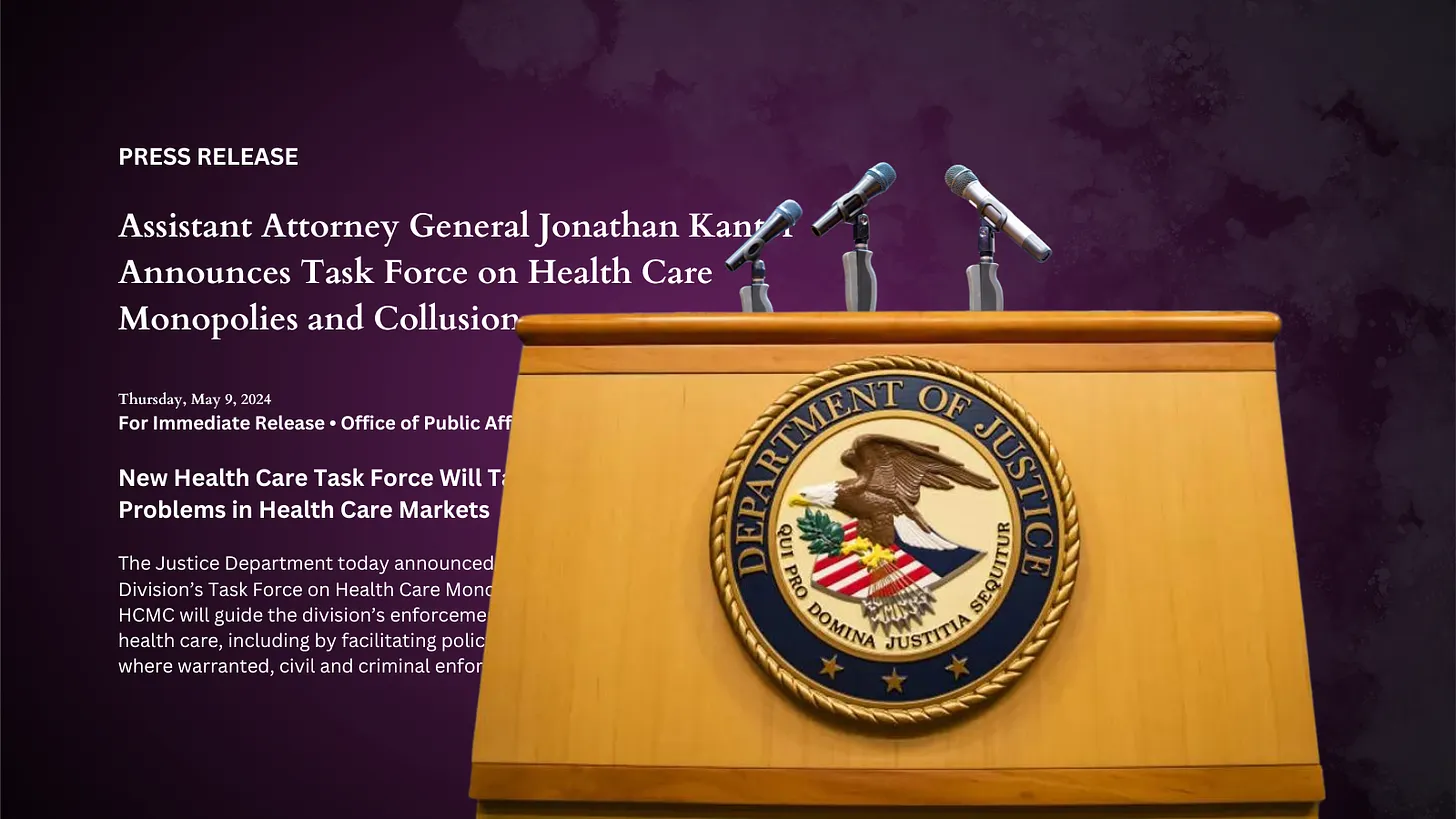
The U.S. Department of Justice has announced the formation of the Antitrust Division’s Task Force on Health Care Monopolies and Collusion (HCMC), which will guide the division’s enforcement strategy and policy approach in healthcare.
This will include facilitating policy advocacy, investigations and, where warranted, civil and criminal enforcement in healthcare markets.
“Every year, Americans spend trillions of dollars on healthcare, money that is increasingly being gobbled up by a small number of payers, providers and dominant intermediaries that have consolidated their way to power in communities across the country,” said Assistant Attorney General Jonathan Kanter of the Justice Department’s Antitrust Division.
The task force is intended to identify and root out monopolies, as well as any collusive practices that increase costs and decrease quality, according to the DOJ.
WHAT’S THE IMPACT
The HCMC will consider widespread competition concerns shared by patients, healthcare professionals, businesses and entrepreneurs, including issues regarding payer-provider consolidation, serial acquisitions, labor and quality of care, medical billing, healthcare IT services, and access to and misuse of healthcare data.
The task force will also bring together civil and criminal prosecutors, economists, healthcare industry experts, technologists, data scientists, investigators and policy advisors from across the division’s Civil, Criminal, Litigation and Policy Programs, and the Expert Analysis Group to identify and address pressing antitrust problems in healthcare markets.
The HCMC will be directed by Katrina Rouse, a long-serving antitrust prosecutor who joined the Antitrust Division in 2011. She previously served as chief of the division’s Defense, Industrials and Aerospace Section, assistant chief of the division’s San Francisco office, and a special assistant U.S. attorney and a trial attorney in the division’s Healthcare and Consumer Products Section.
Rouse holds degrees from Columbia University and Stanford Law School, and has clerked for federal judges in the U.S. District Court for the District of Maryland and the U.S. Court of Appeals for the Fifth Circuit. She will also serve as the division’s deputy director of civil enforcement and special counsel for healthcare.
The Antitrust Division said it welcomes input from the public, including from practitioners, patients, researchers, business owners and others who have direct insight into competition concerns in the healthcare industry.
Where appropriate, the division will refer matters to other federal and state law enforcers, the DOJ said.
Members of the public can share their experiences with the task force by visiting HealthyCompetition.gov.
THE LARGER TREND
Healthcare monopolies, which can be spurred by hospital consolidation, could have a detrimental effect on consumers’ premiums and out-of-pocket spending due to the resulting outpatient facility fees, a 2023 report found.
Consumer advocates, payers and state regulators flagged a range of issues related to outpatient facility fees. Both consumer advocates and regulators expressed concerns about the financial exposure facility fees created for consumers via increased out-of-pocket spending – driven by plans with high deductibles and other benefit design features that increase patients’ exposure to cost-sharing – and higher premiums resulting from increased spending on ambulatory services.
After UnitedHealth Group CEO Andrew Witty’s appearances at two congressional committee hearings last week, I had planned to write a story about what the lawmakers had to say. One idea I considered was to publish a compilation of some of the best zingers, and there were plenty, from Democrats and Republicans alike.
I reconsidered that idea because I know from the nearly half-century I have spent on or around Capitol Hill in one capacity or another that those zingers were carefully crafted by staffers who know how to write talking points to make them irresistible to the media. As a young Washington correspondent in the mid-to-late’70s, I included countless talking points in the stories I wrote for Scripps-Howard newspapers. After that, I wrote talking points for a gubernatorial candidate in Tennessee. I would go from there to write scads of them for CEOs and lobbyists to use with politicians and reporters during my 20 years in the health insurance business.
I know the game. And I know that despite all the arrows 40 members of Congress on both sides of the Hill shot at Witty last Wednesday, little if anything that could significantly change how UnitedHealth and the other big insurers do business will be enacted this year.
Money in politics is the elephant in any Congressional hearing room or executive branch office you might find yourself in (and it’s why I coauthored Nation on the Take with Nick Penniman).
You will hear plenty of sound and fury in those rooms but don’t hold your breath waiting for relief from ever-increasing premiums and out-of-pocket requirements and the many other barriers Big Insurance has erected to keep you from getting the care you need.
It is those same barriers doctors and nurses cite when they acknowledge the “moral injury” they incur trying to care for their patients under the tightening constraints imposed on them by profit-obsessed insurers, investors and giant hospital-based systems.
Funny not funny
Cartoonist Stephan Pastis captured the consequences of the corporate takeover of our government, accelerated by the Supreme Court’s 2010 landmark Citizens United vs. Federal Election Commission ruling, in his Pearls Before Swine cartoon strip Sunday.
Rat: Where are you going, Pig?
Pig: To a politician’s rally. I’m taking my magic translation box.
Rat: He doesn’t speak English?
Pig: He speaks politicianish. This translates it into the truth. Come see.
Politician: In conclusion, if you send me to Washington, I’ll clean up this corrupt system and fight for you everyday hard-working Americans. God bless you. God bless the troops. And God bless America.
Magic translation box: I am given millions of dollars by the rich and the powerful to keep this rigged system exactly as it is. Until you change that, none of this will ever change and we’ll keep hoping you’re too distracted to notice.
Politician’s campaign goon: We’re gonna need a word with you.
Magic translation box: This is too much truth for one comic strip. Prepare to be disappeared.
Rat: I don’t know him.
Back to Sir Witty’s time on the hot seat. It attracted a fair amount of media coverage, chock full of politicians’ talking points, including in The New York Times and The Washington Post. (You can read this short Reuters story for free.) Witty, of course, came equipped with his own talking points, and he followed his PR and legal teams’ counsel: to be contrite at every opportunity; to extol the supposed benefits of bigness in health care (UnitedHealth being by far the world’s largest health care corporation) all the while stressing that his company is not really all that big because it doesn’t, you know, own hospitals and pharmaceutical companies [yet]; and to assure us all that the fixes to its hacked claims-handling subsidiary Change Healthcare are all but in.
Congress? Meh. Paying for care? WTF!
Wall Street was relieved and impressed that Witty acquitted himself so well. Investors shrugged off the many barbs aimed at him and his vast international empire. By the end of the day Wednesday, the company’s stock price had actually inched up a few cents, to $484.11. A modest 2.7 million shares of UnitedHealth’s stock were traded that day, considerably fewer than usual.
Instead of punishing UnitedHealth, investors inflicted massive pain on its chief rival, CVS, which owns Aetna. On the same day Witty went to Washington, CVS had to disclose that it missed Wall Street financial analyst’s earnings-per-share expectations for the first quarter of 2024 by several cents. Shareholders’ furor sent CVS’ stock price tumbling from $67.71 to a 15-year low of $54 at one point Wednesday before settling at $56.31 by the time the New York Stock Exchange closed. An astonishing 65.7 million shares of CVS stock were traded that day.
Postscript: I do want to bring to your attention one exchange between Witty and Rep. Buddy Carter (R-Ga.) during the House Energy and Commerce committee hearing. Carter is a pharmacist who has seen firsthand how UnitedHealth’s virtual integration–operating health insurance companies with one hand and racking up physician practices and clinics with the other–and its PBM’s business practices have contributed to the closure of hundreds of independent pharmacies in recent years. He’s also seen patients walk away from the pharmacy counter without their medications because of PBMs’ out-of-pocket demands (often hundreds and thousands of dollars). And he’s seen other patients face life-threatenng delays because of industry prior authorization requirements. Carter was instrumental in persuading the Federal Trade Commission to investigate PBMs’ ownership and business practices. He told Witty:
I’m going to continue to bust this up…This vertical integration in health care in general has got to end.
M&A Volume Up in Q1 2024 vs. Q1 2023: $10 billion Target Revenues
The number of hospital and health system M&A deals announced in the first quarter of 2024 was significantly higher than in the same period in 2023: 18 announced transactions with $10 billion in total revenues for the targets vs. 12 deals in Q1 2023 with a total of $3.4 billion in revenues for the targets. The 81 deals announced in the last 12 months is the highest it has been over the last few years, building upon the recent momentum of hospital and health system mergers, acquisitions, and divestitures across the country.
Other observations by the Cain Brothers M&A team:
Significant number of for-profit conversions to not-for-profit (e.g., divestitures by Tenet and HCA)
Significant number of divestitures by national systems to regional health systems
Accelerated closing timeline for 3 deals in CA: closed in 30-60 days — prior to new hospital merger review process going into effect April 1, 2024 in CA
Q1 2024 total volume of 18 transactions with $10 billion in revenues for targets vs. $3.4 billion for Q1 2023 This quarter saw transformative deals that may reshape how healthcare is delivered, reflecting creative partnerships that continue to form in a changing healthcare environment. Academic medical centers continue to make investments in assets of high strategic value to expand their clinical, teaching, and research capabilities. Large regional systems were quite active, with large cross regional mergers and smaller strategic acquisitions. With the Consumer Price Index (CPI) holding steady with the previous quarter, alleviation of supply cost pressures will benefit health system financials and allow them to deploy more capital.
In early January, General Catalyst’s healthcare investment subsidiary, Health Assurance Transformation Corporation (“HATCo”), announced its intent to acquire Summa Health, one of the largest integrated health delivery systems in Ohio. This announcement made waves in the healthcare industry, not just because of the size of the acquisition, but because it is the first major health system investment for newly formed HATCo. General Catalyst, a venture capital firm formed in 2000, is known for its investments in global companies including Airbnb, Warby Parker, Snap, and Kayak. General Catalyst launched HATCo in October 2023 as a vehicle to enable health systems to enhance technological health capabilities, improve financial results, and assist in meeting the shift to value based care, creating a sustainable and quality-driven healthcare model for providers and patients.
Under the terms of the deal, Summa Health will become a subsidiary of HATCo and transition from a not-for-profit to a for-profit corporation. A community foundation will be formed to continue to invest in the social determinants of health to enhance community outcomes in the Akron-Canton region. With its first acquisition, HATCo aims to become a chassis for future acquisitions and growth for General Catalyst. The deal is expected to close by the end of 2024.
Academic medical centers were active acquirers in the first quarter of 2024. On the West Coast, two University of California systems announced acquisitions from for-profit operators. In January, UCLA Health announced it is the process to acquire West Hills Hospital and Medical Center from HCA. The 260-bed hospital is located in the San Fernando Valley, north of Los Angeles, and will be UCLA’s first acute care hospital in the area. In February, UC Irvine Health signed a definitive agreement to acquire Tenet’s Pacific Coast Network, which include four hospitals in Los Angeles and Orange counties (see below for transaction multiples). The acquisition greatly expands UCI Health’s presence and inpatient bed capacity to complement their flagship UCI Medical Center in Orange. These deals come off the heels of two other University of California deals announced in 2023; UC San Diego Health’s acquisition of Alvarado Hospital from Prime Healthcare, and UCSF’s announcement to acquire two San Francisco hospitals from Dignity Health, further demonstrating the UC system’s mandate to grow and provide greater access to care in California.
Further east, the University of Minnesota announced in February its intent to reacquire the University of Minnesota Medical Center from Fairview Health. The University of Minnesota Regents voted to support a nonbinding letter of intent with Fairview that would provide the ability for the University’s eventual ownership of the medical center by 2027. The University of Minnesota previously sold the medical center to Fairview in 1997.
In January, Penn Medicine announced it intends to acquire Doylestown Health, a single-hospital system in Bucks County, PA. The seventh hospital for Penn Medicine, the acquisition of Doylestown Health follows a trend of expansion for Penn Medicine, with the acquisition of Chester County Hospital, Lancaster General Health, and Princeton Health all within the past 10 years. The transactions by academic health systems this quarter continue to follow the trend of AMC expansion through development of new entry points into their care network, investments in community health, and developing the ability to expand their teaching and research capabilities.
In addition to the sale of its Pacific Coast Network to UC Irvine Health, Tenet also sold Sierra Vista Regional Medical Center and Twin Cities Community Hospital to Adventist Health in California. The two hospitals, located in San Luis Obispo County in Central California, were sold to Adventist Health for approximately $550 million, implying a Revenue and EBITDA multiple of 1.6x and 14.5x, respectively. The Pacific Coast Network transaction to UCI Health announced in February came with a $975 million price tag, reflecting a 1.0x multiple of revenue and 13.7x multiple of EBITDA. These transactions follow trends of Tenet’s strategic divestitures in high value deals and reflect a broader trend of acquisitions of targets of high strategic value to health systems. It is worth noting that part of the reason for higher multiples in these California transactions is that buying is still cheaper than the high cost to build.
Regional expansion continued this quarter in the Northeast with Nuvance Health’s announcement in February that it will be joining Northwell Health. With seven hospitals in Nuvance and the largest in the State of New York with Northwell, the organizations would merge to form an integrated healthcare delivery system of 28 hospitals, 15,000 physicians, and over 1,000 care sites. In July 2023, Nuvance received a credit downgrade from Moody’s driven by weakened operating performance and reduced liquidity. As stated by both organizations, the merger also allows Northwell to expand into Connecticut while making significant investments in Nuvance’s existing clinical care footprint.
On the other hand, a number of regional mergers in recent years have been called off, including this quarter with the cancellation of the proposed merger between Essential Health and Marshfield Clinic. Previously announced in July 2023, the health systems formally ended merger discussions in January, determining that the affiliation was not the right path for the organizations. Marshfield previously paused merger discussions with Gundersen Health System in 2019.
There were also a number of single hospital acquisitions and tuck-in transactions for larger systems. Below are highlights of a few other notable transactions announced this quarter:
In February, St. Louis- based Mercy announced its plans to acquire Via Christi Hospital, its related physicians and other ancillary healthcare locations from Ascension. 152-bed Via Christi hospital will be Mercy’s third hospital in Kansas, as Mercy continues to grow westward. In 2023, Mercy acquired SoutheastHEALTH followed by its acquisition of Hermann Area District Hospital.
In January, Northern New Jersey health systems, CarePoint Health and Hudson Regional Hospital announced they are seeking to form a new combined entity that will merge the for-profit and not-for-profit hospitals together. Hudson Health System will be the new namesake of the four hospital system. Under the proposed agreement, two of the four hospitals will remain not-for-profit safety net hospitals. The unique arrangement comes after the New Jersey Department of Health confirmed that CarePoint was in financial distress and began to work with local government leaders on a solution. CarePoint executive leaders confirmed the arrangement with Hudson Regional will improve the organization’s operational and financial strength.
Also in New Jersey, Atlantic Health System announced in January its intent to merge with Saint Peter’s Healthcare. Atlantic Health, located in Morristown, NJ, is a seven-hospital health system with locations across New Jersey and Pennsylvania. Saint Peter’s Healthcare is a catholic not-forprofit system with a 478-bed flagship hospital in New Brunswick, NJ. The announcement follows a 2022 judgment by the FTC to block a proposed merger between Saint Peter’s Healthcare and RWJBarnabas Health, citing the deal would cause anti-competitive concerns with merging New Brunswick’s only two hospitals.
WellSpan Health signed a definitive agreement to acquire Evangelical Community Hospital, a 131-bed acute care hospital in Lewisburg, PA. With the pending acquisition, the hospital will become WellSpan Evangelical Hospital and will continue to serve the Central Susquehanna Valley. WellSpan is an eight-hospital system, serving six counties in Pennsylvania and two counties in Maryland. The deal is expected to close in July.
Each quarter, health system acquirers typically cite the need to grow and the desire to enchance clinical outcomes as motivating factors for deal activity. On the other hand, as we are seeing play out in real time, financial challenges area key driver of M&A for sellers.California-based Pipeline Health faces financial challenges as it retrenches its existing portfolio. In late 2023, Pipeline exited the Texas market driven by unsustainable financial losses. This example highlights the need for health systems to match mission-driven growth objectives with the reality of a harsh and volitile operating environment.
Portfolio rationalization,AMCs with the capital to make big bets, and inter-regional consolidations are major trends that will continue into 2024. With an election looming and an uncertain healthcare and regulatory landscape, affiliation opportunities will need to be thoughtful and metric driven.
Hospitals’ business models are being upended by fundamental changes within the health care system, including one that presents a pretty existential challenge: People have far more options to get their care elsewhere these days.
Why it matters:
Health systems’ responses to major demographic, social and technological change have been controversial among policymakers and economists concerned about the impact on costs and competition.
Communities depend on having at least some emergency services available, making the survival of hospitals’ core services crucial.
But without adaptation — which is already underway in some cases — hospitals may be facing deep red balance sheets in the not-too-distant future, leading to facility closures and shutteredservices.
The big picture:
Many hospitals have recovered from the sector’s post-pandemic financial slump, which was driven primarily by staffing costs and inflation. But systemic, long-term trends will continue to challenge their traditional business model.
Many of the services that are shifting toward outpatient settings — like oncology, diagnostics and orthopedic care — are the ones that typically make hospitals the most money and effectively subsidize less profitable departments.
When hospitals lose these higher-margin services, “you’re starving the system that needs profits to provide services that we all might need, but particularly uninsured or underinsured people might need,” said UCLA professor Jill Horwitz.
And hospitals have long claimed that much higher commercial insurance rates make up for what they say are inadequate government rates.
But as the population ages and moves out of employer-sponsored health plans, fewer people will have commercial insurance, forcing hospitals to either cut costs or find new sources of revenue.
By the numbers:
Consulting firms are projecting a bleak decade for health systems.
Oliver Wyman recently predicted that under the status quo, hospitals will need to reduce their expenses by 15-20% by 2030 “to stay viable.”
Boston Consulting Group last year projected that health systems’ annual financial shortfall will total more than $200 billion by 2027, and their operating margins will have dropped by 10 percentage points.
To break even in 2027, a “typical” health system would need payment rate increases of between 5-8% annually — twice the rate growth over the last decade, according to BCG. If the load is borne solely by private insurers, hospitals will need a 10-16% year-over-year increase.
Between the lines:
This is the lens through which to view health systems’ spree of mergers and acquisitions, which have increasingly drawn criticism from policymakers, regulators and economists as being anticompetitive.
For better orworse, when hospitals have a larger market share, they are in a better position to negotiate and bring in more patients, and they can dilute some of the financial pain of poorer-performing facilities.
And when they acquire physician practices or other outpatient clinics, they’re still getting paid for delivering care even when patients aren’t receiving it in a traditional hospital setting.
“I think the hospitals have sort of said … ‘We can keep doing things the same way and we can just merge and get higher markups,'” said Yale economist Zack Cooper. “That push to consolidate is saying, ‘Let’s not move forward, let’s dig in.'”
Yes, but:
A big bonus of outpatient care is that it’s supposed to be cheaper. But when hospitals charge more for care than an independent physician’s office would have, or they tack on facility fees, costs don’t go down.
“They’ve protected their portfolio, and that’s added to the cost of health care,” said Johns Hopkins professor Gerard Anderson.
The other side:
Hospitals are typically on the losing end of negotiations with insurers right now, thanks to how large insurers have become, and are “in an extremely difficult competitive position,” said Ken Kaufman, co-founder of consulting agency Kaufman Hall.
Criticizing their mergers and acquisitions as anticompetitive is a “complete misunderstanding of the situation,” he said, and moving toward a new care model will take “an incredible amount of resources.”
Reality check:
Hospitals account for 30% of the country’s massive health spending tab, and they’ll have to be at the forefront of any real efforts to contain costs.
They’re also anchors in their communities and are powerful lobbyists, which helps explain why Congress has struggled to modestly reduce what Medicare pays hospital outpatient departments.







 HENRY KOTULA