Not for Profit Health Systems are Soft Targets: Here’s Why

Large, not-for-profit hospitals/health systems are getting a disproportionate share of unflattering attention these days. Last week was no exception: Here’s a smattering of their coverage:

Approximate Savings from Lowering Indiana Not-for-Profit Commercial Hospital Facility Prices to 260% of Medicare March 20, 2023 https://employersforumindiana.org/media/resources/Savings-from-Lowering-Indiana-Not-for-profit-Commercial-Hospital-Facility-Prices.

Jiang et al “Factors Associated with Hospital Commercial Negotiated Price for Magnetic Resonance Imaging of Brain” JAMA Network Open March 21. 2023;6(3):e233875. doi:10.1001/jamanetworkopen.2023.3875

Not-for-profit benefits top charity care levels for hospitals: report Bond Buyer March 22, 2023 www.bondbuyer.com/news/not-for-profit-benefits-top-charity-care-levels-for-hospitals-report

What’s Behind Losses At Large Nonprofit Health Systems? Health Affairs March 24, 2023 www.healthaffairs.org/content/forefront/s-behind-losses-large-nonprofit-health-systems

Whaley et al What’s Behind Losses At Large Nonprofit Health Systems? Health Affairs March 24, 2023 10.1377/forefront.20230322.44474

A Pa. hospital’s revoked property tax exemption is a ‘warning shot’ to other nonprofits, expert says KYW Radio Philadelphia March 24, 2023 ww.msn.com/en-us/news/us/a-pa-hospital-s-revoked-property-tax-exemption-is-a-warning-shot-to-other-nonprofits-expert-says

These hospitals are ‘not for profit’ but very wealthy — should the state get more of their cash? News Sentinel March 26, 2023 www.news-sentinel.com/news/local-news/2019/09/26/kevin-leininger-these-hospitals-are-not-for-profit-but-very-wealthy-should-the-state-get-more-of-their-cash

These come on the heals of the Medicare Advisory Commission’s (MedPAC) March 2023 Report to Congress advising that all but safety-net hospitals are in reasonably good shape financially (contrary to industry assertions) and increased lawmaker scrutiny of “ill-gotten gains” in healthcare i.e., Moderna’s vaccine windfall, Medicare Advantage overpayments and employer activism about hospital price-gauging in several states.

Like every sector in healthcare, hospitals enter budget battles with good stories to tell about cost-reductions and progress in price transparency compliance. But in the current political and economic environment, large, not-for-profit hospitals and health systems seem to be targets of more adverse coverage than others as illustrated above. Like many NFP institutions in society (higher education, organized religion, government), erosion of trust is palpable. Not-for-profit hospitals and health systems are no exception.

The themes emerging from last week’s coverage are familiar:

  • ‘Not-for-profit hospitals/health systems, do not provide value commensurate with the tax exemptions they get.’
  • ‘Not for profit hospitals & health systems take advantage of their markets and regulations to create strong brands and generate big profits.’.
  • ‘Not for profit hospitals & health systems charge more than investor-owned hospitals: the victims are employers and consumers who pay higher-than-necessary prices for their services.’
  • ‘NFP operators invest in risky ventures: when the capital market slumps, they are ill-prepared to manage. Risky investments, not workforce and supply chain issues, are the root causes of NFP financial stress. They’re misleading the public purposely.’
  • ‘Executives in NFP systems are overpaid and patient collection policies are more aggressive than for-profits. NFP boards are ineffective.’

The stimulants for this negative attention are equally familiar:

  • Proprietary studies by think tanks, trade associations, labor unions and consultancies designed to “prove a point” for/against not-for-profit hospitals/health systems.
  • Government reports about hospital spending, waste, fraud, workforce issues, patient safety, concentration and compliance with transparency rules.
  • Aggressive national/local reporting by journalists inclined to discount NFP messaging.
  • Public opinion polls about declining trust in the system and growing concern about price transparency, affordability and equitable access.
  • Politicians who use soundbites and dog whistles about NFP hospitals to draw attention to themselves.

The cumulative effect of these is confusion, frustration and distrust of not-for-profit hospitals and health systems. Most believe not-for-profit hospitals/health systems do not own the moral high ground they affirm to regulators and their communities (though religiously-affiliated systems have an edge). Most are unaware that more than half of all hospitals (54%) are not-for-profit and distinctions between safety net, rural, DSH, teaching and other forms of NFP ownership are non-specific to their performance.

What’s clear to the majority is that hospitals are expensive and essential. They’re soft targets representing 31.1% of the health system’s total spend ($4.3 trillion in 2021) increasing 4.9% annually in the last decade while inflation and GDP growth were less.

So why are not-for-profit systems bearing the brunt of hospital criticism?

Simply put: many NFP systems act more like Big Business than shepherds of community health. In fact, 4 of the top 10 multi-hospital system operators is investor owned: HCA (184), CHS (84), LifePoint (84), Tenet (65). In addition, 3 others are in the top 50: Ardent (30), UHS (26), Quorum (22). So, corporatization of hospital care using private capital and public markets for growth is firmly entrenched in the sector exposing not-for-profit operators to competition that’s better funded and more nimble.  And, per industry studies, not-for-profits tend to stay in markets longer and operate unprofitable services more frequently than their investor-owned competitors. But does this matter to insurers, community leaders, legislators, employers, hospital employees and physicians? Some but not much.

My take:

There are no easy answers for not-for-profit hospitals/heath systems. The issue is about more than messaging and PR. It’s about more than Medicare reimbursement (7.5% below cost), protecting programs like 340B, keeping tax exemptions and maintaining barriers against physician-owned hospitals. The issue is NOT about operating income vs. investment income: in every business, both are essential and in each, economic cycles impact gains/losses. Each of these is important but only band-aids on an open wound in U.S. healthcare.

Near-term (the next 2 years), opportunities for not-for-profit hospitals involve administrative simplification to reduce costs and improve the efficiencies and effectiveness of the workforce. Clinical documentation using ChatGPT/Bard-like tools can have a massive positive impact—that’s just a start. Advocacy, public education and Board preparedness require bigger investments of time and resources. But that’s true for every hospital, regardless of ownership. These are table stakes to stay afloat.

The longer-term issue for NFPs is bigger:

It’s about defining the future of the U.S. health system in 2030 and beyond—the roles to be played and resources necessary for it to skate to where the puck is going. It’s about defining the role played by private employers and whether they’ll pay 220% more than Medicare pays to keep providers and insurers solvent. It’s about how underserved and unhealthy people are managed. It’s about defining systemness in healthcare and standardizing processes. It’s about defining sources of funding and optimal use of resources. Not-for-profit systems should drive these discussions in the communities they serve and at a national level.

MedPAC’s 17 member Commission will play a vital role, but equally important to this design process are inputs from employers, consumers and thought leaders who bring fresh insight. Until then, not-for-profit health systems will be soft targets for unflattering media because protecting the status quo is paramount to insiders who benefit from its dysfunction. Incrementalism defined as innovation is a recipe for failure.

It’s time to begin a discussion about the future of the U.S. health system—all of it, not just high-profile sectors like not-for-profit hospitals/health systems who are currently its soft target.
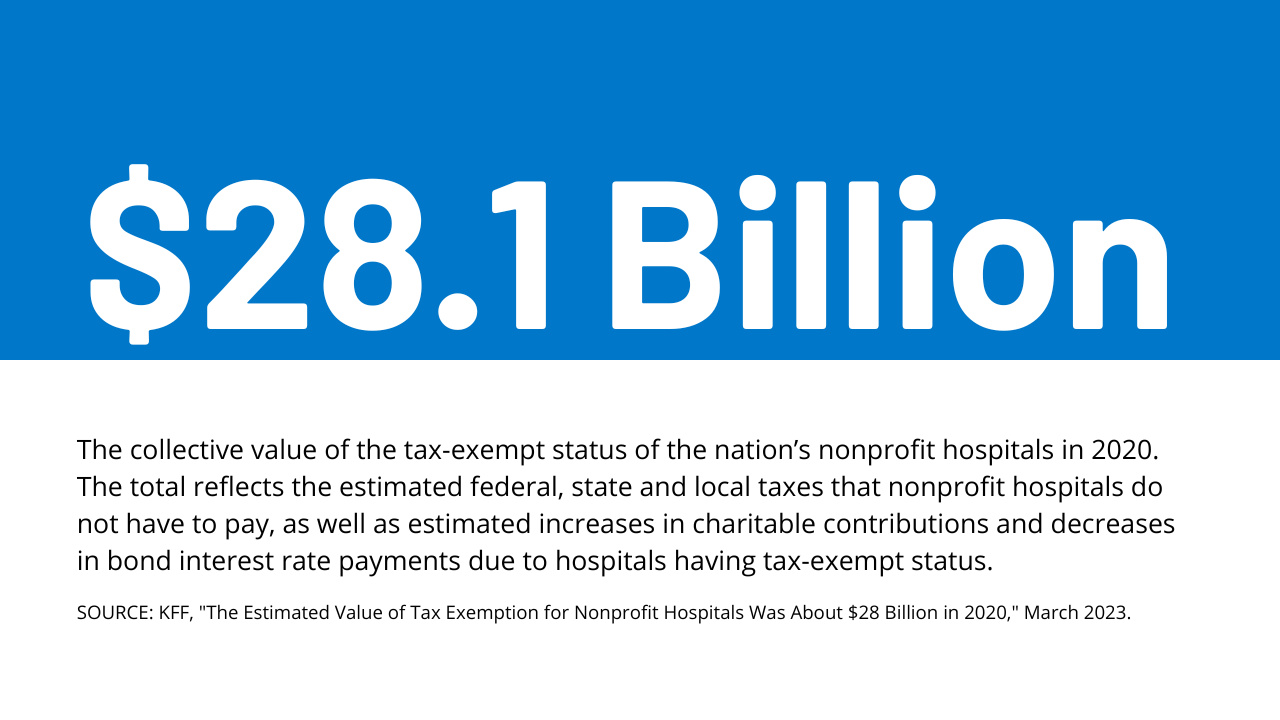

The Estimated Value of Tax Exemption for Nonprofit Hospitals Was About $28 Billion in 2020

Over the years, some policymakers have questioned whether nonprofit hospitals—which account for nearly three-fifths (58%) of community hospitals—provide sufficient benefit to their communities to justify their exemption from federal, state, and local taxes.

This issue has been the subject of renewed interest in light of reports of nonprofit hospitals taking aggressive steps to collect unpaid medical bills, including suing patients over unpaid medical debt, including patients who are likely eligible for financial assistance. Further, recent research indicates that nonprofit hospitals devote a similar or smaller share of their operating expenses to charity care in comparison to for-profit hospitals. In light of these concerns, several policy ideas have been floated to better align the level of community benefits provided by nonprofit hospitals with the value of their tax exemption.

This data note provides an estimate of the value of tax exemption for nonprofit facilities based on hospital cost reports, filings with the Internal Revenue Service (IRS), and American Hospital Association (AHA) survey data (see Methods for additional details). We define the value of tax exemption as the benefit of not having to pay federal and state corporate income taxes, typically not having to pay state and local sales taxes and local property taxes, and any increases in charitable contributions and decreases in bond interest rate payments that might arise due to receiving tax-exempt status.

Results

The total estimated value of tax exemption for nonprofit hospitals was about $28 billion in 2020 (Figure 1). This represented over two-fifths (44%) of net income (i.e., revenues minus expenses) earned by nonprofit facilities in that year. To put the value of tax exemption in perspective, our estimate is similar to the total value of Medicare and Medicaid disproportionate share hospital (DSH) payments in the same year ($31.9 billion in fiscal year 2020) (i.e., supplemental payments to hospitals that care for a disproportionate share of low-income patients which are intended, in part, to offset the costs of charity care and other uncompensated care).

https://datawrapper.dwcdn.net/MAZAW

The estimated value of federal tax-exempt status was $14.4 billion in 2020, which represents about half (51%) of the total value of tax exemption. This is primarily due to the estimated value of not having to pay federal corporate income taxes ($10.3 billion). In addition, we assumed that individuals contribute more to tax-exempt hospitals because they can deduct donations from their income tax base ($2.5 billion) and issue bonds at lower interest rates because the interest is not taxed ($1.6 billion). Our estimates of changes in charitable contributions and interest rates on bonds only account for federal tax rates for simplicity and may therefore understate the total value of tax exemption because they do not account for the effects of state taxes.

The total estimated value of state and local tax-exempt status was $13.7 billion in 2020, which represents about half (49%) of the total value of tax exemption. This amount includes the estimated value of not having to pay state or local sales taxes ($5.7 billion), local property taxes ($5.0 billion) or state corporate income taxes ($3.0 billion).

The total estimated value of tax exemption (about $28 billion) exceeded total estimated charity care costs ($16 billion) among nonprofit hospitals in 2020 (Figure 2), though charity care represents only a portion of the community benefits reported by these facilities. Hospital charity care programs provide free or discounted services to eligible patients who are unable to afford their care and represent one of several different types of community benefits reported by hospitals.

The Internal Revenue Service (IRS) also defines community benefits to include unreimbursed Medicaid expenses, unreimbursed health professions education, and subsidized health services that are not means-tested, among other activities. One study estimated that the value of tax exemption exceeded the value of community benefits broadly for about one-fifth (19%) of nonprofit hospitals during 2011-2018 or about two-fifths (39%) when considering the incremental value of community benefits provided relative to for-profit facilities. Other research suggests that nonprofit hospitals devote a similar or smaller share of their operating expenses to charity care and unreimbursed Medicaid costs—which accounted for most of the value of community benefits in 2017—when compared to for-profit hospitals.

https://datawrapper.dwcdn.net/JxC4B

The value of tax exemption grew from about $19 billion in 2011 to about $28 billion in 2020, representing a 45 percent increase (Figure 3). The value of tax exemption increased in most of the years (7 out of 9) in our analysis, though there was a notable decrease of $5.8 billion in 2018. The largest single-year increase was $4.1 billion in 2020. The large decrease in the value of tax exemption in 2018 coincided with the implementation of the Tax Cuts and Jobs Act of 2017, which permanently reduced the federal corporate income tax rate from 35 to 21 percent and therefore decreased the value of being exempt from federal income taxes.

https://datawrapper.dwcdn.net/Oiork

The large increase in the value of tax exemption in 2020 overlapped with the start of the COVID-19 pandemic. This increase primarily reflects a large increase in aggregate net income for nonprofit hospitals in 2020. Although there were disruptions in hospital operations in 2020, hospitals received substantial amounts of government relief, and it is possible that other sources of revenue, such as from investment income, may have also increased. Increases in net income in turn increased the value of not having to pay federal and state income taxes.

Increases in the estimated value of tax exemption over time also reflect net income growth that preceded the pandemic as well as increases in estimated property values, supply expenses, and charitable contributions, each of which would carry tax implications if hospitals lost their tax-exempt status (e.g., with some supply expenses being subject to sales taxes). Even when setting aside the strong financial performance of nonprofit hospitals in 2020 as a potential outlier, total net income among nonprofit facilities increased substantially in the preceding years, before increasing further in 2020. Although we are not able to directly observe the value of the real estate owned by hospitals, the estimated value of exemption from local property taxes—which is based on our analysis of property taxes paid by for-profit hospitals—increased by 63 percent from 2011 to 2019. Finally, the supply expenses in our analysis increased by 44 percent and charitable contributions increased by 49 percent from 2011 to 2019.

Discussion

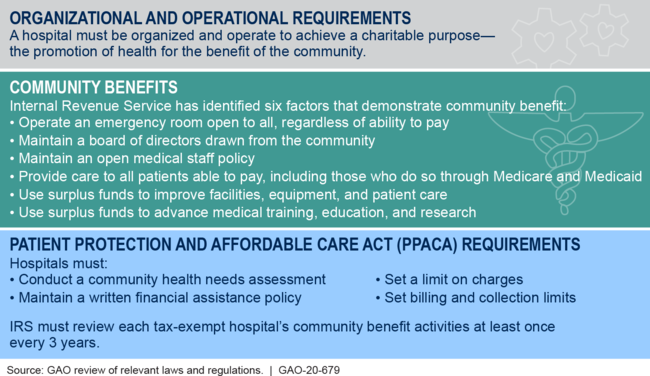
The estimated value of tax exemption for nonprofit hospitals increased from about $19 billion in 2011 to about $28 billion in 2020. The rising value of tax exemption means that federal, state, and local governments have been forgoing increasing amounts of revenue over time to provide tax benefits to nonprofit hospitals, crowding out other uses of those funds. This has raised questions about whether nonprofit facilities provide sufficient benefit to their communities to justify this tax benefit. Federal regulations require, among other things, that nonprofit hospitals provide some level of charity care and other community benefits as a condition of receiving tax-exempt status. However, a 2020 Government Accountability Office (GAO) report raised questions about whether the government has adequately enforced this requirement. Further, some argue that the federal definition of “community benefits” is too broad—e.g., by including medical training and research that could benefit hospitals directly—though others believe that the definition is too narrow. Most states have additional community benefit requirements for nonprofit or broader groups of hospitals—such as providing charity care to patients below a specified income threshold—though there is little information about the effectiveness of these regulations or the extent to which they are enforced.

Several policy ideas have been floated at the federal and state level that would increase the regulation of community benefits spending among nonprofit hospitals or among hospitals more generally. These include proposals to create or expand state requirements that hospitals provide charity care to patients below a specified income threshold, mandate that nonprofit hospitals provide a minimum amount of community benefits, establish a floor-and-trade system where hospitals would be required to either provide a minimum amount of charity care or subsidize other hospitals that do so, create mechanisms to increase the uptake of charity care, expand oversight and enforcement of community benefit requirements, replace current tax benefits with a subsidy that is tied to the value of community benefits provided, and introduce reforms intended to better align community benefits with local or regional needs.

These policy options would inevitably involve tradeoffs. While they may expand the provision of certain community benefits, hospitals would incur new costs as a result, which could in turn have implications for what services they offer, how much they charge commercially insured patients, and how much they invest in the quality of care.

How can boards keep up with health system growth?

https://mailchi.mp/c6914989575d/the-weekly-gist-march-31-2023?e=d1e747d2d8

It feels like governance questions are coming to the fore in a lot of places these days, at least judging by several recent conversations we’ve had with health system CEOs. Probably not surprising, given the number of potential mergers and other partnerships under consideration.

As one CEO told us, growth by M&A raises particularly thorny issues for a not-for-profit system board. “Our governance structure grew out of a single hospital board, which was made up of community members and local physician leaders,” he told us. As the system acquired hospitals in adjacent markets, the combined board took on a representational character—each hospital had local stakeholders involved in governance. “Now we’re talking about merging with an out-of-state system, and our board suddenly seems way too parochial and unsophisticated. Everyone’s still asking what’s in it for their community.” That’s a frustration we hear frequently.

There are legitimate reasons why a tax-exempt community institution should have local representation on the board, advocating for local priorities and resources. But a larger, multi-state board must also oversee the entire portfolio of assets, and make trade-offs across markets, sometimes making decisions that favor one hospital over another.

The larger system board also has a greater need for sophistication, both on business and healthcare issues, as its members are often responsible for billions of dollars of assets. What frequently results from this tension is a nesting series of system and community boards, with varying degrees of accountability—a recipe for tangled, lengthy decision processes, and an enormous time-sink for senior system executives. We’re keeping our eye out for next-generation solutions to the governance question in healthcare—let us know what you’re seeing.

Questions resurface about nonprofit hospitals’ tax-exempt status

https://mailchi.mp/df8b77a765df/the-weekly-gist-may-6-2022?e=d1e747d2d8

A report from The Lown Institute, a Boston-based think tank, finds that many health systems—227 of the 275 evaluated—spend less on providing “community benefit” than the value of their tax exemptions. The American Hospital Association (AHA) criticized the report’s methodology, claiming it “cherry-picks categories of community investment.” This report builds on previous analyses that have found that, taken together, nonprofit hospitals spend less on charity care than government or for-profit hospitals.      

The Gist: Policymakers and academics, prompted by massive capital projects, high executive salaries, and—especially—aggressive pricing and billing strategies, are increasingly questioning whether nonprofit health systems provide sufficient community benefit to retain their tax-exempt status. A recent piece in Health Affairs suggests updating the community benefit standard, which the Internal Revenue Service (IRS) uses to evaluate nonprofit status, to focus on social determinants of health and measurable health outcomes. 

We’d expect tougher scrutiny on this topic in the future, especially if state budgets come under pressure from a deterioration in the broader economy.

Investment gains masking health system operating margin difficulties 

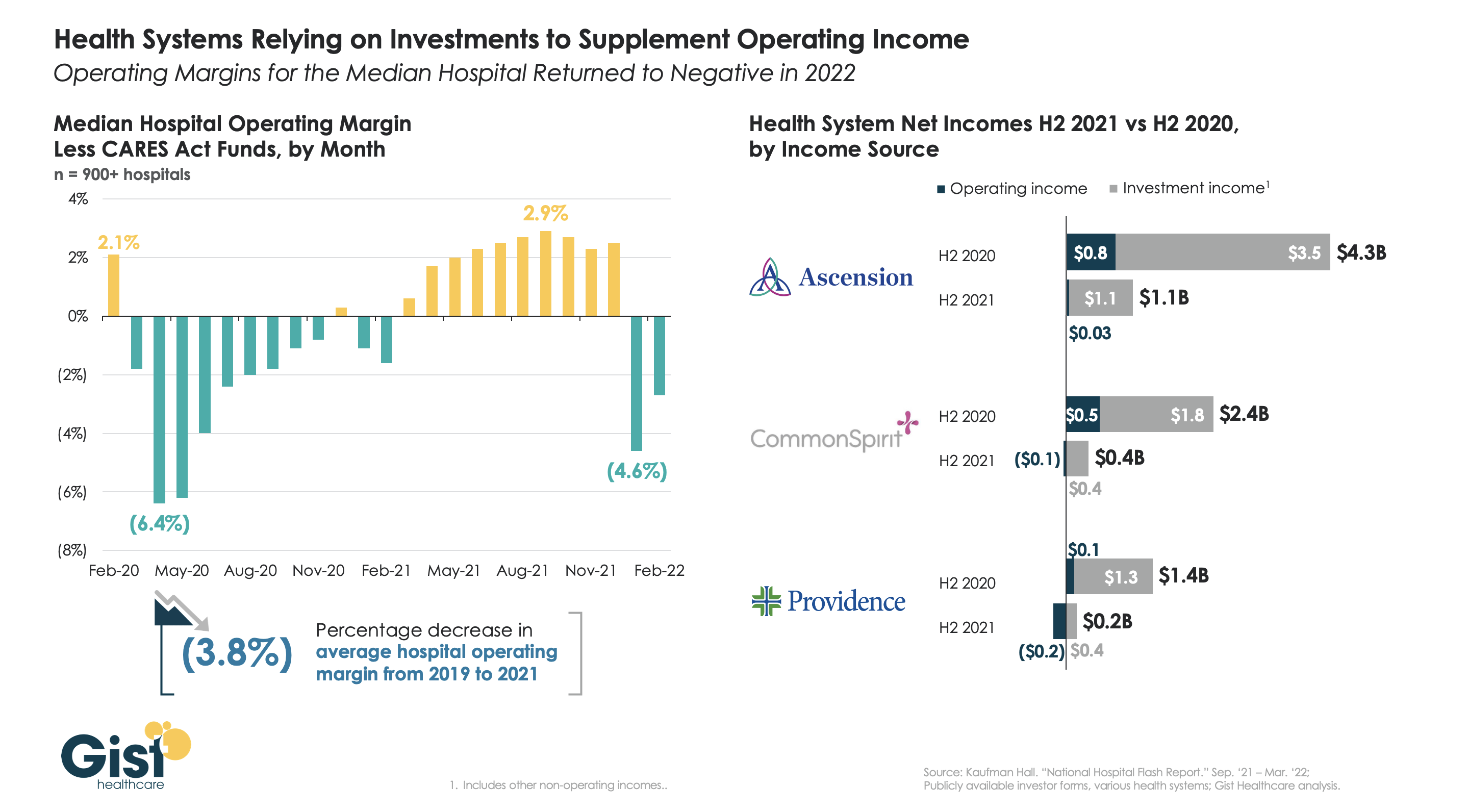
The combination of the Omicron surge, lackluster volume recovery, and rising expenses have contributed to a poor financial start of the year for most health systems. The graphic above shows that, after a healthier-than-expected 2021, the average hospital’s operating margin fell back into the red in early 2022, clocking in more than four percent lower than pre-pandemic levels. 

Despite operational challenges, however, many of the largest health systems continue to garner headlines for their sizable profits, thanks to significant returns on their investment portfolios in 2021.

While CommonSpirit and Providence each posted negative operating margins for the second half of 2021, and Ascension managed a small operating profit, all three were able to use investment income to cushion their performance.

A growing number of health systems are doubling down on investment strategies in an effort to diversify revenue streams, and capture the kind of returns from investments generated by venture capital firms. However, it is unlikely that revenue diversification will be a sustainable long-term strategy.

To succeed, health systems must look to reconfigure elements of the legacy business model that are proving financially unsustainable amid rising expenses, shifts of care to lower-cost settings, and an evolving, consumer-centric landscape.    

14 health systems with strong finances

What next for the US dollar? - TalkingPoint - Schroders

Here are 14 health systems with strong operational metrics and solid financial positions, according to reports from Fitch Ratings, Moody’s Investors Service and S&P Global Ratings.

1. Advocate Aurora Health has an “Aa3” rating and positive outlook with Moody’s. The health system, which has dual headquarters in Milwaukee and Downers Grove, Ill., has a leading market share in two regions and strong financial discipline, Moody’s said. The credit rating agency said it expects Advocate Aurora Health’s operating cash flow margins to return to pre-pandemic levels. 

2. Pinehurst, N.C.-based FirstHealth of the Carolinas has an “AA” rating and stable outlook with Fitch. The health system has a strong financial profile and stable operating performance, despite disruption from the COVID-19 pandemic, Fitch said. The health system’s revenue in the first quarter of fiscal 2021 rebounded to levels close to historical trends, according to the credit rating agency. 

3. Indianapolis-based Indiana University Health has an “Aa2” rating and stable outlook with Moody’s and an “AA” rating and positive outlook with Fitch. Cost controls and patient volume will help the system sustain strong margins and liquidity, Moody’s said. 

4. Rapid City, S.D.-based Monument Health has an “AA-” rating and stable outlook with Fitch. The health system has solid operating margins that Fitch expects to remain stable over the near term. Monument Health’s operating margins will continue to support liquidity growth and capital spending levels, the credit rating agency said. 

5. Chicago-based Northwestern Medicine has an “Aa2” rating and stable outlook with Moody’s, and an “AA+” rating and stable outlook with S&P. The system’s consolidated operating model will allow it to maintain a strong financial position while effectively executing strategies, Moody’s said. The credit rating agency expects Northwestern Medicine to expand its prominent market position in the broader Chicago region because of its strong brand and affiliation with Northwestern University’s Feinberg School of Medicine. 

6. Renton, Wash.-based Providence has an “AA-” rating and stable outlook with Fitch and an “Aa3” rating and stable outlook with Moody’s. Fitch said Providence has a long-term strategic advantage over most of its peers because it has invested heavily in developing technology in recent years, and the system’s plan to transform healthcare delivery through the use of data and technology has been undeterred through the COVID-19 pandemic. Fitch said it expects Providence’s cash flow margins to be close to 7 percent in the coming years. 

7. Livingston, N.J.-based RWJBarnabas Health has an “Aa3” rating and stable outlook with Moody’s. Moody’s said it expects RWJBarnabas, the largest integrated academic health system in New Jersey, to see near-term revenue growth and to execute on several strategic fronts while achieving targeted financial performance.  

8. Broomfield, Colo.-based SCL Health has an “AA-” rating and stable outlook with Fitch and an “Aa3” rating and stable outlook with Moody’s. The health system has consistently improved its liquidity levels and has a long track record of exceptional operations, Fitch said. SCL Health is well positioned for change in the healthcare sector because it has built up cash reserves over time, according to the credit rating agency. 

9. San Diego-based Scripps Health has an “Aa3” rating and stable outlook with Moody’s. The health system has ample liquidity coverage, an extensive footprint and strong brand and market share within San Diego County, Moody’s said. The credit rating agency said it expects Scripps to weather current operating challenges and to grow operating cash flow over the long term. 

10. Norfolk, Va.-based Sentara Healthcare has an “Aa2” rating and stable outlook with Moody’s. The health system has strong margins, and Moody’s said it expects the system to maintain a strong financial position and balance sheet. 

11. Arlington-based Texas Health Resources has an “Aa2” rating and stable outlook with Moody’s. The health system has a strong cash position, which will be boosted by favorable investment gains and bond proceeds, Moody’s said. Based on performance in the second quarter of this year, Moody’s expects Texas Health Resources’ patient volume and operating cash flow margins to recover to pre-COVID-19 levels. 

12. Iowa City-based University of Iowa Hospitals & Clinics has an “Aa2” rating and stable outlook with Moody’s. The credit rating agency said it expects the system to maintain strong operating performance and cash flow. The system benefits as the only academic medical center in Iowa, according to Moody’s. 

13. Des Moines, Iowa-based UnityPoint Health has an “AA-” rating and stable outlook with Fitch. The system has strong leverage metrics, and it benefited from strong market returns during the pandemic. The system’s days with cash on-hand increased to 285 days at the end of 2020, up from 231 days at the end of 2019, according to the credit rating agency. 

14. Kansas City-based University of Kansas Health System has an “AA-” rating and stable outlook with Fitch. The health system has solid operating results and has sustained significant revenue growth, Fitch said. The system’s profitability dipped in fiscal year 2020 because of the COVID-19 pandemic, but its profitability rebounded in fiscal year 2021, according to the credit rating agency. 

S&P upgrades view on nonprofit health sector as COVID-19 cases drop

Dive Brief:

  • S&P Global Ratings on Wednesday upgraded its view on the nonprofit healthcare sector to stable. It had been at negative since March 2020, a view that was affirmed in January.
  • Analysts said the change results from coronavirus vaccination rates and decreasing COVID-19 cases as well as a drop in the unemployment rate that should reduce payer mix shakeup. They also pointed to generally healthy balance sheets across the sector.
  • Headwinds remain, most notably labor expenses as burnout among staff was heavily exacerbated by the pandemic. Increased salaries and benefit expenses will dampen margins going forward, according to the report.

Dive Insight:

The change is another sign for providers that their financial situation is on a rather swift recovery from the upheaval caused by the pandemic. Although some facilities, especially those that are smaller and in rural areas, are certainly still struggling, that was the case before COVID-19 as well.

Most nonprofit health systems reported first-quarter results that showed improved volumes and investment returns. Some are still sporting more than a year’s worth of cash on hand.

Many of them took advantage of federal coronavirus relief funds, most of which can now be used more flexibly. A few, like Kaiser Permanente, did fine without the aid and ended up returning it.

The S&P analysts warned, however, that potential COVID-19 outbreaks this fall would be a setback. That remains a concern with some parts of the country lagging in vaccination rates and the increasing prevalence of more contagious COVID-19 variants.

Other risks include the end of enhanced federal reimbursement and the return of the Medicare sequester cuts when the public health emergency ends, which is expected to be after the end of this year.

But the analysts said agile management teams should be able to combat these challenges.

“[T]o the extent that the pandemic has enabled faster decision making and allowed management teams to pivot and identify new opportunities for expense base restructuring and revenue enhancement, we believe these risks are manageable within our view of the stable sector view,” according to the report.

Non-operating income helps Providence claw back into black for 2020

https://www.healthcaredive.com/news/non-operating-income-helps-providence-claw-back-into-black-for-2020/596370/

Dive Brief:

  • Though the COVID-19 pandemic hampered Providence’s operational performance in 2020, the regional nonprofit powerhouse still ended the year in the black with net income of $1 billion, down about 9% from 2019.
  • Providence ended 2020 with an operating loss of $306 million, compared to an operating income of $214 million in 2019. However, healthy non-operating income recouped operating losses and offset reimbursement shortfalls from Medicaid and Medicare coverage, Providence said in full-year financial results released Monday.
  • The system, which operates 51 hospitals spanning seven states, posted drastic net losses in the first half of 2020 due to the pandemic, but seems to have closed out the year on more stable financial footing though volumes remain down.

Dive Insight:

Like other major systems, the pandemic railroaded Providence’s operational performance in 2020, as state and local lockdowns and orders to pause non-emergency procedures contributed to an unprecedented drop in patient volumes starting in March. As a result, the West Coast system reported a significant dip in patient revenue, along with skyrocketing expenses for personal protective equipment, pharmaceuticals and labor.

Volumes as measured by adjusted admissions were down 9% for the fiscal year ended Dec. 31, Providence said. Despite the lower volume, operating revenues were actually up 3% year over year to $25.7 billion, driven by growth in capitation, premium and diversified revenue streams — and supported by the recognition of $957 million in federal COVID-19 grants to providers from the Coronavirus Aid, Relief, and Economic Security Act passed a year ago.

However, operating expenses climbed 5% year over year to $26 billion, resulting in ​operating earnings before interest, depreciation and amortization of $1.1 billion, compared with $1.6 billion in 2019.

Overall, Providence’s financial results suggest the system was able to sidestep the worst of the pandemic’s financial effects, and mirrors 2020 reports from other major nonprofits.

Kaiser Permanente, which reported in early February, was also able to stay in the black despite COVID-19 deflating operating and net income, which fell about 19% and 15% respectively from 2019. Similarly, nonprofit Mayo Clinic reported a shrinking bottom line, with net income down almost 24% from 2019 though it remained profitable.

California-based nonprofit Sutter Health also squeaked to overall profitability in 2020 despite a operational loss of $321 million. The system, which said it expected to take several years to fully recover from COVID-19, launched a systemwide operational and financial review as a result of its weak operational performance.

For-profit operators weathered similar headwinds and were able to turn a profit in 2020, including Universal Health ServicesHCA HealthcareTenet and Community Health Systems.

A number of hospital executives have called out CARES grants and other federal aid as a key help in turning their finances around in 2020. However, despite the pandemic’s financial pressures, numerous major operators, including Kaiser Permanante, Mayo Clinic and HCA said they would return all or a portion of congressional aid, even as powerful hospital lobbies call on Washington for additional funds.

A recent Kaufman Hall report suggests providers could be overwhelmed by ongoing COVID-19 expenses following a surge in cases over the winter. Researchers estimate hospitals could lose anywhere from $53 billion to $122 billion in revenue in 2021 if pandemic pressures don’t abate, despite the glimmer of hope brought by ongoing vaccination efforts.

Despite increasing distribution of coronavirus vaccines, Moody’s Investors Service has placed a negative outlook on nonprofit hospitals in 2021.

Providence came together in 2016 with the merger of Washington-based Providence Health & Services and California-based St. Joseph Health to create the nation’s fourth-biggest Catholic hospital chain. Its full-year earnings come a week after California Attorney General and Biden nominee for HHS Secretary Xavier Becerra disclosed his office is investigating whether Providence violated legal commitments in applying religious restrictions to medical care at a hospital in Orange County.​

Sutter launches ‘sweeping review’ of finances after $321M operating loss

https://www.healthcaredive.com/news/sutter-launches-sweeping-review-of-finances-after-321m-operating-loss/596221/

Digital assistant uses AI to ease medical documentation at Sutter | Health  Data Management

Dive Brief:

  • Sutter Health is launching a “sweeping review” of its finances and operations due to the pandemic’s squeeze on the system in 2020, which led to a $321 million operational loss, the system said Thursday. 
  • The giant hospital provider in Northern California said it will take “several years to fully recover,” adding that it plans to restructure and even close some programs and services that attract fewer patients, and will reassign those employees to busier parts of its network. 
  • Sutter, which spent $431 million to modernize its facilities last year, is also reassessing its future capital investments due to its current financial situation. 

Dive Insight:

The pandemic “exacerbated” existing challenges for the provider, including labor costs, Sutter said. 

Expenses again outpaced revenue in 2020 and Sutter fears the trajectory is “unsustainable.” 

In 2020, Sutter generated revenue of $13.2 billion which was eclipsed by $13.5 billion in expenses, which was actually lower than its total expenses reported in 2019. 

Last year, the system invested heavily to prepare for the pandemic, buying up personal protective equipment and other supplies all while volumes declined. Sutter estimates it spent at least $121 million on COVID-19 supplies, which does not include outside staffing costs. 

Sutter said labor costs represented 60% of its total operating expenses, blaming high hospital wage indexes in Northern California, which it said are among the priciest in the country.

Still, Sutter was able to post net income of $134 million thanks in part to investment income, which was also deflated compared to the year prior. 

Volume has not rebounded to pre-pandemic levels, the system said. 

Admissions, emergency room visits and outpatient revenues all fell year over year, according to figures in Sutter’s audited financial statements. 

Other major health systems were pinched by the pandemic but were able to post a profit, including Kaiser Permanente.  

How hospital operators fared financially in 2020

“For the most part providers were dependent on that CARES funding. I think they would have been in the red or break even without it,” Suzie Desai, a senior director at S&P Global Ratings, said.

The pandemic weighed heavily on the financial performance of not-for-profit hospitals in 2020, but some of the larger health systems remained profitable despite the upheaval — in large part thanks to substantial federal funding earmarked to prop up providers during the global health crisis. 

Industry observers have been closely watching to see how health systems ultimately fared in 2020. Now, with the fiscal-year ended and accounted for, analysts say the $175 billion in federal funds was crucial for providers’ bottom lines.

Without the stimulus funding, it is very likely we would have seen more issuers [hospitals/health] systems experience either lower profitable margins, or outright losses from operations,” Kevin Holloran, senior director of U.S. public finance for Fitch Ratings, said.  

Still, the pandemic put a squeeze on nonprofit hospital margins last year, according to a recent Moody’s report that showed the median operating margin was 0.5% in 2020 compared to 2.4% in 2019.

The first half of the year hit providers especially hard as volumes fell drastically, seemingly overnight. Revenue plummeted alongside the volume declines as the nation paused lucrative elective procedures to preserve medical resources.

One estimate showed hospitals lost more than $20 billion as they halted surgeries in the early months of the outbreak in the U.S. 

But as the year wore on, the outlook improved as some volumes returned closer to pre-pandemic levels. At the same time, health systems worked to cut expenses to mitigate the financial strain.

Still, some health systems did post operational losses even with the federal funds meant to help them. Moody’s found that 42% of 130 hospitals surveyed posted an operating loss, an increase from 23% the year prior. Yet, the 2019 survey included more hospitals, a total of 282.

Sutter Health, the Northern California giant, reported an operating loss for 2020 and said it was launching a “sweeping review” of its finances as the pandemic exacerbated existing challenges for the provider. Washington-based Providence also reported an operating loss for 2020. However, both Sutter and Providence were able to post positive net income thanks in large part to investment gains.    

Investment income can aid nonprofit operators even when core operations are stunted like during 2020. Though, initially, the pandemic put stress on the stock market as uncertainty around the virus and its duration ballooned. The stock market took a dive and it was reflected in some six-month financials as both operations and investments took a hit. 

“COVID and the stimulus is (hopefully) a once in a lifetime disruption of operations,” Holloran said, who noted analysts have been trying to assess whether the top line losses can be placed squarely on COVID-19. If that’s the case, analysts are typically more apt to keep the provider’s existing rating. 

“For the most part providers were dependent on that CARES funding. I think they would have been in the red or break even without it,” Suzie Desai, a senior director at S&P Global Ratings, said.

For example, Arizona’s Banner Health would have posted an operating loss without federal relief, according to their financial reports. Banner Health was able to work its way back to black after it reported a loss through the first six months of the year. The same was true for Midwest behemoth Advocate Aurora. 

The providers that were able to weather the storm of the pandemic tended to be integrated systems that had a health plan under their umbrella. 

Kaiser Permanente ended the year with both positive operating and net income and returned relief funds it received.   

“The integrated providers, yeah, were one group that just had a natural hedge with the insurance premiums still coming in,” Desai said.  

Still, the hospital lobby is hoping to secure more funding for its members as the threat of the virus is still present even amid large scale efforts to vaccinate a majority of Americans to reach a blanket of protection from the novel coronavirus and its variants.