White House goes public with attacks on Fauci

White House goes public with attacks on Fauci

Dr. Anthony Fauci describes his 'very different' relationships ...

Tensions between the White House and Anthony Fauci, the government’s top infectious diseases expert, are spilling into the open as officials openly attack the doctor for his public health advice during the coronavirus pandemic. 

Fauci’s advice has often run contrary to President Trump’s views, and the attacks on Fauci have begun to look like a traditional negative political campaign against an opponent. Yet this time, the opponent is a public health expert and career civil servant working within the administration. 

Dan Scavino, deputy chief of staff for communications, shared a cartoon on his Facebook page late Sunday that depicted Fauci as a faucet flushing the U.S. economy down the drain with overzealous health guidance to slow the spread of the pandemic.

The cartoon, which shows Fauci declaring schools should remain closed and calling for “indefinite lockdowns,” did not accurately portray what Fauci has advised in public.

Adm. Brett Giroir, the administration’s testing czar, downplayed any riff within the White House coronavirus task force before offering some criticism of Fauci.

“I respect Dr. Fauci a lot, but Dr. Fauci is not 100 percent right and he also doesn’t necessarily, and he admits that, have the whole national interest in mind,” Giroir told “Meet the Press” on Sunday. “He looks at it from a very narrow public health point of view.”

There have been tensions between Trump and Fauci throughout the pandemic. The president has repeatedly downplayed the severity of the virus, broken with the advice of his own public health experts and painted rosy but at times misleading pictures of the U.S. response. Fauci, who has served four decades in his current post, has offered blunt talk on the dangers of the pandemic that has directly contradicted the president from time to time.

But the latest criticisms mark a shift as the White House has begun publicly undermining one of the leading public health voices in the administration at a time when multiple states are struggling to get new outbreaks under control.

White House trade adviser Peter Navarro, whom the president tapped to manage the use of the Defense Production Act, said he personally proceeds with caution before heeding Fauci’s advice.

Trump said last week that Fauci is a nice man but that he’s “made a lot of mistakes.”

A White House official this weekend sent media outlets a lengthy list of “mistakes” Fauci has made since the pandemic began, like his comment in March that there is no need for people to wear masks.

That comment came before scientists knew people could spread the virus without showing symptoms, and Fauci, the Centers for Disease Control and Prevention (CDC) and other experts now urge people to use face coverings in public.

Public health experts have leaped to Fauci’s defense on Twitter, noting that Fauci is one of the most respected health experts in the world, having worked for six presidents and researched HIV/AIDS, Ebola, Zika and a variety of other infectious diseases.

“When studies show that, opposite from SARS & MERS, COVID19 is most infectious soon after infection & less infectious later, we recognize asymptomatic transmission and importance of masks,” tweeted Tom Frieden, the former director of the CDC.

“That’s called science, not a mistake. The real, deadly mistake is not listening to science.” 

Ashish Jha, director of the Harvard Global Health Institute, tweeted, “His track record isn’t perfect. It’s just better than anyone else I know. Sidelining Dr. Fauci makes the federal response worse. And it’s the American people who suffer.”

Polls still show the public trusts Fauci more than Trump for accurate information on the virus, with Democrats more likely than Republicans to believe the infectious diseases expert.

White House press secretary Kayleigh McEnany during a “Fox & Friends” interview Monday insisted Fauci’s recommendations were reaching Trump, while saying he represented only “one viewpoint” among many considered by the president.

“The point of the task force is to be a whole of government look at what is best for this country,” McEnany said when asked about the status of the relationship between Trump and Fauci. “Dr. Fauci is one member of a team, but rest assured, his viewpoint is represented and the information gets to the president through the task force.”

Still, Fauci’s public appearances became few and far between as his dire warnings about the state of the pandemic in the U.S. increasingly clashed from more hopeful messages coming from the White House. 

Fauci also told the Financial Times last week that he hadn’t briefed Trump in two months, in which time a growing number of states have experienced significant surges in cases.

Fauci was not present at the White House coronavirus task force media briefing last week, events that have become rarer even as the COVID crisis grows worse.

And while he was a regular on cable news in the early days of the pandemic, his appearances have dwindled, a fact he said last week could be because of his “honesty.” 

While Fauci has warned that the U.S. could hit 100,000 new COVID-19 cases per day if steps aren’t taken to alter the trajectory of the outbreaks, Trump has tied the rise in cases to increased testing. 

While Fauci attributed outbreaks in some states to reopening too quickly after the spring lockdowns, Trump and his top allies have mostly stood by their decision to push governors to jump over checkpoints set by the White House.

Fauci has refuted the president’s claims that the rise in cases is solely tied to increased testing and that 99 percent of cases are “totally harmless.” 

And as Trump touted a falling COVID-19 death rate, which is actually now increasing, Fauci has said the U.S. shouldn’t take comfort in the “false narrative,” noting the disease can cause other severe health outcomes. 

Fauci’s warnings grew more urgent last week when he warned that the U.S. is “facing a serious problem” and the pandemic has become politicized. 

“And you know from experience historically that when you don’t have unanimity in an approach to something, you’re not as effective in how you handle it,” Fauci said in an interview with FiveThirtyEight. “So I think you’d have to make the assumption that if there wasn’t such divisiveness, that we would have a more coordinated approach.”



Consumer confidence declines as COVID surges

https://mailchi.mp/86e2f0f0290d/the-weekly-gist-july-10-2020?e=d1e747d2d8


Just as consumer confidence was approaching pre-COVID levels in early June, cases began surging in many parts of the country. The graphic below shares highlights from a recent Morning Consult poll, which found reduced consumer confidence in participating in a range of activities, like dining out or going to a mall.

The poll also showed a significant consumer divide based on political affiliation, with Republicans’ confidence levels for many activities being twice that of Democrats. It remains to be seen whether the current surge will result in consumers pulling back on healthcare utilization the way they are beginning to for other activities.

A coalition of healthcare organizations is urging consumers to continue social distancing but “stop medical distancing”—in hopes that the new surge will not lead patients to avoid needed medical care. While cell tower data at thousands of hospital facilities suggest volumes may be stalling again, we anxiously await the latest national data on outpatient visit and elective procedure volumes.

We’d predict the surge will exacerbate consumer discomfort with “waiting” in healthcare settings—urgent care clinics, emergency departments and the like—though we’d expect the reduction in utilization to be less severe and more regionally varied this time around. 

Let us know what you’re seeing!


IHME Model Projects 208,255 U.S. Deaths By November, But Estimate Falls Sharply If Mask Use Increases

https://www.forbes.com/sites/mattperez/2020/07/07/imhe-model-projects-208255-us-deaths-by-november-but-estimate-falls-sharply-if-mask-use-increases/?utm_source=newsletter&utm_medium=email&utm_campaign=dailydozen&cdlcid=5d2c97df953109375e4d8b68#453db3d56f2e

IHME Model Projects 208,255 U.S. Deaths By November, But Estimate ...

TOPLINE

The University of Washington’s influential Covid-19 model, extended out to November 1 for the first time, estimates that 208,255 Americans will die from the virus by then, though, the death toll could be reduced by nearly 22% if mask use were to become widespread, researchers said.

KEY FACTS

The university’s Institute for Health Metrics and Evaluation (IHME) forecasts 162,808 deaths by November if at least 95% of people were to wear face coverings in public.

A Gallup poll released Monday found that 86% of adults wore masks in the past week.

Masks have become a political issue, with only 66% of Republicans reporting mask use in the poll, while President Trump continues to refuse to wear one in public and his campaign has declared them optional at recent public campaign events and rallies.

“Mask mandates delay the need for re-imposing closures of businesses and have huge economic benefits,” said IHME Director Dr. Christopher Murray.

The model anticipates a surge in deaths in September and October, with the IHME noting Tuesday that, “Current data show a strong statistical relationship between Covid-19 transmission and pneumonia seasonality, which is included as a covariate in the model.”

While many of the people infected during the current surge in cases worldwide have been on the younger side, and therefore at lower risk of death, the university warns its current projection could increase if the virus is spread to at-risk populations.

The U.S. is currently experiencing a surge in cases following the easing of social distancing policies, particularly in Southern and Western states, a situation that Dr. Anthony Fauci, the country’s top infectious disease official, characterized as “really not good” during an interview Monday.

CHIEF CRITIC

President Trump, who pushed back against Fauci’s comments on Tuesday. “Well, I think we are in a good place. I disagree with him,”Trump said, according to CNN. “Dr. Fauci said don’t wear masks and now he says wear them. And he said numerous things. Don’t close off China. Don’t ban China. I did it anyway. I didn’t listen to my experts and I banned China. We would have been in much worse shape.”

BIG NUMBER

57,718. That’s the new daily record for confirmed cases of Covid-19 in the U.S., reached on July 2, according to the CDC. The toll has been broken several times since June, the previous high coming in early April with 43,438. The U.S. leads the world in cases of the coronavirus with 2,981,602, as well as reported deaths with 131,248.

TANGENT

Both Fauci and Murry at the IHME agree that the U.S. is still deep into its first wave, as exemplified by Texas, which broke its records for cases, hospitalizations and deaths on Tuesday. Because of the situation, Houston Mayor Sylvester Turner urged Texas’ GOP on Monday to cancel its in-person convention set for next week.


Administration Formally withdraws US from WHO

https://thehill.com/homenews/administration/506214-trump-administration-formally-withdraws-us-from-WHO-

Trump administration informs Congress the US is withdrawing from WHO

The White House has officially withdrawn the United States from the World Health Organization (WHO), a senior administration official confirmed Tuesday, breaking ties with a global public health body in the middle of the coronavirus pandemic.

The U.S. withdrawal is effective as of Monday and has been submitted to the United Nations secretary-general, the official said.

Sen. Bob Menendez (N.J.), the top Democrat on the Senate Foreign Affairs Committee, tweeted that the administration informed Congress of the withdrawal.

“To call Trump’s response to COVID chaotic & incoherent doesn’t do it justice. This won’t protect American lives or interests — it leaves Americans sick & America alone,” the senator tweeted.

The formal notification of withdrawal concludes months of threats from the Trump administration to pull the United States out of the WHO, which is affiliated with the United Nations. President Trump has repeatedly assailed the organization for alleged bias toward China and its slow response to the coronavirus outbreak in Wuhan.

But public health experts and Democrats have raised alarms that the decision may be short-sighted and could undercut the global response to the pandemic, which has infected 11.6 million people worldwide. The U.S. has the highest number of reported cases in the world at nearly 3 million.

They have also argued that some of the WHO’s initial missteps can be attributed to China’s lack of transparency in the early stages of the outbreak.

The president first froze funding for the WHO in April while his administration conducted a review of its relationship with the entity. Weeks later, he wrote to the WHO demanding reforms but did not specify what those reforms would be.

Trump announced at the end of May the U.S. was “terminating” ties with the WHO.

The move was cheered by conservatives who had accused the WHO of harboring pro-China bias and argued the global body was not a productive use of funds.

Critics of the WHO have pointed to its initial assertion that the coronavirus could not be spread via human-to-human transmission, and Trump has harped on the organization’s opposition to travel bans after he imposed one on China.

Trump and his allies have also lashed out at the WHO for failing to stop early warning signs of the outbreak.

China first alerted the WHO to the presence of a cluster of atypical pneumonia in the city of Wuhan on Dec. 31 after the WHO picked up reports through its epidemic intelligence system. But there is evidence to indicate the virus was circulating in Wuhan as early as mid-November.

The United States contributes upwards of $400 million annually to the WHO — making it the group’s largest contributor — and public health experts have warned that a suspension of funds would severely damage the organization.


The U.S. divide on coronavirus masks

https://www.axios.com/political-divide-coronavirus-masks-1053d5bd-deb3-4cf4-9570-0ba492134f3e.html

Politics, not public health, drive Americans' attitudes toward ...

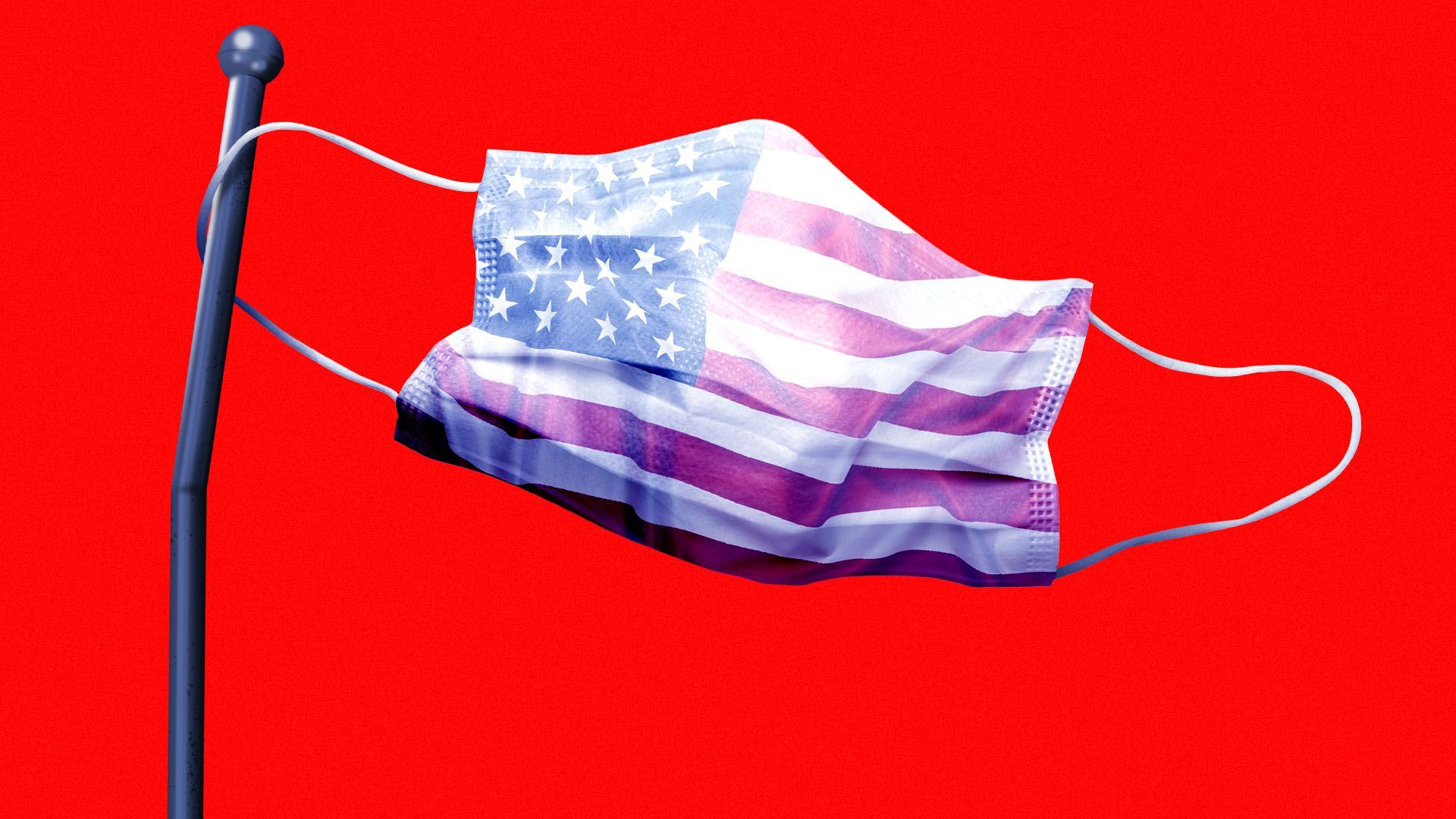
Mask-wearing has become the latest partisan division in an increasingly politically divided pandemic.

Why it matters: It’s becoming increasingly clear that wearing even a basic cloth mask is one of the most effective ways to prevent the spread of COVID-19. But whether or not people are willing to wear one has less to do with the risk of the pandemic than their political affiliation.

By the numbers: Results from months of the Axios-Ipsos coronavirus polls show a clear and growing political divide between Democrats and Republicans on mask-wearing habits.

  • Nationally, the percentage of Democrats who reported wearing a mask all the time when leaving home rose from 49% between April 10 and May 4 to 65% between May 8 and June 22.
  • During the same time period, the percentage of Republicans who reported constant mask-wearing rose from 29% to just 35%.

Context: The political divide Americans are reporting on mask use echoes one seen within nearly all levels of the government.

  • President Trump has not been seen to wear a mask, and he told Axios last week that attendees at his Tulsa campaign event on June 20 should “do what they want” on masks, which were not required at the rally.
  • Governors in many red states like Nebraska have refused to mandate facial masks in public, even as cases have begun to rise in recent weeks. At the same time, leaders in blue states — especially those that grappled with large outbreaks of COVID-19 — have urged residents to wear masks, with California Gov. Gavin Newsom mandating their use last week as cases in the state passed 4,000 a day.
  • The situation is even more divided at the local level, with leaders of red towns in blue states pushing back against mask mandates, and vice versa.

Flashback: Some of the blame for the divide can be traced back to muddled public health messaging on mask use in the early stages of the pandemic, when Americans were urged not to go out and buy masks in bulk because of concerns that there wasn’t enough personal protective equipment for front-line health care workers.

  • Those fears were real, as government virus expert Anthony Fauci pointed out in congressional testimony on Tuesday. And public health officials worried that pushing masks would inadvertently encourage Americans to continue going out in public at a moment when lockdowns demanded they stay inside.
  • Like the divide among experts on whether mass protests would increase coronavirus cases, just the perception that health advice might be based on politics rather than science gives cover to those who would forego masks, especially since the outbreak itself initially seemed like a blue state problem.

Health experts now know that cloth masks are most effective not so much at protecting individuals from infection as protecting the community from infected individuals. But that makes masks as much about social signaling as they are about public health.

  • Conservatives who prize individual autonomy over social responsibility experience “a massive pushback of psychological resistance” when presented with mask mandates, says Steven Taylor, the author of “The Psychology of Pandemics.”
  • That reaction is reinforced “if leaders like Trump downplay the significance of COVID-19 or if they won’t wear masks,” says Taylor. As a result, wearing a mask in conservative communities means visibly going against public opinion, while the opposite is true in communities where mask use is common.
  • The Axios-Ipsos data reflects this reality, showing that while Republicans in blue states use masks less than Democrats, they wear them at higher rates than Republicans in red states, just as Democrats in red states use masks at lower rates than Democrats in blue states.

What to watch: The one factor that seems capable of breaking the political deadlock is the outbreak itself. As cases have skyrocketed in red states like Arizona recently, there’s been a significant increase in Google searches for masks.


Cartoon – Flattening the I.Q. Curve

Editorial cartoons

Mask-wearing becomes political even as some governors ease resistance

Mask-wearing becomes political even as some governors ease resistance

More US states mandate wearing masks | The Canberra Times ...

Some state and local leaders are softening their resistance to issuing public masking requirements as emerging research shows face coverings can slow the spread of COVID-19, even as others are doubling down on their opposition.

The debate over whether to require face coverings in public has become increasingly politicized in recent weeks, even as COVID-19 cases have increased in the Sun Belt and some other parts of the country as lockdowns across the country have greatly eased.

Governors in southern, conservative states have been reluctant to issue statewide mandates on public mask-wearing, and in some cases have prevented local governments from taking stronger actions. 

“We want to make sure that individual liberty is not infringed upon by government and hence government cannot require individuals to wear a mask,” Texas Gov. Greg Abbott (R) said Wednesday in an interview with Waco television station KWTX.

Abbott, who frequently recommends mask-wearing, has resisted calls from local leaders to require it, and has also prohibited them from enforcing local orders with civil or criminal penalties on individuals.

However, two Texas counties on Wednesday announced businesses must impose a mask rule on staff and customers or face fines of up to $1,000, which Abbott said would be allowed under his executive order.

“Businesses … they’ve always had the opportunity and the ability, just like they can require people to wear shoes and shirts, these businesses can require people to wear face masks if they come into their businesses. Now local officials are just now realizing that that was authorized,” he said.

Texas has experienced a rapid increase in COVID-19 cases that experts say is likely related to the state’s decision to lift lockdown measures ahead of Memorial Day. The state reported 3,129 new COVID-19 cases Wednesday, its largest single-day increase. Nearly 2,800 people were hospitalized with COVID-19 as of Wednesday, a new high for the state.

In Arizona, which has also seen a surge in cases, Gov. Doug Ducey (R) on Wednesday again resisted calls to issue a statewide masking requirement, but in a reversal, said he would allow local governments to take their own actions. Larger cities including Phoenix and Tucson plan to do so.

“Every Arizonan should wear a face mask,” he said at a Wednesday press conference. “This is an issue of personal responsibility, and we’re asking Arizonans to make responsible decisions to protect the most vulnerable in our communities.” 

While a number of coastal states and cities led by Democrats have strict mask requirements when in public settings such as grocery stores, where staying six feet away from others may not be possible, some Republicans appear to see it as a restriction on freedom and have emphasized individual responsibility.

Trump has almost exclusively declined to wear a mask, and has criticized his political rival Joe Biden, the Democratic candidate for president, for wearing one. 

“I see Biden. It’s like his whole face is covered,” Trump said in an interview published Thursday in The Wall Street Journal. “It’s like he put a knapsack over his face. He probably likes it that way. He feels good that way because he does. He seems to feel good in a mask, you know, feels better than he does without the mask, which is a strange situation.”

The debate of whether to wear masks has sparked division on Capitol Hill, where two Republicans this week refused to follow a new directive from House Speaker Nancy Pelosi (D-Calif.) 

“I consider masks much more effective at spreading panic and much less effective at stopping a virus,” said Rep. Tom McClintock (R-Calif.), during a hearing yesterday. He later put on a mask. 

Polls have shown Democrats are more likely to wear masks in public than Republicans; a Gallup poll conducted in April found 75 percent of Democrats have worn a mask in public, compared to half of Republicans.

However, emerging evidence shows face coverings can slow the transmission of COVID-19. A study published in Health Affairs this week found that mandated use of face masks in public was associated with a reduction in the daily COVID-19 growth rate in 15 states and Washington, D.C., compared to states that did not have such requirements.

Governors of other states experiencing outbreaks, including Henry McMaster (R) of South Carolina, have recommended but don’t require people to wear face masks in public. City council members in Columbia, S.C., however, are reportedly considering a requirement for the state’s largest city.

Alabama Gov. Kay Ivey (R) hasn’t issued a statewide mask requirement for the public, but employees of certain businesses are required to wear them while working.

In Montgomery, Ala., which has the largest COVID-19 outbreak in the state, Mayor Steven Reed (D) issued an executive order Wednesday requiring face coverings be worn in public after a similar ordinance failed to pass the city’s council.

Florida Gov. Ron DeSantis (R) has also resisted a statewide mask requirement, though localities can require their use in public. On Tuesday, he encouraged people to wear masks when social distancing isn’t possible but said it would not be a requirement.

“In terms of forcing that under penalty of criminal law, we’re not going to be doing that. I think it would be applied unevenly and I just don’t think it would end up working,” DeSantis said at a press conference.

The state is also seeing an increase in cases, which DeSantis ties to increased testing. However, public health experts note that the percentage of tests coming back positive is also increasing, a sign of ongoing community transmission. 

In Nebraska, where the rate of COVID-19 transmission has been declining, Gov. Pete Ricketts (R) encourages the use of masks in public but has threatened to withhold federal relief funding from localities that require their use in government buildings.

“The governor encourages people to wear a mask but does not believe that failure to wear a mask should be the basis for denying taxpayers’ services,” spokesman Taylor Gage told the Omaha World-Herald.

Not all Republican governors have resisted masking mandates. Maryland Gov. Larry Hogan and Massachusetts Gov. Charlie Baker were early to issue wide-ranging mask requirements in their states.

Meanwhile, Democratic governors are mandating mask requirements or say they are seriously considering it. 

As cases continue to climb in North Carolina, Gov. Roy Cooper (D) said this state leaders are considering making mask-wearing in public settings mandatory but has not done so yet.

Oregon Gov. Kate Brown (D) announced Wednesday that people living in seven of the state’s counties will have to wear masks in public beginning June 24 as the state sees an increase in cases.

Democratic governors of states hit hard early in the pandemic including New York, Washington and New Jersey have required the use of face coverings in public for several weeks.

California Gov. Gavin Newsom (D) issued a statewide mask order Thursday amid an increase in COVID-19 cases in his state.

“Science shows that face coverings and masks work,” Newsom said Thursday. “They are critical to keeping those who are around you safe, keeping businesses open and restarting our economy.” 


Coronavirus drugmakers’ latest tactics: Science by press release

https://www.politico.com/news/2020/06/05/drugmakers-media-coronavirus-303895

Coronavirus drugmakers' latest tactics: Science by press release ...

Pharmaceutical companies are using the media to tout treatments that are still under review.

Vaccine maker Moderna attracted glowing headlines and bullish investors when it revealed that eight participants in a preliminary clinical trial of its coronavirus vaccine had developed antibodies to the virus. The company’s share price jumped nearly 20 percent that day as it released a massive stock offering.

But the full results of the 45-person safety study haven’t been published, even though Moderna began a second, larger trial in late May aimed at determining whether the vaccine works. Several vaccine researchers say the scant public information on the earlier safety study is hard to evaluate because it addresses less than 20 percent of participants.

Call it science by press release — a tactic that pharmaceutical companies are increasingly relying upon to set their experimental coronavirus drugs and vaccines apart in a crowded field, shape public opinion and court regulators. Public health experts say the approach could increase political pressure on federal health officials to green-light drugs and vaccines before it is clear they are safe or effective, with potentially dangerous consequences.

“There’s a long history of pharmaceutical manufacturers putting out self-serving press releases related to clinical trial data that they’re developing that present an overly rosy picture of the data, usually with a boilerplate disclaimer at the end, which is fairly useless,” said Aaron Kesselheim, a professor of medicine at Harvard Medical School who studies drug regulation and pricing.

There are already signs of hype and political pressure influencing the U.S.’ coronavirus response. The Food and Drug Administration authorized emergency use of the malaria drug hydroxychloroquine in March without any proof that it was safe or effective for coronavirus patients — but with the backing of President Donald Trump, who had begun touting the treatment during daily White House briefings.

Subsequent studies have found that hydroxychloroquine doesn’t help those with Covid-19 and can cause potentially fatal side effects. And a top government scientist, Rick Bright, filed a whistleblower complaint in May alleging that he was ousted from his job leading the Biomedical Advanced Research Authority after he resisted political pressure to greenlight widespread use of the drug.

“The FDA has remained an unwavering, science-based voice helping to guide the all-of-government response,” agency Commissioner Stephen Hahn said in a statement. “I have never felt any pressure to make decisions, other than the urgency of the situation around COVID-19.”

But observers aren’t so sure. “From the outside looking in, there seems to be more political pressure than ever,” said Marc Scheineson, a former associate commissioner at the FDA and head of the FDA group at Alston & Bird. “The example in the White House is trickling down and there is a lot of pressure on the FDA … to color information on the optimistic side for political purposes and that is a hugely disturbing trend.”

A spokesperson for Moderna, which has received nearly a half billion dollars from the U.S. government and praise from Trump, said the company previewed its vaccine trial results by press release because it was concerned that the data might leak. The National Institutes of Health’s top infectious disease expert, Anthony Fauci, had hinted at the results in an interview with National Geographic, and data from a trial of the experimental drug remdesivir had leaked in April.

“You had this data moving widely around NIH and the remdesivir leak was also in our minds,” the Moderna spokesperson said.

But Peter Bach, director of Memorial Sloan-Kettering’s Center for Health Policy and Outcomes, said Moderna’s effort to preview its findings in the press “could be construed as an effort to make sure they are part of the conversation — and it worked on that front.”

Other groups have also previewed their hotly anticipated vaccine studies in the press. In late April, The New York Times revealed that six monkeys given a vaccine developed by researchers at the U.K.’s University of Oxford had stayed healthy for 28 days despite sustained exposure to the coronavirus. The article quoted Vincent Munster, a researcher at the NIH’s Rocky Mountain Laboratory, which conducted the monkey study at the British scientists’ behest.

The Oxford researchers, who signed a deal with AstraZeneca two days later to develop the experimental vaccine, did not publish a formal scientific analysis of the monkey data until mid-May. The study revealed that the noses of vaccinated monkeys and unvaccinated monkeys contained similar levels of coronavirus particles, suggesting that the vaccinated animals could still spread the disease — and the vaccine might not be as effective as the earlier data had hinted.

AstraZeneca has since inked a $1.2 billion deal with the U.S. government to provide 300 million vaccine doses, and a £65.5 million ($80 million) agreement with the U.K. government to supply 30 million doses.

Liz Derow, a spokesperson for Oxford’s Jenner Institute, where the vaccine researchers are based, said they did not give the monkey data to The New York Times. The NIH’s National Institute of Allergy and Infectious Disease, which operates the Rocky Mountain Laboratory, said it did not provide the data to the newspaper — but one of its researchers, Vincent Munster, spoke to a Times reporter about the monkey findings at the request of the Jenner Institute.

“I was really disturbed by not just Moderna, but the Oxford group as well, presenting a press release without data, without a scientific review, without knowing what the press release was based on,” said Barry Bloom, an immunologist at the Harvard School of Public Health. “And very positively enough to raise the stock price so two days later officials within the company sold their stock and made a whole lot of money, whether or not the vaccine works.”

Four of the pharmaceutical firm’s top executives together saw gains of $29 million from prescheduled sales of shares in the company in the two days following the vaccine announcement. The company has not yet responded to a request for comment on the stock sales.

Neither the Oxford nor Moderna vaccines are available to the public. But some drugs whose safety and efficacy are now being studied have already been repurposed or authorized for emergency use during the pandemic. The rush to release snippets of information on drug trials to the press ahead of full results has left some doctors wondering how to best treat their patients.

After leaked data from a trial of Gilead’s experimental antiviral remdesivir suggested the drug might be the first shown to help coronavirus patients, the company put out a press release in late April teasing results from a larger, government-run study. Hours later, Fauci revealed some findings of the study during an Oval Office press spray.

But the full analysis of the NIAID trial results was not published until three weeks later. Until that point, frontline physicians had no way to know that patients on ventilators did not benefit from remdesivir treatment — meaning that doctors may have inadvertently wasted some of the United States’ limited stock of the drug.

This lack of understanding on how to use remdesivir was evident in a recent survey more than 250 hospitals by the American Society of Health-System Pharmacists, which found that just 15 percent planned to use their remdesivir doses as described in the FDA’s emergency authorization for the drug.

Andre Kalil, an infectious disease doctor at the University of Nebraska Medical Center who led the NIAID trial, told POLITICO that physicians could have patterned their use of remdesivir on the dosages given during the trial.

Others say doctors using experimental treatments should have as much information as possible.

“If we want doctors to make rational medical decisions based on data, then before an authorized product reaches patients, the data should be available to review in some way, not just a press release,” said Walid Gellad, director of the University of Pittsburgh’s Center for Pharmaceutical Policy and Prescribing.

Kesselheim, too, said that clinical trial data should be made public alongside any emergency authorizations to give physicians “the maximum amount of help they need in figuring out how to prescribe the drug.”

Gilead did not respond to a request for comment. But NIAID said that the urgency of the coronavirus prompted Fauci to share initial results before a full analysis was ready for publication.

Ivan Oransky, a professor of medical journalism at New York University and co-founder of the blog Retraction Watch, which monitors errors and misconduct in scientific research, told POLITICO he fears that the temptation to conduct science by press release will get “worse before it gets better.”

The world is growing more desperate for drugs and vaccines that could bring the coronavirus to heel. And many members of the public and politicians are treating every scrap of scientific information about the pandemic equally, he said — whether data comes from a peer-reviewed study or a company press release.

“There have been mechanisms to review science critically that, given the speed of Covid, have gone out the window,” said Bloom.

And interpreting results of clinical trial data can be difficult under the best of circumstances — especially when that data concerns a virus that was unknown to science until December of last year. When to end a trial and which conclusions to highlight are in many cases a matter of discretion, said Scheineson.

“It’s an art, not a science, in that respect,” he said. “I, for one, will not be the first in line to the new Moderna vaccine.”


Axios-Ipsos poll: Americans fear a second wave

https://www.axios.com/axios-ipsos-coronavirus-index-second-wave-87c327c2-42bb-43a5-80b2-5f2f513a24b2.html

Axios-Ipsos poll: Americans fear a second wave - Axios

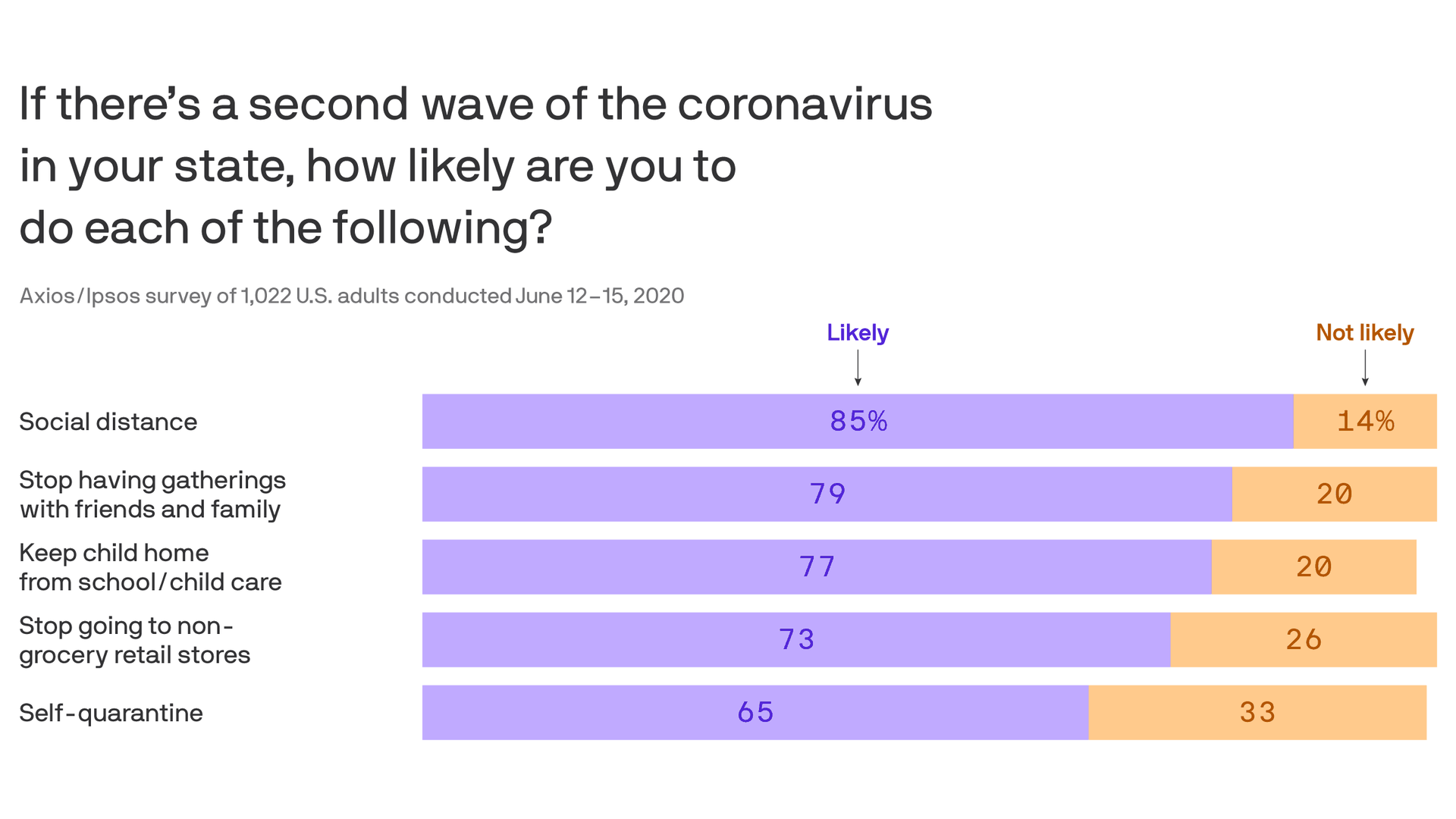
Eight in 10 Americans are worried about a second wave of the coronavirus, with large majorities saying they’ll resume social distancing, dial back shopping and keep their kids out of school if it happens, in Week 13 of the Axios-Ipsos Coronavirus Index.

Why it matters: Businesses and schools around the country are trying to assess how quickly and fully they should reopen based in part on what Americans will demand and tolerate. These findings underscore the challenges in predicting how they should proceed.

  • But getting Americans to swallow a second round of 14-day self-quarantining could be tougher than getting them to go back to social distancing, with one in three saying they likely won’t do it.
  • The biggest factor is partisan identification, with 81% of Democrats but only 49% of Republicans saying they’ll self-quarantine if a second wave hits.

The big picture: The latest installment of our national weekly survey shows a renewed sense of risk following reports of new hospitalizations since states began lifting stay-at-home orders — but quarantine fatigue is still driving people to take their chances.

  • People’s assessment of large or moderate risk grew last week for each of these categories: returning to their normal workplace, dining out, retail shopping, going to the hair salon or participating in protests.
  • But the share of those going out to eat rose from 31% to 41%. Those visiting friends or relatives rose from 56% to 60%. Those getting their hair done rose from 26% to 31%. Those attending demonstrations rose from 11% to 14%.

What they’re saying: “People are starting to be concerned about it again,” said pollster Chris Jackson, senior vice president for Ipsos Public Affairs. “We’re not yet seeing changes in the patterns of their behavior yet, though.”

  • Their behaviors are not really catching up to their concern level.”

By the numbers: 81% say they’re concerned about a second wave — including those who are extremely (30%), very (26%) or somewhat (24%) concerned.

  • 64% of those surveyed say returning to their normal pre-coronavirus life represents a large or moderate risk, up from 57% a week ago.
  • The share of people extremely or very concerned about getting sick rose from 32% to 40% last week. Those fearing U.S. economic collapse rose from 48% to 54%.
  • There also were upticks in people’s concerns about job security and the government’s response to the outbreak.
  • Americans’ ability to afford household goods also decreased.
  • One in 10 surveyed say they’ve been collecting unemployment benefits in recent weeks.
  • 35% of Americans now know someone who’s tested positive, a new high for the survey.

Between the lines: The survey suggests an evolving understanding of the racial disparities in the pandemic.

  • The share of those saying they are extremely or very concerned that the coronavirus is doing greater damage to people of color rose from 36% to 42%.
  • The share of those extremely or very concerned that official responses are biased against certain groups also rose from 36% to 42%.