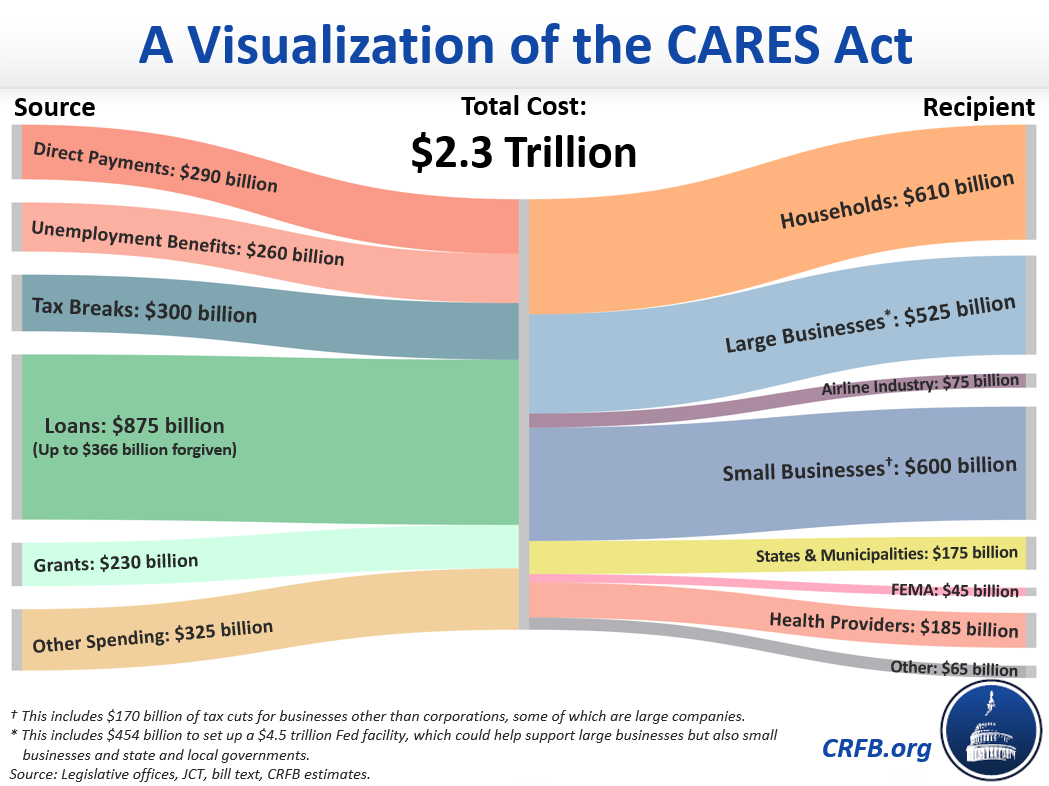
For-profit, higher-margin hospitals at advantage when it comes to CARES funding

https://www.healthcaredive.com/news/for-profit-higher-margin-hospitals-at-advantage-when-it-comes-to-cares-fun/577941/

Understanding the CARES Act student loan relief | Sanford Center ...

Dive Brief:

  • Hospitals that tend to have a higher mix of private payer revenue are likely to receive more novel coronavirus federal grant money compared to hospitals that rely on government payers such as Medicare and Medicaid, a new analysis from the Kaiser Family Foundation found.
  • The study aims to analyze the implications of tying the latest round of $50 billion in federal bailout money to providers’ net patient service revenue. It examined hospital financial data and used the HHS’ grant formula to determine the amount of grant money hospitals were likely to receive.
  • KFF found that hospitals with the highest share of private insurance revenue, or those in the top 10%, received $44,321 per hospital bed, or more than double the hospitals in the bottom 10%.

Dive Insight:

This latest analysis reveals some hospitals may be at a disadvantage when it comes to receiving federal funding that is meant to serve as a lifeline for them during the COVID-19 pandemic.

The study found that hospitals with the highest share of private insurance revenue — and those set to receive more in bailout money — were less likely to be teaching hospitals and more likely to be for-profit. Also, they were more likely to have higher operating margins and provided less uncompensated care as a share of operating expenses.

In short, KFF explains that the funding package is skewed toward hospitals with higher revenue from private payers.

“These hospitals’ large share of private reimbursement may be due either to having more patients with private insurance or charging relatively high rates to private insurers or a combination of those two factors. All things being equal, hospitals with more market power can command higher reimbursement rates from private insurers and therefore received a larger share of the grant funds under the formula HHS used,” according to the analysis.

The study points out that a community health center that sees a small portion of patients with private pay would receive less funding than a private physician office that sees the same total number of patients but treats more with private pay.

“With HHS expected to release additional relief fund grants and Congress considering additional stimulus, this analysis demonstrates that the formula used to distribute funding has significant consequences for how funding is allocated among providers,” according to KFF.

Hospitals have been battered by the outbreak of the novel coronavirus. They’ve halted elective procedures and routine care in an effort to preserve needed medical supplies and in an attempt to snuff out the spreading virus.

That has caused hospital volumes and revenues to plummet as care is deferred, so the federal government has sent financial aid in response as part of the Coronavirus Aid, Relief, and Economic Security Act.

This latest round of funding was designed to be a more targeted approach than the initial wave. The first $30 billion released was distributed based on a facility’s share of Medicare fee-for-service. That put facilities with a small slice of Medicare fee-for service business, such as children’s hospitals, at a disadvantage. However, the first round was one way to get money out the door quickly, which officials have acknowledged, knowing a more targeted approach would follow.


Treasury Has Hardly Spent Its $500 Billion Coronavirus Relief Fund

https://www.thefiscaltimes.com/newsletter/20200518-500-Billion-Coronavirus-Fund-Has-Barely-Been-Used

Hard News Cafe » Blog Archive » Water-faucet-shutterstock-june-2011

The Treasury Department has disbursed just $37.5 billion out of $500 billion in emergency coronavirus funds approved by Congress as part of the CARES Act passed in March, according to the first report of the congressional oversight commission monitoring the implementation of the law.

Airlines still waiting on billions from relief fund: Congress allocated $46 billion for aid to the air travel industry, but the Treasury Department has yet to disburse any of the money. The funds include $25 billion for airlines and $17 billion for related businesses that are critical to national security.

Lending programs not yet lending: The Federal Reserve and Treasury last month announced five lending facilities meant to help prop up various segments of the economy, including “Main Street” lending programs targeting small- and mid-sized businesses, a program for states and municipalities, and a corporate-bond buying facility. Only one of those programs is fully up and running. Treasury disbursed $37.5 billion to the corporate facility, called the Secondary Market Corporate Credit Facility (SMCCF), earlier this month.

“The Treasury and the Fed have announced these facilities but, with the exception of the SMCCF, the Treasury has not invested in them yet, nor has the Fed put them into operation,” the oversight report says. “Their size and scope may also grow as the Treasury has only pledged $185 billion of the $454 billion appropriated in the CARES Act for investments in Fed lending facilities.”

Changes to lending terms: “The report describes how even before any money from the Main Street program has been lent, the terms of the program already have evolved,” The Washington Post’s Erica Werner reports. “The changes include increasing the size of loans, eliminating a requirement that companies have to attest they need money ‘due to the exigent circumstances presented by’ the coronavirus, and modifying a requirement that companies make ‘reasonable efforts’ to maintain payroll and retain employees during the term of a loan. Instead, they will be required to make ‘commercially reasonable efforts’ to do so.”

The Fed and Treasury also expanded the $35 billion facility to buy debt from states, cities and counties, after criticism that the original guidelines left only a few dozen cities and counties eligible to participate. The facility will now buy notes from counties with a population of at least 500,000 residents (instead of the original floor of 2 million residents) and cities with a population of at least 250,000 residents (instead of a million residents). The program will also buy notes that mature within at least three years instead of two years.

The bottom line: Congress may have moved with unusual speed to provide money to address the pandemic, but while the Treasury Department quickly implemented other elements of the CARES Act, the report highlights how the lending programs have gotten off to a slow start and how many questions remain to be answered about how they will function. Roughly a third of the new report is filled with questions for the Treasury Department and the Federal Reserve about the programs.

Similar questions still hang over the oversight commission and broader oversight of the trillions in new spending approved by Congress. The five-member commission still doesn’t have a chairman, as House Speaker Nancy Pelosi and Senate Majority Leader Mitch McConnell have yet to agree on a person to fill that post. The Senate also has yet to confirm a special inspector general to oversee the $500 billion Treasury fund.

The commission’s next report is reportedly due in mid-June.


Administration’s Handling of Coronavirus Threatens a Long Unemployment Crisis

https://www.americanprogress.org/issues/economy/news/2020/05/07/484795/trump-administrations-handling-coronavirus-threatens-long-unemployment-crisis/
The Trump Administration's Handling of Coronavirus Threatens a ...

On Friday, the Bureau of Labor Statistics will release employment numbers for April that are expected to show a tragic and historic increase in unemployment. Consensus estimates anticipate more than 20 million jobs lost and an unemployment rate of 16 percent—a figure that may well be an underestimate given that millions of people may not be looking for jobs, effectively exiting the labor force and reducing the labor force participation rate. Moreover, state-level unemployment claims data show that this economic pain is being felt across the country, with sharp rises in joblessness in every state. And Thursday’s jobless claims release suggests that job losses have continued at high levels since the April unemployment survey was taken.

While the immediate cause of this spike in joblessness is, of course, the necessary stay-at-home orders and social distancing measures taken to respond to the crisis, the rise in unemployment—and how long it lasts—cannot be separated from choices made by the Trump administration. In understanding the state of the economy, as well as what comes next, the following three elements of this crisis must be understood:

  1. The economic crisis we are facing—and the economic pain we expect in the months ahead—is the result of a failed public health response. The Trump administration ignored early warnings, misled the public, and made the coronavirus crisis worse. The fact that the administration bungled the testing regime early on in the crisis meant that the United States could never contain the virus, as other countries such as South Korea, New Zealand, and Taiwan have done. As a consequence of that failure, the United States has had to engage in social distancing that has meant economic shock in order to avoid significantly greater levels of infections and deaths. The depth and scope of the economic pain being felt is a consequence of the administration’s delayed response and complete failure take leadership during this crisis.
  2. The administration’s inability to put in place appropriate public health measures going forward—combined with its insistence that efforts to contain the virus should be lifted in the absence of those measures—is likely to not only prolong the public health crisis but also extend the economic pain. Rather than provide workers, businesses, and families the confidence that they can return to activity safely, the administration is taking steps that try to ignore the risk of infection, such as absolving employers of responsibility for worker safety through a liability shield or forcing workers to return to work even when they have concerns about their health. In this environment, we are likely to see decreased demand for some time to come because people will have little confidence in individual state reopening strategies disconnected from science—as we are already seeing across the country.
  3. By rejecting efforts that would support families, workers, and communities during this crisis, the administration and its allies in Congress are putting us on a path for continued double-digit unemployment even after the pandemic finally ends. Indeed, the Congressional Budget Office (CBO) projects that the unemployment rate—absent additional action—will be near 10 percent at the end of 2021, several months after they project social distancing as a result of the health crisis abates. By opposing efforts to provide sufficient aid to states and localities; relief to families and unemployed workers; and assistance to those struggling the most, President Donald Trump, Majority Leader Mitch McConnell (R-KY), and their allies are insisting on making this extended period of double-digit unemployment a reality.

There is an alternative path, however: Taking the necessary steps to address the public health crisis and ensure that people can go back to work safely and doing what is needed to address the immediate economic pain and avoid prolonged unemployment. As Congress and the administration consider an additional stimulus package, they should put in place necessary public health protections while providing robust aid to families, workers, and communities for as long as the crisis lasts. This will allow us to avoid double-digit unemployment from being a devastating reality for American families for the next year and a half or more.

Public health failures has driven unemployment up

The rise in unemployment over the past two months is a direct consequence of the public health crisis—one that could have taken a far less severe toll under an administration that had been better prepared for it and that had approached it more wisely. The Trump administration has failed to develop an evidence-based plan to end the coronavirus crisis. Instead, its mismanagement has resulted in widespread fear and uncertainty as to when it might be appropriate to reopen parts of the economy. President Trump did not take the pandemic seriously when cases first emerged in the United States; his administration failed to use the month of April—when the nation was largely shut down—to ramp up the testing, contact tracing, and other pieces necessary for the public health response. And now, Trump is pushing states to reopen too soon. Before people feel comfortable enough to once again venture out of their homes and reengage in work and other economic activities, we need to ensure the country has developed the necessary health infrastructure to allow us to gradually reopen our economy without sparking a second wave of infections.

The economic crisis cannot end until public health crisis is solved

The Trump administration and its allies are arguing that the way to solve the economic crisis is to open up the country, ending stay-at-home orders and engaging in aggressive efforts to force business to return to normal. But in the absence of public health measures that actually allow activity to return safely, the administration’s strategy appears to be one of “ignore and press on,” with potentially devastating results for workers and communities. This strategy includes:

  • Pushing communities to lift stay-at-home orders and other public health measures before sufficient testing, tracing, isolation and ongoing surveillance is in place
  • Forcing workers back on the job, even without sufficient personal protective equipment or workplace safety protections—whether by removing unemployment insurance for those who are recalled to unsafe situations or through executive actions such as those taken for the meatpacking industry
  • Proposing to absolve employers of the responsibility to keep workers and communities safe through blanket immunity from liability—a measure that would do nothing to keep workers safe or build confidence in economic reopening

These steps reflect an acceptance of elevated risks of transmission, and ultimately, death. And despite the president’s rhetoric, it will make it less likely that the economy can return faster.

First, it is clear that the public isn’t going to feel safe to return to normal economic activity absent additional public health measures. A recent Washington Post-University of Maryland poll found that “67 percent say they would be uncomfortable shopping at a retail clothing store, and 78 percent would be uncomfortable eating at a sit-down restaurant.” These results were similar both in states that had loosened restrictions and those that had not and is consistent with other data. As long as people are anxious that returning to normal activities could put them at risk of contracting the virus, the economy will be unable to recover.

Second, a strategy that fails to put in place the necessary protections against spreading the virus will increase transmission among the public, and especially workers, in ways that may force additional shutdowns and prolong the period of public health crisis. In sum, prolonged public health crisis equals a prolonged state of economic distress—extending the number of months with a job market like April’s. The best approach—an approach adopted by other countries who are faring better both with their health outcomes and their economic impacts—is a national plan to fight the virus that is based on testing, tracing, and isolation.

After the pandemic ends, double-digit unemployment will persist under the current course

The CARES act provided large, necessary relief to most Americans, including assistance for workers, families, and small businesses. But this assistance will run out before the economic emergency is behind us, forcing the economy into unnecessarily prolonged hardship.

Indeed, the measures in the CARES Act both leave important gaps and will expire long before the economy is expected to return to normal. States and localities are facing extreme budget shortfalls. If action is not taken before state budget deadlines on July 1, states are likely to begin implementing layoffs of teachers and first responders and service cuts in the coming months that will cause additional job loss. Expanded unemployment insurance benefits expire at the end of July, removing an important lifeline for those out of work. While the direct payments in the CARES Act provided important assistance to families, the $1,200 per person payment will not be enough to sustain households through a prolonged crisis. The initial Paycheck Protection Program (PPP) support for small businesses has run out, and a second round of funding may soon run out too. And in important areas such as housingfood assistancechild care, and health coverage, among others, the CARES Act failed to do enough to address the hardship being felt today, let alone over a prolonged crisis—even as it provided generous aid to corporations.

As a result, under baseline projections—those that assume no further action on the part of the government—double-digit unemployment is expected to be a feature of the economy for at least the next year and a half. As noted above, the CBO estimates that the unemployment rate will remain near 10 percent at the end of 2021—many months after they predict that social distancing due to the pandemic itself ends.

Yet the Trump administration and congressional Republicans have indicated that they are prepared to accept this reality, or at best, offer solutions that do nothing to shift it. White House economic adviser Kevin Hassett said that another round of coronavirus relief legislation might not be necessary, and chief economic adviser Larry Kudlow said on Sunday that nothing has been decided yet and that “there’s kind of a pause period right now” and that “we will wait and see.” Senator McConnell has dismissed state and local aid as a “blue state bailout,” despite pain being felt in all states.

To the extent the administration or its allies have signaled a desire to act, they have focused on measures that would be woefully insufficient to address the economic challenges we face. Aside from the liability shield, Trump has signaled a push for poorly targeted corporate tax cuts or a payroll tax cut that would fail to benefit those who are out of work. An illustrative example of Trump’s approach is his call for removing limits on corporate deductions for meals and entertainment—effectively allowing companies to deduct expenses for sports tickets, golf trips, or visits to casinos—which would provide a benefit to corporations and their wealthiest executives but do little to help put money in the hands of those who need it.

A better path: a response that meets the public health and economic challenge

As it considers another package to address this crisis, Congress has the opportunity to take a path that rejects double-digit unemployment as a lasting feature of this crisis. The approach Congress should take would allow economic activity to restart safely and ensure that, as the economy restarts, we are actually getting people back to work rather than accepting a recession that keeps millions unemployed.

First, that requires a sufficient public health response. The purpose of stay-at-home orders in the first place was to suppress transmission to low levels and buy time to put in place extensive testing and contact tracing programs, but we have yet to meet those goals. Nationally, we still need to increase our testing capacity and reach at least 500,000 tests a day; scale up contact tracing—both manually and by apps that meet privacy standards—in order to isolate people who test positive as well as their contacts; and have in place a far more robust disease surveillance system.

And second, it requires an economic response that offers relief that both addresses immediate pain that families, small businesses, and communities are facing and is sufficient to build back to a stronger economy.

In particular, the package must be:

  1. At a scale necessary to address the crisis. We need to pursue a fiscal response that is proportional to both the public health and economic threat posed by COVID-19. The economic consequences of this crisis are staggering. Children are going hungry; households are piling massive debts; millions of homeowners are delaying their mortgage payments; small businesses in hard hit states received fewer loans than others; minority small business owners are struggling to stay open; and state and local governments are preparing for significant layoffs of teachers and first responders in the absence of federal aid. Action needs to be sufficiently large to both address the immediate hardship that families are facing and get the economy back to work. This big push for aid has to be coordinated at the national, state, and local levels. An important lesson form the Great Recession was that austerity at the level of states and localities was a key factor in delaying economic recovery for years, since states were in austerity mode from 2008 until 2012, contributing to lower GDP growth. And, in contrast to concerns raised by some congressional Republicans—concerns that were absent during the passage of nearly $2 trillion in tax cuts in 2017—we have the fiscal capacity to respond robustly, especially with interest rates near zero. Indeed, evidence suggests that increased fiscal stimulus may increase fiscal sustainability.
  2. Sustained for the duration of the crisis. Relief must be sustained, automatic, and available with certainty for as long as it is needed. We should learn from the Great Recession, when stimulus was insufficient and removed too soon. During that crisis, unemployment insurance expired for many workers long before the crisis had passed; fiscal aid ended long before state and fiscal budget cuts ceased being a drag on the recovery. Key measures to support the economy, such as unemployment insurance, state and local aid, and direct relief to families, should automatically extend for the duration of the economic crisis—ensuring that we are providing sufficient relief and necessary stimulus as long as is needed to support a robust recovery.
  3. Targeted to all the areas where Americans are feeling economic hardship. There is no silver bullet that will bring the economy back. We need a multilayered attack that addresses the root cause of the problem—the spread of the virus—and ameliorates its symptoms in the form of hardship for families, workers, small businesses, and communities. Building off the CARES Act, additional aid needs to make sure it is reaching those who have been excluded. That requires ensuring that aid is more completely available—for example, ensuring that immigrant families can access needed relief or closing loopholes that prevent workers from having access to paid leave. It also means providing much needed assistance in areas such as food assistance, child care, housing, and for people with disabilities—areas that would both address concentrated harm and support the economy going forward. Finally, the package should be designed so that—rather than exacerbating structural problems in our economy that benefited corporations over workers—it puts us on a path for a stronger economy once the crisis ends.

The administration and its allies appear content to accept a prolonged period of public health and economic harm that is a result of the mismanagement of the COVID-19 crisis to date—essentially condemning the nation to a greater toll from the virus itself and a much longer period of economic distress. It must be clear that the harsh reality of the April jobs report—and the much broader pain that has been felt over recent weeks—was the result of both failed policy decisions and mismanagement. By the same token, we have the choice going forward as to whether we accept further pain or take steps that would both keep people healthy and get Americans back to work.


14 health systems receiving biggest CARES Act payments

https://www.beckershospitalreview.com/finance/14-health-systems-receiving-biggest-cares-act-payments.html?utm_medium=email

A Visualization of the CARES Act | Committee for a Responsible ...

Hospitals across the U.S. received their first payments in April from the $175 billion in relief aid Congress allocated to cover expenses or lost revenues tied to the COVID-19 pandemic. 

The first $50 billion in funding from the Coronavirus Aid, Relief and Economic Security Act was delivered to hospitals last month. HHS distributed $30 billion based on Medicare fee-for-service reimbursements and another $20 billion based on hospitals’ share of net patient revenue.

HHS released new data May 7, sharing where the $50 billion in funding went. The department provided a list of hospitals that received payments and agreed to the terms and conditions for receiving the relief aid as of May 4. As part of those terms, hospitals agreed not to balance bill COVID-19 patients and to submit documents showing the funds were used for expenses or lost revenue attributable to COVID-19.

Here are the 10 health systems that received the most funding: 

1. Dignity Health (San Francisco): $180.3 million

2. Cleveland Clinic: $103.3 million

3. Stanford Health Care (Palo Alto, Calif.): $102.4 million

4. Memorial Hermann Health System (Houston): $92.4 million

5. NYU Langone Hospitals (New York City): $92.1 million

6. The County of Los Angeles: $80.9 million (Los Angeles County operates four hospitals)

7. Hackensack (N.J.) Meridian Health: $76.8 million

8. Florida Cancer Specialists & Research Institute (Fort Myers): $67.3 million

9. Memorial Hospital for Cancer and Allied Diseases (New York City): $64 million

10. Massachusetts General Hospital (Boston): $58.1 million


Separately, major publicly traded hospital operators disclosed how much funding they received from the CARES Act. Each company received at least $195 million. 

1. HCA Healthcare (Nashville, Tenn.): $700 million

2. Tenet Healthcare (Dallas): $345 million

3. Community Health Systems (Brentwood, Tenn.): $245 million

4. Universal Health Services (King of Prussia, Pa.): $195 million


The coronavirus is outlasting the stimulus

https://www.axios.com/newsletters/axios-vitals-7038a5b1-74fa-44e3-ba7e-43c87052e1c5.html?utm_source=newsletter&utm_medium=email&utm_campaign=newsletter_axiosvitals&stream=top

The coronavirus is outlasting the stimulus - Axios

The coronavirus pandemic is lasting longer than Congress and the White House anticipated when it committed hundreds of billions of dollars to individuals and small businesses, Axios’ Dan Primack and Alayna Treene report.

Why it matters: These bailouts were meant to stop the bleeding, to buy time while the wound cauterizes. Unfortunately, the injury was more severe than originally diagnosed.

Treasury Secretary Steve Mnuchin told CBS that “the entire package provides economic relief overall for about 10 weeks.”

  • The CARES Act was signed by President Trump on March 27.
  • Mnuchin’s 10-week window expires on June 5.
  • No one expects to see a Phase 4 stimulus by that date, nor a full-scale economic reopening.

Paycheck Protection Program (PPP) loans require that small businesses maintain staffing levels for eight weeks. For early recipients, that means their payroll obligations could run out by month’s end.

  • Direct checks of up to $1,200 to individuals were only expected to help cover expenses for one month, even though many states already are well into their second month of locking down.

All of this makes economic reopening even more complicated.

  • The federal government has effectively created a “back to normal” deadline for small businesses, even though such decisions are supposed to be made by the states.

The bottom line: The small business loans and individual checks were designed as bridges to reopening, but if they only delayed layoffs and economic pain by a couple of months, then they may end up being remembered as bridges to nowhere.


The U.S. plans to lend $500 billion to large companies. It won’t require them to preserve jobs or limit executive pay.

https://www.washingtonpost.com/business/2020/04/28/federal-reserve-bond-corporations/?fbclid=IwAR21PBlVqLVVDVf8CeVxGpTuHgxXbDqy49K49BpeeYav-KmKYxS_xfnAX5A&platform=hootsuite

DownWithTyranny!: April 2020

The Fed’s coronavirus aid program lacks restrictions Congress placed on companies seeking financial help under other programs.

A Federal Reserve program expected to begin within weeks will provide hundreds of billions in emergency aid to large American corporations without requiring them to save jobs or limit payments to executives and shareholders.

Under the program, the central bank will buy up to $500 billion in bonds issued by large companies. The companies will use the influx of cash as a financial lifeline but are required to pay it back with interest.

Unlike other portions of the relief for American businesses, however, this aid will be exempt from rules passed by Congress requiring recipients to limit dividends, executive compensation and stock buybacks and does not direct the companies to maintain certain employment levels.

Critics say the program could allow large companies that take the federal help to reward shareholders and executives without saving any jobs. The program was set up jointly by the Federal Reserve and the Treasury Department.

“I am struck that the administration is relying on the good will of the companies receiving this assistance,” said Eswar Prasad, a former official at the International Monetary Fund and economist at Cornell University. “A few months down the road, after the government purchases its debt, the company can turn around and issue a bunch of dividends to shareholders or fire its workers, and there’s no clear path to get it back.”

Treasury Secretary Steven Mnuchin defended the corporate aid program, saying that the lack of restrictions on recipients had been discussed and agreed to by Congress. “This was highly discussed on a bipartisan basis. This was thought through carefully,” he said in an interview with The Washington Post. “What we agreed upon was direct loans would carry the restrictions, and the capital markets transactions would not carry the restrictions.”

Democrats asked for restrictions on how companies can use the money from the central bank’s bond purchases but were rebuffed by the administration during negotiations about the Cares Act, said a spokesman for Senate Minority Leader Charles E. Schumer (D-N.Y.). The spokesman said Democrats won meaningful concessions from the administration on reporting transparency in the final agreement. (Transparency requirements do not apply to the small-business loans, the biggest business aid program rolled out to date.)

Mnuchin also said the program had already bolstered investor confidence in U.S. capital markets, which in turn helped firms raise capital they used to avoid layoffs.

“The mere announcement of these facilities, quite frankly, led to a reopening of a lot of these capital markets,” Mnuchin said in an interview. “Even before these facilities are up and running, they’ve had their desired impact of having stability in the markets. Stability in the markets allows companies to function, and raise money and allows them to keep and retain workers and get back to work.”

The corporate debt purchases by the Fed stand in stark contrast with other portions of the federal aid for U.S. businesses that come with requirements to protect jobs or limit spending.

The Paycheck Protection Program, which offers $659 billion for small businesses, requires companies to certify that the money will be used to “retain workers and maintain payroll or make mortgage payments, lease payments, and utility payments.”

The “Main Street” program offering up to $600 billion to “midsize” businesses — with 500 to 10,000 employees — forbids companies from issuing dividends and places limits on executive compensation, according to a term sheet issued by the Fed. Those restrictions are in effect until 12 months after the loan is no longer outstanding. The companies must also “make reasonable efforts” to maintain payroll and retain employees.

Likewise, the $46 billion program for airlines, air cargo companies and national security forbids dividends and limits executive pay. Its requirement on retaining employment is more rigorous, however. Companies are supposed retain at least 90 percent of their employees.

The first version of the Fed program to buy bonds from large companies, known as the Primary Market Corporate Credit Facility, probably would have compelled recipients of the aid to limit executive pay and dividends. That version of the program, described in a March 23 term sheet issued by the Fed, offered direct loans and bond purchases to companies. Under the Cares Act, the federal programs offering direct loans must set restrictions on company dividends and CEO pay; those that buy only corporate bonds do not. Both are forms of lending, although bonds are more easily resold.

But on April 9, the Fed altered the design of the program to exclude direct corporate lending. The Fed program will still essentially lend money to large companies — by buying their bonds — but the Fed will not be compelled by the Cares Act to ensure that companies abide by the divided and CEO pay rules.

“The change to the term sheet between March and April is the smoking gun on the Fed’s own culpability here,” said Gregg Gelzinis, a senior policy analyst at the Center for American Progress, a left-leaning think tank. “The basic principle of the Cares Act was that if we’re going to provide taxpayer funding to private industry, we need conditions to make sure it is in the public interest. This violates that principle.”

Bharat Ramamurti, an aide to Sen. Elizabeth Warren (D-Mass.) who was appointed to the board overseeing the bailout, said in a statement: “Big corporations have shown time and again that they will put their shareholders and executives ahead of their workers if given the choice. That’s why I’m so concerned that the Treasury and the Fed have chosen to direct hundreds of billions of dollars to big companies with no strings attached.”

A spokesman for the Federal Reserve declined to comment. The Fed’s board of governors unanimously approved the new bond purchasing program on March 22. The Fed has said it will purchase only the bonds of firms above a certain grade. The issuer of the bond also must meet the conflicts-of-interest requirements in the Cares Act, which preclude federal lawmakers or their relatives from benefiting financially from the government bailout.

In the interview, Mnuchin also said many companies are ceasing stock buybacks and are likely to use the additional capital to retain workers.

“A lot of companies have stopped their share buybacks and slashed their dividends, because they need that capital to invest in their business. Even though these restrictions don’t necessarily apply, that’s already happening,” he said.

Some experts disputed that assertion. “Some companies have ceased buybacks and dividends and some haven’t. We shouldn’t have to keep our fingers crossed,” Gelzinis said.

It is unknown what the terms will be for the Fed lending under the program, or how favorable they will be for recipients. The term sheet says only that they will depend on the company and be “informed” by market conditions.

Companies selling their bonds to the central bank are expected to be primarily investment grade, publicly traded firms and therefore subject to more disclosure and oversight than those that are privately held. Patricia C. Mosser, a former senior official at the Federal Reserve Bank of New York, said these corporations are scrutinized by the U.S. Securities and Exchange Commission, private investors and the credit rating agencies.

“It’s true that there’s nothing stopping these companies from continuing to pay stock dividends. You may not like that, and I have sympathy for that position,” said Mosser, now a professor at Columbia University. “But it’s easier to unmask bad behavior in public companies. Large companies certainly don’t do everything right, but they have to admit publicly how they pay top executives, where their profits go and how they use them. That history of disclosure and oversight means the risk of not being repaid is lower.”

The weaker restrictions on recipients of the Fed’s lending program may be partly justified, said Nathan Tankus, research director at the Modern Money Network, which studies monetary policy. The corporate bonds that the Fed is purchasing from companies can be resold, whereas direct loans establish an agreement between the company and the government that makes the asset less valuable to the central bank, he said.

“Purchases of debt are a slightly more arm’s-length transaction than the loan, which is forming a bilateral relationship,” Tankus said. “But this is really just the fig leaf the Fed can use to justify lifting the restrictions.”


CMS suspends advance payments to providers, is reevaluating accelerated payments for hospitals

https://www.fiercehealthcare.com/hospitals-health-systems/cms-suspends-accelerated-payment-program?mkt_tok=eyJpIjoiWXpNMlpXUTVaakpoTmpJMSIsInQiOiJzU3ViK3ZwV0oyMUxOS3N5T0tXY3h1anlUSW5ndTJ0MDlEMkE1S3BGRDg1Mlc1eDdpY3hGaHRCV0U1eUpFbWxhR3ZoSVlRdlU5M1NCek5FamxZZ0NLMEhxQ25teFwvNVwvSFEzYnlETEpuMnlZM0FJYThWeEhTcUFodElZUEcwS1RlIn0%3D&mrkid=959610

CMS suspends advance payments to providers, is reevaluating ...

The Trump administration is suspending a program that offered advanced payments to providers and reevaluating another program that offered accelerated payments to health systems after doling out about $100 billion. 

The Centers for Medicare & Medicaid Services (CMS) announced over the weekend it is immediately suspending its Advance Payment Program to Medicare Part B suppliers such as doctors, non-physician practitioners and durable medical equipment suppliers.

The agency is reevaluating the amounts that will be paid under its Accelerated Payment Program, which have been made available to fee-for-service Medicare providers such as hospitals in light of the $100 billion already sent to providers through the program.

CMS had expanded the loan programs to ensure providers and suppliers had resources needed to combat COVID-19 as many began furloughing or laying off workers due to sharp revenue drops from elective care amid the COVID-19 response.

CMS approved more than 24,000 applications under the program and advanced more than $40 billion to Part B suppliers in the last several weeks. It approved 21,000 applications for accelerated payments, totaling nearly $60 billion in payments to hospitals.

Prior to COVID-19, the agency had only approved just over 100 of such requests.

The advanced and accelerated payments are not grants, but instead payments that are required to be paid back within one year, officials said.  

In a release, CMS officials said the actions are also being taken “in light of the $175 billion recently appropriated for healthcare provider relief payments,” the agency said, referring to $100 billion allocated in the CARES Act as well as $75 billion allocated to providers through the Paycheck Protection Program and Health Care Enhancement Act.

The Department of Health and Human Services is distributing that money through the Provider Relief Fund. Those funds will be used to support healthcare-related expenses or lost revenue attributable to the COVID-19 pandemic and to ensure uninsured Americans can get treatment for COVID-19, officials said.

Among the recipients of the funding, HCA Healthcare said it benefited from about $4 billion in accelerated Medicare payments provided under the CARES Act, saying that money will be repaid over an eight-month period beginning in August. HCA also received about $700 million of funds from the first phase of the public health and social services emergency fund.

Those two pieces of economic assistance have had the greatest impact in stabilizing the health system’s financials amid challenges presented by COVID-19, HCA officials said during a recent conference call with analysts.


Tentative steps toward recovering from a deadly pandemic

https://mailchi.mp/0d4b1a52108c/the-weekly-gist-april-24-2020?e=d1e747d2d8

Baby Steps – Selah Someonetotalkto's Blog

The death toll from the novel coronavirus continued to mount this week, with more than 50,000 deaths reported in the US, and over 900,000 confirmed cases nationwide. Globally, the disease has infected more than 2.7M people and killed nearly 200,000. On Tuesday, public health officials in California announced that two people who died in Santa Clara County in early February were victims of COVID-19, making them the earliest known fatalities in the US, and altering experts’ understanding of how long the disease has been spreading in the country. New modeling from researchers at Northeastern University this week suggested that the virus may have been spreading widely in several cities by early February, but went undetected because of restrictions on testing.

National attention has remained focused on the subject of testing, as states and localities scramble to secure enough testing supplies and equipment to allow them to understand community spread and identify new cases. President Trump signed an emergency $484B relief bill on Friday that will provide $25B to ramp up testing, give additional aid to businesses forced to shutter, and send hospitals $75B in additional emergency funding.

The new money for hospitals is in addition to $100B already approved by Congress for a “provider relief fund” as part of the CARES Act. Having already distributed $30B of the initial grant money to hospitals, the Department of Health and Human Services (HHS) was expected to pay out an additional $20B today, this time according to a formula based on the net patient revenue of each hospital, rather than the earlier approach based on Medicare billings. The shift is expected to address concerns among children’s hospitals, safety-net providers, and others who were disadvantaged by the Medicare-based approach. It is unclear how the newly approved $75B of additional funding will be allocated.

Meanwhile, states began to plan for the reopening of their economies, with most governors taking a measured approach in coordination with neighboring states. A handful of states moved to loosen stay-at-home restrictions in advance of meeting the Trump administration’s “gating” criteria, including Florida, which reopened some beaches for recreational use, Oklahoma, and Georgia, which controversially allowed gyms, bowling alleys, hair and nail salons, and tattoo parlors to reopen on Friday.

Many states began to put in place plans to restart elective surgeries, which had been curtailed by a patchwork of differing state and local directives. The Centers for Medicare and Medicaid Services (CMS) released guidelines this week to help local officials decide when and how to restart surgeries. Whether for healthcare services or other types of economic activity, states will (and should) be guided by the ability to conduct widespread testing, robust contact tracing, and isolation of those infected with the virus. Ensuring that ability will likely make the next phase of the pandemic a protracted and frustrating “dance” of fits and starts, likely to last into the summer months and beyond.


Hospitals to get $75B in latest round of COVID-19 funding passed by Senate

https://www.healthcaredive.com/news/hospitals-to-get-75b-in-latest-round-of-covid-19-funding-passed-by-senate/576466/

Jobs: A Historic Topic When Presidents Address Congress ...

Dive Brief:

  • Hospitals are set to get $75 billion in the next round of emergency funding for the country’s COVID-19 response as the Senate approved legislation Tuesday and the White House expressed support. The House of Representatives could return for a vote as soon as this week.
  • The amount is three-quarters of what various hospital groups had requested as their facilities face a major financial hit from the pandemic. Most have stopped lucrative elective procedures at the same time expenses rise due to increased need for staff and specialty supplies to treat the virus. Still, hospitals commended the legislation, saying it would “help ensure that critical care can continue to be provided by frontline providers throughout the country.”
  • The Paycheck Protection Program and Health Care Enhancement Act allocates another $25 billion for expanding and administering COVID-19 testing for active infection and prior exposure as well as conducting surveillance and contact tracing.

Dive Insight:

Major hospital operators HCA Healthcare, Community Health Systems and Tenet Healthcare have all pulled their 2020 guidance as they adjust for the influx of COVID-19 patients across the country.

In its first quarter report Tuesday, HCA attributed a steep decrease in volumes and 45% drop in profit to the pandemic. “We do believe the impact to the company will be most pronounced during this current response phase, as volume continues to decline throughout April,” HCA CFO Bill Rutherford told investors Tuesday.

Hospitals received $100 billion in the $2.2 trillion Coronavirus Aid, Relief, and Economic Security Act passed last month and the first tranche of that funding has already been deposited in facilities’ bank accounts, based on historic Medicare payments.

The second round will be targeted to reach providers in hot spots and those not included previously, CMS has said. The agency has declined to give further details or an update on timing, however.

The American Hospital Association said in a statement the CARES funds “are already being used by hospitals and health systems to increase capacity and provide care, and in some cases to keep access to care available by keeping the doors open.”

And while the agency touted the funding as “no strings attached,” terms and conditions subsequently put out have given some providers pause.

CMS has made other attempts to help hospitals financially. The CARES Act includes a 20% bump to payments for treating COVID-19 and the agency has sent billions in expedited Medicare payments as hospitals request them.

Hospitals warned Tuesday that HHS should distribute funds quickly. “While we appreciate Congress taking swift action — more still needs to be done to defeat COVID,” the Federation of American Hospitals said in a statement. “It is important that HHS distributes the funding in a timely, well-targeted fashion. And it remains mission-critical to reform the Medicare Accelerated Payment Program so that it does not impede hospitals’ ability to meet patient needs.”


What is work sharing and how can it help the labor market?

https://www.brookings.edu/blog/up-front/2020/04/16/what-is-work-sharing-and-how-can-it-help-the-labor-market/?utm_campaign=Brookings%20Brief&utm_source=hs_email&utm_medium=email&utm_content=86505163

What is work sharing and how can it help the labor market?

When economic conditions worsen, as they did beginning in March 2020 because of the COVID-19 pandemic, employers often respond by laying off their employees. This can lead to very undesirable outcomes for society at large. Research shows that losing a job often causes decreased long-term earnings, health problems, and other adverse outcomes, the effects of which can last generations (Abraham and Houseman 2014). Layoffs create future costs for employers as well—once demand picks back up, firms will have to expend valuable resources on significant search, hiring, and training costs.

The U.S. unemployment insurance (UI) system can help. Its core function is to replace some of the earnings of workers who have lost their jobs, helping them to stay afloat during tough economic times. But the UI system can also support workers and employers as they reduce, rather than eliminate, employees’ work hours.

WHAT IS WORK SHARING?

A program called work sharing, or short-time compensation, encourages employers to temporarily reduce the hours of their employees rather than lay them off during an economic downturn. Work sharing allows employers to keep their skilled workforce and reestablish a full-time schedule when economic conditions improve. With this approach, employees continue to be paid for the hours they work, collecting pro-rated unemployment benefits that help cover the work hours they lose. For example, employers could reduce everyone’s hours by 20 percent and employees would qualify for 20 percent of the weekly unemployment benefit amount.

In a Hamilton Project proposal, economists Katharine Abraham and Susan Houseman described reforms that would facilitate the use of work sharing. The importance of these reforms for addressing the current economic downturn was discussed further in a recent webcast titled, “Unemployment Insurance during the COVID-19 Pandemic: Reducing the Impact of this Economic Downturn.”

WHAT IS THE RATIONALE FOR WORK SHARING? HOW MANY JOBS COULD IT SAVE?

Work sharing provides employers a way to respond to a decrease in demand by cutting back on hours rather than laying workers off. This approach maintains employer-employee connections, minimizing layoffs and supporting workers who have their hours reduced. Work sharing can be particularly helpful when the drop in demand is expected to be temporary, as many think likely for this pandemic-caused recession.

The value of preserving relationships between employers and employees is twofold. First, it can avoid huge spikes in permanent job losses that are financially ruinous for many families. Workers continue their employment, albeit with reduced hours, and avoid many of the damaging effects of losing a job (like loss of health insurance coverage). Second, both employers and workers will avoid costly search, hiring, and training once demand eventually picks back up.

Throughout the Great Recession, when only 17 states offered the option, use of work-sharing was very limited. Abraham and Houseman estimate that if work sharing had been available for the entire country during the Great Recession—and take-up rates had been similar to our European counterparts—work-sharing programs could have saved up to 1 million jobs, or 1 in 8 of the net jobs that were lost during the Great Recession.

HOW WIDESPREAD ARE WORK-SHARING PROGRAMS?

Today, 26 states, covering nearly 70 percent of the workforce, have operational work-sharing programs in place. But work sharing has been little used in the earliest days of this recession. As of the week ending in March 28, just 0.3 percent of the more than 8.2 million people claiming UI benefits received work-sharing benefits.

To expand coverage, Abraham and Houseman propose that Congress pass legislation that requires states to have a work-sharing program as a part of their UI system to participate in the federal–state UI system. Further, in order to encourage state take-up, they propose that the U.S. Department of Labor modify its funding formula to more accurately fund state administrative burdens associated with implementing and promoting work-sharing programs.

WHAT ELSE CAN BE DONE TO MAKE IT EASY FOR EMPLOYERS TO USE THE PROGRAM?

First, states could look for opportunities to expedite the process of starting up a work-sharing plan and paying benefits. Second, states could remove policies that tend to discourage the use of work sharing and push employers toward layoffs. For example, some states bar employers who have heavily used the UI system in the past from participating in work-sharing programs. Additionally, some states impose higher effective UI tax rates on employers who choose work-share programs than if they laid off their workers. Designed to prevent abuse of the UI system, these policies may discourage work sharing, especially during downturns. Abraham and Houseman recommend that Congress add a prohibition against the use of these policies to the existing criteria for state eligibility to participate in the federal–state UI system.

HOW CAN WORK-SHARING PROGRAMS BE FURTHER INCORPORATED INTO THE EXISTING UI SYSTEM?

Under current law, sharp increases in a state’s unemployment rate trigger extensions to the benefits available in that state; the federal government covers half the cost of those extensions. That same federal-state program could enhance the use of work sharing. Abraham and Houseman propose that the federal government cover half the cost of work-sharing programs when UI extended benefits are triggered in a state. As explained below, Congress has recently gone beyond this proposal, but only on a temporary basis.

HOW IS WORK SHARING ADDRESSED IN THE CORONAVIRUS AID, RELIEF, AND ECONOMIC SECURITY ACT (CARES ACT)?

The CARES Act, signed into law on March 25, 2020, encourages states and employers to use work-sharing programs. The federal government will reimburse 100 percent of the cost of short-time compensation benefits paid in states that have work-sharing programs in place. For those states that do not have a work-sharing program, the CARES act includes funds to pay for short-time benefits at a 50 percent federal coverage rate. Finally, the CARES Act allocates grant funding for states to promote and improve the implementation and administration of work-sharing programs.