

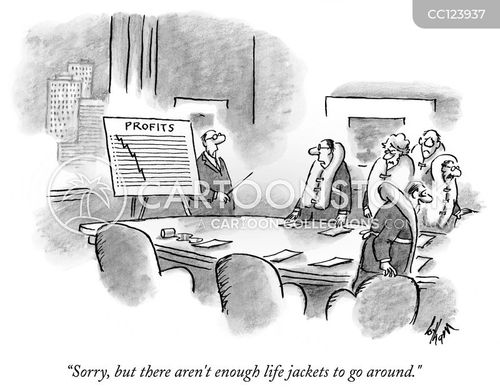
Cartoon – Sorry, but there aren’t enough Life Jackets to go around
https://www.axios.com/coronavirus-west-virginia-first-case-ac32ce6d-5523-4310-a219-7d1d1dcb6b44.html
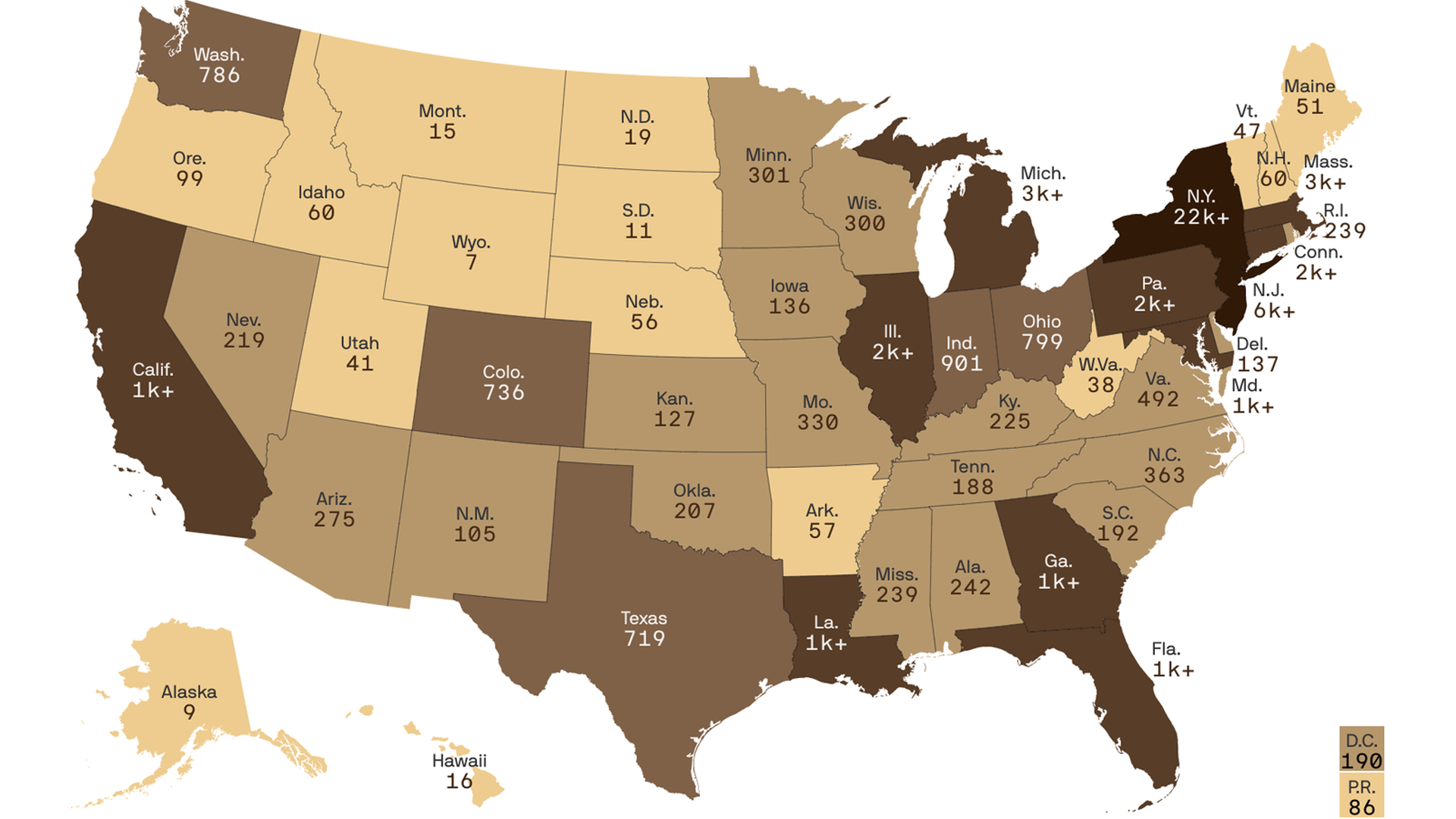
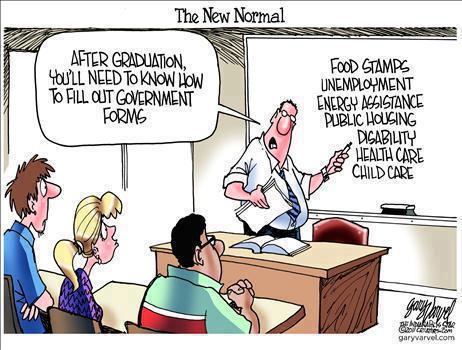
Former FDA commissioner Scott Gottlieb said on Sunday that despite widespread mitigation efforts, the coronavirus has exhibited “persistent spread” that could mean a “new normal” of 30,000 new cases and over 1,000 deaths a day through the summer.
The big picture: COVID-19 has killed over 66,000 Americans and infected over 1.1 million others in less than three months since the first known death in the U.S., Johns Hopkins data shows.
By the numbers: As states try to mitigate the spread of the coronavirus while easing restrictions, unemployment filings in the U.S. topped 30 million in six weeks, and the number of unemployed could be higher than the weekly figures suggest.
Catch up quick: The number of deaths in states hit hardest by the coronavirus is well above the normal range, according the CDC.
Lockdown measures: Dozens of states have outlined plans to ease coronavirus restrictions, but the pandemic’s impact on our daily lives, politics, cities and health care will outlast stay-at-home orders.
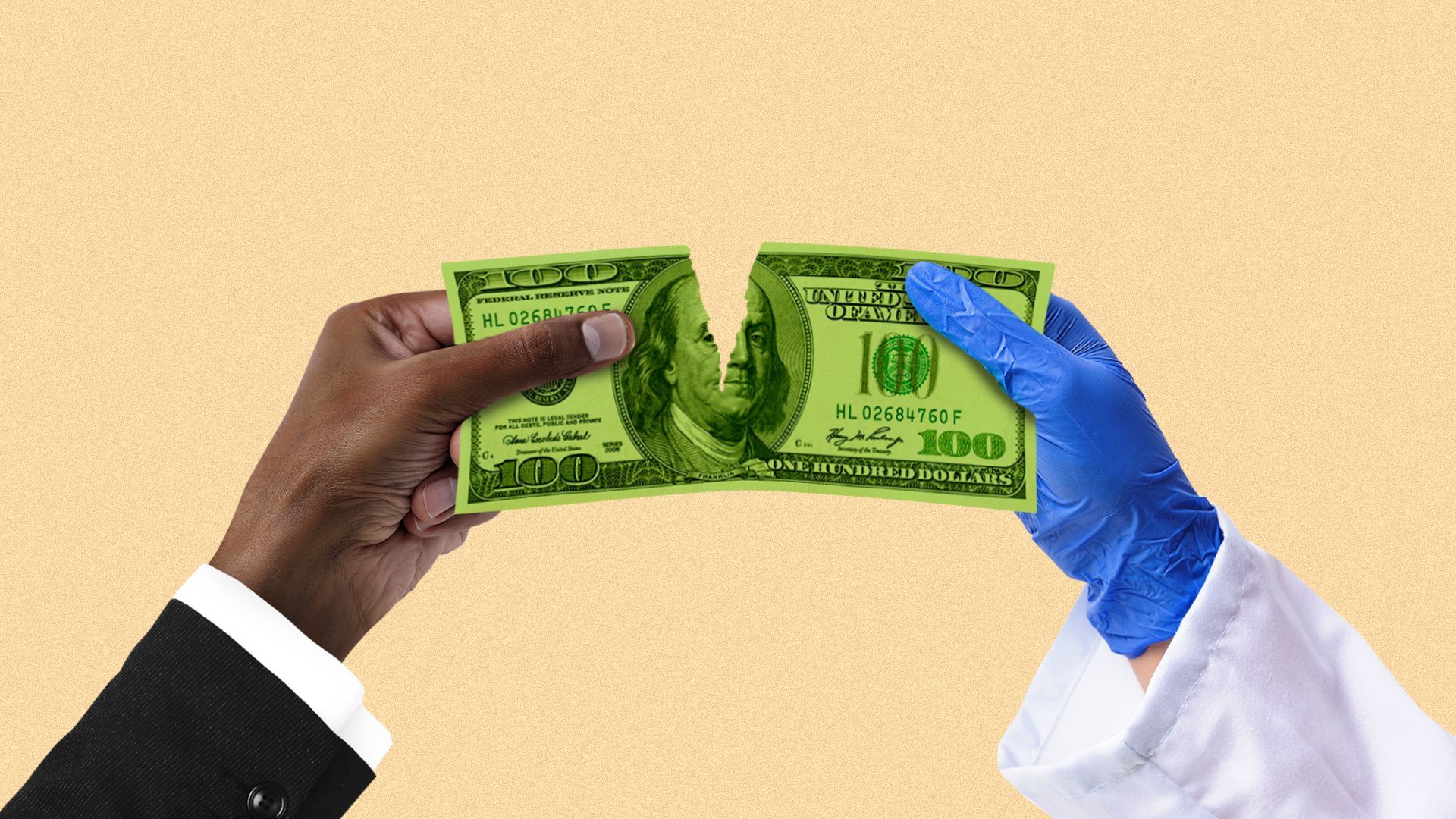
Several large employer groups this week refused to sign on to funding requests they consider a “handout” for hospitals and insurers, according to three people close to the process.
The big picture: Coronavirus spending bills are sharpening tensions between the employers that fund a significant portion of the country’s health care system and the hospitals, doctors and insurers that operate it, Bob reports.
Driving the news: The industry’s most recent request — written primarily by the large hospital and health insurance lobbying groups — focused on a few items for the next coronavirus legislation:
Between the lines: Employers know they get charged a lot more for health care services compared with public insurers, but many weren’t keen about urging Congress to “set up a government program to pay commercial reimbursements,” said an executive at a trade group that represents large corporations.
The other side: Several health care groups that signed the letter dismissed the idea of any disagreement with employers.
As the novel coronavirus pandemic brought business to a halt, the pain rippled outward, blowing up sector after sector. According to a detailed analysis of unemployment claims, no industry was left untouched.
After that first chaotic week of lockdowns mid-March, as officials scrambled to slow the spread of the deadliest pandemic in more than a century, restaurants and theaters saw job losses slow while losses in other sectors, such as construction and supply-chain work, accelerated. Now, it appears the economic upheaval is hitting professional and public-sector jobs that some once regarded as safe.
The Labor Department doesn’t release jobless claims by industry. So, building on the work of economist Ben Zipperer and his colleagues at the Economic Policy Institute, we analyzed industry-specific new unemployment-benefit claims from 14 states that publish them. (For a full list, see the charts below.)
For that, we need to focus in on the weekly changes in jobless claims to distinguish between industries where claims are falling and those where claims are steady or increasing. The data can also help us estimate how the labor market will change in coming months.
(Highest week-to-week change included: accommodation and food services; arts entertainment and recreation; hairdressers, auto mechanics and laundry workers)
The first week of closures slammed headfirst into industries that require the most face-to-face customer contact — America’s hospitality sector. More than 7 percent of all restaurant, hotel and bar workers filed for unemployment in this first week alone.
For public officials looking to enforce social distancing, bars, hotels and movie theaters were obvious targets: They’re discretionary spending and require significant human interaction. Another category, which the government calls “other services” but is primarily made up of hairdressers, auto mechanics and laundry workers, also suffered swift and significant losses.
The number of newly unemployed filers in all these high-contact industries fell off in subsequent weeks, but they remain the biggest casualties of the crisis. And unemployment claims probably understate the pain of lower-earning Americans. Low-wage workers often don’t qualify for benefits because they haven’t spent enough time on the job, or aren’t being paid enough, Zipperer said.
A survey released Tuesday by Zipperer and his colleague Elise Gould implies unemployment numbers may be significantly worse than government statistics show. For every 10 people who successfully applied for unemployment benefits during the crisis, they show, another three or four couldn’t get through the overloaded system, and two more didn’t even apply because the system is too difficult.
(Highest week-to-week change included: manufacturing; construction; retail)
By the second week, the shutdown moved from businesses where the primary danger is interacting with customers to those, like construction and manufacturing, that require in-person interaction with large crews of colleagues.
On March 26, for example, Spokane, Wash.-area custom-cabinet maker Huntwood Industries, laid off around 500 employees, according to Thomas Clouse of the Spokesman-Review. As a manufacturer whose sales depend on the construction industry, it was hit doubly hard by the shutdowns.
“It is a scary time,” Amy Ohms, 37, told Clouse. “It’s kind of unfair. I think construction is essential. There is a lot of uncertainty.”
Manufacturers were among the first publicly traded companies to note travel and supply-chain risks related to the coronavirus outbreak in China in financial filings, according to a separate analysis by Oxford researchers Fabian Stephany and Fabian Braesemann and collaborators in Berlin. By March, manufacturers were noting domestic production issues.
Their analysis also shows that, in the middle of March, concern about the coronavirus and its disease, covid-19, from retail corporations eclipsed that of manufacturers. Indeed, retail struggled mightily in the second week of the crisis. More workers were told to stay home, and folks realized foot traffic was often incompatible with social distancing.
The retail sector wasn’t hit as quickly or as forcefully as food services or entertainment, presumably because the sector includes grocery stores and others who employ workers who were deemed essential.
(Highest week-to-week change included: wholesale trade; retail trade; administrative and waste management)
In the third week, the pain worked its way up the supply chain, as wholesale trade — a sector that includes some sales representatives, truck drivers and freight laborers — got slammed.
In theory, the lockdowns created near-perfect trucking conditions: traffic vanished, diesel keeps getting cheaper and the roads are safer than they have been in decades. Only one problem: There’s not much to haul right now.
Don Hayden, president of Louisville trucking firm M&M Cartage, feared he would have to lay off about 70 percent of his 400 employees — drivers, mechanics and office staff — in early April. Orders from his customers in heavy manufacturing evaporated.
But, just in time, he got a Payroll Protection Program loan through his local bank. He was shocked at how rapidly his loan was approved and the money arrived, and he said the Treasury Department had done an outstanding job.
“We’re good through May and into June,” he said. “We have a good workforce. We’re proud of them. We sure would like to retain them.”
At this point in the crisis, the focus shifted from huge, industry-eviscerating swings in jobless numbers to gradual weekly trends that help us guess where the jobless claims will settle in the weeks and months to come.
As industries fall like dominoes, policymakers need to realize the damage isn’t contained to a few specific sectors, said University of Tennessee economist Marianne Wanamaker, a former member of Trump’s Council of Economic Advisers.
She said there may be a temptation to extend benefits for difficult-to-reopen industries such as food service and hospitality, but “it doesn’t comport with the data because the damage is so widespread. It’s not fair to say, ‘Hotel and restaurant workers, you get these really generous packages and everybody else has to go back to work.’ ”
(Highest week-to-week change included: management; finance and insurance; public administration)
White-collar industries have been shedding jobs since mid-March, albeit at a much lower rate than lower-income sectors. But as losses in low-income sectors subsided, white-collar jobless claims stayed flat or even intensified. By week four, categories that contain managers, bookkeepers, insurance agents and bank tellers saw some of the worst weekly trends of any sector.
On April 9, the online review site Yelp laid off 1,000 workers and furloughed 1,100 more (about a third of its workforce) as traffic on the site plunged while businesses were locked down.
“The physical distancing measures and shelter-in-place orders, while critical to flatten the curve, have dealt a devastating blow to the local businesses that are core to our mission,” CEO Jeremy Stoppelman wrote at the time.
Jane Oates, president of the employment-focused nonprofit organization WorkingNation, used to oversee the Labor Department wing that coordinates unemployment claims and training. “The big difference between coronavirus and the Great Recession is that this has completely stopped the economy across so many sectors,” she said.
During the Great Recession, she and her team had the luxury of flooding support into areas that were being hit hardest in a particular week or month. They went from state to state and industry to industry, putting out fires as they arose.
The Labor Department can’t address individual problems like that during the coronavirus recession, she said, because everybody’s getting shellacked simultaneously.
(Highest week-to-week change included: oil, gas and mining; utilities; public administration)
In the week ending April 18, the most recent for which we have data, we can no longer avoid one of the most ominous trends in the entire analysis: a rise in public-sector layoffs. Utilities, public administration and education services — all of which have close implicit or explicit ties to state and local government, were among the worst-faring sectors on a weekly basis.
To stem the tide of what could be millions of job losses and furloughs, the National League of Cities is pushing for a $250 billion bailout of cities throughout the country, colleague Tony Romm reports.
In Broomfield, Colo., a Denver-area suburb of about 70,000 residents, 235 city and county employees were furloughed on April 22, according to Jennifer Rios in the Broomfield Enterprise.
“The impact of the COVID-19 coronavirus is more significant than any of us could have ever expected for our well-being, as well as our municipal financial stability,” Rios reports that officials wrote in a letter to furloughed employees.“
State and local governments are typically required to balance their budgets. Now that they’re staring down the barrel of a huge tax-revenue shortfall, “these revenue losses are going to cause government budgets to fall and they’re going to lay people off,” Zipperer said.
“You’re seeing the beginnings of a big contraction in the public sector,” he said. “That’s going to be the next huge thing.”
The public sector used to be the bulwark that kept the economy going while the private sector pulled back during a recession, Zipperer said. “Over the last couple of recessions, the public sector hasn’t played that traditional role,” Zipperer said. “As a result, we’ve seen steeper recessions and slower recoveries.”

With an eye on replacing the Affordable Care Act, the Trump administration took one particularly critical action in October 2017. It discontinued cost-sharing reduction subsidy payments to health insurers participating in the ACA marketplaces.
But the response to those cuts was likely not what President Trump expected. State insurance commissioners and insurers used them to make marketplace health plans more affordable.
Premium decreases were large – so large that 4.2 million potential enrollees had the option to purchase a marketplace plan for free in 2019.
These changes made us wonder: Did President Trump’s effort to sabotage the Affordable Care Act backfire? I’m a health economist at the University of Pittsburgh. Along with my colleague David Anderson, a policy expert on the Affordable Care Act, we tried to answer that question shortly after the payment cuts. We discovered that more than 200,000 people, using the Healthcare.gov platform in 2019, gained insurance in 37 states due to the Trump administration’s actions. This finding may even be more important now as massive unemployment from the coronavirus pandemic leads to huge losses of employer-based insurance coverage – and ultimately more people enrolling in the marketplaces.
People who sign up for a plan in the Health Insurance Marketplaces may qualify for two types of subsidies. The first type is the advanced premium tax credit, which reduces the premium paid by the enrollee; lower-income enrollees receive larger premium tax credits. The second type is the cost-sharing reduction subsidy, which decrease deductibles and co-pays.
Premium tax credits may be applied to any marketplace plan, though they’re based on silver plan premiums, which cover 70% of an average enrollee’s health care expenses. Cost-sharing reduction subsidies can only be applied to silver plans; that means qualifying enrollees in less generous bronze plans and more generous gold plans don’t benefit from reduced deductibles and co-pays provided by these subsidies.
When Trump ended those payments, marketplace insurers were suddenly in a bind. They are legally required to provide cost-sharing reduction subsidies to enrollees whether or not the federal government was paying. The expectation: marketplace insurers, forced to make up the lost revenue, would either increase premiums or exit the marketplaces altogether. And Obamacare would implode.
But that’s not what happened. Why did the plans become more affordable? Insurers increased only the premiums of their silver plans. That approach – known as silver loading – did two things. First, the cost of silver plan premiums rose drastically. Second, premium tax credits increased along with premiums. So those enrollees receiving premium tax credits saw no increase in the premiums of their silver plans.
At the same time, non-silver plans became cheaper. Many bronze plans, already costing less, became so cheap they were free after applying premium tax credit subsidies. Lower-income enrollees benefited the most.
In 2019, 4.2 million enrollees could enter the marketplace for free through a zero-dollar bronze plan, largely due to silver loading. Without those zero-premium plans, our analysis showed more than 200,000 lower-income marketplace enrollees would have gone uninsured.
Another 60,000 would have gained insurance had California and New Jersey eliminated regulations that prohibited zero premium plans — and if Indiana, Mississippi and West Virginia had adopted silver loading. Many more likely got coverage in states not included in our study.
All this is clearly not what the Trump administration had in mind when it cut subsidy payments. Other changes to the marketplaces probably masked some coverage gains that occurred. Notably, cuts in the public outreach for Healthcare.gov, along with the elimination of the individual mandate, decreased enrollment. But the popularity of zero premium plans resulting from silver loading likely stopped much of the damage – and Trump’s attempt to destabilize the marketplaces.
Now states can take advantage of the attractiveness of zero premium plans to increase health coverage through the marketplaces. One way: States requiring marketplace insurers to provide extra benefits – again, like California and New Jersey – can pick up the small tab for those extras. For example, California enrollees pay for abortion coverage through a one-dollar monthly premium surcharge. This is not covered by premium tax credits. By shifting premiums from even one dollar to zero dollars, our estimates indicate enrollment would increase by approximately 13% among those with lower incomes.
Another way: States without silver loading should adopt it. This is not a partisan issue. Conservative states – or at least, GOP-controlled states like Alabama, Wyoming and Florida – have silver-loaded. State governments pay nothing, revenue for insurers is increased, and most critically, lower-income Americans are provided with affordable health insurance. Put simply, there’s no downside for states.
The Trump administration is prevented from restricting silver loading through 2021. However, a forthcoming Supreme Court case, Texas v. Azar, may yet repeal the entire ACA. If the court’s conservative majority rules in favor of the GOP plaintiffs, they will put affordable health insurance out of reach for the 11.4 million Americans that purchased health insurance in the marketplaces. They will also eliminate Medicaid coverage for an additional 16.9 million Americans.
If the case succeeds, the uninsured rate could easily surpass levels not seen since the height of the Great Recession. And for millions of Americans, access to health insurance – desperately needed, particularly during the COVID-19 pandemic – will be eliminated.
On the heels of worse-than-anticipated first-quarter GDP data, investors got additional economic data Thursday to reflect the ongoing damage being done to the U.S. economy as a result of the COVID-19 pandemic.
The U.S. Labor Department released its weekly jobless claims figures Thursday morning, and another 3.839 million Americans filed for unemployment benefits during the week ending April 25. Economists were predicting 3.5 million claims for the week, and the prior week’s figure was revised higher to 4.44 million from 4.43 million. In just the previous six weeks, more than 30 million Americans have filed unemployment insurance claims.
Continuing claims, which lags initial jobless claims data by one week, totaled 17.99 million for the week ending April 18. The prior week’s record 15.98 million continuing claims was revised lower to 15.82 million.
“This is the fourth consecutive slowing in the pace of new jobless claims, but it is still horrible and underlines the severe economic consequences of the Covid-19 containment measures,” ING economist James Knightley wrote in a note Thursday.
“The re-opening of some states, including Georgia, Tennessee, South Carolina and Florida, appear to have gone fairly slowly. Consumers remain reluctant to go shopping or visit a restaurant due to lingering COVID-19 fears, while the social distancing restrictions placed on the number of customers allowed in restaurants do not make it economically justifiable for some to open. Evidence so far suggests very little chance of a V-shaped recovery, meaning that unemployment is unlikely to come down anywhere near as quickly as it has been going up,” Knightley added.
Certain states got hit harder than others last week as massive backlogs continued to pile up, and states that implemented shelter-in-place orders later than others saw an increase in claims. For the week ending April 25, Florida saw the highest number of initial jobless claims at an estimated 432,000 on an unadjusted basis, from 507,000 in the prior week. California reported 328,000, down from 528,000 in the previous week. Georgia had an estimated 265,000 and Texas reported 254,000.
While consensus economists anticipate weekly jobless claims will be in the millions in the near term, a continued steady decline is largely expected going forward.
“We expect initial jobless claims to continue to decline on a weekly basis. Many workers affected by closures of nonessential businesses have likely already filed for benefits at this point,” Nomura economist Lewis Alexander wrote in a note April 27. “In addition, the strong demand for Paycheck Protection Program (PPP) loans, part of the CARES Act passed on 27 March, suggests some room for labor market stabilization.”
However, Barclays warned that some recent data indicated that the decline in weekly claims could actually be slower than previously estimated.
“NYC 311 calls in the week ending April 24 were running about 30% higher than a week earlier and support our change in forecast,” Barclays economist Blerina Uruci wrote in a note Wednesday. “In particular, we find it concerning that after declining steadily in recent weeks, the number of calls related to unemployment rose again during the week ending April 24.”
The firm increased its estimate for weekly jobless claims to 4 million from the previously estimated 3.25 million for the week ending April 25. Bank of America also boosted its estimate for claims to 4.1 million from the previously forecast 3.5 million claims.
“Scanning through the local news, we were able to locate information about ten states + DC. We found that claims declined only 2.5% week-to-week NSA [not seasonally adjusted],” Bank of America said in a note Wednesday.
COVID-19 cases recently topped 3.2 million worldwide, according to Johns Hopkins University data. There were more than 1 million cases in the U.S. and 60,000 deaths, as of Thursday morning.
As Iowa prepares to partially reopen on Friday, the state has told furloughed workers that they will lose their unemployment benefits if they refuse to return to work.
The Des Moines Register reported that businesses like restaurants, bars, retail stores, and fitness centers would be allowed to reopen at half capacity starting on May 1. Gov. Kim Reynolds said the 77 reopening counties either have no cases or are on a downward trend.
Iowa Workforce Development, a state agency that provides employment services for individual workers, said an employee’s refusal return to work out of fear would be considered a “voluntary quit” — which would mean they could no longer receive unemployment benefits. The announcement applies to workers across the state.
Ryan West, the deputy director of Iowa Workforce Development, told Radio Iowa that there were some exceptions, such as workers diagnosed with COVID-19.
The Iowa Workforce Development website prompts employers to fill out what it calls a Job Offer Decline Form for employees who refuse to return to work. The governor has said that opting not to go back to work could disqualify employees from future unemployment benefits.
Business Insider’s Andy Kiersz reported that 232,913 Iowans filed for unemployment between March 15 and April 18, which is 13.5% of the state’s labor force.
Last week, seven epidemiology and biostatistics professors from the University of Iowa advised the governor not to loosen social-distancing restrictions, KWWL reported. They wrote a research paper for the governor after they were commissioned by the Iowa Department of Public Health.
“We observe a huge range of possible outcomes, from relatively low fatalities to catastrophic loss of life,” the paper said.
The scientists said there was still “considerable uncertainty” over how many deaths the state may eventually have; the projections range from 150 to over 10,000 deaths.
“We have found evidence of a slowdown in infection and mortality rates due to social distancing policies, but not that a peak has been reached,” the paper said. The professors said that did not mean measures should be eased: “Therefore, prevention measures should remain in place. Without such measures being continued, a second wave of infections is likely.”
https://www.axios.com/coronavirus-west-virginia-first-case-ac32ce6d-5523-4310-a219-7d1d1dcb6b44.html

The pandemic is a long way from over, and its impact on our daily lives, information ecosystem, politics, cities and health care will last even longer.
The big picture: The novel coronavirus has infected more than 939,000 people and killed over 54,000 in the U.S., Johns Hopkins data shows. More than 105,000 Americans have recovered from the virus as of Sunday.
Lockdown measures: Demonstrators gathered in Florida, Texas and Louisiana Saturday to protest stay-at-home orders designed to protect against the spread of COVID-19, following a week of similar rallies across the U.S.
Catch up quick: Deborah Birx said Sunday that it “bothers” her that the news cycle is still focused on Trump’s comments about disinfectants possibly treating coronavirus, arguing that “we’re missing the bigger pieces” about how Americans can defeat the virus.

The coronavirus pandemic is shaking bedrock assumptions about U.S. exceptionalism. This is perhaps the first global crisis in more than a century where no one is even looking for Washington to lead.
As images of America’s overwhelmed hospital wards and snaking jobless lines have flickered across the world, people on the European side of the Atlantic are looking at the richest and most powerful nation in the world with disbelief.
“When people see these pictures of New York City they say, ‘How can this happen? How is this possible?’” said Henrik Enderlein, president of the Berlin-based Hertie School, a university focused on public policy. “We are all stunned. Look at the jobless lines. Twenty-two million,” he added.
“I feel a desperate sadness,” said Timothy Garton Ash, a professor of European history at Oxford University and a lifelong and ardent Atlanticist.
The pandemic sweeping the globe has done more than take lives and livelihoods from New Delhi to New York. It is shaking fundamental assumptions about American exceptionalism — the special role the United States played for decades after World War II as the reach of its values and power made it a global leader and example to the world.
Today it is leading in a different way: More than 840,000 Americans have been diagnosed with Covid-19 and at least 46,784 have died from it, more than anywhere else in the world.
As the calamity unfolds, President Trump and state governors are not only arguing over what to do, but also over who has the authority to do it. Mr. Trump has fomented protests against the safety measures urged by scientific advisers, misrepresented facts about the virus and the government response nearly daily, and this week used the virus to cut off the issuing of green cards to people seeking to emigrate to the United States.
“America has not done badly, it has done exceptionally badly,” said Dominique Moïsi, a political scientist and senior adviser at the Paris-based Institut Montaigne.
The pandemic has exposed the strengths and weaknesses of just about every society, Mr. Moïsi noted. It has demonstrated the strength of, and suppression of information by, an authoritarian Chinese state as it imposed a lockdown in the city of Wuhan. It has shown the value of Germany’s deep well of public trust and collective spirit, even as it has underscored the country’s reluctance to step up forcefully and lead Europe.
And in the United States, it has exposed two great weaknesses that, in the eyes of many Europeans, have compounded one another: the erratic leadership of Mr. Trump, who has devalued expertise and often refused to follow the advice of his scientific advisers, and the absence of a robust public health care system and social safety net.
“America prepared for the wrong kind of war,” Mr. Moïsi said. “It prepared for a new 9/11, but instead a virus came.”
“It raises the question: Has America become the wrong kind of power with the wrong kind of priorities?” he asked.
Ever since Mr. Trump moved into the White House and turned America First into his administration’s guiding mantra, Europeans have had to get used to the president’s casual willingness to risk decades-old alliances and rip up international agreements. Early on, he called NATO “obsolete” and withdrew U.S. support from the Paris climate agreement and the Iran nuclear deal.
But this is perhaps the first global crisis in more than a century where no one is even looking to the United States for leadership.
In Berlin, Germany’s foreign minister, Heiko Maas, has said as much.
China took “very authoritarian measures, while in the U.S., the virus was played down for a long time,” Mr. Maas recently told Der Spiegel magazine.
“These are two extremes, neither of which can be a model for Europe,” Mr. Maas said.
America once told a story of hope, and not just to Americans. West Germans like Mr. Maas, who grew up on the front line of the Cold War, knew that story by heart, and like many others in the world, believed it.
But nearly three decades later, America’s story is in trouble.
The country that helped defeat fascism in Europe 75 years ago next month, and defended democracy on the continent in the decades that followed, is doing a worse job of protecting its own citizens than many autocracies and democracies.
There is a special irony: Germany and South Korea, both products of enlightened postwar American leadership, have become potent examples of best practices in the coronavirus crisis.
But critics now see America failing not only to lead the world’s response, but letting down its own people as well.
“There is not only no global leadership, there is no national and no federal leadership in the United States,” said Ricardo Hausmann, director of the Growth Lab at Harvard’s Center for International Development. “In some sense this is the failure of leadership of the U.S. in the U.S.”
Of course, some countries in Europe have also been overwhelmed by the virus, with the number of dead from Covid-19 much higher as a percentage of the population in Italy, Spain and France than in the United States. But they were struck sooner and had less time to prepare and react.
The contrast between how the United States and Germany responded to the virus is particularly striking.
While Chancellor Angela Merkel has been criticized for not taking a forceful enough leadership role in Europe, Germany is being praised for a near-textbook response to the pandemic, at least by Western standards. That is thanks to a robust public health care system, but also a strategy of mass testing and trusted and effective political leadership.
Ms. Merkel has done what Mr. Trump has not. She has been clear and honest about the risks with voters and swift in her response. She has rallied all 16 state governors behind her. A trained physicist, she has followed scientific advice and learned from best practice elsewhere.
Not long ago, Ms. Merkel was considered a spent force, having announced that this would be her last term. Now her approval ratings are at 80 percent.
“She has the mind of a scientist and the heart of a pastor’s daughter,” Mr. Garton Ash said.
Mr. Trump, in a hurry to restart the economy in an election year, has appointed a panel of business executives to chart a course out of the lockdown.
Ms. Merkel, like everyone, would like to find a way out, too, but this week she warned Germans to remain cautious. She is listening to the advice of a multidisciplinary panel of 26 academics from Germany’s national academy of science. The panel includes not just medical experts and economists but also behavioral psychologists, education experts, sociologists, philosophers and constitutional experts.
“You need a holistic approach to this crisis,” said Gerald Haug, the academy’s president, who chairs the German panel. “Our politicians get that.”
A climatologist, Mr. Haug used to do research at Columbia University in New York.
The United States has some of the world’s best and brightest minds in science, he said. “The difference is, they’re not being listened to.”
“It’s a tragedy,” he added.
Some cautioned that the final history of how countries fare after the pandemic is still a long way from being written.
A pandemic is a very specific kind of stress test for political systems, said Mr. Garton Ash, the history professor. The military balance of power has not shifted at all. The United States remains the world’s largest economy. And it was entirely unclear what global region would be best equipped to kick-start growth after a deep recession.
“All of our economies are going to face a terrible test,” he said. “No one knows who will come out stronger at the end.”
Benjamin Haddad, a French researcher at the Atlantic Council, wrote that while the pandemic was testing U.S. leadership, it is “too soon to tell” if it would do long-term damage.
“It is possible that the United States will resort to unexpected resources, and at the same time find a form of national unity in its foreign policy regarding the strategic rivalry with China, which it has been lacking until now,” Mr. Haddad wrote.
There is another wild card in the short term, Mr. Moïsi pointed out. The United States has an election in November. That, and the aftermath of the deepest economic crisis since the 1930s, might also affect the course of history.
The Great Depression gave rise to America’s New Deal. Maybe the coronavirus will lead the United States to embrace a stronger public safety net and develop a national consensus for more accessible health care, Mr. Moïsi suggested.
“Europe’s social democratic systems are not only more human, they leave us better prepared and fit to deal with a crisis like this than the more brutal capitalistic system in the United States,” Mr. Moïsi said.
The current crisis, some fear, could act like an accelerator of history, speeding up a decline in influence of both the United States and Europe.
“Sometime in 2021 we come out of this crisis and we will be in 2030,” said Mr. Moïsi. “There will be more Asia in the world and less West.”
Mr. Garton Ash said that the United States should take an urgent warning from a long line of empires that rose and fell.
“To a historian it’s nothing new, that’s what happens,” said Mr. Garton Ash. “It’s a very familiar story in world history that after a certain amount of time a power declines.”
“You accumulate problems, and because you’re such a strong player, you can carry these dysfunctionalities for a long time,” he said. “Until something happens and you can’t anymore.”

 HENRY KOTULA