Coronavirus Dashboard

https://www.axios.com/coronavirus-latest-news-quick-highlights-57a186a3-7547-45bf-852a-83019849d8d5.html

Coronavirus dashboard: Catch up fast - Axios


  1. Global: Total confirmed cases as of 9 a.m. ET: 9,635,935 — Total deaths: 489,922 — Total recoveries — 4,861,715 — Map.
  2. U.S.: Total confirmed cases as of 9 a.m ET: 2,422,312 — Total deaths: 124,415 — Total recoveries: 663,562 — Total tested: 29,207,820 — Map.
  3. Public health: America’s workers still aren’t protected from the coronavirus — Gilead says coronavirus drug should likely cost no more than $2,800.
  4. White House: Trump administration asks Supreme Court to overturn ACA during pandemic.
  5. Sports: Universities cut sports teams, as they struggle with coronavirus fallout.


The U.S. divide on coronavirus masks

https://www.axios.com/political-divide-coronavirus-masks-1053d5bd-deb3-4cf4-9570-0ba492134f3e.html

Politics, not public health, drive Americans' attitudes toward ...

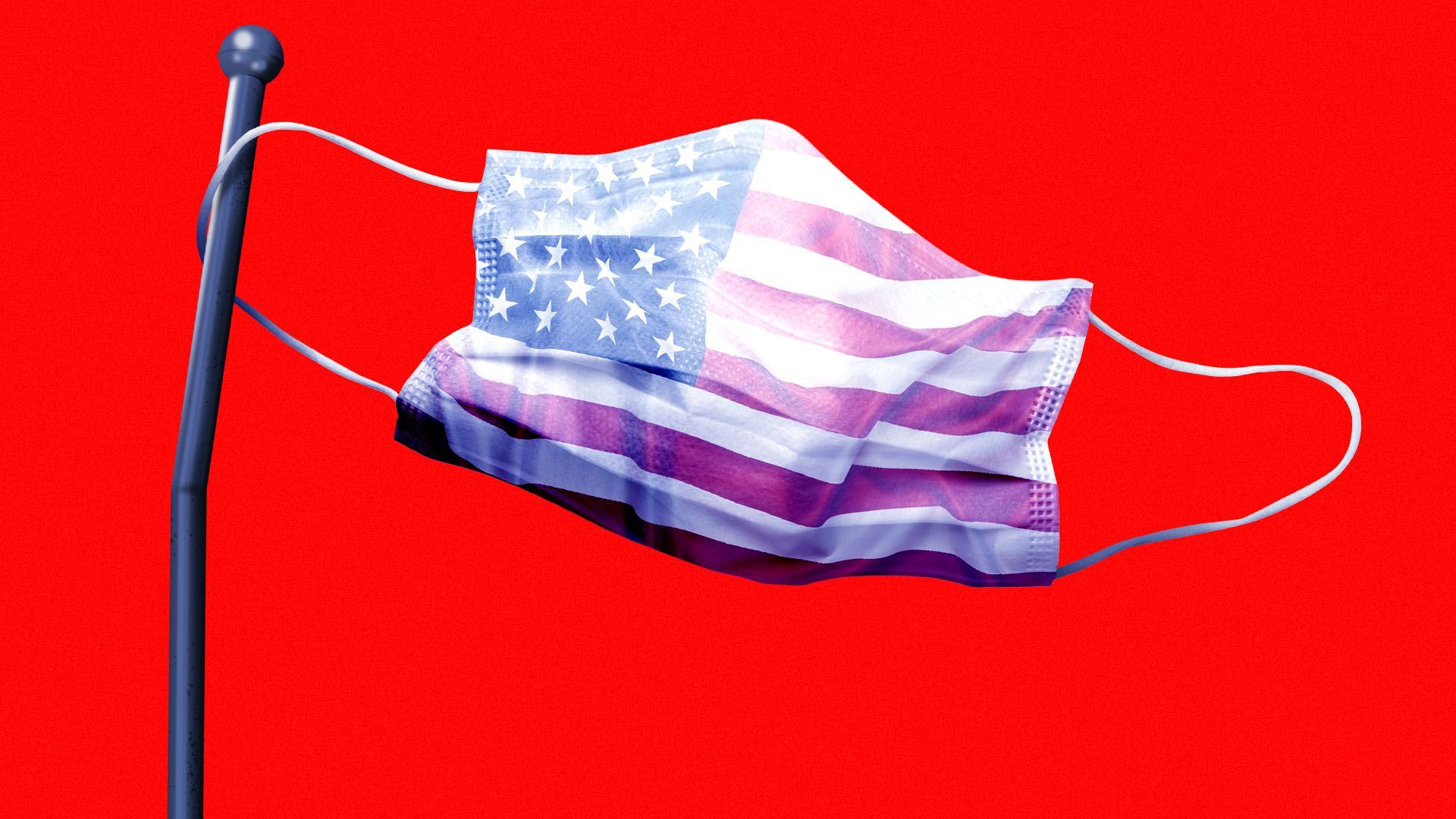
Mask-wearing has become the latest partisan division in an increasingly politically divided pandemic.

Why it matters: It’s becoming increasingly clear that wearing even a basic cloth mask is one of the most effective ways to prevent the spread of COVID-19. But whether or not people are willing to wear one has less to do with the risk of the pandemic than their political affiliation.

By the numbers: Results from months of the Axios-Ipsos coronavirus polls show a clear and growing political divide between Democrats and Republicans on mask-wearing habits.

  • Nationally, the percentage of Democrats who reported wearing a mask all the time when leaving home rose from 49% between April 10 and May 4 to 65% between May 8 and June 22.
  • During the same time period, the percentage of Republicans who reported constant mask-wearing rose from 29% to just 35%.

Context: The political divide Americans are reporting on mask use echoes one seen within nearly all levels of the government.

  • President Trump has not been seen to wear a mask, and he told Axios last week that attendees at his Tulsa campaign event on June 20 should “do what they want” on masks, which were not required at the rally.
  • Governors in many red states like Nebraska have refused to mandate facial masks in public, even as cases have begun to rise in recent weeks. At the same time, leaders in blue states — especially those that grappled with large outbreaks of COVID-19 — have urged residents to wear masks, with California Gov. Gavin Newsom mandating their use last week as cases in the state passed 4,000 a day.
  • The situation is even more divided at the local level, with leaders of red towns in blue states pushing back against mask mandates, and vice versa.

Flashback: Some of the blame for the divide can be traced back to muddled public health messaging on mask use in the early stages of the pandemic, when Americans were urged not to go out and buy masks in bulk because of concerns that there wasn’t enough personal protective equipment for front-line health care workers.

  • Those fears were real, as government virus expert Anthony Fauci pointed out in congressional testimony on Tuesday. And public health officials worried that pushing masks would inadvertently encourage Americans to continue going out in public at a moment when lockdowns demanded they stay inside.
  • Like the divide among experts on whether mass protests would increase coronavirus cases, just the perception that health advice might be based on politics rather than science gives cover to those who would forego masks, especially since the outbreak itself initially seemed like a blue state problem.

Health experts now know that cloth masks are most effective not so much at protecting individuals from infection as protecting the community from infected individuals. But that makes masks as much about social signaling as they are about public health.

  • Conservatives who prize individual autonomy over social responsibility experience “a massive pushback of psychological resistance” when presented with mask mandates, says Steven Taylor, the author of “The Psychology of Pandemics.”
  • That reaction is reinforced “if leaders like Trump downplay the significance of COVID-19 or if they won’t wear masks,” says Taylor. As a result, wearing a mask in conservative communities means visibly going against public opinion, while the opposite is true in communities where mask use is common.
  • The Axios-Ipsos data reflects this reality, showing that while Republicans in blue states use masks less than Democrats, they wear them at higher rates than Republicans in red states, just as Democrats in red states use masks at lower rates than Democrats in blue states.

What to watch: The one factor that seems capable of breaking the political deadlock is the outbreak itself. As cases have skyrocketed in red states like Arizona recently, there’s been a significant increase in Google searches for masks.


America’s workers still aren’t protected from the coronavirus

https://www.axios.com/americas-workers-vulnerable-coronavirus-944e3451-4458-4f1d-83d2-c86a1beb1117.html

America's workers still aren't protected from the coronavirus - Axios

Essential workers have borne the brunt of the coronavirus pandemic for months, but the U.S. is still doing relatively little to protect them.

Why it matters: With no end to the pandemic in sight, America’s frontline workers still must choose between risking their health and losing their source of income.

Driving the news: The Trump administration said this week that health insurers aren’t required to cover coronavirus diagnostic tests performed as part of workplace safety or public health surveillance efforts.

  • It didn’t say who is supposed to pay for these tests. If employers are stuck footing the bill, that makes the testing less likely to happen.

The big picture: There’s been no national effort or initiative to protect essential workers, and America is still failing to implement basic public health measures as new cases skyrocket.

  • Masks have become a political flashpoint and aren’t required in many of the states that are emerging coronavirus hotspots.
  • That means essential workers go to work each day without any guarantee that the people they’re interacting with will take one of the most basic and effective steps to prevent transmission of the virus.
  • No one is even talking about mass distribution of personal protective equipment beyond health care workers. And even some health care workers — particularly those who work in nursing homes — don’t have the protective gear that they need.

More broadly, the financial incentives for frontline workers, particularly those who are low-income, to keep working make it nearly impossible for them to avoid health risks.

  • At least 69 million American workers are potentially ineligible for the emergency paid sick leave benefits that Congress passed earlier this year, per the Kaiser Family Foundation.
  • An estimated 25-30 million people — particularly lower-wage workers in service industries — are unable to work from home but also face a high risk of severe infection, KFF’s Drew Altman wrote earlier this week.

What we’re watching: The line between essential workers and those who are required to return to the office by their employer has become blurry, and millions more Americans are facing dilemmas similar to those faced by grocers and bus drivers.

  • The sickest — and thus most vulnerable — Americans may feel the most pressure to return to work, as that’s often where they get their health insurance, the NYT points out.
  • Nearly a quarter of adult workers are vulnerable to severe coronavirus infections, per KFF.

The bottom line: Essential workers and their families will continue to feel the impact of America’s coronavirus failures most acutely.

Go deeper: “Disposable workers” doing essential jobs


Outsourcing A Hospital Turnaround And The Team Involved

https://www.healthtechs3.com/outsourcing-a-hospital-turnaround-and-the-team-involved/

Outsourcing A Hospital Turnaround and The Team Involved - HealthTechS3

Hospitals are constantly faced with challenges that require them to reassess how they deliver care to their communities.  Continuous improvement is necessary as expense inflation consistently outpaces reimbursement gains.  However, more fundamental issues threaten hospital fiscal viability such as payor mix deterioration, population or market share declines, and utilization changes. Amplify this environment with a difficult EMR installation and a “perfect storm” creates a fiscal crisis that necessitates a turnaround.

If covenants are breached, bond agreements often require an external and independent consulting firm that is engaged to help create and oversee the implementation of a turnaround plan.  Otherwise, a CEO must make a value judgment on whether to outsource the turnaround balancing cost considerations with an honest assessment of (1) their management team’s bandwidth, and (2) ability to prepare and execute a turnaround.

There are multiple models for outsourcing a turnaround.  In a complete outsourcing, an engagement letter with the “performance improvement” consulting firm would include an assessment phase and the preparation of a comprehensive plan that covers all areas of operations followed by implementation support services.  The firm may require an on-site presence of one year or more to assess, validate, and assist in the implementation of recommended interventions.  This can be effective, but the fees can easily reach seven figures even for modest community hospitals.  In addition, even in a complete outsourcing there is still a major demand on the time of senior leadership.  As a result, management sometimes chooses to limit the scope of a performance improvement engagement, which results in a partial outsource.  The limitation may be to only outsource the plan development in the form of a report.  This would detail the operational interventions and the implementation steps, but it would leave the heavy lifting of implementation to existing leadership.   Alternatively, the scope may be limited by excluding certain areas of review.  While there may be valid reasons for the latter approach, limiting the areas of review can be counterproductive to a turnaround plan because many issues are systemic such as patient throughput or revenue cycle.  Further, restricting certain areas for review may create the appearance of “untouchables” or “sacred cows,” which should be avoided in a turnaround.

While the CEO should always be the ultimate leader of the turnaround, the CFO is indispensable in the process whether it is fully or partially outsourced or done completely in-house.  These abilities are not always in the CFO’s skill set; some executives are most effective in a steady-state as opposed to a turnaround environment. The CEO will be relying on the CFO to demonstrate the following traits, which require a large degree of emotional intelligence:

  • Delegate some responsibility to their lieutenants but communicate the financial imperative and manage overall execution of the turnaround
  • Appropriately raise the alarm when progress is not being made. Too much alarm can be seen as crying wolf and too little can add to complacency.
  • Do not be averse to confrontation but do not create it where it is not necessary. Only use the CEO for those most difficult situations where it cannot be avoided to ensure execution remains on point.

Human nature dictates that self-interest may compromise the CFO’s objectivity.  There will be times when the best interest of the organization and the individual are in conflict.  If the incumbent CFO is not up to the task, replacing them with an interim CFO with turnaround experience is a better option.

An experienced interim CFO in a turnaround situation has several advantages.   First, it can afford the CEO the opportunity to underscore the urgency of the situation by making an example. The experienced interim CFO understands their primary role is to be a key asset in the execution of the turnaround.   They are not there to make friends but to influence people (although the best ones do both).  Because they are not angling for promotions or favor for future consideration from the board, they are apolitical, and their intentions are more transparent.  Having been through turnarounds before, they possess the tools to assist the CEO and the board navigates the ups and downs.  Perhaps most importantly, the interim CFO is in the best position to tell the CEO and the board things they may not want to hear such as the need to give up independence or consult bankruptcy counsel if the situation warrants.

Obviously, it is necessary that the hospital must continue to operate safely, securely, and legally during a turnaround.  This can be a difficult balancing act, not just for the CFO but for all senior management.  The CFO must continue to safeguard the assets of the organization.  Likewise, other members of senior management must push back if a turnaround plan may imperil patients, visitors or staff, or violate the law.  Consequently, it may be beneficial to bring in other interim C-Suite leaders who are able to effectively manage the multiple critical priorities during a turnaround in addition to, or instead of, an interim CFO.  However, this must be carefully weighed against continuity of management and the organization’s ability to attract and retain talent.  Senior management turnover creates stress on the organization and is ultimately a reflection on the CEO.

There is not a one-size-fits-all approach to creating and executing a turnaround plan.  Outsourcing to consulting firms can infuse new ideas and analytical talent, but it is expensive and still often leaves management with the bulk of the responsibilities.  Experienced interim management can add independence and objectivity to create a glidepath for execution.


Credit downgrades aren’t attributable to COVID-19 but cash flow will be a challenge

https://www.healthcarefinancenews.com/news/credit-downgrades-arent-attributable-covid-19-cash-flow-will-be-ongoing-challenge?mkt_tok=eyJpIjoiTUdSbVptVmhaR0ZpT0RJMyIsInQiOiJ2TVwvb3g5VWF4R05DeWFScVJ4U0lXeW9xWG1cL0pVMWo1RE1cL24rd21ySEErbk9kZWNIXC9hdmZYYmJBcGU1RDQ5MDVDNXVyZ2RZSWo2djRRSXhSOVFVQk1yNjFWOTVoVjlkTXVxXC95QXU1SU8yMEhJcEtHZXJ3ZDhDc2RMb2RcLzlMcSJ9

Just How Bad Is My Bad Credit Score? | Credit.com

The coronavirus is mainly affecting the credit outlook for the rest of the year and beyond as hospitals adapt to new financial realities.

While the COVID-19 coronavirus is likely to cause cash flow and liquidity issues for hospitals through the end of the year and into 2021, the credit outlook for the healthcare industry isn’t as dire as some had feared. While there have been some downgrades this year, most of those are attributable to healthcare financial performance at the end of 2019.

At a virtual session of the Healthcare Financial Management Association on Wednesday, Lisa Goldstein, associate managing director at Moody’s Investors Service, said the agency is taking a measured approach to issuing credit ratings and will “triage” these ratings based on factors such as liquidity and cash flow.

“Changes are happening daily, and sometimes hourly with funding coming from the federal government,” said Goldstein, “so we’re taking a very measured approach.”

Healthcare is among the most volatile industries being affected by the coronavirus due to the fact that it operates like a business, with a general lack of government support to pay off debt.

Credit downgrades are on the rise, but there’s historical precedent at play. Looking at data beginning with the 2008 financial crisis, there were consistently more downgrades than upgrades in the healthcare industry, owing to its inherent volatility. It was and has generally been subject to public policy and competitive forces. In any given year, downgrades exceed upgrades.

After passage of the Affordable Care Act, however, the number of uninsured Americans hit an all-time low. Hospitals grew in occupancy and revenues improved. The situation started to worsen once more when it became clear that there was a national nursing shortage, as well as top-line revenue pressure from government and commercial payers lowering their rates, but credit downgrades didn’t truly explode until this year. There have been 24 downgrades so far this year, already exceeding the 13 downgrades in all of 2019.

The rub is that it’s not the coronavirus’s fault.

“Most downgrades were in the first quarter of the year,” said Goldstein. “We did have a lot of downgrades in March, which is when the pandemic really started – when it became a pandemic – but even though there were 11 downgrades in March, it was based on what we’d seen through the end of 2019. There were problems that were appearing that had nothing to do with the pandemic.”

Basic fundamental operating challenges were becoming more pronounced during that time. A decline in inpatient cases, a rapid rise in observation stays, a decline in outpatient cases to competing clinics and health centers, and staffing and productivity challenges all contributed to material increases in debt.

COVID-19’s effects on hospital credit ratings are in the outlook for the rest of the year and beyond. Interestingly, in March, Moody’s changed its outlook from negative to stable.

“We haven’t seen anything like this,” said Goldstein. “The industry has been through shocks, but something this long in duration has been something we think will have an impact on financial performance going forward.”

Moody’s anticipates cash flow will remain low into 2021, mostly from the suspension of elective surgeries, rising staffing expenses and uncertainty around securing enough personal protective equipment. Liquidity is still a concern, but is more of a side issue due to Medicare funding providing a Band-Aid of sorts. The CARES act will help to fill some of that gap, but not all of it, said Goldstein.

She added that the $175 billion in stimulus funding is favorable, but modestly so, since it is estimated to cover only about two months’ worth of spending. The good news is that the opportunity to apply for grant money, which doesn’t have to be repaid, can help to fill some of the gap.

Some hospital leaders are concerned that if they violate covenants – also known as a technical default – their credit outlook will be downgraded. Goldstein sought to assuage those concerns.

“Debt service covenants are expected to rise, but an expected covenant breach or violation won’t have an impact on credit quality because it’s driven by an unusual event happening,” she said. “It doesn’t speak to your fundamental history as an operating entity.”