US Postal Service is Critical to American Healthcare.

https://www.linkedin.com/pulse/us-postal-service-critical-american-healthcare-julie-kliger/

The Role of The USPS In Health Delivery

When I worked in the emergency department, almost all patients had to get some sort of test—a blood test or an xray. And lots of times those test results took a few days to determine the results. Like, if a patient had an infection that required a specific type of antibiotic, that took a few days to figure out.  Of course, by then, most of emergency department patients had been discharged ‘to home.’

Even though the patient had been discharged, the medical staff still needed to reach the patient to let them know about the need to come back for treatment. Of course, the staff would try to reach the patient by phone, but often patients did not have phones, or, the call went to voice mail—and personal medical information cannot be left on voice mail…Nor can it be texted.

So, how did the medical staff communicate important medical findings to patients? Especially to those patients that needed to come back to the hospital for medical treatment? Why, through the US Postal Service—by sending the patient an actual, physical letter. Not email, not a phone call, not text, not twitter or Facebook—only through the US mail, can medical institutions prove that they’ve tried to reach the patient. This is the necessary ‘physical paper trail’ that hospitals and doctors offices need to protect themselves should the patient never come back for medical treatment.


USPS Is A Branch of HealthCare

Actually, lots of healthcare happens via the mail. Lots. Without this ‘pony express highway’ running efficiently, patient safety and patient wellness is compromised. Consider this:

·        At least 1 million prescriptions are sent through the USPS every single week.

·        80% of medications are sent to veterans by mail. These are important medications that control blood pressure, diabetes, heart disease, depression and many other critical medical conditions.

·        Medical notices for lab and x-ray results, and upcoming appointments are sent via mail.


USPS Is an Economic Engine for the USA

Additionally the USPS is a critical ‘super highway’ for getting

·        Upwards of 72 million social security checks are mailed every single month.

·        472 million letters, checks, legal notices, love letters (remember those?) are delivered each and every day, regardless of snow, sleet or snow (as the saying goes) gets delivered to every American household.

·        And still, today, some mail is delivered by mules (think bottom of the Grand Canyon).

·        And, the USPS is as American as it gets—every single Founding Father supported the creation of the postal system. It’s even in the Articles of Confederation

Also, loads of Americans work for the USPS—roughly 600,000 Americans! One of those Americans included my father, who got a job as a letter carrier (or, back in those days, ‘a mailman’), to help him afford college.


The USPS Is Santa’s Helper

And let’s not forget that the Postal Service also sends letters to Santa Claus—several hundred thousand letters (True statement). If the postal service is cut, compromised or decommissioned, who will deliver all those letters? And more importantly, who will respond? Because—and this is true—the postal service employees will respond to the letters with a hand written response signed by Santa and—this is also true—some employees will purchase gifts for the children!


The Cost of Knee-Capping the USPS

So, this discussion about dismantling or knee-capping the postal service is not only a very serious healthcare concern, it is also a workforce and American identity crisis—for what is America without our 6-days-a-week US mail service? 

If this non-partisan, non-profit organization goes away or is severely limited who or what will, in the absence of this Great American Institution, replace it? Goodness help us all if it becomes privatized.  We know what happens when institutions ‘get privatized…’ Private for-profit companies will close post offices to save money, which means households in rural areas might not get home delivery but only regional delivery. Services will probably be cutback from 6 days a week to 4 days a week. For all that ‘great service’ of fewer days and no home delivery, these private companies will charge you more to mail a letter so that the executives can raise their stock share price.


The Best Value Money Can Buy

What organization that you know of can deliver 212 billion pieces of mail each year, to anywhere in the USA for 55 cents? Anywhere, any letter, 6 days a week for 55 cents… (Honestly, what can you possibly buy for 55 cents that produces that much value?)


USPS is More American Than Baseball

No question about this—the USPS is not only ‘like’ Mom, Apple Pie and Baseball, it is Mom and Apple Pie and Baseball of our Great United States. Stand united for the USPS because in doing so, We The People, are standing up for ourselves.


Medicaid Is Essential for Workers

Medicaid Is Essential for Workers as COVID-19 Spreads

Earlier this year, when public schools in Kansas City, Missouri, shut down in-person instruction because of the COVID-19 pandemic, Nika Cotton quit her job in social work to start her own business. She has two young children — ages 8 and 10 — and no one to watch them if she were to continue working a traditional job.

It was a big decision, made weightier by the loss of her employer-sponsored health insurance. But on August 5, Cotton awoke to the news that Missouri voters had narrowly approved the expansion of the state’s Medicaid program via ballot initiative, making it the second politically right-leaning state to do so during the pandemic. The expansion opens Medicaid eligibility to individuals and families with incomes up to 138% of the federal poverty guidelines, which are $12,760 for an individual and $21,720 for a family of three, allowing Cotton’s family of three to qualify.

“It takes a lot of stress off of my shoulders with having to think about how I’m going to take care of myself, how I’m going to be able to go and see a doctor and get the health care I need while I’m starting my business,” she told Alex Smith of KCUR, the NPR affiliate in Kansas City.

Nearly 1,264,000 voters weighed in on the measure, with 53% voting for it and 47% against it. Missouri’s Republican governor Mike Parson opposed it, arguing that the state could not afford the coverage expansion — even though the federal government pays 90% of the costs and a fiscal analysis (PDF) by the Center for Health Economics and Policy at Washington University estimated that the state would save $39 million if it implemented Medicaid expansion in 2020.

The ballot measure requires the state to expand Medicaid by July 2021, and an estimated 230,000 residents with low incomes will become eligible for affordable health coverage.

Voters Signal Support

In late June, Oklahoma voters also approved Medicaid expansion by ballot measure, eking out a victory by less than one percentage point.

“It is difficult to ignore that these ballot initiatives passed in right-leaning states in the middle of the coronavirus pandemic, when millions of Americans have lost their jobs and, with them, their employer-sponsored health insurance,” Dylan Scott wrote in Vox. “This is partly a coincidence — the signatures were collected to put the Medicaid expansion questions on the ballot long before COVID-19 ever arrived in the US — but the relatively narrow margins made me wonder if the pandemic and its economic and medical consequences proved decisive.”

Earlier this year, Scott spoke to Cynthia Cox, MPH, director of the Peterson-Kaiser Health System Tracker, about the potential impact of the pandemic on health care politics. “Many of the biggest coverage expansions both in the US and in similar countries happened in the context of wars and social upheavals, as well as financial crises,” Cox said. “One theory is that those circumstances redefine social solidarity, thus expanding views of the role of government.”

Between February and May, Missouri’s Medicaid program saw enrollment rise nearly 9%, one of the largest increases nationwide during the pandemic, Rachel Roubein reported in Politico. During that same period, Oklahoma’s Medicaid program saw enrollment increase by about 6%.

States that implemented Medicaid expansion are better positioned to respond to COVID-19, according to a report by the Center on Budget and Policy Priorities (CBPP). These states entered the health crisis and resulting economic downturn with lower uninsured rates, which is important for public health “because people who are uninsured may forgo testing or treatment for COVID-19 due to concerns that they cannot afford it, endangering their health while slowing detection of the virus’ spread,” the authors wrote.

CBPP and KFF estimate that 3.6 to 4.4 million uninsured adults would become eligible for Medicaid coverage if the 12 states that have not yet expanded the program did so. Those states are Alabama, Florida, Georgia, Kansas, Mississippi, North Carolina, South Carolina, South Dakota, Tennessee, Texas, Wisconsin, and Wyoming.

Coverage for Frontline Essential Workers

Medicaid is particularly important for frontline essential workers — such as those working in grocery stores, meat processing plants, and nursing homes — during the pandemic. Their jobs require them to report in person, increasing their risk of getting sick with the coronavirus as they interact with coworkers and, in many cases, with customers and patients. Essential workers are often paid low wages and not offered employer-sponsored health insurance or can’t afford the premiums for it.

About 5 million essential workers nationwide get health coverage through Medicaid, “including nearly 1.8 million people working in frontline health care services and 1.6 million in other frontline essential services including transportation, waste management, and child care,” Matt Broaddus, senior research analyst at CBPP, wrote on the center’s blog.

In California, over 950,000 essential workers are enrolled in Medi-Cal, the state’s Medicaid program. People of color are overrepresented in many categories of essential jobs. According to a UC Berkeley Labor Center analysis of the 15 largest frontline essential occupations, Latinx workers are overrepresented in agriculture, construction, and food preparation, among other occupations. Asian workers are overrepresented among registered nurses and personal care aides; and Black workers are overrepresented among personal care aides, laborers and material movers, and office clerks.

In addition to low-wage workers, Medi-Cal continues to bridge the coverage gap for other key populations amid the COVID-19 crisis, which is magnifying historical health inequities. (Medi-Cal covers nearly 40% of the state’s children, half of Californians with disabilities, and over one million seniors. For a refresher on the program, see CHCF’s Medi-Cal Explained series.)

Medicaid Saves Lives

Research has shown time and time again the varied benefits of Medicaid expansion: lower mortality rates among older adults with low incomes, declines in infant mortality, reductions in racial disparities in the care of cancer patients, and fewer personal bankruptcies, just to name a few.

Even though Missouri’s Medicaid expansion won’t take effect for another year, Nika Cotton remains excited. “It’s better late than never,” she said. “The fact that it’s coming is better than nothing” — perhaps a takeaway for the remaining 12 states.


Fearing a ‘Twindemic,’ Health Experts Push Urgently for Flu Shots

Fearing a 'Twindemic,' Health Experts Push Urgently for Flu Shots ...

There’s no vaccine for Covid-19, but there’s one for influenza. With the season’s first doses now shipping, officials are struggling over how to get people to take it.

As public health officials look to fall and winter, the specter of a new surge of Covid-19 gives them chills. But there is a scenario they dread even more: a severe flu season, resulting in a “twindemic.”

Even a mild flu season could stagger hospitals already coping with Covid-19 cases. And though officials don’t know yet what degree of severity to anticipate this year, they are worried large numbers of people could forgo flu shots, increasing the risk of widespread outbreaks.

The concern about a twindemic is so great that officials around the world are pushing the flu shot even before it becomes available in clinics and doctors’ offices. Dr. Robert Redfield, director of the U.S. Centers for Disease Control and Prevention has been talking it up, urging corporate leaders to figure out ways to inoculate employees. The C.D.C. usually purchases 500,000 doses for uninsured adults but this year ordered an additional 9.3 million doses.

Dr. Anthony Fauci, director of the National Institute of Allergy and Infectious Diseases, has been imploring people to get the flu shot, “so that you could at least blunt the effect of one of those two potential respiratory infections.”

In Britain, Prime Minister Boris Johnson has been waging his own pro flu-shot campaign. Last month, he labeled people who oppose flu vaccines “nuts” and announced the country’s largest ever rollout of the shots. In April, one of the few reasons Australia allowed citizens to break the country’s strict lockdown was to venture out for their flu shots.

The flu vaccine is rarely mandated in the U.S. except by some health care facilities and nursery schools, but this month the statewide University of California system announced that because of the pandemic, it is requiring all 230,000 employees and 280,000 students to get the flu vaccine by November 1.

A life-threatening respiratory illness that crowds emergency rooms and intensive care units, flu shares symptoms with Covid-19: fever, headache, cough, sore throat, muscle aches and fatigue. Flu can leave patients vulnerable to a harsher attack of Covid-19, doctors believe, and that coming down with both viruses at once could be disastrous.

The 2019-20 flu season in the United States was mild, according to the C.D.C. But a mild flu season still takes a toll. In preliminary estimates, the C.D.C. says that cases ranged from 39 million to 56 million, resulting in up to 740,000 hospitalizations and from 24,000 to 62,000 flu-related deaths.

According to the C.D.C., flu season occurs in the fall and winter, peaking from December to February, and so was nearing its end as the pandemic began to flare in the United States in March.

But now, fighting flu proactively during the continuing pandemic presents significant challenges: not only how to administer the shot safely and readily, but also how to prompt people to get a shot that a majority of Americans have typically distrusted, dismissed and skipped.

With many places where the flu shot is administered en masse now inaccessible — including offices and plants that offered it free to employees on site and school health clinics — officials have been reaching out to local health departments, health care providers and corporations to arrange distribution. From now through Oct. 31, publicity campaigns will blast through social media, billboards, television and radio. Because the shot will be more difficult to access this year, people are being told to get it as soon as possible, although immunity does wane. There will be flu shot tents with heaters in parking lots and pop-up clinics in empty school buildings.

Because of the efforts, vaccine makers are projecting that a record 98 million flu shots will be given this year in the United States, about 15 percent more than doses ordered last year. The Kaiser Permanente health care system will be flooding more than 12 million of its members with flu shot reminders via postcard, email, text and phone calls.

Pharmacies and even supermarkets are expected to play a bigger role than they have in previous years. As of this week, Walgreens and CVS will have flu shots available. Walgreens will be hosting additional off-site flu vaccine clinics in community centers and churches. To reduce contact time, CVS is allowing patients to fill out paperwork digitally.

In New York City, which averages about 2,000 flu-related deaths a year, the health department has been reaching out to hundreds of independent pharmacies to administer the shots, because they are often located in outer-borough neighborhoods where the coronavirus has been rampaging. The health department has a detailed online flu vaccine locator.

“Access is a problem for all adult vaccines,” said L. J. Tan, chief strategy officer for the Immunization Action Coalition, a nonprofit group that works to increase vaccination rates, who was an early promoter of the term twindemic. “Adults may think, If I can get the flu shot easily, I might consider it.”

But as difficult as getting the flu shot to people safely will be, perhaps harder still will be persuading them to actually get it. In the 2018-19 flu season in the United States, only 45.3 percent of adults over 18 got the vaccine, with rates for those ages 18 to 50 considerably lower.

Skepticism to this vaccine runs high, particularly in communities of color because of longstanding distrust and discrimination in public health.2017 study in the journal Vaccine noted that, compared with white people, “African Americans were more likely to report barriers to vaccination, were more hesitant about vaccines in general and the flu vaccine specifically, more likely to believe in conspiracy theories and use naturalism as an alternative to getting vaccinated.”

Across all demographic groups, perhaps the most striking reason given for avoiding the flu vaccine is that people do not see it as efficacious as, say, the measles vaccine.

Indeed, it is a good vaccine but not a great one. It must be repeated annually. Immunity takes up to two weeks to kick in. But its efficacy also depends on how accurately infectious disease centers worldwide forecast which strains are expected to circulate in the coming year. And then those strains can mutate.

Although the flu shot confers immunity at all ages over six months, it can be less complete in people over 65. Depending on many factors, the shot’s effectiveness in a given year can range from 40 to 60 percent.

“But a vaccine not given won’t protect anyone,” said Dr. Jane R. Zucker, assistant commissioner for the Bureau of Immunization at the New York City Health Department, which has been hosting webinars for providers about how to have conversations about the flu shot with hesitant patients.

As health officials note, should a vaccinated person contract the flu, the severity will almost certainly be reduced, hospitalization rarely necessary. Especially with Covid-19 raging, public officials reason, those odds look pretty good.

Another reason people give for not getting the shot is they think it makes them sick.

“People who say ‘I’ll never get it because it gives me the flu’ have not had the flu and don’t know what it is,” said Patsy Stinchfield, senior director of infection prevention at Children’s Minnesota.

“What you’re feeling is your body’s immune response to the virus’s antigens,” said Ms. Stinchfield, a member of the C.D.C.’s influenza work group. “You may feel flu-ish. And that’s a good thing. It’s your body’s way of saying, ‘I am ready for the flu, and I won’t get as sick if I get the real one.’”

Public campaigns will describe the shot as a critical weapon during the pandemic. “Hopefully people will say, ‘There’s no Covid vaccine so I can’t control that, but I do have access to the flu vaccine and I can get that,’” Ms. Stinchfield said. “It gives you a little power to protect yourself.”

Other campaigns will emphasize familial and community responsibility.

Usually, flu vaccine compliance rates among people ages 18 to 49 are low. Vermont’s, for example, is only about 27 percent.

Christine Finley, the state’s immunization program manager, believes that rates will improve because of the pandemic’s stay-at-home households. “People are more aware that the risks they take can negatively impact others,” she said. “They’re often taking care of young children and older parents.”

If any example could prove instructive about protective behavior and flu vaccines during the coronavirus epidemic, it could well be Australia.

Australia’s flu vaccine rate tends to be modest, but this year demand was high. The government’s rollout of the shot began earlier than usual for the June-through-August winter because the coronavirus pandemic was exploding. Though the government had also issued strict no-entry limits among many states and territories and bans on international travel, the flu shot was one of the few reasons people could emerge from lockdown.

The prevalent strain circulating in the country is Type A, the most common and virulent form of flu, said Dr. Kelly L. Moore, a public health expert at the Vanderbilt University School of Medicine.

According to the C.D.C., Type A is the most likely to circulate globally. It mutates readily, particularly as it jumps between animals and humans.

“There are two strains of Type A influenza in the vaccine,” Dr. Moore said, “and so the very best way to protect yourself is to get the shot.”

Reported cases of flu in Australia have dropped 99 percent compared with 2019.

Australia’s milder-than-usual flu season is likely the result of a number of factors — strong flu vaccination uptake, social distancing, but also severely decreased movement of people,” said Dr. Jonathan Anderson, a spokesman for Seqirus, a supplier of flu vaccine.

But though American public health authorities usually look to Australia’s flu season as a predictive, Australians say this year it’s not a reliable indicator.

“This situation is of no comfort as these measures do not apply to the United States where the populace has never been effectively physical distancing,” nor have the country’s entry restrictions been as onerous, said Dr. Paul Van Buynder, a public health professor at Griffith University in Queensland, Australia.

All that Americans can do is get vaccinated against flu, he added, because circulation of the coronavirus remains high.

“It is likely they will have a significant influenza season this northern winter,” he said.


More than 1,000 people in the US have died of coronavirus nearly every day this month

https://www.cnn.com/2020/08/17/health/us-coronavirus-monday/index.html?utm_source=Sailthru&utm_medium=email&utm_campaign=Issue:%202020-08-17%20Healthcare%20Dive%20%5Bissue:29123%5D&utm_term=Healthcare%20Dive

Corpse Starts to Move In Body Bag - Valdelucio Goncalves - YouTube

The Covid-19 death toll in the United States has soared to more than 170,000, just 18 days after the nation marked 150,000 lives lost.

As cases have increased in the US, the lull between grim milestones has grown shorter. It took 54 days for the number of people killed by the virus to go from one to 50,000, and then 34 days to cross 100,000 mark on May 27. Now, more than 5.4 million people have been infected and 170,052 have died, according to data from Johns Hopkins University.
By September 5, the number of deaths could grow to 189,000, according to a projection from an ensemble forecast by the US Centers for Disease Control and Prevention.
More than 1,000 coronavirus deaths have been reported nearly every day this month. Since July 27, only five days have been under that threshold.

Cases and deaths are climbing as a potential vaccine is still months away and as students return to school for in-person classes amid growing outbreaks among younger populations.


‘We’ve got to break through to our young people’

While older Americans are more at risk for severe illness from coronavirus, health experts and officials are continuing to warn that younger populations are at the forefront of its spread.
“We’ve got to break through to our young people that they are not immune to the virus,” Chicago Mayor Lori Lightfoot said.
The city has seen a steady increase in cases, which she attributed to 18 to 29-year-olds.
Also steadily increasing is the number of cases among children, according to CDC guidance.
Early data led many experts to believe that children did not contract or spread the virus in the same way that adults do. But as more research has been done into their age group, that belief is changing, the CDC said.
“Recent evidence suggests that children likely have the same or higher viral loads in their nasopharynx compared with adults and that children can spread the virus effectively in households and camp settings,” the guidance states.
The new guidance comes as many schools have opened their doors to bring students back for in-person learning. Several have already experienced outbreaks, prompting quarantines and closures.
The Los Angeles Unified School District (LAUSD), which will begin its school year virtually this week, is launching a new program “that will provide regular COVID-19 testing and contact tracing to school staff, students and their families,” Superintendent Austin Beutner announced in a news release Sunday.
“Extraordinary circumstances call for extraordinary actions, and while this testing and contact tracing effort is unprecedented, it is necessary and appropriate,” Beutner said.

Infections reported as colleges reopen

Cases have also cropped up at colleges and universities as students return to campus.
Oklahoma State University announced Sunday that at least 23 sorority members in an off-campus house tested positive for the virus. The entire house is in isolation or quarantine and “will be prohibited from leaving the facility,” the university said.
Less than a week after starting classes, the University of North Carolina at Chapel Hill announced its fourth cluster of coronavirus on Sunday. The clusters were located at two residence halls, a private apartment complex that serves students and the Sigma Nu fraternity.
The North Carolina Department of Health and Human Services defines a cluster as five or more cases in close proximity.
The latest cases come after some universities reported infections even before the new school year began.
Over the summer, at least 38 students living in 10 University of Washington fraternity houses tested positive for the virus. And officials at UC Berkley confirmed 47 cases in just one week in July. Most of those cases, the university said in a statement, came from “parties connected to the CalGreek system.”

Positivity rates climbing

Health officials are hopeful that a new saliva test could give Americans a fast and inexpensive way to learn if they have Covid-19 and help to prevent increasing spread.
The SalivaDirect test, from researchers at the Yale School of Public Health, received emergency use authorization from the Food and Drug Administration on Saturday.
“If cheap alternatives like SalivaDirect can be implemented across the country, we may finally get a handle on this pandemic, even before a vaccine,” said Nathan Grubaugh, a Yale assistant professor of epidemiology.
The test comes as frustration grows over testing delays and shortages. Seventeen states are performing fewer tests this past week compared with the previous week, according to the Covid Tracking Project.
But while testing has gone down in those states, test positivity rates have increased in 34 states.
The test positivity rate is the percentage of tests being performed that come back positive for the virus. It is one of the metrics experts encourage officials to monitor when making reopening decisions.
Part of Illinois will be under new guidelines after three days in a row with a test positivity rate of 8% or higher, according to a news release from Gov. J.B. Pritzker.
Beginning Tuesday, all bars, restaurants and casinos in the Metro East area of Illinois will close by 11 p.m. Party buses will be closed and gatherings will be limited to 25 people or less, Pritzker said Sunday.
“If the data shows we need to go backwards in our reopening, I won’t hesitate to tighten restrictions to protect our collective health,” said Pritzker.


‘We’ve got to do better than this’: College students raise alarm by packing bars, avoiding masks

https://www.washingtonpost.com/nation/2020/08/17/alabama-georgia-college-parties-covid/?utm_campaign=wp_main&utm_medium=social&utm_source=facebook&fbclid=IwAR12brHn8KNahffNq1suWFbq1vjIJUj-LH8Y911HNVw-hhjhA-RIYiZqKdo

As college students pack bars, local officials sound a dire ...

Music blared outside a row of off-campus houses on Saturday near the University of North Georgia as hundreds of students packed the streets and front yards. Virtually no one wore a mask.

The huge party in Dahlonega, Ga., captured in a viral Twitter video, was one of a number of mass gatherings around the country this weekend as tens of thousands of students returned to college towns already on edge amid the novel coronavirus pandemic.

Local officials from Georgia to Alabama to Oklahoma reacted with horror and anger on Sunday, warning that unless students take social distancing and mask rules seriously, the fall semester could come to a swift end.

“Why?” tweeted Walt Maddox, mayor of Tuscaloosa, Ala., above a photo of hundreds of mostly mask-free University of Alabama students outside downtown restaurants. “We are desperately trying to protect @tuscaloosacity.”

Some universities are already battling coronavirus outbreaks, including the University of North Carolina at Chapel Hill — where four viral clusters have emerged one week after in-person classes started — and Oklahoma State University, where a single sorority house has 23 confirmed cases.

There’s no national consensus on how to approach college this fall, with many schools going at least partially online and others trying mass testing of students. But other large schools are welcoming everyone back to campus and relying on masks and social distancing to avoid outbreaks — a plan, as local leaders noted this past weekend, that could crumble if students don’t abide by the recommendations.

In Dahlonega, university officials chided the hundreds of students who gathered at an off-campus housing complex for the Saturday night party. In-person classes are scheduled to start Monday for the school’s roughly 19,000 students.

“We are disappointed that many of our students chose to ignore COVID-19 public health guidance by congregating in a large group without social distancing or face coverings,” a school spokeswoman told the Gainesville Times.

At Alabama’s two biggest schools, football players were particularly vocal in sounding the alarm as they watched fellow students congregate without face coverings. Although many of college football’s biggest conferences have canceled their fall seasons, the Big 12, ACC and SEC are pushing ahead — assuming campus outbreaks don’t interfere.

At Auburn University, wide receiver Anthony Schwartz tweeted Saturday that he had “seen crowds of people and none of them are wearing masks.” Chris Owens, a center at the University of Alabama, tweeted a photo on Sunday afternoon of a crowd of students with barely any face coverings in sight, asking: “How about we social distance and have more than a literal handful of people wear a mask? Is that too much to ask Tuscaloosa?”

Alabama’s athletic director, Greg Byrne, also warned that the scenes in Tuscaloosa put the season at risk.

“Who wants college sports this fall?? Obviously not these people!!” he tweeted Sunday. “We’ve got to do better than this for each other and our campus community. Please wear your masks!”

Maddox, the mayor, said he would ask the school’s police force to help Tuscaloosa police enforce mask rules. “Wearing a mask and practicing social distancing is not much to ask for to protect yourself, your family, your friends … and the jobs of thousands of people,” he tweeted.

In Stillwater, Okla., the editor at Oklahoma State’s student newspaper shot videos this weekend of packed clubs and bars and long lines outside downtown establishments.

The campus was already on high alert after the school announced Saturday it had quarantined dozens of students inside the Pi Beta Phi sorority house following at least 23 positive tests on Friday. “I’ve decided.. I’m not going to class on Monday,” Tre Sterling, a defensive back on OSU’s football team, tweeted above videos of student crowds downtown.

Stillwater Mayor Will Joyce said the city council would consider new pandemic rules on Monday, including an “emergency declaration, if necessary.”

“Every single person in Stillwater has a responsibility to help,” he tweeted. “Take every precaution you can to slow the spread. Wear your mask, avoid crowded areas, wash your hands, be a good neighbor.”


Cartoon – What does your mask say about you?

Jim Morrissey: What does your coronavirus mask say about you ...

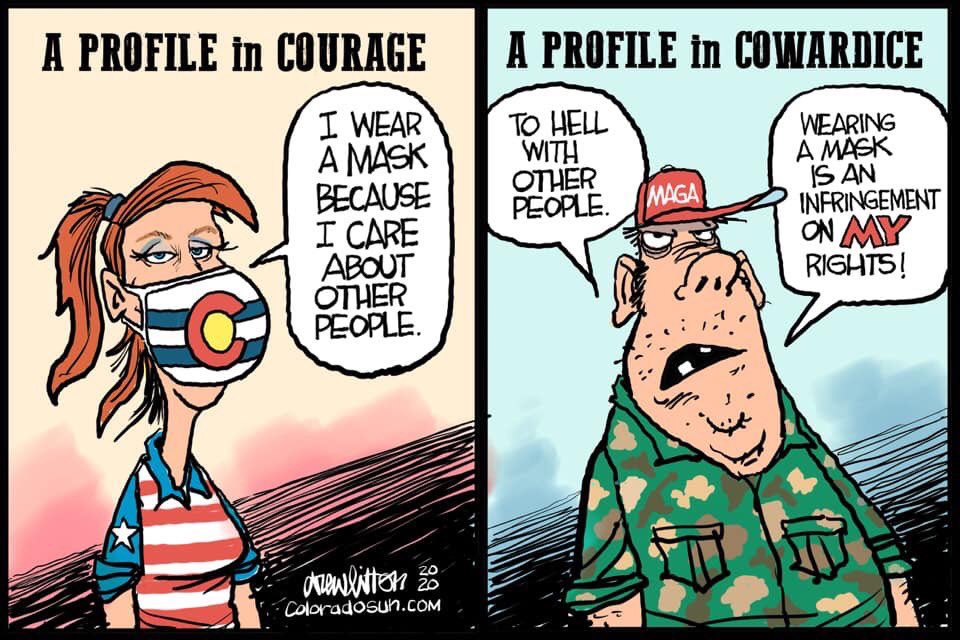
Cartoon – Profile in Courage vs. Cowardice

COVID-19 News - Updated Daily

Prosecuting the case against the COVID response

https://mailchi.mp/647832f9aa9e/the-weekly-gist-august-14-2020?e=d1e747d2d8

Bruce Plante Cartoon: Corona virus denial

This week, in her debut as running mate to presidential candidate Joe Biden, California Sen. Kamala Harris gave a preview of one of the Democratic ticket’s key arguments for the fall campaign, making a full-throated, prosecutorial case against the Trump administration’s handling of the coronavirus pandemic.

“The virus has impacted almost every country,” Harris said, “but there’s a reason it has hit America worse than any other advanced nation. It’s because of Trump’s failure to take it seriously from the start.

After receiving a briefing from public health experts on Thursday, Biden and Harris argued for a more comprehensive, aggressive national strategy to battle the virus, including major federal investment in contact tracing, a national mask mandate, and guaranteed free access to a COVID vaccine when it becomes available.

The remarks came as the US experienced the deadliest day of the summer so far, with nearly 1,500 COVID fatalities on Wednesday, and a seven-day rolling average of over 1,000 deaths per day for the last 17 days. Meanwhile, a new analysis by the New York Times, using data from the Centers for Disease Control and Prevention (CDC), indicated that the true US death toll from COVID may be as much as 35 percent higher than the reported total of 167K—a finding based on “excess deaths” above normal levels since March.

As President Trump continued to urge schools to reopen for in-person instruction nationwide, the White House released new guidance for ensuring students’ safe return to school. The guidance encouraged social distancing, frequent handwashing, better ventilation of school facilities, and the use of outdoor settings wherever possible.

Despite the President’s claim last week that children are “virtually immune” from the virus, a new analysis from the American Academy of Pediatrics and the Children’s Hospital Association showed that 97,000 children tested positive for COVID in the last two weeks of July alone, a 40 percent increase in the total number of known cases over that period.

About 340,000 children have tested positive so far, representing about 9 percent of all US cases. As schools face pressure to reopen, those numbers are likely to mount, and early-opening school districts in Georgia, Tennessee, Indiana, and Mississippi are already struggling to keep schools open amid rising cases.

Federal assistance to help schools deal with what seems like inevitable rounds of positive cases and closures is not forthcoming, however: after failing to reach a deal on another round of COVID relief, lawmakers have left Washington until September.

US coronavirus update: 5.2M cases; 167K deaths; 64.6M tests conducted.


Cash-Pinched Hospitals Press Congress to Break Virus Fund Logjam

https://news.bloomberglaw.com/health-law-and-business/cash-pinched-hospitals-press-congress-to-break-virus-fund-logjam

DIY Money Tree Gift Idea - So TIPical Me

Hospital groups are pressing Congress to put more money into a relief fund for hospitals and providers, even as labor data showed signs of a turnaround for the health-care industry last month.

Congressional leaders are at a standstill over the next coronavirus-relief package and it could be weeks until lawmakers vote on legislation. Hospital groups have said the $175 billion Congress already approved has been a crucial lifeline to keep hospitals from laying off more staff or potentially closing. Some are worried the money may start to run dry soon.

The coronavirus is prompting many Americans to delay health care, and further funding delays exacerbate the need for assistance, the hospitals warn. Some providers that shed jobs earlier in the pandemic have begun adding them back, but employment levels remain far below where they once were.

“The longer we are in the pandemic the more clear it becomes that this is not going to be a short-term issue,” Beth Feldpush, senior vice president of policy and advocacy at America’s Essential Hospitals, said.

Leaders of both parties back more federal funding to help hospitals and doctors’ offices stay in business. Democrats proposed $100 billion for the industry, as hospital groups such as AEH sought, in virus-relief legislation (H.R. 6800) the House passed earlier this year. Republicans included $25 billion in their counterproposal.

The Health and Human Services Department has promised about $115 billion of the $175 billion in relief Congress approved this year to help health-care providers offset their Covid-19-related losses, according to agency data. That leaves the industry with about $60 billion left.

The U.S. exceeded 5 million confirmed Covid-19 cases Aug. 9, according to data from Bloomberg News and Johns Hopkins University, more than any other country. Almost 165,000 people in the U.S. have died from the virus.

Industry Impact

The health-care industry added more than 126,000 jobs in July, according to data released last week by the Bureau of Labor Statistics. Dentist offices and hospitals, the section of the industry that was laying off tens of thousands of people in April and May, accounted for more than 70,000 of those new jobs.

Still, there were 797,000 fewer health-care jobs compared to before the pandemic, according to BLS.

The virus hit parts of the heath-care industry unevenly. Large health systems such as HCA Healthcare Inc. and Universal Health Services Inc. posted better-than-expected profits for the second quarter of 2020.

Some hospitals that didn’t have much cash-on-hand to start the year are struggling with lower profits and may need added relief if the virus continues to keep Americans from seeking care, industry watchers said.

“No hospital is going to come out of this year better than they were in prior years,” Suzie Desai, senior director for S&P Global Rating’s Not-for-Profit Health Care group, said.

The federal relief funds helped buoy hospitals this year, hospital groups argue. The American Hospital Association estimates that without relief funds, hospitals margins would have been down 15% and could be down 11% at the end of 2020 if the virus continues to spread at its current pace.

The AHA estimated losses for the nation’s hospitals and health systems will reach $323 billion this year.


U.S. records deadliest coronavirus day of the summer

https://www.axios.com/1485-us-coronavirus-death-record-5ee493cc-df91-4549-8c9d-43a5fee0bd87.html

U.S. records deadliest coronavirus day of the summer - Axios

The U.S. reported 1,485 deaths due to the coronavirus on Wednesday, COVID Tracking Project data shows.

Why it matters: It’s the highest single-day COVID-19 death toll since May 15, when the country reported 1,507 deaths. The U.S. has seen a total of 157,758 deaths from the virus.

The big picture: Georgia reported 109 deaths on Wednesday — its second triple-digit day in a row.

Go deeper: 5 states set single-day coronavirus case records last week