Fed chair Powell warns of “lasting” economic damage without more stimulus

https://www.axios.com/fed-jerome-powell-coronavirus-spending-e71d88c5-09ec-4410-b08f-3d4ad6304db0.html

Fed chair Powell warns of "lasting" economic damage without more ...

Federal Reserve Chairman Jerome Powell said Congress may need to do more to prevent a worse economic downturn triggered by the coronavirus pandemic, in an interview with the Peterson Institute’s Adam Posen on Wednesday.

Why it matters: Powell warned of dire economic consequences without additional stimulus. While the Fed has responded to the pandemic with the most aggressive policy actions in the central bank’s history, it doesn’t have the power to get money directly in the hands of Americans and businesses in the form of grants like Congress does.

The backdrop: The coronavirus has pushed the economy into a downturn not seen since the Great Depression, with a record number of Americans out of work.

  • Congress and the Fed have unleashed trillions of dollars in coronavirus aid to support the economy.
  • House Democrats proposed another $3 trillion in stimulus this week, but more spending is facing resistance from Republican members of Congress.

What they’re saying: “Additional fiscal support could be costly, but worth it if it helps avoid long-term economic damage and leaves us with a stronger recovery,” Powell said.

  • “It’s not the time to prioritize” concerns about fiscal spending, Powell said.

Powell warned about the long-lasting damage a steep, prolonged downturn could have on the economy, including permanent scarring to the most vulnerable workers in the labor force.

  • In a Fed survey set to be released tomorrow, Powell said 40% of people making less than $40,000/year who were employed in February, lost their job in March.


COVID-19 by the numbers: 51 stats, dollar figures and dates for hospital leaders to know

https://www.beckershospitalreview.com/hospital-management-administration/covid-19-by-the-numbers-51-stats-dollar-figures-and-dates-for-hospital-leaders-to-know.html?utm_medium=email

Coronavirus death rate in US compared to countries like Italy ...

In recent months, hospitals and health systems across the U.S. have made dramatic changes to quickly respond to the COVID-19 pandemic. To help provide a more detailed picture of the COVID-19 pandemic and response efforts, Becker’s Hospital Review has compiled key stats, dollar figures and dates for hospital and health system leaders to know.

COVID-19 relief aid 

Congress has allocated $175 billion in relief aid to hospitals and other healthcare providers to cover expenses or lost revenues tied to the COVID-19 pandemic. 

The first $50 billion in funding from the Coronavirus Aid, Relief and Economic Security Act was delivered to hospitals in April. HHS distributed $30 billion based on Medicare fee-for-service reimbursements and another $20 billion based on hospitals’ share of net patient revenue.

In addition, HHS is sending $12 billion to 395 hospitals that provided inpatient care for 100 or more COVID-19 patients through April 10 and disbursing another $10 billion to hospitals, clinics and health centers in rural areas.

HHS recently provided a list of hospitals that received payments from the general distribution and rural targeted allocation of the provider relief fund as well as hospitals that received COVID-19 high-impact payments.

Below are the 10 health systems that received the most funding from the general distribution and rural targeted allocation of the provider relief fund based on data updated May 12. Each health system received payments and agreed to the terms and conditions for receiving relief aid as of May 6. 

1. Dignity Health: $180.3 million

2. NewYork-Presbyterian Hospital: $119 million

3. Cleveland Clinic: $103.3 million

4. Stanford Health Care: $102.4 million

5. Intermountain Healthcare: $97.9 million

6. Memorial Hermann Health System: $92.4 million

7. NYU Langone Hospitals: $92.1 million

8. Sutter Health: $82.7 million

9. County of Los Angeles: $80.8 million (County operates four hospitals)

10. Hackensack Meridian Health: $76.8 million


Below are the 10 hospitals that received the most funding from the $12 billion COVID-19 high-impact fund based on data updated May 8. 

1. Long Island Jewish Medical Center (New Hyde Park, N.Y.): $277.7 million

2. Holy Name Medical Center (Teaneck, N.J.): $213.4 million

3. Tisch Hospital (New York City): $203.2 million

4. Montefiore Hospital-Moses Campus (New York City): $156.7 million

5. Columbia University Irving Medical Center (New York City): $152.7 million

6. NewYork-Presbyterian Queens (New York City): $143.3 million

7. Mount Sinai Medical Center (New York City): $140.8 million

8. Sandra Atlas Bass Heart Hospital (Manhasset, N.Y.): $137.5 million

9. Maimonides Medical Center (New York City): $131.5 million

10. Weill Cornell Medical Center (New York City): $118.6 million


COVID-19 vulnerability 

Every state in the U.S. will be affected by COVID-19, but some are more vulnerable due to limited ability to mitigate and treat the virus, and to reduce its economic and social impacts, according to a COVID-19 vulnerability index created by the Surgo Foundation.

The Surgo Foundation, a privately funded think tank, created an index that combines indicators specific to COVID-19 with the CDC’s social vulnerability index, which measures the expected negative impact of disasters of any type. The Surgo Foundation’s index takes into account factors that fall into one of several categories, including socioeconomic status, minority status, housing type, epidemiologic factors and healthcare system factors. Each state and the District of Columbia received a score in each category and an overall score, with a higher score indicating that the state is more vulnerable. Read more about the methodology here.

Below are the 10 states with the highest composite scores based on the vulnerability index. 

1. Mississippi: 1

2. Louisiana: 0.98

3. Arkansas: 0.96

4. Oklahoma: 0.94

5. Alabama: 0.92

6. West Virginia: 0.9

7. New Mexico: 0.88

8. Nevada: 0.86

9. North Carolina: 0.84

10. South Carolina: 0.82


Where COVID-19 cases, deaths are decreasing most

An analysis from The New York Times based on county-level data shows some U.S. cities are seeing sustained decreases in COVID-19 cases and deaths.

Below are the top five metro areas where COVID-19 cases have decreased the most (relative to population) in the past week. The list reflects The New York Times‘ rankings as of May 13 at 6:30 a.m. CDT. 

1. Grand Island, Neb.
Change rate: -394 cases per 100,000 population

2. Waterloo-Cedar Falls, Iowa
Change rate: -265 cases per 100,000 population

3. Pine Bluff, Ark.
Change rate: -197 per 100,000 population

4. New York City area
Change rate: -184 cases per 100,000 population

5. Boston
Change rate: -139 cases per 100,000 population


Below are the top five metro areas where COVID-19 deaths have decreased the most in the past week. 

1. Grand Island, Neb.
Change rate: -11.8 deaths per 100,000 population

2. New York City area
Change rate: -11.1 deaths per 100,000 population

3. Fairfield County (Conn.)
Change rate: -9.7 deaths per 100,000 population

4. Hartford, Conn.
Change rate: -9.7 deaths per 100,000 population

5. Springfield, Mass.
Change rate: -9.5 deaths per 100,000 population


States resuming elective surgeries 

Below are the states that have allowed or announced plans to allow healthcare providers to resume elective surgeries as of May 13. There are different restrictions in each state, which are detailed in executive orders and other documents from the state. 

April 22
California
Texas
Utah

April 24
Oklahoma

April 26
Colorado

April 27
Arkansas
Indiana
Iowa
Kentucky
Louisiana
Mississippi
Pennsylvania

April 28
New York
West Virginia

April 30
Alabama
Tennessee

May 1
Arizona
Illinois
Ohio
Oregon
Virginia

May 4
Alaska
Florida
Nebraska

May 15
Vermont

May 18
Washington

May 31
South Dakota


The latest in the U.S.

https://www.axios.com/newsletters/axios-vitals-72173ec6-3383-4391-afbb-a5ed682e5d7a.html?utm_source=newsletter&utm_medium=email&utm_campaign=newsletter_axiosvitals&stream=top

COVID-19 in the U.S.

As of May 12, 2020, 11pm EDT

Deaths       Confirmed Cases

82,376           1,369,574

Trump and some top aides question accuracy of coronavirus death ...


The U.S. will “without a doubt” have more coronavirus infections and deaths in the fall and winter if effective testing, contact tracing and social distancing measures are not scaled up to adequate levels, NIAID director Anthony Fauci testified on Tuesday.

  • He also said that the “consequences could be really serious” for states and cities that reopen without meeting federal guidelines.

Sen. Mitt Romney (R-Utah) criticized the Trump administration’s coronavirus testing coordinator Adm. Brett Giroir at a Senate hearing Tuesday, accusing him of framing U.S. testing data in a politically positive light: “I find our testing record nothing to celebrate whatsoever.”

Millions of Americans are risking their lives to feed us and bring meals, toiletries and new clothes to our doorsteps — but their pay, benefits and working conditions do not reflect the dangers they face at work, Axios’ Erica Pandey reports.

House Democrats released Tuesday their phase 4 $3 trillion coronavirus relief proposal that would provide billions of additional aid to state and local governments, hospitals and other Democratic priorities.

The American Federation of Teachers launched several capstone lesson plans Tuesday to help K-12 teachers measure student progress during school closures and overcome the challenges of a remote learning setting.

Grocery staples in the U.S. cost more in the last month than in almost 50 years, according to new data out Tuesday from the U.S. Bureau of Labor Statistics.

A new study by economists at the University of Illinois, Harvard Business School, Harvard University and the University of Chicago projects that more than 100,000 small businesses have permanently closed since the coronavirus pandemic was declared in March, the Washington Post reports.


Coronavirus likely forced 27 million off their insurance

https://www.axios.com/newsletters/axios-vitals-72173ec6-3383-4391-afbb-a5ed682e5d7a.html?utm_source=newsletter&utm_medium=email&utm_campaign=newsletter_axiosvitals&stream=top

The coronavirus pandemic is hitting Main Street and triggering ...

Roughly 27 million people have likely have lost job-based health coverage since the coronavirus shocked the economy, according to new estimates from the Kaiser Family Foundation.

Why it matters: Most of these people will be able sign up for other sources of coverage, but millions are still doomed to be uninsured in the midst of a pandemic, Axios’ Bob Herman reports.

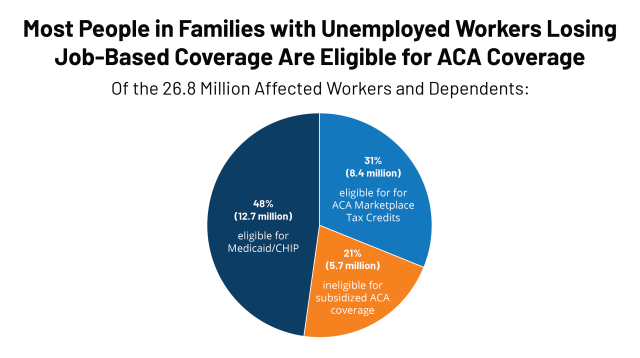
By the numbers: For the 27 million people who are losing their job-based coverage, about 80% have other options, said Rachel Garfield, a health policy expert at the Kaiser Family Foundation and lead author of the report.

  • Roughly half are eligible for Medicaid or the Children’s Health Insurance Program.
  • Another third are eligible for subsidized health plans on the Affordable Care Act’s marketplaces.
  • The remaining 20% are pretty much out of luck because they live in a state that didn’t expand Medicaid or are ineligible for other kinds of subsidized coverage.
  • House Speaker Nancy Pelosi’s latest coronavirus relief bill would fully subsidize the cost of maintaining an employer plan through COBRA — an option that would otherwise be prohibitively expensive for many people. But that’s a long way from becoming law.

The bottom line: The coronavirus is blowing up health insurance at a time when people need it most.


Eligibility for ACA Health Coverage Following Job Loss

Eligibility for ACA Health Coverage Following Job Loss
Eligibility for ACA Health Coverage Following Job Loss – Methods ...

The economic consequences of the coronavirus pandemic have led to historic level of job loss in the United States. Social distancing policies required to address the crisis have led many businesses to cut hours, cease operations, or close altogether. Between March 1st and May 2nd, 2020, more than 31 million people had filed for unemployment insurance. Actual loss of jobs and income are likely even higher, as some people may be only marginally employed or may not have filed for benefits. Some of these unemployed workers may go back to work as social distancing curbs are relaxed, though further job loss is also possible if the economic downturn continues or deepens.

In addition to loss of income, job loss carries the risk of loss of health insurance for people who were receiving health coverage as a benefit through their employer. People who lose employer-sponsored insurance (ESI) often can elect to continue it for a period by paying the full premium (called COBRA continuation) or may become eligible for Medicaid or subsidized coverage through the Affordable Care Act (ACA) marketplaces. Over time, as unemployment benefits end, some may fall into the “coverage gap” that exists in states that have not expanded Medicaid under the ACA.

In this analysis, we examine the potential loss of ESI among people in families where someone lost employment between March 1st, 2020 and May 2nd, 2020 and estimate their eligibility for ACA coverage, including Medicaid and marketplace subsidies, as well as private coverage as a dependent (see detailed Methods at the end of this brief). To illustrate eligibility as their state and federal unemployment insurance (UI) benefits cease, we show eligibility for this population as of May 2020 and January 2021, when most will have exhausted their UI benefits.

What are coverage options for people losing ESI?

Eligibility for health coverage for people who lose ESI depends on many factors, including income while working and family income while unemployed, state of residence, and family status. Some people may be ineligible for coverage options, and others may be eligible but opt not to enroll. Some employers may temporarily continue coverage after job loss (for example, through the end of the month), but such extensions of coverage are typically limited to short periods.

Medicaid: Some people who lose their jobs and health coverage—especially those who live in states that expanded Medicaid under the ACA— may become newly eligible1 for Medicaid if their income falls below state eligibility limits (138% of poverty in states that expanded under the ACA). For Medicaid eligibility, income is calculated based on other income in the family plus any state unemployment benefit received (though the $600 per week federal supplemental payment available through the end of July is excluded). Income is determined on a current basis, so prior wages for workers recently unemployed are not relevant. In states that have not expanded Medicaid under the ACA, eligibility is generally limited to parents with very low incomes (typically below 50% of poverty and in some states quite a bit less); thus many adults may fall into the “coverage gap” that exists for those with incomes above Medicaid limits but below poverty (which is the minimum eligibility threshold for marketplace subsidies under the ACA). Undocumented immigrants are ineligible for Medicaid, and recent immigrants (those here for fewer than five years) are ineligible in most cases.

Marketplace: ACA marketplace coverage is available to legal residents who are not eligible for Medicaid and do not have an affordable offer of ESI; subsidies for marketplace coverage are available to people with family income between 100% and 400% of poverty. Some people who lose ESI may be newly-eligible for income-based subsidies, based on other family income plus any state and new federal unemployment benefit received (including the $600 per week federal supplement, unlike for Medicaid).2 While current income is used for Medicaid eligibility, annual income for the calendar year is used for marketplace subsidy eligibility. Advance subsidies are available based on estimated annual income, but the subsidies are reconciled based on actual income on the tax return filed the following year. People who lose ESI due to job loss qualify for a special enrollment period (SEP) for marketplace coverage.3 As with Medicaid, undocumented immigrants are ineligible for marketplace coverage or subsidies. However, recent immigrants, including those whose income makes them otherwise eligible for Medicaid, can receive marketplace subsidies.

ESI Dependent Coverage: People who lose jobs may be eligible for ESI as a dependent under a spouse or parent’s job-based coverage. Some people may have been covered as a dependent prior to job loss, and some may switch from their own coverage to coverage as a dependent.

COBRA: Many people who lose their job-based insurance can continue that coverage through COBRA, although it is typically quite expensive since unemployed workers generally have to pay the entire premium – employer premiums average $7,188 for a single person and $20,576 for a family of four – plus an additional 2%. People who are eligible for subsidized coverage through Medicaid or the marketplaces are likely to opt for that coverage over COBRA, though COBRA may be the only option available to some people who are income-ineligible for ACA coverage.

Short-term plans: Short-term plans, which can be offered for up to a year and can sometimes be renewed under revised rules from the Trump administration, are also a potential option for people losing their employer-sponsored insurance. These plans generally carry lower premiums than COBRA or ACA-compliant coverage, as they often provider more limited benefits and usually deny coverage to people with pre-existing conditions. Even when coverage is issued, insurers generally may challenge benefit claims that they believe resulted from pre-existing medical problems; given the long latency between initial infection and sickness with COVID-19, these plans are riskier than usual during the current pandemic. People cannot use ACA subsidies toward short-term plan premiums.

Our analysis examines eligibility for Medicaid, marketplace subsidies, and dependent ESI coverage. We do not estimate enrollment in COBRA, short-term plans, or temporary continuation of ESI. See Methods for more details.

How does coverage and eligibility change following job loss?

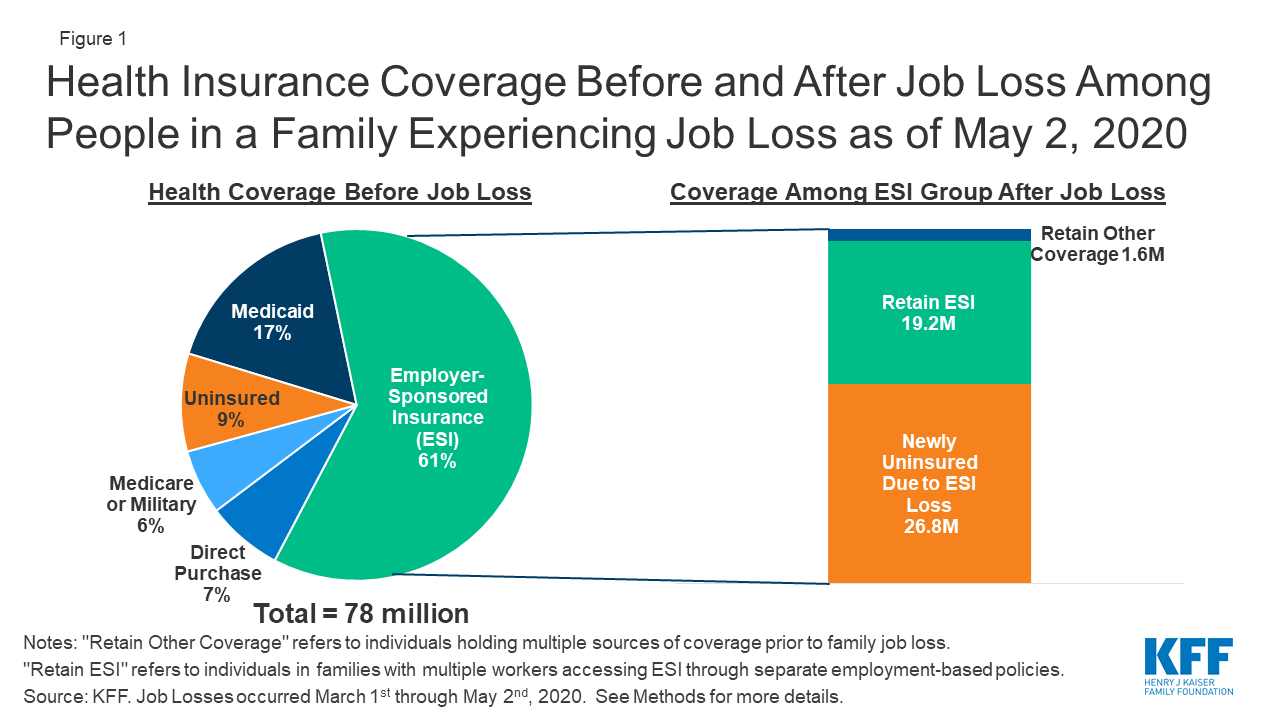
Between March 1st, 2020 and May 2nd, 2020, we estimate that nearly 78 million people lived in a family in which someone lost a job. Most people in these families (61%, or 47.5 million) were covered by ESI prior to job loss. Nearly one in five (17%) had Medicaid, and close to one in ten (9%) were uninsured. The remaining share either had direct purchase (marketplace) coverage (7%) or had other coverage such as Medicare or military coverage (6%) (Figure 1).
Eligibility for ACA Health Coverage Following Job Loss | The Henry ...

We estimate that, as of May 2nd, 2020, nearly 27 million people could potentially lose ESI and become uninsured following job loss (Figure 1). This total includes people who lost their own ESI and those who lost dependent coverage when a family member lost a job and ESI. Additionally, some people who otherwise would lose ESI are able to retain job-based coverage by switching to a plan offered to a family member: we estimate that 19 million people switch to coverage offered by the employer of a working spouse or parent. A very small number of people who lose ESI (1.6 million) also had another source of coverage at the same time (such as Medicare) and retain that other coverage. These coverage loss estimates are based on our assumptions about who likely filed for UI as of May 2nd, 2020 and the availability of other ESI options in their family (see Methods for more detail).

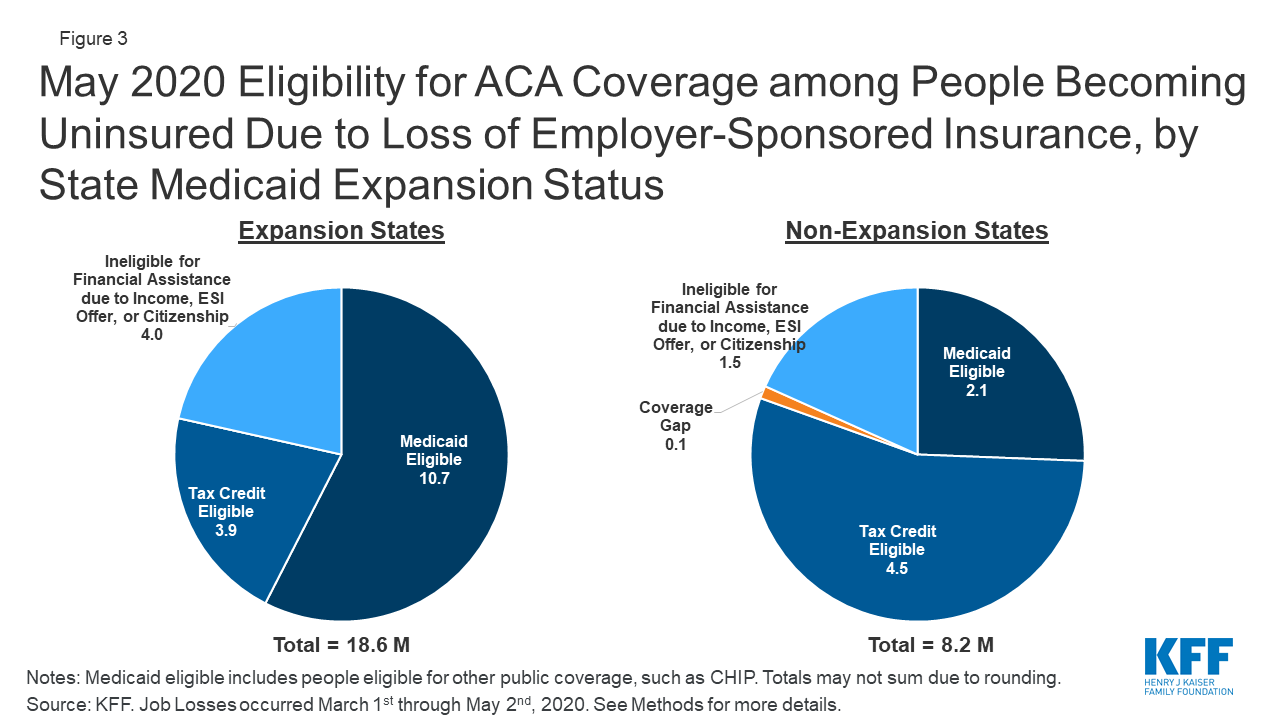
Among people who become uninsured after job loss, we estimate that nearly half (12.7 million) are eligible for Medicaid, and an additional 8.4 million are eligible for marketplace subsidies, as of May 2020 (Figure 2). In total, 79% of those losing ESI and becoming uninsured are eligible for publicly-subsidized coverage in May. Approximately 5.7 million people who lose ESI due to job loss are not eligible for subsidized coverage, including almost 150,000 people who fall into the coverage gap, 3.7 million people ineligible due to family income being above eligibility limits, 1.3 million people who we estimate have an affordable offer of ESI through another working family member, and about 530,000 people who do not meet citizenship or immigration requirements. We project that very few people fall into the coverage gap immediately after job loss (as of May 2020) because wages before job loss plus unemployment benefits (including the temporary $600 per week federal supplement added by Congress) push annual income for many unemployed workers in non-expansion states above the poverty level, making them eligibility for ACA marketplace subsidies for the rest of the calendar year.
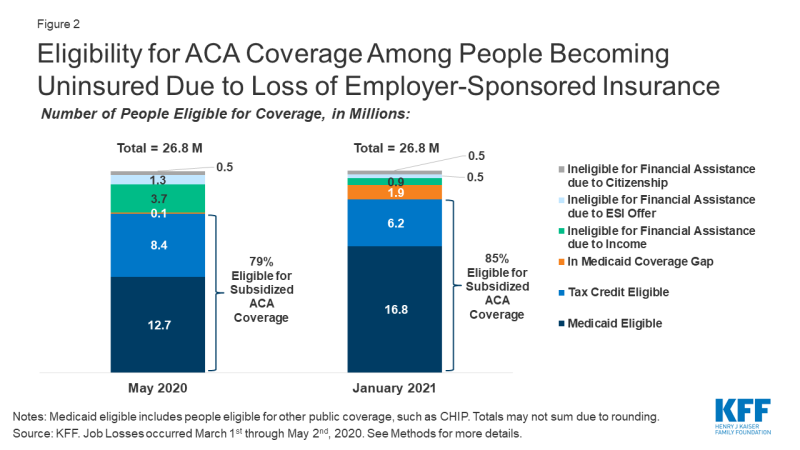
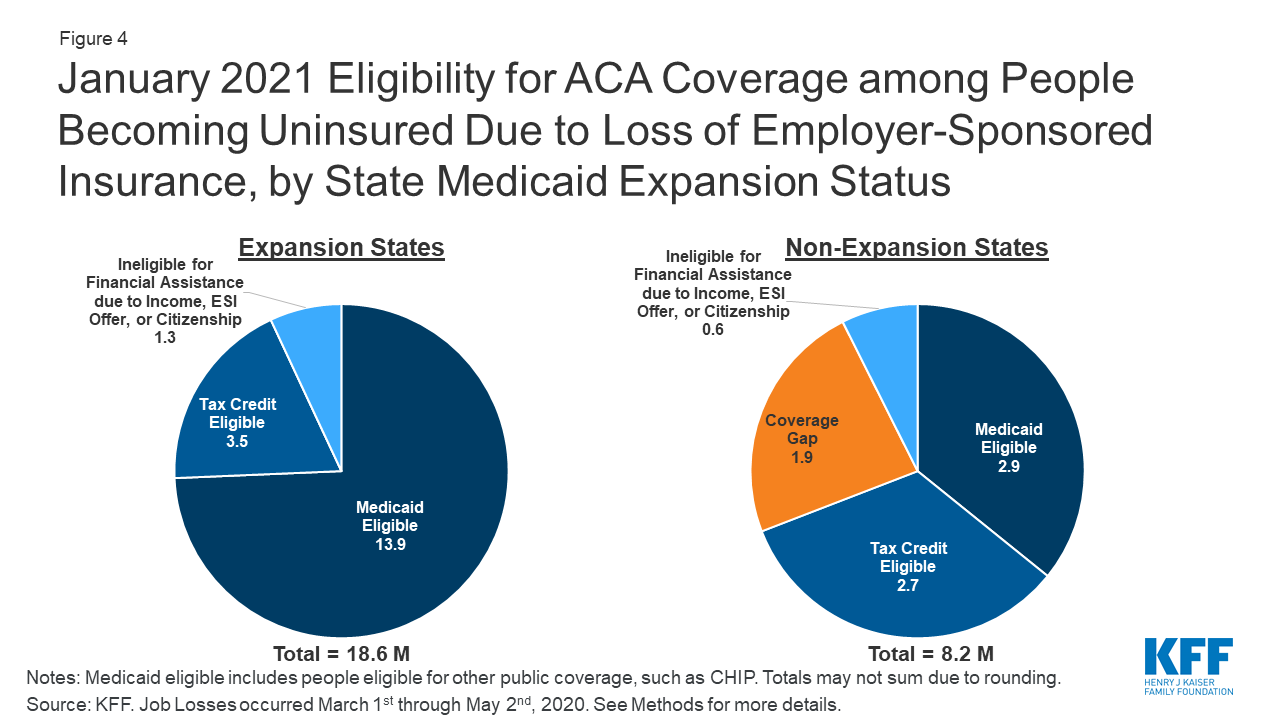
By January 2021, when UI benefits cease for most people, we estimate that eligibility shifts to nearly 17 million being eligible for Medicaid and about 6 million being eligible for marketplace subsidies (Figure 2), assuming those who are recently unemployed have not found work. Many unemployed workers who are eligible for ACA marketplace subsidies during 2020 would instead be eligible for Medicaid or fall into the coverage gap during 2021. The number in the coverage gap grows to 1.9 million (an increase of more than 80% of its previous size), and the number ineligible for coverage due to income shrinks to 0.9 million.

Estimates of coverage loss and eligibility vary by state, depending largely on underlying state employment by industry and Medicaid expansion status. Not surprisingly, states in which the largest number of people are estimated to lose ESI are large states with many people working in affected industries (Appendix Table 1). Eight states (California, Texas, Pennsylvania, New York, Georgia, Florida, Michigan, and Ohio) account for just under half (49%) of all people who lose ESI. Five of the top eight states have expanded Medicaid, and people eligible for Medicaid among the potentially newly uninsured as of May 2020 in these five states account for 40% of all people in that group nationally. Overall, patterns by state Medicaid expansion status show that people in expansion states are much more likely to be eligible for Medicaid, while those in non-expansion states are more likely to qualify for marketplace subsidies (Figure 3). However, the number of people qualifying for marketplace subsidies is similar across the two sets of states, as more people live in expansion states. Three states that have not expanded Medicaid, including Texas, Georgia, and Florida, account for 30% of people who become marketplace tax credit eligible nationally in May 2020. Assuming unemployment extends into 2021 when UI benefits would likely expire for most families, the proportion eligible for Medicaid would increase in expansion states while non-expansion states may see more nonelderly adults moving into the Medicaid coverage gap (Figure 4; Appendix Table 2).
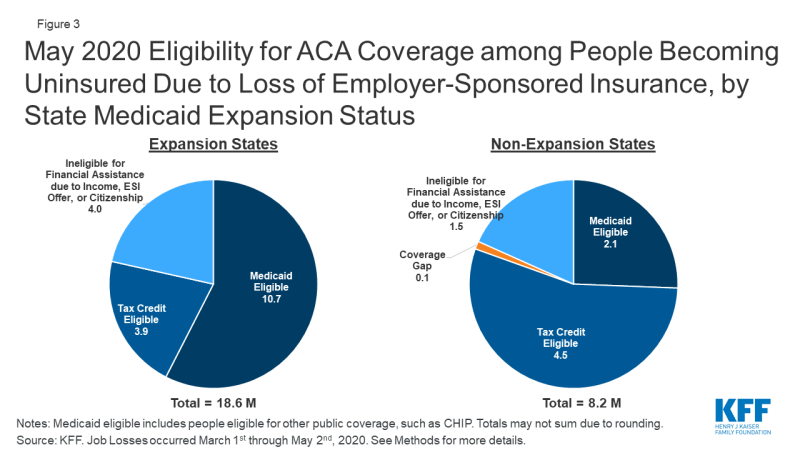
Figure 3: May 2020 Eligibility for ACA Coverage among People Becoming Uninsured Due to Loss of Employer-Sponsored Insurance, by State Medicaid Expansion Status
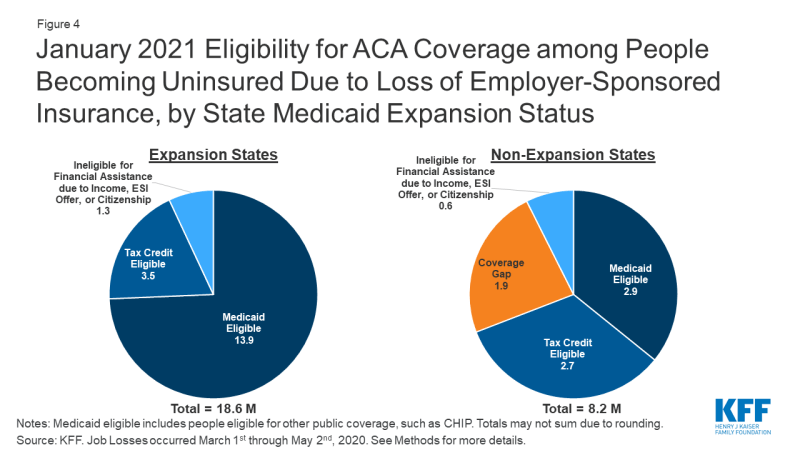
Figure 4: January 2021 Eligibility for ACA Coverage among People Becoming Uninsured Due to Loss of Employer-Sponsored Insurance, by State Medicaid Expansion Status

Nearly 7 million people losing ESI and becoming uninsured are children, and the vast majority of them are eligible for coverage through Medicaid or CHIP. Within the 26.8 million people losing ESI and becoming uninsured in May 2020, 6.1 million are children. Because Medicaid/CHIP income eligibility limits for children are generally higher than they are for adults, the vast majority of these children are eligible for Medicaid/CHIP in May 2020 (5.5 million, or 89%) or January 2021 (5.8 million, or 95%).

Discussion

Given the health risks facing all Americans right now, access to health coverage after loss of employment provides important protection against catastrophic health costs and facilitates access to needed care. Unemployment Insurance filings continue to climb each week, and it is likely that people will continue to lose employment and accompanying ESI for some time, though some of them will return to work as social distancing curbs are loosened. The ACA expanded coverage options available to people, and we estimate that the vast majority of people who lose ESI due to job loss will be eligible for ACA assistance either through Medicaid or subsidized marketplace coverage. However, some people will fall outside the reach of the ACA, particularly in January 2021 when UI benefits cease for many and some adults fall into the Medicaid coverage gap due to state decisions not to expand coverage under the ACA.

Both ACA marketplace subsidies and Medicaid are counter-cyclical programs, expanding during economic downturns as people’s incomes fall. In return for additional federal funding to help states finance their share of Medicaid cost during the public health crisis, states must maintain eligibility standards and procedures that were in effect on January 1, 2020 and must provide continuous eligibility through the end of the public health emergency, among other requirements. These provisions may help eligible individuals enroll in and maintain Medicaid, particularly in light of state and federal actions prior to the crisis to increase eligibility verification requirements or transition people off Medicaid.

Our estimates only examine eligibility among people who lost ESI due to job loss and potentially became uninsured. Additional uninsured individuals—including some of the 9% of the 78 million individuals in families where someone lost employment—may also be eligible for Medicaid or subsidized coverage. It is possible that contact with state UI systems may lead them to seek and enroll in coverage, even if they were eligible for financial assistance before job loss but uninsured.

It is unclear whether people losing ESI and becoming uninsured will enroll in new coverage. We did not estimate take-up or enrollment in coverage options but rather only looked at eligibility for coverage. Even before the coronavirus crisis, there were millions of people eligible for Medicaid or marketplace subsidies who were uninsured. Eligible people may not know about coverage options and may not seek coverage; others may apply for coverage but face challenges in navigating the application and enrollment process. Still others may find marketplace coverage, in particular, unaffordable even with subsidies. As policymakers consider additional efforts to aid people, expanding outreach and enrollment assistance, which have been reduced dramatically by the Trump Administration, could help people maintain coverage as they lose jobs.

This is the first economic downturn during which the ACA will be in place as a safety net for people losing their jobs and health insurance. The Trump Administration is arguing in case before the Supreme Court that the ACA should be overturned; a decision is expected by next Spring. The ACA has gaps, and for many the coverage may be unaffordable. However, without it, many more people would likely end up uninsured as the U.S. heads into a recession.


Now Is the Time to Address Surprise Billing

https://www.medpagetoday.com/blogs/marty-makary/86455?xid=fb_o&trw=no&fbclid=IwAR1boFFgBZuSqJ9-1728UdSFeIK790TTXNeoJJ9mky9jCKbGyQ_G4jqwrfk

Tips to avoid surprise medical bills

The doctor-patient relationship is being undermined.

Private equity companies have spent millions in dark money to stall and effectively kill all versions of surprise billing reform. But this week, the issue will come before Congress again. Legislation was introduced Tuesday in the House that, among other things, would further assist hospitals with more relief funds. With this potential third disbursement of federal dollars comes an opportunity to finally address the embarrassing problem of surprise billing that has eroded the public trust in our great medical profession.

Physicians across the country are now signing a letter urging leaders of Congress to address surprise billing once and for all. I have already signed this letter and encourage you to consider doing so as well.

One reason the medical profession is the greatest profession in the world is that patients put their faith and trust in us. But 64% of Americans now say they have avoided or delayed medical care for fear of the bill. As more and more patients lose faith in the system, the doctor-patient relationship is being undermined by surprise billing and the modern-day business practices of price gouging and predatory billing. In fact, these egregious practices have become part of the business model of some private equity groups, which seek to replace physician autonomy with corporate medicine.

Our system today is unnecessarily complicated and works against patients’ interests by putting them in the middle of a finger-pointing blame game, which leaves them holding the bag. It doesn’t make sense for us to accept people with open arms, treat their ailment, and then ruin their lives financially. Medical science is a bastion of scientific and intellectual genius. We can fix this problem. Already, some efforts are advancing price transparency by creating a transparent marketplace for patients.

I’ve spent many years looking at the systematic cost issues that face our health system and patients. Simply put, the lack of fairness and transparency in pricing and billing practices has created financial toxicity and increased the general mistrust of the medical system for millions of Americans. No one designed it to be this bad. In fact, we have good people working in a bad system. When I explain details of pricing, billing, and collections with doctors and hospital leaders, they are invariably shocked and furious to learn how out of control their billing offices have gotten in overcharging patients and shaking people down for more than a reasonable amount for a service.

The current COVID-19 crisis is a stark reminder of the gaps in our health system that exacerbate the pressures facing providers and patients. Many Americans are getting crushed right now. Despite many years of debate in Washington and bipartisan agreement that something must be done, there is still no federal protection in place to safeguard consumers from an egregious surprise medical bill if they need emergency care or have limited options. The reality is that special interests — including the very private equity firms that stand to benefit financially from these exploitative business practices — continue to spend millions to maintain the status quo.

It’s time for a bipartisan compromise to end the non-transparent game of surprise medical billing. It’s time that Congress takes meaningful action to protect patients during this COVID-19 crisis and finally address this issue. Congress has solutions on the table that would bring much greater fairness and transparency to the healthcare system, protect patients from these predatory charges, and ensure that physicians are paid fairly for our services, as we deserve. It’s time we put an end to the cycle of financial toxicity and rebuild the great public trust in the medical profession.


Germany’s daily coronavirus cases nearly TRIPLE – states bring back tougher measures

https://www.express.co.uk/news/world/1281241/germany-coronavirus-cases-jump-lockdown-lift-tougher-lockdown-rules-angela-merkel?fbclid=IwAR0D6VbvvxIu4PUwUwMOu7AAKePOdxcUhZFyQybDdJTvEmosNZlrDeodLnM

coronavirus

CORONAVIRUS cases in Germany have almost trebled in the past 24 hours sparking fears of a second wave of COVID-19 infections.

Health authorities in Germany have reported more than 900 new cases of the deadly coronavirus less than a week after lockdown restrictions were relaxed by German Chancellor Angela Merkel. The Robert Koch Institute for public health and disease control has reported 933 new COVID-19 infections on Tuesday – an increase from just 357 on Monday.

According to the Institute the infection rate – the so-called “R” rate – has been above one for the past three days.

The rate means on average one person will potentially transmit the virus to one other individual.

The Institute for public health estimated the “R” rate was at 1.07 on Monday and 1.13 on Sunday.

The number indicates that 100 infected people would on average infect 107 others.

Today, the R rate once again dipped just below one with an estimated value of 0.94, but the latest spike in cases will worry some.

Despite the rise in the rate in recent days, the Robert Koch Institute said: “So far, we do not expect a renewed rising trend.”

Last Thursday Ms Merkel outlined a scenario at which the country would need to apply an “emergency brake” and re-impose restrictions.

The lockdown measures would be introduced again if a second wave of new infections were reported at a rate of 50 per 100,000 people.

Since Ms Merkel’s announcement, however, three districts across Germany have used the emergency measures to halt the virus.

The states of North Rhine-Westphalia and Schleswig-Holstein were forced to re-introduce lockdown after outbreaks of coronavirus at meat processing plants.

One district in the state of Thuringia is also understood to have implemented the emergency measures after outbreaks in care homes.

Just six days ago the German Chancellor announced measures to lift the lockdown by opening more shops and outlining the gradual re-opening of schools.

Shops and gyms have been allowed to begin trading providing social distancing measures were enforced.

The Chancellor also announced most Germans will be allowed to meet people from outside their households for the first time.

Top flight Bundesliga matches are also set to begin behind closed-doors this upcoming weekend.

Ms Merkel has been under increasing pressures to kick-start the faltering German economy with widespread protests taking place at the weekend in major cities including Munich.


How a restaurant’s ventilation system can affect the spread of the coronavirus

https://www.cbsnews.com/video/how-a-restaurants-ventilation-system-can-affect-the-spread-of-the-coronavirus/?fbclid=IwAR2z-bdgzOxsKeW-cL2szCpc6UzNtyh3yvdI4PQzGyqA6y8Ge-AAc9m8EF0

As some restaurants reopen, model shows how coronavirus can spread ...

Surprising new research may help keep people safe from coronavirus in restaurants, as states begin to loosen rules and reopen. As Omar Villafranca discovered, there’s something important beyond masks and social distancing that restaurants might need to consider: air currents.


Fauci’s warning about reopening may have more influence over Americans than governors

https://www.washingtonpost.com/politics/2020/05/12/faucis-warning-about-reopening-may-have-more-influence-over-americans-than-governors/?fbclid=IwAR0eDoGHpOUI1Ty2RdCoKcxSzwne2NscJfoVGQXnEH8ud2s5MEKIunzXuRA

White House coronavirus expert Dr Anthony Fauci says world may ...

It’s one of those moments that, even as it occurs, seems definitive. The country’s leading infectious-disease expert, Anthony S. Fauci, offering testimony before a Senate committee about a virus that’s infected more than a million Americans — but doing so remotely, because of his own contact with an infected individual. Speaking from quarantine, Fauci will offer a grim warning: Attempting to return economic activity to normal levels too quickly will “result in needless suffering and death” and itself result in negative effects for the economy.

Fauci’s warning stands in obvious contrast to the assertions of his boss, President Trump. As he has so often over the course of the pandemic, Trump waves away questions about whether states are ready to resume normal economic activity, insisting that many places are ready to gear back up. His White House released a set of recommendations for doing so, recommendations to which Fauci will refer. But even as those recommendations were introduced, Trump undercut them. He quickly embraced anti-social-distancing protests in states with blue governors — states where things were not yet ready to return to normal.

The recommendations espoused by Fauci (and, ostensibly, Trump) set an initial baseline of data that states should meet before taking even introductory steps toward reopening their economies. They’re centered on three categories benchmarks: coronavirus symptoms, actual cases and hospital capacity. The initial presentation from the White House explained how those benchmarks could be met:

For the first two, we have publicly available data that allows us to evaluate how states are doing. In the case of demonstrated symptoms, the data are somewhat old, with the most recent metrics reflecting the week of May 2. What’s more, data on the number of people showing up to emergency rooms with symptoms reflecting possible covid-19 cases (the disease caused by the coronavirus) are compiled only by region. Nonetheless, we can get a sense for how many people in each place are showing symptoms as well as up-to-date information on the number of cases and positive tests in each state.

By now, many states appear to meet the benchmarks on these two conditions. (Again, given the limits on the symptomatic data, it’s tricky to say how each fares in the moment.) A number of states that have already begun to reopen, though, don’t. In Texas, for example, the number of new cases is up and the percent of positive tests is flat. In Georgia, the number of new cases is flat and the rate of positive tests has been variable. Both states are nonetheless reopening.

Georgia’s been in the process of reopening for about three weeks, despite missing the basic benchmarks even when that process began. Gov. Brian Kemp (R) made a blanket determination that things could get back to normal, ignoring the sort of regionalized shifts that Trump himself has advocated.

New York, the state hit hardest by the virus, has implemented a deliberate, region-by-region plan for reopening. Gov. Andrew M. Cuomo (D) has outlined seven different criteria in each region of the state before it can resume some normal economic activity (though not all). (Among those? A program sufficient to trace the contacts of individuals with newly confirmed infections.) As of Monday, only three regions met the seven conditions. New York City hit four of the seven.

This is presumably how states are encouraged to reopen to avoid Fauci’s most dire predictions. It’s no guarantee that outbreaks won’t emerge, but New York’s plan is predicated on safety over normalcy while Georgia’s appears to be the opposite.

That’s the important context for Fauci’s testimony. His warnings about moving slowly are not new — though, in the past, they’ve mostly been tempered by the looming physical presence of a president who’s not very interested in diluting his optimistic economic assumptions. Fauci’s language about the ramifications is strong, but the message is consistent.

It also comes a bit too late for states such as Georgia — at least at the official level. One effect of the effort to get the state back to normal is that many Georgians aren’t ready to do so. Economic data shows that, despite businesses being open, they’re often not seeing many customers. The state’s residents are skeptical about getting back to normal. A new Post-Ipsos poll suggests that they are also skeptical of their governor.

Those participating in protests against social distancing are a small minority. Most Americans understand the thrust of Fauci’s concerns and are willing to support continued social distancing measures. While governors are occasionally skipping over the guidelines offered by Fauci and his team, the consumers who can return the economy to normal are still wary — and may be the best audience for Fauci’s warnings.