Trump reportedly squandered 3 crucial weeks to mitigate the coronavirus outbreak after a CDC official’s blunt warnings spooked the stock market

https://www.businessinsider.com/trump-wasted-3-weeks-coronavirus-mitigation-time-february-march-nyt-2020-4

Dow closes with decline of 950 points as coronavirus continues to ...

  • President Donald Trump’s administration wasted three key weeks between February and March that could have been spent enacting mitigatory measures against COVID-19, The New York Times reported on Saturday.
  • By the end of February, top officials knew that time was running out to stem the virus spread, and wanted to present Trump with a plan to enact aggressive social distancing and stay-at-home measures.
  • But on February 26, a top CDC official issued stark warnings about the virus’ spread right before the stock market plummeted, which angered Trump for being, in his view, too alarmist. 
  • The Times reported that the entire episode killed off the efforts to persuade Trump to take aggressive, action to mitigate the virus’ spread. In the end, Trump didn’t issue stay-at-home guidance until March 16. 

President Donald Trump’s administration stalled three key weeks in February that could have been spent enacting mitigatory measures against COVID-19 after Trump was angered by a public health official issuing a dire warning about the virus, The New York Times reported on Saturday.

On Saturday,The Times published a lengthy investigation of all the instances Trump brushed aside warnings of the severity of the coronavirus crisis, failed to act, and was delayed by significant infighting and mixed messages from the White House over what action to take and when. 

The Times wrote: “These final days of February, perhaps more than any other moment during his tenure in the White House, illustrated Mr. Trump’s inability or unwillingness to absorb warnings coming at him.”

The Times conducted dozens of interviews with current and former officials and obtained 80 pages of emails from a number of public health experts both within and outside of the federal government who sounded the alarm about the severity of the crisis on an email chain they called “Red Dawn.”

One of the members of the email group, Health & Human Service disaster preparedness official Dr. Robert Kadlec, became particularly concerned about how rapidly the virus could spread when Dr. Eva Lee, a Georgia Tech researcher, shared a study with the group about a 20-year-old woman in China who spread the virus to five of her family members despite showing no symptoms.

“Eva is this true?! If so we have a huge [hole] on our screening and quarantine effort,” he replied on February 23. 

At that point, researchers and top officials in the federal government determined that since it was way too late to try to keep the virus out of the United States, the best course of action was to introduce mitigatory, non-pharmaceutical interventions (NPIs) like social distancing and prohibiting large gatherings.

As officials sounded the alarm that they didn’t have any time to waste before enacting aggressive measures to contain the virus, top public health officials including Dr. Robert Kadlec concluded that it was time to present Trump with a plan to curb the virus called “Four Steps to Mitigation.”

The plan, according to The Times, included canceling large gatherings, concerts, and sporting events, closing down schools, and both governments and private businesses alike ordering employees to work from home and stay at home as much as possible, in addition to quarantine and isolating the sick.

But their entire plan was derailed by a series of events that ended up delaying the White House’s response by several weeks, wasting precious time in the process.

Trump was on a state visit to India when Dr. Kadlec and other experts wanted to present him with the plan, so they decided to wait until he came back.

But less than a day later, Dr. Nancy Messonnier, the director of the National Center for Immunization and Respiratory Diseases at the CDC, publicly sounded the alarm about the severity of the coronavirus outbreak in a February 26 press conference, warning that the outbreak would soon become a pandemic.

“It’s not so much a question of if this will happen anymore but rather more a question of exactly when this will happen and how many people in this country will have severe illness,” Messonnier said, bluntly warning that community transmission of the virus would be inevitable.

The Times reported that Trump spent the plane ride stewing in anger both over Messonnier’s comments and the resulting plummet of the stock market they caused, calling Secretary of Health & Human Services Alex Azar “raging that Dr. Messonnier had scared people unnecessarily,” The Times said. 

The Times reported that the entire episode effectively killed off any efforts to persuade Trump to take aggressive, decisive action to mitigate the virus’ spread and led to Azar being sidelined, writing, ” With Mr. Pence and his staff in charge, the focus was clear: no more alarmist messages.” 

In the end, Dr. Kadlec’s team never made their presentation. Trump did not issue nationwide social distancing and stay-at-home guidelines until March 16, three weeks after Messonnier warned that the US had limited time to mitigate community transmission of the virus, and several weeks after top experts started calling for US officials to implement such measures.

In those nearly three weeks between February 26 and March 16, the number of confirmed COVID-19 cases rose from just 15 to 4,226, The Times said. As of April 12, there are over half a million confirmed cases in the United States with over 21,000 deaths.


The Costly Toll of Not Shutting Down Spring Break Earlier

https://www.yahoo.com/news/costly-toll-not-shutting-down-161107861.html

The Costly Toll of Florida Not Shutting Down Spring Break During ...

You could find Beatriz Diaz at this spring’s Winter Party Festival in Miami Beach, giving out hand sanitizer.

It was early March. She knew the coronavirus was beginning to make its way around the world, but she figured if she kept her hands clean and avoided sweaty people, she would be safe.

“I was thinking, ‘OK, well, hold on, the government did not cancel it, so it should be fine,’” she said.

Within days, reports started popping up on Facebook about a DJ and several partygoers who were suddenly terribly ill. By the end of the month, two people who attended the festival had died.

As of last week, 38 people had reported that they were symptomatic or had tested positive for the coronavirus in the weeks following the event, according to the organizer, the National LGBTQ Task Force. Diaz was among them.

Weeks before Florida ordered people to stay at home, the coronavirus was well into its insidious spread in the state, infecting residents and visitors who days earlier had danced at beach parties and reveled in theme parks. Only now, as people have gotten sick and recovered from — or succumbed to — COVID-19, the disease caused by the coronavirus, has the costly toll of keeping Florida open during the spring break season started to become apparent.

Gov. Ron DeSantis, a Republican, has blamed travelers from New York, Europe and other places for seeding the virus in the state. But the reverse was also true: People got sick in Florida and took the infection back home.

The exact number of people who returned from leisure trips to Florida with the coronavirus may never be known. Cases as far away as California and Massachusetts have been linked to the Winter Party Festival, a beachside dance party and fundraiser for the LGBTQ community held March 4-10. Another California man died after going to Orlando for a conference and then to a packed Disney World. Two people went to Disney and later got relatives sick in Florida and Georgia.

Slow action by Florida’s governor left local leaders scrambling to make their own closure decisions during one of the busiest and most profitable times of the year for a state with an $86 billion tourism economy. The result was that rules were often in conflict, with one city canceling a major event while a neighboring city allowed another event to continue.

The governor, who did not order people to stay home until April 1, has said the state supported local governments that ordered event cancellations and beach closures but that it was not his role to step in first.

“Let’s have tailored approaches, surgical approaches, that are going to work best for those regions,” DeSantis said at a news conference March 24. “These blunt measures — you wouldn’t want to do them on a community where the virus hasn’t spread.”

With little testing available, local officials made decisions blindly. Data that suggested looming trouble, such as rising fever readings from internet-connected thermometers, were ignored, a spokeswoman for Kinsa Health, the company that produces the thermometers, has said.

Only later did the effects become apparent.

Florida has confirmed more than 17,500 coronavirus cases and nearly 400 deaths, with the epidemic still expanding in the state.

A video by data analytics and visualization company Tectonix showed how cellphones that were on one Fort Lauderdale beach at the beginning of March spread across the country — up the Eastern Seaboard and further West — over the next two weeks.

“At the time, there was still this debate: Should we close public beaches? Should we shut down these big public events?” said Mike DiMarco, the company’s chief marketing officer. “When you actually see it visually on a map like that, it brings a ton of awareness to what that really looks like.”

The first festivalgoer to die was Israel Carrera, a 40-year-old Lyft and Uber driver who spent several days in the hospital in Miami Beach before his death March 26. His boyfriend, who also attended, got mildly sick and is now making plans to deliver Carrera’s ashes to his surviving family in Cuba.

Ron Rich, a 65-year-old festival volunteer, died over the weekend of March 28.

The decision to hold the festival five weeks ago came at a different point in the crisis, before a single person had tested positive in Miami-Dade County, said Rea Carey, executive director of the National LGBTQ Task Force. The event ended the day before the World Health Organization declared the virus a pandemic.

“It points to what we didn’t know at the time,” she said. “If we had had the information that is available now, the information that has become available after Winter Party as this pandemic has played out, we would have made a different decision.”

Photos of the festival show hundreds of people crammed in front of a stage under neon lights, dancing, hugging and practicing little social distancing.

Diaz, 42, got a fever March 15. The next day her girlfriend was also sick. By the time Diaz was confirmed positive for COVID-19, she had been grocery shopping, gone to the pharmacy and spent time with her employer’s 80-year-old father and 14-year-old daughter.

“I understand that was my choice to be there; I take full responsibility for that,” Diaz, who lives in Wilton Manors, Florida, said of the Winter Party Festival, which drew about 5,500 people and has been a fixture in the LGBTQ community for more than 25 years.

“I am really upset for the way it was handled,” she said.

Loc Nguyen, a software developer, felt exhausted from the time he returned home to Los Angeles from the festival March 9. He went to work the next day but had to call in sick after that, feeling shortness of breath and such terrible shivers that he wrapped himself in three winter jackets to go to the doctor.

“You’re coughing and gasping for air,” Nguyen said. “You are scared. You can’t breathe.”

His friend who went to the festival with him also tested positive. A third friend got sick but was unable to get a test.

Nguyen knew the risk of attending but said he did not want to lose the money he had spent on tickets. He did not blame organizers for holding the festival and pointed to mixed messages from local officials.

“If one city closes and one city is open, it’s not consistent,” he said. “And therefore you can’t stop this pandemic.”

On March 6, the city of Miami, which is separate from Miami Beach, canceled the Ultra Music Festival, a marquee electronic dance music event that draws tens of thousands of people. Other local leaders criticized the action as too drastic: The Centers for Disease Control and Prevention was not yet recommending mass closures. Florida announced its first confirmed coronavirus case March 1, but it was in the Tampa area.

“We should live our lives normally,” with public health safeguards in place, Mayor Carlos Gimenez of Miami-Dade County said March 5.

By March 12, he had reversed course and canceled the Miami Open tennis tournament and the county youth fair. The fairgrounds now house a field hospital.

“We did what we thought — and I’m sure all cities did what they thought — was the right thing to do at the right time,” Gimenez said last week. “It’s called novel coronavirus for a reason. We don’t really know how it acts.”

Mayor Francis Suarez of Miami, one of the first elected officials in the country to test positive for the coronavirus, said other jurisdictions’ decisions to keep events going proved costly.

“That ended up as a national embarrassment, when you saw what happened with the spring breakers and what happened unfortunately, tragically, with the music festival,” he said, referring to the Winter Party.

Further north, near Orlando, people streamed into the six Disney World theme parks before they closed March 15. Courtney Sheard recalled that the weather was beautiful and that a new ride at Hollywood Studios, Mickey & Minnie’s Runaway Railway, was especially crowded.

After she got back home to Naples, Florida, on March 12, she awoke with a terrible headache and a sore throat. Her 3-year-old daughter, Journey, ran a fever and vomited.

By the time she received a positive test result, Sheard, 30, had been around her sister, her sister’s children, a friend, her parents, beachgoers and diners at a Bonefish Grill.

When Sheard learned that Jeffrey Ghazarian, 34, had died March 19 in California after visiting the theme park, she figured that the coronavirus had been circulating in Disney while he, and then she, were there.

“Think of all the people from around the world, from around the country, that were in Disney and then went home,” she said.

Officials at Walt Disney World did not respond to a request for comment.

Mayor Jerry Demings of Orange County, home to Orlando, said local officials had insufficient guidance to act consistently to slow the spread.

“We were left to our own devices to come up with strategies ourselves because of the lack of direction from the federal government and governor’s office,” he said.

Nicholas Hickman started feeling ill three or four days after returning home to Ringgold, Georgia, on March 11. He had spent five days at Disney with friends who were on spring break. They were also celebrating Hickman’s 20th birthday.

Back home, Hickman came down with a fever, chills and chest pains but struggled to get tested because no one else in his county had received a coronavirus diagnosis.

Hickman has since recovered, but only after getting his mother, and likely his father, sick. He does not blame Disney for his infection.

“If we would have been told not to go to Disney and just avoid going, we would not have gone,” he said. “There’s no way we would have gone.”


Fauci: US could have ‘saved lives’ if social-distancing restrictions were enforced earlier

https://thehill.com/homenews/administration/492411-fauci-us-could-have-saved-lives-if-social-distancing-restrictions

Top doc Fauci admits lives could have been saved if US had shut ...

Anthony Fauci, the U.S. government’s top infectious disease expert, said Sunday that the U.S. would have saved lives had the country enforced firm social-distancing requirements as early as February, but noted that those recommendations were met with pushback at the time.

Speaking on CNN’s “State of The Union,” Fauci addressed a New York Times report that said he and other health experts concluded on Feb. 21 that the Trump administration would need to issue aggressive mitigation measures in order to slow the spread of COVID-19, the disease caused by the novel coronavirus. 

“As I have said many times, we look at it from a pure health standpoint,” Fauci said. “We make a recommendation. Often, the recommendation is taken. Sometimes, it’s not. It is what it is. We are where we are right now.”

Fauci added that “you could logically say, that if you had a process that was ongoing, and you started mitigation earlier, you could have saved lives.”

“Obviously, no one is going to deny that. But what goes into those kinds of decisions is complicated,” he said. “I mean, obviously, if we had, right from the very beginning, shut everything down, it may have been a little bit different. But there was a lot of pushback about shutting things down back then.”

The National Security Council reportedly received intelligence reports in January warning that the COVID-19 outbreak would spread to the U.S. By the third week of February, Dr. Robert Kadlec, the top disaster response official at the Health and Human Services Department (HHS), convened a meeting on whether officials should lock down the country to prevent an outbreak. The group determined that mitigation measures such as school and business closures were necessary despite the devastating economic implications, The Times noted.

The White House issued social-distancing guidelines, including recommendations against gatherings of more than 10 people, in mid-March. President Trump later that month extended those guidelines through the end of April.

The U.S. has reported more than 530,000 confirmed COVID-19 cases and roughly 20,600 deaths caused by it as of Sunday morning, according to a Johns Hopkins University database. 

Asked whether the statistics were a direct cause of the late start on mitigation measures, Fauci said that “it isn’t as simple as that.” While earlier mitigation efforts would have had an impact, Fauci noted that “where we are right now is the result of a number of factors,” including the size of the country and the heterogeneity of the country.

“I think it’s a little bit unfair to compare us to South Korea, where they had an outbreak in Daegu, and they had the capability of immediately, essentially, shutting it off completely in a way that we may not have been able to do in this country,” he said. “So, obviously it would have been nice if we had a better head start, but I don’t think you could say that we are where we are right now because of one factor.”

The Trump administration has faced continued scrutiny over its handling of the outbreak, as state and federal officials raise alarms over testing and medical equipment shortages.

The president on Feb. 28 predicted that the disease would disappear like a “miracle.” Asked about those comments last week, Trump said that “the cases really didn’t build up for a while” and that he was trying to avoid stirring panic. 


The US just became the first country in the world to record more than 2,000 coronavirus deaths in 24 hours

https://www.yahoo.com/news/us-just-became-first-country-092209704.html

US becomes first country to record 2,000 coronavirus deaths in 1 ...

The US has become the first country in the world to record more than 2,000 coronavirus deaths in a single day.

2,108 people lost their lives on Friday, according to data collated by researchers at Johns Hopkins University.

The US also surpassed half a million infections at the end of what has been a devastating week.

More Americans died between Monday and Saturday (8,800) than died from the wars in Afghanistan and Iraq combined. 

The US death toll, 18,693, as of Saturday morning, is expected to surpass that in Italy, 18,849, by Sunday, but the overall picture indicates that while deaths continue to rise, the speed of the outbreak looks to be slowing.

“We’re starting to see the leveling off and the coming down,”Dr Anthony Fauci, the US top epidemiologist advising the White House, said on Friday.

But other officials were keen to play down any thoughts of an end to the crisis.

“As encouraging as they are, we have not reached the peak,” Dr Deborah Birx, White House coronavirus response director, said of the easing of new cases on Friday.

While the US as a whole may look better, New York state is still in a dire situation, and remains the country’s worst affected region. 777 new fatalities were reported on Friday, according to The Associated Press.


When the coronavirus lockdowns end, we will live in a shrunken world

https://www.yahoo.com/news/coronavirus-lockdowns-end-live-shrunken-122800321.html

Flipboard: When the coronavirus lockdowns end, we will live in a ...

  • A projection from the Department of Homeland Security, published by the New York Times, shows coronavirus cases spiking again at the end of summer.
  • It’s a stark reminder that American life after lockdown will still be one of limited human interaction. And that means we’ll have to live with a smaller economy too. 
  • The economy will be packed with uncertainty given the possibility of another shelter-in-place order.
  • Until we can all hang out again with confidence, the US economy is going to be a shell of its former self.

When the US emerges from its various shades of shelter-in-place orders, it will emerge to a shrunken global economy. One that will not easily be inflated living within parameters the coronavirus demands.

Financial transactions are a form of human interaction, and even after strict orders to stay at home are lifted, Americans will need to limit human interaction to mitigate the spread of coronavirus. One projection from the Department of Homeland Security, first reported by the New York Times, imagines a world where schools remain closed, 25% of Americans work from home, and social distancing remains in place through the summer.

And people will still be scared. They will know that there is an deadly virus infecting people who interact with other people.

In this scenario, back to work doesn’t mean back to growth because people won’t be spending money the way they did before. Back to work simply means finding a more sane, stable way to maintain society until we get a vaccine. There will be no V-shaped recovery. This is a marathon, and if we’re lucky, we will limp across the finish line.

As incomplete as it is, China is the best picture we have for understanding what a life after lockdown looks like, and it doesn’t look like a booming economy. 460,000 businesses closed permanently in China during the first quarter.

One Chinese county has gone back into lockdown already. In Beijing — where state media says epidemic prevention and control will “probably” become “long-term normal” — restaurants have been ordered to maintain social distance by cutting seating in half and limiting tables to three people. Customers have been slow to come back anyway.

All of this is to say that even if we’re out of lockdown, this saga isn’t remotely over.

Deflation strikes back

What China’s economy is telling us is that once this weird supply funk brought on by everyone staying home is over, and some people are able to go back to work, we’ll still have a demand crisis. Even though the virus has been contained analysts at Oxford Economics told clients it expects to see “basically no growth” in China this year. With other global economies weakened it will sell fewer exports. 

Zhu Jun, director of the international department of the People’s Bank of China, said that there’s a small chance the world risks another Great Depression. Cheery, I know, but until there’s a vaccine, optimism will be in short supply.

Here in the US, just as in China, people will be broke and businesses will be broken. Money will be scarce. Demand will be depressed not just because of a lack of funds, but because people will have changed their behavior to avoid getting sick. 

Wall Street it seems, hasn’t processed this bad news yet. It’s taking this pandemic day-by-day, not looking at life after lockdown. This week the market rallied on news that all over the US, even New York City, the curve is flattening. It was a silly rally.

It’s silly for the market to declare victory before we’ve even seen how much damage has been done (that will take months at least). It’s silly to expect any kind of stability until we know what kind of demand a post-shelter-in-place, pre-vaccine American economy will have.

Finally, we don’t know how long Washington will be in a giving mood. So far the Federal Reserve has pulled out all the stops, and Congress has approved trillions in aid. But will Washington keep sending checks to unemployed Americans until we have a vaccine? 

US employment by industry who can work from home

We thought we knew uncertainty

I think back to all the times I’ve heard CEOs and Wall Street types talk about uncertainty around regulations, or elections, or literally anything else that has happened in my life time, and I have to laugh. All of it seems silly compared to the uncertainty before us right now.

It is quite possible that sometime this summer scientists will develop a treatment for COVID-19 that makes the symptoms much more mild — something more like a standard, week-long flu. That discovery could make things a lot easier, and really bolster confidence enough to bring the economy back until we have a vaccine. But government officials obviously can’t plan with that in mind. Neither can businesses.

And so, those charged with imagining the worst case scenario must imagine a world where Americans are again forced to shelter-in-place to flatten the curve. Homeland Security’s projections put a resurgence of the virus somewhere around the end of summer to the beginning of fall. It’s not unreasonable to think certain populations may have to go back into shelter-in-place then.

Singapore has a robust system of testing for and tracking the coronavirus and its citizens went back into shelter-in-place this week. Here in the US we don’t have such a system. Last week the White House ended federal funding for its drive-thru testing site program.

On Friday New York Governor Andrew Cuomo urged the President to invoke the Defense Production Act to ramp up production of antibody tests that can show who has been infected with the coronavirus and built up immunity. That would allow people to go back to work, but the federal government will only be able to produce 2,000 a day in the next two weeks. 

As a nation, we need to be doing everything we can to ensure that when this lockdown is over, those who can go out can do so with as much confidence as possible. We need to inject as much certainty into this situation as possible Without testing, that’s not happening.

In an interview with CNBC, Bill Gates — the Microsoft founder and billionaire philanthropist who has dedicated a significant chunk of his charitable efforts to studying pandemics — said the federal government simply doesn’t seem interested in a unified testing system. This is one of the few variables in this pandemic the government can control, and it’s blowing it.

Testing is one of the only things that will make our beleaguered, shrunken coronavirus economy a little bit bigger. It’s one of the only ways we can impact the ugly twist of this economic downturn, behavior.

Even then, though, the possibility of an outbreak in a workplace, city, or state will change the way our economy works in ways that will make money scarce. We need to be ready for that.


Cartoon – Reality Check

Cartoon, April 9 | Cartoons | themountaineer.com

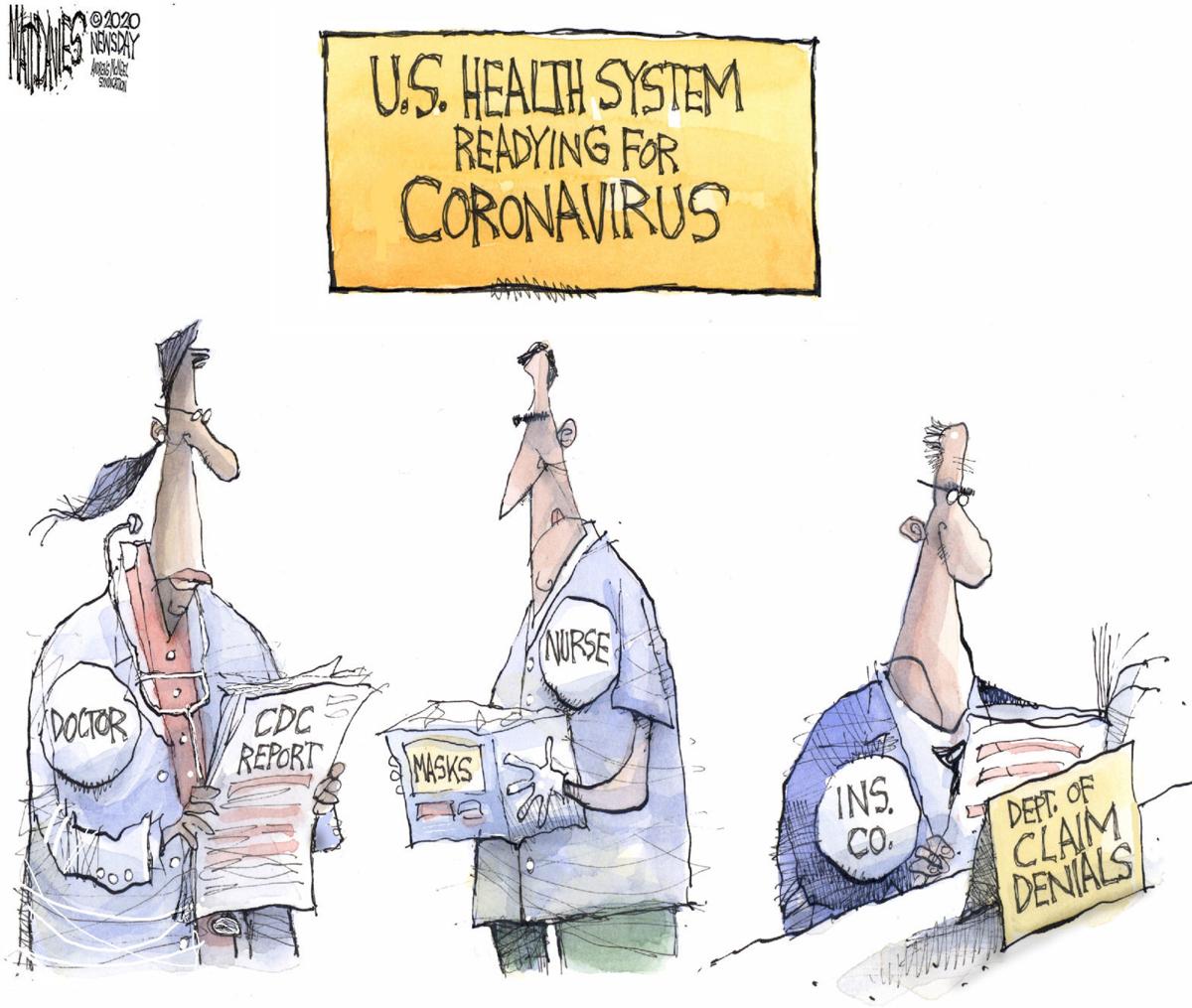
Cartoon – U.S Health System Readying for Coronavirus

Corona response | Cartoons | postregister.com

Coronavirus Dashboard

https://www.axios.com/coronavirus-west-virginia-first-case-ac32ce6d-5523-4310-a219-7d1d1dcb6b44.html

Dashboard of a downturn: coronavirus starts to set off some ...

  1. Global: Total confirmed cases as of 12:30 p.m. ET: 1,724,736 — Total deaths: 104,938 — Total recoveries: 390,335 — Map.
  2. U.S.: Total confirmed cases as of 12:30 p.m. ET: 503,594 — Total deaths: 18,860 — Total recoveries: 29,223 — Map.
  3. Public health latest: Chronic health conditions and inequality put people of color at heightened risk for coronavirus — New FDA guidelines focus on protecting food service workers.
  4. 2020 latest: Maryland’s June 2 primary will be “primarily through mail-in ballots” — Republicans worried about Trump’s daily briefings, eventual plan to restart economy.
  5. Business latest: Some smaller airlines won’t have to provide federal government with collateral.
  6. Federal government update: Most of U.S. won’t be able to reopen by May 1— Efforts to increase work requirements for food stamps paused — Tech companies are stepping into the void.
  7. 🌷🐇 Easter weekend: America’s biggest test yet on social distancing.
  8. 1 Gen Z thing: The coronavirus may be a defining experience.
  9. What should I do? Hydroxychloroquine questions answered — Pets, moving and personal health — Answers about the virus from Axios experts — What to know about social distancing — Q&A: Minimizing your coronavirus risk.
  10. Other resources: CDC on how to avoid the viruswhat to do if you get it.


U.S. coronavirus updates: U.S. passes Italy on reported deaths

https://www.axios.com/coronavirus-west-virginia-first-case-ac32ce6d-5523-4310-a219-7d1d1dcb6b44.html

Trump dodges whether he was briefed on aide's doomsday scenario on ...

The U.S. passed Italy for recorded coronavirus deaths on Saturday, per Johns Hopkins data. 18,860 Americans have died.

Where it stands: Government projections show lifting social distancing restrictions after just 30 days will lead to a dramatic infection spike this summer and death tolls would rival doing nothing, the New York Times reports.

The big picture: The coronavirus has killed more than 1,000 people every day in the U.S. since April 1, and infected over 501,000 others. New York’s death toll sits at 8,627 as of Saturday after 783 people died in 24 hours — a slight uptick from the day prior.

  • Public health officials warned this would be a deadly week for America, even as New York began to see declining trends of hospitalizations and ICU admissions.
  • All but eight states have issued stay-at-home orders.

What’s happening: New York hospitalizations appears to have plateaued as the state flattens the coronavirus curve, Gov. Andrew Cuomo (D) said on Saturday. Intubations are also down, a good sign for fatalities in the state.

  • Surgeon General Jerome Adams disagreed Friday that the federal government’s 30-day campaign will provide enough time for all Americans to resume their work and lifestyles.
  • Smaller airlines receiving bailouts of up to $100 million won’t have to provide the federal government with compensation, the Treasury Department said.
  • This Easter Sunday will be America’s biggest test yet for whether people can social distance long enough to flatten the coronavirus curve.
  • Apple and Google announced a joint effort to notify people via smartphone — on an opt-in basis — if they’ve come into contact with someone with the coronavirus, without having to share users’ location information with government authorities.
  • Roughly 16 million Americans have filed for jobless benefits over the past three weeks due to the pandemic’s growing economic repercussions. Trump is preparing to launch a second coronavirus task force focused on economic recovery.
  • President Trump has been increasingly frustrated with the pandemic’s impact on the economy and pushed for a May 1 reopening.
  • 20 cruise ships at port or anchorage in the U.S. have reported “known or suspected COVID-19 infection” among their crews, the CDC says.
  • The pandemic will likely drop global carbon dioxide emissions more than any prior crisis or war.
  • The U.S. expelled more than 6,000 migrants under new powers invoked by the CDC’s emergency public health order. The number of people coming into the U.S. has plummeted due to coronavirus travel bans.
  • Hospitals, doctors’ offices, suppliers and other health care facilities have now received $51 billion in “advance payments” from Medicare.
  • The federal government is deploying 90% of stockpiled medical equipment to fight the pandemic. These shipments aren’t enough to meet current demands from states.

Between the lines: Data on fatalities generally lag a couple of weeks behind what’s fueling the outbreak, which is mainly the number of new cases and hospitalizations, NIAID Director Dr. Anthony Fauci told Fox News on Wednesday.

  • State officials have stressed that lockdowns must continue even if cities begin to see slight improvements from social distancing.
  • Coronavirus testing capacity is still far enough behind demand that the U.S. continues to only test the sickest patients, which allowed the coronavirus outbreak to spread without detection, almost certainly making it worse than it would have been otherwise.

Go deeper: In photos: Life in the era of coronavirus across the U.S.


Timeline: How the U.S. fell behind on the coronavirus

https://www.axios.com/coronavirus-timeline-trump-administration-testing-c0858c03-5679-410b-baa4-dba048956bbf.html

Behind the Curve | Netflix

Early missteps allowed the new coronavirus to spread throughout the U.S for weeks before state and local officials implemented strict lockdowns designed to keep the pandemic from spinning further out of control.

Why it matters: The U.S. missed the boat on the kind of swift, early response that would have been most effective, and has been scrambling to catch up ever since. This timeline, compiled from official sources as well as media reports, shows how that all-important time was lost.

Dec. 31, 2019: China reports the novel coronavirus to the World Health Organization.

Jan. 6: The Centers for Disease Control and Prevention issued a travel notice for Wuhan, China.

Jan. 15: The first U.S. case is confirmed, in a man who traveled from Wuhan.

Jan. 17: The World Health Organization publishes a protocol for manufacturing coronavirus tests.

  • The Centers for Disease Control and Prevention opts to develop its own test instead of using the WHO’s.

Jan. 30: The WHO declares global health emergency.

Jan. 31: The Trump Administration suspended entry into the U.S. for most foreign nationals who had traveled to China in the past 14 days.

Feb. 5: The CDC begins shipping its diagnostic tests to state and local health agencies.

Feb. 8: Labs report problems with the CDC’s tests.

Feb. 24: President Trump tweets: “The Coronavirus is very much under control in the USA. We are in contact with everyone and all relevant countries. CDC & World Health have been working hard and very smart. Stock Market starting to look very good to me!”

Feb. 29: Washington state reports the first COVID-19 death in the U.S.

  • The Food and Drug Administration allows academic labs to develop and begin testing coronavirus testing kits while reviewing pending applications.
  • The WHO reports 86,604 coronavirus cases worldwide.

March 5: LabCorp and Quest Diagnostics launch coronavirus test for commercial use.

March 9: Trump tweets: “So last year 37,000 Americans died from the common Flu. It averages between 27,000 and 70,000 per year. Nothing is shut down, life & the economy go on. At this moment there are 546 confirmed cases of CoronaVirus, with 22 deaths. Think about that!”

  • The WHO reports 114,381 coronavirus cases worldwide.

March 13: Trump declares a national emergency, freeing up $50 billion in federal funds for states and territories.

March 15: 33 states and the District of Columbia closed public schools, according to Education Week. This included the New York City school system, the largest in the country.

March 16: Trump advises Americans to self-isolate for 15 days.

March 19: Trump signed into law an emergency coronavirus relief package for paid sick leave and free testing.

March 23: 9 states had stay-at-home orders.

  • Washington, Oregon, California, Louisiana, Illinois, Ohio, New York, Massachusetts and New Jersey.

March 26: The U.S. now leads world in coronavirus cases.

  • 12 more states issue stay-at-home orders, totaling 21: Idaho, Colorado, New Mexico, Michigan, Wisconsin, Kentucky, Indiana, West Virginia, Hawaii, Connecticut, Vermont and Delaware

March 29: Trump extends social distancing measures to April 30.

March 30: Nine more states issue stay-at-home orders, bringing the total to 30.

  • Governors say testing is still lacking in many states.

March 31: Trump warns of the potential for 100,000 to 240,000 deaths.

April 6: Twelve more states issue stay-at-home orders, bringing the total to 42.