Not jumping to conclusions on coronavirus treatment

https://mailchi.mp/39947afa50d2/the-weekly-gist-april-17-2020?e=d1e747d2d8

A Closer Look At Remdesivir, An Experimental Coronavirus Drug ...

Early reports of hastened recoveries among patients taking the antiviral drug remdesivir sent manufacturer Gilead Sciences’ stock soaring over 8 percent this morning, and contributing to an overall uptick in the market. The gains came after a scoop by healthcare news site STAT, which obtained a copy of an internal webinar from University of Chicago Medicine, where an infectious disease specialist discussed positive results from their early experience with remdesivir. The system recruited 125 patients into Gilead’s Phase 3 clinical trials for the drug; 113 patients had severe disease. The presenting physician reported rapid reductions in fever and improvements in respiratory symptoms, noting that just two patients had died, and most of the participating patients had already been discharged—on average after just six days, suggesting a long course of drug treatment may not be necessary.

The STAT leak comes on the heels of a NEJM article late last week, which reported clinical improvement of over two-thirds in COVID-19 patients who received remdesivir. Critics were quick to point out  numerous flaws in the study, including lack of a control group, cherry-picking of patients, and the deep involvement of the manufacturer in study design, many of which also apply to the University of Chicago report.

In the thick of the pandemic, doctors and patients’ families are understandably motivated to get very sick patients access to any treatment that may help—but the resulting frenzy following the publication of early results may make it even harder to get good data to understand what works, and what doesn’t.

In the words of one expert, “Fast trials are generally not very interpretable, interpretable trials are generally not fast”. In the search for a “COVID-19 cure”, it’s highly unlikely that any single drug will provide a cure for the viral illness, and the only way we’ll know if a treatment is truly working is to wait for the results of randomized, controlled trials—despite how frustrating it is to muster the patience to do so.


Beginning the long, winding journey back from coronavirus

https://mailchi.mp/39947afa50d2/the-weekly-gist-april-17-2020?e=d1e747d2d8

45cat - The Beatles - The Long And Winding Road / For You Blue ...

It was another brutal week in the coronavirus pandemic, with more than 2.1M cases and nearly 150,000 deaths worldwide. The US continued to be the hardest-hit country, reaching a daily record 4,591 deaths from COVID-19 on Thursday. The national death toll is now more than 35,000, though there are signs that the number of new cases in the US has begun to plateau, raising hopes that the worst days may be drawing to a close. Meanwhile, with strict stay-at-home measures continuing in most places across the country, the economic toll of the virus mounted. New unemployment claims rose by another 5.2M, bringing the estimated number of American jobs claimed by the virus to 22M, eliminating a decade’s worth of job growth, and raising the unemployment rate to an estimated 17 percent.

As the growth in new cases flattened, attention turned this week to plans to “reopen” the American economy. Despite insisting early in the week that he alone would decide when and how to reopen the country, President Trump yesterday unveiled a set of non-binding, “Opening Up America Again” guidelines for state and local officials to use in judging when to loosen restrictions. The guidelines suggest a three-stage, gated approach, gradually allowing individuals and employers to return to normal activities based on criteria including disease trends, hospital capacity, and the availability of robust testing. Progressing from one stage to the next is predicated on maintaining a downward trajectory in new cases—with any signs of a resurgence indicating a need to reimpose restrictions.

Missing from the White House plan are specific details about how states, cities, and healthcare providers are to procure and pay for the many millions of tests and extensive contact tracing that will need to be available to allow businesses, public transport systems, and other essential services to resume activity. By week’s end, about 3.5M coronavirus tests had been conducted nationally, but the daily number of tests conducted has plateaued, and the test-positivity rate is still troublingly high. Public health experts continue to warn that testing must ramp up significantly before any steps toward reopening can be considered, a difficult challenge given widespread reports of shortages of testing supplies and trained lab technicians. To bolster testing capacity, the Centers for Medicare and Medicaid Services (CMS) this week nearly doubled the amount it will pay laboratories to analyze tests using high-throughput equipment.

Three coalitions of states—in the Northeast, Midwest, and West Coast—were formed this week to coordinate regional efforts to reopen the economy. Among the issues they’ll need to address: interstate travel restrictions, coordinated purchasing of critical supplies, investments in contact tracing capabilities, and ongoing surveillance of the virus’ spread. With federal agencies taking a back seat to states (“You are going to call your own shots,” the President told governors on a call this week), it became clear that the road back from the coronavirus pandemic will be circuitous, with a patchwork of different timelines and approaches in different locations based on local conditions and resources.

In the words of William Gibson, “The future is here—it’s just not very evenly distributed.”


A New Statistic Reveals Why America’s COVID-19 Numbers Are Flat

https://www.theatlantic.com/technology/archive/2020/04/us-coronavirus-outbreak-out-control-test-positivity-rate/610132/

A New Statistic Reveals Why America's COVID-19 Numbers Are Flat ...

Few figures tell you anything useful about how the coronavirus has spread through the U.S. Here’s one that does.

How many people have the coronavirus in the United States? More than two months into the country’s outbreak, this remains the most important question for its people, schools, hospitals, and businesses. It is also still among the hardest to answer. At least 630,000 people nationwide now have test-confirmed cases of COVID-19, according to The Atlantic’s COVID Tracking Project, a state-by-state tally conducted by more than 100 volunteers and experts. But an overwhelming body of evidence shows that this is an undercount.

Whenever U.S. cities have tested a subset of the general population, such as homeless people or pregnant women, they have found at least some infected people who aren’t showing symptoms. And, as ProPublica first reported, there has been a spike in the number of Americans dying at home across the country. Those people may die of COVID-19 without ever entering the medical system, meaning that they never get tested.

There is clearly some group of Americans who have the coronavirus but who don’t show up in official figures. Now, using a statistic that has just become reliable, we can estimate the size of that group—and peek at the rest of the iceberg.

According to the Tracking Project’s figures, nearly one in five people who get tested for the coronavirus in the United States is found to have it. In other words, the country has what is called a “test-positivity rate” of nearly 20 percent.

That is “very high,” Jason Andrews, an infectious-disease professor at Stanford, told us. Such a high test-positivity rate almost certainly means that the U.S. is not testing everyone who has been infected with the pathogen, because it implies that doctors are testing only people with a very high probability of having the infection. People with milder symptoms, to say nothing of those with none at all, are going undercounted. Countries that test broadly should encounter far more people who are not infected than people who are, so their test-positivity rate should be lower.

The positivity rate is not the same as the proportion of COVID-19 cases in the American population at large, a metric called “prevalence.”* Nobody knows the true number of Americans who have been exposed to or infected with the coronavirus, though attempts to produce much sharper estimates of that figure through blood testing are under way. Prevalence is a crucial number for epidemiologists, in part because it lets them calculate a pathogen’s true infection-fatality rate: the number of people who die after becoming infected.

But the positivity rate is still valuable. “It’s not a normal metric, but it can be a very useful one in some circumstances,” Andrews said. The test-positivity rate is often used to track the spread of rare but deadly diseases, such as malaria, in places where most people aren’t able to get tested, he said. And if the same proportion of a population is being tested over time, the test-positivity rate can even be used to calculate the contagiousness of a disease.

Because the number of Americans tested for COVID-19 has changed over time, the U.S. test-positivity rate can’t yet provide much detailed information about the contagiousness or fatality rate of the disease. But the statistic can still give a rough sense of how bad a particular outbreak is by distinguishing between places undergoing very different sizes of epidemics, Andrews said. A country with a 25 percent positivity rate and one with a 2 percent positivity rate are facing “vastly different epidemics,” he said, and the 2 percent country is better off.

In that light, America’s 20 percent positivity rate is disquieting. The U.S. did almost 25 times as many tests on April 15 as on March 15, yet both the daily positive rate and the overall positive rate went up in that month. If the U.S. were a jar of 330 million jelly beans, then over the course of the outbreak, the health-care system has reached in with a bigger and bigger scoop. But every day, 20 percent of the beans it pulls out are positive for COVID-19. If the outbreak were indeed under control, then we would expect more testing—that is, a larger scoop—to yield a smaller and smaller proportion of positives. So far, that hasn’t happened.

In an ideal testing regime—and in any of the testing regimes that experts say must exist before the United States can end its lockdowns—anyone with a fever and a dry cough would be tested immediately. A very large portion, if not most, of those people would turn out not to be infected with the new coronavirus, SARS-CoV-2, because humans are susceptible to many other respiratory infections. But when tests are rationed so strictly, only people with severe symptoms make it into the testing pool, ensuring that the positivity rate will be extremely high.

Local rationing rules are not the only reason that Americans are not getting tested. Some people live in a place that’s not doing much testing at all, either because doctors’ offices have no tests to offer or because of an already strained or nonexistent local health-care system. Others avoid the doctor if they’re sick, or never get sick enough to seek a test—but if the U.S. were testing more people, as experts say it must, then general-population surveillance or workplace testing could detect their illness, too.

The test-positivity rate, then, is a decent (if unusual) proxy for the severity of an outbreak in an area. And it shows clearly that the U.S. still lags far behind other countries in the course of fighting its outbreak. South Korea—which discovered its first coronavirus case on the same day as the U.S.—has tested more than half a million people, or about 1 percent of its population, and discovered about 10,500 cases. The U.S. has now tested 3.2 million people, which is also about 1 percent of its population, but it has found more than 630,000 cases. So while the U.S. has a 20 percent positivity rate, South Korea’s is only about 2 percent—a full order of magnitude smaller.

South Korea is not alone in bringing its positivity rate down: America’s figure dwarfs that of almost every other developed country. CanadaGermany and Denmark have positivity rates from 6 to 8 percent. Australia and New Zealand have 2 percent positivity rates. Even Italy—which faced one of the world’s most ravaging outbreaks—has a 15 percent rate. It has found nearly 160,000 cases and conducted more than a million tests. Virtually the only wealthy country with a larger positivity rate than the U.S. is the United Kingdom, where more than 30 percent of people tested for the virus have been positive.

Comparing American states to regions in other countries results in the same general pattern. In Lombardy, the hardest hit part of Italy, the positive rate today stands at about 28 percent. That’s comparable to the rate in Connecticut. But New York, so far the hardest hit state in the U.S., has an even higher rate of 41 percent. And in New Jersey, an astounding one in two people tested for the virus are found to have it.

The prevalence of COVID-19 might be higher in the New York area than anywhere else in the country, but high test-positivity rates are not confined to the mid-Atlantic. Five other states have a positive rate above 20 percent: Michigan, Georgia, Massachusetts, Illinois, and Colorado. They are spread across the country, and they all have obviously serious outbreaks. Each of the eight states with positive rates over 20 percent has, individually, reported more COVID-19 deaths than South Korea.

Hawaii, meanwhile, has tested twice as many people per capita as Illinois, but its positivity rate is only one-tenth as high as the larger state’s. As the outbreak comes under control, more states should have positivity rates closer to Hawaii’s, Andrews, the Stanford professor, said. At the beginning of a pandemic, both the actual number of infections and the number of tests per day shoot up, and the positivity rate is controlled by whichever happens to grow faster, he said. In this case, the faster-growing number appears to have been infections. “As things stabilize, if the testing rate declines and the positivity rate declines, you have some good signal that the epidemic is declining,” he said.   

Not every epidemiologist feels as comfortable drawing conclusions from the test-positivity rate as Andrews. “If you want to interpret [the positivity rate] as a hint to prevalence in a particular location, you have to assume lots of other things stay constant,” Daniel Westreich, an epidemiology professor at the University of North Carolina, told us. He warned that too little was still known about who exactly is getting tested, and how reliable the tests are, to draw large conclusions from the positivity rate alone.

“We just haven’t tested enough people yet,” he said. “If you were doing random screening of the whole population, we just don’t know what you’d see. We don’t know how many asymptomatic viral shedders are out there.” As such, he advised extreme caution in using the rate—but being cautious about data, he added, “is my job.”

We feel confident reporting the U.S. test-positivity rate now for several reasons. First, we know that when states and cities ration tests, they do so by imposing criteria that allow for only the sickest or the most vulnerable people, such as residents of nursing homes, to get tested. We know that in states with a very high test-positivity rate, such as New Jersey, many people are still dying in nursing homes without getting tested. And we know that, even though a wide variety of nose-swab tests are being used across the country, the type of test used—called a polymerase chain reaction, or PCR, test—is generally very reliable. Westreich and Andrews said that any PCR test was “pretty good” at detecting true negatives.

Finally, the test-positivity rate has become much more reliable nationwide over the past few weeks. As recently as the end of March, not all states reported every negative test result from commercial laboratories. Nearly every state now publishes those numbers.

While our numbers still probably do not capture every coronavirus test in the U.S., outside evidence now suggests that our data are fairly complete. When the White House Coronavirus Task Force has reported the number of tests completed nationwide, its numbers have broadly matched the COVID Tracking Project’s. In addition, the largest commercial-test processors, Quest and LabCorp, have released top-line statistics that align with ours at the COVID Tracking Project.

The high positivity rate also suggests that new cases in the U.S. have plateaued only because the country has hit a ceiling in its testing capacity. Looking solely at positives, the U.S. is steaming toward 650,000 confirmed cases, but the number of new cases per day appears to be plateauing or even declining.

Graph of new positive COVID-19 cases from March 1 to April 15

There are several ways to interpret this development. It might suggest, for instance, that the more than 3.2 million tests completed in the U.S. over the past two months have finally captured a good chunk of the people who are actually infected. While it’s clear that the country is not capturing every case, this decline in new positive cases might suggest the country has started to get the virus’s spread under control.

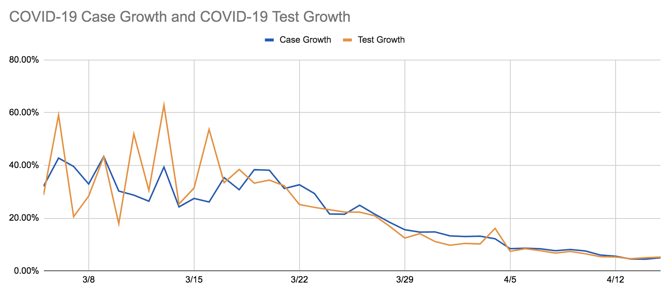
But there is another way to interpret the decline in new cases: The growth in the number of new tests completed per day has also plateaued. Since April 1, the country has tested roughly 145,000 people every day with no steady upward trajectory. The growth in the number of new cases per day, and the growth in the number of new tests per day, are very tightly correlated.

Graph comparing COVID-19 case growth and test growth

This tight correlation suggests that if the United States were testing more people, we would probably still be seeing an increase in the number of COVID-19 cases. And combined with the high test-positivity rate, it suggests that the reservoir of unknown, uncounted cases of COVID-19 across the country is still very large.

Each of those uncounted cases is a small tragedy and a microcosm of all the ways the U.S. testing infrastructure is still failing. When Sarah Pavis, a 36-year-old engineer in New York, woke up on Tuesday, she was out of breath and her heart was racing. An hour of deep breathing failed to calm her pulse. When her extremities started tingling, she called 911. It was her ninth day of COVID-19 symptoms.

New York City’s positivity rate is an astonishing 55 percent. More than 111,000 of the city’s residents have lab-confirmed cases of COVID-19, but Pavis is not among them. When the ambulance arrived at Pavis’s apartment, an EMS worker took her vitals, then explained there was little he could do to help. The city’s hospitals only admitted people with a blood-oxygen level of 94 percent or lower, he said. Pavis’s blood-oxygen reading was 96 percent. That 2 percent difference meant that her illness was not serious enough to merit hospitalization, not serious enough to be tested, not serious enough to be counted.


Early peek at data on Gilead coronavirus drug suggests patients are responding to treatment

Early peek at data on Gilead coronavirus drug suggests patients are responding to treatment

Gilead data suggests coronavirus patients are responding to treatment

A Chicago hospital treating severe Covid-19 patients with Gilead Sciences’ antiviral medicine remdesivir in a closely watched clinical trial is seeing rapid recoveries in fever and respiratory symptoms, with nearly all patients discharged in less than a week, STAT has learned.

Remdesivir was one of the first medicines identified as having the potential to impact SARS-CoV-2, the novel coronavirus that causes Covid-19, in lab tests. The entire world has been waiting for results from Gilead’s clinical trials, and positive results would likely lead to fast approvals by the Food and Drug Administration and other regulatory agencies. If safe and effective, it could become the first approved treatment against the disease.

The University of Chicago Medicine recruited 125 people with Covid-19 into Gilead’s two Phase 3 clinical trials. Of those people, 113 had severe disease. All the patients have been treated with daily infusions of remdesivir.

“The best news is that most of our patients have already been discharged, which is great. We’ve only had two patients perish,” said Kathleen Mullane, the University of Chicago infectious disease specialist overseeing the remdesivir studies for the hospital.

Her comments were made this week during a video discussion about the trial results with other University of Chicago faculty members. The discussion was recorded and STAT obtained a copy of the video.

The outcomes offer only a snapshot of remdesivir’s effectiveness. The same trials are being run concurrently at other institutions, and it’s impossible to determine the full study results with any certainty. Still, no other clinical data from the Gilead studies have been released to date, and excitement is high. Last month, President Trump touted the potential for remdesivir — as he has for many still-unproven treatments — and said it “seems to have a very good result.”

In a statement Thursday, Gilead said: “What we can say at this stage is that we look forward to data from ongoing studies becoming available.”

Gilead had said to expect results for its trial involving severe cases in April. Mullane said during her presentation that data for the first 400 patients in the study would be “locked” by Gilead Thursday, meaning that results could come any day.

Mullane, while encouraged by the University of Chicago data, made clear her own hesitancy about drawing too many conclusions.

“It’s always hard,” she said, because the severe trial doesn’t include a placebo group for comparison. “But certainly when we start [the] drug, we see fever curves falling,” she said. “Fever is now not a requirement for people to go on trial, we do see when patients do come in with high fevers, they do [reduce] quite quickly. We have seen people come off ventilators a day after starting therapy. So, in that realm, overall our patients have done very well.”

She added: “Most of our patients are severe and most of them are leaving at six days, so that tells us duration of therapy doesn’t have to be 10 days. We have very few that went out to 10 days, maybe three,” she said.

Reached by STAT, Mullane confirmed the authenticity of the footage but declined to comment further. In a statement, the University of Chicago Medicine said “drawing any conclusions at this point is premature and scientifically unsound.” 

Asked about the data, Eric Topol, director of the Scripps Research Translational Institute, described them as “encouraging.”

“The severely hit patients are at such high-risk of fatality. So if it’s true that many of the 113 patients were in this category and were discharged, it’s another positive signal that the drug has efficacy,” he said, adding that it will be important to see more data from randomized controlled studies.

Gilead’s severe Covid-19 study includes 2,400 participants from 152 different clinical trial sites all over the world. Its moderate Covid-19 study includes 1,600 patients in 169 different centers, also all over the world.

The trial is investigating five- and 10-day treatment courses of remdesivir. The primary goal is a statistical comparison of patient improvement between the two treatment arms. Improvement is measured using a seven-point numerical scale that encompasses death (at worst) and discharge from hospital (best outcome), with various degrees of supplemental oxygen and intubation in between.

The lack of a control arm in the study could make interpreting the results more challenging. 

A lack of data has led to yo-yoing expectations for the drug. Two studies in China had enrollment suspended partway through because there were not enough patients available. A recent report of patients given the drug under a special program to make it available to those who are very ill generated both excitement and skepticism.

In scientific terms, all the data are anecdotal until the full trial reads out, meaning that they should not be used to draw final conclusions. But some of the anecdotes are dramatic.

Slawomir Michalak, a 57-year-old factory worker from a suburb west of Chicago, was among the participants in the Chicago study. One of his daughters started feeling ill in late March and was later diagnosed with mild Covid-19. Michalak, by contrast, came down with a high fever and reported shortness of breath and severe pain in his back.

“It felt like someone was punching me in the lungs,” he told STAT.

At his wife’s urging, Michalak went to the University of Chicago Medicine hospital on Friday, April 3. His fever had spiked to 104 and he was struggling to breath. At the hospital, he was given supplemental oxygen. He also agreed to participate in Gilead’s severe Covid-19 clinical trial.

His first infusion of remdesivir was on Saturday, April 4. “My fever dropped almost immediately and I started to feel better,” he said.

By his second dose on Sunday, Michalak said he was being weaned off oxygen. He received two more daily infusions of remdesivir and recovered enough to be discharged from the hospital on Tuesday, April 7.

“Remdesivir was a miracle,” he said. 

The world is waiting to find out if it is really so.


Researchers stop COVID-19 drug trial after 11 patients die

https://bigthink.com/coronavirus/covid-treatment-deaths

COVID-19 chloroquine trial cut short after 11 patients die - Big Think

  • Scientists around the world are currently experimenting with chloroquine and hydroxychloroquine as potential treatments for COVID-19.
  • Despite some early reports suggesting that these antimalarial drugs may help prevent and treat the disease, there’s still no solid evidence showing that they’re a safe and effective treatment.
  • The recent trial in Brazil suggests that high doses of chloroquine are toxic and should be avoided.

A small clinical trial in Brazil suggests that one potential treatment for COVID-19 comes with life-threatening side effects.

As the world searches for effective COVID-19 treatments, some nations have authorized doctors to give patients antimalarial drugs as part of experimental clinical trials. These trials show some indication that the drugs, chloroquine and the closely related hydroxychloroquine, may be effective at treating and preventing COVID-19.

Early reports from China and France, for example, suggested that the drugs may help improve patients’ conditions. But health experts have cautioned against overhyping the results, flagging methodological issues in the research like not including a control group or having a small sample size. To date, there’s no solid evidence showing that these drugs effectively treat COVID-19 or block coronaviruses from infecting cells.

What is clear, based on previous research and the new trial in Brazil, is that these drugs can cause serious side effects, particularly among those with heart conditions.

“The antimalarial medication hydroxychloroquine and the antibiotic azithromycin are currently gaining attention as potential treatments for COVID-19, and each have potential serious implications for people with existing cardiovascular disease,” the American Health Association notes in a statement.

“Complications include severe electrical irregularities in the heart such as arrythmia (irregular heartbeat), polymorphic ventricular tachycardia (including Torsade de Pointes) and long QT syndrome, and increased risk of sudden death.”

In the recent Brazil trial, researchers gave chloroquine to 81 COVID-19 patients in a hospital in Manaus. The study involved two groups: One received a high dose of 12 grams of chloroquine over 10 days, the second group received 2.7 grams over five days. Both groups also received the antibiotic azithromycin, which poses its own heart risks.

By the sixth day of the trial, 11 patients had died, and the researchers decided to stop giving the drug to the high-dose group.

“Preliminary findings suggest that the higher chloroquine dosage (10-day regimen) should not be recommended for COVID-19 treatment because of its potential safety hazards. Such results forced us to prematurely halt patient recruitment to this arm,” the team wrote in a preprint paper.

The high-dose group had an especially high risk of suffering heart arrhythmias, a finding also observed in a separate trial on hydroxychloroquine conducted in a hospital in France, which cut the trial short.

“To me, this study conveys one useful piece of information, which is that chloroquine causes a dose-dependent increase in an abnormality in the ECG that could predispose people to sudden cardiac death,” Dr. David Juurlink, an internist and the head of the division of clinical pharmacology at the University of Toronto, told The New York Times.

Still, it’s possible that some combination of chloroquine, hydroxychloroquine and azithromycin may be effective at preventing and treating COVID-19. The researchers behind the Brazil trial said more research is “urgently needed,” but warned doctors against using high dosages.

“We therefore strongly recommend that this dosage is no longer used anywhere for the treatment of severe COVID-19, especially because in the real world older patients using cardiotoxic drugs should be the rule.”

One major problem in searching for COVID-19 treatments is that it’s currently difficult to conduct clinical trials in a normal and methodologically sound manner. Despite increasing demand for drugs like chloroquine, many health experts are warning that more research is needed to understand their effects and risks.

“The urgency of COVID-19 must not diminish the scientific rigor with which we approach COVID-19 treatment,” Robert A. Harrington, M.D., FAHA, president of the American Heart Association said in a recent statement. “While these medications may work against COVID-19 individually or in combination, we recommend caution with these medications for patients with existing cardiovascular disease.”


More than 9,000 healthcare workers have contracted COVID-19 as of last week, CDC says

https://www.healthcarefinancenews.com/node/139992?mkt_tok=eyJpIjoiTWprMk5XVmlOVFV5T0RNMyIsInQiOiJ6dFdBNXNaYUVKdER0RXQzckFKMVpmanhyRjRBMjVSdHFrajR0UnBJSlkyWG50SzNtalp5a3FXXC9HUFl2ZndYcEZ2TVdyd1VvdGxLRWUrZkRCTXB6U3AxRTQzTXRtWTJoUDN3QytSbVwvV1IzZXg5QnpYdWp0SDhXV2tjQ25UTDNiIn0%3D

Healthcare Finance News

CDC warns the data may not reflect the true scope of the problem, as uneven reporting of confirmed cases likely underestimates the impact.

Healthcare workers who treat patients infected with the COVID-19 coronavirus are at risk of contracting the disease themselves due to frequent exposure and proximity to such patients.

New figures from the U.S. Centers for Disease Control and Prevention detail the extent to which this is true, finding that 9,282 healthcare workers across the country are confirmed to have been infected.

Of those confirmed cases, 27 have died, according to numbers culled from February 12 to April 9. About 55% of all healthcare personnel who were infected only had contact with COVID-19 patients within the healthcare setting.

The vast majority of confirmed positive healthcare workers – 90% – were not hospitalized. Up to 5% of those who were hospitalized ended up in intensive care, while 10 of the 27 deaths were among those workers 65 years old or older.

The CDC warned that the data may not reflect the true scope of the problem, as uneven reporting of confirmed cases across the country has resulted in figures that likely underestimate the number of healthcare workers infected.

WHAT’S THE IMPACT?

The number of coronavirus cases among healthcare workers is expected to rise. While this is due in part to more communities experiencing widespread transmission, the nature of working in the healthcare field understandably contributes to the risk: About 45% of workers who tested positive lived in households or communities in which the virus was present, meaning they risk exposure on two fronts, both inside a healthcare setting and outside of it.

Compounding the problem is that transmission can come from unrecognized sources, including those who are asymptomatic or presymptomatic. Because of that, contact tracing after occupational exposures will likely fail to identify many healthcare workers who are at risk for developing COVID-19.

As with the general population, the higher a healthcare workers’ age, the more likely they were to experience a severe outcome, although severe outcomes – including death – are possible at any age.

Preventative measures meant to staunch the spread among healthcare personnel include screening all workers for fever and respiratory symptoms at the beginning of their shifts, prioritizing such workers for testing, and discouraging working while sick by offering flexible and non-punitive medical leave policies.

The CDC said older healthcare personnel, or those with underlying health conditions, should consult with their healthcare provider and employee health program to better understand their risks. On hospitals’ part, they should consider the enhanced likelihood of severe outcomes among older personnel when mobilizing retired workers to increase surge capacity, especially in light of a shortage of personal protective equipment. One consideration would be preferential assignment of retired workers to lower-risk settings such as telehealth, administrative assignments or clinics for non-COVID-19 patients.

THE LARGER TREND

PPE shortages, insufficient tests, slow results and a dearth of ventilators are all factors that contribute to risk of infection among healthcare workers, and these challenges play off each other in a toxic cycle, an Office of the Inspector General report found last week.

Hospitals said their most significant challenges centered on testing and caring for patients with COVID-19 and keeping staff safe. Severe shortages of testing supplies and extended waits for test results limited hospitals’ ability to monitor the health of patients and staff, and widespread shortages of PPE are putting both groups at risk. Hospitals also said they were not always able to maintain adequate staffing levels or to offer staff adequate support.


W.H.O., Now Trump’s Scapegoat, Warned About Coronavirus Early and Often

W.H.O. Warned Trump About Coronavirus Early and Often - The New ...

The World Health Organization, always cautious, acted more forcefully and faster than many national governments. But President Trump has decided to cut off U.S. funding to the organization.

On Jan. 22, two days after Chinese officials first publicized the serious threat posed by the new virus ravaging the city of Wuhan, the chief of the World Health Organization held the first of what would be months of almost daily media briefings, sounding the alarm, telling the world to take the outbreak seriously.

But with its officials divided, the W.H.O., still seeing no evidence of sustained spread of the virus outside of China, declined the next day to declare a global public health emergency. A week later, the organization reversed course and made the declaration.

Those early days of the epidemic illustrated the strengths and weaknesses of the W.H.O., an arm of the United Nations that is now under fire by President Trump, who on Tuesday ordered a cutoff of American funding to the organization.

With limited, constantly shifting information to go on, the W.H.O. showed an early, consistent determination to treat the new contagion like the threat it would become, and to persuade others to do the same. At the same time, the organization repeatedly praised China, acting and speaking with a political caution born of being an arm of the United Nations, with few resources of its own, unable to do its work without international cooperation.

Mr. Trump, deflecting criticism that his own handling of the crisis left the United States unprepared, accused the W.H.O. of mismanaging it, called the organization “very China-centric” and said it had “pushed China’s misinformation.”

But a close look at the record shows that the W.H.O. acted with greater foresight and speed than many national governments, and more than it had shown in previous epidemics. And while it made mistakes, there is little evidence that the W.H.O. is responsible for the disasters that have unfolded in Europe and then the United States.

The W.H.O. needs the support of its international members to accomplish anything — it has no authority over any territory, it cannot go anywhere uninvited, and it relies on member countries for its funding. All it can offer is expertise and coordination — and even most of that is borrowed from charities and member nations.

The W.H.O. has drawn criticism as being too close to Beijing — a charge that grew louder as the agency repeatedly praised China for cooperation and transparency that others said were lacking. China’s harsh approach to containing the virus drew some early criticism from human rights activists, but it proved effective and has since been adopted by many other countries.

A crucial turning point in the pandemic came on Jan. 20, after China’s central government sent the country’s most famous epidemiologist, Zhong Nanshan, to Wuhan to investigate the new coronavirus racing through that city of 11 million people. Dr. Zhong delivered a startling message on national television: Local officials had covered up the seriousness of the outbreak, the contagion spread quickly between people, doctors were dying and everyone should avoid the city.

Dr. Zhong, an eccentric 83-year-old who led the fight against the SARS outbreak of 2002 and 2003, was one of few people in China with enough standing to effectively call Wuhan’s mayor, Zhou Xianwang, a rising official in the Communist Party, a liar.

Mr. Zhou, eager to see no disruption in his plans for a local party congress from Jan. 11 to 17 and a potluck dinner for 40,000 families on Jan. 18, appears to have had his police and local health officials close the seafood market, threaten doctors and assure the public that there was little or no transmission.

Less than three days after Dr. Zhong’s warning was broadcast, China locked down the city, preventing anyone from entering or leaving and imposing strict rules on movement within it — conditions it would later extend far behind Wuhan, encompassing tens of millions of people.

The national government reacted in force, punishing local officials, declaring that anyone who hid the epidemic would be “forever nailed to history’s pillar of shame,” and deploying tens of thousands of soldiers, medical workers and contact tracers.

It was the day of the lockdown that the W.H.O. at first declined to declare a global emergency, its officials split and expressing concern about identifying a particular country as a threat, and about the impact of such a declaration on people in China. Such caution is a standard — if often frustrating — fact of life for United Nations agencies, which operate by consensus and have usually avoided even a hint of criticizing nations directly.

Despite Dr. Zhong’s warning about human-to-human transmission, Tedros Adhanom Ghebreyesus, the W.H.O.’s director-general, said there was not yet any evidence of sustained transmission outside China.

“That doesn’t mean it won’t happen,” Dr. Tedros said.

“Make no mistake,” he added. “This is an emergency in China, but it has not yet become a global health emergency. It may yet become one.”

The W.H.O. was still trying to persuade China to allow a team of its experts to visit and investigate, which did not occur until more than three weeks later. And the threat to the rest of the world on Jan. 23 was not yet clear — only about 800 cases and 25 deaths had been reported, with only a handful of infections and no deaths reported outside China.

“In retrospect, we all wonder if something else could have been done to prevent the spread we saw internationally early on, and if W.H.O. could have been more aggressive sooner as an impartial judge of the China effort,” said Dr. Peter Rabinowitz, co-director of the MetaCenter for Pandemic Preparedness and Global Health Security at the University of Washington.

Amir Attaran, a public health and law professor at the University of Ottawa, said, “Clearly a decision was taken by Dr. Tedros and the organization to bite their tongues, and to coax China out of its shell, which was partially successful.”

“That in no way supports Trump’s accusation,” he added. “The president is scapegoating, dishonestly.”

Indeed, significant shortcomings in the administration’s response arose from a failure to follow W.H.O. advice.

The Centers for Disease Control and Prevention bungled the rollout of diagnostic tests in the United States, even as the W.H.O. was urging every nation to implement widespread testing. And the White House was slow to endorse stay-home restrictions and other forms of social distancing, even after the W.H.O. advised these measures were working in China.

It is impossible to know whether the nations of the world would have acted sooner if the W.H.O. had called the epidemic a global emergency, a declaration with great public relations weight, a week earlier than it did.

But day after day, Dr. Tedros, in his rambling style, was delivering less formal warnings, telling countries to contain the virus while it was still possible, to do testing and contact tracing, and isolate those who might be infected. “We have a window of opportunity to stop this virus,” he often said, “but that window is rapidly closing.”

In fact, the organization had already taken steps to address the coronavirus, even before Dr. Zhong’s awful revelation, drawing attention to the mysterious outbreak.

On Jan. 12, Chinese scientists published the genome of the virus, and the W.H.O. asked a team in Berlin to use that information to develop a diagnostic test. Just four days later, they produced a test and the W.H.O. posted online a blueprint that any laboratory around the world could use to duplicate it.

On Jan. 21, China shared materials for its test with the W.H.O., providing another template for others to use.

Some countries and research institutions followed the German blueprint, while others, like the C.D.C., insisted on producing their own tests. But a flaw in the initial C.D.C. test, and the agency’s slowness in approving testing by labs other than its own, contributed to weeks of delay in widespread testing in the United States.

In late January, Mr. Trump praised China’s efforts. Now, officials in his administration accuse China of concealing the extent of the epidemic, even after the crackdown on Wuhan, and the W.H.O. of being complicit in the deception. They say that lulled the West into taking the virus less seriously than it should have.

Larry Gostin, director of the W.H.O.’s Center on Global Health Law, said the organization relied too heavily on the initial assertions out of Wuhan that there was little or no human transmission of the virus.

“The charitable way to look at this is that W.H.O. simply had no means to verify what was happening on the ground,” he said. “The less charitable way to view it is that the W.H.O. didn’t do enough to independently verify what China was saying, and took China at face value.”

The W.H.O. was initially wary of China’s internal travel restrictions, but endorsed the strategy after it showed signs of working.

“Right now, the strategic and tactical approach in China is the correct one,” Dr. Michael Ryan, the W.H.O.’s chief of emergency response, said on Feb. 18. “You can argue whether these measures are excessive or restrictive on people, but there is an awful lot at stake here in terms of public health — not only the public health of China but of all people in the world.”

A W.H.O. team — including two Americans, from the C.D.C. and the National Institutes of Health — did visit China in mid-February for more than a week, and its leaders said they were given wide latitude to travel, visit facilities and talk with people.

Whether or not China’s central government intentionally misstated the scale of the crisis, incomplete reporting has been seen in every other hard-hit country. France, Italy and Britain have all acknowledged seriously undercounting cases and deaths among people who were never hospitalized, particularly people in nursing and retirement homes.

New York City this week reported 3,700 deaths it had not previously counted, in people who were never tested. The United States generally leaves it to local coroners whether to test bodies for the virus, and many lack the capacity to do so.

In the early going, China was operating in a fog, unsure of what it was dealing with, while its resources in and around Wuhan were overwhelmed. People died or recovered at home without ever being treated or tested. Official figures excluded, then included, then excluded again people who had symptoms but had never been tested.

On Jan. 31 — a day after the W.H.O.’s emergency declaration — President Trump moved to restrict travel from China, and he has since boasted that he took action before other heads of state, which was crucial in protecting the United States. In fact, airlines had already canceled the great majority of flights from China, and other countries cut off travel from China at around the same time Mr. Trump did.

The first known case in the United States was confirmed on Jan. 20, after a man who was infected but not yet sick traveled five days earlier from Wuhan to the Seattle area, where the first serious American outbreak would occur.

The W.H.O. said repeatedly that it did not endorse international travel bans, which it said are ineffectual and can do serious economic harm, but it did not specifically criticize the United States, China or other countries that took that step.

Experts say it was China’s internal travel restrictions, more severe than those in the West, that had the greatest effect, delaying the epidemic’s spread by weeks and allowing China’s government to get ahead of the outbreak.

The W.H.O. later conceded that China had done the right thing. Brutal as they were, China’s tactics apparently worked. Some cities were allowed to reopen in March, and Wuhan did on April 8.

The Trump administration has not been alone in criticizing the W.H.O. Some public health experts and officials of other countries, including Japan’s finance minister, have also said the organization was too deferential to China.

The W.H.O. has altered some of its guidance over time — a predictable complication in dealing with a new pathogen, but one that has spurred criticism. But at times, the agency also gave what appeared to be conflicting messages, leading to confusion.

In late February, before the situation in Italy had turned from worrisome to catastrophic, Prime Minister Giuseppe Conte and other government officials, citing W.H.O. recommendations, said the regional governments of Lombardy and Veneto were doing excessive testing.

“We have more people infected because we made more swabs,” Mr. Conte said.

In fact, the W.H.O. had not said to limit testing, though it had said some testing was a higher priority. It was — and still is — calling for more testing in the context of tracing and checking people who had been in contact with infected patients, but few Western countries have done extensive contact tracing.

But the organization took pains not to criticize individual countries — including those that did insufficient testing.

On March 16, Dr. Tedros wrote on Twitter, “We have a simple message for all countries: test, test, test.” Three days later, a W.H.O. spokeswoman said that there was “no ‘one size fits all’ with testing,” and that “each country should consider its strategy based on the evolution of the outbreak.”

The organization was criticized for not initially calling the contagion a pandemic, meaning an epidemic spanning the globe. The term has no official significance within the W.H.O., and officials insisted that using it would not change anything, but Dr. Tedros began to do so on March 11, explaining that he made the change to draw attention because too many countries were not taking the group’s warnings seriously enough.


Testing Falls Woefully Short as Trump Seeks an End to Stay-at-Home Orders

Coronavirus Testing Falls Woefully Short as Trump Seeks to Reopen ...

As President Trump pushes to reopen the economy, most of the country is not conducting nearly enough testing to track the path and penetration of the coronavirus in a way that would allow Americans to safely return to work, public health officials and political leaders say.

Although capacity has improved in recent weeks, supply shortages remain crippling, and many regions are still restricting tests to people who meet specific criteria. Antibody tests, which reveal whether someone has ever been infected with the coronavirus, are just starting to be rolled out, and most have not been vetted by the Food and Drug Administration.

Concerns intensified on Wednesday as Senate Democrats released a $30 billion plan for building up what they called “fast, free testing in every community,” saying they would push to include it in the next pandemic relief package. Business leaders, who participated in the first conference call of Mr. Trump’s advisory council on restarting the economy, warned that it would not rebound until people felt safe to re-emerge, which would require more screening.

And Gov. Andrew M. Cuomo of New York reiterated his call for federal assistance to ramp up testing, both for the virus and for antibodies.

“The more testing, the more open the economy. But there’s not enough national capacity to do this,” Mr. Cuomo, a Democrat, said at his daily briefing in Albany. “We can’t do it yet. That is the unvarnished truth.”

As the governor spoke, a PowerPoint slide behind him said, “WE NEED FEDERAL SUPPORT.”

At his own briefing later in the day, Mr. Trump boasted of having “the most expansive testing system anywhere in the world” and said that some states could even reopen before May 1, the date his task force had tentatively set. Twenty-nine states, he added, “are in good shape.”

From the beginning of the coronavirus crisis, lapses by the federal government have compromised efforts to detect the pathogen in patients and communities. A diagnostic test developed by the Centers for Disease Control and Prevention proved to be flawed. The F.D.A. failed to speed approval for commercial labs to make tests widely available. All of that means that the U.S. has been far behind in combating the virus.

Whether in New York City, with its densely packed 8.4 million residents, or Nebraska, with fewer than two million spread across mostly rural expanses, widespread diagnostic and antibody testing will be crucial for determining a number of factors: How many in a community are infected but asymptomatic? Who has the protective antibodies that might allow them to go about their lives without fear? Are workplaces and schools safe?

“It is great that we are flattening the curve,” said Dr. Mark McClellan, director of the Margolis Center for Health Policy at Duke University, who worked in the George W. Bush administration and is advising state and federal policymakers on the virus response.

“But for this next phase, where we are really aiming to detect and stamp out smaller outbreaks before they get so big, testing is critical for that,” he said. “So we have to plan ahead now for much larger capacity.”

By the end of May, he added, “we will maybe be up to two million tests a week, but we are definitely not at that level now.”

Nationally, an average of 145,000 people have been tested for the virus each day over the past week, according to the Covid Tracking Project, which reported a total of nearly 3.1 million tests across the United States as of Tuesday night.

State health officials and medical providers around the country say they are unable to test as many people as they would like. Many of them say the biggest challenge is getting not the diagnostic tests themselves but the supplies to process them, including chemical reagents, swabs and pipettes. Manufacturers are facing a huge global demand as every country fights the pandemic, with many attempting the widest-scale testing they have ever undertaken.

“We’re at a really critical juncture and the supply chain has not yet caught up,” Scott Becker, chief executive of the Association of Public Health Laboratories, said on Wednesday.

Yet even as people waited hours for drive-through testing in California, Florida, New Jersey and elsewhere, some laboratories reported having ample capacity.

Two weeks ago, officials at University of California San Diego Health rushed to scale up testing, setting up a second laboratory devoted only to Covid-19. “You know the saying, ‘If you build it, they will come’?” said Dr. David T. Pride, director of the molecular microbiology laboratory there. “We built it and nobody has come. ” He said confusion over which laboratories were accepting tests, and “convoluted” systems connecting providers to labs, meant his facilities were running about 200 to 300 tests per day when they could handle 1,000.

Quest Diagnostics, one of the nation’s biggest testing laboratories, said on Wednesday that it could now process more tests than it was receiving, and that it was reaching out to state health departments, doctors and nursing homes. After dealing with backlogs for weeks, the company said it was returning results in less than two days for ordinary patients, and in less than one day for priority patients.

In Nebraska, as of Wednesday afternoon, 11,757 people had been screened for Covid-19, and of those, 901 were positive, according to state health data.

Peter C. Iwen, director of the Nebraska Public Health Laboratory, said that chemicals and equipment needed to run the tests were going to places like New Orleans and New York. “We’re trying to compete with those people, and we’re just not getting the reagents sent to us,” he said in an interview with the Omaha television station KETV.

The nonprofit Community Health of South Florida is operating three drive-through sites in the Miami area and the Florida Keys, where it has provided free testing to 1,300 people.

Tiffani Helberg, the group’s vice president for communications, said a tight supply of testing swabs as well as staffing numbers meant the nonprofit was not screening as many people as it would like.

“Is it a struggle every day? Absolutely,” she said.

The lack of testing is hitting minority communities especially hard, according to Dr. James E.K. Hildreth, president and chief executive of Meharry Medical College in Nashville, one of the nation’s largest historically black medical schools.

“Testing should be a priority for vulnerable populations — that would be prisons, nursing homes, assisted living facilities and, last but not least, minorities and disadvantaged communities,” said Dr. Hildreth, an infectious disease expert. “Because in those communities, we know there are many individuals with underlying conditions, and they are more likely to get severe disease and die.”

But even as short supplies are limiting who can get tests, some laboratories say they have extra capacity.

The American Clinical Laboratory Association, a trade group representing large diagnostic companies like LabCorp and Quest, has recently reported a dip in the daily testing volumes of its members. On Monday, its members processed 43,000 tests, the lowest number since March 20. At one point in early April, members were processing more than 100,000 a day.

“They are reaching out to providers to make sure they know that we have more testing capacity,” said Julie Khani, president of the lab association.

But even as testing for active coronavirus infections is struggling to meet demand, public health officials and major laboratories say they are gearing up for the next wave: antibody testing. A well-designed antibody test will detect whether someone has been exposed to the virus and generated an immune response, and whether the person may be protected from further illness.

“Antibody testing is not a cure-all,” Gov. Doug Ducey of Arizona, a Republican, said on Tuesday as he announced a partnership with the University of Arizona to provide antibody tests for 250,000 health care workers and emergency responders. “But learning more about it is an important step to identifying community exposure, helping us make decisions about how we protect our citizens and getting us to the other side of this pandemic more quickly.”

Most of the available antibody tests can say only whether someone has antibodies, not how many they have or how powerful they are at fighting the virus. Many of the tests are also flawed and signal the presence of antibodies even when there are none. The F.D.A. has granted emergency approval to three companies to begin selling the tests, but dozens more have entered the market after the agency loosened the guidelines in March.

“We have to to make sure it’s an accurate test with good specificity,” said Dr. Rachel Levine, Pennsylvania’s health secretary. “And we really need to know that antibodies are truly protective and how long-lasting they are.”

Dr. Jon R. Cohen, the executive chairman of BioReference Laboratories, which is processing tests at drive-through sites in New York and New Jersey and other locations around the country, said he was still evaluating different antibody tests but planned to begin offering them soon. Other large laboratories said the same.

“It’s a huge factor, we believe, in terms of people regaining confidence and jump-starting the economy,” he said. “To me, it’s an absolute moral imperative.”


Quest Diagnostics furloughing 4,000 employees

https://www.beckershospitalreview.com/supply-chain/quest-diagnostics-furloughing-4-000-employees.html?utm_medium=email

Quest Diagnostics is a monopoly, schemed with insurers, California ...

Quest Diagnostics, the commercial lab that has performed about 800,000 COVID-19 tests, is furloughing more than 4,000 employees, which is about 9 percent of its workforce, CBS News reports.

Demand for COVID-19 testing has only partially offset a sharp drop in business for the company, according to CEO Steve Rusckowski.

The Secaucus, N.J.-based company has so far performed about 800,000 COVID-19 tests, making up about 40 percent of all testing done by commercial labs in the U.S. The company can process 45,000 diagnostic tests per day. 

But, Quest saw its overall testing volumes drop by more than 40 percent in the last two weeks of March, CBS News reported.

In addition to the furloughs, members of the company’s executive board are all taking 25 percent pay cuts for the next 12 weeks and other employees’ salaries are being cut between 5 percent and 20 percent. 

Quest has also suspended 401(k) matching for its employees and is dismissing temporary contract workers. 

The company said its cost-cutting efforts won’t impact COVID-19 testing.

Read the full article here.


We can’t just flip the switch on the coronavirus

https://www.axios.com/coronavirus-slow-recovery-econony-deaths-27e8d258-754e-4883-bebe-a2e95564e3b6.html

The end of the coronavirus lockdown won't be like flipping a ...

It feels like some big, terrible switch got flipped when the coronavirus upended our lives — so it’s natural to want to simply flip it back. But that is not how the return to normalcy will go.

The big picture: Even as the number of illnesses and deaths in the U.S. start to fall, and we start to think about leaving the house again, the way forward will likely be slow and uneven. This may feel like it all happened suddenly, but it won’t end that way.

What’s next: Nationally, the number of coronavirus deaths in the U.S. is projected to hit its peak within the next few days. But many big cities will see their own peaks significantly later — for them, the worst is yet to come.

  • The White House is eyeing May 1 as the time to begin gradually reopening the economy. But that also will not be a single nationwide undertaking, and it will be a halting process even in the places where it can start to happen soon.
  • “In principle it sounds very nice, and everyone wants to return to normalcy. I think in reality it has to be incredibly carefully managed,” said Claire Standley, an infectious-disease expert at Georgetown University.

The future will come in waves — waves of recovery, waves of more bad news, and waves of returning to some semblance of normal life.

  • “It’s going to be a gradual evolution back to something that approximates our normal lives,” former Food and Drug Administration Commissioner Scott Gottlieb said.

What the post-lockdown world will look like:

  • Some types of businesses will likely be able to open before others, and only at partial capacity.
  • Stores may continue to only allow a certain number of customers through the door at once, or restaurants may be able to reopen but with far fewer tables available at once.
  • Some workplaces will likely bring employees back into the office only a few days a week and will stagger shifts to segregate groups of workers from each other, so that one new infection won’t get the whole company sick.
  • Large gatherings may need to stay on ice.

And there will be more waves of infection, even in areas that have passed their peaks.

  • “Everything doesn’t just go down to zero” once a city or region gets through its initial crush of cases, said Janet Baseman, a professor of epidemiology at the University of Washington.
  • This is happening now in Singapore, which controlled its initial outbreak more effectively than almost any other country in the world but is now seeing the daily number of new cases climb back up.

This is all but inevitable in the U.S., too, especially as travel begins to pick back up. Some places may need to shut down again, or at least tighten back up, if these new flare-ups are bad enough.

  • Part of the reason to lock down schools, businesses and workplaces is to prevent an outbreak from overwhelming the local health care system. If new cases start to pile up too quickly, leaders may need to pump the brakes.
  • “If you go back to normal too fast, then cases start to go up quickly, and then we end up back where we started,” Baseman said.
  • The good news, though, is that hospitals should have far more supplies by the fall, thanks to the coming surge in manufacturing for items like masks and ventilators.

What we’re watching: We’ll still need a lot more diagnostic testing to make this process work. Public health officials need to be able to identify people who might be spreading the virus before they begin to feel sick, and then identify the people they may have infected.

  • Most of the U.S. does not seem prepared for that undertaking, at least on any significant scale.
  • Another kind of test — serology tests, which identify people who have already had the virus and may be immune to it — will also help. We can’t test everyone, but identifying potential immunity could be important in knowing who can safely return to work in high-risk fields like health care.

The real turning point won’t come until there’s a proven, widely available treatment or, even better, a widely available vaccine.

  • A vaccine is still about a year away, even at a breakneck pace and if everything goes right. A treatment isn’t likely to be available until the fall, at the earliest.
  • In the meantime, all we can do is try to manage a slow recovery, using a less aggressive version of the same tools that are in place today.

The bottom line: “I’m not going back to Disneyland, I’m not going to take a cruise again, until we have a very aggressive testing system or we have very effective therapeutics or a vaccine,” Gottlieb said.