The United States’ top infectious-disease expert, Anthony S. Fauci, cautioned against despair as the country endures a surge in covid-19 cases unlike anything it has previously seen. A record high of 145,835 new cases were reported Wednesday, just one week after the U.S. hit 100,000 cases for the first time. At least 65,000 Americans are hospitalized with covid-19, according to The Post’s latest data.
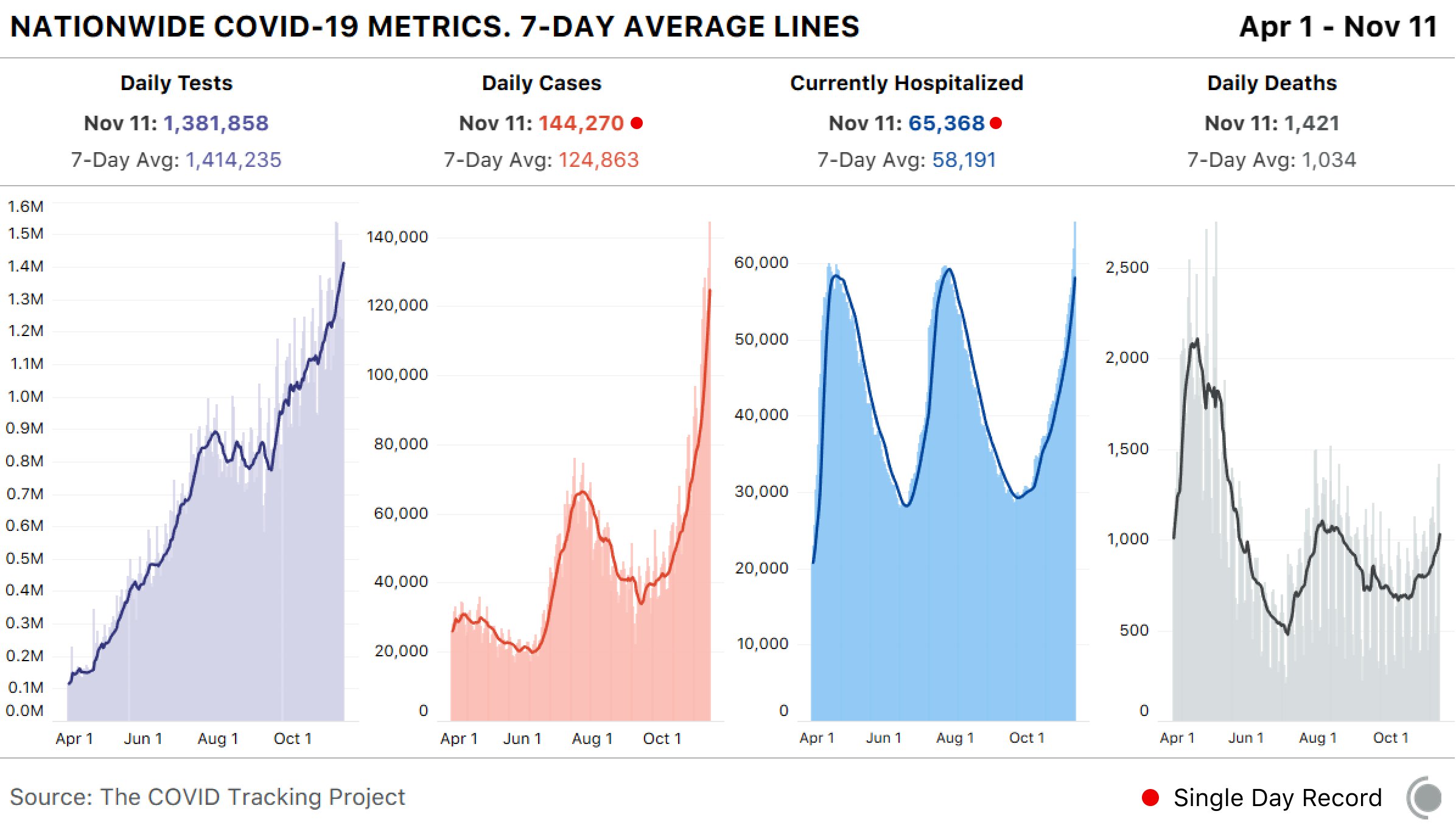
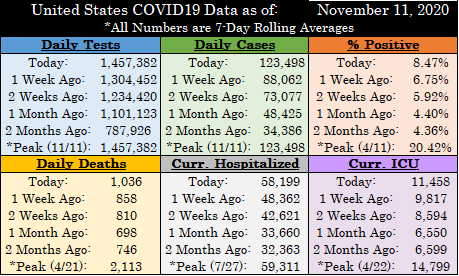
Our daily update is published. States reported 1.4M new tests and 144k cases, another all-time high. 65.4k people are hospitalized, 15k more than on election day. The death toll was 1,421, pushing the 7-day average over 1,000.
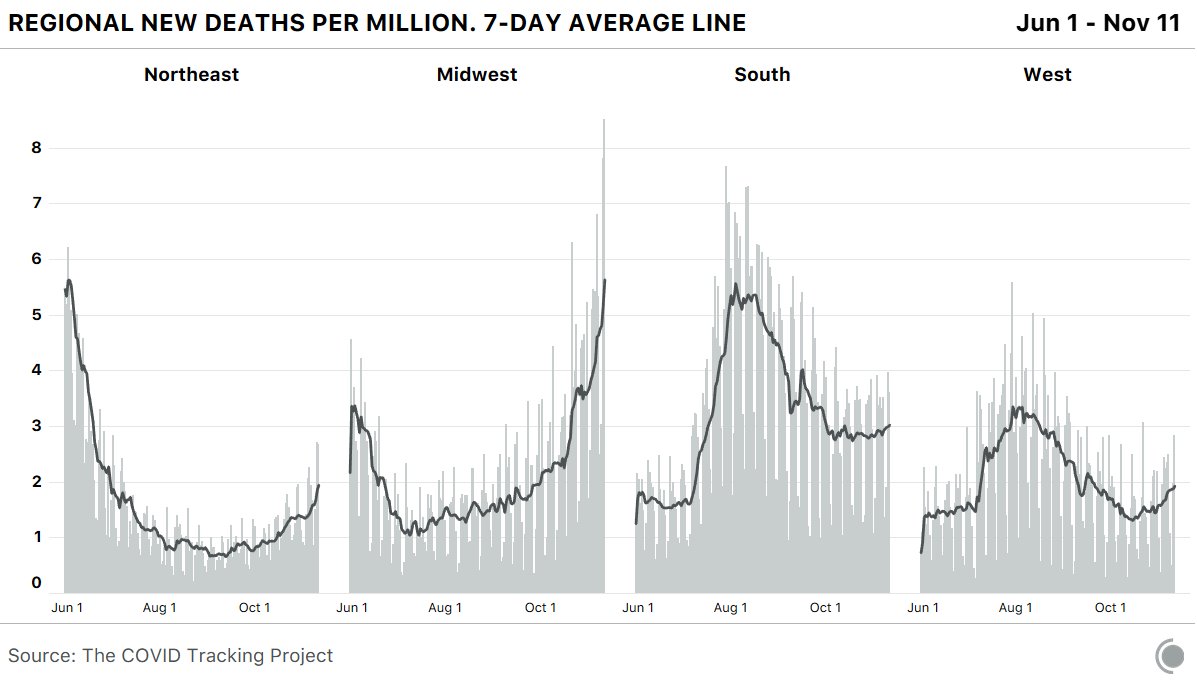
On a per capita basis, more people are now dying across the Midwest than even at the peak of the summer surge in the South.
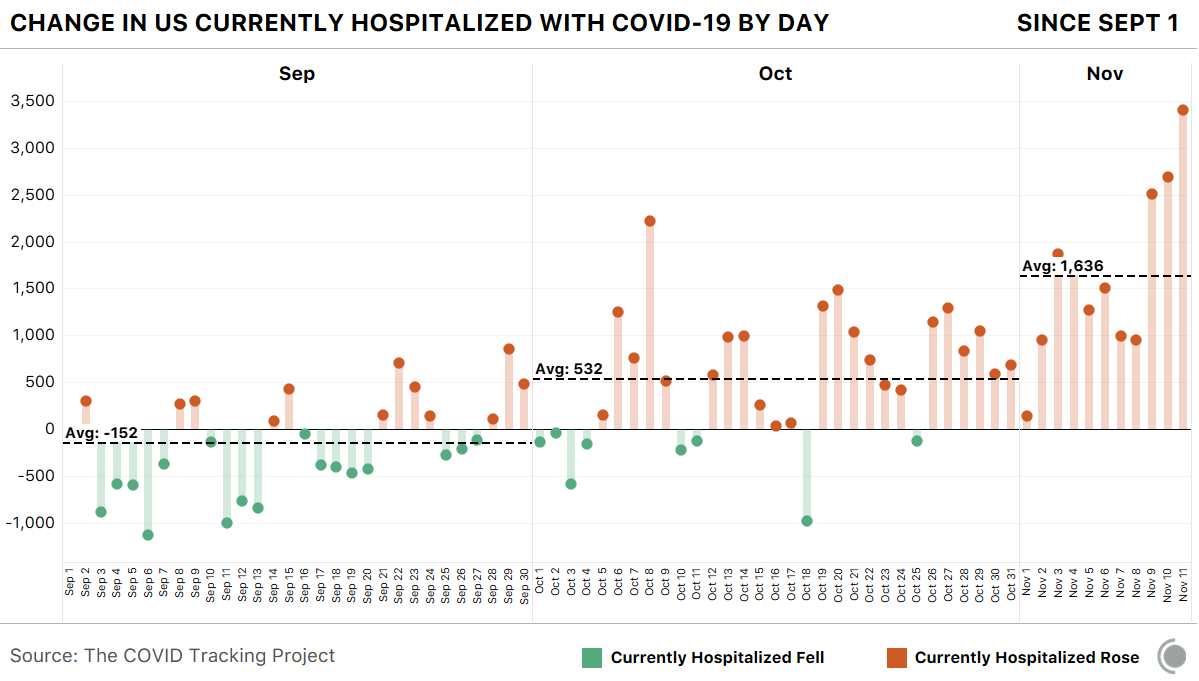
Hospitalizations are now rising very quickly. The last three days standout, but across all of November, we’re averaging 1,636 more current hospitalizations each day.
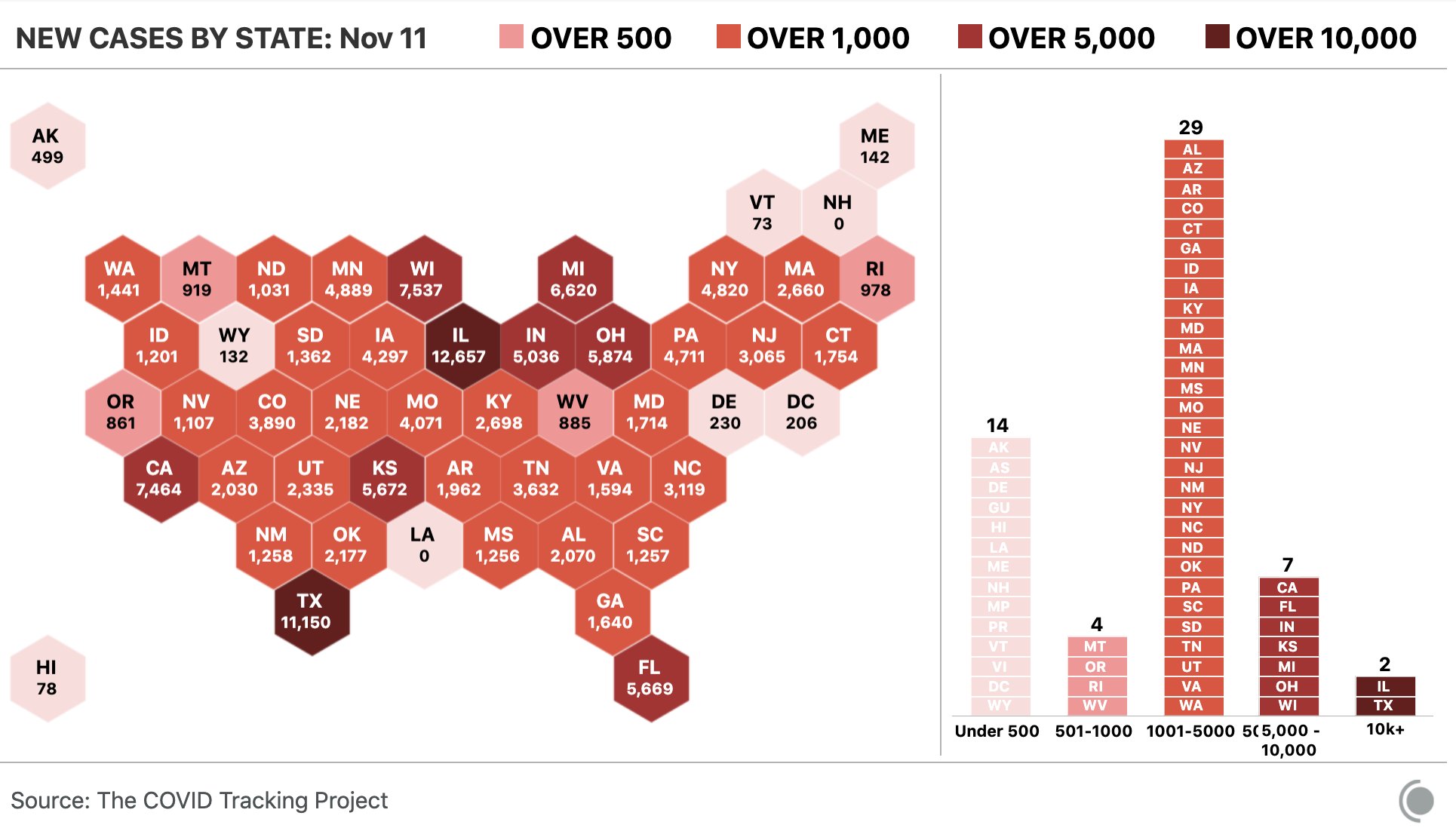
38 states reported over 1,000 cases today.
*Today’s #Covid19 Update Thread* (tests, cases, deaths, hospitalizations, ICU, and % testing positive as of Today, 1 week, 2 weeks, 1 month, and 2 months ago—data from @COVID19Tracking)
In the days and weeks leading up to Election Day, President Donald Trump claimed that the “fake news media” chose to focus on Covid-19 to damage his campaign, predicting that once November 4th arrived, Americans would not hear about the virus anymore, however, in the seven days since that date, infections and hospitalizations have spiked to unseen levels, shattering previous records.
KEY FACTS
The United States reported a record-setting high of 139,855 new positive cases on Tuesday and 1,448 coronavirus deaths, according to a New York Times database.
In the seven days since Nov. 4, there has been an average of 123,315 new cases per day (a total of 863,205), which is the highest daily average ever recorded in any nation, and an increase of 69% from the average just two weeks earlier.
According to the Covid Tracking Project, a record high of 61,964 people are currently hospitalized in the United States.
A total of 7,021 Americans have been killed by the virus since November 4th, as the daily average death count has risen above 1,000 for the first time since August.
CRITICAL QUOTE:
“That’s all I hear about now. That’s all I hear. Turn on television—’Covid, Covid, Covid, Covid, Covid, Covid.’ A plane goes down. 500 people dead, they don’t talk about it,” Trump told his supporters at a campaign rally in Lumberton, North Carolina, on October 24th. “Covid, Covid, Covid, Covid.’ By the way, on November 4, you won’t hear about it anymore,”
KEY BACKGROUND:
On October 27th, Trump tweeted: “ALL THE FAKE NEWS MEDIA WANTS TO TALK ABOUT IS COVID, COVID, COVID. ON NOVEMBER 4th, YOU WON’T BE HEARING SO MUCH ABOUT IT ANYMORE. WE ARE ROUNDING THE TURN!!!“ In August, speaking at Republican National Convention, Trump asserted that Democrats were imposing restrictions to damage the economy. He prognosticated that these left-leaning states would reopen after the election. “On November 4th, it will all open up,” said the president, adding, “They want to make our numbers look as bad as possible for the election.” Back in May, Eric Trump, during an appearance on Fox News, said the Democrats “will milk it every single day between now and November 3rd, and guess what, after November 3rd, coronavirus will magically all of a sudden go away and disappear.” In late October, Trump alleged, “Until November 4th., Fake News Media is going full-on Covid, Covid, Covid.” Although the coronavirus is raging out of control, the president has yet to address the pandemic since the election. Trump has tweeted 149 times since Nov. 3 but has not once mentioned Covid, Covid-19, or the coronavirus. Nor has he offered an update to U.S. citizens on how the federal government plans to counteract this most recent nationwide outbreak.
TANGENT:
Vice President Mike Pence is the head of the White House Coronavirus Task Force. According to the Federal Aviation Administration, Pence was scheduled to vacation in Sanibel, Florida, Tuesday through Saturday this week. However, the Washington Post reported Tuesday that Pence is no longer planning to leave Washington.
BIG NUMBER:
240,000. Since the start of the pandemic, more than 10,331,900 Americans have been infected with the coronavirus, and at least 240,200 have died.
For the first time in the coronavirus pandemic, more than 60,000 Americans are hospitalized for Covid-19, according to The COVID Tracking Project, which also reported yet another record for new cases Tuesday—130,989, as the pandemic continues to worsen.
KEY FACTS
61,964 Covid-19 hospitalizations were reported in the U.S. Tuesday, breaking a record that had stood since April 15, when 59,940 were in the hospital.
The record for new cases was also broken, topping 130,000 for the first time, but the old record had stood for just three days.
1,347 deaths were reported, which is the most since Aug. 19, according to The COVID Tracking Project, which collects its data from local reporting agencies.
WHAT TO WATCH FOR
The grim impacts of the third U.S. coronavirus surge are starting to be felt. Hard-hit El Paso, Texas is running out of morgue space, while Tulsa ran out of ICU beds Monday night. In North Dakota, hospitals are at capacity and the state is now taking the extreme step of allowing Covid-positive nurses to keep working in some cases amid a serious staffing shortage.
KEY BACKGROUND
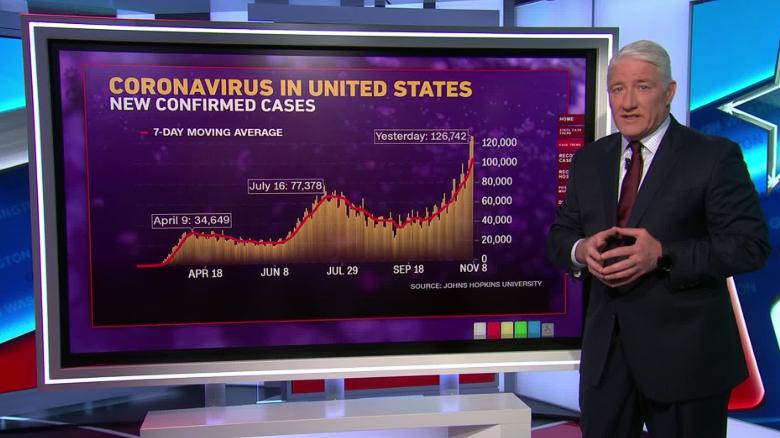
New cases have been rising exponentially since mid-September, with no signs of slowing up. Hospitalizations starting rising around a week later—a rate that has been on the increase. Deaths, which lag behind rises in other metrics, remained relatively steady until around Oct. 18. The death toll has been on a steady rise ever since, with the 7-day rolling average now just shy of 1,000 per day.
TANGENT
President-elect Joe Biden says that fighting coronavirus is a top priority of his incoming administration. He announced a 12-member Covid task force on Monday, with the goal of coming up with a plan to combat the pandemic. That’s in contrast to President Donald Trump, whose administration has not come up with a national plan while the president has continued to make false statements that the U.S. is “rounding the turn” on coronavirus.
President-elect Joe Biden and Vice President-elect Kamala Harris have released a seven-point plan regarding the COVID-19 pandemic.
The Biden administration’s seven pandemic plans:
1. Ensure all Americans have access to regular, reliable and free testing by doubling the number of drive-thru testing sites, investing in next-generation testing, developing a pandemic testing board to produce and distribute tests, and establishing a U.S. Public Health Jobs Corps.
2. Provide all states, cities, tribes and territories with critical supplies. Efforts will include full use of the Defense Production Act, building American-sourced and manufactured capabilities.
3. Provide clear, consistent and evidence-based guidance for how communities should navigate the pandemic. Planned resources will be tailored to the needs of schools, small businesses and families.
4. Plan for effective and equitable distribution of treatments and vaccines. The administration intends to invest in a $25 billion manufacturing and distribution plan to guarantee every American can receive the vaccine for free. The administration also said it will work to ensure that politics won’t play a role in determining the safety and efficacy of vaccines.
5. Protect older Americans and other high-risk groups. Efforts will include establishing a COVID-19 racial and ethnic disparities task force and a nationwide pandemic dashboard that can be checked in real-time to gauge local transmission.
6. Rebuild and expand defenses to prevent and mitigate pandemic threats, including the restoration of the White House National Security Council Directorate for Global Health Security and Biodefense and the nation’s membership with the World Health Organization.
President-elect Joe Biden on Monday announced the members of his coronavirus task force, a group made up entirely of doctors and health experts,signaling his intent to seek a science-based approach to bring the raging pandemic under control.
Biden’s task force will have three co-chairs: Vivek H. Murthy, surgeon general during the Obama administration; David Kessler, Food and Drug Administration commissioner under Presidents George H.W. Bush and Bill Clinton; and Marcella Nunez-Smith, associate dean for health equity research at the Yale School of Medicine. Murthy and Kessler have briefed Biden for months on the pandemic.
Biden will inherit the worst crisis since the Great Depression, made more difficult by President Trump’s refusal to concede the election and commit to a peaceful transition of power. The Trump administration has not put forward national plans for testing, contact tracing and resolving shortages in personal protective equipment that hospitals and health-care facilities are experiencing again as the nation enters its third surge of the virus.
“Dealing with the coronavirus pandemic is one of the most important battles our administration will face, and I will be informed by science and by experts,” Biden said in a statement. “The advisory board will help shape my approach to managing the surge in reported infections; ensuring vaccines are safe, effective, and distributed efficiently, equitably, and free; and protecting at-risk populations.”
The United States is recording more than 100,000 new coronavirus cases a day and, on many days, more than 1,000 deaths, a toll expected to worsen during the crucial 10-week stretch of the transition. It remains unclear whether Trump or his top aides will oversee and lead a robust response to the pandemic during the transition, which could further exacerbate the crisis Biden and Vice President-elect Kamala D. Harris inherit.
The 13-member task force also includes former Trump administration officials, including Rick Bright, former head of the Biomedical Advanced Research and Development Authority, who, after being demoted, spoke out against the administration’s approach to the pandemic. Luciana Borio, director for medical and biodefense preparedness on Trump’s National Security Council until 2019, is also on the panel.
The group includes several other prominent doctors:
· Ezekiel Emanuel, chair of the Department of Medical Ethics and Health Policy at the University of Pennsylvania.
· Atul Gawande, a surgeon at Brigham and Women’s Hospital and a professor at Harvard Medical School who is a prolific author.
· Michael T. Osterholm, director of the Center for Infectious Disease Research and Policy at the University of Minnesota.
· Eric Goosby, global AIDS coordinator under President Barack Obama and professor of medicine at the University of California at San Francisco School of Medicine.
· Celine R. Gounder, clinical assistant professor of medicine and infectious diseases at New York University’s Grossman School of Medicine.
· Julie Morita, executive vice president of the Robert Wood Johnson Foundation, a philanthropy focused on health issues.
· Loyce Pace, president and executive director of the Global Health Council, a U.S.-based nonprofit organization dedicated to global health issues.
· Robert Rodriguez, professor of emergency medicine at the UCSF School of Medicine.
Rebecca Katz, director of the Center for Global Health Science and Security at Georgetown University Medical Center, and Beth Cameron, director for global health security and biodefense on the White House National Security Council during the Obama administration, are serving as advisers to the transition task force.
Task force members will work with state and local officials to craft public health and economic policies to address the virus and racial and ethnic disparities, while also working to reopen schools and businesses, the transition team said in a news release.
While the makeup of the task force garnered widespread praise, Peter Hotez, dean of the National School of Tropical Medicine at the Baylor College of Medicine, said the group needs more geographic diversity.
“They are all from the Acela corridor or the [San Francisco] Bay Area,” he said. “Who is going to be the field marshal or the supreme allied commander who goes into middle of the country and get this done? The coasts are doing okay but the red states are being hammered and the deaths are going to be extraordinary. There needs to be a frank reckoning between leaders of the two parties, to say we cannot let this happen.”
Public health experts said Biden should use the transition to provide leadership as the pandemic continues through a deadly stretch and begin communicating a strong national message.
“Clearly from the election outcomes, half the country doesn’t believe we’re in a crisis,” said Kavita Patel, a fellow at the Brookings Institution who worked on health policy in the Obama administration. Biden and Harris “have an incredible platform that can be used for communication. The country needs clear daily briefings that we thought we’d get from the White House coronavirus task force. They have an incredible platform, if not an official platform.”
Biden plans to call Republican and Democratic governors to ask for their help in developing a consistent message from federal and state leaders, according to three Biden advisers who spoke on the condition of anonymity because they were not authorized to speak publicly about these matters. He will urge governors to adopt statewide mask mandates and to provide clear public health guidance to their constituents, including about social distancing and limiting large gatherings.
The task force will have subgroups that focus on issues related to the response, including testing, vaccine distribution and personal protective equipment, according to two people familiar with the plans who spoke on the condition of anonymity to reveal plans that were not yet public.
In his victory speech Saturday, Biden addressed challenges in bringing the pandemic under control.
“We cannot repair the economy, restore our vitality or relish life’s most precious moments — hugging a grandchild, birthdays, weddings, graduations, all the moments that matter most to us — until we get this virus under control,” Biden said. “That plan will be built on a bedrock of science. It will be constructed out of compassion, empathy and concern. I will spare no effort — or commitment — to turn this pandemic around.”
Yet the plans Biden laid out on the campaign trail are set to collide with political realities. That includes a deeply divided nation in which more than 71 million people voted for Trump and the possibility of having to navigate a Republican-controlled Senate disinclined to support a greater federal role in testing and contact tracing, among other responsibilities now left mostly to the states.
Biden’s most ambitious plans will require significant congressional funding. Senate Majority Leader Mitch McConnell (R-Ky.) has said he would like to pass new coronavirus relief measures during Congress’s lame-duck session, and Congress faces a Dec. 11 government funding deadline. Biden and his team are poised to begin engaging with congressional Democrats on their priorities.
Biden’s plans include dramatically expanding testing and building a U.S. public health jobs corps to have 100,000 Americans conduct contact tracing. They also include ramping up production of personal protective equipment and implementing a vaccine distribution plan.
Murthy, who served as the 19th U.S. surgeon general, is a physician whose nomination was stalled in the Senate for more than a year because of his view that gun violence is a public health issue. Three months into the Trump administration, he was replaced as “the nation’s doctor” with more than two years left on his four-year term.
In 2016, he wrote a landmark report on drug and alcohol addiction, which put that condition alongside smoking, AIDS and other public health crises that previous surgeons general addressed. The report called the addiction epidemic “a moral test for America.” Murthy’s office sent millions of letters to doctors asking for their help to combat the opioid crisis.
The son of immigrants from India, he earned medical and MBA degrees at Yale before joining the faculty at Harvard Medical School, where his research focused on vaccine development and the participation of women and minorities in clinical trials.
After leaving his post as surgeon general, he wrote a book on loneliness and social isolation, including their implications for health, that grew out of his conversations with people in clinical practice and as surgeon general.
Several public health officials celebrated Nunez-Smith’s leadership role on the task force. Her research focuses on promoting health and health-care equity in marginalized populations, according to her Yale biography. She has also studied discrimination that patients endure in the health-care system — expertise that many said was welcome in an epidemic that is disproportionately affecting people of color.
Kessler was FDA commissioner from 1990 to 1997, during the George H.W Bush and Clinton administrations. He is well-known for his attempts to regulate cigarettes — an effort that resulted in a loss in the Supreme Court, which ruled that the agency did not have the authority. That prompted Congress to pass a law, enacted in 2009, that explicitly gave the agency that power.
Kessler, a pediatrician and lawyer, worked at the FDA to accelerate AIDS treatments and on food and nutrition issues. He oversaw the FDA’s development of standardized nutrition labels and notably ordered the seizure of orange juice labeled “fresh” because it was made from concentrate. He has written several books on diet, mental illness and other topics, and has served as dean of the medical schools at Yale and UCSF.
President-elect Joe Biden’s healthcare agenda: building on the ACA, value-based care, and bringing down drug prices.
In many ways, Joe Biden is promising a return to the Obama administration’s approach to healthcare:
Building on the Affordable Care Act (ACA) through incremental expansions in government-subsidized coverage
Continuing CMS’ progress toward value-based care
Bringing down drug prices
Supporting modernization of the FDA
Bolder ideas, such as developing a public option, resolving “surprise billing,” allowing for negotiation of drug prices by Medicare, handing power to a third party to help set prices for some life sciences products, and raising the corporate tax rate, could be more challenging to achieve without overwhelming majorities in both the House and the Senate.
Biden is likely to mount an intensified federal response to the COVID-19 pandemic, enlisting the Defense Production Act to compel companies to produce large quantities of tests and personal protective equipment as well as supporting ongoing deregulation around telehealth. The Biden administration also will likely return to global partnerships and groups such as the World Health Organization, especially in the area of vaccine development, production and distribution.
What can health industry executives expect from Biden’s healthcare proposals?
Broadly, healthcare executives can expect an administration with an expansionary agenda, looking to patch gaps in coverage for Americans, scrutinize proposed healthcare mergers and acquisitions more aggressively and use more of the government’s power to address the pandemic. Executives also can expect, in the event the ACA is struck down, moves by the Biden administration and Democratic lawmakers to develop a replacement. Healthcare executives should scenario plan for this unlikely yet potentially highly disruptive event, and plan for an administration marked by more certainty and continuity with the Obama years.
All healthcare organizations should prepare for the possibility that millions more Americans could gain insurance under Biden. His proposals, if enacted, would mean coverage for 97% of Americans, according to his campaign website. This could mean millions of new ACA customers for payers selling plans on the exchanges, millions of new Medicaid beneficiaries for managed care organizations, millions of newly insured patients for providers, and millions of covered customers for pharmaceutical and life sciences companies. The surge in insured consumers could mirror the swift uptake in the years following the passage of the ACA.
Biden’s plan to address the COVID-19 pandemic
Biden is expected to draw on his experience from H1N1 and the Ebola outbreaks to address the COVID-19 pandemic with a more active role for the federal government, which many Americans support. These actions could shore up the nation’s response in which the federal government largely served in a support role to local, state and private efforts.
Three notable exceptions have been the substantial federal funding for development of vaccines against the SARS-CoV-2 virus, Congress’ aid packages and the rapid deregulatory actions taken by the FDA and CMS to clear a path for medical products to be enlisted for the pandemic and for providers, in particular, to be able to respond to it.
Implications of Biden’s 2020 health agenda on healthcare payers, providers and pharmaceutical and life sciences companies
The US health system has been slowly transforming for years into a New Health Economy that is more consumer-oriented, digital, virtual, open to new players from outside the industry and focused on wellness and prevention. The COVID-19 pandemic has accelerated some of those trends. Once the dust from the election settles, companies that have invested in capabilities for growth and are moving forcefully toward the New Health Economy stand to gain disproportionately.
Shortages of clinicians and foreign medical students may continue to be an issue for a while
The Trump administration made limiting the flow of immigrants to the US a priority. The associated policy changes have the potential to exacerbate shortages of physicians, nurses and other healthcare workers, including medical students. These consequences have been aggravated by the pandemic, which dramatically curtailed travel into the US.
Healthcare organizations, especially rural ones heavily dependent on foreign-born employees, may find themselves competing fiercely for workers, paying higher salaries and having to rethink the structure of their workforces.
Providers should consider reengineering primary care teams to reflect the patients’ health status and preferences, along with the realities of the workforce on the ground and new opportunities in remote care.
Focus on modernizing the supply chain
Biden and lawmakers from both parties have been raising questions about life sciences’ supply chains. This focus has only intensified because of the pandemic and resulting shortages of personal protective equipment (PPE), pharmaceuticals, diagnostic tests and other medical products.
Investment in advanced analytics and cybersecurity could allow manufacturers to avoid disruptive stockouts and shortages, and deliver on the promise of the right treatment to the right patient at the right time in the right place.
Drug pricing needs a long-term strategy
Presidents and lawmakers have been talking about drug prices for decades; few truly meaningful actions have been implemented. Biden has made drug pricing reform a priority.
Drug manufacturers may need to start looking past the next quarter to create a new pricing strategy that maximizes access in local markets through the use of data and analytics to engage in more value-based pricing arrangements.
New financing models may help patients get access to drugs, such as subscription models that provide unlimited access to a therapy at a flat rate.
Companies that prepare now to establish performance metrics and data analytics tools to track patient outcomes will be well prepared to offer payers more sustainable payment models, such as mortgage or payment over time contracts, avoiding the sticker shock that comes with these treatments and improving uptake at launch.
Pharmaceutical and life sciences companies will likely have to continue to offer tools for consumers like co-pay calculators and use the contracting process where possible to minimize out-of-pocket costs, which can improve adherence rates and health outcomes.
View interoperability as an opportunity to embrace, not a threat to avoid or ignore
While the pandemic delayed many of the federal interoperability rule deadlines, payers and providers should use the extra time to plan strategically for an interoperable future.
Payers should review business partnerships in this new regulatory environment.
Digital health companies and new entrants may help organizations take advantage of the opportunities that achieving interoperability may present.
Companies should consider the legal risks and take steps to protect their reputations and relationships with customers by thinking through issues of consent and data privacy.
Health organizations should review their policies and consider whether they offer protections for customers under the new processes and what data security risks may emerge. They should also consider whether business associate agreements are due in more situations.
Plan for revitalized ACA exchanges and a booming Medicare Advantage market
The pandemic has thrown millions out of work, generating many new customers for ACA plans just as the incoming Biden administration plans to enrich subsidies, making more generous plans within reach of more Americans.
Payers in this market should consider how and where to expand their membership and appeal to those newly eligible for Medicare. Payers not in this market should consider partnerships or acquisitions as a quick way to enter the market, with the creation of a new Medicare Advantage plan as a slower but possibly less capital-intensive entry into this market.
Payers and health systems should use this opportunity to design more tailored plan options and consumer experiences to enhance margins and improve health outcomes.
Payers with cash from deferred care and low utilization due to the pandemic could turn to vertical integration with providers as a means of investing that cash in a manner that helps struggling providers in the short term while positioning payers to improve care and reduce its cost in the long term.
Under the Trump administration, the FDA has approved historic numbers of generic drugs, with the aim of making more affordable pharmaceuticals available to consumers. Despite increased FDA generics approvals, generics dispensed remain high but flat, according to HRI analysis of FDA data.
Pharmaceutical company stocks, on average, have climbed under the Trump administration, with a few notable dips due to presidential speeches criticizing the industry and the pandemic.
Providers have faced some revenue cuts, particularly in the 340B program, and many entered the pandemic in a relatively weak liquidity position. The pandemic has led to layoffs, pay cuts and even closures. HRI expects consolidation as the pandemic continues to curb the flow of patients seeking care in emergency departments, orthopedic surgeons’ offices, dermatology suites and more.
Lawmakers and politicians often use bold language, and propose bold solutions to problems, but the government and the industry itself resists sudden, dramatic change, even in the face of sudden, dramatic events such as a global pandemic. One notable exception to this would be a decision by the US Supreme Court to strike down the ACA, an event that would generate a great deal of uncertainty and disruption for Americans, the US health industry and employers.
The United States surpassed 10 million coronavirus cases on Monday, just 10 days after hitting 9 million. The average number of daily new infections has exceeded 100,000, and public health experts warn the country is entering the pandemic’s worst phase yet.
After an exhausting and contentious election campaign, and a vote count that was prolonged by enormous voter turnout and record-breaking use of early and mail-in voting, the major news networks have now made their calls. Joseph R. Biden, Jr. will be the 46th President of the United States, and Kamala D. Harris will be the first woman, and first person of color, to become Vice President. Securing an electoral victory by achieving razor-thin victories in a number of battleground states, President-elect Biden received the largest number of votes of any candidate in American history. Although the Trump campaign vowed to pursue legal challenges to the validity of the election, Biden’s win appeared to be secure.
The election results came in the midst of a dramatic acceleration of the coronavirus pandemic.Over the last week, the average number of new cases per day in the US surpassed 96,000, up 54 percent from just two weeks earlier. On Friday the nation recorded a pandemic-high 132,700 new cases, along with at least 1,220 COVID deaths. Hospitalizations were up in most states, hospital bed and workforce capacity are strained, and public health experts warned that the coming weeks and months will bring even worse news. Unsurprisingly, the pandemic was a top issue on the minds of voters. According to exit polls, however, the electorate was deeply divided on the issue: 82 percent of Biden voters cited the pandemic itself as one of the most important issues in determining their vote, with only 14 percent of Trump voters agreeing. Conversely, 82 percent of Trump voters said the economy was the most important issue on their minds, as opposed to Biden voters, only 17 percent of whom listed the economy as their top issue. Based on that data, it appears that at least one important split among the electorate was “lives” versus “livelihoods”—whether the pandemic response, or its impact on the economy, was of greatest concern.
In the coming weeks, attention is likely to turn in earnest to addressing both aspects of the issue during the lame duck period. Senate Majority Leader Mitch McConnell (R-KY) has signaled that he intends toresume negotiations on a stimulus package with Democrats in the House, whose majority was diminished in the election. At this writing, it appears likely that control of the Senate will come down to the results of two runoff elections in Georgia, and McConnell will undoubtedly want to make the case that Senate Republicans have taken decisive action to bolster the economic recovery. It’s also possible that, as part of the Trump administration’s Operation Warp Speed, a coronavirus vaccine will be granted approval by the end of the year. Health officials at both federal and state levels must continue to work closely together to tackle the complex logistics of distributing and administering the vaccine, and it will be critical for the incoming administration to seek ways to collaborate with the Trump team to ensure a smooth transition of this vital work.
The outcome of the Senate runoffs in Georgia will determine whether the Biden administration must work with divided Congress, or an evenly split Senate in which Vice President-elect Kamala Harris casts the deciding vote. In either case, given the political realities underscored by the electoral result, it’s very unlikely than any of the more sweeping proposals in the Biden campaign platform—lowering the eligibility age for Medicare, establishing a government-run “public option” insurance plan, extending premium subsidies to middle-income workers—will advance very far. Rather, as we’ve discussed before, we’d expect a Biden administration’s first actions to focus on an enhanced federal response to managing the pandemic, including issuing a national mask mandate, enhancing efforts to augment and coordinate personal protective equipment (PPE) supply, and rejoining the World Health Organization.
As we look to the next two years, most healthcare policy changes are likely to come in the form ofregulatory reform, such as reversing waivers for Medicaid programs to establish work requirements and withdrawing flexibility for short-term plans that fail to comply with the Affordable Care Act (ACA). Other Trump-era regulatory changes might continue. There’s broad bipartisan support for efforts to make value-based Medicare payment reforms more successful, to increase price transparency, and to address the issues of surprise billing and the cost of prescription drugs. But even in if Democrats beat the odds and win back control of the Senate, we believe the Biden administration will have other legislative priorities that will supersede any attempt to dramatically overhaul healthcare coverage—voting reforms, climate change legislation, immigration reform, and long-overdue infrastructure investments.
Unless, that is, the Supreme Court throws a spanner in the works by overturning the ACA. Should the Court rule that the individual mandate is not severable from the rest of the law, and that the entire ACA is unconstitutional, the new administration would be forced to take quick action to protect coverage and insurance protections for millions of Americans. In that event, healthcare would rocket to the top of the agenda. Either the Biden team would be forced to find a compromise solution that could pass a divided Congress, or (if Harris is the tie-breaking vote) find a way to use the budget reconciliation process to address coverage. That potential drama lies months in the future, as we won’t know the outcome of the case until next spring. We’ll monitor the oral arguments in the ACA case closely, and let you know what we hear, and what we think it means for the future of the case.
In the coming weeks, we’ll be watching for answers to some of the big healthcare questions that lie ahead: How will the Trump administration handle the worsening pandemic situation in the 75 days between now and Inauguration Day? Will any new stimulus package include additional economic relief for healthcare providers? When and how will a COVID vaccine become widely available? And perhaps most importantly, what toll will the “third wave” of the pandemic take on a nation already exhausted by a difficult year, and a bitter political fight? Surely one reason to be optimistic is that, having turned out to vote in the largest numbers in a century, Americans are more engaged than ever in finding a way forward amid the problems that confront us. Let’s hope our political leaders from across the ideological spectrum will rise to the occasion, and meet this difficult moment with positive, constructive solutions.






 HENRY KOTULA
