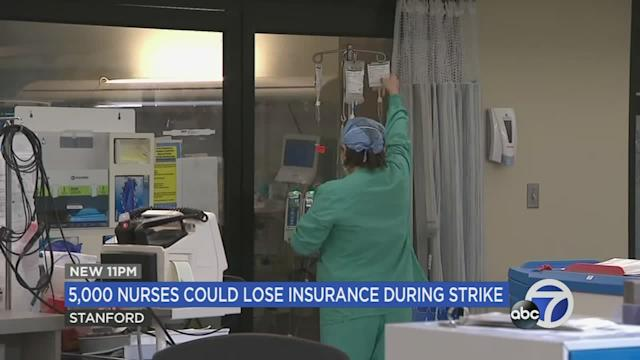
Stanford Health Care and Lucile Packard Children’s Hospital administrators have notified union leaders that its nurse members who strike later in April risk losing pay and health benefits, according to Palo Alto Weekly.
The Committee for Recognition of Nursing Achievement, a union at Stanford Health Care and Stanford Children’s Health that represents about 5,000 nurses, has scheduled a strike to begin April 25. The nurses’ contract expired March 31.
If the strike moves forward, Stanford Health Care and the Lucile Packard Children’s Hospital, both based in Palo Alto, Calif., are prepared to continue to provide safe, quality healthcare, according to a statement from Dale Beatty, DNP, RN, chief nurse executive and vice president of patient care services for Stanford Health Care, and Jesus Cepero, PhD, RN, senior vice president of patient care and chief nursing officer for Stanford Children’s Health.
But the statement, which was shared with Becker’s, said nurses who choose to strike will not be paid for shifts they miss.
“In addition, employer-paid health benefits will cease on May 1 for nurses who go out on strike and remain out through the end of the month in which the strike begins,” Drs. Beatty and Cepero said.
The leaders quoted from Committee for Recognition of Nursing Achievement’s “contingency manual” that the union provided to nurses: “If a strike lasts beyond the end of the month in which it begins and the hospitals discontinue medical coverage, you will have the option to pay for continued coverage.”
Drs. Beatty and Cepero said nurses who strike may pay to continue their health coverage through the Consolidated Omnibus Budget Reconciliation Act.
In a separate statement shared with Becker’s, Committee for Recognition of Nursing Achievement President Colleen Borges called Stanford and Packard management’s move regarding nurses’ health benefits “cruel” and “immoral.”
“Health benefits should not be used against workers, especially against the very healthcare professionals who have made Stanford a world-class health system,” said Ms. Borges, who is also a pediatric oncology nurse at Lucile Packard Children’s Hospital. “We have spent our careers caring for others and putting others first — now more than ever we need solutions that will ensure sustainability, safe staffing and strong benefits to retain nurses. But instead of taking our proposals seriously, hospitals are spending their time and energy weaponizing our medical benefits. We refuse to be intimidated from standing up for the fair contracts that we need in order to continue delivering world-class patient care.”
The union has organized a petition to tell Stanford not to cut off medical benefits for nurses and their families during the strike. As of April 19, the petition had more than 25,150 signatures.
While healthcare workers battle burnout, hospitals have been ramping up wages and other benefits to recruit and retain workers. It has created a culture of competition among health systems as well as travel agencies that offer considerably higher pay.
But other healthcare organizations are not hospitals’ only competitors. Some hospitals, particularly those in rural areas, are struggling to match rising employee pay among nonindustry employers such as Target and Walmart.
“We monitor and we’ve been looking and we ask around in the community and we can ask who’s paying what,” Troy Bruntz, CEO of Community Hospital in McCook, Neb., told Becker’s. “So we know where Walmart is on different things, and we’re OK. But if Walmart tried to match what Target’s doing, that would not be good.”
At Target, the hourly starting wage now ranges from $15-$24. The organization is making a $300 million investment total to boost wages and benefits, including health plans. Starting pay is dependent on the job, the market and local wage data, according to NPR.
Walmart raised the hourly wages for 565,000 workers in 2021 by at least $1 an hour, The New York Times reported. The company’s average hourly wage is $16.40, with the lowest being $12 and the highest being $17.
Meanwhile, Costco raised its minimum wage to $17 an hour, according to NPR. The federal minimum wage is $7.25.
Estimated employment for healthcare practitioners and technical occupations is 8.8 million, according to the latest data released March 31 by the U.S. Bureau of Labor Statistics. This includes nurse practitioners, physicians, registered nurses, physician assistants and respiratory therapists, among others.
In sales and related occupations, estimated employment is 13.3 million, according to the bureau. This includes retail salespersons, cashiers and first-line supervisors of retail salespersons, among others.
While retail companies up their wages, at least one hospital CEO is monitoring the issue. Healthcare leaders weigh their options
Mr. Bruntz said rising wages among retailers is an issue his organization monitors. Although Target does not have a store in McCook, there is a Walmart, where pay is increasing.
“I was quoted a few months ago saying Walmart was approaching $15 an hour, and we can handle that,” Mr. Bruntz said. “But when it gets to $20 or $25, it’s going to be an issue.”
He also said he cannot solely increase the wages of the people making less than $15 or less than $25 because he has to be fair in terms of wages for different types of roles.
Specifically, he said he is concerned about what matching rising wages at retailers would mean for labor expenses, which make up about half of the hospital’s cost structure.
“I double that half, that’s 25 percent more expenses instantly,” Mr. Bruntz said. “And how is that going to ratchet to a bottom line anything less than a massive negative number? So it’s a huge problem.”
Clinical positions are not the only ones hospitals and health systems are struggling to fill; they are encountering similar difficulties with technicians and food service workers. Regarding these roles, competition from industries outside healthcare is particularly challenging.
This is an issue Patrice Weiss, MD, executive vice president and chief medical officer of Roanoke, Va.-based Carilion Clinic, addressed during a Becker’spanel discussion April 4. The organization saw workforce issues not just in its clinical staff, but among environmental services staff.
“When you look at what … even fast food restaurants were offering to pay per hour, well gosh, those hours are a whole lot better,” she said during the panel discussion. “There’s no exposure. You’re not walking into a building where there’s an infectious disease or patients with pandemics are being admitted.”
Amid workforce challenges, Community Hospital is elevating its recruitment and retention efforts.
Mr. Bruntz touted the hospital as a hard place to leave because of the culture while acknowledging the monetary efforts his organization is making to keep staff.
He said the hospital has a retention program where full-time employees get a bonus amount if they are at the employer on Dec. 31 and have been there at least since April 15. Part-time workers are also eligible for a bonus, though a lesser amount.
“It also encourages staff [who work on an as-needed basis] to go part-time or full-time, and [those who are] part-time to go full-time,” Mr. Bruntz said. “That’s another thing we’re doing is higher amounts for higher status to encourage that trend.”
Additionally, Community Hospital, which has 330 employees, offers a referral bonus to staff to encourage people they know to come work with them.
“We want staff to bring people they like. [We are] encouraging staff to be their own ambassadors for filling positions,” Mr. Bruntz said.
He said the hospital also will offer employees a sizable market wage adjustment not because of competition from Walmart but because of inflation.
Graham County Hospital in Hill City, Kan., is also affected by the tight labor market, although it has not experienced much competition with retail companies, CEO Melissa Atkins told Becker’s. However, the hospital is struggling with competition from other healthcare organizations, particularly when it comes to patient care departments and nursing. While many hospitals have struggled to retain employees from travel agencies, Graham County Hospital has mostly been able to avoid it.
“As the demand increases, so does the wage,” Ms. Atkins said. “In addition to other hospitals offering sign-on bonuses and increased wages, nurse agency companies are offering higher wages for traveling nurse aides and nurses. We are extremely fortunate in that we have not had to use agency nurses. Our current staff has stepped up and filled in the shortages [with additional incentive pay].”
To combat this trend, the hospital has increased hourly wages and shift differentials, as many healthcare organizations have done. It has also provided bonuses using COVID-19 relief funds.
Overall, Mr. Bruntz said he prefers “not to get into an arms race with wages” among nonindustry competitors.
“It’s not going to end well for anybody. We prefer not to use that,” he said. “At the same time, we’re trying to do as much as possible without being in a full arms race. But if Walmart started paying $25 for a door greeter and cashier, we would have to reassess.”
It was a winter of surging job creation. Employers created jobs on a mass scale, Americans returned to the workforce, and the labor market shrugged off the Omicron variant and its broader pandemic funk.
That’s the takeaway from the February jobs report, which showed employers added 678,000 jobs last month. December and January job growth was better than previously thought, and the unemployment rate fell to 3.8%.
Why it matters: Yes, inflation is high as prices rose 7.5% over the last year as of January, and could rise higher as disruptions from the Ukraine war ripple through the economy.
But rising prices are coming amid an astonishingly rapid jobs boom.
Between the lines: The report shows the pandemic impact is fading. But some analysts warn not to expect this level of gains to continue as the crisis in Ukraine cuts into growth.
“The improvement in the American labor market is now very much a rearview mirror phenomenon,” economist Joe Brusuelas wrote in a research note.
One big surprise: Wage growth was essentially nonexistent, with average hourly earnings rising only a penny to $31.58.
That may reflect the nature of the jobs being added — disproportionately in the low-paying leisure and hospitality sector.
That is good news for those worried that rising wages and prices will drive further inflation. It is worse news for workers, whose average pay gain of 5.1% over the last year is far below inflation.
The share of adults in the labor force — which includes those looking for work — ticked up, as did the share of the population that’s actually employed. That suggests the robust job growth is pulling people back into the workforce, if gradually.
The labor force participation rate was 62.3% in February, more than a percentage point below its level two years ago, before the pandemic.
State of play: The Federal Reserve is set to begin an interest rate hiking campaign on March 16, amid high inflation and new geopolitical uncertainty from the Ukraine war. The new numbers are unlikely to change that one way or the other.
The U.S. economy added 467,000 jobs in January as the omicron variant spiked to record heights, with the labor market performing better than many expected two years after the pandemic began.
The unemployment rate ticked up slightly to 4 percent, from 3.9 percent the month before.
The monthly report, released by the Department of Labor, stems from a survey taken in mid-January, around the time the omicron variant was beginning to peak, with close to 1 million new confirmed cases each day. The rapid spread during that period upended many parts of the economy, closing schools, day cares, and a number of businesses, forcing parents to scramble.
But the labor market, according to the new data, performed very well during that stretch.
In addition to the robust January, the Department of Labor also revised upward the figure for December’s jobs report, to 510,000 from 199,000, and November, to 647,000 from 249,000. That means that there were some 700,000 more jobs added at the end of last year than previously estimated — showing a labor market with momentum heading into the new year.
The data sets show a labor market that continues to recover at a strong pace from the pandemic’s worst disruption in March and April of 2020.
New outbreaks and variants have sent shockwaves through the economy since then, but the labor market has continued to return, with companies working to add jobs and wages steadily rising.
The industries experiencing growth in January were lead by the leisure and hospitality sector, which added 151,000 jobs on the month, mostly in restaurants and bars. Professional and business services added 86,000 jobs. Retailers added 61,000 jobs in January, which is typically an off month. Transportation and warehousing added 54,000 jobs.
The labor market’s participation rate, a critical measurement that has never fully recovered from losses during the pandemic’s earliest days, also went up significantly, to 62.2 percent from 61.9 percent. That shows more people are reentering the labor force, looking for work.
Average hourly earnings increased by 23 cents on the month to $31.63, up 5.7 percent over the last year. However, those gains for many people have largely been wiped out by rising prices from inflation.
January is traditionally a weak month for employment when retail and other industries shed jobs after the holiday season. Economists say that seasonal adjustments made to the survey’s data to account for this have the potential to distort the survey in the other direction, given that the holiday shopping boom appeared to take place earlier this year than typical.
As such, predictions for job growth for the month had been all over the map. Analysts surveyed by Dow Jones predicted an average of about 150,000 jobs added for the month, in what would be the lowest amount added in a year. Some economists predicted job losses, of up to 400,000.
Last year was a strong year for growth in the labor market, with the country adding an average of more than 550,000 jobs a month — regaining some 6.5 million jobs lost in the pandemic’s earlier days, after the Department revised its numbers. The country has about 2.9 million fewer jobs than it had before the pandemic, according to the figures released Friday.
“Omicron is going to make it look like things dropped off a cliff in January, but overall they did not,” said Drew Matus, chief market strategist for MetLife Investment Management.
Some economists like Matus say that the prospects for such rapid regrowth are more complicated this year, with the fiscal measures that boosted the economy during the pandemic’s first two years, like generous government aid, and record low interest rates from federal bankers, having largely expired, and the country’s confidence in a virus-free future dented after the winter wave.
Since the rollout of vaccines last year, there have been hopes that a return to a more typical rhythm of life could encourage some of the roughly two million people who have left the labor force during the pandemic to seek work anew, but thus far, continued threats from variants — and uncertainty after more closures of schools, daycares, and office — have prevented this from materializing in a substantial way.
There are signs that the omicron exacted a toll on the economy during its peak.
Weekly unemployment claims swelled mid-month to its highest level since October, though the numbers have come down in the two weeks since. Other statistical markers like passenger traffic at airports, hotel revenues, and dining reservations also took a hit during the month.
Recent months continue to be marked by incredible churn in the labor market, as record numbers of workers are switching jobs. In December, some 4.3 million people quit or changed jobs — a number which was down from an all-time high in November but still at elevated. Employers continue to report near record numbers of job openings: the Bureau of Labor Statistics said they reported some 10.9 million openings last month.
CFOs rank the challenge of attracting and retaining employees far above other internal risks for 2022, citing labor shortages and the difficulty of crafting a balance between remote and in-office work, Deloitte found in a quarterly survey.
“The number of times CFOs cited talent/labor and related issues heavily outweighed other priorities for 2022,” Deloitte said Thursday in a report on the survey of Fortune 500 CFOs. “‘Retention, retention, retention’ was a resounding refrain, including through wages and incentives.”
Eighty-eight percent of the 130 respondents said they will use a hybrid work model next year, 92% will increase automation and 41% expect to shrink their companies’ real estate footprint, Deloitte said.
Dive Insight:
The slow return of workers from coronavirus lockdowns has led to labor shortages, competition for hires and an increase in wages.
Employees are switching jobs for higher pay at a near-record pace. The quits rate, or the number of workers who left their jobs as a percent of total employment, rose from 2.3% in January to 2.8% in October, the second-highest level in data going back to 2000, the U.S. Labor Department said. The quits rate hit a high of 3% in September.
Attracting and retaining employees vaulted to the No. 2 ranking of business risks for 2022 and the next decade, from No. 8 a year ago, according to a global survey of 1,453 C-suite executives and board members by Protiviti and NC State University. (Leading the list of risks for 2022 is the impact on business from pandemic-related government policy).
Companies are trying to hold on to workers, and attract hires, by raising pay. Private sector hourly wages rose 4.8% in November compared with 12 months before, according to the Labor Department.
Tight labor markets and the highest inflation in three decades have prompted companies to budget 3.9% wage increases for 2022 — the biggest jump since 2008, according to a survey by The Conference Board.
The proportion of small businesses that raised pay in October hit a 48-year high, with a net 44% increasing compensation and a net 32% planning to do so in the next three months, the National Federation of Independent Business said last month.
CFO respondents to the Deloitte survey said they plan to push up wages/salaries by 5.2%, a nine percentage point increase from their 4.3% forecast during the prior quarter.
“Talent/labor — and several related issues, including attrition, burnout and wage inflation — has become an even greater concern of CFOs this quarter, and the challenges to attract and retain talent could impinge on their organizations’ ability to execute their strategy on schedule,” Deloitte said.
The proportion of CFOs who feel optimistic about their companies’ financial prospects dropped to just under half from 66% over the same time frame.
“CFOs over the last several quarters have become a little more bearish,” Steve Gallucci, managing partner for Deloitte’s CFO program, said in an interview, citing the coronavirus, competition for talent, inflation and disruptions in supply chains.
CFOs have concluded that the pandemic will persist for some time and that they need to “build that organizational muscle to be more nimble, more agile,” he said.
At the same time, CFOs expect their companies’ year-over-year growth will outpace the increase in wages and salaries, estimating revenue and earnings next year will rise 7.8% and 9.6%, respectively, Deloitte said.
“We are seeing in many cases record earnings, record revenue numbers,” Gallucci said.
Describing their plans for capital in 2022, half of CFOs said that they will repurchase shares, 37% say they will take on new debt and 22% plan to “reduce or pay down a significant proportion of their bonds/debt,” Deloitte said.
CFOs view inflation as the most worrisome external risk, followed by supply chain bottlenecks and changes in government regulation, Deloitte said. The Nov. 8-22 survey was concluded before news of the outbreak of the omicron variant of COVID-19.
Attending a recent executive retreat with one of our member health systems, we heard the CEO make a statement that really resonated with us. Referring to the current workforce crisis—pervasive shortages, pressure to increase compensation, outsized reliance on contract labor to fill critical gaps—the CEO made the assertion that this situation isn’t temporary. Rather, it’s the “new normal”, at least for the next several years.
The Great Resignation that’s swept across the American economy in the wake of COVID has not spared healthcare; every system we talk to is facing alarmingly high vacancy rates as nurses, technicians, and other staff head for the exits. The CEO made a compelling case that the labor cost structure of the system has reset at a level between 20 and 30 percent more expensive than before the pandemic, and executives should begin to turn attention away from stop-gap measures (retention bonuses and the like) to more permanent solutions (rethinking care models, adjusting staffing ratios upward, implementing process automation).
That seemed like an important insight to us. It’s increasingly clear as we approach a third year of the pandemic: there is no “post-COVID world” in which things will go back to normal. Rather, we’ll have to learn to live in the “new normal,” revisiting basic assumptions about how, where, and by whom care is delivered.
If hospital labor costs have indeed permanently reset at a higher level, that implies the need for a radical restructuring of the fundamental economic model of the health system—razor-thin margins won’t allow for business to continue as usual. Long overdue, perhaps, and a painful evolution for sure—but one that could bring the industry closer to the vision of “right care, right place, right time” promised by population health advocates for over a decade.
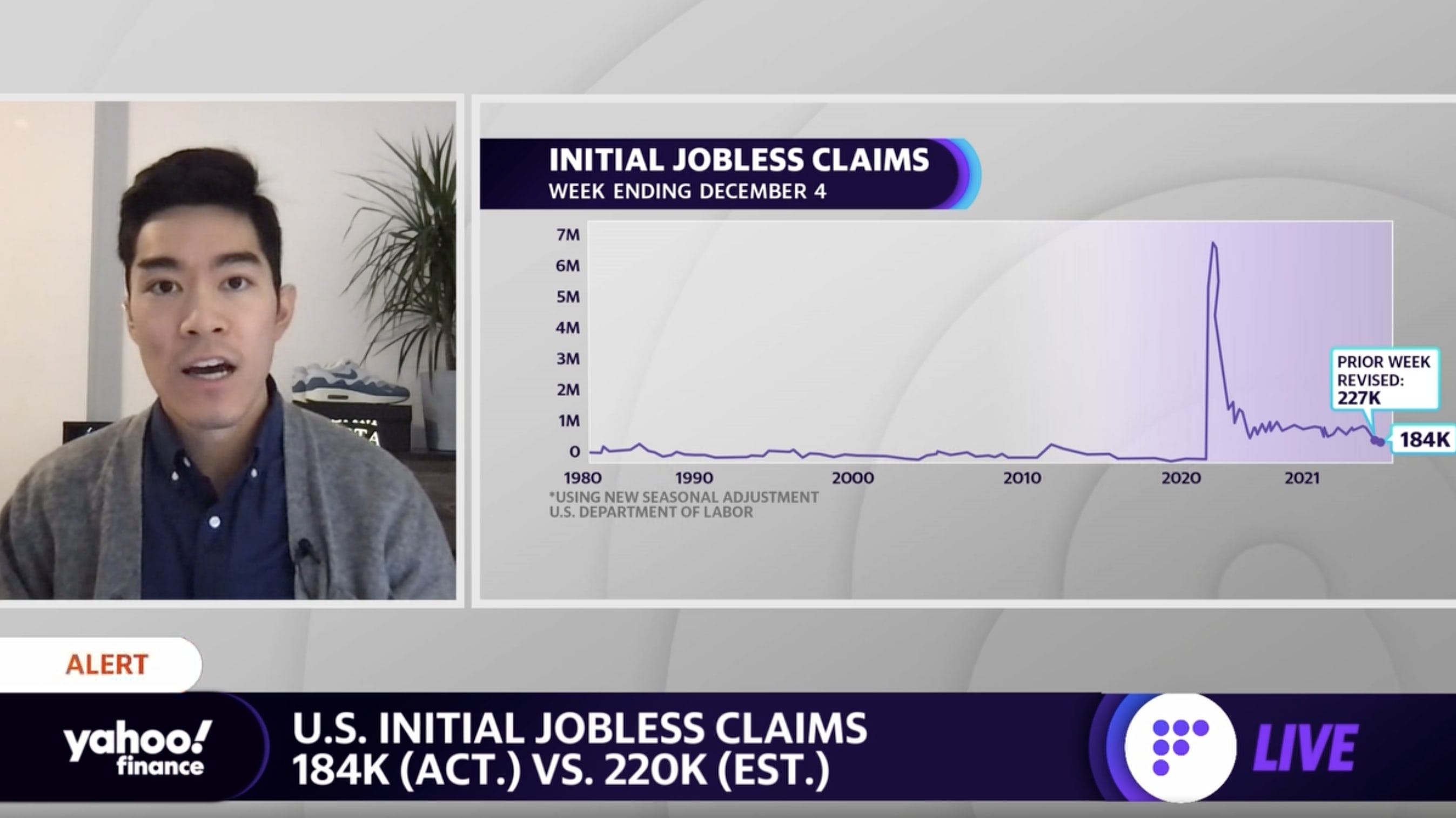
New initial jobless claims improved much more than expected last week to reach the lowest level in more than five decades, further pointing to the tightness of the present labor market as many employers seek to retain workers.
Initial unemployment claims, week ended Dec. 4: 184,000 vs. 220,000 expected and an upwardly revised 227,000 during prior week
Continuing claims, week ended Nov. 27: 1.992 millionvs. 1.910 million expected and a downwardly revised 1.954 million during prior week
Jobless claims decreased once more after a brief tick higher in late November. At 184,000, initial jobless claims were at their lowest level since Sept. 1969.
“The consensus always looked a bit timid, in light of the behavior of unadjusted claims in the week after Thanksgiving in previous years when the holiday fell on the 25th, but the drop this time was much bigger than in those years, and bigger than implied by the recent trend,” Ian Shepherdson, chief economist for Pantheon Macroeconomics, wrote in an email Thursday morning. “A correction next week seems likely, but the trend in claims clearly is falling rapidly, reflecting the extreme tightness of the labor market and the rebound in GDP growth now underway.”
After more than a year-and-a-half of the COVID-19 pandemic in the U.S., jobless claims have begun to hover below even their pre-pandemic levels. New claims were averaging about 220,000 per week throughout 2019. At the height of the pandemic and stay-in-place restrictions, new claims had come in at more than 6.1 million during the week ended April 3, 2020.
Continuing claims, which track the number of those still receiving unemployment benefits via regular state programs, have also come down sharply from pandemic-era highs, and held below 2 million last week.
“Beyond weekly moves, the overall trend in filings remains downward and confirms that businesses facing labor shortages are holding onto workers,” wrote Rubeela Farooqi, chief U.S. economist for High Frequency Economics, in a note on Wednesday.
Farooqi added, however, that “the decline in layoffs is not translating into faster job growth on a consistent basis, which was evident in a modest gain in non-farm payrolls in November.”
“For now, labor supply remains constrained and will likely continue to see pandemic effects as the health backdrop and a lack of safe and affordable child care keeps people out of the workforce,” she added.
Other recent data on the labor market have also affirmed these lingering pressures. The November jobs report released from the Labor Department last Friday reflected a smaller number of jobs returned than expected last month, with payrolls growing by the least since December 2020 at just 210,000. And the labor force participation rate came in at 61.8%, still coming in markedly below its pre-pandemic February 2020 level of 63.3%.
And meanwhile, the Labor Department on Wednesday reported thatjob openings rose more than expected in October to top 11 million, coming in just marginally below July’s all-time high of nearly 11.1 million. The quits rate eased slightly to 2.8% from September’s record 3.0% rate.
“There is a massive shortage of labor out there in the country that couldn’t come at a worst time now that employers need workers like they have never needed them before. This is a permanent upward demand shift in the economy that won’t be alleviated by companies offering greater incentives to their new hires,” Chris Rupkey, FWDBONDS chief economist, wrote in a note Wednesday. “Wage inflation will continue to keep inflation running hot as businesses fall all over themselves in a bidding war for talent.”
Hospitals saw operating margins continue to erode in October, declining 12% from September under the weight of rising labor costs, according to a national median of more than 900 health systems calculated by Kaufman Hall. It was the second consecutive monthly drop and comes as facilities are preparing for the fast-spreading omicron variant of the coronavirus.
Although expenses remained highly elevated, patient days and average length of stay fell for the first time in months in October, likely reflecting lower hospitalization rates as the pressure of treating large numbers of COVID cases began to ease, Kaufman Hall said in its latest report.
At the same time, operating room minutes rose 6.8% from September, pointing to renewed patient interest in elective procedures.
Dive Insight:
Doctors and nurses have barely caught a breath from the most recent surge in inpatient volumes driven by the delta variant. Now, hospitals face the possibility of a fresh wave of cases led by omicron.
“Performance could continue to suffer in the coming months as hospitals face sustained labor increases and the uncertainties of the emerging omicron variant,” according to the Kaufman Hall report.
The new variant has not been detected in the U.S. as of Wednesday morning, but Canada is amongthe 20 countries that have confirmed cases.
Scientists are scrambling to understand the characteristics of the omicron variant. Anthony Fauci, director of the National Institute of Allergy and Infectious Diseases, told a White House press briefing Tuesday that omicron’s mutation profile points to “increased transmissibility and immune evasion.” But it is too soon to tell whether omicron will cause more severe disease than other COVID-19 variants, or how well current vaccines and treatments work against it, Fauci said.
Moderna CEO Stéphane Bancel told the Financial Times he thought existing vaccines would be less effective against omicron than earlier variants. Moderna, Pfizer, Johnson & Johnson and other manufacturers are already working to adapt their vaccines to combat the new threat, first reported by South African scientists on Nov. 24.
Regeneron also said its COVID-19 antibody drug, the top-selling treatment in the U.S., might be less effective against omicron. The company said it is now conducting tests to determine how the variant affects its drug.
The median hospital operating margin, not including federal Coronavirus Aid, Relief, and Economic Security Act funding, was down 31.5% in October, compared to pre-pandemic levels in the same month of 2019, according to Kaufman Hall’s snapshot. Hospitals in the West, South and Midwest that were hardest hit by the delta variant saw year-over-year margin declines.
Total labor expenses rose nearly 3% from September to October, 12.6% compared to October 2020 and 14.8% compared to October 2019, Kaufman Hall said. Full-time equivalents per adjusted occupied bed decreased 4.5% versus 2020 and 4% versus 2019, suggesting higher salaries due to nationwide labor shortages, rather than increased staffing levels, are driving up labor expenses.
Total non-labor expenses, however, decreased 1% in October from September for supplies, drugs and purchased services, following months of increases.
“Broader economic trends such as U.S. labor shortages are adding to the extreme pressures of the pandemic. Hospitals face greater uncertainties in the coming months as a result, as COVID-19 cases and hospitalizations appear to once again be on the upswing before many have even had a chance to recover from the last surge,” Erik Swanson, a senior vice president of data and analytics at Kaufman Hall said.







 HENRY KOTULA