Over the past 20 years, we’ve seen an evolution in payor contracts from fee-for-service to value-based care (VBC). This evolution is occurring across payor types: Commercial, Medicare, and Medicaid. In recent years, many providers have signed VBC contracts, which often provide better reimbursement rates as a reward for improvements in care delivery and care outcomes.
Specifically, a significant number of providers signed incentive-laden 5-10-year VBC contracts in 2020 moving away from traditional fee-for-service models, which helped improve their financial positioning throughout the pandemic. However, recent economic shifts have changed the landscape in which these contracts exist. Current contracts fail to take into account the rate of inflation and heightened financial distress we are seeing in the industry today. They also do not take into consideration the fact that many COVID-19-era government relief options — such as the CARES Act, Provider Relief Fund, and American Rescue Plan of 2021 — are sunsetting.
Simply stated, VBC contracts negotiated pre-pandemic are not only obsolete but likely contain pricing provisions that do not consider either unprecedented cost increases or difficulty in meeting performance incentives due to changes in patient behaviors. The result is an urgent need to reassess payor contracts of all types across all payor types.
However, before you renegotiate your contracts, you need to carefully consider your organization’s structure and business model so that you can ensure you’re working toward the best possible outcome.
To begin, take some time to examine the following considerations:
· Market Position: Having greater market share often leads to better-negotiated rates. Your organization should understand its market position before renegotiating its VBC contracts to understand what advantages you may have.
· Total Reimbursement & Total Value: Assess your total reimbursement rates, base reimbursement, and incentive reimbursement opportunity.
· Current Yield: Determine the percentage of total cost and the value of your denials and write-offs.
· Fee-for-service vs. Risk-based Models: Fee-for-service-based models should assess their steerage. Risk-based models should identify actuarily sound allocations, percentage of premium reconciliations, and risk adjustments/risk scores.
· IT Infrastructure: Evaluate your IT infrastructure. For example, is your EHR system set up for data analysis and able to benchmark KPIs? It’s important that your systems are designed to provide this information for negotiations and to ensure you have a complete picture of your patient population.
· Business Structure: Some provider organizations benefit from VBC models more than others. For example, a primary care provider (PCP) is more likely to coordinate along the continuum of care than a specialist. This enables the PCP to potentially have more control over the cost of care and revenue streams than specialists, making them a better candidate for a risk-based contract.
Carefully considering these six factors is a crucial first step to renegotiating your value-based contracts. Once you’ve made these considerations, you’re ready to move forward.
Ready to get started renegotiating your value-based contracts? Read our insight to get five tips for negotiation success.
Robert Wood Johnson University Hospital in New Brunswick, N.J., said it plans to temporarily cut off healthcare benefits for striking union workers, effective Sept. 1.
Hospital spokesperson Wendy Gottsegen described the move as unfortunate.
“We have said all along that no one benefits from a strike — least of all our nurses. We hope the union considers the impact a prolonged strike is having on our nurses and their families,” Ms. Gottsegen said in an Aug. 28 news release shared with Becker’s. “As of Sept. 1, RWJUH nurses must pay for their health benefits through COBRA. This hardship, in addition to the loss of wages throughout the strike, is very unfortunate and has been openly communicated to the union and the striking nurses since prior to the walkout on Aug. 4.”
The ongoing strike involves the United Steelworkers Local 4-200, which represents about 1,700 nurses at the facility.
Union members voted to authorize a strike in July. The union and hospital have been negotiating a new agreement for months, with the last bargaining session occurring Aug. 16.
During negotiations, the union has said it seeks a contract that provides safe staffing standards, living wages and quality, affordable healthcare.
Local 4-200 President Judy Danella, RN, said in a previous union release, “Our members remain deeply committed to our patients. However, we must address urgent concerns, like staffing. We need enough nurses on each shift, on each floor, so we can devote more time to each patient and keep ourselves safe on the job.”
Several nurses told TAPinto New Brunswick last week that they began preparing for the current situation ahead of the strike, taking overtime shifts and saving as much money as possible. Others told the publication they are taking part-time jobs or temporary employment elsewhere in the nursing field or adjacent roles.
“I think it’s important that you [remember] you might not get the job you want to do at that moment, but people have to do what they have to do to get it done,” Jessica Newcomb, RN, told TAPinto New Brunswick.
Meanwhile, the hospital has contracted with an agency to hire replacement nurses during the strike.
“As always, our top priority is to our patients. RWJUH is open, fully operational and completely staffed, and we remain steadfast in our commitment to deliver the highest quality and always-safe patient care,” Ms. Gottsegen said.
As of Aug. 28, no further dates for negotiations were scheduled by mediators.
Healthcare expenses declined in July, but not by enough to offset revenue losses, Kaufman Hall said in its latest National Hospital Flash Report.
Key Takeaways
Hospital performance declined on a month-over-month basis in July. All volume indicators registered declines this month. However, when compared to 2022, there is some slight improvement in operating margins.
Outpatient volumes decreased slightly more than inpatient. Some of this decline may be attributed to less patients seeking elective procedures in summer.
Expenses declined, but not enough to offset revenue losses. Labor continues to be the biggest share of hospital expenses, and expenses will likely continue to fluctuate due to inflation.
Bad debt and charity care rose month-over-month. Medicaid eligibility redetermination continues to affect hospitals and patients, with more than 30 states disenrolling people in June and July.
Action Steps
In an environment where hospitals continue to feel the effects of Medicaid disenrollment and labor expenses, those that have been more successful have made care transition a priority.
Hospitals should consider:
Starting off right by obtaining the necessary pre-certifications and payer authorizations before the patient comes in the door, as well as planning for discharge as soon as they are admitted.
Collecting data and using it to inform process improvement. Hospitals need to quantify lengths-of-stay and related data, and more importantly, use this data to make change.
Establishing relationships with post-acute care settings and having a clear pathway for patients’ post-discharge transition.
Last Monday, four U.S. Senators took aim at the tax exemption enjoyed by not-for-profit (NFP) hospitals in a letter to the IRS demanding detailed accounting for community benefits and increased agency oversight of NFP hospitals that fall short.
Last Tuesday, the Elevance Health Policy Institute released a study concluding that the consolidation of hospitals into multi-hospital systems (for-profit/not-for-profit) results in higher prices without commensurate improvement in patient care quality. “
Friday, Kaiser Health News Editor in Chief Elizabeth Rosenthal took aim at Ballad Health which operates in TN and VA “…which has generously contributed to performing arts and athletic centers as well as school bands. But…skimped on health care — closing intensive care units and reducing the number of nurses per ward — and demanded higher prices from insurers and patients.”
And also last week, the Pharmaceuticals’ Manufacturers Association released its annual study of hospital mark-ups for the top 20 prescription drugs used on hospitals asserting a direct connection between hospital mark-ups (which ranged from 234% to 724%) and increasing medical debt hitting households.
(Excerpts from these are included in the “Quotables” section that follows).
It was not a good week for hospitals, especially not-for-profit hospitals.
In reality, the storm cloud that has gathered over not-for-profit health hospitals in recent months has been buoyed in large measure by well-funded critiques by Arnold Ventures,Lown Institute, West Health, Patient Rights Advocate and others. Providence, Ascension, Bon Secours and now Ballad have been criticized for inadequate community benefits, excessive CEO compensation, aggressive patient debt collection policies and price gauging attributed to hospital consolidation.
This cloud has drawn attention from lawmakers: in NC, the State Treasurer Dale Folwell has called out the state’s 8 major NFP systems for inadequate community benefit and excess CEO compensation.
In Indiana, State Senator Travis Holdman is accusing the state’s NFP hospitals of “hoarding cash” and threatening that “if not-for-profit hospitals aren’t willing to use their tax-exempt status for the benefit of our communities, public policy on this matter can always be changed.” And now an influential quartet of U.S. Senators is pledging action to complement with anti-hospital consolidation efforts in the FTC leveraging its a team of 40 hospital deal investigators.
In response last week, the American Hospital Association called out health insurer consolidation as a major contributor to high prices and,
in a US News and World Report Op Ed August 8, challenged that “Health insurance should be a bridge to medical care, not a barrier.
Yet too many commercial health insurance policies often delay, disrupt and deny medically necessary care to patients,” noting that consumer medical debt is directly linked to insurer’ benefits that increase consumer exposure to out of pocket costs.
My take:
It’s clear that not-for-profit hospitals pose a unique target for detractors: they operate more than half of all U.S. hospitals and directly employ more than a third of U.S. physicians.
But ownership status (private not-for-profit, for-profit investor owned or government-owned) per se seems to matter less than the availability of facilities and services when they’re needed.
And the public’s opinion about the business of running hospitals is relatively uninformed beyond their anecdotal use experiences that shape their perceptions. Thus, claims by not-for-profit hospital officials that their finances are teetering on insolvency fall on deaf ears, especially in communities where cranes hover above their patient towers and their brands are ubiquitous.
Demand for hospital services is increasing and shifting, wage and supply costs (including prescription drugs) are soaring, and resources are limited for most.
The size, scale and CEO compensation for the biggest not-for-profit health systems pale in comparison to their counterparts in health insurance and prescription drug manufacturing or even the biggest investor-owned health system, HCA…but that’s not the point.
NFPs are being challenged to demonstrate they merit the tax-exempt treatment they enjoy unlike their investor-owned and public hospital competitors and that’s been a moving target.
Thus, the methodology for consistently defining and accounting for community benefits needs attention. That would be a good start but alone it will not solve the more fundamental issue: what’s the future for the U.S. health system, what role do players including hospitals and others need to play, and how should it be structured and funded?
The issues facing the U.S. health industry are complex. The role hospitals will play is also uncertain. If, as polls indicate, the majority of Americans prefer a private health system that features competition, transparency, affordability and equitable access, the remedy will require input from every major healthcare sector including employers, public health, private capital and regulators alongside others.
It will require less from DC policy wonks and sanctimonious talking heads and more from frontline efforts and privately-backed innovators in communities, companies and in not-for-profit health systems that take community benefit seriously.
No sector owns the franchise for certainty about the future of U.S. healthcare nor its moral high ground. That includes not-for-profit hospitals.
The darkening cloud that hovers over not-for-profit health systems needs attention, but not alone, despite efforts to suggest otherwise.
Clarifying the community-benefit standard is a start, but not enough.
Are NFP hospitals a problem? Some are, most aren’t but all are impacted by the darkening cloud.
Last week, six notable associations representing health insurers and large employers announced Better Solutions for Healthcare (BSH):“An advocacy organization dedicated to bringing together employers, consumers, and taxpayers to educate lawmakers on the rising cost of healthcare and provide ideas on how we can work together to find better solutions that lower healthcare costs for ALL Americans.”
BSH, which represents 492 large employers, 34 Blue Cross plans, 139 insurers and 42 business coalitions, blames hospitals asserting that “over the last ten years alone, the cost of providing employee coverage has increased 47% with hospitals serving as the number one driver of healthcare costs.”
Its members, AHIP, the Blue Cross Blue Shield Association, the Business Group on Health, Public Sector Health Care Roundtable, National Alliance of Healthcare Purchaser Coalitions and the American Benefits Council, pledge to…
Promote hospital competition
Enforce Federal Price Transparency Laws for Hospital Charges
Rein in Hospital Price Mark-ups
Insure Honest Billing Practices
And, of particular significance, BSH calls out “the growing practice of corporate hospitals establishing local monopolies and leveraging their market dominance to charge patients more…With hospital consolidation driving down competition, there’s no pressure for hospitals to bring costs back within reach for employees, retirees and their families…prices at monopoly hospitals are 12% higher than in markets with four or more competitors.”
The BSH leadership team is led by DC-based healthcare policy veterans with notable lobbying chops: Adam “Buck” Buckalew, a former Sen. Lamar Alexander (R-TN) staffer who worked on the Health Education, Labor and Pensions (HELP) committee and is credited with successfully spearheading the No Surprises Act legislation that took effect in January 2022, and Kathryn Spangler, another former HELP staffer under former Sen. Mike Enzi (R-WY) who most recently served as Senior Policy Advisor at the American Benefits Council.
It’s a line in the sand for hospitals, especially large not-for-profit systems that are on the defensive due to mounting criticism.
Examples from last week: Atrium and Caremont were singled in NC by the state Treasurer for their debt collection practices based on a Duke study that got wide media coverage. Allina’s dispute with 550 of its primary care providers seeking union representation based on their concerns about patient safety. Jefferson Health was called out for missteps under its prior administration’s “growth at all costs” agenda and the $35 million 2021 compensation for Common Spirit’s CEO received notice in industry coverage.
My take:
BSH represents an important alignment of health insurers with large employers who have shouldered a disproportionate share of health costs for years through the prices imposed for the hospitals, prescriptions and services their employees and dependents use.
Though it’s too early to predict how BSH vs. Corporate Hospitals will play out, especially in a divided Congress and with 2024 elections in 14 months, it’s important to inject a fair and balanced context for this contest as the article of war are unsealed:
Health insurers and hospitals share the blame for high health costs along with prescription drug manufacturers and others. The U.S. system feasts on opaque pricing, regulated monopolies and supply-induced demand. Studies show unit costs for hospitals along with prescription drug costs bear primary responsibility for two-thirds of health cost increases in recent years—the result of increased demand and medical inflation. But insurers are complicit: benefits design strategies that pre-empt preventive health and add administrative costs are parts of the problem.
Corporatization of the U.S. system cuts across every sector: Healthcare’s version of Moneyball is decidedly tilted toward bigger is better: in healthcare, that’s no exception. 3 of the top 10 in the Fortune 100 are healthcare (CVS-Aetna, United, McKesson)) and HCA (#66) is the only provider on the list. The U.S. healthcare industry is the largest private employer in the U.S. economy: how BSH addresses healthcare’s biggest employers which include its hospitals will be worth watching. And Big Pharma companies pose an immediate challenge: just last week, HHS called out the U.S. Chamber of Commerce for siding with Big Pharma against implementation of drug price controls in the Inflation Reduction Act—popular with voters but not so much in Big Pharma Board rooms.
The focus will be on Federal health policies. BSH represents insurers and employers that operate across state lines–so do the majority of major health systems. Thus, federal rules, regulations, administrative actions, executive orders, and court decisions will be center-stage in the BSH v. corporate hospitals war. Revised national policies around Medicare and federal programs including military and Veterans’ health, pricing, equitable access, affordability, consolidation, monopolies, data ownership, ERISA and tax exemptions, patent protections and more might emerge from the conflict. As consolidation gets attention, the differing definitions of “markets” will require attention: technology has enabled insurers and providers to operate outside traditional geographic constraints, so what’s next? And, complicating matters, federalization of healthcare will immediately impact states as referenda tackle price controls, drug pricing, Medicaid coverage and abortion rights—hot buttons for voters and state officials.
Boards of directors in each healthcare organization will be exposed to greater scrutiny for their actions: CEO compensation, growth strategies, M&A deals, member/enrollee/patient experience oversight, culture and more are under the direct oversight of Boards but most deflect accountability for major decisions that pose harm. Balancing shareholder interests against the greater good is no small feat, especially in a private health system which depends on private capital for its innovations.
8.6% of the U.S. population is uninsured, 41% of Americans have outstanding medical debt, and the majority believe health costs are excessive and the U.S. system is heading in the wrong direction.
Compared to other modern systems in the world, ours is the most expensive for its health services, least invested in social determinants that directly impact 70% of its costs and worst for the % of our population that recently skipped needed medical care (39.0% (vs. next closest Australia 21.2%), skipped dental care (36.2% vs. next closest Australia 31.7%) and had serious problems/ were unable to pay medical bills (22.4% next closest France 10.1%). Thus, it’s a system in which costs, prices and affordability appear afterthoughts.
Who will win BSH vs. Corporate Hospitals? It might appear a winner-take all showdown between lobbyists for BSH and hospital hired guns but that’s shortsighted. Both will pull out the stops to win favor with elected officials but both face growing pushback in Congress and state legislatures where “corporatization” seems more about a blame game than long-term solution.
Each side will use heavy artillery to advance their positions discredit the other. And unless the special interests that bolster efforts by payers are hospitals are subordinated to the needs of the population and greater good, it’s not the war to end all healthcare wars. That war is on the horizon.
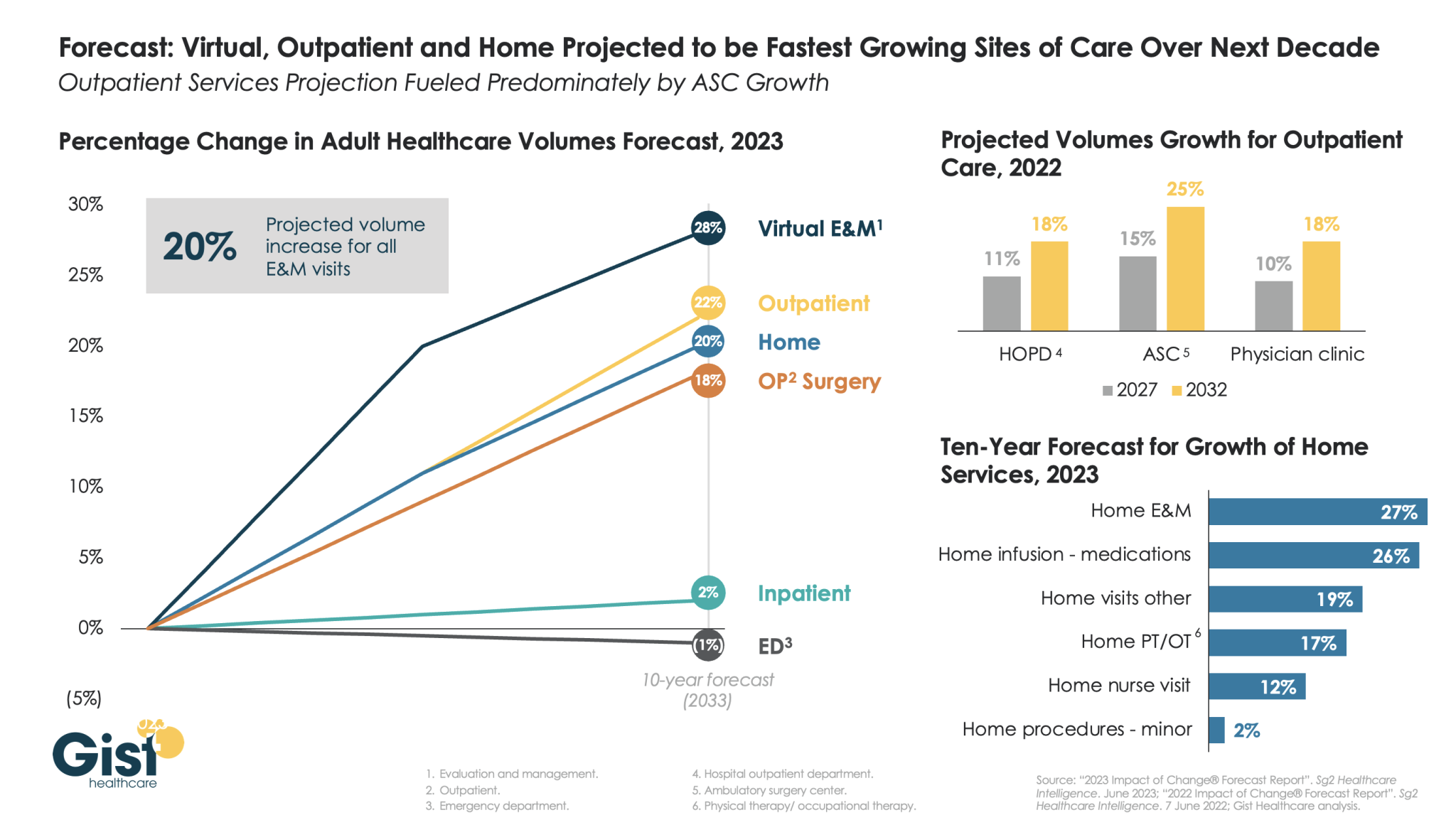
The pandemic accelerated the outpatient shift, which had been progressing steadily for decades, into a new gear, as safety-minded consumers avoided inpatient settings.
Using the latest forecasting data from strategic healthcare consulting firm Sg2, the graphic above illustrates how the outpatient shift will continue to accelerate in the coming years. With each projected to grow by 20 percent or more, outpatient, virtual, and home-based care services will continue far outpace growth in hospital-based care over the next decade.
Ambulatory surgery centers (ASCs) will be at the center of this care shift, reflected by a projected 25 percent rise in ASC volumes by 2032.
The breadth of care available at home will also expand as care delivery technology improves. With the population becoming older and sicker, higher incidence of chronic disease will be met by a rapid expansion of home evaluation and management services (E&M),reflecting a shift away from hospitals and doctors’ offices as hubs for complex care management.
Instead, the patients still coming to hospitals will present with increasingly acute conditions, driving up demand for resource-intensive critical care, as broader inpatient volume remains relatively flat.
As 41% of American adults face medical debt, residents of this southern Colorado city contend their local nonprofit hospitals aren’t providing enough charity care to justify the millions in tax breaks they receive.
The two hospitals in Pueblo, Parkview Medical Center and Centura St. Mary-Corwin, do not pay most federal or state taxes. In exchange for the tax break, they are required to spend money to improve the health of their communities, including providing free care to those who can’t afford their medical bills. Although the hospitals report tens of millions in annual community benefit spending, the vast majority of that is not spent on the types of things advocates and researchers contend actually create community benefits, such as charity care.
And this month, four U.S. senators called on the Treasury’s inspector general for tax administration and the Internal Revenue Service to evaluate nonprofit hospitals’ compliance with tax-exempt requirements and provide information on oversight efforts.
The average hospital in the U.S. spends 1.9% of its operating expenses on charity care, according to an analysis of 2021 data by Johns Hopkins University health policy professor Ge Bai. Last year, Parkview provided 0.75% of its operating expenses, about $4.2 million, in free care.
Centura Health, a chain of 20 tax-exempt hospitals, reports its community benefit spending to the federal government in aggregate and does not break out specific numbers for individual hospitals. But St. Mary-Corwin reported $2.3 million in charity care in fiscal year 2022, according to its state filing. The filing does not specify the hospital’s operating expenses.
The low levels of charity care have translated into more debt for low-income residents.
About 15% of people in Pueblo County have medical debt in collections, compared with 11% statewide and 13% nationwide, according to 2022 data from the Urban Institute. Those Puebloans have median medical debt of $975, about 40% higher than in Colorado and the U.S. as a whole. And all of those numbers are worse for people of color.
“How far into debt do people have to go to get any kind of relief?” said Theresa Trujillo, co-executive director at the Center for Health Progress’ Pueblo office. “Once you understand that there are tens of millions of dollars every single year that hospitals are extracting from our communities that are meant to be reinvested in our communities, you can’t go back from that without saying, ‘Oh my gosh, that is a thread we need to pull on.’”
Trujillo is organizing a group of fed-up residents to engage both hospitals on their community benefit spending. The group of at least a dozen residents believe the hospitals are ignoring the needs identified by the community — things like housing, addiction treatment, behavioral health care, and youth activities — and instead spending those dollars on things that mainly benefit the hospitals and their staffs.
For the fiscal year ending June 2022, with total revenue of $593 million, Parkview reported $100 million in community benefit spending. But most of that — more than $77 million — represented the difference between the hospital’s cost of providing care and what Medicaid paid for it.
IRS guidelines allow hospitals to claim Medicaid shortfall as a community benefit, but many academics and health policy experts argue such balance sheet shifts aren’t the same as providing charity care to patients.
Parkview also reported $4.7 million for educating its medical staff and $143,000 in incentives to recruit health professionals as community benefit. The hospital spent only $44,000 on community health improvement projects, which appear to have consisted mainly of launching a new mobile app to streamline appointments and referrals.
Meanwhile, the hospital recently spent $58 million on a new orthopedic facility and $43 million on a new cancer center. Parkview also wrote off $39 million in bad debt in fiscal 2022, although that is different from charity care. The bad debt is money the hospitals tried to collect from patients and ultimately decided they’d never get. But by that time, those patients would likely have been sent to collections and potentially had their credit damaged. And outstanding debt often keeps patients from seeking other needed care.
There is a disconnect between what the community said its biggest health needs were and where Parkview directed its spending. The hospital’s community needs assessment pegged access to care as the top concern, and the hospital said it launched the phone app in response.
The second-largest perceived health need was addressing alcohol and drug use. Yet, the only initiative Parkview cited in response was posting preventive health videos online, including some on alcohol and drug use. Meanwhile, the hospital shut down its inpatient psychiatric unit.
Parkview declined to answer questions about its charity care spending, but hospital spokesperson Todd Seip emailed a statement saying the hospital system “has been committed to providing extensive charity care to our community.”
Seip noted that 80% of Parkview’s patients are covered by Medicare or Medicaid, which pay lower rates than commercial insurance. The hospital posted a net loss of $6.7 million in the 2022 fiscal year, although its charity care wasn’t appreciably higher in previous years in which it posted a net gain.
Centura St. Mary-Corwin reported $16 million in Medicaid shortfall and $2 million in medical staff education in 2022, according to its state filing. The hospital spent about $38,000 for its community health improvement projects, primarily on emergency medical services outreach programs in rural areas. The hospital provided another $96,000 in services, mainly to promote covid-19 vaccination.
Centura also declined to answer questions about its charity care spending. Hospital spokesperson Lindsay Radford emailed a statement saying St. Mary-Corwin was aligning its community health needs assessment process with the Pueblo Department of Public Health and Environment “to develop shared implementation strategies for our community benefit funds, ensuring the resources are targeting the highest needs.”
Trujillo questioned how the hospital has conducted its community health assessments, relying on a social media poll to identify needs. After community members identified 12 concerns, she said, hospital leaders chose their priorities from the list.
“They talk about a community garden like they’re feeding the whole south side of the community,” Trujillo said. The hospital established a community garden in 2021, with 20 beds that could be adopted by residents to grow vegetables. Trujillo did praise the hospital for converting part of its building into dorms for a community college nursing program.
Trujillo’s group has spent much of the summer researching hospital charity spending and showing up at public meetings to have their views heard. They are working to gain seats on hospital and other state boards that influence how community benefit dollars are spent, and are urging hospitals to reconfigure their boards to better represent the demographics of their communities.
“We’ve made folks now aware that we want to be a part of those processes,” Trujillo said. “We’re willing to help them reach deeper into the community.”
Tax-exempt hospitals have been under increased state scrutiny for their charitable spending, especially after the Affordable Care Act and Medicaid expansion drove down the uninsured rate. That in turn cut the amount of care hospitals had to provide without being paid, potentially freeing up money to help more people without insurance or with high-deductible plans.
In Colorado, hospitals’ charity care spending and bad debt write-offs dropped from an average of $680 million a year in the five years prior to the ACA being fully implemented in 2014 to an average of $337 million in the years after, according to the Colorado Healthcare Affordability and Sustainability Enterprise Board, a state advisory group.
In states like Colorado, which used federal funding to expand the number of people covered by Medicaid, hospitals shifted more of their community benefit spending to cover Medicaid reimbursement shortfalls.
A January report from Colorado’s Department of Health Care Policy & Financing concluded that payments from public and private health plans help the state’s hospitals make more than enough money to offset lower Medicaid rates and still turn a profit while providing more true charity care.
Colorado has enacted two bills in the past five years to increase the transparency of hospitals’ charitable efforts with new reporting requirements.
“I think overall, we’re pleased with the amount of money that hospitals are reporting they spent,” said Kim Bimestefer, the executive director of the Department of Health Care Policy & Financing. “Is that money being expended in meaningful ways, ways that improve health and well-being of the community? Our reports right now can’t determine that.”
Shorter contracts, noncompete agreements and increased emphasis on value-based components are among the shifts occurring in physician contracts as hospitals and medical groups build recruitment pipelines and offer incentives to retain physicians.
Changes in how physician contracts are layered echoes a trend that has been occurring in the labor market itself. Physicians are increasingly opting for employed opportunities and contracts within those models are changing accordingly.
From 2019 to 2021, more than 108,700 physicians left private practice for employment opportunities, with 58,200 physicians joining hospitals. About three in four physicians are now employed by hospitals, health systems, private-equity-owned groups, payers or other corporate entities.
The rising costs of private practice, increasing administrative burdens and reimbursement hurdles are also making solo practice a challenging model for many physicians today.
Fewer large medical groups are offering salaries with production bonuses, according to an AMN Healthcare report on physician and advanced practitioner recruiting incentives. The company’s 2017 report found that 75 percent of contracts featured a salary with production bonus, while only 17 percent had a straight salary.
Some medical groups have stopped offering production bonuses because they found that the straight salary model has less ambiguity and is less likely to cause friction with physicians, according to the report.
AMN also found that a relatively high percentage of academic medical centers do not offer the salary with production bonus model, which may account for the decline in the use of this compensation structure in its report.
Income guarantees, which are essentially loans that must be repaid generally (but can be forgiven over time) are used to establish physicians in solo or small independent practices. Income guarantees were once the standard contract model, but as the number of private practices has declined, so has the use of income guarantees, according to the report..
Health systems continue to rethink physician contracts as healthcare continues its shift away from fee for service, but challenges remain when it comes to compensation in these models. Systems at the forefront of this shift are developing ways to incentivize physicians in value-based care as the trend towards team-based compensation gains traction and fosters collaboration among providers.
Epic was named the top EHR for acute care hospitals with 251 beds or more by Black Book Research.
The research group based its results on surveys of 18 performance indicators conducted between the second quarter of 2022 and the third quarter of 2023.
Here are the top six EHRs for large hospitals, according to the report:
Faced with tighter margins and continued rising costs, many health system C-suites are restructuring. At least 17 health systems have reorganized executive teams and some eliminated C-suite roles.
The chief operating officer role in particular has been on the chopping block for health systems but not everyone is slimming down.
Some are bulking up amid organizational transformation with an eye on the future.
In June, Sutter Health in Sacramento, Calif., named Todd Smith, MD, its inaugural senior vice president and chief physician executive, responsible for supporting the health system through clinical transformation. Dr. Smith will focus on service line standards, reducing variation and strengthening the system’s relationship with medical group and community physicians.
Sutter isn’t the only system adding clinical leaders to the C-suite. Mass General Brigham in Somerville, Mass., named Erica Shenoy, MD, PhD, its first chief of infection control in June. Her expanded role is accountable for leading the integration of infection control at the system and developing and implementing infection control standards, policies and measurements. She was also appointed to the National Infection Control Advisory Committee to guide HHS earlier this year.
Meritus Health in Hagerstown, Md., added physician leadership to its executive team. Adrian Park, MD, became the system’s first chief surgical officer with responsibility for building a surgical program with advanced technology and minimally invasive procedures to the system. He is known for surgical innovation in laparoscopic techniques, and holds more than 20 patents.
MaineHealth in Portland recently added Chris Thompson, MD, to the C-suite as the system’s first chief medical transformation officer. He is responsible for chief medical officer duties as well as innovating in care delivery.
Richmond, Va.-based VCU Health and OU Health in Oklahoma City named their first chief nursing executives as well earlier this year.
Health systems are also adding strategic experts with expertise in patient experience, transformation and data analytics.
Atlanta-based Emory Healthcarecreated a new role for Amaka Eneanya, MD, to serve as chief transformation officer, accountable for enhancing patient and clinician experiences. She took on the role in July and is tasked with developing systemwide strategies to boost patient experience, improve access to care, increase community engagement and enrich clinician experience. Dr. Eneanya works with the system’s diversity, equity and inclusion office to prioritize strategies for health equity, diversity and inclusion in care delivery as well.
“Amaka is a forward-thinking leader who is well versed in transformational strategy and operational structure and will help us move Emory Healthcare to the next level,” said Joon S. Lee, MD, CEO of Emory Healthcare. “We look forward to working with her in our continued pursuit to transform and strengthen patient access and the patient experience.”
Last year, Centura Health in Centennial, Colo., also added a chief transformation officer, Scott Lichtenberger, MD, as a new position to balance short-term improvements and long-term value. He is responsible for ensuring the system delivers results quickly.
Finally, Cleveland Clinic has elevated another IT leader into the C-suite in recent weeks. Albert Marinez was named the system’s first chief analytics officer, set to begin his new role Aug. 28. He previously served as chief analytics officer of Intermountain Health in Salt Lake City, and will be responsible for overseeing data strategies for better patient care and lower costs at Cleveland Clinic. He will also have accountability for boosting the system’s growth alongside chief digital officer Rohit Chandra, PhD.









 HENRY KOTULA