Map: See the 2,500 hospitals that face readmission penalties this year

Which States Had the Most Hospitals Penalized for Readmissions 2020

A recent CMS analysis of its Hospital Readmissions Reduction Program (HRRP) found that 2,500 hospitals will face HRRP penalty reductions and around 18% of hospitals will face penalties of at least 1% of their Medicare reimbursements for fiscal year (FY) 2022, Modern Healthcare reports.

Cheat sheet: Hospital readmissions reduction program

How HRRP works

Under the HRRP, CMS withholds up to 3% of regular reimbursements for hospitals if they have a higher-than-expected number of 30-day readmissions for any of six conditions:
Toolkit: CV medical readmissions reduction

  • Chronic lung disease
  • Coronary artery bypass graft surgery
  • Heart attacks
  • Heart failure
  • Hip and knee replacements
  • Pneumonia

Historically, hospitals received a penalty if their observed readmissions for any one of these conditions exceeded a national standard. However, in response to criticism, CMS in 2019 scrapped the national standard comparison standard. It now compares hospitals’ performance with that of other hospitals serving a similar population of low-income patients.

Under the current methodology, CMS has categorized all participating hospitals into quintiles according to the proportion of dual-eligible patients (patients eligible for Medicare and Medicaid) each hospital serves. Now, each hospital is compared with the median readmissions performance of its cohort, and hospitals with higher-than-cohort-median performance are penalized.

The program does not apply to veterans hospitals, children’s hospitals, psychiatric hospitals, or hospitals in Maryland, which has a federal waiver for how it distributes Medicare funding. In addition, hospitals are not evaluated under the program if they do not treat enough cases of the conditions evaluated.

Fewer hospitals are facing high HRRP penalties

In a recent analysis, CMS looked at HRRP data from July 2017 to December 2019. It found that 2,500 hospitals will face HRRP penalty reductions for FY 2022, and around 18% of hospitals will be penalized more than 1% of their reimbursements, down from 20% from July 2016 through June 2019.
The financial value of readmissions reduction

The analysis also found that 80% of hospitals with the highest proportion of Medicare-Medicaid dual-eligible patients will pay penalties, while nearly 72% of hospitals with the lowest proportion of dual-eligible patients will receive penalties.

This likely will be the last set of readmissions data unaffected by the Covid-19 pandemic. Under ordinary circumstances, CMS reviews three years of data in calculating HRRP penalties, so the agency ordinarily would have considered data from July 2017 to June 2020 in calculating the fiscal year 2022 penalties. However, CMS elected to stop its analysis in December 2019 to exclude data gathered during the Covid-19 pandemic.

CMS has not yet said how it will handle readmissions data from the pandemic, Modern Healthcare reports.

Reaction

Akin Demehin, director of policy for the American Hospital Association (AHA), said the drop in hospitals paying high HRRP penalties is a success.

“America’s hospitals and health systems have made substantial progress in reducing unnecessary readmissions, which has improved quality and enhanced care coordination,” Demehin said.

Demehin also praised CMS for excluding data from the Covid-19 pandemic from its analysis.

“We are pleased that CMS heard our concerns and excluded data from the first six months of 2020 to account for the pandemic when calculating performance,” he said. “We will continue to ask CMS to use its discretion to exclude pandemic-affected data in calculating performance in its hospital quality and value programs going forward.”

Demehin also added that CMS should expand its peer-grouping of hospitals by incorporating other social risk factors beyond a hospital’s control.

Peer grouping provides relief to many hospitals serving the poorest and most vulnerable communities,” he said. “Congress gave CMS the ability to refine its social risk factor adjustment approach over time, and because the research and science on this issue continues to evolve, the AHA has encouraged CMS to consider ongoing refinements.” (Gillespie, Modern Healthcare, 10/1)

Jefferson Health, Einstein Healthcare finalize merger, create 18-hospital system

Jefferson Health New Jersey |

More than three years after signing a letter of intent to merge, Jefferson Health and Einstein Healthcare Network have finalized the deal. 

The combination of the Philadelphia-based organizations brings together two academic medical centers and creates an integrated 18-hospital system with more than 50 outpatient and urgent care locations.

“The culmination of the multiyear process of bringing two great organizations with more than 300 combined years of service, clinical excellence and academic expertise is not just a merger,” said Stephen Klasko, MD, president of Thomas Jefferson University and CEO of Jefferson Health. “Einstein and the new Jefferson together represent an opportunity for the Philadelphia region to creatively construct a reimagining of healthcare, education, discovery, equity and innovation that will have national and international reverberations.”

The merger had previously faced antitrust scrutiny and delays from legal challenges. In particular, both the Federal Trade Commission and Pennsylvania’s attorney general sued the health systems in attempts to block the deal.

The FTC sued in February 2020, arguing that the combination of the two systems would reduce competition in both Philadelphia and Montgomery counties “to the detriment of patients.” An appellate court denied the FTC’s attempt to block the merger in December 2020, and the FTC officially dropped its challenge to the transaction in February 2021. 

The Pennsylvania attorney general also dropped his opposition to the merger in January 2021 after the FTC lost its case. 

Ken Levitan will continue serving as president and CEO of Einstein and add the role of executive vice president at Jefferson Health. In his new role, he will help guide the integration efforts. 

Read more here.

14 health systems with strong finances

What next for the US dollar? - TalkingPoint - Schroders

Here are 14 health systems with strong operational metrics and solid financial positions, according to reports from Fitch Ratings, Moody’s Investors Service and S&P Global Ratings.

1. Advocate Aurora Health has an “Aa3” rating and positive outlook with Moody’s. The health system, which has dual headquarters in Milwaukee and Downers Grove, Ill., has a leading market share in two regions and strong financial discipline, Moody’s said. The credit rating agency said it expects Advocate Aurora Health’s operating cash flow margins to return to pre-pandemic levels. 

2. Pinehurst, N.C.-based FirstHealth of the Carolinas has an “AA” rating and stable outlook with Fitch. The health system has a strong financial profile and stable operating performance, despite disruption from the COVID-19 pandemic, Fitch said. The health system’s revenue in the first quarter of fiscal 2021 rebounded to levels close to historical trends, according to the credit rating agency. 

3. Indianapolis-based Indiana University Health has an “Aa2” rating and stable outlook with Moody’s and an “AA” rating and positive outlook with Fitch. Cost controls and patient volume will help the system sustain strong margins and liquidity, Moody’s said. 

4. Rapid City, S.D.-based Monument Health has an “AA-” rating and stable outlook with Fitch. The health system has solid operating margins that Fitch expects to remain stable over the near term. Monument Health’s operating margins will continue to support liquidity growth and capital spending levels, the credit rating agency said. 

5. Chicago-based Northwestern Medicine has an “Aa2” rating and stable outlook with Moody’s, and an “AA+” rating and stable outlook with S&P. The system’s consolidated operating model will allow it to maintain a strong financial position while effectively executing strategies, Moody’s said. The credit rating agency expects Northwestern Medicine to expand its prominent market position in the broader Chicago region because of its strong brand and affiliation with Northwestern University’s Feinberg School of Medicine. 

6. Renton, Wash.-based Providence has an “AA-” rating and stable outlook with Fitch and an “Aa3” rating and stable outlook with Moody’s. Fitch said Providence has a long-term strategic advantage over most of its peers because it has invested heavily in developing technology in recent years, and the system’s plan to transform healthcare delivery through the use of data and technology has been undeterred through the COVID-19 pandemic. Fitch said it expects Providence’s cash flow margins to be close to 7 percent in the coming years. 

7. Livingston, N.J.-based RWJBarnabas Health has an “Aa3” rating and stable outlook with Moody’s. Moody’s said it expects RWJBarnabas, the largest integrated academic health system in New Jersey, to see near-term revenue growth and to execute on several strategic fronts while achieving targeted financial performance.  

8. Broomfield, Colo.-based SCL Health has an “AA-” rating and stable outlook with Fitch and an “Aa3” rating and stable outlook with Moody’s. The health system has consistently improved its liquidity levels and has a long track record of exceptional operations, Fitch said. SCL Health is well positioned for change in the healthcare sector because it has built up cash reserves over time, according to the credit rating agency. 

9. San Diego-based Scripps Health has an “Aa3” rating and stable outlook with Moody’s. The health system has ample liquidity coverage, an extensive footprint and strong brand and market share within San Diego County, Moody’s said. The credit rating agency said it expects Scripps to weather current operating challenges and to grow operating cash flow over the long term. 

10. Norfolk, Va.-based Sentara Healthcare has an “Aa2” rating and stable outlook with Moody’s. The health system has strong margins, and Moody’s said it expects the system to maintain a strong financial position and balance sheet. 

11. Arlington-based Texas Health Resources has an “Aa2” rating and stable outlook with Moody’s. The health system has a strong cash position, which will be boosted by favorable investment gains and bond proceeds, Moody’s said. Based on performance in the second quarter of this year, Moody’s expects Texas Health Resources’ patient volume and operating cash flow margins to recover to pre-COVID-19 levels. 

12. Iowa City-based University of Iowa Hospitals & Clinics has an “Aa2” rating and stable outlook with Moody’s. The credit rating agency said it expects the system to maintain strong operating performance and cash flow. The system benefits as the only academic medical center in Iowa, according to Moody’s. 

13. Des Moines, Iowa-based UnityPoint Health has an “AA-” rating and stable outlook with Fitch. The system has strong leverage metrics, and it benefited from strong market returns during the pandemic. The system’s days with cash on-hand increased to 285 days at the end of 2020, up from 231 days at the end of 2019, according to the credit rating agency. 

14. Kansas City-based University of Kansas Health System has an “AA-” rating and stable outlook with Fitch. The health system has solid operating results and has sustained significant revenue growth, Fitch said. The system’s profitability dipped in fiscal year 2020 because of the COVID-19 pandemic, but its profitability rebounded in fiscal year 2021, according to the credit rating agency. 

Stark divide in industry outlook

Nearly three in five U.S. health care workers are optimistic about where the industry is headed, according to a new poll released today by Morning Consult.

Why it matters: Amid increasing concerns about burnout in health care and workforce shortages, the poll of more than 900 workers between Sept. 2–8 shows there is still a lot of optimism about the health care profession even as workers deal with stressful working conditions.

A common theme among the responses was the message that “working in healthcare is hard and it’s something that should only be done if you are completely committed to it.”

  • Responses ranged from one worker who said “it’s a great career,” to another who said young people should avoid the field “unless you have a death wish.”
  • The poll also found men were more likely than women to be optimistic about the future of the health care industry.

Setting the rules for settling “surprise bills”

https://mailchi.mp/a2cd96a48c9b/the-weekly-gist-october-1-2021?e=d1e747d2d8

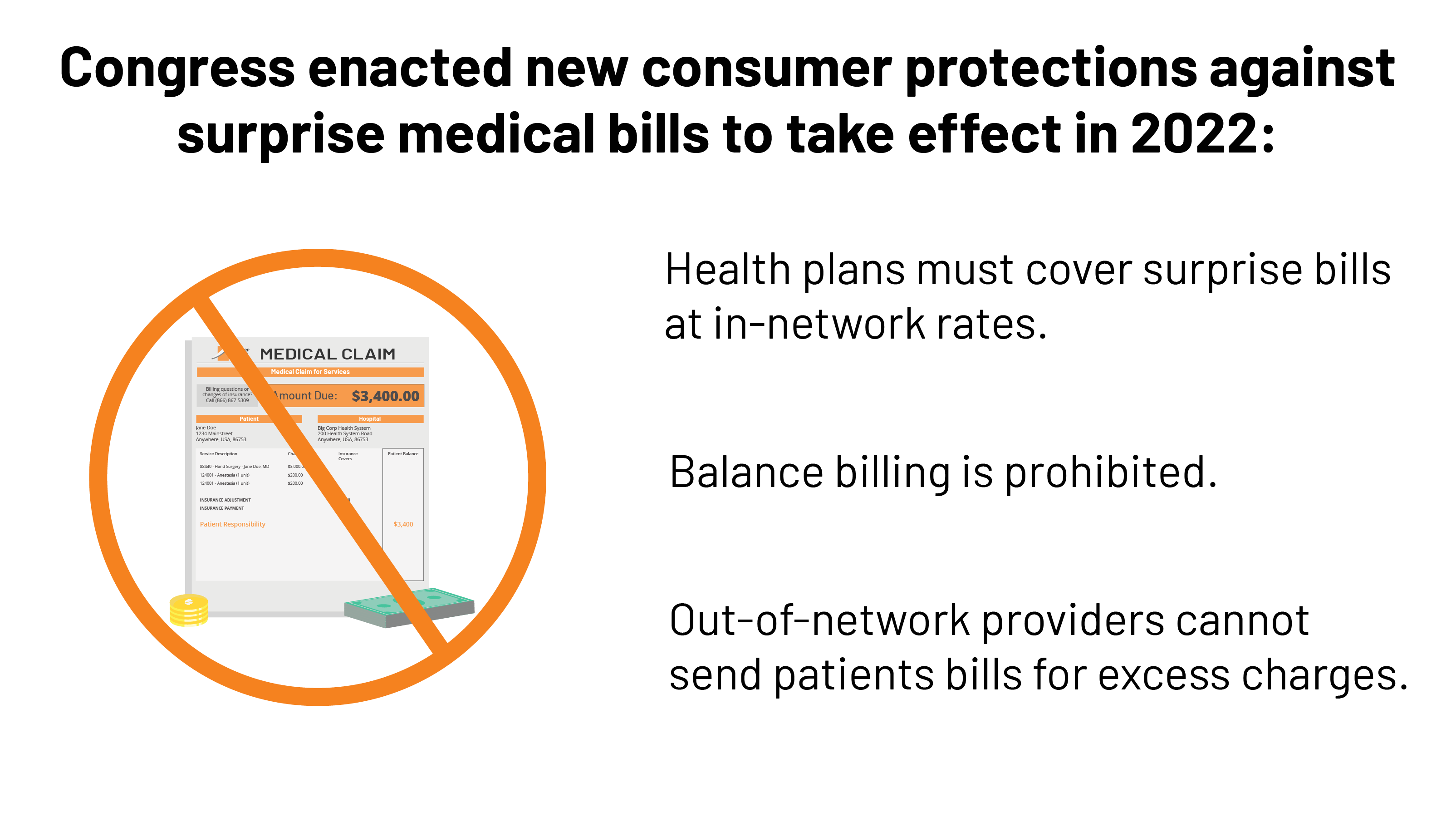
Surprise Medical Bills: New Protections for Consumers Take Effect in 2022 |  KFF

On Thursday the Department of Health and Human Services (HHS), along with other federal agencies, released the long-awaited second half of its proposed regulations implementing the No Surprises Act, passed by Congress at the end of last year, which bans “surprise billing” of patients who unsuspectingly receive care from out-of-network providers.

The interim final rule, which will take effect on January 1st after a comment and review period, lays out a process for addressing disputed patient bills, first through a 30-day “open negotiation” between the patient’s insurer and the out-of-network provider, and then through a federally-managed arbitration process.

Of most interest to insurers and providers who have lobbied fiercely for months to ensure a favorable interpretation of the law, the new regulation specifies that the outsider arbitrator, to be agreed upon by both parties, must begin with the presumption that the median in-network rate for services in the local market is the correct one. The arbitrator can then modify that price based on the specific circumstances of the case.

That method was broadly favored by insurers, and AHIP strongly endorsed the proposed approach, saying in a press release that “this is the right approach to encourage hospitals, healthcare providers, and health insurance providers to work together and negotiate in good faith.” Predictably, the hospital lobby felt otherwise; the American Hospital Association reacted by calling the rule “a windfall for insurers”, saying that it “unfairly favors insurers to the detriment of hospitals and physicians who actually care for patients.” 

The ultimate winners here are patients, who will gain important new protections against the potentially crippling financial implications of surprise billing. We’d agree with HHS Secretary Xavier Becerra, who told the New York Times that the new rule would “[take] patients out of the middle of the food fight,” and provide “a clear road map on how you can resolve that food fight between the provider and the insurer.” It’s about time. 

Still unresolved: the high cost of out-of-network ambulance services, left out of the No Surprises Act altogether. Let’s hope Congress circles back to address that issue soon.

Preparing for generations of Medicare growth

https://mailchi.mp/72a9d343926a/the-weekly-gist-september-24-2021?e=d1e747d2d8

The healthcare industry is now at the peak of the long-awaited transition of the Baby Boom generation into Medicare. The “greying” of the Boomers will continue to bring a rapid influx of new Medicare beneficiaries, but this is just the beginning of a protracted period of growth for the program, with the number of Medicare-eligible Americans increasing by more than 50 percent over the next three decades.

Using data from the US Census Bureau, the graphic above shows how the generational makeup of the Medicare population will change across time. The next decade will bring the fastest growth, as the latter half of the Baby Boom generation turns 65. Over that time, the Medicare-eligible population will increase by almost a third. Gen X will begin to age into Medicare in 2029. (Go ahead, take a minute. It hurts.) While fewer in number, Gen X beneficiaries, combined with the longer lifespan of Baby Boomers, will bring no respite from Medicare growth, with enrollment still increasing 11 percent between 2030 and 2040. 

As the country looks at a prolonged period of Medicare cost growth, we’ll be counting on a ballooning workforce of Millennials and Gen Z youngsters—each part of generations even larger than the Baby Boom—to continue to fund the Medicare trust across the next 25 years, when the first Millennials will receive their Medicare cards. (See how it feels?)

Intermountain, SCL Health to create $11B system 

https://mailchi.mp/72a9d343926a/the-weekly-gist-september-24-2021?e=d1e747d2d8

Trends In Hospital and Health System Marketing in a Rapidly Consolidating  Industry - Hirsch Healthcare Consulting

Salt Lake City-based Intermountain Healthcare announced plans to merge with Broomfield, CO-based SCL Health to form a 33-hospital, $11B dollar system working in six states. The combined system will keep the Intermountain name, be based in Salt Lake City, and be led by Intermountain CEO Dr. Marc Harrison.

Harrison said that the merger will accelerate the evolution toward population health and value, and “swiftly advance that cause across a broader geography”—a similar value proposition to the system’s previously proposed combination with South Dakota-based Sanford Health, which fell apart last December after Sanford’s CEO stepped down following his controversial comments about mask-wearing.

Intermountain has long been regarded as a national leader in clinical quality, and its integrated payer-provider approach is often cited as a model for US healthcare. The merger with SCL Health will enable expansion of its SelectHealth insurance plan and integrated care model into Colorado, Montana and Kansas, including the fast-growing Denver metropolitan area, making the combined system a formidable player across the Mountain West.

But as we’ve written before, achieving that vision will require a level of integration not often realized in similar mergers, and the burden of proof is on health systems to demonstrate that the merger will create meaningful value for patients and consumers.

We’ll be watching closely to better understand their plans for lowering costs and improving access and quality for patients across the region.

Prime Healthcare hospitals cut ties with UnitedHealthcare, citing low reimbursement

https://www.healthcarefinancenews.com/news/prime-healthcare-hospitals-new-jersey-cut-ties-unitedhealthcare-citing-low-reimbursement

Unitedhealth group Stock Photos & Royalty-Free Images | Depositphotos

Prime Healthcare’s New Jersey hospitals announced this week they would terminate their contracts with major insurer UnitedHealthcare, citing significant underpayment compared to the rates of neighboring facilities, and lower reimbursement rates than those offered by Medicaid.

The decision impacts Saint Clare’s Health in Denville, Dover and Boonton, Saint Michael’s Medical Center in Newark, and Saint Mary’s General Hospital in Passaic.

Dr. Sonia Mehta, regional CEO and chief medical officer of Prime Healthcare New Jersey, said in a statement that the hospitals have been underpaid for years, including some rates well below that of Medicaid, and added that UnitedHealthcare’s contract proposal jeopardizes the organization’s ability to deliver quality care.

WHAT’S THE IMPACT?

Due to new disclosure requirements by the Centers for Medicare and Medicaid Services, all hospitals must now disclose their contracted rates. Prime Healthcare said it learned it had been underpaid compared to what United has been paying neighboring hospitals.

The New Jersey Hospital Association reported that Prime Healthcare hospitals provide quality healthcare services and that its cost of care is among the lowest in the State of New Jersey.

“We are patient-focused and are committed to delivering the most compassionate care by exceptional physicians using state-of-the-art technology,” said Mehta. “Undercutting our payments is unacceptable, and so we are taking the necessary step of providing notice of our intent to provide care out-of-network. We realize it is a bold move, but a necessary one to separate our hospitals from organizations that work contrary to our mission and commitment to our patients.”

Prime’s New Jersey hospitals will continue to honor the rates and services in the agreements until the end of the cooling off period, which is December 16 for the Medicaid product and December 31 for the commercial and Medicare products.

All patients can continue to use Prime’s emergency services at its New Jersey hospitals, regardless of insurance, and the hospitals are willing to negotiate single patient agreements for elective services. The hospitals will also honor all continuity of care services for United members.

UnitedHealthcare told Healthcare Finance News that Prime’s demands are unreasonable.

Prime is demanding a 14% price hike in just one year for our employer-sponsored and individual plans, which is unsustainable and would increase healthcare costs for New Jersey residents and employers,” said spokesperson Cole Manbeck. “We hope Prime will work with us to ensure the people we serve have continued access to Prime’s hospitals at an affordable cost.

“While we have agreement on rates for our Medicare Advantage and Medicaid plans and proposed to Prime that we finalize the contract for these plans, Prime refused unless we accepted its 14% price hike demands for our employer-sponsored and individual plans,” he said.

“This unnecessarily puts thousands of New Jersey residents in the middle of our negotiation, presumably because Prime hopes the potential disruption in care for our most vulnerable members would pressure us to give in to its price hike demands.”

THE LARGER TREND

Prime Healthcare New Jersey is part of Prime Healthcare, a health system operating 45 hospitals and more than 300 outpatient locations in 14 states. In 2020, Prime successfully completed its acquisition of St. Francis Medical Center, a 384-bed Los Angeles County medical facility that had previously been owned by Verity Health.

Prime acquired St. Francis for a net of more than $350 million, including a $200 million base cash price and $60 million for accounts receivable.

Just last week, CMS blocked four Medicare Advantage plans from enrolling new members in 2022 because they didn’t spend the minimum threshold on medical benefits, with three UnitedHealthcare plans and one Anthem plan failing to hit the required 85% mark three years in a row. Medicare Advantage plans are required to spend a minimum of 85% of premium dollars on medical expenses; failure to do so for three consecutive years triggers the sanctions.

In June, UnitedHealthcare backtracked on a proposed policy retroactively rejecting emergency department claims. The policy, which was slated to take effect on July 1, meant UHC would evaluate ED claims to determine if the visits were truly necessary for commercially insured members. Claims deemed non-emergent would have been subject to “no coverage or limited coverage,” according to the insurer.

UHC rolled back the policy – for now. The insurer told The New York Times that the policy would be stalled until the end of the ongoing COVID-19 pandemic, whenever that might be.

Hospitals projected to lose $54 billion in net income this year

https://www.healthcarefinancenews.com/news/hospitals-projected-lose-54-billion-net-income-year

Hospitals and Health Systems Projected to Lose About $54B in Net Income in  2021 | HealthLeaders Media

Higher expenses for labor, drugs and supplies as well as a continuation of delayed care during the ongoing COVID-19 pandemic is projected to cost hospitals an estimated $54 billion in net income over the course of this year, according to a new Kaufman Hall analysis released by the American Hospital Association.

Hospitals and health systems are seeing sicker patients, the report said. This includes COVID-19 patients and patients who put off care during the pandemic. They are requiring longer lengths of stay and more services than prior to the pandemic in 2019, the report said.

The seven-day average of new hospital admissions of patients with COVID-19 has increased 488%, from 1,900 on June 19 to 11,168 on September 14, the report said, citing recent data from the Centers for Disease Control and Prevention.

Many hospitals are also reportedly spending a lot more on staffing, paying for contract or travel nurses due to shortages.

WHY THIS MATTERS

The report projects hospitals nationwide will lose an estimated $54 billion in net income over the course of the year, even after taking into account federal Coronavirus Aid, Relief, and Economic Security (CARES) Act funding from last year

If there were no relief funds from the federal government, losses in net income would be as high as $92 billion. 

However, the AHA said, the uncertain trajectory of the Delta and Mu variants in the U.S. this fall could result in even greater financial uncertainty for hospitals.

Despite the recent announcement of additional provider relief funds, none have yet to be allocated or distributed, the AHA said. 

THE LARGER TREND

This latest analysis incorporates actual hospital performance data in the first and second quarters of this year, from before the latest surge. Projections were then made for the remainder of 2021 based on this data.

Based on the analysis, median hospital margins are projected to be 11% below pre-pandemic levels by year’s end. More than a third of hospitals are expected to end 2021 with negative margins.

Many hospitals were financially challenged and already operating in the red heading into the COVID-19 pandemic, the AHA said last year.

CARES Act funding helped hospitals and health systems, but covered only a portion of the more than $323 billion in losses hospitals were expected to have in 2020. 

The government allocated a total of $175 billion in relief funds to providers.

ON THE RECORD 

“America’s hospitals and health systems continue to face significant, ongoing instability and strain as the COVID-19 pandemic endures and spreads,” said AHA President and CEO Rick Pollack. “With cases and hospitalizations at elevated levels again due to the rapid spread of the Delta variant, physicians, nurses and other hospital caregivers and personnel are working tirelessly to care for COVID-19 patients and all others who need care. At the same time, hospitals are experiencing profound headwinds that will continue throughout the rest of 2021.”

CommonSpirit’s net income jumps to $5.5B in 2021, reversing major COVID-19 loss

Dive Brief:

  • Nonprofit hospital giant CommonSpirit Health reported a better operating performance in its 2021 fiscal year than in 2020, but said in financial results released Friday it expects COVID-19 to continue to pressure its operations in the coming year.
  • The Chicago-based Catholic system reported operating income of $998 million for its fiscal year ended June 30, compared to an operating loss of $550 million the year prior.
  • However, excluding federal relief funds from the Coronavirus Aid, Relief, and Economic Security Act passed last March and a sale of part of its stake in an unnamed joint venture, the system would be posting an operating loss of $215 million.

Dive Insight:

It’s CommonSpirit’s second full fiscal year as a a combined organization after the merger of Dignity Health and CHI was completed in February 2019. The marriage resulted in the largest nonprofit system in the U.S., with 140 hospitals and roughly 1,500 sites across 21 states.

However, that scale didn’t protect CommonSpirit from being slammed by the pandemic’s financial effects in 2020, as lower admissions, badly performing investments and higher charity and uncompensated care expenses severely depressed its bottom line.

Though many COVID-19 headwinds continued into its 2021 fiscal year, returning patients, stronger investment performance and cost reduction initiatives helped CommonSpirit to net income of $5.5 billion for the year, compared to its steep loss of $524 million in 2020.

CommonSpirit’s revenues rose more than 12% compared to the 2020 fiscal year, mostly due to recovering patient volume and the addition of new care sites, including Virginia Mason Health System in the Pacific Northwest and Yavapai Regional Medical Center in Arizona, and expanded ambulatory surgical center relationships in several states.

Expenses were also up by 7% year over year mostly due to “significant” pandemic-related expenses, CommonSpirit said in its release on the results.

However, the higher costs were offset by cost management, including more than $400 million in cost reductions in the fiscal year. And, due to stronger financial markets, the system’s balance sheet was also boosted by $3.4 billion in investment income.

But despite the turnaround, CommonSpirit management warned COVID-19 is still likely to dog the system’s performance as it enters its third fiscal year as a combined entity.

The recent surge in patients due to the rise of the highly infectious delta variant caused the system’s COVID-19 inpatient census to jump to almost 2,900 in early September. That’s up from a low of 340 in June, though still significantly lower than CommonSpirit’s previous peak of more than 4,100 COVID-19 inpatients recorded in early January.

Amid the rising cases, the system said it’s emphasizing employee retention as staffing shortages, especially acute among nurses, continue to stress providers nationwide.

CommonSpirit noted it doesn’t expect personal protective equipment or ventilator availability to be a problem, despite increasingly taxed capacity and rising need in the U.S.

Like other providers, the nonprofit operator reported it saw patients begin to return for preventative and delayed care throughout the fiscal year, though that return decelerated in tandem with escalating COVID-19 cases.

Same-facility adjusted admissions dropped 2.7% year over year, while outpatient visits rose 5.1% overall.

Additionally, demand for virtual visits has remained strong even as in-office volumes have recovered. Telehealth use has stabilized at roughly 13% of overall volumes, CommonSpirit said, though that’s down from a high of more than 37% notched in April of last year.

Net patient and premium revenues jumped more than 10% year over year due to higher patient acuity, the YRMC and VMHS affliliations and stable payer mix, CommonSpirit said. Those tailwinds were partly offset by volume shortfalls due to the pandemic.

CommonSpirit, which said it was still on track to achieve the cost-savings goals outlined in CHI and Dignity’s 2019 merger plans, expects to release a new five-year strategic roadmap in the fall.