Patient acuity is driving up hospital costs, AHA says

https://www.healthcarefinancenews.com/news/patient-acuity-driving-hospital-costs-aha-says?mkt_tok=NDIwLVlOQS0yOTIAAAGGiU3xe0NkF9CXkX2TRevw1rc34F0gW3xrh4u01QiSJCzDyJT2rG2TAkJAz344ryPgANhHM9yerPG9lZlib0xHBLXAwqAMIXRTIvQXgJLT

The AHA wants Congress to halt Medicare payment cuts and extend or make permanent certain waivers, among other requests.

The American Hospital Association has released a report on patient acuity that shows hospital patients are sicker and more medically complex than they were before the COVID-19 pandemic.

This is driving up hospital costs for labor, drugs and supplies, according to the AHA report. 

Hospital patient acuity, as measured by average length of stay, rose almost 10% between 2019 and 2021, including a 6% increase for non-COVID-19 Medicare patients as the pandemic contributed to delayed and avoided care, the report said. For example, the average length of stay rose 89% for patients with rheumatoid arthritis and 65% for patients with neuroblastoma and adrenal cancer. 

In 2022, patient acuity as reflected in the case mix index rose 11.1% for mastectomy patients, 15% for appendectomy patients and 7% for hysterectomy patients.

WHY THIS MATTERS

Mounting costs, combined with economy-wide inflation and reimbursement shortfalls, are threatening the financial stability of hospitals around the country, according to the AHA report.

The length of stay due to increasing acuity is occurring at a time of significant financial challenges for hospitals and health systems, which have still not received support to address the Delta and Omicron surges that have comprised the majority of all COVID-19 admissions, the AHA said. 

The AHA is asking Congress to halt its Medicare payment cuts to hospitals and other providers; extend or make permanent certain waivers that improve efficiency and access to care; extend expiring health insurance subsidies for millions of patients; and hold commercial insurers accountable for improper and burdensome business practices.

THE LARGER TREND

Hospitals, through the AHA, have long been asking the federal government for relief beyond what’s been allocated in provider relief funds.

In January, the American Hospital Association sought at least $25 billion for hospitals to help combat workforce shortages and labor costs exacerbated by what the AHA called “exorbitant” rates on the part of some staffing agencies. The Department of Health and Human Services released $2 billion in additional funding for hospitals.

In March, the AHA asked Congress to allocate additional provider relief funds beyond the original $175 billion in the Coronavirus Aid, Relief and Economic Security Act.

Earlier this month, the Centers for Medicare and Medicaid Services increased what it originally proposed for payment in the Inpatient Prospective Payment system rule. The AHA said the increase was not enough to offset expenses and inflation.

7 travel nurse pay trends for healthcare leaders to know

The COVID-19 pandemic intensified hospitals’ reliance on travel nurses to address staffing shortages and highlighted the gap between full-time workers’ pay and lucrative temporary contracts. In the third year of the pandemic, hospitals continue to rely on travel nurses and grapple with workforce shortages for a variety of reasons. However, some organizations have reduced their reliance on travel nurses, and pay overall is lower compared to certain points of the pandemic, experts told Becker’s

Here are seven travel nurse pay trends for healthcare leaders to know, per Vivian Health, a national healthcare hiring marketplace used by about 800,000 clinicians, and AMN Healthcare, a medical staffing firm based in Coppell, Texas:

1. The average weekly travel nurse pay in July in the U.S. was $2,997, up 12 percent from $2,681 during the same time in 2021, according to a report from Vivian Health. The report, which was shared with Becker’s, is based on proprietary data of job postings on Vivian Health in July.

2. Among states, Alaska saw the largest average increase to travel nurse pay in July compared to the same time in 2021, according to the Vivian Health report. Florida saw the largest average decrease.  

3. When taking a month-over-month view of 2022, average travel nurse pay is declining and coming back to last year’s levels, according to Vivian Health. The company cited several factors for this trend, such as a shift away from travel roles and toward permanent nursing roles as well as less federal money being shifted toward hospitals for large travel contracts.

4. Rishabh Parmar, head of strategy and operations at Vivian Health, told Becker’s: “Compared with July 2021, we still see that travel rates are higher [year over year] — close to around 12 percent to 15 percent — but it seems to be stabilized. Now, in terms of the demand, there’s still a lot of demand out there.”

5. Mr. Parmar estimated that available travel nurse jobs on Vivian Health’s platform doubled in July 2021 compared to pre-pandemic numbers in March 2020. As of July 2022, they were at 2.7 times the rate of March 2020 job numbers.

6. AMN Healthcare also reported lower rates. “According to a recent earnings call, AMN Healthcare expects the company will exit 2022 with travel nurse and allied healthcare professional bill rates at approximately 30 percent lower than first-quarter levels,” the company told Becker’s. “Though demand for travel nurses and allied professionals has declined from an all-time high in Q1, the company expects persistent vacancies and labor shortages to continue.”

7. Some hospitals “are saying, ‘We need to use travel nurses, we just have to use [travel contracts] at lower rates,'” Mr. Parmar said. Some organizations are also offering internal travel programs amid an opportunity to attract workers while decreasing contract labor expenses.

Why 67% of nurses want to quit—and what would make them stay

As RNs struggle to work through staffing shortages, their job satisfaction has sharply declined, with 67% saying they plan to leave their jobs within the next few years, according to a survey from the American Association of Critical-Care Nurses (AACN) published in Critical Care Nurse.

RNs cite poor work environments

For the survey, AACN collected responses from 9,862 nurses, 9,335 of which met the study criteria of being currently practicing RNs, in October 2021. The mean age was 46.5 years, and the mean years of experience was 17.8 years.

Of the participants, 78.3% worked in direct care, and 19.4% worked in a Beacon unit, meaning that their unit had been recognized by an AACN Beacon Award for Excellence. Half of the participants said they spent 50% or less of their time caring for Covid-19 patients, while the other half said they spent 50% or more.

To measure the health of a work environment, AACN looked at six standards:

  • Skilled communication
  • True collaboration
  • Effective decision-making
  • Meaningful recognition
  • Authentic leadership
  • Appropriate staffing

Overall, AACN found that nurses’ perceptions of quality on these six measures had declined across the board since the organization’s 2018 survey.

In particular, appropriate staffing was the lowest rated of all the standards at 2.33 out of 4, which is the lowest rating the standard has received since AACN first began the survey in 2006. Only 24% of RNs said their units had the right number of nurses with the right knowledge and skills more than 75% of the time—down from 39% who said the same in 2018.

In addition, there was a significant decline in how RNs rated the quality of care in their organizations and their units. Only 16% rated their organizations’ quality of care as excellent (compared to 24% in 2018), and 30% rated their units’ quality of care as excellent (compared to 44% in 2018). Over 50% of nurses said quality of care in their organization or unit has gotten somewhat or much worse over the last year.

Many nurses also reported difficulties with their physical and psychological well-being in the survey. For example, less than 50% of RNs said they felt their organization values their health and safety, a significant decline from 68% who said the same in 2018.

In addition, 40% of participants reported that they were not emotionally healthy. The percentage of RNs who reported experiencing moral distress also doubled from 11% in 2018 to 22% in 2021.

A significant portion of RNs also reported experiencing verbal abuse, physical abuse, sexual harassment, or discrimination over the past year. Of the 7,399 RNs who answered this question, 72% said they had experienced at least one negative incident, with verbal abuse being the most common at 65%, followed by physical abuse at 28%.

RN job satisfaction

Only 40% of RNs said they were “very satisfied” with their job, down from 62% who said the same in 2018. Further, a significant number of RNs in the survey reported planning to leave their jobs within the next few years.

Overall, 67% of RNs said they planned to leave their current position within the next three years, compared to 54% in 2018. Of this group, 36% said they planned to leave within the next year, with 20% planning to leave within the next six months.

According to the respondents, the top factors that could lead them to reconsider their decision to leave their job were a higher salary and more benefits (63%), better staffing (57%), and more respect from administration (50%).

“Without improvements in the work environment, the results of this study indicate that nurses will continue to exit the workforce in search of more meaningful, rewarding, and sustainable work,” the survey’s authors wrote. “It is time for bold action, and this study shows the way.” (Firth, MedPage Today, 8/3; Ulrich et al., Critical Care Nurse, 8/1)

Hard truths on the current and future state of the nursing workforce

image

Concerns about an imbalance in supply and demand in the nursing workforce have been around for years. The number of nursing professionals nationally may be healthy, but many nurses are not in the local areas, sites of care, or roles where they’re needed most. And many of today’s nurses don’t have the specialized skills they need, widening the existing gap between nurse experience and job complexity.

As a result, gaping holes in staffing rosters, prolonged vacancies, unstable turnover rates, and unchecked use of premium labor are now common.

Health care leaders need to confront today’s challenges in the nursing workforce differently than past cyclical shortages. In this report, we present six hard truths about the nursing workforce. Then, we detail tactics for how leaders can successfully address these challenges—stabilizing the nursing workforce in the short term and preparing it for the future.

Read More

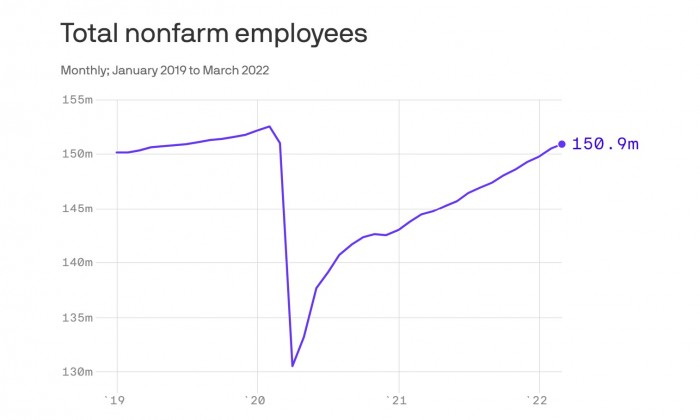
U.S. adds whopping 528,000 jobs in July as labor market booms

Employers added a stunning 528,000 jobs in July, while the unemployment rate ticked down to 3.5%, the lowest level in nearly 50 years, the Labor Department said on Friday.

Why it matters: It’s the fastest pace of jobs growth since February as the labor market continues to defy fears that the economy is heading into a recession.

  • Economists expected the economy to add roughly 260,000 jobs in July.
  • Job gains in May and June were a combined 28,000 higher than initially estimated.

The backdrop: The data comes at a delicate time for the U.S. economy. Growth has slowed as the Federal Reserve raises interest rates swiftly in an attempt to contain soaring inflation.

  • Many economists and Fed officials alike are pointing to the ongoing strength of the labor market as a sign the economy has not entered a recession.
  • Policymakers want to see some heat come off the labor market. They are hoping to see more moderate job growth as the economy cools, in order to ease inflation pressures.

HOSPITALS SEE NEGATIVE MARGINS FOR SIXTH CONSECUTIVE MONTH

https://www.healthleadersmedia.com/finance/hospitals-see-negative-margins-sixth-consecutive-month

Expenses are still weighing heavily on hospitals, health systems, and physician’s practices as the cost of care continues to rise.

Hospitals, health systems, and physician’s practices are still struggling under the weight of significant financial pressure, that the rise in patient volume and revenue can’t seem to outweigh.

The increase in patient volume and revenue has not been able to offset the historically high operating margins these organizations are facing, according to data from Kaufman Hall’s National Hospital Flash Report and Physician Flash Report. Hospitals, health systems, and physician’s practices dealt with negative margins in June for the sixth consecutive month this year.

“To say that 2022 has challenged healthcare providers is an understatement,” Erik Swanson, a senior vice president of data and analytics with Kaufman Hall, said in an email report. “It’s unlikely that hospitals and health systems can undo the damage caused by the COVID-19 waves of earlier this year, especially with material and labor costs at record highs this summer.”

The median Kaufman Hall year-to-date operating margin index for hospitals was -0.09% through June, for the sixth month of cumulative negative actual operating margins. However, the median change in operating margin in June was up 30.8% compared to May, but down 49.3% from June 2021.

Hospital revenues for June continued to trend upward, even as volumes evened out, according to the Kauffman Hall data. Organizations saw a 2.1% drop in patient length of stay. Both patient days and emergency department visits each dropped by 2.6% in June when compared to May. Hospital’s gross operating revenue was up 1.2% in June from May.

Expenses have been dragging down hospital margins for months, however, June saw a slight month-over-month improvement as total hospital expenses dropped 1.3%, despite this, year-over-year expenses are still up 7.5% from June 2021. Physician practices saw a drop in provider compensation, according to the Kaufman Hall data, however, this wasn’t enough to offset expenses. The competitive labor market for healthcare support staff resulted in a new high for total direct expense per provider FTE in Q2 2022 of $619,682—up 7% from the second quarter of 2021 and 12% from the second quarter of 2020.

“Given the trends in the data, physician practices need to focus on efficiency in the second half of 2022,” Matthew Bates, managing director and Physician Enterprise service line lead with Kaufman Hall, said in the email report. “Amid historically high expenses, shifting some services away from physicians to advanced practice providers like nurse practitioners or physician assistants could help rein in the costs of treating an increased patient load while taking some of the weight off the shoulders of physicians.”

Hospitals need ‘transformational changes’ to stem margin erosion

https://www.healthcaredive.com/news/Fitch-ratings-nonprofit-hospital-changes/627662/

Dive Brief:

  • Nonprofit hospitals are reporting thinner margins this year, stretched by rising labor, supply and capital costs, and will be pressed to make big changes to their business models or risk negative rating actions, Fitch Ratings said in a report out Tuesday.
  • Warning that it could take years for provider margins to recover to pre-pandemic levels, Fitch outlined a series of steps necessary to manage the inflationary pressures. Those moves include steeper rate increases in the short term and “relentless, ongoing cost-cutting and productivity improvements” over the medium term, the ratings agency said.
  • Further out on the horizon, “improvement in operating margins from reduced levels will require hospitals to make transformational changes to the business model,” Fitch cautioned.

Dive Insight:

It has been a rough year so far for U.S. hospitals, which are navigating labor shortages, rising operating costs and a rebound in healthcare utilization that has followed the suppressed demand of the early pandemic. 

The strain on operations has resulted in five straight months of negative margins for health systems, according to Kaufman Hall’s latest hospital performance report.

Fitch said the majority of the hospitals it follows have strong balance sheets that will provide a cushion for a period of time. But with cost inflation at levels not seen since the late 1970s and early 1980s, and the potential for additional coronavirus surges this fall and winter, more substantial changes to hospitals’ business models could be necessary to avoid negative rating actions, the agency said.

Providers will look to secure much higher rate increases from commercial payers. However, insurers are under similar pressures as hospitals and will push back, using leverage gained through the sector’s consolidation, the report said.

As a result, commercial insurers’ rate increases are likely to exceed those of recent years, but remain below the rate of inflation in the short term, Fitch said. Further, federal budget deficits make Medicare or Medicaid rate adjustments to offset inflation unlikely.

An early look at state regulatory filings this summer suggests insurers who offer plans on the Affordable Care Act exchanges will seek substantial premium hikes in 2023, according to an analysis from the Kaiser Family Foundation. The median rate increase requested by 72 ACA insurers was 10% in the KFF study.

Inflation is pushing more providers to consider mergers and acquisitions to create economies of scale, Fitch said. But regulators are scrutinizing deals more strenuously due to concerns that consolidation will push prices even higher. With increased capital costs, rising interest rates and ongoing supply chain disruptions, hospitals’ plans for expansion or renovations will cost more or may be postponed, the report said.

Providence restructures leadership team, cuts executive jobs

https://www.healthcaredive.com/news/providence-job-cuts/627660/

Providence said Tuesday it is restructuring and reducing executive roles amid persistent operating challenges spurred by the COVID-19 pandemic.

Providence said it will reduce its regional executive teams to three divisions from seven. The Washington-based nonprofit health system also has plans to consolidate three clinical lines of business — physician enterprise, ambulatory care network and clinical institutes — down to one executive leadership team. 

“We began this journey before the pandemic, but it has become even more imperative today as health systems across the country face a new reality,” Providence President and CEO Rod Hochman said in a statement. 

The new operating model is aimed at protecting direct patient care staff and other essential roles, Melissa Tizon, vice president of communication, told Healthcare Dive. 

It’s unclear how many roles will be eliminated as part of the restructuring. Providence did not provide a specific number of job reductions. 

Erik Wexler, former president of strategy and operations in Providence’s southern regions, will step into a new role as chief operating officer and will oversee the three new divisions.

Kevin Manemann will serve as division chief executive of the South region, which includes operations in Southern and Northern California. 

Joel Gilbertson, division chief executive for the central region, will oversee operations in Eastern Washington, Montana, Oregon, Texas and New Mexico. 

Guy Hudson will lead the North Division, which includes operations in Western Washington and Alaska. Hudson will keep his role as president and CEO of Swedish Health Services in Seattle. 

David Kim, an executive vice president, will lead the three clinical business lines that were consolidated under one leadership team. 

The shakeup comes after Providence reported in March that its operating loss doubled in 2021, reaching $714 million as operating expenses climbed 8% for the year. 

The system said it treated more patients who were sicker and required a higher level of care than in 2020 and, at the same time, struggled with labor shortages.