Tacoma, Wash.-based Virginia Mason Franciscan Health has laid off more than 300 administrative employees, the Puget Sound Business Journal reported April 4.
The job cuts affected less than 2 percent of the health system’s 19,000-plus workforce.
“Like many healthcare providers in the Pacific Northwest, we are experiencing tremendous financial strain caused by a number of factors, including lasting impacts from the COVID-19 pandemic, inflation and labor shortages,” Kelly Campbell, vice president of marketing and communications, told the Journal.
Affected employees will be eligible for career transition assistance, extended benefits and severance programs, according to the report.
Virginia Mason, which includes 10 hospitals and nearly 300 care sites, said it is focused on improving efficiencies and reducing costs in response to financial headwinds.
In 2022, Washington hospitals reported a total net loss of more than $2.7 billion, compared to a $1.2 billion loss in 2021, while their net operating loss was $2.1 billion, up from $742 million in 2021.
“We’re very concerned that access to this specialized care, the highest level of care, and in many cases, the life-saving care is threatened by unsustainable financial losses as hospitals are resorting to extraordinary means to close the gaps in their budgets,” Cassie Sauer, president and CEO of the Washington State Hospital Association, said in a March 21 media briefing.
Contrary to widespread reports of staffing shortages, healthcare employment reached pre-pandemic levels with the addition of 44,200 jobs in February, according to a recent report from Altarum.
A recent survey of hospital CEOs found that healthcare staffing was their top concern. Nurses nationwide have reported unsafe staffing levels, leading health systems to restructure and lawmakers to consider safe-staffing laws.
Yet, healthcare currently has 1.3 percent more jobs than it did in February 2020, according to the monthly Health Sector Economic Indicators brief from Altarum. The nonprofit, healthcare-focused research and consulting organization analyzes available data on spending, prices, employment and utilization to craft the monthly report.
The data holds that this isn’t a new occurence. The sector has been adding — on average — 49,100 jobs per month for the past year, according to the brief. In February, hospitals led that growth, tapping 19,400 workers. Nursing and residential care facilities added 13,700 jobs, and ambulatory care settings added 11,100.
However, as healthcare employment rises, its wage growth continues to decline and now lags behind economywide growth. Healthcare wage growth has been declining since mid-2022; in January, pay grew 4.2 percent year over year, while total private sector wage growth grew 4.4 percent.
This statistic also defies industry narratives, as recent labor negotiations between unions and health systems have scored big raises for workers and clinicians.
A number of hospitals and health systems are trimming their workforces or jobs due to financial and operational challenges.
Below are workforce reduction efforts or job eliminations that were announced within the past six months and/or take effect later this year.
Editor’s Note: This webpage was updated March 27 and will continue to be updated.
1. Bellevue, Wash.-based Overlake Medical Center and Clinics has laid off administrative staff, the health system confirmed to the Puget Sound Business Journal. The layoffs, which occurred earlier this year, included 30 workers across Overlake’s human resources, information technology and finance departments, a spokesperson said, according to the publication. This represents about 6 percent of the organization’s administrative workforce. Overlake’s website says it employs more than 3,000 people total.
2. Columbia-based University of Missouri Health Care is eliminating five hospital leadership positions across the organization, spokesperson Eric Maze confirmed to Becker’s March 20. Mr. Maze did not specify which roles are being eliminated saying that the organization won’t address individual personnel actions. According to MU Health Care, the move is a result of restructuring “to better support patients and the future healthcare needs of Missourians.”
3. Greensboro, N.C.-based Cone Healtheliminated 68 senior-level jobs. The job eliminations occurred Feb. 21, Cone Health COO Mandy Eaton told The Alamance News. Of the 68 positions eliminated, 21 were filled. Affected employees were offered severance packages.
4. The newly merged Greensburg, Pa.-based organization made up of Excela Health and Butler Health Systemeliminated 13 filled managerial jobs. The affected employees and positions are from across both sides of the new organization, Tom Chakurda, spokesperson for the Excela-Butler enterprise, confirmed to Becker’s. The positions were in various support functions unrelated to direct patient care.
5. Crozer Health, a four-hospital system based in Upland, Pa., is laying off roughly 215 employees amid financial challenges. The system announced the layoffs March 15 as part of its “operational restructuring plan” that “focuses on removing duplication in administrative oversight and discontinuing underutilized services.” Affected employees represent about 4 percent of the organization’s workforce.
6. Philadelphia-based Penn Medicine is eliminating administrative positions. The change is part of a reorganization plan to save the health system $40 million annually, the Philadelphia Business Journal reported March 13. Kevin Mahoney, CEO of the University of Pennsylvania Health System, told Penn Medicine’s 49,000 employees last week that changes include the elimination of a “small number of administrative positions which no longer align with our key objectives,” according to the publication. The memo did not indicate the exact number of positions that were eliminated.
7. Sovah Health, part of Brentwood, Tenn.-based Lifepoint Health, has eliminated the COO positions at its Danville and Martinsville, Va., campuses. The responsibilities of both COO roles will now be spread across members of the existing administrative team.
8. Valley Health, a six-hospital health system based in Winchester, Va., eliminated 31 administrative positions. The job cuts are part of the consolidation of the organization’s leadership team and administrative roles.
9. Marshfield (Wis.) Clinic Health System will lay off 346 employees, representing less than 3 percent of its employee base.
11. Roseville, Calif.-based Adventist Health plans to go from seven networks of care to five systemwide to reduce costs and strengthen operations. The reorganization will result in job cuts, including reducing administration by more than $100 million.
12. Arcata, Calif.-based Mad River Community Hospital is cutting 27 jobs as it suspends home health services.
13.. Hutchinson (Kan.) Regional Medical Centerlaid off 85 employees, a move tied to challenges in today’s healthcare environment.
14. Oklahoma City-based OU Health is eliminated about 100 positions as part of an organizational redesign to complete the integration from its 2021 merger.
15. Memorial Sloan Kettering Cancer Center announced it would lay off to reduce costs amid widespread hospital financial challenges. The layoffs are spread across 14 sites in New York City, and equate to about 1.8 percent of Memorial Sloan’s 22,500 workforce.
16. St. Louis-based Ascensioncompleted layoffs in Texas, the health system confirmed in January. A statement shared with Becker’s says the layoffs primarily affected nonclinical support roles. The health system declined to specify to Becker’s the number of employees or positions affected.
18. Chillicothe, Ohio-based Adena Health System announced it would eliminate 69 positions — 1.6 percent of its workforce — and send 340 revenue cycle department employees to Ensemble Health Partners’ payroll in a move aimed to help the health system’s financial stability.
19. Ascension St. Vincent’s Riverside in Jacksonville, Fla., will end maternity care at the hospital, affecting 68 jobs, according to a Workforce Adjustment and Retraining Notification filed with the state Jan. 17. The move will affect 62 registered nurses as well as six other positions.
20. Visalia, Calif.-based Kaweah Health aims to eliminate 94 positions through early January as part of a new strategy to reduce labor costs. The job cuts come in addition to previously announced workforce reductions; the health system already eliminated 90 unfilled positions and lowered its workforce by 106 employees.
21. Oklahoma City-based Integris Health is eliminating 200 jobs to curb expenses. The eliminations include 140 caregiver roles and 60 vacant jobs.
22. Toledo, Ohio-based ProMedica plans to lay off 262 employees, a move tied to its exit from a skilled-nursing facility joint venture late last year. The layoffs will take effect between March 10 and April 1.
23. Employees at Las Vegas-based Desert Springs Hospital Medical Center were notified of layoffs coming to the facility, which will transition to a freestanding emergency department. There are 970 employees affected. Desert Springs is part of the Valley Health System, a system owned and operated by King of Prussia, Pa.-based Universal Health Services.
24. Philadelphia-based Jefferson Health plans to go from five divisions to three in an effort to flatten management and become more efficient. The reorganization will result in an unspecified number of job cuts, primarily among executives.
25. Pikeville (Ky.) Medical Center will lay off 112 employees by year’s end as it outsources its environmental services department. The 112 layoffs are effective Jan. 1, 2023, with the affected employees’ last day of work expected to be Dec. 31.
26. Southern Illinois Healthcare, a four-hospital system based in Carbondale, announced it would eliminate or restructure 76 jobs in management and leadership. The 76 positions fall under senior leadership, management and corporate services. Included in that figure are 33 vacant positions, which will not be filled. No positions in patient care are affected.
27. Citing a need to further reduce overhead expenses and support additional investments in patient care and wages, Traverse City, Mich.-based Munson Health is eliminating 31 positions and leaving another 20 jobs unfilled. All affected positions are in corporate services or management. The layoffs represent less than 1 percent of the health system’s workforce of nearly 8,000.
28. West Reading, Pa.-based Tower Health on Nov. 16 laid off 52 corporate employees as the health system shrinks from six hospitals to four. The layoffs, which are expected to save $15 million a year, account for 13 percent of Tower Health’s corporate management staff.
29. Sioux Falls, S.D.-based Sanford Health announced layoffs affecting an undisclosed number of staff in October, a decision its CEO said was made “to streamline leadership structure and simplify operations” in certain areas. The layoffs primarily affect nonclinical areas.
30. St. Vincent Charity Medical Center in Cleveland closed its inpatient and emergency room care Nov. 11, four days before originally planned — and laid off 978 workers in doing so. After the transition, the Sisters of Charity Health System will offer outpatient behavioral health, urgent care and primary care.
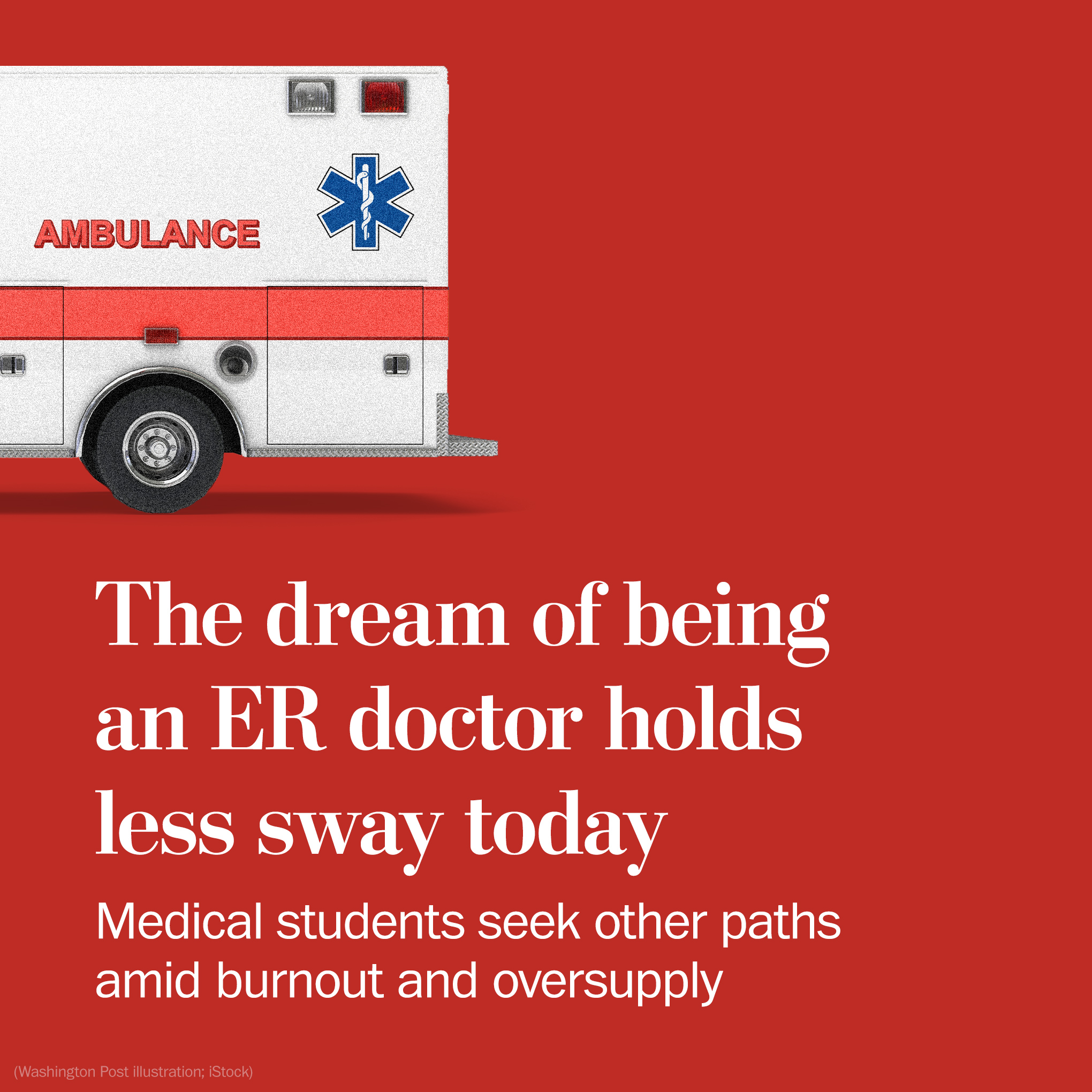
With recent residency match data showing a 26 percent drop in applications to emergency medicine training programs since 2021, this article in the Washington Post grapples with why the once sought-after profession is now struggling with recruitment.
Some point to high rates of pandemic burnout and the unappealing nature of the work: emergency departments (EDs) are increasingly overcrowded, understaffed, and violent—turning ED docs into “the cops of medicine,” as one ED residency program leader put it. Others suggest that residents are simply following the money elsewhere, discouraged by reports of an impending oversupply of ED physicians in coming years.
The Gist: The days of the television drama ER, which inspired a generation of would-be doctors to pursue emergency medicine, are gone—most medical students graduating today weren’t even born when the show first aired in 1994. The article fails to note the changes in EDs brought on by investor-backed staffing companies, which now staff anywhere from an estimated quarter to half of the nation’s EDs.
They’re accused of cutting costs by hiring fewer ED docs, as well as funding more ED residency spots in an attempt to flood the market and drive down their future labor costs even further. In the wake of COVID, emergency physicians find themselves in EDs largely staffed by advanced practice providers.
While in the near-term hospitals will surely face challenges in staffing these critical roles, shortages may drive momentum to refine and expand technology- and team-based care models.
At least five health systems announced changes to executive ranks and administration teams in February and March.
The changes come as hospitals continue to grapple with financial challenges, leading some organizations to cut jobs and implement other operational adjustments. Changes to executive ranks include reorganizing executive responsibilities and executive appointments.
The following changes were announced within the last two months and are summarized below, with links to more comprehensive coverage of the changes.
1. Philadelphia-based Penn Medicine is eliminating administrative positions. The change is part of a reorganization plan to save the health system $40 million annually, the Philadelphia Business Journal reported March 13. Kevin Mahoney, CEO of the University of Pennsylvania Health System, told Penn Medicine’s 49,000 employees last week that changes include the elimination of a “small number of administrative positions which no longer align with our key objectives,” according to the publication. The memo did not indicate the exact number of positions that were eliminated.
2. Sovah Health, part of Brentwood, Tenn.-based Lifepoint Health, has eliminated the COO positions at its Danville and Martinsville, Va., campuses. The responsibilities of both COO roles will now be spread across members of the existing administrative team.
3. Cox Medical Group, a subsidiary of Springfield, Mo.-based CoxHealth, has made several leadership changes to support the health system’s new operating model. The new model is focused on key service lines — such as cardiovascular services, orthopedics and primary care. Four things to know.
4. Valley Health, a six-hospital health system based in Winchester, Va., eliminated 31 administrative positions. The job cuts are part of the consolidation of the organization’s leadership team and administrative roles. They were announced internally on Feb. 28.
5. Roseville, Calif.-based Adventist Health will transition from seven networks of care to five systemwide to reduce costs and strengthen operations, according to a Feb. 15 news release shared with Becker’s. Under the reorganization, the health system will have separate networks for Northern California, Central California, Southern California, Oregon and Hawaii. The reorganization will result in job cuts, including reducing administration by more than $100 million.
New Hyde Park, N.Y.-based Northwell Health began 2023 with a low, but positive operating margin, but labor costs are expected to increase again this year on the back of recent union activity in the state.
To offset such increases that were not anticipated in the 2023 budget, Northwell is evaluating opportunities to reduce expenses and increase revenue across the health system, which includes 21 hospitals and about 83,000 employees.
Michael Dowling, CEO of Northwell, spoke to Becker’s Hospital Review about the health system’s biggest challenge this year, how it approaches cost-cutting and why outpatient care is its biggest growth area.
Editor’s note: Responses are lightly edited for length and clarity.
Question: Many health systems saw margins dip last year amid rising inflation, increased labor costs and declining patient volumes. How have you led Northwell through the challenges of last year?
Michael Dowling: We ended 2022 with a low, but positive margin. We’ve been coming back from COVID quite successfully, and we’re back pretty much in all areas to where we were prior to the pandemic. Volumes have returned and we’re very busy. We came into 2023 with a positive budget and a positive margin. We anticipate that you’re always going to have challenges and disturbances, but it’s important to stay focused and deal with it. We have a very detailed strategic plan, which outlines our various goals, and we stick to it.
Q: What is your top priority today?
MD: The biggest issue for us today is labor costs. We have lots of union activity in New York at the moment. There were various nurse strikes in New York City at the beginning of the year. None of our hospitals were involved in those deliberations, but some of those hospitals agreed to contracts that have increases that were not anticipated in anybody’s 2023 budget. That’s going to have an effect on us. We have negotiations ongoing with the nurses’ union, and have 10 unions overall. About 90 percent of Northwell’s facilities have unions, so the bottom line is we are going to have expenses as a result of these contracts that were not anticipated in the budget. I don’t know the final number on these contracts yet, but it’s definitely going to be more than what we anticipated.
The unions in New York get a lot of government support and have become very empowered and quite aggressive. The bottom line is there’s more expense than we anticipated in our budget, so we need to figure out how to address that. We’re looking at everything across our health system to find expense reductions or revenue enhancements to be able to make up for the increased labor costs and be optimistic about ending the year with a positive margin. But we’re in a good place and are not like some other health systems that are struggling financially.
Q: Where are the biggest opportunities to reduce expenses or increase revenue to offset the increased labor costs?
MD: It’s a combination of a lot of things. We have a detailed capital plan that we may slow down. We hire about 300 people a week, so maybe we’ll target that hiring into specific areas and not be as broad based as we thought we could be. We will examine if we have specific programs or initiatives we can curtail without doing any damage to our core mission. It will end up being a portfolio of items; it won’t be one big thing. On the revenue side, we’re working very hard to increase our neurosurgery, cardiac, cancer and orthopedic businesses. Over the next couple of months, all of those things will be taken into consideration. The bottom line is we are going to come out of this winning.
Q: Looking three or four years down the line, where do you see the biggest growth opportunities for Northwell?
MD: Our biggest growth is in outpatient care. A lot of surgeries are moving outpatient, so we have to get ahead of that. Some think we are only a hospital system, but only about 46 percent of our business is from our hospital sector today. Home care is going to grow phenomenally, especially given the new technology that’s available. Digital health will also dramatically expand.
We’re also looking at expanding into new geographic areas and markets. It’s about positioning your offerings in places close to where people live, so you reduce the inconvenience of people having to travel long distances for care when it should be available to them closer to home. When you do that, you increase market share. We’re constantly increasing our market share by being very aggressive about going to where the customer is and providing the highest quality care that we can. Part of that is also being able to recruit top-line, quality physicians. When you do that, you attract new business because you have competencies that you didn’t have before. It’s a combination of all of these things, but there’s certainly no limit to the opportunities in front of us. We’re not in a world of challenges; we’re in a world of opportunity. The question is are we aggressive enough and do we have enough tolerance for some risk? We need to be as aggressive as we possibly can to take advantage of some of those opportunities.
Q: What is the biggest challenge on the horizon for Northwell?
MD: The biggest challenge is the huge growth in government payer business — Medicare and Medicaid. The problem with Medicaid — especially in a union environment — is it doesn’t cover your costs. The government is a big part of a potential future issue there. By increasing Medicaid, the more of your business becomes Medicaid and the worse you end up doing, unless you can increase your commercial payer business to continue to cross-subsidize. We also have a lot of union negotiations over the next couple of months, which will put a strain on our 2023 budget, but we will resolve it.
Q: How do you see hospitals and health systems evolving as CMS, commercial payers and patients continue to push more services to outpatient settings, where they can arguably be performed at a higher quality and lower cost?
MD: I think it’s going to continue to grow. For example, Northwell has 23 hospitals — 21 of which it owns — yet it has 890 outpatient facilities. We’ve been ahead of this curve a long time. Our primary expansion is in ambulatory care, not in-hospital care. Like I said, only 46 percent of Northwell’s total business is its hospital business. If you’re relying on the hospital to be the core provider of the future, you’re going to lose. You’ve got to take a little bit of a hit by going out and expanding your ambulatory presence. But the more you expand ambulatory and grow in the right locations, the more you increase market share, which brings more of the necessary inpatient care back to your hospitals. Our hospitals are growing and getting busier in addition to our outpatient centers because we are growing market share. If we enter a new community and see 100 people, five of them will need to be hospitalized. That’s a new market. Ambulatory cannot be disassociated from its connection to the inpatient market.
Q: Many financial experts are projecting a recession this year. How might that affect hospitals and health systems, and how can they best prepare?
MD: Even if we do have a recession, it doesn’t mean that people don’t get sick. In fact, people’s problems increase. Our business does not slow down if we have a recession; our business will probably increase. On the revenue side, it won’t necessarily affect our government reimbursement, which we don’t do well on anyway. The things you worry about during a recession is if employers give up the coverage of their staff. Then those employees with no insurance may go on a state Medicaid program, and that might affect hospitals.
In the healthcare sector, even in a recession, the need for hospital services actually increases. No recession could be as bad as what we experienced during COVID, yet we managed it. We had a problem that we didn’t even understand, and we worked through it. I think healthcare deserves an extraordinary credit for what was done during COVID. If there is a recession, we will deal with it. It’s just one of those things that happens, and we will respond to it in as comprehensive a way as we can. I can’t control it, but I can control our response. Leadership to me is about having a positive disposition; basically saying that whatever happens to you, you’re going to win.
Workforce problems in U.S. hospitals are troublesome enough for the American College of Healthcare Executives to devote a new category to them in its annual survey on hospital CEOs’ concerns. In the latest survey, executives identified “workforce challenges” as the No. 1 concern for the second year in a row.
Financial challenges, which consistently held the top spot for 16 years in a row until 2021, were listed the second-most pressing concern in the American College of Healthcare Executives’ annual survey.
Although workforce challenges were not seen as the most pressing concern for 16 years, they rocketed to the top quickly and rather universally for healthcare organizations in the past two years. Most CEOs (90 percent) ranked shortages of registered nurses as the most pressing within the category of workforce challenges, followed by shortages of technicians (83 percent) and burnout among non-physician staff (80 percent).
Here are the most concerning issues hospital CEOs ranked in 2022, along with the score of how pressing CEOs find each issue.
1. Workforce challenges (includes personnel shortages and staff burnout, among other issues) — 1.8
2. Financial challenges — 2.8
3. Behavioral health and addiction issues — 5.2
4. Patient safety and quality — 5.9
5. Governmental mandates — 5.9
6. Access to care — 6.0
7. Patient satisfaction — 6.6
8. Physician-hospital relations — 7.6
9. Technology — 7.7
10. Population health management — 8.6
11. Reorganization (mergers and acquisitions, partnerships and restructuring) — 8.7
Within financial challenges, most CEOs (89 percent) ranked increasing costs for staff and supplies as the most pressing, followed by operating costs (66 percent) and Medicaid reimbursement (63 percent). CEOs are less concerned about price transparency and moving away from fee-for-service.
Seventy-eight percent of CEOs ranked lack of appropriate facilities/programs as most pressing within the category of behavioral health and addiction issues. That was followed by lack of funding for addressing behavioral health and addiction issues (77 percent).
The results are based on a survey administered to CEOs of community hospitals (non-federal, short-term, non-specialty hospitals). ACHE asked respondents to rank 11 issues affecting their hospitals in order of how pressing they are. Results are based on responses from 281 executives.
Roseville, Calif.-based Adventist Health plans to go from seven networks of care to five systemwide to reduce costs and strengthen operations, according to a Feb. 15 news release shared with Becker’s.
Under the reorganization, Adventist Health will have separate networks for Northern California, Central California, Southern California, Oregon and Hawaii.
“Reducing the number of care networks strengthens our operational structure and broadens the meaning and purpose of our network model as well as the geographical span of one Adventist Health,” Todd Hofheins, COO of Adventist Health, said in the release. “This also reduces overhead and administrative costs.”
The reorganization will result in job cuts, including reducing administration by more than $100 million.
“Our commitment to rural and urban healthcare remains steadfast, and we are expanding to other locations to invest and transform the integrated delivery of care,” Kerry Heinrich, president and CEO of Adventist Health, said in the release.
Specifically, the health system has a recently approved affiliation agreement for Mid-Columbia Medical Center in The Dalles, Ore., to join Adventist Health, the health system said. The agreement is pending final regulatory and state approvals.
Meanwhile, Adventist Health filed a Worker Adjustment and Retraining Notification Act notice with California officials Feb. 15.
Adventist Health will eliminate job functions and positions for employees at its corporate office campus along with some remote roles, the notice states.
Layoffs from Adventist Health began Feb. 1 and will continue into April, according to the notice.
Adventist Health said it has provided all affected employees 60 days’ written notice of the layoff. The health system expects about 59 employees to be separated from employment with Adventist Health.
Employees affected by the layoffs include administrative directors, directors, managers and project managers, among others.
“We recognize that these changes impact people’s lives and want to respect each affected individual,” Joyce Newmyer, chief people officer for Adventist Health, said in the health system’s release. “We will make every effort to identify other opportunities for team members impacted.”
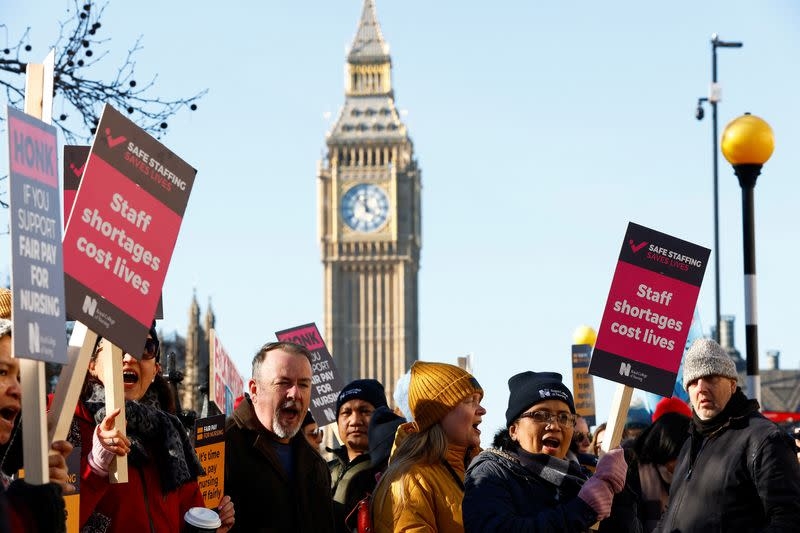
Monday’s walkout of tens of thousands of nurses and ambulance staff was the largest in the NHS’s 75-year history.
Labor demonstrations have been ongoing across the past few months, as workers demand higher pay and better working conditions amid rampant national inflation and increased workloads.
Specific demands vary by union and nation within the United Kingdom. Welsh nurses called off their strike this week to review a proposal from Wales’ Labour Party-run government, while the Royal College of Nurses, the UK’s largest nursing union, has countered a nominal 5 percent pay increase proposal with demands for a five percent pay raise on top of inflation, which topped 10 percent in Britain in December.
The Gist: A glance at our neighbors across the pond shows that the US healthcare system is not the only one currently experiencing a labor crisis.
The UK’s nationalized system has also failed to shield its workers from the combined impact of COVID burnout and inflation. But the NHS, as the UK’s largest employer and perennial object of political maneuvering, is more susceptible to organized labor actions.
In contrast, American healthcare unions, which only covered 17 percent of the country’s nurses in 2021, must negotiate with local employers, whose responses to their demands vary.
While this may enhance the bargaining power of US health system leaders, it also heightensthe risk that we will fail to adequately secure our nursing workforce, a key national resource already in short supply, for the longer term.
With input from stakeholders across the industry, Modern Healthcare outlines six challenges health care is likely to face in 2023—and what leaders can do about them.
1. Financial difficulties
In 2023, health systems will likely continue to face financial difficulties due to ongoing staffing problems, reduced patient volumes, and rising inflation.
According to Tina Wheeler, U.S. health care leader at Deloitte, hospitals can expect wage growth to continue to increase even as they try to contain labor costs. They can also expect expenses, including for supplies and pharmaceuticals, to remain elevated.
Health systems are also no longer able to rely on federal Covid-19 relief funding to offset some of these rising costs. Cuts to Medicare reimbursement rates could also negatively impact revenue.
“You’re going to have all these forces that are counterproductive that you’re going to have to navigate,” Wheeler said.
In addition, Erik Swanson, SVP of data and analytics at Kaufman Hall, said the continued shift to outpatient care will likely affect hospitals’ profit margins.
“The reality is … those sites of care in many cases tend to be lower-cost ways of delivering care, so ultimately it could be beneficial to health systems as a whole, but only for those systems that are able to offer those services and have that footprint,” he said.
2. Health system mergers
Although hospital transactions have slowed in the last few years, market watchers say mergers are expected to rebound as health systems aim to spread their growing expenses over larger organizations and increase their bargaining leverage with insurers.
“There is going to be some organizational soul-searching for some health systems that might force them to affiliate, even though they prefer not to,” said Patrick Cross, a partner at Faegre Drinker Biddle & Reath. “Health systems are soliciting partners, not because they are on the verge of bankruptcy, but because they are looking at their crystal ball and not seeing an easy road ahead.”
Financial challenges may also lead more physician practices to join health systems, private-equity groups, larger practices, or insurance companies.
“Many independent physicians are really struggling with their ability to maintain their independence,” said Joshua Kaye, chair of U.S. health care practice at DLA Piper. “There will be a fair amount of deal activity. The question will be more about the size and specialty of the practices that will be part of the next consolidation wave.”
3. Recruiting and retaining staff
According to data from Fitch Ratings, health care job openings reached an all-time high of 9.2% in September 2022—more than double the average rate of 4.2% between 2010 and 2019. With this trend likely to continue, organizations will need to find effective ways to recruit and retain workers.
Currently, some organizations are upgrading their processes and technology to hire people more quickly. They are also creating service-level agreements between recruiting and hiring teams to ensure interviews are scheduled within 48 hours or decisions are made within 24 hours.
Eric Burch, executive principal of operations and workforce services at Vizient, also predicted that there will be a continued need for contract labors, so health systems will need to consider travel nurses in their staffing plans.
“It’s really important to approach contract labor vendors as a strategic partner,” Burch said. “So when you need the staff, it’s a partnership and they’re able to help you get to your goals, versus suddenly reaching out to them and they don’t know your needs when you’re in crisis.”
When it comes to retention, Tochi Iroku-Malize, president of the American Academy of Family Physicians (AAFP), said health systems are adequately compensated for their work and have enough staff to alleviate potential burnout.
AAFP also supports legislation to streamline prior authorization in the Medicare Advantage program and avoid additional cuts to Medicare payments, which will help physicians provide care to patients with less stress.
4. Payer-provider contract disputes
A potential recession, along with the ensuing job cuts that typically follow, would limit insurers’ commercial business, which is their most profitable product line. Instead, many people who lose their jobs will likely sign up for Medicaid plans, which is much less profitable.
Because of increased labor, supply, and infrastructure costs, Brad Ellis, senior director at Fitch Ratings, said providers could pressure insurers into increasing the amount they pay for services. This will lead insurers to passing these increased costs onto members’ premiums.
Currently, Ellis said insurers are keeping an eye on how legislators finalize rules to implement the No Surprise Act’s independent resolution process. Regulators will also begin issuing fines for payers who are not in compliance with the law’s price transparency requirement.
5. Investment in digital health
Much like 2022, investment in digital health is likely to remain strong but subdued in 2023.
“You’ll continue to see layoffs, and startup funding is going to be hard to come by,” said Russell Glass, CEO of Headspace Health.
However, investors and health care leaders say they expect a strong market for digital health technology, such as tools for revenue cycle management and hospital-at-home programs.
According to Julian Pham, founding and managing partner at Third Culture Capital, he expects corporations such as CVS Health to continue to invest in health tech companies and for there to be more digital health mergers and acquisitions overall.
In addition, he predicted that investors, pharmaceutical companies, and insurers will show more interest in digital therapeutics, which are software applications prescribed by clinicians.
“As a physician, I’ve always dreamed of a future where I could prescribe an app,” Pham said. “Is it the right time? Time will tell. A lot needs to happen in digital therapeutics and it’s going to be hard.”
6. Health equity efforts
This year, CMS will continue rolling out new health equity initiatives and quality measurements for providers and insurers who serve marketplace, Medicare, and Medicaid beneficiaries. Some new quality measures include maternal health, opioid related adverse events, and social need/risk factor screenings.
CMS, the Joint Commission, and the National Committee for Quality Assurance are also partnering together to establish standards for health equity and data collection.
In addition, HHS is slated to restore a rule under the Affordable Care Act that prohibits discrimination based on a person’s gender identity or sexual orientation. According to experts, this rule may conflict with recently passed state laws that ban gender-affirming care for minors.
“It’s something that’s going to bear out in the courts and will likely lack clarity. We’ll see differences in what different courts decide,” said Lindsey Dawson, associate director of HIV policy and director of LGBTQ health policy at the Kaiser Family Foundation. “The Supreme Court acknowledged that there was this tension. So it’s an important place to watch and understand better moving forward.”









 HENRY KOTULA