The largest health insurers are quickly becoming vertically integrated healthcare organizations that span the care and coverage continuum. While 2021 was a mixed year for these companies as healthcare volumes bounced back, their diversified portfolios helped cushion losses from higher claims.
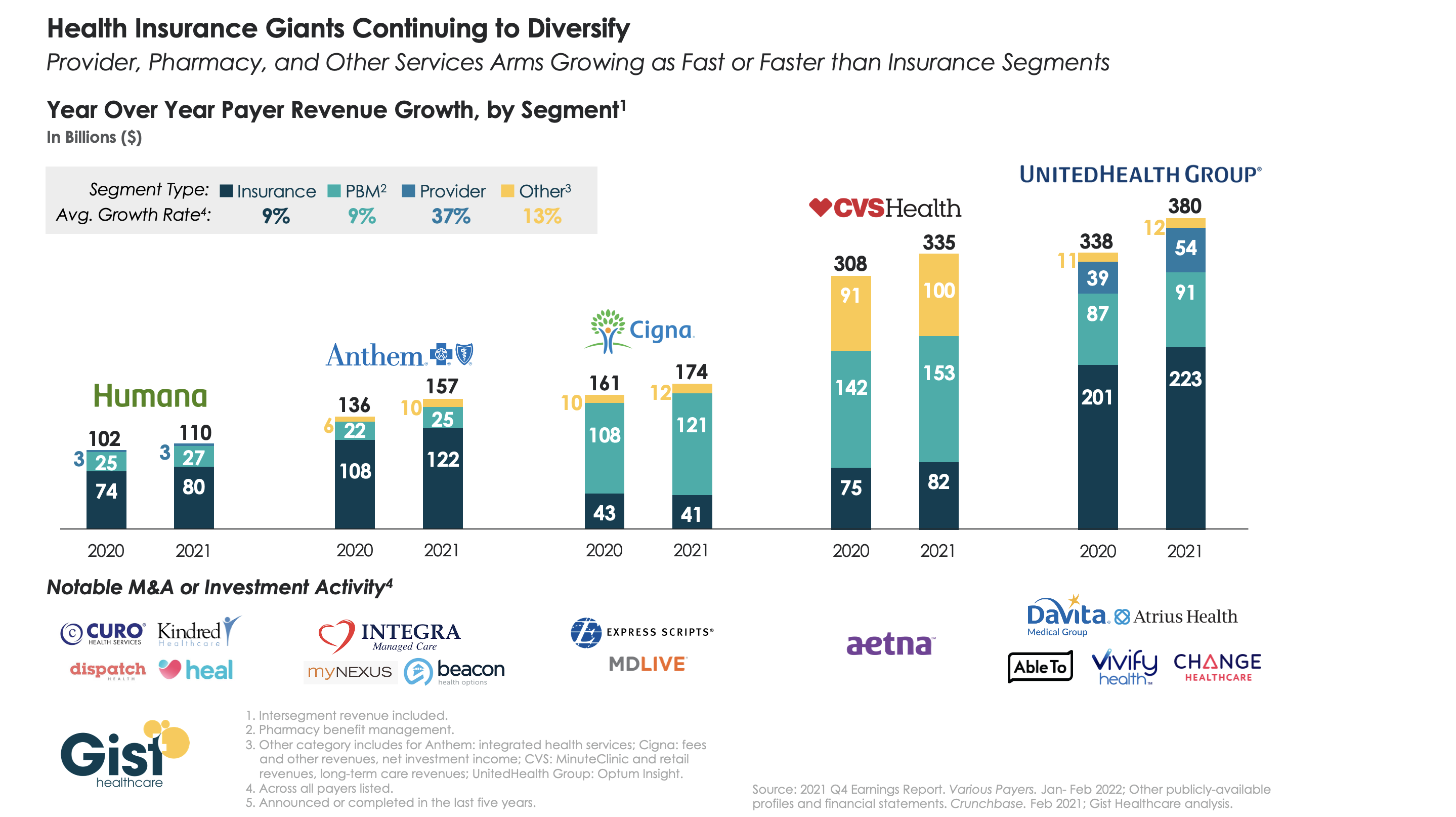
The graphic above analyzes revenue growth by segment for the five largest insurers across the last two years. On averagethe insurance and pharmacy benefit management components of the companies grew at nine percent, while care delivery and integrated health services grew at much higher rates. UnitedHealth Group (UHG) and Anthem boasted the highest year-over-year revenue growth, driven by UHG’s Optum subsidiary and Anthem’s integrated health services.
Cigna and CVS Health each earned less than a quarter of their total revenue from their insurance arms lastyear. While Humana lags the others in topline revenue, it has assembled a robust portfolio of care delivery investments and partnerships, surpassed only by UHG.
As antitrust scrutiny on vertical integration increases (case in point: the DOJ is now challenging UHG’s acquisition of Change Healthcare), insurers will face the hard task of integrating their portfolio of service—and demonstrating that they deliver value to consumers and patients.
DOJ alleges that allowing UHG’s Optum subsidiary to acquire Change, a direct competitor used by most large commercial insurers for healthcare claims solutions, would give UHG 75 percent of the healthcare claims processing and management market. This would significantly reduce competition, the DOJ claims, while simultaneously giving UHG access to its competitors’ sensitive plan design and pricing information. UHG called the DOJ’s position ‘deeply flawed’ and promised to fight the case.
The Gist: This is the second big move by antitrust regulators in a week to put the brakes on consolidation in healthcare: shortly after the DOJ sued to block Rhode Island’s two largest health systems, Care New England and Lifespan, from merging, those systems abandoned plans to combine.
We are seeing the first real signs that the Biden administration is following through on plans to more closely scrutinize healthcare deals, including payer-led vertical integration. For both payers and providers, increased scrutiny will place a premium on the consumer value proposition of any combination—and force merging companies to deliver on the benefits of scale.
Good morning. Here’s Axios chief economic correspondent Neil Irwin and markets correspondent Emily Peck with what you need to know about today’s surprising jobs numbers.
After days of doom-and-gloom talk about how bad the January jobs numbers would be due to the Omicron variant, they turned out to be, um, great?
Employers added 467,000 jobs last month, despite millions out sick.
Why it matters: It’s rare for any jobs numbers to be stunning, but these were. They leave little doubt that this remains a tight job market in which employers are doing everything they can to hold on to their workers.
The big picture: Some of the biggest job gains were in categories that have strong seasonal patterns, normally adding workers in the fall and then cutting those temporary workers in January.
But employers, desperate for staff, appear to have held onto those workers in greater numbers than in a normal year.
Due to the statistical process of seasonal adjustment, “cutting fewer workers than usual for this time of year” gets translated as “adding lots of jobs.”
By the numbers: Leisure and hospitality added 151,000 jobs; retail added 61,000; and transportation and warehousing added 54,000.
Between the lines: The report offered more evidence that this is an exceptionally tight labor market with inflationary pressures brewing, giving the Federal Reserve the green light for interest rate increases.
Average hourly earnings rose a robust 0.7%, and are up 5.7% over the last year. Employers are being forced to pay up to fill their job openings.
Yes, but: Omicron really did have an effect. The report said 6 million people were unable to work because their employers were closed or lost business due to the pandemic, up from 3.1 million in December.
What they’re saying: “Had the prior relationship between Covid cases and employment held true, 800k daily new Covid cases would have led to 2.3 million job losses,” Julia Pollak, chief economist at ZipRecuiter, tweeted. “Instead, we saw 467,000 job GAINS!”
The bottom line: This is an incredibly strong labor market that is poised to strengthen further as Omicron fades.
The U.S. economy added 467,000 jobs in January as the omicron variant spiked to record heights, with the labor market performing better than many expected two years after the pandemic began.
The unemployment rate ticked up slightly to 4 percent, from 3.9 percent the month before.
The monthly report, released by the Department of Labor, stems from a survey taken in mid-January, around the time the omicron variant was beginning to peak, with close to 1 million new confirmed cases each day. The rapid spread during that period upended many parts of the economy, closing schools, day cares, and a number of businesses, forcing parents to scramble.
But the labor market, according to the new data, performed very well during that stretch.
In addition to the robust January, the Department of Labor also revised upward the figure for December’s jobs report, to 510,000 from 199,000, and November, to 647,000 from 249,000. That means that there were some 700,000 more jobs added at the end of last year than previously estimated — showing a labor market with momentum heading into the new year.
The data sets show a labor market that continues to recover at a strong pace from the pandemic’s worst disruption in March and April of 2020.
New outbreaks and variants have sent shockwaves through the economy since then, but the labor market has continued to return, with companies working to add jobs and wages steadily rising.
The industries experiencing growth in January were lead by the leisure and hospitality sector, which added 151,000 jobs on the month, mostly in restaurants and bars. Professional and business services added 86,000 jobs. Retailers added 61,000 jobs in January, which is typically an off month. Transportation and warehousing added 54,000 jobs.
The labor market’s participation rate, a critical measurement that has never fully recovered from losses during the pandemic’s earliest days, also went up significantly, to 62.2 percent from 61.9 percent. That shows more people are reentering the labor force, looking for work.
Average hourly earnings increased by 23 cents on the month to $31.63, up 5.7 percent over the last year. However, those gains for many people have largely been wiped out by rising prices from inflation.
January is traditionally a weak month for employment when retail and other industries shed jobs after the holiday season. Economists say that seasonal adjustments made to the survey’s data to account for this have the potential to distort the survey in the other direction, given that the holiday shopping boom appeared to take place earlier this year than typical.
As such, predictions for job growth for the month had been all over the map. Analysts surveyed by Dow Jones predicted an average of about 150,000 jobs added for the month, in what would be the lowest amount added in a year. Some economists predicted job losses, of up to 400,000.
Last year was a strong year for growth in the labor market, with the country adding an average of more than 550,000 jobs a month — regaining some 6.5 million jobs lost in the pandemic’s earlier days, after the Department revised its numbers. The country has about 2.9 million fewer jobs than it had before the pandemic, according to the figures released Friday.
“Omicron is going to make it look like things dropped off a cliff in January, but overall they did not,” said Drew Matus, chief market strategist for MetLife Investment Management.
Some economists like Matus say that the prospects for such rapid regrowth are more complicated this year, with the fiscal measures that boosted the economy during the pandemic’s first two years, like generous government aid, and record low interest rates from federal bankers, having largely expired, and the country’s confidence in a virus-free future dented after the winter wave.
Since the rollout of vaccines last year, there have been hopes that a return to a more typical rhythm of life could encourage some of the roughly two million people who have left the labor force during the pandemic to seek work anew, but thus far, continued threats from variants — and uncertainty after more closures of schools, daycares, and office — have prevented this from materializing in a substantial way.
There are signs that the omicron exacted a toll on the economy during its peak.
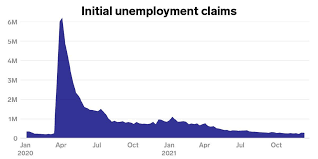
Weekly unemployment claims swelled mid-month to its highest level since October, though the numbers have come down in the two weeks since. Other statistical markers like passenger traffic at airports, hotel revenues, and dining reservations also took a hit during the month.
Recent months continue to be marked by incredible churn in the labor market, as record numbers of workers are switching jobs. In December, some 4.3 million people quit or changed jobs — a number which was down from an all-time high in November but still at elevated. Employers continue to report near record numbers of job openings: the Bureau of Labor Statistics said they reported some 10.9 million openings last month.
Overall health sector M&A activity bounced back in 2021 across nearly every subsector except one: hospitals, which saw a significant decrease in deal volume. Drawing on data from Kaufman Hall, the graphic above shows the scale of the most recent wave of health system consolidation, driven by last year’s eight “mega-mergers” between entities with over $1B in annual revenue each.
While the total number of hospital transactions decreased, the average seller size increased, with the total valuation of all hospital M&A activity nearly tripling from 2020 to 2021. With a dwindling number of independent hospitals left, health systems are pursuing larger combinations with their peers, to achieve greater scale and maintain economic “relevance.”
But as systems who have struggled to complete such mergers can attest, getting a larger deal across the finish line isn’t easy. The path to hospital consolidation now hinges on navigating complex organizational structures and issues of cultural compatibility, in addition to simply identifying “synergies” and avoiding antitrust pitfalls.
HCA has purchased MD Now Urgent Care, Florida’s largest urgent care chain, adding 59 urgent care centers to its existing 170. Meanwhile Tenet’s $1.1B deal to buy SurgCenter Development cements its position as the nation’s largest ambulatory surgery center (ASC) operator, eclipsing Envision-owned AMSURG and Optum-owned Surgical Care Affiliates.
The Gist: Healthcare services are increasingly moving outpatient and even virtual—a trend only accelerated by the pandemic. With this latest acquisition, Tenet will now own or operate nearly seven times as many ASCs as hospitals. Such national, for-profit systems are looking to add more non-acute assets to their portfolios, to capitalize on a shift fueled by both consumer preference for greater convenience, and purchaser pressure to reduce care costs.
Another challenging year defined by the continued COVID-19 fight and vaccination drives has created a unique healthcare landscape. Pandemic-induced telehealth booms, continued strain due to understaffing and pressure from big tech disruptors are just some of the issues that have presented themselves this year.
Here are five major trends that hospitals and health systems may see in 2022. While some present challenges, others present significant opportunities for healthcare facilities.
Workforce pressure
Record numbers of workers have quit their jobs in 2021, with some 4.4 million people quitting in September. That means that 1 in 4 people quit their jobs this year across all industries. Around 1 in 5 healthcare workers have left their positions, creating issues with understaffing and lack of resources in hospitals and health systems. Stress, burnout and lack of balance have all been cited as reasons for staff leaving their roles. An increase in violence toward medical professionals, continued COVID-19 surges and low pay and benefits have contributed to the exodus of healthcare workers. None of those problems seems poised to disappear come 2022, so the new year could bring continued workforce and staffing challenges.
Pressure from disruptors
Big tech and retail giants have continued their push into healthcare this year. Companies like Apple, Amazon and Google stepped up their game in the wearables market. Pharmacy and retail chains Walmart and CVS Health both detailed their intended expansions into primary care. The pandemic also encouraged big corporations outside the healthcare sector, like Pepsi and Delta Airlines, to consider hiring CMOs to make sense of public health regulations guide them on their policy. These moves all mean there is a tightening of competition for the top physicians and hospital executives. Going into 2022, health systems may be under pressure to hang onto top talent and keep patients from using other convenient health services offered by retail giants.
Health equity
The unequal toll of the pandemic on people of color both medically and economically helped shed a light on the rampant inequities in American healthcare and society at large. Indigineous, Black and Hispanic people were much more likely than white or Asian people to suffer severe illness or require hospitalization as a result of COVID-19. Increasing numbers of hospitals, health systems and organizations are starting initiatives to advance health equity and focus on the socioeconomic drivers of health. The American Medical Association launched a language guide to encourage greater awareness about the power of language. Z-code usage has also been encouraged by CMS to increase knowledge and data about the social determinants of health. Next year, the perspective of health as holistic instead of just a part of an individual’s life will continue, with special attention being paid to social drivers.
Telehealth expansion
The pandemic helped the telemedicine industry take off in a big way. Telehealth was often the only healthcare option for many patients during the height of the lockdown measures introduced during the pandemic. Despite a return to in-person visits, telehealth has retained its popularity with patients. Some advocates argue that telehealth can help increase access to healthcare and improve health equity. About 40 percent of patients said that telehealth makes them more engaged and interact more frequently with their providers. However, while Americans see telehealth as the future of healthcare, a majority still prefer in-person visits. Regardless of patient opinion, telehealth will remain a key part of health strategy. In late December, the FCC approved $42.7 million in funding for telehealth for 68 healthcare providers. This suggests that there are investments and subsidies available in the future for health systems to bolster their telehealth services.
Climate change
At the 2021 UN Climate Conference, Cop26, in Glasgow, Scotland, hospitals and health systems acknowledged the role they have to play in mitigating the effects of climate change. Hospitals and health systems shed light on the health-related effects of climate change, such as illness and disease from events like wildfires and extreme weather. Health systems are also becoming more aware of their own contributions to climate change, with the U.S. healthcare system emitting 27 percent of healthcare emissions worldwide. To that end, HHS created an office of climate change and health equity that will work alongside regulators to reduce carbon emissions from hospitals. More health systems too are taking charge and pledging net neutrality and zero carbon emissions goals, including Kaiser Permanente and UnitedHealth group. It’s expected that more systems will follow suit in the coming year and make more concrete plans to address emissions reduction.
Initial jobless claims, week ended Dec. 18: 205,000 vs. 205,000 expectedand a downwardly revised 205,000 during prior week
Continuing claims, week ended Dec. 11: 1.859 million vs. 1.835 million expected and an upwardly revised 1.867 million during prior week
This week’s new jobless claims report coincides with the survey week for the December monthly jobs report from the Labor Department, offering an early indication of the relative strength expected in that print due for release in early January.
At 205,000, initial unemployment claims were expected to come in below even pre-pandemic levels yet again, with jobless claims having averaged around 220,000 per week throughout 2019. Earlier this month, first-time unemployment filings fell sharply to 188,000, or the lowest level since 1969. And based on the latest report, the four-week moving average for new claims was near its lowest in 52 years, ticking up by 2,750 week-over-week to reach 206,250.
Continuing claims have also come down sharply from pandemic-era highs, albeit while remaining slightly above the 2019 average of about 1.7 million. This metric, which counts the total number of individuals claiming benefits across regular state programs, came in below 2 million for a fourth straight week and reached the lowest level since March 2020.
“The claims data indicate strong demand for workers and a reluctance by businesses to lay off workers,” Rubeela Farooqi, chief economist for High Frequency Economics, wrote in a note. “However, disruptions around Omicron and Delta could be a headwind if businesses have to close for health-related reasons.”
“Overall, the direction in the labor market recovery remains positive, with demand still strong,” she added. “Labor shortages are persisting, preventing a stronger recovery, although these appeared to ease somewhat in November.”
And indeed, policymakers have also taken note of the improving labor market situation. In a press conference last week, Federal Reserve Chair Jerome Powell maintained, “Amid improving labor market conditions and very strong demand for workers, the economy has been making rapid progress toward maximum employment.” And at the close of the Federal Open Market Committee’s latest policy-setting meeting, officials decided to speed their rate of asset-purchase tapering, paring back some crisis-era support in the economy as the recovery progressed.
Many Americans have also cited solid labor market conditions, especially as job openings hold at historically high levels. In the Conference Board’s latest Consumer Confidence report for December, 55.1% of consumers surveyed said jobs were “plentiful.” While this rate was down slightly from November’s 55.5%, it still represented a “historically strong reading,” according to the Conference Board.






 HENRY KOTULA