Republicans ready to revive ACA repeal talks

https://www.beckershospitalreview.com/hospital-management-administration/republicans-ready-to-revive-aca-repeal-talks.html

Image result for aca repeal

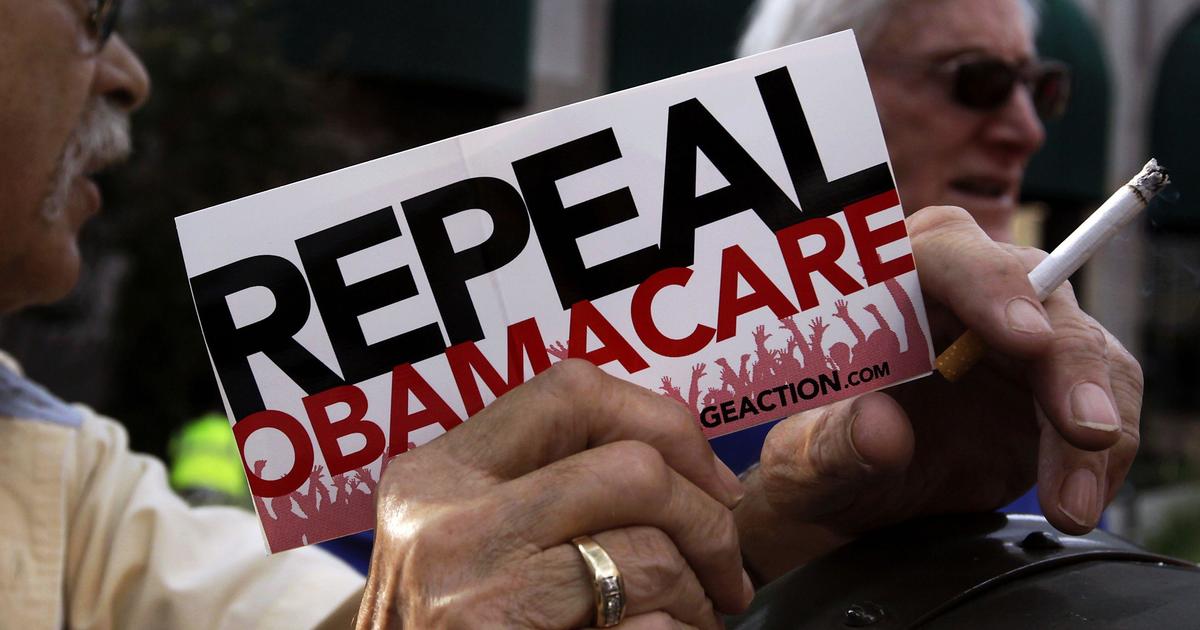
Sen. Lindsey Graham, R-S.C., promised to revive ACA repeal in Congress if Republicans can win back a majority in the House and reelect President Donald Trump in 2020, according to an interview on South Carolina radio show “The Morning Answer with Joey Hudson,” featured by The Hill

“This is what 2020 is about: If we can get the House back, and keep our majority in the Senate, and President Trump wins reelection, I can promise you, not only are we going to repeal Obamacare, we are going to do it in a smart way where South Carolina would be the biggest winner,” Mr. Graham said.

Mr. Graham, who failed to pass an ACA repeal plan in 2017, called “Medicare for All” and other Democratic presidential candidates’ healthcare plans “crazy.”  

“Medicare for All is $30 trillion, and it’s going to take private sector healthcare away from 180 million Americans,” he said. Instead, he proposed giving states the power to determine healthcare policy through block grants and other smaller reforms. This would allow states to test conservative healthcare policies against liberal ones, he said. 

“This election has got a common thing: Federalism versus socialism,” Mr. Graham said. “What I want to do is make sure the states get the chance to administer this money using conservative principles if you are in South Carolina, and if you want Medicare for All in California, knock yourself out.”

Trump Shift, Backed by States, Fuels Fear of Too Few Medicaid Docs

https://www.pewtrusts.org/en/research-and-analysis/blogs/stateline/2019/08/07/trump-shift-backed-by-states-fuels-fear-of-too-few-medicaid-docs?omnicid=CFC1662263&mid=henrykotula@yahoo.com

Stateline Aug7

Dr. Barbara Ricks is a pediatrician in Greenville, Mississippi, whose patients are nearly all on Medicaid. The Trump administration proposed eliminating an Obama-era rule that aims to ensure that patients can find a doctor who accepts Medicaid.
Rogelio V. Solis/The Associated Press

The Trump administration wants to drop an Obama-era rule designed to ensure that there are enough doctors to care for Medicaid patients.

State health officials say the rule, which requires states to monitor whether Medicaid reimbursement rates are high enough to keep doctors in the program, forces them to spend a lot of time collecting and analyzing data with little benefit. Health care advocates, though, fear that dropping the regulation would enable states to set those payments at a level that would cause some of the 72 million Americans who rely on Medicaid to scramble for health care. Research shows that when reimbursement rates drop, fewer providers agree to accept low-income Medicaid patients.

Although the Medicaid Access Rule, adopted in 2016, pertains to Medicaid fee-for-service plans, the Trump administration also is seeking to relax requirements on how states determine whether Medicaid managed care organizations have enough providers.

If reimbursement rates are too low, there’s a risk that health care providers would see fewer Medicaid patients or even refuse to treat Medicaid enrollees altogether. That, in turn, could lead to longer wait times to see providers still participating in Medicaid or force patients to travel longer distances to reach providers remaining in the program.

Medicaid, the government health plan for low-income U.S. residents, covers 1 in 5 citizens. It is jointly administered and financed by the federal government and the states.

The rule, the Centers for Medicare and Medicaid Services (CMS) said, “excessively constrains state freedom to administer the program in the manner that is best for the state and Medicaid beneficiaries in the state.”

According to Matt Salo, executive director of the National Association of Medicaid Directors, scrapping it would eliminate a bureaucratic headache for states that, in the end, hasn’t improved patients’ access to providers.

“Nobody is moving the goal of improved access,” Salo said.

Some health care advocates disagree, pointing out that the rule hasn’t been in place very long and that getting rid of it fits the Trump administration’s overall mission of giving states more freedom in operating Medicaid.

“The Trump administration’s approach to Medicaid has been state flexibility, giving states a lot more discretion to do what they want without a lot of attention to what beneficiaries need,” said Abbi Coursolle, a senior attorney with the National Health Law Program, a group based in Washington, D.C., that works to protect access to health care for low-income populations.

CMS last year called for a significant watering down of the Obama rule. Last month, the agency proposed to scrap it altogether. The comment period on elimination of the rule runs through next month, after which CMS will announce its decision.

The initial proposal to weaken the rule generated plenty of opposition. Among those objecting were hospital and physician organizations, groups that advocate for health care access for all, and organizations created to support those living with certain diseases and to raise funds for research into those conditions.

Among the latter was the Epilepsy Foundation, which warned in its public comment that weakening the rule would deprive CMS of information it needed to monitor and enforce Medicaid beneficiaries’ access to care. State reimbursement rates, the foundation said, are crucial to ensuring enough willing providers are available to treat Medicaid beneficiaries.

Shawn Martin, senior vice president of the Academy of Family Physicians, said scrapping the rule would make states more likely to set reimbursement rates too low, prompting practitioners to stop taking Medicaid patients or cut back. “A low reimbursement would affect how many beneficiaries providers are willing to see.”

Just as adamant on the other side, however, are many states that complain that the Obama rule is cumbersome and ineffective at ensuring access for Medicaid beneficiaries.

At the Maryland Department of Health, Tricia Roddy, a research director, said the rule doesn’t do much to help gauge the fees’ effects on access to care.

Similarly, at the Colorado Department of Health Care Policy and Financing, Marc Williams, a spokesman, said his state uses other strategies to ensure Medicaid beneficiaries’ access to the health services they need.

According to Salo of the Medicaid directors group, states of both political stripes, red and blue, are delighted that the Trump administration is moving to abolish the rule.

“It was creating many bureaucratic burdens without accomplishing anything concrete,” Salo said. The rule, he said, “is insanely micro-managed and overly bureaucratic.”

The 1965 law establishing Medicaid has been amended through the years to ensure that enough doctors, nurses and other providers are available to serve beneficiaries. Congress in 1989 passed an amendment making clear states’ obligation to pay providers enough to ensure Medicaid enrollees have access to care.

Medicaid pays doctors about three-fourths as much as Medicare, the government program for senior citizens, according to a 2017 analysis by the Urban Institute, a nonpartisan think tank in Washington, D.C. And Medicare pays much less than private insurers.

When Medicaid and Medicare payments, or reimbursement rates, go down, research shows that patients make fewer doctor’s visits and more trips to the emergency room.

According to a 2017 Kaiser Family Foundation report, only about 70% of office-based physicians accept new Medicaid patients. The results vary from 39% in New Jersey to 97% in Nebraska. By comparison, the study found, 85% of doctors accept new patients with private insurance.

The 2016 rule required states to tell the agency every three years how providers from various geographic regions and specialties were participating in Medicaid, and how reimbursement rates were affecting that participation.


Rural hospitals take spotlight in coverage expansion debate

https://www.modernhealthcare.com/payment/rural-hospitals-take-spotlight-coverage-expansion-debate?utm_source=modern-healthcare-daily-dose-wednesday&utm_medium=email&utm_campaign=20190807&utm_content=article1-readmore

Image result for rural hospital

Opponents of the public option have funded an analysis that warns more rural hospitals may close if Americans leave commercial plans for Medicare.

With the focus on rural hospitals, the Partnership for America’s Health Care Future brings a sensitive issue for politicians into its fight against a Medicare buy-in. The policy has gone mainstream among Democratic presidential candidates and many Democratic lawmakers.

Rural hospitals could lose between 2.3% and 14% of their revenue if the U.S. opens up Medicare to people under 65, the consulting firm Navigant projected in its estimate. The analysis assumed just 22% of the remaining 30 million uninsured Americans would choose a Medicare plan. The study based its projections of financial losses primarily on people leaving the commercial market where payment rates are significantly higher than Medicare.

The estimate assumed Medicaid wouldn’t lose anyone to Medicare, and plotted out various scenarios where up to half of the commercial market would shift to Medicare.

The analysis was commissioned by the Partnership for America’s Health Care Future, a coalition of hospitals, insurers and pharmaceutical companies fighting public option and single-payer proposals.

In their most drastic scenario of commercial insurance losses, co-authors Jeff Goldsmith and Jeff Leibach predict more than 55% of rural hospitals could risk closure, up from 21% who risk closure today according to their previous studies.

Leibach said the analysis was tailored to individual hospitals, accounting for hospitals that wouldn’t see cuts since they don’t have many commercially insured patients.

The spotlight on rural hospitals in the debate on who should pay for healthcare is common these days, particularly as politicians or the executive branch eye policies that could cut hospital or physician pay.

On Wednesday, Sen. Elizabeth Warren (D-Mass.) seemingly acknowledged this when she published her own proposal to raise Medicare rates for rural hospitals as part of her goal to implement single payer, or Medicare for All. She is running for the Democratic nomination for president for the 2020 election.

“Medicare already has special designations available to rural hospitals, but they must be updated to match the reality of rural areas,” Warren said in a post announcing a rural strategy as part of her campaign platform. “I will create a new designation that reimburses rural hospitals at a higher rate, relieves distance requirements and offers flexibility of services by assessing the needs of their communities.”

Warren is a co-sponsor of the Medicare for All legislation by Sen. Bernie Sanders (I-Vt.), who is credited with the party’s leftward shift on the healthcare coverage question. But she is trying to differentiate herself from Sanders, and the criticisms about the potentially drastic pay cuts to hospitals have dogged single-payer debates.

Most experts acknowledge the need for a significant policy overhaul that lets rural hospitals adjust their business models. Those providers tend to have aging and sick patients; high rates of uninsured and public pay patients over those covered by commercial insurance; and fewer patients overall than their urban counterparts.

But lawmakers in Washington aren’t likely to act during this Congress. The major recent changes have mostly been driven by the Trump administration, where officials just last week finalized an overhaul of the Medicare wage index to help rural hospitals.

As political rhetoric around the public option or single payer has gone mainstream this presidential primary season, rural hospitals will likely remain a talking point in the ideas to overhaul or reorganize the U.S.’s $3.3 trillion healthcare industry.

This was in evidence in May, when the House Budget Committee convened a hearing on Medicare for All to investigate some of the fiscal impacts. One Congressional Budget Office official said rural hospitals with mostly Medicaid, Medicare and uninsured patients could actually see a boost in a redistribution of doctor and hospital pay.

But the CBO didn’t analyze specific legislation and offered a vague overview of how a single-payer system might look, rather than giving exact numbers.

The plight of rural hospitals has been used in lobbying tactics throughout this year — in Congress’ fight over how to end surprise medical bills as well as opposition to hospital contracting reforms proposed in the Senate.

And it has worked to some extent. Both House and Senate committees have made concessions to their surprise billing proposals to mollify some lawmakers’ worries.


Are Trump’s Top Medicaid Regulators Ignoring Major Problems? Insurance Giant’s Tense Meeting With a Senator Adds to Growing Concern

https://www.propublica.org/article/centene-bob-casey-are-trump-top-medicaid-regulators-ignoring-major-problems?utm_source=pardot&utm_medium=email&utm_campaign=dailynewsletter

The ranking member of the Senate health committee has complained for months about the Trump administration’s failure to look into Medicaid contractors that have reaped big profits while sometimes failing to provide crucial patient services.

So last week, Sen. Bob Casey, D-Pa., called in the top boss of Centene, the nation’s largest Medicaid managed care company. He wanted to question the company about reports that its Texas subsidiary denied life-sustaining care to sick and disabled children — in one case, leaving a baby in foster care to suffer a catastrophic brain injury.

The meeting with longtime Centene CEO Michael Neidorff did not go well, according to Casey.

“I thought they would try to persuade me that they were going to do better, but they didn’t seem interested in that at all,” Casey told ProPublica and The Dallas Morning News in an interview. “I just couldn’t believe it.”

Casey said the Centene official denied providing inadequate care and cast blame for failures on foster parents and nurses.

Centene declined to make Neidorff available for an interview and emailed a brief statement in response to questions about the meeting with Casey.

“Centene and its subsidiaries care deeply about each and every member we serve,” the email read. “We work tirelessly to ensure we provide the appropriate level of care for our members.”

Under Neidorff, Centene has grown from a tiny health network in the Midwest into a $60-billion-a-year health care empire, backed almost entirely with taxpayer money. The company cares for more than 8.5 million Medicaid patients.

The company came under criticism last year after an eight-part investigation published in the Morning News examined whether Centene and other Medicaid managed care companies were skimping on care to bolster profits. The series raised questions about Centene’s Texas subsidiary, Superior HealthPlan, and its handling of the case of D’ashon Morris, a Texas toddler who was born with severe defects and was living in a foster home.

The series, titled “Pain & Profit,” reported that D’ashon was denied 24/7 nursing care and suffered brain damage after a medical incident that occurred while he did not have his nurse around. (Read the full story here.)

The Morning News reported that state health officials had found the Centene subsidiary in violation of state and federal Medicaid rules and recommended the company face steep fines for what happened to the child. But top Texas health officials never assessed those fines, the Morning News reported.

D’ashon’s adoptive mother sued the Centene subsidiary in Texas state court. That case is tied up in the Texas appeals court, where the Centene subsidiary has argued that the lawsuit should be dismissed because D’ashon and his mother are stifling the company’s right to free speech.

During hearings in the state Capitol, Superior representatives denied that the company’s refusal to provide 24/7 nursing was improper.

After his meeting with the Centene official, Casey sent a strongly worded letter to Seema Verma, a former health consultant appointed by President Donald Trump to run the Centers for Medicare and Medicaid Services.

In the letter, Casey called Centene’s response to questions about D’ashon’s case “callous.”

He also asked Medicaid officials to dig further into Centene’s business practices and to provide documentation on any response to the Morning News investigation.

“It’s another indication that the regulatory approach here by the administration is, at best, suspect,” Casey said.

A CMS spokesman said that Texas officials have shared with the agency an “action plan they intended to take to address the concerns raised,” adding that CMS is in regular communication to ensure the state improves.

“CMS has received Sen. Casey’s letter and will respond to his office directly,” spokesman Brian Leshak said in an email.

Casey’s position as the top Democrat on two Senate panels overseeing federal health programs gives him the standing to raise questions about the Medicaid managed care system.

It’s not unusual for company officials facing a federal audit or investigation to meet with members of Congress to address concerns, but it is unusual for such meetings to spill into public view.

Casey said he sent the letter to CMS because of what he called Centene’s “cold and clinical” defense of what happened in D’ashon’s case. He said it gave him concern about how the company cares for other patients — and what, if anything, regulators are doing when things go wrong.

Last month, more than a year after the Morning News story was published, Centene officials provided Casey’s office with a one-page rebuttal titled: “The Dallas Morning News got it wrong.”

The company’s explanations include that D’ashon’s foster mother was a trained nurse. But, as the Morning News reported, she was on an approved vacation at the time of D’ashon’s injury, and he had been placed in a different foster home.

The company also said D’ashon’s foster mother should have restrained the baby, but the Morning News previously reported that Texas foster care officials confirmed restraints would have required a doctor’s order, which she did not have.

“It was all blame shifting and pointing to other factors,” Casey said of Centene’s letter.

Casey said the meeting left him wondering why federal regulators weren’t doing more.

“It might even be worse than asleep at the wheel,” he said of CMS under Verma’s watch.

“They may be awake at the wheel but choosing consciously to say, ‘We’re going the other direction.’”

Without commenting on specific cases, the CMS spokesman said the agency routinely monitors states and intervenes when necessary.

Problems with this privatized Medicaid model have grabbed headlines in other states, too. And advocates in those states said they haven’t heard much from CMS, which they say is a shift from the Obama administration.

In Iowa, for instance, The Des Moines Register reported failures to provide care and chronicled patients who had been caught in that state’s broken medical appeals system.

Rob Sand, Iowa’s state auditor, wrote to state officials in June that two large managed care companies had “significantly harmed” two paraplegic patients by refusing to provide services they needed.

Mary Nelle Trefz, of Iowa’s Child and Family Policy Center, said she’s been shocked to hear nothing about that from CMS.

“I don’t feel, or can’t observe, or point to anything, where CMS has stepped in to provide that oversight and accountability,” she said.

In March, California’s state auditor found that millions of children in that state’s privatized Medicaid system weren’t being provided services that taxpayers had paid for. Auditor Elaine Howle blamed California health officials’ “deficient oversight of the managed care plans.”

Andy Schneider, a researcher at Georgetown’s Center for Children and Families, and a former top adviser to CMS under the Obama administration, said these episodes come at an inconvenient time for the Trump administration, which is focused on reducing regulation and creating additional eligibility hurdles like work requirements.

CMS has taken a hands-off approach compared with the previous administration, he said.

“These are reports coming from reputable media sources,” he said. “They’re very concerning, they have to do with the operation of the program, they suggest that something is wrong.”

Lowering Out-of-Pocket Health Costs Isn’t Easy. States Have Tried

https://www.governing.com/topics/health-human-services/gov-trump-prescription-drug-prices-states-canada-import.html?utm_term=Lowering%20Out-of-Pocket%20Health%20Costs%20Isn%27t%20Easy.%20States%20Have%20Tried.&utm_campaign=Lowering%20Out-of-Pocket%20Health%20Costs%20Isn%27t%20Easy.%20States%20Have%20Tried.%20Now%20Congress%20Is%20Giving%20It%20a%20Shot.&utm_content=email&utm_source=Act-On+Software&utm_medium=email

U.S. Sen. Bill Cassidy shows a chart during a congressional hearing.

Congress has promised to tackle high consumer health-care costs this year. It’s one of the few issues where lawmakers on both sides of the aisle find common ground.

The Lower Health Care Costs Act, introduced in June, is an almost 200-page piece of legislation that seeks to prevent surprise medical bills, lower prescription drug prices and force hospitals to be more transparent about what they bill insurance companies.

But there are already signs of potential failure.

Despite early momentum, Congressional leaders postponed a vote on the measure until after August recess. The pharmaceutical industry as well as hospital and provider groups have started to lobby against the legislation, meeting with President Trump in July to make their case.

Although the Affordable Care Act led to more people having health insurance, many Americans still struggle with out-of-pocket costs, especially ones they weren’t expecting. Meanwhile, health care is taking up an ever-growing size of state budgets. Governors and lawmakers try to tackle this issue almost every legislative session, but few have succeeded in a meaningful way.

“It’s usually a third of state budgets. States have every reason to try and control health-care costs. And yet, everybody struggles to,” says Josh Shaferstein, vice dean of Johns Hopkins University’s Office of Public Health Practice and Training, and a former health secretary for the state of Maryland.

Battling the Health-Care Industry

The first and usually biggest hurdle is private interest groups who see reforms as a threat to their livelihood.

“There are a lot of stakeholders that have vested interest and lobbyists on the ground that will fight tooth and nail, whether it’s doctors and nurses groups or insurance companies. They are perhaps moreso willing to fight at the state level,” says Sabrina Corlette, research professor at Georgetown University’s Center on Health Insurance Reforms.

She points to a bill introduced in Colorado this year that would have capped payments to hospitals in order to lower premiums. After pushback from hospital groups, lawmakers amended the legislation — which was signed into law — so that hospitals will be paid the same but will have to pay back a portion of their revenue to help lower premiums. 

In Washington state, which passed a first-in-the-nation “public option” bill this year, lawmakers rewrote the original legislation after doctor and hospital groups fought a provision that would have set the same cap on provider payments as Medicare. The final legislation reflected a compromise for insurers to pay providers 160 percent of Medicare rates.

At least eight other states discussed or introduced public option bills this year, but they failed to gain traction.

In Delaware — a state that ranks third in health-care spending but 31st in health outcomes — Gov. Jay Carney signed an executive order in November that outlines eight goals the state will work toward to curb the growth in health spending. But Kara Odom Walker, the state’s health secretary, concedes that they weren’t able to convince stakeholders to enact new penalties or regulations.

“Being a small state makes it a lot harder to do things that might be unpopular. Any conversation that includes words like ‘penalty’ or ‘payment cap’ is like a bomb going off,” she says.

The health-care industry is one of the biggest in the country. That gives it a lot of leverage.

“The health systems are often the largest employers in town. The governor says they want to slow health-care spending growth, and the hospital group will say, ‘that means losing jobs,’” says Robert Mechanic, executive director of the Health Industry Forum.

But as Congress tries to lower out-of-pocket costs, they have an asset that states don’t: better data. Corlette says states often lack impartial numbers on potential policies, hurting their ability to assess and defend legislation.

“It’s very hard for your average state legislator to pierce the veil,” Corlette says. “There’s an imbalance of info for legislators to really tackle the problem. They don’t have a Congressional Budget Office.”

One Person’s Savings Are Another’s Costs

Many compare efforts to control health-care costs to a game of whack-a-mole. A state might successfully regulate spending in one area only to see costs skyrocket in another.

“You might be able to cut rates in Medicaid, but then rates will pop up in private insurance. The standard toolkit for states is fraught with political danger,” says Shaferstein.

“Health care is so complex, and there are so many different players. It’s really hard to get your arm around the whole bundle,” says Mechanic.

For instance, Medicare lowered the limit for how long older patients can stay in hospitals. But there’s some evidence that the Medicare savings became extra costs for nursing homes because hospitals started providing fewer services for elderly patients altogether.

State Legislation

When it comes to controlling drug prices, states haven’t made much progress. They have made more headway regulating surprise medical bills.

Half the states have passed surprise billing laws. Only nine of them, though, included “comprehensive protections” that apply to all insurance plans, according to the Commonwealth Fund.

While states have struggled to actually lower drug prices, like Congress plans to do, they have passed laws to make them more transparent and to clamp down on pharmacy benefit managers — middlemen who negotiate drug benefits for plans.

Five states have enacted laws that require drug companies to notify them if they will significantly raise the price of a drug, and at least a dozen have restricted the power that a pharmacy benefit manager can have, like requiring them to register with the state.

Solutions That Have Worked

There are some success stories and lessons learned that Congress could use to lower health-care spending in general.

“States should be thinking of more global solutions because you kind of have to go big. Oftentimes people are looking to save $1 to $2 million a year, but that’s not going to make much of a difference,” says Shafterstein.

Only a couple of states have “gone big” in this sense.

Massachusetts passed what became the framework for the federal Affordable Care Act in 2006, known as “RomneyCare,” which requires residents to have health insurance. Health-care spending has since slowed in recent years. Mechanic credits that to the law’s requirements for private health entities to publicly justify price hikes and high spending.

In Maryland, it has taken decades to get health-care spending under control. The state has had an all-payer system for hospitals since the 1970s, meaning they get a fixed sum every month rather than bill insurers for every claim. While that system — which is only used by one other state, Vermont — curbed hospital spending per patient, hospital spending overall grew at a slightly higher rate than the national average.

So in 2014, Maryland forced hospitals to limit their spending to 0.5 percent less than the national growth rate. It has largely been deemed a success, with a report commissioned by the federal Centers for Medicare and Medicaid Services finding that “Maryland hospitals were able to operate within their global budgets without adverse effects on their financial status.”

On a less global scale, states have been able to drive down premiums by implementing reinsurance programs, meaning the government pays for the most expensive patients, taking that bill off insurance companies’ plate.

But reinsurance is like slapping a band-aid on a much larger wound.

“Recent state efforts on reinsurance have worked, but they aren’t really getting at the overall cost of coverage,” says Kevin Lucia, research professor at Georgetown University’s Health Policy Institute.


Seventy two percent of all rural hospital closures are in states that rejected the Medicaid expansion

https://www.gq.com/story/rural-hospitals-closing-in-red-states

Image result for rural hospital bankruptcies

States that refused Obamacare’s Medicaid expansion are hemorrhaging hospitals in rural areas.

Roughly 20 percent of Americans live in rural areas, including more than 13 million children, according to the last U.S. census. And, according to research and reporting by the Pittsburg Morning Sun and its parent company, GateHouse Media, those people have been steadily losing access to hospitals for years.

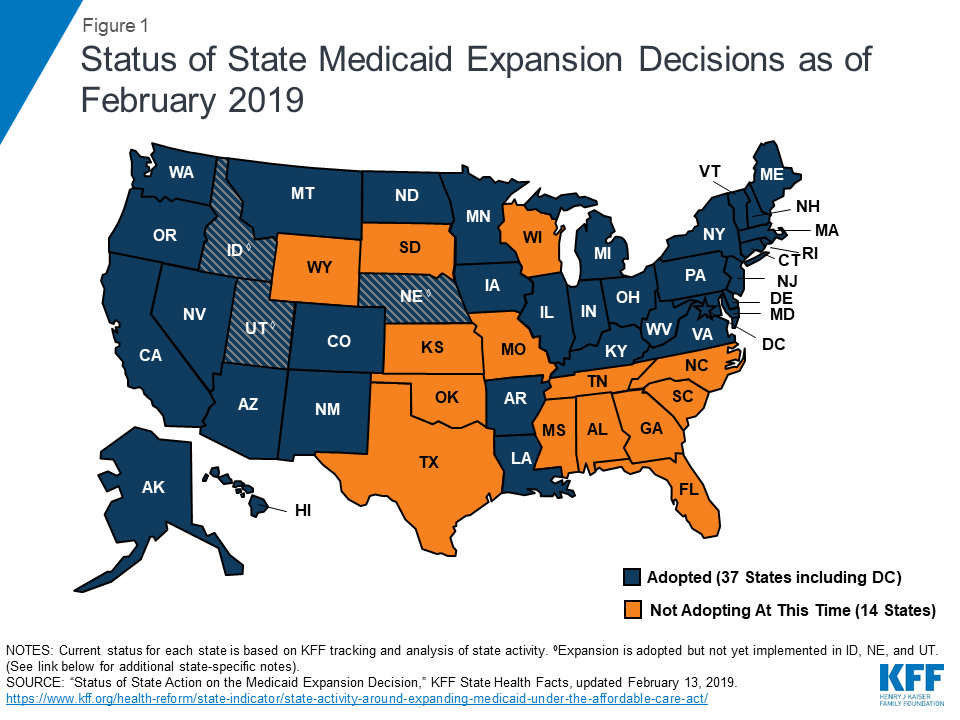
In Oklahoma, Georgia, South Carolina, and Mississippi, at least 52 percent of all rural hospitals spent more money than they made between 2011 to 2017. In Kansas, it’s 64 percent, and five hospitals there shut down completely in that time. Since 2010, 106 rural hospitals have closed across the country. (Another 700 are “on shaky ground,” and about 200 are “on the verge of collapse,” according to Gatehouse.) Of those 106 that closed, 77 were in deep red states where local politicians refused the Obama administration’s Medicaid expansion that came about as a result of the Affordable Care Act.

In short, the federal government provided funds to expand coverage for Medicaid, a program that helps pay for health care for low income patients. But the expansion was optional, and 14 Republican-controlled states rejected to take the money. The only state that bucked this trend was Utah, where rural hospitals were among the most profitable in the country thanks to a policy of shifting funds and resources from urban hospitals. Only 14 percent of rural hospitals operated at a loss and none shut down over the same time period.

The number of rural hospitals has been shriveling for some time now: more than 200 rural hospitals closed between 1990 and 2000, according to a report from the Office of Health and Human Services. Since rural areas have been losing hospitals for decades already, every additional closure is more devastating. And even the hospitals that remain open are struggling to stay fully staffed. According to the Health Resources and Services Administration, rural parts of the U.S. need an additional 4,022 doctors to completely close their coverage gaps.

Just refusing the Medicaid expansion alone doesn’t completely account for the hundreds of rural hospital closures across Republican-controlled states. For one thing, medical treatment and technology has gotten more advanced. Dr. Nancy Dickey, president of the Rural and Community Health Institute at Texas A&M, told Gatehouse, “Most of what we knew how to do in the 1970s and 1980s could be done reasonably well in small towns. But scientific developments and advances in neurosurgery, microscopic surgery and the like required a great deal more technology and a bigger population to support the array of technology specialists.” As a result, the number of services that rural hospitals offered started to shrink, while at the same time rural populations dwindled as both jobs and young people moved away. What’s left were older, poorer populations that needed more medical care and had less money to pay for it. In that situation, hospitals can’t generate enough revenue to stay open, let alone enough to pay the salaries of even new doctors, who carry an average of $200,000 in student debt.

Still, if the state legislatures and governors had accepted the money, billions of dollars could have gone to improving insurance coverage and propping up the hospitals’ bottom lines. In a health-care industry where the average CEO pay is $18 million a year, hospitals have to produce a lot of money to justify their existence to shareholders. The Medicaid expansion was one of the few lifelines available to rural Americans, and their politicians snubbed it.


No partial Medicaid expansions

https://www.axios.com/newsletters/axios-vitals-a4051909-429f-4b4c-a88b-22051b431ef7.html?utm_source=newsletter&utm_medium=email&utm_campaign=newsletter_axiosvitals&stream=top

Image result for No partial Medicaid expansions

The Trump administration made a very big decision over the weekend: It won’t approve full federal funding for a partial Medicaid expansion.

Why it matters: The partial expansion had looked like a key weapon in red states’ continued resistance to the ACA. Without it, Medicaid enrollment likely will keep growing.

Between the lines: Although the reasoning is different, the Trump administration is now adopting the same policy as the Obama administration — a decision many experts believe the law compels.

Details: Utah voters approved the full ACA expansion last year, but the state legislature overruled them to pass a more limited version.

  • Utah believed that the federal Centers for Medicare & Medicaid Services would approve full federal funding even for the partial expansion, which prompted other red states to explore the same idea.

The intrigue: While the Obama administration rejected these requests on the grounds that federal law dictates the terms of a Medicaid expansion, the Trump administration went a different route, per the Washington Post.

  • “White House advisers argued that it did not make sense to approve generous federal funding under the ACA while the administration is arguing that the entire law should be overturned,” the Post reports.

The bottom line: Utah has a backup plan in place — the full Medicaid expansion that Utah residents voted for in the first place.

  • Partial expansion was mainly attractive to red states facing pressure to expand but had leaders who didn’t want to. With that option off the table, don’t be surprised if more states end up just going along with the expansion.


Red states’ Medicaid gamble: Paying more to cover fewer people

https://www.axios.com/republicans-medicaid-affordable-care-act-expensive-d7057a8e-0a55-4f0d-906e-e42aa3f00ba9.html

Illustration of a price tag hanging from an IV stand

Red states are getting creative as they look for new ways to limit the growth of Medicaid. But in the process those states are taking legal, political and practical risks that could ultimately leave them paying far more, to cover far fewer people.

Why it matters: Medicaid and the Children’s Health Insurance Program cover more than 72 million Americans, thanks in part to the Affordable Care Act’s Medicaid expansion. Rolling back the program is a high priority for the Trump administration, and it needs states’ help to get there.

The big picture: The Centers for Medicare & Medicaid Services, under the leadership of Administrator Seema Verma, has made clear that it wants to say “yes” to new limits on Medicaid eligibility, and has invited states to ask for those limits.

  • But CMS hasn’t actually said “yes” yet to some of the most significant limits states have asked for.
  • In the meantime, states are left either with vague ambitions they’re not sure how to implement, or with risky plans that put their own budgets on the line.

What we’re watching: State-level Republicans are waiting for CMS to resolve two related issues: how much federal funding their versions of Medicaid can receive, and the extent to which they’re able to cap enrollment in the program.

  • “These issues are going to continue to be intertwined,” said Joan Alker, the executive director of Georgetown University’s Center for Children and Families.

Verma has reportedly told state officials that she wants to use her regulatory power to convert Medicaid funding into a system of block grants — which would be an enormous rightward shift and probably a big cut in total funding.

  • CMS probably cannot do that on its own, experts said, but it could achieve something similar by approving caps on either enrollment or spending.

Where it stands: GOP lawmakers in a handful of states are looking to Utah, which has bet big on Verma’s authority, for signals about what’s possible.

  • Utah voters approved the full ACA expansion last year, but the state legislature overruled them to pass a more limited version.
  • By foregoing the full expansion, Utah passed up enhanced federal funding. It’s still asking for that extra money — a request CMS has never previously approved.
  • Utah will also ask CMS to impose a per-person cap on Medicaid spending — a steep cut that was part of congressional Republicans’ failed repeal-and-replace bill, and which may strain CMS’ legal authority.
  • If Utah doesn’t get those two requests, its backup plan is simply to adopt the full expansion.

What’s next: Utah is not the only red state leaning into Verma’s agenda, but it’s further out on a limb than any other.

  • Idaho, like Utah, overruled its voters to pass a narrower Medicaid bill. But it preserved an option for people to buy into the ACA’s expansion.
  • Alaska Gov. Mike Dunleavy has said he wants to take Verma up on her offer of block grants; so have legislators in Tennessee and Georgia. But in the absence of any detail about what that means, or what CMS will approve, that’s all pretty vague right now.

If CMS does move forward on any of this, it could face the same threat of lawsuits that have stymied its first big Medicaid overhaul — work requirements.

  • Those rules are on ice in two states because a judge said they contravene Medicaid’s statutory structure and goals. The same argument could await a partial expansion or tough spending caps.

“There’s a clear agenda here to get a handful of states to take up these waivers, which fundamentally undermine the central tenets of the Medicaid program — which [are] that it is a guarantee of coverage, and a guarantee of federal funding,” Alker said.


The Problematic Law And Policy Of Medicaid Block Grants

https://www.healthaffairs.org/do/10.1377/hblog20190722.62519/full/?utm_source=Newsletter&utm_medium=email&utm_content=Health+Spending+Briefing%3B+Single-Payer%3B+Drug+Prices%3B+Cannabis+Patients%3B+ACA%3B+Access+To+Antidiabetic+Drugs%3B+Skilled+Nursing+Facilities&utm_campaign=HASU

Image result for Medicaid Block Grants

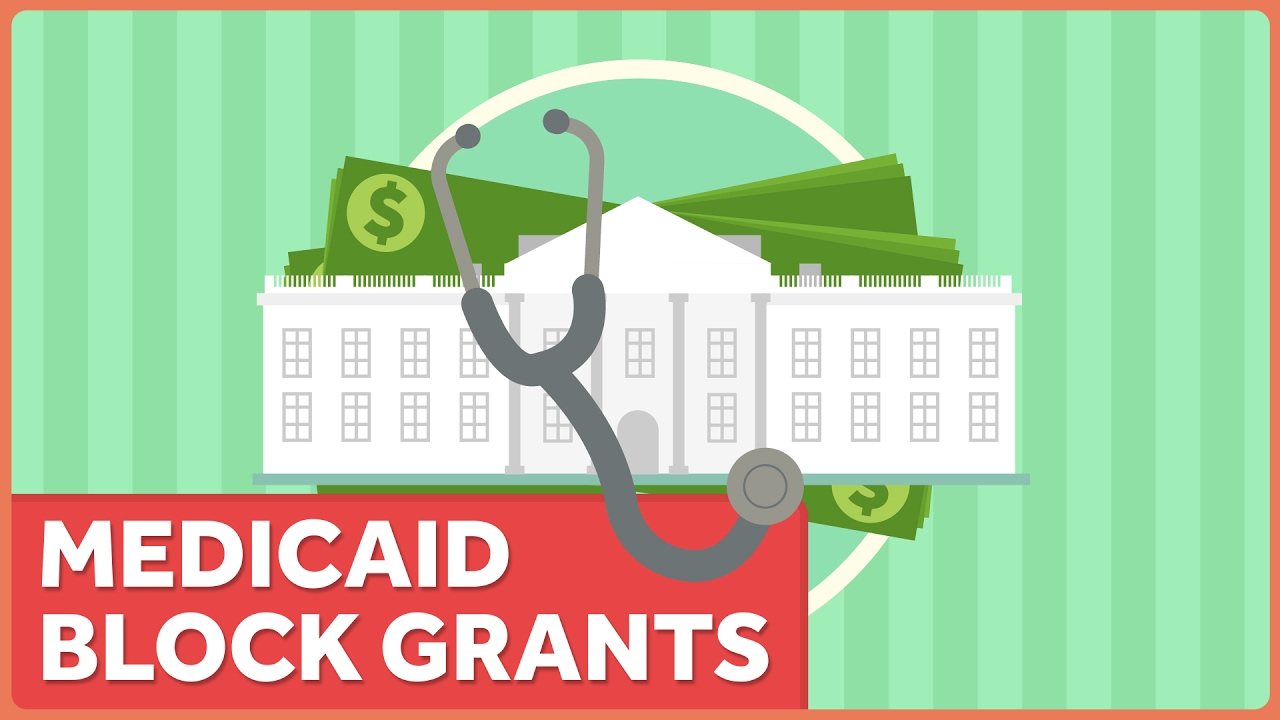
Recent news reports indicate that the Trump administration is seeking to authorize states to convert open-ended federal Medicaid funds into a block grant system, and a formal proposal to do so landed at the Office of Management and Budget on June 4. House Democrats have written to Health and Human Services (HHS) secretary Alex Azar to express their concerns about the legal and policy implications of a block grant system. 

Not only are there strong legal arguments against efforts to implement a block grant policy, but block grants would also create challenges for states that chose to implement such a program. These legal and policy concerns are foreseeable. The Centers for Medicare and Medicaid Services (CMS) is not only courting yet another legal battle but also threatening access to important health care services—such as prescription drugs, as discussed below—for many of the most vulnerable patients.

Understanding Capped Spending Proposals

The Medicaid Act provides for unlimited federal matching funds for all state spending under Medicaid’s federal rules. This federal match is required by law and encourages states to implement both Medicaid’s mandatory benefits and its optional benefits, such as prescription drugs. This unlimited federal funding also has been central in helping states respond to economic shocks such as recessions and natural disasters and to unplanned programmatic demands such as public health emergencies or expensive new treatments. Switching Medicaid to a block grant program has been proposed by prior administrations and most recently appeared in different bills during the Affordable Care Act repeal-and-replace debates in 2017, but such proposals have been rejected by Congress.

Despite Congress’s refusal to alter Medicaid in this way, and despite long-standing and clear benefits to states of open-ended entitlement funding, the Trump administration has been inviting states, such as Alaska, to discuss capped spending, and other states are poised to respond to the new policy guidance. For example, Alaska commissioned a study of block grants; Tennessee’s legislature enacted a law commanding the governor to seek a block grant; Utah submitted a waiver application seeking per capita caps for Medicaid spending; and Texas commissioned a block grant study in 2017.

To understand this drastic policy change, a little more background is helpful. Medicaid operates through joint funding by states and the federal government, with the federal government matching states’ spending at a set rate that is informed by the per capita income of a state. A poorer state such as Mississippi has a higher federal match rate (76 percent in 2019) than wealthier states (for example, New York at 50 percent). In either case, for every dollar a state spends on Medicaid, it receives a matching amount of federal funds—without limit—making Medicaid a statutory entitlement for states participating in the program.

The federal match developed out of states’ inability to provide adequate medical support for their poor residents. Although the federal government gave states a kind of block grant (grants in aid) before Medicaid was enacted in 1965, the unlimited federal match that the Medicaid Act provides was designed to increase help for poor people while still allowing states to provide for the needs of their particular populations within a federal statutory baseline.

A block grant scheme would be very different from Medicaid’s statutorily required open-ended funding. Caps on spending could be designed in a number of ways, such as a block grant under which states would receive a limited, pre-budgeted amount of money from the federal government, or a per capita cap, which would pre-determine the amount of money spent per person enrolled in Medicaid. No matter the specific form of spending limitation, the administration’s planned policy is not lawful. 

Legal Barriers To Capped Spending Proposals

More specifically, the administration would have to grant Section 1115 demonstration waivers to states seeking these limits, because the Medicaid Act does not contemplate such spending limitations. Demonstration waivers can be approved under Section 1115 of the Social Security Act, which gives the secretary of HHS authority to waive Section 1902 of the Medicaid Act if a state’s proposed waiver will further the purposes of Medicaid. The goal of these waivers is to allow states to experiment with certain aspects of the Medicaid program to improve beneficiary coverage or care. Section 1115 does not limit federal spending on demonstration waivers, but since the Carter administration, it has been HHS policy to seek federal budget neutrality in 1115 waivers, although states may spend as much as they like.

At least two statutory problems exist for such waivers in this context. First, Medicaid spells out federal payment within Section 1903, which states that the HHS secretary “shall pay to each State…the [federal match] of the total amount expended…as medical assistance under the State plan….” This language is not waivable under Section 1115, which explicitly permits waivers of Section 1902 but not Section 1903. (HHS can approve more spending than Section 1903 contemplates to match a state’s expansion of Medicaid coverage, but it cannot waive Section 1903.) As a result, HHS cannot cap the Medicaid funds it disburses to states, either per person or programmatically, because it must pay the federal match for the “total amount” of a state’s spending. Even if a state wanted to cap its own Medicaid spending, that would necessitate disenrollment and require waiver of many other Medicaid Act requirements such as sufficient state Medicaid funding, equal coverage of beneficiaries across the state, and adequate payment to providers.

Second, block grants are not “likely to assist in promoting the objectives” of Medicaid, the legal standard for HHS to authorize states’ proposals for demonstration waivers. Medicaid’s statutory purpose is to “furnish medical assistance” to eligible beneficiaries, a phrase that recently has been dissected in the context of HHS’s authorization of several 1115 waivers for Medicaid work requirements. The federal court hearing challenges to the legality of work requirements has interpreted “furnish medical assistance” to mean that Medicaid must pay for care, not simply promote a generalized idea of “health” or decrease cost. Spending caps would certainly decrease enrollment (like work requirements already have in Arkansas) and limit care across all kinds of Medicaid coverage, the opposite of furnishing medical assistance.

Any new CMS policy will likely follow the same pattern as the 2018 State Medicaid Director policy letter authorizing work and other conditions of eligibility. That letter promotes waivers for work requirements under the guise of “health” and cost concerns (although, more generally, CMS has been clear that it disagrees with Medicaid expansion). HHS is likely to offer similar reasoning here, allowing new limitations with a predictable impact on the “undeserving” expansion population. 

HHS’s recent losses in the work requirement cases may pose an obstacle to capped spending proposals. A recent US Supreme Court case may also create barriers. In Department of Commerce v. New York, the Court concluded that an agency cannot engage in sham regulatory processes. The Roberts-led majority expressed deep concern about the secretary of commerce’s predetermined goal of adding a citizenship question to the 2020 census, calling the secretary’s reasons for adding the question a “pretext” and “contrived” because the publicly stated reason for adding the question was totally unrelated to the actual rationale.

This kind of mismatch is likely to exist in the block grant context as well. No state would be able to serve the purposes of Medicaid, that is, to furnish medical assistance, through a cap on spending, because no matter the structure, such a cap would foreseeably result in disenrollment. But HHS cannot permit state waiver applications that seek to disenroll beneficiaries, which means that HHS and states may offer pretextual reasons for authorizing block grants.

Policy Harms To Patients From Capped Spending

Even putting aside legal obstacles to a capped spending system, block grants are simply bad policy. Proposals of this kind are predictably harmful to both beneficiaries and to state economic interests. The Congressional Budget Office has recognized that block grants encourage states to take actions that include restricting enrollment for legally eligible beneficiaries, limiting mandatory and optional benefits, decreasing already low reimbursement rates (which may lead providers to abandon the program), a combination of all three, and more. In some cases, states may pursue such restrictions but then face unexpected economic pressures, such as a natural disaster or a recession. For example, Puerto Rico, which already exists under an alternative and limited Medicaid program, has experienced these problems acutely in the wake of terrible hurricane damage to the island.

Take just one example of a foreseeable area in which a state might seek to limit benefits under a capped spending regime: prescription drug coverage. Prescription drugs have always been an optional category of care under the Medicaid program, but all states have chosen to cover them. That choice comes with a set of obligations as well as a set of benefits for states and beneficiaries. States must cover essentially all Food and Drug Administration-approved drugs, so that beneficiaries are able to access medically necessary products. However, because this coverage requirement limits states’ bargaining power with drug manufacturers, state Medicaid programs are legally entitled to preferred pricing benefits. Medicaid programs receive large statutory discounts off the average market prices of the products they purchase, obtain the “best price” among private market payers if that price is lower, and are protected if the price of a drug increases faster than inflation.

Even with these discounts, Medicaid prescription drug spending is projected to grow faster than spending on other health care services, putting steady pressure on limited state budgets. These pressures are likely only to increase, as new drugs are introduced at ever-higher launch prices. Indeed, Novartis has just launched a drug with a list price of $2.1 million, setting a new standard. Even if these drugs represent good value for the price, states will struggle even harder to pay for these products if they are operating within an inherently limited monetary environment.

Capped spending would prompt states to make dangerous choices for patients. Initially, states might try to exclude individual drugs from coverage, if only to increase their bargaining power and obtain greater discounts on particular drugs. Massachusetts recently requested a waiver to do just that, asking CMS to allow it to exclude particular drugs from its Medicaid formulary that have demonstrated little or no evidence of efficacy. Massachusetts was undoubtedly concerned that spending on some of these high-cost, low-value drugs was crowding out valuable spending elsewhere in its Medicaid program.

However, CMS denied Massachusetts’ waiver request. Although CMS did not explain the legal reasoning behind its denial, it did suggest that a state may choose to exclude drugs if it forgoes Medicaid’s statutory discounts. This strategy, though, is unlikely to lead to savings larger than the program was able to obtain already. Only if a state severely restricts the drugs it will cover, and therefore severely restricts patients’ access to care, could cost savings occur.

States could make other choices that are even more harmful to patients. For example, nearly half of states impose limits on the number of prescriptions Medicaid beneficiaries are able to fill at one time. States that do not have such policies might adopt them, and states that have already implemented such limitations might seek to tighten them—even though recent research suggests that such limits may be harmful to patients. An extreme cost-cutting decision would be to drop prescription drugs from coverage, although this likely would not be states’ first choice for constraining Medicaid expenditures.

States already have significant flexibility within the Medicaid program, which always has been state specific. The administration’s desired policy change attempts to bypass the law, raising serious separation of powers concerns. And capped spending would very likely involve disenrollment and other cost-cutting measures that endanger the lives of the most vulnerable patients. Under a capped spending policy, it is foreseeable that states would face cost-cutting choices that harm the health of Medicaid beneficiaries of all kinds and especially those relying on access to care such as the medications necessary to manage chronic diseases and other life-threatening conditions.


Healthcare Executives See a Mixed Outlook

https://www.jpmorgan.com/commercial-banking/insights/healthcare-mixed-outlook

Image result for Healthcare Executives See a Mixed Outlook

In a recent survey of healthcare leaders, most were confident about their own organizations going into the new year. But respondents expressed concern about a range of evolving industry-wide challenges, including costs, technology and talent.

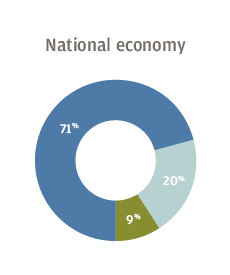
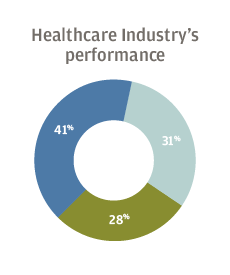
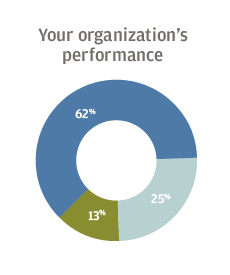
A majority of US healthcare executives surveyed by J.P. Morgan said they were optimistic about the financial performance of their own organizations going into 2019, as well as the national and local economies. But most were less positive about the outlook for the industry as a whole, with 28 percent expressing pessimism and another 31 percent merely neutral.

National economy 71% optimistic, 20% neutral, 9% pessimistic
Healthcare Industry's performance 41% optimistic, 31% neutral, 28% pessimistic
Your organization's performance 62% optimistic, 13% neutral, 25% pessimistic
Legend - Optimistic, Blue
Legend: Neutral Gray
Legend: Pessimistic, Green

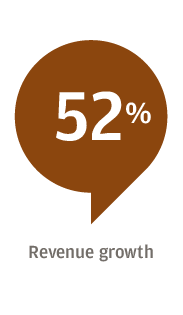
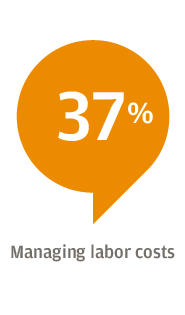
Respondents to the survey, conducted Oct. 16 to Nov. 2 of 2018, said their biggest concerns were revenue growth, rising expenses and labor costs. The executives said their organizations plan to invest the most in information technology and physician recruitment.

Healthcare Changes Shape Perceptions

The pessimism about the industry likely stems, in part, from regulatory uncertainty and an ongoing shift from a fee-for-service model toward a value-based payment system, said Will Williams, Senior Healthcare Industry Executive within J.P. Morgan’s Commercial Banking Healthcare group. “Healthcare is going through the most transition of any industry in the country right now,” he said. Amid this upheaval, healthcare organizations face a combination of challenges, including lower reimbursement rates for Medicaid and Medicare patients, increased competition, and higher costs for labor, pharmaceuticals and technology investments.

The optimism that executives feel about their own hospital or healthcare group may come from a sense that an individual organization can adapt to industry changes, said Jenny Edwards, Commercial Banker in the healthcare practice at J.P. Morgan. “You can control certain factors, and make adjustments to compensate for the headwinds.”

Biggest Challenges for the New Year

Growth Strategies

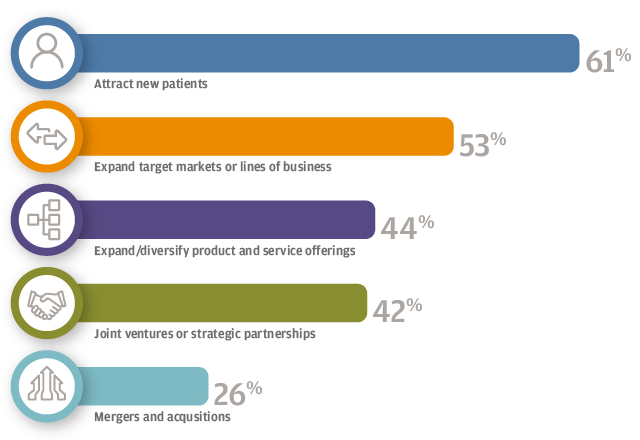
For 61 percent of respondents, the focus is on attracting new patients, followed by expanding target markets or lines of business (53 percent), and expanding or diversifying product and service offerings (44 percent). Hospitals, for example, have worked to add more patients to their broader healthcare system by opening clinics for urgent care or physical therapy, Edwards said.

As patient habits change, hospital systems have needed to become more consumer-focused, Edwards said. Patients are more likely to shop around for their care, expect transparent pricing and review healthcare workers on social media sites. This “retail-ization” trend in healthcare is accelerating, Edwards said. “You can shop for healthcare like you would a new pair of jeans.”

Skilled Talent Wanted

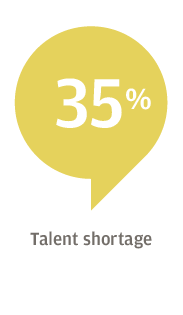
The talent shortage is top of mind for many healthcare executives, with 92 percent of survey respondents saying they were at least somewhat concerned with finding candidates with the right skill set. For 35 percent of respondents, the talent shortage is one of their top three challenges.

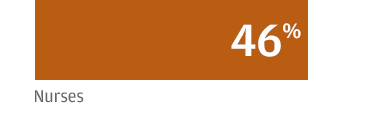
For those respondents who expressed concern, the most difficulty arises in filling positions for physicians (52 percent) and nurses (46 percent). To address the challenge, 76 percent said they expect to increase compensation of their staff over the next 12 months. According to 37 percent of respondents, the talent pool’s high compensation expectations factor into the shortage.

Most Challenging Positions to Fill

52%
46%
38%
29%
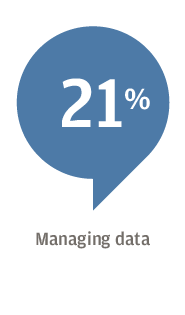
21%
21%

The talent shortage is an issue across the industry, Williams said, and burnout among doctors and nurses presents an ongoing problem. One contributing cause could be evolving changes in daily practice, with considerably more time today spent on electronic medical record entries and less on patient care. Williams said, “Doctors are getting frustrated. The problem is trying to replace those doctors as they quit practicing.”

Healthcare executives are particularly concerned about shortages of primary care professionals. “Rural communities already have these shortages,” said Brendan Corrigan, Vice Chair of the J.P. Morgan Healthcare Council.

Labor costs tend to be higher in healthcare than in other sectors, Williams said, as a hospital must have coverage for all of its major roles 24 hours a day. When asked where they struggle with workforce management, the survey respondents cite staff turnover and its associated cost (47 percent), the ability to flex staff based on patient volumes (41 percent), and the cost of overtime and premium labor (36 percent). These workforce issues not only represent specific challenges; they all contribute to labor costs, which, as noted above, rank in the top three challenges for 2019.

Investments for a Changing Industry

A majority (51 percent) of organizations plan to invest in IT over the next 12 months. Other areas for investment included physician recruitment (44 percent) and new or replacement facilities (36 percent).

Since healthcare organizations manage a large amount of private patient health information, data security remains a large part of IT expenditures. “It’s a huge focus—they’re spending a lot of time and money on preventing a breach,” Edwards said. She goes on to note that the transition to patient EMR systems brings another big IT expense—more than $1 billion for the largest healthcare systems.

Overall, the survey showed healthcare executives grappling with rising costs and structural changes that affect the entire industry. “Healthcare is trying to figure out how to fix themselves,” Williams said.