Einstein warns of cuts, ‘death spiral’ without Jefferson merger

https://www.beckershospitalreview.com/hospital-transactions-and-valuation/einstein-warns-of-cuts-death-spiral-without-jefferson-merger.html?utm_medium=email

How to emerge from a 'death spiral' in stocks - MarketWatch

In a court filing, Einstein Healthcare Network warned that a move by the Federal Trade Commission to block its merger with Jefferson Health could lead to a “death spiral” at its Philadelphia flagship safety-net hospital, according to the Philadelphia Business Journal.

In court documents opposing an FTC analysis of the merger, Einstein said that its financial condition has deteriorated since 2017, resulting in operating losses averaging about $30 million per year.

Einstein said it will incur even greater losses, largely because of the challenging payer mix and large underinsured or uninsured population of its flagship Philadelphia medical center. 

Without a merger, “Einstein [would have to] dramatically cut its services at Einstein Medical Center Philadelphia, leading to job losses and even further reductions in maintenance and needed investment, precipitating a ‘death spiral’ that would jeopardize access to health care for many of Philadelphia’s underserved residents,” Einstein wrote in the documents, according to the Philadelphia Business Journal. 

The FTC announced in February its intent to sue to block the proposed merger, arguing that combining the two systems would reduce competition in Philadelphia and Montgomery counties.

“Jefferson and Einstein have a history of competing against each other to improve quality and service,” the FTC said in February. “The proposed merger would eliminate the robust competition between Jefferson and Einstein for inclusion in health insurance companies’ hospital networks to the detriment of patients.”

Einstein and Jefferson Health countered that a combined system still would face competition from other hospitals and operate in a challenging market dominated by one healthcare insurer, according to the report. 

Atrium, Wake Forest Baptist merge to create 42-hospital system

https://www.beckershospitalreview.com/hospital-transactions-and-valuation/atrium-wake-forest-baptist-merge-to-create-42-hospital-system.html?utm_medium=email

Wake Forest Baptist, Atrium Health merge into a 'single enterprise' to be  based in Charlotte | Local | journalnow.com

Charlotte, N.C.-based Atrium Health and Winston-Salem, N.C.-based Wake Forest Baptist Health have completed their merger, creating a 42-hospital system with more than 70,000 employees. 

With the transaction complete, Wake Forest Baptist Health and Wake Forest School of Medicine will become the “academic core” of Atrium Health. The health system said it plans to build a second campus of the school of medicine in Charlotte. 

“As the healthcare field goes through the most transformative period in our lifetime, in addition to a new medical school, our vision is to build a ‘Silicon Valley’ for healthcare innovation spanning from Winston-Salem to Charlotte,” Atrium President and CEO Eugene A. Woods said in a news release. “We are creating a nationally-leading environment for clinicians, scientists, investors and visionaries to collaborate on breakthrough technologies and cures. Everything we do will be focused on life changing care, for all, in urban and rural communities alike. And we will create jobs that provide inclusive opportunities to enhance the economic vitality of our entire region.”

Atrium cited an independent economic analysis that showed the direct and indirect annual employment impact of the combined system exceeds 180,000 jobs. 

“The impact of the strategic combination will be far-reaching, elevating North Carolina as a clear destination of choice to receive medical care for people all across the nation,” said Julie Ann Freischlag, MD, CEO of Wake Forest Baptist Health and dean of Wake Forest School of Medicine. “Through our combined, nationally recognized clinical centers of excellence in multiple specialties, we will be able to expand our research in signature areas, such as cancer, cardiovascular, regenerative medicine and aging, and target bringing research breakthroughs to the community in less than half the time of the national average.”

Mr. Woods will serve as president and CEO of the combined system, and Dr. Freischlag was appointed chief academic officer for Atrium Health in addition to her current positions. 

A 16-member board of directors appointed by the Charlotte Mecklenburg Hospital Authority and Wake Forest University Baptist Medical Center will govern the new nonprofit enterprise. 

Election 2020: Trump and Biden’s starkly diverging views on healthcare

https://www.healthcaredive.com/news/presidential-election-2020-trump-biden-different-healthcare-policies-ACA-coronavirus/585184/?utm_source=Sailthru&utm_medium=email&utm_campaign=Issue:%202020-10-01%20Healthcare%20Dive%20%5Bissue:29992%5D&utm_term=Healthcare%20Dive

Spoiler: the 2 nominees differ on almost everything.

President Donald Trump and Democrat nominee Joe Biden’s starkly contrasting views on healthcare were laid bare during this week’s chaotic debate. But some major industry executives noted at a recent conference they’ve done relatively well under Trump and could likely weather a Biden presidency, given his moderate stance and rejection of liberal dreams of “Medicare for All.”

The former vice president stresses incremental measures to shore up President Barack Obama’s landmark Affordable Care Act. Trump’s campaign website has no list of healthcare priorities, making his record even more relevant to attempts to forecast his future policies.

“I think a lot of the president’s second term agenda will be extensions of things he’s done in his first term,” Lanhee Chen, domestic policy director at Stanford University’s Public Policy program, said at AHIP in September.

Either way, the impact of whoever lands in the White House next year still matters for the industry’s future.

And 33 seats in the Senate are also up for grabs in November, complicating the outlook. Two scenarios would likely lead to health policy gridlock, according to analysts and DC experts: Trump wins regardless of Senate outcome, or Biden wins and Republicans maintain control of the Senate. A third scenario, where Biden wins and Democrats retake the Senate, would be the most negative for healthcare stocks, Jefferies analysts say, while the other two outcomes would be a net positive or mostly neutral.

Here’s a look at where the candidates stand on the biggest healthcare issues: the coronavirus pandemic, the Affordable Care Act, changes to Medicare and Medicaid and lowering skyrocketing healthcare costs.

COVID-19 response

Trump

Of all wealthy nations, the U.S. has been particularly unsuccessful in mitigating the pandemic. The U.S. makes up 4% of the global population, but accounted for 23% of all COVID-19 cases and 21% of all deaths as of early September.

Public health experts assign the majority of the blame to an uncoordinated federal response, with the president electing to take a largely hands-off approach to the virus that’s killed nearly 207,000 people in the U.S. to date. That backseat stance is unlikely to change if Trump is elected to a second term.

In March, Trump said a final COVID-19 death toll in the range of 100,000 to 200,000 Americans would mean he’s “done a very good job.”

Critics blame shortages of supplies like test materials, personal protective equipment and ventilators, especially in the crucial early days of the pandemic, on Trump’s approach. States and healthcare companies have also reported challenges with shifting federal guidelines on topics from risk of infection to hospital requirements for reporting COVID-19 caseloads.

Trump has also pushed unproven treatments for COVID-19, giving rise to concerns about political influence on traditionally nonpartisan agencies like the Food and Drug Administration and the Centers for Disease Control and Prevention.

These concerns have colored Operation Warp Speed, the administration’s public-private partnership to fast-track viable vaccines. The operation received $10 billion in funds from Congress, but administration officials have also pulled $700 million from the CDC, even as top health officials face accusations of trying to manipulate CDC scientific research publications.

Fears that political motivations, not clinical rigor, are driving the historically speedy timeline could lower public trust in a vaccine once it’s eventually approved.

Trump has also repeatedly refused to endorse basic protections like widespread mask wearing, often eschewing the face covering himself in public appearances. He’s consistently downplayed the severity of the pandemic, saying it’ll go away on its own while suggesting falsely that rising COVID-19 cases were solely due to increased testing.

While Trump’s list of priorities for his second term include “eradicating COVID-19,” the plan is short on details. His most aggressive promise has been approval of a vaccine by the end of this year and creating all “critical medicines and supplies for healthcare workers” for a planned return to normal in 2021, along with refilling stockpiles to prepare for future pandemics.

Biden

Biden, for his part, would likely work to enact COVID-19 legislation and dramatically change the role of the federal government in pandemic response first thing if elected.

The Democratic candidate says he would re-assume primary responsibility for the pandemic. He plans to “dramatically scale up testing” and “giving states and local governments the resources they need to open schools and businesses safely,” per an August speech in Wilmington, Delaware.

Biden says he’d take a backseat to scientists and allow FDA to unilaterally make decisions on emergency authorizations and approvals.

The candidate supports reopening an ACA enrollment period for the uninsured, eliminating out-of-pocket costs for COVID-19 treatment, enacting additional pay and protective equipment for essential workers, increasing the federal match rate for Medicaid by at least 10%, covering COBRA with 100% premium subsidies during the emergency, expanding unemployment insurance and sick leave, reimbursing employers for sick leave and giving them tax credits for COVID-19 healthcare costs.

Trump opposes most of these measures, though he did sign COVID-19 relief legislation that upped the Medicaid match rate by 6.2% and extended the COBRA election period, though without subsidies.

Biden has said he’d be willing to use executive power for a national mask mandate, though ensuring compliance would be difficult. He’d also rejoin the World Health Organization, which Trump pulled the U.S. out of in May.

Affordable Care Act

Trump

On his first day in office, Trump issued an executive order saying: “It is the policy of my Administration to seek the prompt repeal of the Patient Protection and Affordable Care Act.” But after the Republican repeal-and-replace effort floundered in 2017, the administration began steadily chipping away at key tenets of the decade-old law through regulatory avenues.

Trump has maintained he’ll protect the 150 million people with preexisting conditions in the U.S. But despite publicly promising a comprehensive replacement plan on the 2015 campaign trail (and at least five times this year alone), Trump has yet to make one public. The president did in September sign a largely symbolic executive order that it’s the stance of his administration to protect patients with preexisting conditions.

The president doesn’t mention the ACA in his list of second term priorities. The omission could have been intentional, as Trump is backing a Republican state-led lawsuit seeking to overturn the sweeping law, now pending in front of the U.S. Supreme Court and scheduled for oral arguments one week after the election.

The death of liberal justice Ruth Bader Ginsburg puts the law in an even more precarious position.

And Trump’s health agencies have enacted myriad policies keeping the law from functioning as designed.

The president signed legislation zeroing out the individual mandate penalty requiring people to be insured in 2017. The same year, he ended cost-sharing reduction payments to insurers, suggesting that would cause the ACA to become “dead.” But the marketplace generally stabilized.

The administration has also increased access to skimpier but cheaper coverage that doesn’t have to comply with the 10 essential health benefits under the ACA. The short-term insurance plans widely discriminate against people with pre-existing health conditions, even as a growing number of Americans, facing rising healthcare costs, enrolled, according to a probe conducted by House Democrats this year.

Trump has also encouraged state waivers that promote non-ACA plans, cut funding for consumer enrollment assistance and outreach, shortened the open enrollment period and limited mid-year special enrollments.

​Despite his efforts, the ACA has grown in popularity among voters on both sides of the aisle, mostly due to provisions like shoring up pre-existing conditions and allowing young adults to stay on their parent’s insurance until age 26.

Biden

If elected, Biden would likely roll back Trump-era policies that allowed short-term insurance to proliferate, and restore funding for consumer outreach and assistance, political consultants say.

Building on the law is the linchpin of Biden’s healthcare plan. The nominee has pledged to increase marketplace subsidies to help more people afford ACA plans through a number of policy tweaks, including lowering the share of income subsidized households pay for their coverage; determining subsidies by setting the benchmark plan at the pricier “gold” level; and removing the current cap limiting subsidies to people making 400% of the federal poverty level or below.

Biden maintains as a result of these changes, no Americans would have to pay more than 8.5% of their annual income toward premiums. They could save millions of people hundreds of dollars a month, according to a Kaiser Family Foundation analysis. Commercial payers mostly support these efforts, hoping they’ll stabilize the exchanges.

But a second prong of Biden’s health strategy is deeply unpopular with private insurers: the public option. Biden’s called for a Medicare-like alternative to commercial coverage, available to anyone, including people who can’t afford private coverage or those living in a state that hasn’t expanded Medicaid.

The rationale of the public plan is that it can directly negotiate prices with hospitals and other providers, lowering costs across the board. However, market clout will depend on enrollment, which is still to-be-determined.

Critics see the plan, which by Biden’s estimate would cost $750 billion over 10 years, as a down payment on Medicare for All. And the private sector worries it could threaten the very profitable healthcare industry, which makes up about a fifth of the U.S. economy.

Medicare

Trump

Neither Trump nor Biden supports Medicare for All, dashing the hopes of supporters of the sweeping insurance scheme for at least another four years.

“It has a pulse — it’s not dead — I just don’t see it happening in any near term,” John Cipriani, vice president at public affairs firm Global Strategy Group, said at AHIP.

Trump has promised to protect Medicare if elected to a second term, and it’s unlikely he’d make any major changes to the program’s structure or eligibility requirements, experts say.

But Medicare is quickly running out of money, and neither Trump nor Biden has issued a complete plan to ensure it survives beyond 2024. Political consultants think it’ll teeter right up to the edge of insolvency before lawmakers feel compelled to act.

The president’s administration has allowed Medicare to pay for telehealth and expanding supplemental benefits in privately run Medicare Advantage programs, efforts that would likely bleed into his second term — or Biden’s first, given general bipartisan support on both, experts say.

Under Trump, HHS did pass a site-neutral payment policy, cutting Medicare payments for hospital outpatient visits in a bid to save money. But Democratic lawmakers have argued Trump’s calls to get rid of the federal payroll tax, which partially funds Medicare, could throw the future of the cash-strapped program in jeopardy.

The president has also signed legislation experts say accelerated insolvency, including the Tax Cuts and Jobs Act of 2017, the Bipartisan Budget Act of 2018 and the Further Consolidated Appropriations Act of 2020, which repealed the ACA’s Cadillac tax — a tax on job-based insurance premiums above a certain level.

Nixing that tax lowered payroll tax revenue, also dinging Medicare’s shrinking trust fund.

Trump’s proposed budget for the 2021 fiscal year floated culling about $450 billion in Medicare spending over a decade. And repealing the ACA would also nix provisions that closed the Medicare prescription drug “donut hole,” that added free coverage of preventive services and reduced spending to strengthen Medicare’s winnowing Hospital Insurance Trust Fund.

Biden

Biden has proposed lowering the Medicare age of eligibility to 60 years, with the option for people aged 60-64 to keep their coverage if they like it. The idea is popular politically, though providers oppose it, fearful of losing more lucrative commercial revenue.

It would make about 20 million more people eligible for the insurance, but could also add even more stress onto the program, experts say. Biden’s campaign says it would be financed separately from the current Medicare program, with dollars from regular tax revenues, and will reduce hospital costs.

Biden also says he’d add hearing, vision and dental benefits to Medicare.

Medicaid

Trump

Trump’s tenure has also been defined by repeated efforts to prune Medicaid. The president has consistently backed major cuts to the safety net insurance program, along with stricter rules for who can receive coverage. That’s likely to continue.

Republican lawmakers maintain the program costs too much and discourages low-income Americans from getting job-based coverage, and have enacted policies trying to privatize Medicaid. The Trump administration took a step toward a long-held conservative dream earlier this year, when CMS invited state waivers that would allow states to deviate from federal standards in program design and oversight, in exchange for capped funding.

So far, no states have enacted the block grants.

The administration also aggressively encouraged states to adopt work requirements, programs tying Medicaid coverage to work or volunteering hours. A handful of states followed suit, but all halted implementation or rolled back the idea following fierce public backlash and legal ramifications.

And repealing the ACA would ax Medicaid expansion, which saved some 20,000 lives between 2014 and 2017, according to the Center on Budget and Policy Priorities.

Biden

Biden, however, wants to preserve expansion, and would take a number of other steps to bolster the program, including increasing federal Medicaid funding for home- and community-based services. The roughly 4.8 million adults in states that elected not to expand Medicaid would be automatically enrolled into his public option, with no premium and full Medicaid benefits.

Additionally, states that have expanded Medicaid could elect to move their enrollees into the public option, with a maintenance-of-effort payment.

Lowering costs of drugs and services

Trump

Efforts to lower prescription drug costs have defined Trump’s healthcare agenda in his first term, and been a major talking point for the president. That’s more than likely to continue into a second term, experts say, despite a lack of results.

Trump did cap insulin costs for some Medicare enrollees, effective 2021. He also signed legislation in 2018 banning gag clauses preventing pharmacists from telling customers about cheaper options.

But despite fiery rhetoric and a litany of executive orders, Trump has made little if any concrete progress on actually lowering prices. One week into 2020, drugmakers had announced price hikes for almost 450 drugs, despite small price drops earlier in Trump’s tenure.

Trump has proposed several ideas either dropped later or challenged successfully by drugmakers in court, including allowing patients to import drugs from countries like Canada, banning rebates paid to pharmacy benefit manufacturers in Medicare and forcing drugmakers to disclose the list prices of drugs in TV ads.

The president has signed recent executive orders to lower costs largely viewed as pre-election gambits, including one tying drug prices in Medicare to other developed nations and another directing his agencies to end surprise billing. Implementation on both is months away. Trump has also promised to send Medicare beneficiaries $200 in drug discount cards before the election, an effort slammed as vote-buying that would cost Medicare at least $6.6 billion.

Both Trump and Biden support eliminating surprise bills but haven’t provided any details how. That “how” is important, as hospitals and payers support wildly different solutions.

Biden

Biden also has a long list​ of proposals to curb drug costs, including allowing the federal government to negotiate directly with drug manufacturers on behalf of Medicare and some other public and private purchasers, with prices capped at the level paid by other wealthy countries. Trump actually supported this proposal in his 2016 campaign, but quickly dropped it amid fierce opposition from drugmakers and free market Republican allies.

Biden would also cap out-of-pocket drug costs in Medicare Part D — but wouldn’t ban rebates, as of his current plan, allow consumers to import drugs (subject to safeguards) and eliminate tax breaks for drug advertising expenses.

He would also prohibit prices for all brand-name and some generic drugs from rising faster than inflation under Medicare and his novel public option. Biden would create a board to assess the value of new drugs and recommend a market-based price, in a model that’s shown some efficacy in other wealthy countries like Germany.

Both Biden and Trump say they support developing alternative payment models to lower costs. But they diverge on the role of competition versus transparency in making healthcare more affordable. In a rule currently being challenged in court, Trump’s HHS required hospitals to disclose private negotiated prices between hospitals and insurers, with the hope price transparency will allow consumers to shop between different care sites and shame companies into lowering their prices.

Biden, by comparison, says he would enforce antitrust laws to prevent anti-competitive healthcare consolidations, and other business practices that jack up spending. Trump has been mum on the role of M&A in driving healthcare costs, and inherited a complacent Federal Trade Commission that’s done little to reduce provider consolidation. Until a contentious hospital merger in February this year, the FTC hadn’t opposed a hospital merger since 2016.


FTC expands retrospective scrutiny of mergers

https://www.beckershospitalreview.com/hospital-transactions-and-valuation/ftc-expands-retrospective-scrutiny-of-mergers.html?utm_medium=email

Federal Trade Commission (FTC) Definition

The Federal Trade Commission is expanding its retrospective review of mergers and acquisitions, using data from before and after a deal to assess whether the transaction affected prices, quality and consumer choice. 

The FTC has retrospectively reviewed mergers since 1984. The two goals of the program are to understand whether the agency’s threshold for bringing an enforcement action in a merger case has been too permissive and to assess the performance of tools that FTC economists use to predict the effects of proposed mergers.

The expanded program means the agency will dedicate more time and resources to studying completed mergers, addressing antitrust questions that have not been extensively studied in previous years and expanding retrospective reviews to industries that have not been studied.

Compared to other industries, healthcare mergers have undergone extensive scrutiny under the retrospective review program, with eight studies since 2011. These retrospective analyses have proven influential to federal challenges of subsequent healthcare mergers: The FTC was able to challenge 13 hospital cases from 2008 to 2018.

As part of the expanded program, the FTC director of the bureau of economics will release an annual summary on lessons and findings from the retrospective studies.


Einstein’s flagship hospital at risk without merger, Jefferson and Einstein say

https://www.beckershospitalreview.com/hospital-transactions-and-valuation/einstein-s-flagship-hospital-at-risk-without-merger-jefferson-and-einstein-say.html?utm_medium=email

FTC says merger of Jefferson and Einstein would raise hospital prices 6.9%

The merger of Einstein Healthcare Network and Jefferson Health is a matter of survival for Einstein’s flagship hospital, the two Philadelphia systems argued in a federal court filing this week, according to The Philadelphia Inquirer.

The health systems are attempting to overcome opposition to their merger from the Pennsylvania attorney general and the Federal Trade Commission.

A Sept. 14 hearing is slated on the FTC’s preliminary injunction request. 

A court filing from the two health systems argued that Einstein, which has only had annual operating profits twice since 2012, is on a path to financial failure and needs $500 million to invest in key capital projects and deferred maintenance.

Without the infusion, Jefferson and Einstein said Einstein will continue to weaken “as it is forced to cut services or close facilities,” the Inquirer reported.

“Einstein was unable to identify any alternative buyer to Jefferson that possessed the financial strength and scale necessary to address Einstein’s financial problems,” the filing read, according to the Inquirer. “No other potential strategic partners were willing and able to commit to keep EMCP [Einstein Medical Center Philadelphia] open with its current set of services.”

The FTC announced in February its intent to sue to block the merger, arguing that combining the two systems would reduce competition in Philadelphia and Montgomery County.

“Jefferson and Einstein have a history of competing against each other to improve quality and service,” the FTC said in the February announcement. “The proposed merger would eliminate the robust competition between Jefferson and Einstein for inclusion in health insurance companies’ hospital networks to the detriment of patients.”

The FTC said that with a combination, the two parties would own at least 60 percent of the inpatient general acute care service market around Philadelphia and at least 45 percent of that same market in Montgomery County.


Amazon Is Hiring an Intelligence Analyst to Track ‘Labor Organizing Threats’

https://www.vice.com/en_us/article/qj4aqw/amazon-hiring-intelligence-analyst-to-track-labor-organizing-threats?fbclid=IwAR2HPsGNDFctpmNzBb_6Su9yof5SN_ke-E9cG0vHwgseLJw8UaQmarmGoPk

Amazon is looking to hire two people who can focus on keeping tabs on labor activists within the company.

Amazon is looking to hire two intelligence analysts to track “labor organizing threats” within the company.

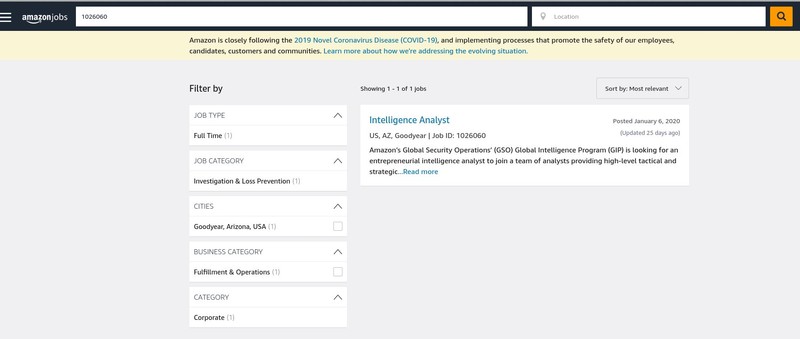
The company recently posted two job listings for analysts that can keep an eye on sensitive and confidential topics “including labor organizing threats against the company.” Amazon is looking to hire an “Intelligence Analyst” and a “Sr Intelligence Analyst” for its Global Security Operations’ (GSO) Global Intelligence Program (GIP), the team that’s responsible for physical and corporate security operations such as insider threats and industrial espionage. 

The job ads list several kinds of threats, such as “protests, geopolitical crises, conflicts impacting operations,” but focuses on “organized labor” in particular, mentioning it three times in one of the listings. 

Amazon has historically been hostile to workers attempting to form a union or organize any kind of collective action. Last year, an Amazon spokesperson accused unions of exploiting Prime Day “to raise awareness to their cause” and increase membership dues. Earlier this year, the company fired Christian Smalls, a Black employee who led a protest at a fulfillment center in New York over Amazon’s inadequate safety measures in the early days of the COVID-19 pandemic. During a meeting with Amazon CEO Jeff Bezos, company executives discussed plans to smear Smalls calling him “not smart, or articulate.”  

These job listings show Amazon sees labor organizing as one of the biggest threats to its existence.

Do you work at Amazon, did you used to, or do you know anything else about the company? We’d love to hear from you. Using a non-work phone or computer, you can contact Lorenzo Franceschi-Bicchierai securely on Signal at +1 917 257 1382, on Wickr at lorenzofb, OTR chat at lorenzofb@jabber.ccc.de, or email lorenzofb@vice.com.

After this story was published, Amazon deleted the job listings and company spokesperson Maria Boschetti said in an email that “the job post was not an accurate description of the role— it was made in error and has since been corrected.” The spokesperson did not respond to follow-up questions about the alleged mistake. The job listing, according to Amazon’s own job portal, had been up since January 6, 2020.

Dania Rajendra, the Director of the Athena Coalition, an alliance of dozens of grassroots labor groups that organize amazon workers, criticized the listing.

“Workers, especially Black workers, have been telling us all for months that Amazon is targeting them for speaking out. This job description is proof that Amazon intends to continue on this course,” Rajendra told Motherboard in a statement. “The public deserves to know whether Amazon will continue to fill these positions, even if they’re no longer publicly posted.”

On Monday, the Open Markets Institute, a nonprofit that studies monopolies, published a report on Amazon’s employee surveillance efforts, claiming that these practices “create a harsh and dehumanizing working environment that produces a constant state of fear, as well as physical and mental anguish.” 

After a week of the jobs being posted online, 71 people have applied to the Intelligence Analyst position, and 24 people to the Sr Intelligence Analyst job, according to Linkedin. The first job was posted in the Amazon Jobs portal in January, the second job on July 21, according to the company’s site.

UPDATE Sept. 1, 12:04 p.m. ET: Shortly after this story was published, Amazon removed the listings from its job portal.


12-hospital CHI Franciscan-Virginia Mason system would be part of CommonSpirit under new deal

https://www.beckershospitalreview.com/hospital-transactions-and-valuation/12-hospital-chi-franciscan-virginia-mason-system-would-be-part-of-commonspirit-under-new-deal.html?utm_medium=email

CHI Franciscan and Virginia Mason moving toward merger | Tacoma ...

Washington health systems CHI Franciscan and Virginia Mason agreed to explore a combination through a joint operating company that would be part of CommonSpirit Health, the organizations said July 16. 

The proposed 12-hospital system would include more than 250 care sites and nearly 5,000 employed and affiliated providers. Combining the two systems would allow Tacoma-based CHI Franciscan and Seattle-based Virginia Mason to “shape healthcare nationally,” according to Virginia Mason CEO Gary Kaplan, MD. He told Becker’s Hospital Review in an interview that the organizations “envision creating a health system of the future.”

Ketul Patel, the CEO of CHI Franciscan and president of the Pacific Northwest division at parent system CommonSpirit Health, said in the same interview that, “Together, we’re going to not only be able to boast that we have the largest access point in the state, but we are going to be the largest and best-quality [system] in the state of Washington. We’re in a unique place to scaling and being a showcase for the entire country.” 

Dr. Kaplan and Mr. Patel would serve as co-CEOs of the organization, and the health system’s board would have equal representation from both organizations.

Quality and innovation are major focuses of the proposed deal. Virginia Mason is one of only 32 hospitals in the U.S. and the only hospital in Washington to receive an A grade in quality and patient safety from The Leapfrog Group every spring and fall since the organization started publishing grades. All but two of CHI Franciscan’s hospitals received A rankings from Leapfrog this spring, Dr. Kaplan said. Outside of that, Virginia Mason and CHI Franciscan draw patients nationally for cardiology and complex spine programs, Mr. Patel said.

Dr. Kaplan said details of the deal will be hammered out as the organizations move toward a final agreement, with hopes to finalize the process by the end of the year. The joint operating company would be in addition to the organizations’ prior relationships, which include partnerships in obstetrics and women’s health, as well as radiation oncology.

No financial information about the proposal was disclosed. Virginia Mason reported total revenues of $1.2 billion in fiscal year 2019, while Chicago-based CommonSpirit’s totaled nearly $21 billion.


FTC, Justice Department have new guidelines for vertical mergers

https://www.beckershospitalreview.com/hospital-transactions-and-valuation/ftc-justice-department-have-new-guidelines-for-vertical-mergers.html?utm_medium=email

Trump Administration Updates Vertical Merger Guidelines - Multichannel

Guidance on vertical mergers got its first major overhaul from the Federal Trade Commission and the U.S. Department of Justice in more than 35 years under new joint guidelines published June 30.

Vertical mergers are those that combine firms or assets at different stages of the same supply chain, such as healthcare company CVS Health’s acquisition of insurer Aetna. Previously proposed mergers like that of insurers Humana and Aetna would be considered horizontal.

FTC Chairman Joe Simon said in a news release that the new guidances “are an important step forward in maintaining vigorous antitrust enforcement, and reaffirm our commitment to challenge vertical mergers that are anticompetitive and would harm American consumers.”

Leaders said that the guidelines explain FTC and Justice Department investigative practices and will give the business community clarity about antitrust concerns, such as the type of evidence the FTC and Justice Department review and how they define markets.

To read the full guidelines, click here


BANKS PRESSURE HEALTH CARE FIRMS TO RAISE PRICES ON CRITICAL DRUGS, MEDICAL SUPPLIES FOR CORONAVIRUS

Banks Pressure Health Care Firms to Raise Prices on Critical Drugs, Medical Supplies for Coronavirus

Image result for BANKS PRESSURE HEALTH CARE FIRMS TO RAISE PRICES ON CRITICAL DRUGS, MEDICAL SUPPLIES FOR CORONAVIRUS

IN RECENT WEEKS, investment bankers have pressed health care companies on the front lines of fighting the novel coronavirus, including drug firms developing experimental treatments and medical supply firms, to consider ways that they can profit from the crisis.

The media has mostly focused on individuals who have taken advantage of the market for now-scarce medical and hygiene supplies to hoard masks and hand sanitizer and resell them at higher prices. But the largest voices in the health care industry stand to gain from billions of dollars in emergency spending on the pandemic, as do the bankers and investors who invest in health care companies.

Over the past few weeks, investment bankers have been candid on investor calls and during health care conferences about the opportunity to raise drug prices. In some cases, bankers received sharp rebukes from health care executives; in others, executives joked about using the attention on Covid-19 to dodge public pressure on the opioid crisis.

Gilead Sciences, the company producing remdesivir, the most promising drug to treat Covid-19 symptoms, is one such firm facing investor pressure.

Remdesivir is an antiviral that began development as a treatment for dengue, West Nile virus, and Zika, as well as MERS and SARS. The World Health Organization has said there is “only one drug right now that we think may have real efficacy in treating coronavirus symptoms” — namely, remdesivir.

The drug, though developed in partnership with the University of Alabama through a grant from the federal government’s National Institutes of Health, is patented by Gilead Sciences, a major pharmaceutical company based in California. The firm has faced sharp criticism in the past for its pricing practices. It previously charged $84,000 for a yearlong supply of its hepatitis C treatment, which was also developed with government research support. Remdesivir is estimated to produce a one-time revenue of $2.5 billion.

During an investor conference earlier this month, Phil Nadeau, managing director at investment bank Cowen & Co., quizzed Gilead Science executives over whether the firm had planned for a “commercial strategy for remdesivir” or could “create a business out of remdesivir.”

Johanna Mercier, executive vice president of Gilead, noted that the company is currently donating products and “manufacturing at risk and increasing our capacity” to do its best to find a solution to the pandemic. The company at the moment is focused, she said, primarily on “patient access” and “government access” for remdesivir.

“Commercial opportunity,” Mercier added, “might come if this becomes a seasonal disease or stockpiling comes into play, but that’s much later down the line.”

Steven Valiquette, a managing director at Barclays Investment Bank, last week peppered executives from Cardinal Health, a health care distributor of N95 masks, ventilators and pharmaceuticals, on whether the company would raise prices on a range of supplies.

Valiquette asked repeatedly about potential price increases on a variety of products. Could the company, he asked, “offset some of the risk of volume shortages” on the “pricing side”?

Michael Kaufmann, the chief executive of Cardinal Health, said that “so far, we’ve not seen any material price increases that I would say are related to the coronavirus yet.” Cardinal Health, Kaufman said, would weigh a variety of factors when making these decisions, and added that the company is “always going to fight aggressively to make sure that we’re getting after the lowest cost.”

“Are you able to raise the price on some of this to offset what could be some volume shortages such that it all kind of nets out to be fairly consistent as far as your overall profit matrix?” asked Valiquette.

Kaufman responded that price decisions would depend on contracts with providers, though the firm has greater flexibility over some drug sales. “As you have changes on the cost side, you’re able to make some adjustments,” he noted.

The discussion, over conference call, occurred during the Barclays Global Healthcare Conference on March 10. At one point, Valiquette joked that “one positive” about the coronavirus would be a “silver lining” that Cardinal Health may receive “less questions” about opioid-related lawsuits.

Cardinal Health is one of several firms accused of ignoring warnings and flooding pharmacies known as so-called pill mills with shipments of millions of highly addictive painkillers. Kaufmann noted that negotiations for a settlement are ongoing.

Owens & Minor, a health care logistics company that sources and manufactures surgical gowns, N95 masks, and other medical equipment, presented at the Barclays Global Healthcare Conference the following day.

Valiquette, citing the Covid-19 crisis, asked the company whether it could “increase prices on some of the products where there’s greater demand.” Valiquette then chuckled, adding that doing so “is probably not politically all that great in the sort of dynamic,” but said he was “curious to get some thoughts” on whether the firm would consider hiking prices.

The inquiry was sharply rebuked by Owens & Minor chief executive Edward Pesicka. “I think in a crisis like this, our mission is really around serving the customer. And from an integrity standpoint, we have pricing agreements,” Pesicka said. “So we are not going to go out and leverage this and try to ‘jam up’ customers and raise prices to have short-term benefit.”

AmerisourceBergen, another health care distributor that supplies similar products to Cardinal Health, which is also a defendant in the multistate opioid litigation, faced similar questions from Valiquette at the Barclays event.

Steve Collis, president and chief executive of AmerisourceBergen, noted that his company has been actively involved in efforts to push back against political demands to limit the price of pharmaceutical products.

Collis said that he was recently at a dinner with other pharmaceutical firms involved with developing “vaccines for the coronavirus” and was reminded that the U.S. firms, operating under limited drug price intervention, were among the industry leaders — a claim that has been disputed by experts who note that lack of regulation in the drug industry has led to few investments in viral treatments, which are seen as less lucrative. Leading firms developing a vaccine for Covid-19 are based in Germany, China, and Japan, countries with high levels of government influence in the pharmaceutical industry.

AmerisourceBergen, Collis continued, has been “very active with key stakeholders in D.C., and our priority is to educate policymakers about the impact of policy changes,” with a focus on “rational and responsible discussion about drug pricing.”

Later in the conversation, Valiquette asked AmerisourceBergen about the opioid litigation. The lawsuits could cost as much as $150 billion among the various pharmaceutical and drug distributor defendants. Purdue Pharma, one of the firms targeted with the opioid litigation, has already pursued bankruptcy protection in response to the lawsuit threat.

“We can’t say too much,” Collis responded. But the executive hinted that his company is using its crucial role in responding to the pandemic crisis as leverage in the settlement negotiations. “I would say that this crisis, the coronavirus crisis, actually highlights a lot of what we’ve been saying, how important it is for us to be very strong financial companies and to have strong cash flow ability to invest in our business and to continue to grow our business and our relationship with our customers,” Collis said.

The hope that the coronavirus will benefit firms involved in the opioid crisis has already materialized in some ways. New York Attorney General Letitia James announced last week that her lawsuit against opioid firms and distributors, including Cardinal Health and AmerisourceBergen, set to begin on March 20, would be delayed over coronavirus concerns.

MARKET PRESSURE has encouraged large health care firms to spend billions of dollars on stock buybacks and lobbying, rather than research and development. Barclays declined to comment, and Cowen & Co. did not respond to a request for comment.

The fallout over the coronavirus could pose potential risks for for-profit health care operators. In Spain, the government seized control of private health care providers, including privately run hospitals, to manage the demand for treatment for patients with Covid-19.

But pharmaceutical interests in the U.S. have a large degree of political power. Health and Human Services Secretary Alex Azar previously served as president of the U.S. division of drug giant Eli Lilly and on the board of the Biotechnology Innovation Organization, a drug lobby group.

During a congressional hearing last month, Azar rejected the notion that any vaccine or treatment for Covid-19 should be set at an affordable price. “We would want to ensure that we work to make it affordable, but we can’t control that price because we need the private sector to invest,” said Azar. “The priority is to get vaccines and therapeutics. Price controls won’t get us there.”

The initial $8.3 billion coronavirus spending bill passed in early March to provide financial support for research into vaccines and other drug treatments contained a provision that prevents the government from delaying the introduction of any new pharmaceutical to address the crisis over affordability concerns. The legislative text was shaped, according to reports, by industry lobbyists.

As The Intercept previously reported, Joe Grogan, a key White House domestic policy adviser now serving on Donald Trump’s Coronavirus Task Force, previously served as a lobbyist for Gilead Sciences.

“Notwithstanding the pressure they may feel from the markets, corporate CEOs have large amounts of discretion and in this case, they should be very mindful of price gouging, they’re going to be facing a lot more than reputational hits,” said Robert Weissman, president of public interest watchdog Public Citizen, in an interview with The Intercept.

“There will be a backlash that will both prevent their profiteering, but also may push to more structural limitations on their monopolies and authority moving forward,” Weissman said.

Weissman’s group supports an effort led by Rep. Andy Levin, D-Mich., who has called on the government to invoke the Defense Production Act to scale up domestic manufacturing of health care supplies.

There are other steps the government can take, Weissman added, to prevent price gouging.

“The Gilead product is patent-protected and monopoly-protected, but the government has a big claim over that product because of the investment it’s made,” said Weissman.

“The government has special authority to have generic competition for products it helped fund and prevent nonexclusive licensing for products it helped fund,” Weissman continued. “Even for products that have no connection to government funding, the government has the ability to force licensing for generic competition for its own acquisition and purchases.”

Drug companies often eschew vaccine development because of the limited profit potential for a one-time treatment. Testing kit companies and other medical supply firms have few market incentives for domestic production, especially scaling up an entire factory for short-term use. Instead, Levin and Weissman have argued, the government should take direct control of producing the necessary medical supplies and generic drug production.

Last Friday, Levin circulated a letter signed by other House Democrats that called for the government to take charge in producing ventilators, N95 respirators, and other critical supplies facing shortages.

The once inconceivable policy was endorsed on Wednesday when Trump unveiled a plan to invoke the Defense Production Act to compel private firms to produce needed supplies during the crisis. The law, notably, allows the president to set a price ceiling for critical goods used in an emergency.