Cartoon – At last a Sport We can Watch

KAL's cartoon | The world this week | The Economist

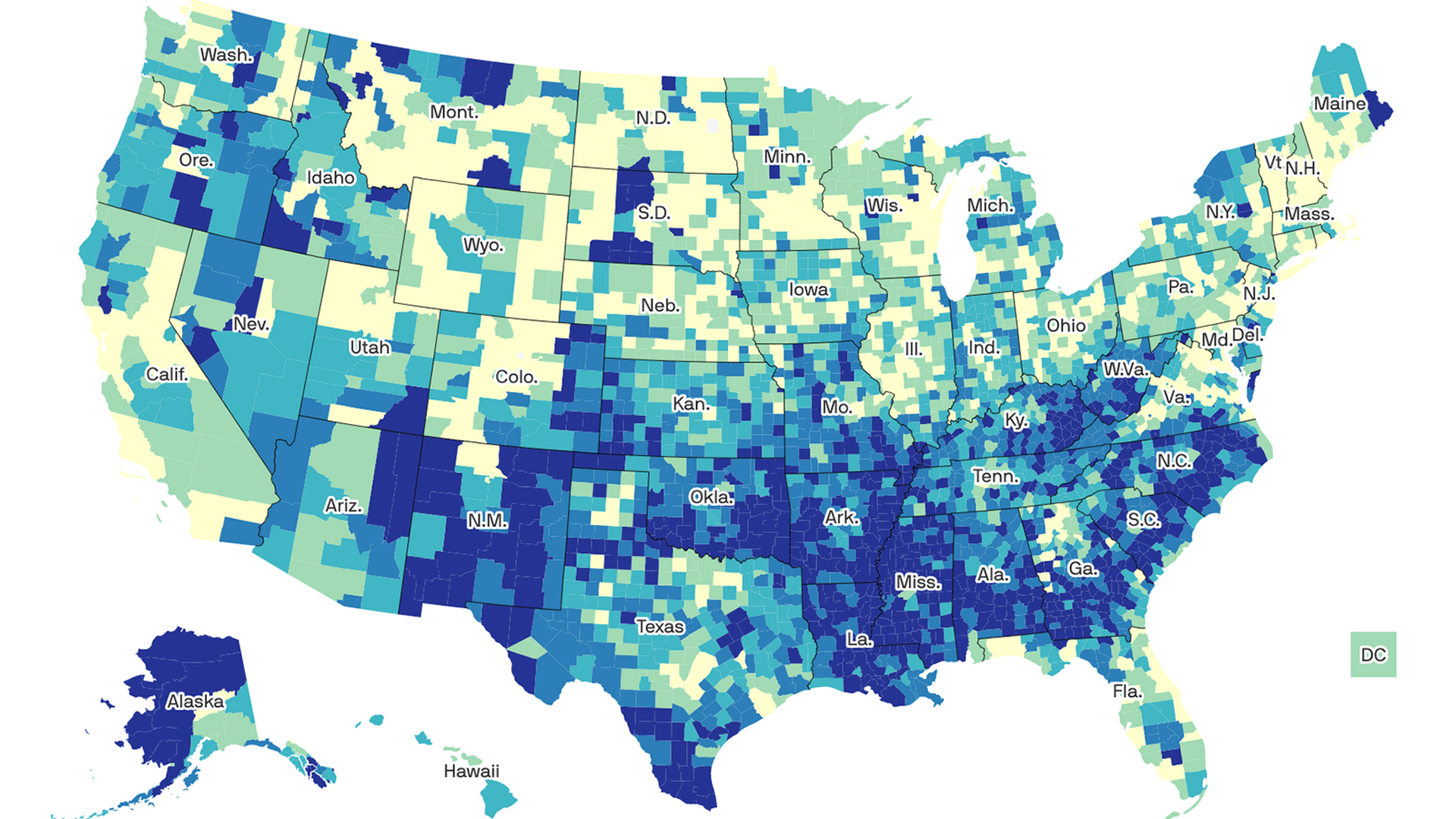
The South is vulnerable to a coronavirus nightmare

https://www.axios.com/newsletters/axios-vitals-d53939d5-90fb-4aef-a87d-30cf2b0ceebf.html?utm_source=newsletter&utm_medium=email&utm_campaign=newsletter_axiosvitals&stream=top

COVID-19 vulnerability index, by county

Arrow


The South is at risk of being devastated by the coronavirus.

Why it matters: Southern states tend to have at-risk populations and weak health care systems — and they’re the ones moving fastest to loosen social distancing rules. That puts them at risk for the worst-case coronavirus scenarios.

The big picture: To stop the spread of the coronavirus, there are really only two options: stringent social distancing, or stringent public health measures.

Driving the news: Several southern states including Georgia, Tennessee and South Carolina have recently announced that they’re starting to back off of social distancing.

  • Our national testing capacity is still nowhere near where experts say it needs to be, and only some communities have announced efforts to build up contact tracing.

Between the lines: The Surgo Foundation created a coronavirus community vulnerability index that takes into account factors like socioeconomic status, minority status, housing type, epidemiologic factors and health care system factors.

The bottom line: The South is already worse off in almost every way, partially due to policy choices made in these states. Its comparatively unhealthy population is vulnerable to more serious illness, and looser social distancing will enable the virus’ spread.


Here are the innovations we need to reopen the economy

https://www.washingtonpost.com/opinions/2020/04/23/bill-gates-here-are-innovations-we-need-reopen-economy/?arc404=true

Bill Gates: Here are the innovations we need to reopen the economy ...

Bill Gates is a co-chair of the Bill & Melinda Gates Foundation. This article is adapted from his blog post “Pandemic I: the First Modern Pandemic,” available at gatesnotes.com.

It’s entirely understandable that the national conversation has turned to a single question: “When can we get back to normal?” The shutdown has caused immeasurable pain in jobs lost, people isolated and worsening inequity. People are ready to get going again.

Unfortunately, although we have the will, we don’t have the way — not yet. Before the United States and other countries can return to business and life as usual, we will need some innovative new tools that help us detect, treat and prevent covid-19.

It begins with testing. We can’t defeat an enemy if we don’t know where it is. To reopen the economy, we need to be testing enough people that we can quickly detect emerging hotspots and intervene early. We don’t want to wait until the hospitals start to fill up and more people die.

Innovation can help us get the numbers up. The current coronavirus tests require that health-care workers perform nasal swabs, which means they have to change their protective gear before every test. But our foundation supported research showing that having patients do the swab themselves produces results that are just as accurate. This self-swab approach is faster and safer, since regulators should be able to approve swabbing at home or in other locations rather than having people risk additional contact.

Another diagnostic test under development would work much like an at-home pregnancy test. You would swab your nose, but instead of sending it into a processing center, you’d put it in a liquid and then pour that liquid onto a strip of paper, which would change color if the virus was present. This test may be available in a few months.

We need one other advance in testing, but it’s social, not technical: consistent standards about who can get tested. If the country doesn’t test the right people — essential workers, people who are symptomatic and those who have been in contact with someone who tested positive — then we’re wasting a precious resource and potentially missing big reserves of the virus. Asymptomatic people who aren’t in one of those three groups should not be tested until there are enough for everyone else.

The second area where we need innovation is contact tracing. Once someone tests positive, public-health officials need to know who else that person might have infected.

For now, the United States can follow Germany’s example: interview everyone who tests positive and use a database to make sure someone follows up with all their contacts. This approach is far from perfect, because it relies on the infected person to report their contacts accurately and requires a lot of staff to follow up with everyone in person. But it would be an improvement over the sporadic way that contact tracing is being done across the United States now.

An even better solution would be the broad, voluntary adoption of digital tools. For example, there are apps that will help you remember where you have been; if you ever test positive, you can review the history or choose to share it with whoever comes to interview you about your contacts. And some people have proposed allowing phones to detect other phones that are near them by using Bluetooth and emitting sounds that humans can’t hear. If someone tested positive, their phone would send a message to the other phones, and their owners could get tested. If most people chose to install this kind of application, it would probably help some.

Naturally, anyone who tests positive will immediately want to know about treatment options. Yet, right now, there is no treatment for covid-19. Hydroxychloroquine, which works by changing the way the human body reacts to a virus, has received a lot of attention. Our foundation is funding a clinical trial that will give an indication whether it works on covid-19 by the end of May, and it appears the benefits will be modest at best.

But several more-promising candidates are on the horizon. One involves drawing blood from patients who have recovered from covid-19, making sure it is free of the coronavirus and other infections, and giving the plasma (and the antibodies it contains) to sick people. Several major companies are working together to see whether this succeeds.

Another type of drug candidate involves identifying the antibodies that are most effective against the novel coronavirus, and then manufacturing them in a lab. If this works, it is not yet clear how many doses could be produced; it depends on how much antibody material is needed per dose. In 2021, manufacturers may be able to make as few as 100,000 treatments or many millions.

If, a year from now, people are going to big public events — such as games or concerts in a stadium — it will be because researchers have discovered an extremely effective treatment that makes everyone feel safe to go out again. Unfortunately, based on the evidence I’ve seen, they’ll likely find a good treatment, but not one that virtually guarantees you’ll recover.

That’s why we need to invest in a fourth area of innovation: making a vaccine. Every additional month that it takes to produce a vaccine is a month in which the economy cannot completely return to normal.

The new approach I’m most excited about is known as an RNA vaccine. (The first covid-19 vaccine to start human trials is an RNA vaccine.) Unlike a flu shot, which contains fragments of the influenza virus so your immune system can learn to attack them, an RNA vaccine gives your body the genetic code needed to produce viral fragments on its own. When the immune system sees these fragments, it learns how to attack them. An RNA vaccine essentially turns your body into its own vaccine manufacturing unit.

There are at least five other efforts that look promising. But because no one knows which approach will work, a number of them need to be funded so they can all advance at full speed simultaneously.

Even before there’s a safe, effective vaccine, governments need to work out how to distribute it. The countries that provide the funding, the countries where the trials are run, and the ones that are hardest-hit will all have a good case that they should receive priority. Ideally, there would be global agreement about who should get the vaccine first, but given how many competing interests there are, this is unlikely to happen. Whoever solves this problem equitably will have made a major breakthrough.

World War II was the defining moment of my parents’ generation. Similarly, the coronavirus pandemic — the first in a century — will define this era. But there is one big difference between a world war and a pandemic: All of humanity can work together to learn about the disease and develop the capacity to fight it. With the right tools in hand, and smart implementation, we will eventually be able to declare an end to this pandemic — and turn our attention to how to prevent and contain the next one.


Operating margins plummet at US hospitals, Kaufman Hall says

https://www.healthcaredive.com/news/Kaufman-hospitals-operating-margin-decline/576491/

Third Quarter Investment Report: Moving Into Choppy Waters « CPEA ...

Dive Brief:

  • Operating margins at the nation’s hospitals have plummeted due to large-scale volume and revenue declines coupled with flat to rising expenses, according to a new report from Kaufman Hall.
  • Based on March data from more than 800 U.S. hospitals, average operating margins dropped 150% year over year, plunging non-profit hospitals, which historically operate on already thin margins, into troublesome territory.
  • The data paint a dire picture for U.S. hospitals. “These initial numbers only reflect the first two weeks of the COVID-19 response and likely indicate more negative results in the future,” Jim Blake, managing director at Kaufman Hall, said in a statement.

Dive Insight:

Hospitals depend heavily on elective surgeries for revenue, but had to cancel or postpone many of them starting last month in order to preserve coveted COVID-19 resources such as personal protective equipment, beds and staff.

Those measures have upended the financial health of the entire industry in a matter of just weeks, according to new data and analysis from Kaufman Hall.

“We anticipate April will be significantly worse, and at this point, no one knows how long hospitals will continue on their current path,” Blake said.

Despite the ongoing pandemic, patient volumes overall have plunged. During March, the median hospital occupancy rate was 53%, with operating room minutes down 20% year-over-year and emergency room visits down 15% year over year, according to the report.

At the same time, hospitals’ labor expenses were up 3% year over year, and non-labor expenses were up 1%. In order to rein in operating costs, some health systems have begun to furlough or lay off workers.

While non-profit systems are especially vulnerable given their razor-thin margins, major for-profit systems are also struggling financially.

HCA Healthcare, Community Health Systems and Tenet Healthcare have all pulled their 2020 guidance in response to the pandemic. In its first quarter report Tuesday, HCA attributed a steep decrease in volumes and 45% drop in profit to the pandemic.

And Jefferies analyst wrote in a note Tuesday they are reducing their volume and earnings expectations for those companies for this year and 2021 based on the pandemic. “Our belief is that high unemployment translates to reduced commercial insurance coverage and disposable income to fund co-pays/deductibles, which results in fewer physician visits and procedures,” they wrote.

Under these circumstances, the federal government has attempted to financially support struggling hospitals through ongoing coronavirus relief legislation.

First came accelerated Medicare payments based on reimbursement data, in the form of loans that providers will have to pay back.

Separately, the Coronavirus Aid, Relief, and Economic Security Act passed by Congress in March benchmarked $100 billion in funding to provide financial support to struggling hospitals.

$30 billion first round was announced April 8 and given to providers based on historic Medicare payments. A second round of CARES act funding for systems in hot spots is next, although the timing is unclear.

On Tuesday the Senate approved a separate $484 billion aid package, the Paycheck Protection Program and Health Care Enhancement Act, that would send an additional $75 billion in emergency funds to hospitals. It also allocates $25 billion to expand testing for the virus across the country.

The White House expressed support for the package. It still needs House approval, which could happen as soon as this week.

The latest package comes in response to depleted funding for the Small Business Administration’s Paycheck Protection Program. Upon replenishing those funds, smaller health systems may be eligible for forgivable PPP loans used to meet payroll and other operating costs, but only if they have 500 or fewer employees.


Melinda Gates: This is not a once-in-a-century pandemic.

https://www.businessinsider.com/melinda-gates-coronavirus-interview-vaccine-timeline-2020-4?linkId=87026774

Melinda Gates

‘We will absolutely have more of these.’ The billionaire philanthropist predicts a timeline for going back to normal.

  • Business Insider spoke with Melinda Gates about COVID-19, the prospect and timeline of making an effective vaccine, and how the world will be permanently changed by the coronavirus.
  • Gates said it would likely take about 18 months for a vaccine to become widely available, and that it should first go to healthcare workers to help them keep others safe.
  • She said this pandemic was not a once-in-a-century situation, like the Spanish flu. Because the world is now a global community, we’re likely to see other pandemics in our lifetimes, Gates said.
  • Even after things get back to normal, “our psyches are going to permanently changed … I hope we change to realize that we’re a global community.”

Melinda Gates is the cochair of the Bill & Melinda Gates Foundation, which has donated more than $45 billion to tackle some of the world’s toughest problems, including vaccination research and combating pandemics, from coronavirus to Ebola.

Gates and her husband have long been concerned about a pandemic and have warned that we need to be more prepared at a global level.

In a wide-ranging interview with Gates on Thursday afternoon, she gave her thoughts on the coronavirus pandemic, the inequality of it all, and how the world can go back to semi-normal. The highlights:

  • The world needs a vaccine delivered at mass scale to go back to “normal.” A realistic timeline is about 18 months, the same time it took to create an Ebola vaccine.
  • It is possible we won’t be able to find an effective vaccine for coronavirus, although Gates thinks that is highly unlikely.
  • The idea of herd immunity solving coronavirus is far-fetched. Gates said that would require more than half the population to get coronavirus (which isn’t anywhere close to happening) and a lot of death along the way.
  • To effectively roll out a vaccine, Gates believes you need to first give it to health workers, then to high-risk groups, then distribute it equitably to different countries and communities. The vaccine also has to cost very little with a fund to cover it for everyone. What the US is doing right now, pitting states against each other for supplies and allowing wealthy individuals to access tests first, would be disastrous for a vaccine rollout.
  • To prepare for the second wave of coronavirus this fall, or even a next pandemic, we need mass testing from the get-go, voluntary data sharing from people so that we can trace who has been tested and where they have been, and vaccine stockpiles so that you can distribute those as soon as you see signs of an outbreak.
  • Gates said there would “absolutely” be more pandemics in our lifetime. Coronavirus is not a once-in-a-century occurrence like the Spanish flu.
  • If you want to help vulnerable, poor communities survive coronavirus, Gates recommends giving to the WHO COVID Solidarity FundUnited Way, or America’s Food Fund.

We need a vaccine to be widely distributed before the world will start to feel normal again. Gates says we won’t get that for at least 18 months.

Alyson Shontell: How is it going in the Gates household?

Melinda Gates: Like all other families, it’s been a complete change of life for all of us. But we are also incredibly privileged, and we know that, and our kids know that. But yes, life has changed drastically. The kids are studying online. Bill and I are doing all of our meetings via video teleconference. I’m a terrible cook, so I’m heating things up a lot more, and everybody’s trying to pitch in to do what needs to get done in terms of things around the house.

And the other thing I would just say is every night, we’ve had this tradition for a long time of saying grace before meals. And what that looks like is that we all go around and say something we’re thankful for. Pretty much every night what comes up from the kids and us is we’re thankful for our health and for the fact that we’re not going hungry and the fact that we can still do our work and the kids can still learn. It’s kind of amazing.

Shontell: We heard Dr. Fauci say earlier this week that things probably won’t return to normal until we have a vaccine. What do you think is a realistic timeline for a wide distribution of a vaccine? Is anything faster than 18 months really safe?

Gates: I think it’s likely 18 months. Just from everything we know from working with our partners for many, many years on vaccines, you have to test the compounds. Then, you have to go into preclinical trials, then full-scale trials. And even though I’m sure the FDA will fast-track some of these vaccine trials like they did with Ebola, still by the time you get it through the trials safety- and efficacy-wise, then you have to manufacture the vaccine and manufacture at scale. I think it really is 18 months.

The good news that I’m seeing on that front, though, is so many scientists are coming forward, and I’m seeing CEOs come forward and say, “I have this platform we can use.” Pharmaceutical companies are coming together already to say, “How do we build up the manufacturing capacity so it’s there when we get a vaccine and we can basically just run it through the manufacturing process?” I’m seeing lots of good things come forward, but it’s a process that needs to run its full course, because you don’t want to put something in someone’s body that is harmful.

Shontell: Right. It seems like, in addition to creating something we’ve never had before, you do really have to do these human tests in a way that’s safe so that you’re not creating a vaccine that maybe cures coronavirus but gives you something else.

Gates: I’d add also that we need to know who it’s safe to give the vaccine to and in what dosages. We know COVID-19 is affecting people who are particularly vulnerable health-wise if they have diabetes, or a heart condition, or they have asthma. You have to make sure that, safety-wise, you’re not giving somebody a vaccine that’s going to affect their heart. So yeah, there are lots of issues there that have to be tested.

It’s possible we won’t be able to create a coronavirus vaccine, although Gates thinks that’s highly unlikely. Also, herd immunity is not the solution.

Shontell: If at the end of this 18-month period, or however long it is, we do feel like we’ve got a vaccine, what do you think that vaccine will actually look like? Is it possible that we actually won’t be able to create a vaccine at all? Could that be one scenario?

Gates: Well, it’s possible. We have to look at how far science has come even in the last five years. And the number of compounds we have, there’s something like 14,000 compounds that we, with our partners alone, have. And there are many, many, many others testing compounds that we’re looking at to see, “Is this promising?” Could that one be promising? And we have high throughput screening now of compounds. I really think we’re going to find a vaccine.

We found a vaccine for Ebola, right? And we did that in about an 18-month time frame, and that was hard. When I see the scientific community all coming together the way they are around the globe and sharing data and sharing information, we’re going to get a vaccine.

Shontell: OK, so you’d say that it’s a high likelihood.

Gates: High likelihood.

Shontell: That’s very, very good to know.

Gates: The other thing to think about is, in the meantime, there’s another whole strand of work going on, which is the therapeutics accelerator. Through the accelerator, we’re trying to find medicines so that if you get COVID-19, hopefully we can boost your immune system or tamp down the effect of the disease on you. So again, hopefully, we’ll come up with some medicines that will also help so people don’t get as sick as they’re getting and landing in the ICU, which is what’s truly tragic.

Shontell: Is there anything to this idea of herd immunity? Could we be closer than we think on that, or is that far-fetched thinking?

Gates: That’s still very far-fetched today. You don’t get herd immunity until you have a huge percent of your population that has had the disease. We know that from all the diseases in the past that humans have had. So no, we’re still a long way from herd immunity. And you can’t count on that because a lot of people are going to die in the meantime if you let the experiment run and you just let the disease run its course in communities. Sure, we could get herd immunity and we will get so much death. That’s why it’s so important to remind people the only tools we have today are physical distancing, handwashing, and wearing masks in public. We have to go with what we know works.

How to distribute a coronavirus vaccine to the masses: 1. Make it cheap and buy it for everyone. 2. Give it to healthcare workers. 3. Give it to the highest-risk people. 4. Come up with an equitable way for everyone else to get it (the US is screwing that up right now).

Shontell: Once we have a vaccine, what do you think is the best way to distribute it to the masses? Who should get it first? How would we do it on such a big scale?

Gates: We have to make sure that the vaccine is very low priced and that there’s a fund for buying it for everyone, whether you’re in a low-, middle-, or a high-income country. And that’s doable. We’ve done that with the Vaccine Alliance that exists today. That’s been in existence since 1990, so we know how to do that piece.

But we also have to distribute very carefully. The very first people that need to get this vaccine are healthcare workers, because if you can keep them safe, they can help keep others safe. Then you need to distribute it to the people who are the very most vulnerable. That is, they have underlying health conditions, some of the ones that we’ve talked about before. And from there, you then make it distributed completely equitably across society.

And even the United States is going to have to really work at that. COVID-19 is exposing all the inequities we have in our healthcare system. And so we need to look at, OK, does Mississippi get this vaccine at the same time California gets it and New York gets it? We can’t do this game that we’re playing right now where you have 50 different states competing for resources for masks and PPE, that makes zero sense. You need a national strategy that will equitably distribute this vaccine and we first look at the vulnerable populations.

Shontell: To touch on that point, as you mentioned, there are so many inequalities coming to light with this pandemic, from who has been able to get initial testing on to how it’s affecting different genders in different ways, to more African Americans in the US dying of this than other races. When you think about it, social distancing, stocking up on food, and handwashing are all privileges that some of the poorest communities don’t have.

You’ve done a lot of work on equality efforts, and you’ve said it’s the best way to fix everything in society is to level the playing field. How do we start leveling the playing field so the next time it’s better for everybody? How do we help the people who are in the poorest, most vulnerable communities right now?

Gates: We have to start by remembering that COVID-19 anywhere is COVID-19 everywhere. And if we keep that front and center in our minds, then we will start to think really deeply about these most vulnerable populations.

The thing that keeps me up at night — because I’ve traveled to Africa so many times and been in so many townships and slums — is if you are a person living in those conditions, you can’t begin to handwashing or social distance. In those situations, we need to start with food. People need to be able to feed themselves. And then if they feel like they have COVID symptoms, then they don’t have to go out of the house looking for food.

When I think forward about how we would do this, right now, we have to focus on the pandemic today right in front of us. We have to take the tools we have and try and distribute them as equitably as we possibly can. That means a national response that is thought out and strategic. So you start there.

When you plan for the future, you start to plan it out the way we did for other diseases that came into the world. You would create a vaccine stockpile. We’ve actually been quite involved with that for cholera, which we don’t get much in the United States anymore, but you get in a lot of places in the developing world or in refugee camps. And when there’s a stockpile of vaccine, then when you see an outbreak or a vulnerable population get it, it’s already basically paid for and you ship the vaccines out.

We have to have not a national stockpile of vaccines but an international stockpile of vaccines for something like COVID. We can predict some of these types of disease outbreaks; we just haven’t been planning it. We plan for things like an earthquake or a fire. We need to plan for disease. We are a global community. People travel. We’ve just learned that New York mostly got infected from people coming back from Europe. We have to plan for these things as a global community in the future.

How to be ready for the 2nd wave to hit this fall: Are you ready to give up your personal data and get tracked?

Shontell: Clearly, we were caught flat-footed and unprepared here in the US especially. There’s talk of a second wave of coronavirus potentially hitting in the fall. What are the things we need to do to plan for it? What has to be done by the end of the summer to put us all in a much better shape for it? And then I’m curious what we need to have in place to prevent something like this moving forward, if that’s even possible.

Gates: In terms of what we need to do to prepare ourselves this fall, first of all, all the way through this, we need to listen to the medical experts and the science experts. They know what’s real. We need to do the disease modeling to see where the outbreaks are going. We need to plan resources appropriately and share them in the United States with all the states in an equitable way.

And then we need to do massive testing. We have to have testing at wide scale so that you can get a test and you can know if you’re positive. And if you’re positive, then you self-isolate. Unless you get further disease, you then get telemedicine. You figure out if you need to go to the health system. And you have different tiers of the health system, places people can go for oxygen versus people who go to the ICU.

We can do that, kind of. You can do that triage of people if you have a test. To be frank, we also need to be able to share all that testing data so that eventually the US would be a place like South Korea, where I can literally prove on my phone “I took a test this morning — I’m COVID-free” or “Guess what? I had COVID before and I tested for antibodies in my system. I can be out in society working maybe now.” You could literally have a code on your phone that says, “Tested this morning” or “See? I have a COVID antibody.”

And so we can start to see who can be in society versus who needs to self-isolate. But without testing and contact tracing and some way of being able to prove to one another we’re safe, you can’t plan for a full eventual reopening of society. We need to do get that up and running at scale at a national level.

Preparing for the next epidemic is a whole different conversation. You’d have tests available from the get-go. You would have fought through the civil-liberties issues of people sharing their health information willingly or not willingly. Am I willing to share my health data so that you know if I got it?

Early on, people with COVID had symptoms we didn’t know to track. If we had known that from the get-go because they were able to share their information into a national database voluntarily, we would have known to tell people, “Look for these symptoms. Self-isolate just in case you have it.” We have to be able to start thinking through those types of systems as a country so that we’re prepared for whatever comes next.

Whose job is it to solve a pandemic, the elite’s or the government’s?

Shontell: Yes to all of that. Edelman put out on their annual Trust Barometer in January. They found that trust in media is really low right now. Trust in the government is really low too. But trust in business leaders is the highest group, and people seem to put the most faith in business leaders to solve some of society’s biggest problems.

You and Bill have done a tremendous amount with the foundation. You’re seeing Mark Zuckerberg giving a ton of money toward this. Sheryl Sandberg is doing the same. Jack Dorsey just pledged a big chunk of net worth to help fight COVID. Lots of people are stepping up. Bezos as well.

Is it the responsibility of business leaders to do this versus the government? Is this something we should come to expect? How do you kind of view the responsibility of the people who are in positions of the most privilege as we tackle something as wide-scale is this?

Gates: What I’m seeing is people stepping up. I sometimes wish people could see the number of emails we’re receiving daily at the foundation, not just Bill and me, but our scientists and our head of global health. We’re seeing CEOs come forward. We’re seeing philanthropists come forward. We’re seeing people who have knowledge and data saying, “Should we look at this? What should we do?” I am seeing the best of humanity come out right now in some of these leaders who are stepping forward and doing the right thing.

“Is this the responsibility of business?” was your question. It’s the responsibility of all of us. Business won’t be able to solve this. There’s no way business or philanthropy can solve this alone. It takes the government. It’s government who puts out huge amounts of money into our healthcare system to take care of everybody, to take care of the most vulnerable. It’s philanthropy and business and nonprofits coming together with government to have a national response. That is the only way we’re going to be able to care for all Americans.

But what I see is amazing scientists like Dr. Fauci stepping up and giving all the right messages. Those are the people we should be listening to, and I am seeing so many people come together behind the scenes to try and do the right thing. While the vulnerable is what keeps me up at night, one of the things that keeps me encouraged when I wake up in the morning is seeing so many people doing the right thing.

This is not just a once-in-a-century pandemic. ‘We are absolutely going to have more of these.’

Shontell: Is this a once-in-a-century pandemic like the Spanish flu, or do we need to expect to face more pandemics like this moving forward?

Gates: This is not a once-in-a-century pandemic. We are absolutely going to have more of these. This thing is highly infectious, COVID-19. But it is not nearly as infectious as measles. And we dealt with measles in the world. We know how to deal with measles. We’re going to see more, so we need to plan for them. And we haven’t planned for them as a global community.

Shontell: Why do you think we’ll see more pandemics?

Gates: We’ll see more because of all kinds of reasons, but mainly because we’re a global community and we travel and we spread disease.

Alyson: To end on a positive note, we are going to get through this, right? It will be hard, but we will get through this. I’m curious from your estimation: What timeline are we looking at for life to feel normal again? Or are we in a new normal, and are there things that we should expect to be permanently changed?

No one really knows when things will feel normal again. But be prepared for some permanent changes, including to your psyche.

Gates: I definitely think there are going to be things that are permanently changed. Our psyches are going to be permanently changed. We are learning some things about how to do more meetings online. We’re learning how to take care of each other online. People are reaching out to the elderly in their homes and doing video calls and sending emails or dropping a meal off. What’s going to change is our psyche, and I hope we change to realize that we’re a global community.

To the question of when does society reopen in what we think of as our normal form, nobody really knows the answer to that. It really is when we get a vaccine at scale.

Will we get, over time, probably some partial reopenings of society where you can do certain smaller group things or be out walking with one friend or two friends? I think we will start to see some partial reopenings.

We have to follow the data, though, of how is that working in Wuhan right now? How did it work in South Korea? How does it work in Germany? The places that are kind of ahead of us on both their response and when they got the disease? And then, we’ll start to be able to see, OK, where can we open up pockets of society over time? For right now, we need to be physically distant from one another.

Shontell: If the average person wants to give to help a vulnerable person or community, what’s the best way to do that other than social distancing? Is there some cause to give to or something that’s most helpful?

Gates: Yes. You could go globally. You could go to the WHO COVID Solidarity Fund. Locally, you could go to United Way. America’s Food Fund is another place you can go. I would give also to local domestic-violence organizations. We see domestic violence on the rise for many, many people, particularly women. Any of those would be amazing places to go and to give, even if you only give $10 — $10 or $100, it all makes a difference.

Shontell: I’m leaving this conversation very hopeful. Thank you for all efforts you and Bill and the foundation are doing in helping fight this. You were early to realizing the problems of pandemics, and we are grateful that you’re on it.

Gates: Thanks, Alyson. Be safe. Be well.


New England Journal of Medicine publishes letter from doctor explaining how FBI and DHS almost grabbed the medical masks his hospital was buying

https://www.alternet.org/2020/04/new-england-journal-of-medicine-publishes-letter-from-doctor-explaining-how-fbi-and-dhs-almost-grabbed-the-medical-masks-his-hospital-was-buying/

New England Journal of Medicine publishes letter from doctor ...

The New England Journal of Medicine has begun a new series called “Covid-19 Notes,” which is focusing on the innovative responses to the dealing with the coronavirus. On Friday, the journal published a letter about acquiring N95 masks written by Dr. Andrew W. Artenstein, M.D., of Baystate Health in Springfield, Massachusetts. Here’s an excerpt from the letter:

As a chief physician executive, I rarely get involved in my health system’s supply-chain activities. The Covid-19 pandemic has changed that. Protecting our caregivers is essential so that these talented professionals can safely provide compassionate care to our patients. Yet we continue to be stymied by a lack of personal protective equipment (PPE), and the cavalry does not appear to be coming.

Our supply-chain group has worked around the clock to secure gowns, gloves, face masks, goggles, face shields, and N95 respirators. These employees have adapted to a new normal, exploring every lead, no matter how unusual. Deals, some bizarre and convoluted, and many involving large sums of money, have dissolved at the last minute when we were outbid or outmuscled, sometimes by the federal government. Then we got lucky, but getting the supplies was not easy. […]

Hours before our planned departure, we were told to expect only a quarter of our original order. We went anyway, since we desperately needed any supplies we could get. Upon arrival, we were jubilant to see pallets of KN95 respirators and face masks being unloaded. We opened several boxes, examined their contents, and hoped that this random sample would be representative of the entire shipment. Before we could send the funds by wire transfer, two Federal Bureau of Investigation agents arrived, showed their badges, and started questioning me. No, this shipment was not headed for resale or the black market. The agents checked my credentials, and I tried to convince them that the shipment of PPE was bound for hospitals. After receiving my assurances and hearing about our health system’s urgent needs, the agents let the boxes of equipment be released and loaded into the trucks. But I was soon shocked to learn that the Department of Homeland Security was still considering redirecting our PPE. Only some quick calls leading to intervention by our congressional representative prevented its seizure. I remained nervous and worried on the long drive back, feelings that did not abate until midnight, when I received the call that the PPE shipment was secured at our warehouse.

It would be nice to have federal leadership that doesn’t make acquiring essential medical equipment seem more like buying a heroin shipment.

https://www.nejm.org/doi/full/10.1056/NEJMc2010025?query=featured_coronavirus


In front of White House, nurses read names of colleagues killed by coronavirus

https://www.washingtonpost.com/local/nurses-read-names-of-colleagues-who-died-of-the-coronavirus-in-front-of-the-white-house/2020/04/21/fc93184c-83e6-11ea-878a-86477a724bdb_story.html?fbclid=IwAR3uHwtfPR-JqZaeFCfIrwmVEzDRSN574QocAt932Pa2pyUt6oL9KC3Kka8&fbclid=IwAR2VQF-oNTrPWkrGFODp9d_WMPOzIUW-imvhPWPGZlU2SN32I6W7trHrjEA&fbclid=IwAR2vXZ6AGvzXd9kZp1naBhLYA8Z2MzWVpYi2zbfXUNM9ybmRZ6FhW1hASEU&utm_campaign=wp_main&utm_medium=social&utm_source=facebook

Coronavirus deaths: Nurses read names at White House of colleagues ...

Registered nurses gathered Tuesday in front of the White House to read the names of health-care workers who have died fighting the coronavirus pandemic.

Wearing masks and standing six feet apart, the nurses held up photographs of the deceased as Melody Jones, a member of the National Nurses United union, addressed the news media in an otherwise empty Lafayette Square.

The names came from all over the country — New York and Alabama, Puerto Rico and Nevada, California and Michigan, Florida and Maryland, New Jersey and the District.

A man in blue scrubs stood behind Jones as she read, holding a metallic gold sign painted with the message: “20 seconds won’t scrub ‘hero’ blood off your hands.”

“Let us remember and honor the ultimate sacrifice these nurses paid,” Jones said. “We commit ourselves to fight like hell for the living.”

The protest stood in stark contrast to demonstrations in recent days in some parts of the country in which protesters have demanded the reopening of nonessential businesses. Nurses have been spotted at those gatherings, too, standing arms crossed, in opposition to demonstrators, many of whom are unmasked and milling in crowds.

More than 9,000 health-care workers in the United States have tested positive for the novel coronavirus, according to figures from the Centers for Disease Control and Prevention. Those numbers are believed to be an undercount of infections due to a lack of tests in many areas.

The nurses said Tuesday that they wanted to bring their demands for more personal protective equipment directly to President Trump’s doorstep.

Health-care providers in hospitals, clinics, nursing homes, assisted-living facilities and rehabilitation centers have for weeks asked lawmakers and government agencies for more protective equipment to shield themselves and their vulnerable patients from the spread of covid-19.

National Nurses United last month petitioned the Occupational Safety and Health Administration to institute an emergency safety standard that would provide nurses with more protective gear, including N95 respirator masks, face shields, gowns, gloves and shoe coverings.

Health-care workers, governors and other officials have for weeks demanded that Trump enforce the Defense Production Act to order mass production of those materials. Many have also petitioned Congress to mandate Trump use his authority to help boost the production of such gear.

Last week, a protest in the shadow of the Capitol displayed the faces of health-care workers demanding better protection on 1,000 signs. The sign represented protesters that organizers said would not have been safe if gathered together on the Capitol lawn.


Cartoon – Sending Our Medical Warriors to Battle

Marshall Ramsey: PPE | Mississippi Today

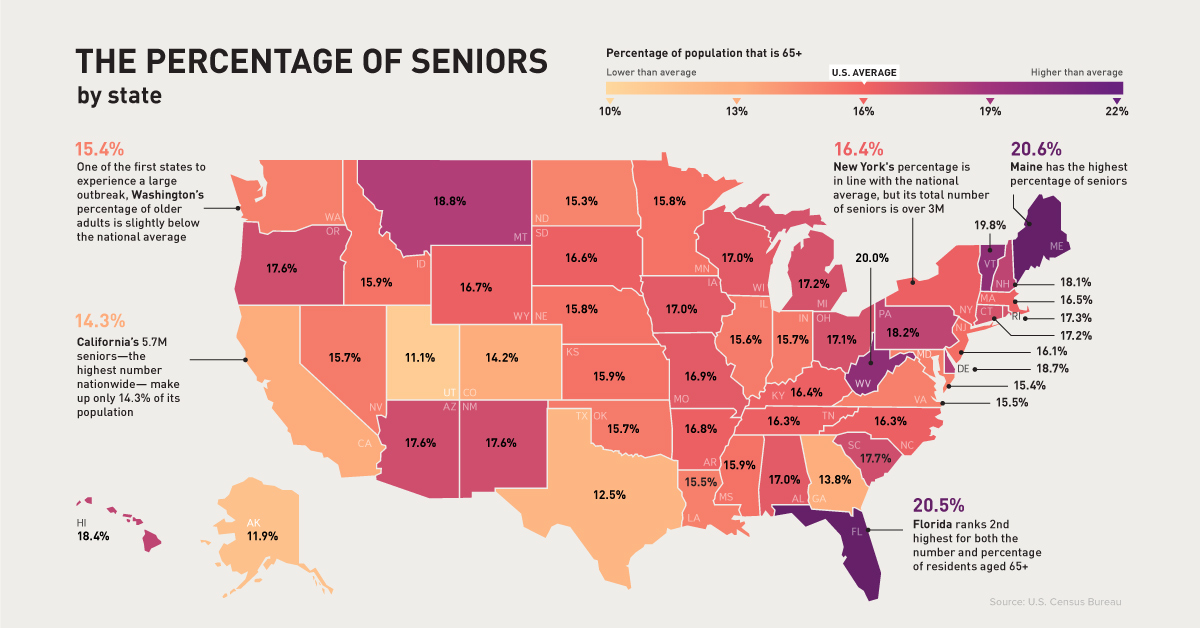
At Risk: The Geography of America’s Senior Population

At Risk: The Geography of America’s Senior Population

At Risk: The Geography of the U.S. Senior Population

U.S. Senior Population by State, Covid-19

senior population vs covid-19 outbreak


A D.C. protest without people: Activists demand PPE for health care workers on front line of coronavirus pandemic

https://www.washingtonpost.com/local/a-dc-protest-without-people-activists-demand-ppe-for-health-care-workers-on-front-line-of-coronavirus-pandemic/2020/04/17/e4a915b4-80d6-11ea-a3ee-13e1ae0a3571_story.html?fbclid=IwAR25nXMi24JerZwm0uFL47exQtEkyWEPh5-tFp1eFO2O4zfzUmdltOfpd3A&utm_campaign=wp_main&utm_medium=social&utm_source=facebook


Activists in D.C. demand PPE for healthcare workers on frontline ...

Spaced six feet apart on the West Lawn of the Capitol, the faces of front-line health-care workers looked out over the nation’s capital. Some wore masks. Others held signs imploring lawmakers for more personal protective equipment.

But these workers were not there in the flesh. Friday’s protest was peopleless.

With mandatory social distancing guidelines and stay-at-home orders in effect throughout the region, and given the grueling demands of their jobs as the deadly coronavirus continues to spread, it would have been nearly impossible to assemble 1,000 health-care workers outside Congress this week.

Instead, volunteers put up 1,000 signs to stand on the lawn in their absence.

Activists who are used to relying on people power to amplify messages and picket lawmakers have been forced to use alternative protest tactics amid the pandemic.

Half a dozen volunteers with liberal activist group MoveOn pressed lawn signs into the grass outside the Capitol as the sun peaked over the Statue of Freedom.

On each sign was a message.

Some, bearing the blue Star of Life seen on the uniforms of doctors, first responders and emergency medical technicians, reiterated a hashtag that has made the rounds on social media for weeks, accompanying posts from desperate front-line workers who say they are running out of necessary protective equipment: #GetUsPPE.

Others showed photos of medical workers in scrubs and hair nets and baseball caps. Some wore face shields and plastic visors. Others donned gloves.

One barefaced doctor in a white lab coat held up a hand-drawn sign. “Trump,” it said. “Where’s my mask?”

Health-care providers in hospitals, clinics, nursing homes, assisted-living facilities and rehabilitation centers have for weeks begged for more PPE to protect themselves and their vulnerable patients.

States and hospitals have been running out of supplies and struggling to find more. The national stockpile is nearly out of N95 respirator masks, face shields, gowns and other critical equipment, the Department of Health and Human Services announced last week.

“Health-care workers are on the front lines of this crisis, and they’re risking their lives to save ours every day, and our government, from the very top of this administration on down, has not used the full force of what they have with the Defense Production Act to ensure [workers] have the PPE they need and deserve,” said Rahna Epting, the executive director of MoveOn. “We wanted to show that these are real people who are demanding that this government protect them.”

Unlike protests that have erupted from Michigan to Ohio to Virginia demanding that states flout social distancing practices and reopen the economy immediately, organizers with MoveOn said they wanted to adhere to health guidelines that instruct people not to gather in large groups.

“Normally, we’d want everyone down here,” said MoveOn volunteer Robby Diesu, 32, as he looked out over the rows of signs. “We wanted to find a way to show the breadth of this problem without putting anyone in harm’s way.”

A large white sign propped at the back of the display announced in bold letters: “Social distancing in effect. Please do not congregate.”

The volunteers who put up the signs live in the same house and have been quarantining under the same roof for weeks. Still, as they worked, several wore masks over their face to protect passersby — even though there were few.

A handful of joggers stopped to take pictures as the sun rose.

One man, who spoke on the condition of anonymity because he is a government employee, said he supported the idea.

“I’m so used to seeing protests out here by the Capitol that it really is bizarre to see how empty it is,” he said. “But this is really impressive to me.”

By sharing images and video on social media of front-line workers telling their stories, MoveOn organizers said they hope to galvanize people in the same way as a traditional rally with a lineup of speakers.

Activists planned to deliver a petition to Sen. Chris Murphy (D-Conn.) with more than 2 million signatures urging Congress to require the delivery of more PPE to front-line workers. Murphy has been a vocal critic of the Trump administration’s coronavirus task force and its reliance on private companies to deliver an adequate amount of critical gear, such as N95 respirator masks, medical gowns, gloves and face shields, to health-care workers.

“In this critical hour, FEMA should make organized, data-informed decisions about where, when, and in what quantities supplies should be delivered to states — not defer to the private sector to allow them to profit off this pandemic,” the senator wrote last week in a letter to Vice President Pence, co-signed by 44 Democratic and two independent senators.

Organizers said the signs would remain on the Capitol lawn all day, but that the demonstration was only the beginning of a spate of atypical ones the group expects to launch this month.

Epting described activists’ energy as “more intense” than usual as the pandemic drags on.

“The energy is very high, the intensity is very high,” she said. “That’s forcing us to be creative and ingenuitive in order to figure out how to protest in a social distancing posture and keep one another safe at the same time.”