From Nonprofit Blues to Wall Street Blues: Elevance’s Stock Points Down

Elevance, which owns Blue Cross plans, is now reeling from Wall Street losses thanks to its Medicare Advantage business.

The company now known as Elevance, which owns Blue Cross plans in 14 states, took a drubbing on Wall Street yesterday after executives told shareholders that it had to pay out way more in medical claims during the second quarter than expected, especially in its Medicare Advantage business. As a reminder, Wall Street hates to hear such news, so much so that investors rushed to sell their shares in the company, sending the stock price to $296.39 – a 52-week low – before closing at $302.45 yesterday afternoon. That’s down 47% from the all-time high of $567.36 it reached last September.

The news was so distressing for people who still have investments in for-profit health insurers that many of them finally bailed, getting the message that the entire sector is likely not the best place to make money these daysAll seven of the companies (Centene, Cigna, CVS/Aetna, Elevance, Humana, Molina and UnitedHealth) saw big drops in their stock price with two others (Centene and Molina) also falling to 52-week lows. The companies’ stock is continuing to tank today as I write this.

When Denial Becomes a Liability

UnitedHealth has historically been the first of the companies to release quarterly earnings, but it stepped back as leader of the pack this quarter after that giant’s recent troubles on Wall Street. UnitedHealth missed financial analysts’ profit expectations last quarter and withdrew its profit guidance for the year, an unprecedented move for that company, which terrified its shareholders. UnitedHealth’s stock price has lost nearly 55% of its value since reaching a high of $630.73 last November.

Like UnitedHealth, Elevance had been a Wall Street darling until a business practice common in the health insurance game – refusing to pay for patients’ medically necessary care – finally caught up with it.

I’m talking about prior authorization, the benign sounding term that covers a number of ways a health insurer banks money by saying no to a doctor’s plea to cover a patient’s treatment or medications. The fundamental problem is that by refusing to pay for care a patient needs, that patient likely will get sicker and wind up needing even more expensive care down the road. Insurance company beancounters know that can happen, but they also know there is a decent chance that that potentially high-cost patients will not even be enrolled in one of the company’s health plans when the day finally arrives that they have to go to the hospital, which, of course, might have been avoided if the initial treatment had been approved in the first place.

We’re not just talking about a stay in the hospital. One permutation of prior auth is called step therapy in which an insurer demands that a patient try other medications on the insurer’s list of preferred drugs (its “formulary”) before approving the drug a doctor believes will work best. Sometimes it’s called “fail first.” In other words, a patient must endure pain and suffering for weeks or months taking an ineffective drug on an insurer’s formulary – the price of which the insurer has negotiated to its financial advantage with a drug maker – before the insurer will agree to cover the medication the doctor believes will be more effective. The doctor will then have to persuade the insurer that the insurer’s preferred drug failed. We’ll dive deeper into that insurer-induced nightmare in a future post, but know for now that it is a big and expensive time-suck that doctors have to endure while insurers can keep unused premium dollars in their investment accounts.

The Conversion That Changed Everything

But let’s go back to Elevance, which until recently was called Anthem and before that WellPoint. Many of its subsidiaries still use the term Anthem in its branding, like the biggest under its corporate umbrella, Anthem Blue Cross of California. All of those Blues plans operated on a nonprofit basis until a savvy executive named Leonard Schaeffer, who was CEO of Anthem of California back when it was still a nonprofit, pulled off a deal that would put him on the path to considerable fame and fortune, a first-of-its-kind “conversion” that would prove to be a major reason why the U.S. has the most complex, expensive and inefficient health care system on the planet.

According to his official bio on the website of the Leonard D. Schaffer Fellows in Government Service, which is affiliated with some of the country’s most prestigious universities, Schaeffer was recruited as CEO of Blue Cross of California in 1986 when, we are told, it was near bankruptcy. We’re also told that Schaeffer “managed the turnaround of Blue Cross of California and the IPO (initial public offering, i.e., converting it to for-profit status) creating WellPoint in 1993. During his tenure, WellPoint made 17 acquisitions and endowed four charitable foundations with assets of over $6 billion. Under Schaeffer’s leadership, WellPoint’s value grew from $11 million to over $49 billion.”

One might think from reading that last sentence that Schaeffer himself wrote big personal checks to endow those foundations, but establishing those nonprofit foundations (which includes the California Endowment, the California Health Care Foundation and the California Wellness Foundation) was demanded by California regulators as a condition of their approval of the IPO. The money was referred to as a conversion fund (converting from nonprofit to for-profit status), and it came from the proceeds of the IPO.

But Schaffer did indeed make a ton of money from the deal and WellPoint’s subsequent acquisition by a rival company that also owned recently converted Blues plans, Anthem, in 2004.

One of the organizations that opposed the WellPoint-Anthem deal, Consumer Watchdog, wrote at the time that:

Payments to WellPoint executives after the company’s buyout by Anthem Inc. could top $600 million if regulators and shareholders do not modify the acquisition terms, according to documents received from California regulators by the Foundation for Taxpayer and Consumer rights under a Public Records Act Request late Tuesday.

The documents detail potential payments in excess of those estimated by the company to shareholders at $200 million in a recent proxy. Executives will receive cash bonuses worth between $146 million and $365 million under the proposed terms of the company buyout by Anthem, in addition to over $251 million in stock options. WellPoint CEO Leonard Schaeffer has already begun exercising his stock options as of June 1st at sweetheart prices – earning him $16 million on that one day alone and increasing the size of his shares by hundreds of thousands.

When we look back at the history of health insurance in this country, we can thank this one man for the rapid shifting of Americans out of what historically had been nonprofit health insurance plans that initially were community-rated, meaning they charged everybody the same premium, regardless of gender, health status, occupation or address, and did not use gimmicks like prior authorization to boost profits. Being nonprofits, they couldn’t even book profits, although many of them did amass millions more in “reserves” than regulators required for solvency reasons.

I was working at Cigna when WellPoint joined the club of big for-profit insurers in 1993, along with Aetna, Humana (where I also previously worked), UnitedHealth, which was a relatively small player back then, and giant “multiline” insurers like MetLife, Prudential and Travelers. All of those last three decided to sell their health insurance operations to UnitedHealth and Aetna, putting those companies on the path to becoming the behemoths they are today.

And Schaeffer would wind up being one of America’s richest men, and, to his credit, he has been personally philanthropic. We know that because his name shows up all over the place in U.S. health care think-tank world. Indeed, his name is now associated far more with groups and institutions engaged in public policy than the “platinum parachute,” to use Consumer Watchdog’s term, he got when he and a few colleagues engineered the sale of WellPoint to Anthem. As his bio notes:

In 2009, Schaeffer established the Schaeffer Center for Health Policy and Economics at the University of Southern California, which emphasizes the interdisciplinary approach to research and analysis to support evidence-based health policy. In 2015, he established the Schaeffer Fellows in Government Service program which has supported 418 undergraduates to date in high-level, summer government internships. In 2004, he established the Schaeffer Institute for Public Policy & Government Service. He has also endowed chairs in health care financing and policy at the Brookings Institution, Harvard Medical School, the National Academy of Medicine, UC Berkeley and USC.

If Schaeffer still owns shares in Elevance, he is a bit poorer today than he was yesterday morning, but he’s probably still doing OK. Shares of Elevance’s stock have increased 1731% in value since they started trading on the New York Stock Exchange in October 2001, even with the company’s very bad Thursday on the Street.

The Fox Guards the Hen House – Translating AHIP’s Commitments to Streamlining Prior Authorization

We urge the Administration to consider the timing of these policies in the context of the broader scope of requirements and challenges facing the industry that require significant system changes.”

  • AHIP, March 13, 2023 (in a letter to CMS Administrator Chiquita Brooks-LaSure responding to CMS’s proposed rule on Advancing Interoperability and Improving Prior Authorization Processes, proposed Final Rule, CMS-0057-P)

“Health insurance plans today announced a series of commitments to streamline, simplify and reduce prior authorization – a critical safeguard to ensure their members’ care is safe, effective, evidence-based and affordable.”

  • AHIP, June 23, 2025 (press release announcing voluntary prior authorization reforms)

What a difference two years make.

After lobbying aggressively to delay implementation of the PA reforms proposed by the previous administration (successfully delayed one year and counting), AHIP, the big PR and lobbying group for health insurers, now claims the mantle of reformer, announcing a set of voluntary commitments to streamline prior authorization.

So naturally, the industry’s “commitments” deserve closer scrutiny. Let’s unpack them. As a former health insurance industry executive, I speak their language, so allow me to translate. AHIP, which has no enforcement power, by the way, claims that 48 large insurers will:

  1. Develop and implement standards for electronic prior authorization using Fast Healthcare Interoperability Resources Application Programming Interfaces (FHIR APIs).Translation: CMS is already requiring all insurers to do this by 2027. We might as well take credit preemptively.
  2. Reduce the volume of in-network medical authorizations. Translation: We already demand hundreds of millions of unnecessary prior authorizations for thousands of procedures and services, so cutting a few (who knows how many?) should be a layup and won’t cut into profits.
  3. Enhance continuity of care when patients change health plans by honoring a PA decision for a 90-day transition period starting in 2026.Translation: We’re already required to do this in Medicare Advantage. And since we delayed implementation of e-authorization until 2027, we’re in the clear until then anyway.
  4. Improve communications by providing members with clear explanations for authorization determinations and support for appeals. Translation: We’re already required by state and federal law to do this. We’ll double-check our materials.
  5. Ensure 80% of prior authorizations are processed in real time and expand new API standards to all lines of business. Translation: We had to promise to hold ourselves accountable to at least one measurable goal. We will set the denominator – we’ll decide which procedures and medications require PA – so we’ll hit this goal, no problem, and we might even use more non-human AI algorithms to do it.
  6. 6. Ensuring medical review of non-approved requests. Translation: People will be relieved we’re not using robots. And we’ll avoid having Congress insist that reviews must be done by a same-specialty physician, as proposed in the Reducing Medically Unnecessary Delays in Care Act of 2025 (H.R. 2433).

Of course, I wasn’t in the room when AHIP drafted these commitments, so take my translations with a grain of salt. But let’s be honest: These promises are thin on specifics, short on accountability, and devoid of measurable impact.

They also follow a familiar script, blaming physicians for cost escalation by “deviating from evidence-based care” and the “latest research”, while positioning PA as a necessary safeguard to protect patients from “unsafe or inappropriate care.” And largely ignoring how PA routinely delays necessary treatment and harms patients.

It’s also rich coming from an industry still reliant on something called the X12 transaction standard – technology that is now over 40 years old – to process prior authorization requests, while simultaneously pointing the finger at providers for outdated technology and being slow to adopt modern systems. Many insurers did not start accepting electronic submissions of prior authorization until roughly 2019, nearly 20 years after clinicians started using online portals such as MyChart in their regular practice. The claim that providers are the ones behind on technology is another ploy by insurers to dodge scrutiny for their schemes.

We shouldn’t settle for incremental fixes when the system itself is the problem. Nor should we allow the industry that created this problem – and perpetuates it in its own self-interest – to dictate the pace or terms of reforming it.

As we argued in our recent piece, Congress should act to significantly curtail the use of prior authorization, limiting it to a narrow, evidence-based set of high-risk use cases. Insurers should also be required to rapidly adopt smarter, lower-friction cost-control methods, like gold-carding trusted clinicians (if it can be implemented with integrity and fairness), without compromising patient access or clinical autonomy.

Letting the fox design the hen house’s security perimeter won’t protect the hens. It’s time for Congress to build a better fence.

BIG INSURANCE 2022: Revenues reached $1.25 trillion thanks to sucking billions out of the pharmacy supply chain – and taxpayers’ pockets

HIGHLIGHTS

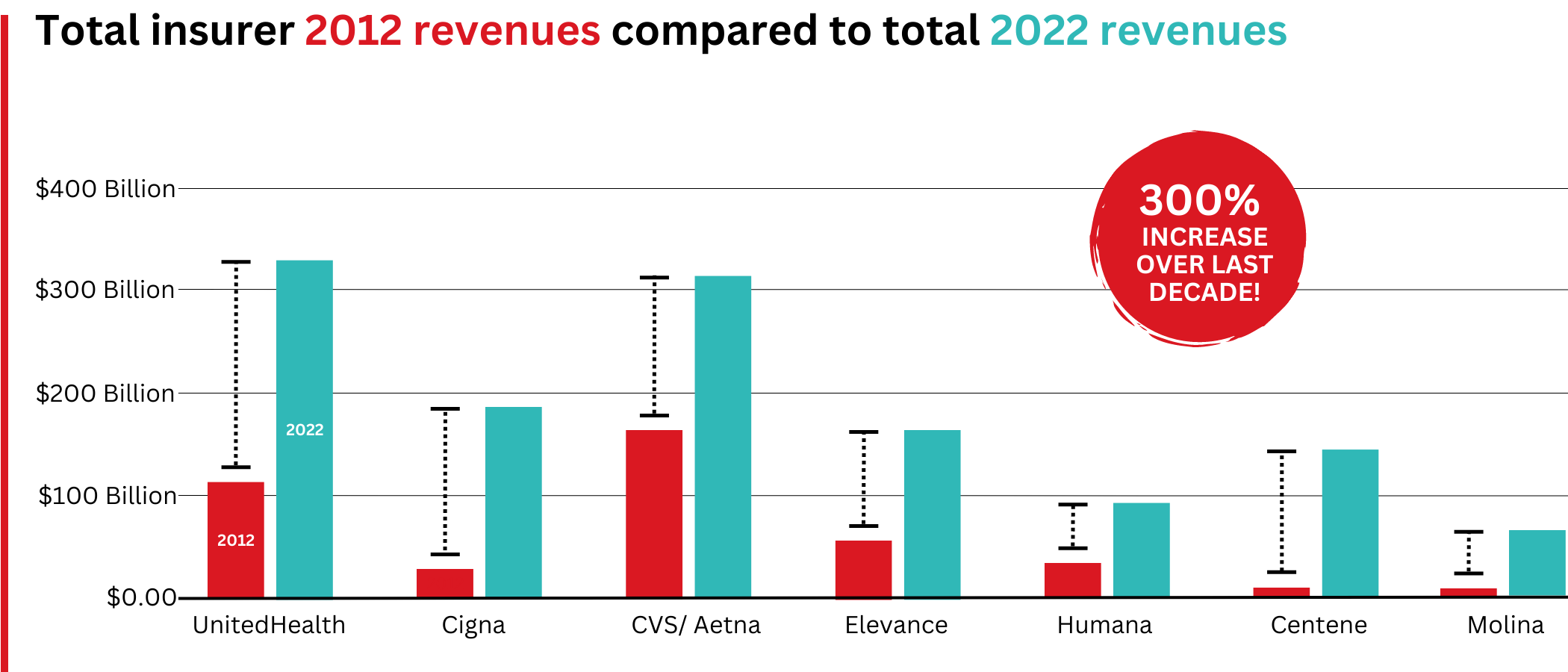
  • Big Insurance revenues and profits have increased by 300% and 287% respectively since 2012 due to explosive growth in the companies’ pharmacy benefit management (PBM) businesses and the Medicare replacement plans they call Medicare Advantage.
  • The for-profits now control more than 80% of the national PBM market and more than 70% of the Medicare Advantage market

In 2022, Big Insurance revenues reached $1.25 trillion and profits soared to $69.3 billion.

That’s a 300% increase in revenue and a 287% increase in profits from 2012, when revenue was $412.9 billion and profits were $24 billion.

Big insurers’ revenues have grown dramatically over the past decade, the result of consolidation in the PBM business and taxpayer-supported Medicare and Medicaid programs. 

Sucking billions out of the pharmacy supply chain – and taxpayers’ pockets

What has changed dramatically over the decade is that the big insurers are now getting far more of their revenues from the pharmaceutical supply chain and from taxpayers as they have moved aggressively into government programs. This is especially true of Humana, Centene, and Molina, which now get, respectively, 85%, 88%, and 94% of their health-plan revenues from government programs. 

The two biggest drivers are their fast-growing pharmacy benefit managers (PBMs), the relatively new and little-known middleman between patients and pharmaceutical drug manufacturers, and the privately owned and operated Medicare replacement plans they market as Medicare Advantage.

With the exception of Humana, Centene, and Molina, most of the companies that constitute Big Insurance continue to make substantial amounts of money selling policies and services in what they refer to as their commercial businesses – to individuals, families, and employers – but the seven companies’ commercial revenue grew just 260%, or $176 billion, over 10 years (from $110.4 billion to $287.1 billion). While that’s significant, profitable growth in the commercial sector has become a major challenge for big insurers – so much so that Humana just last week announced it is exiting the employer-sponsored health-insurance marketplace entirely. 

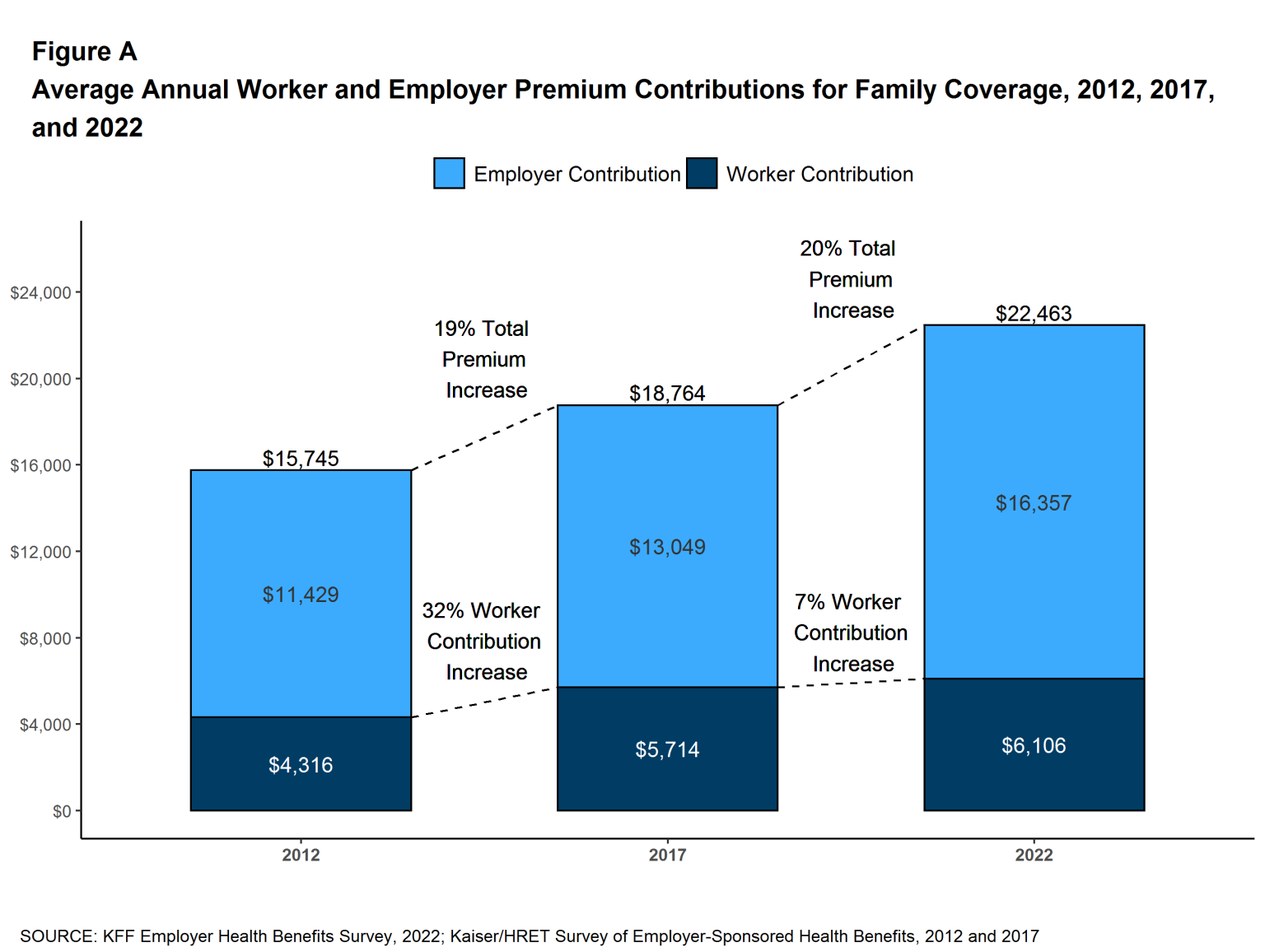
The insurers’ commercial businesses have stagnated because small businesses – which employ nearly half of the nation’s workers – are increasingly being priced out of the health insurance market. Most small businesses can no longer afford the premiums. The average premium for an employer-sponsored family plan – not including out-of-pocket requirements – was $22,463 in 2022, up 43% since 2012, which has contributed to the decades-long decline in the percentage of U.S. employers offering coverage to their workers.

The percentage of U.S. employers providing some level of health benefits to their workers dropped from 69% to 51% between 1999 and 2022 – including a dramatic 8% decrease last year alone. Growth in this category is largely the result of insurers “stealing market share” from each other or from smaller competitors.

As a consequence of this segment’s relative stagnation, PBMs and government programs have become the new cash cows for Big Insurance.

Spectacular PBM Growth

PBM HIGHLIGHTS

  • Cigna now gets far more revenue from its PBM than from its health plans. CVS gets more revenue from its PBM than from either Aetna’s health plans or its nearly 10,000 retail stores. 
  • UnitedHealth has the biggest share of both the PBM and Medicare markets and, through numerous acquisitions of physician practices, is now the largest U.S. employer of doctors.

PBMs are middlemen companies that manage prescription drug benefits for health insurers, Medicare Part D drug plans, employers, and, in some cases, unions. As the Commonwealth Fund has noted

PBMs have a significant behind-the-scenes impact in determining total drug costs for insurers, shaping patients’ access to medications, and determining how much pharmacies are paid. 

The Commonwealth Fund went on to say that PBMs have faced growing scrutiny about their role in rising prescription drug costs and spending. A big reason for the scrutiny – by Congress, state lawmakers and now also by the FTC – is that the biggest PBMs are now owned by Big Insurance.

Through mergers and acquisitions in recent years, three of the seven for-profit insurers – Cigna, CVS/Aetna, and UnitedHealth – now control 80% of the U.S. pharmacy benefits market.

They determine which drugs will be listed in each of their formularies (lists of drugs they will “cover” based on secret deals they negotiate with pharmaceutical companies) and how much patients will have to pay out of their own pockets at the pharmacy counter – in many cases hundreds or thousands of dollars – before their coverage kicks in. The PBMs also “steer” health-plan enrollees to their preferred or owned pharmacies (and, increasingly, away from independent pharmacists), thereby capturing even more of what we spend on our prescription medications.

Cigna, CVS/Aetna, and UnitedHealth now control 80% of the U.S. PBM market. Correction: this graph was initially published with inaccurate numbers. The source for this information can be found here.

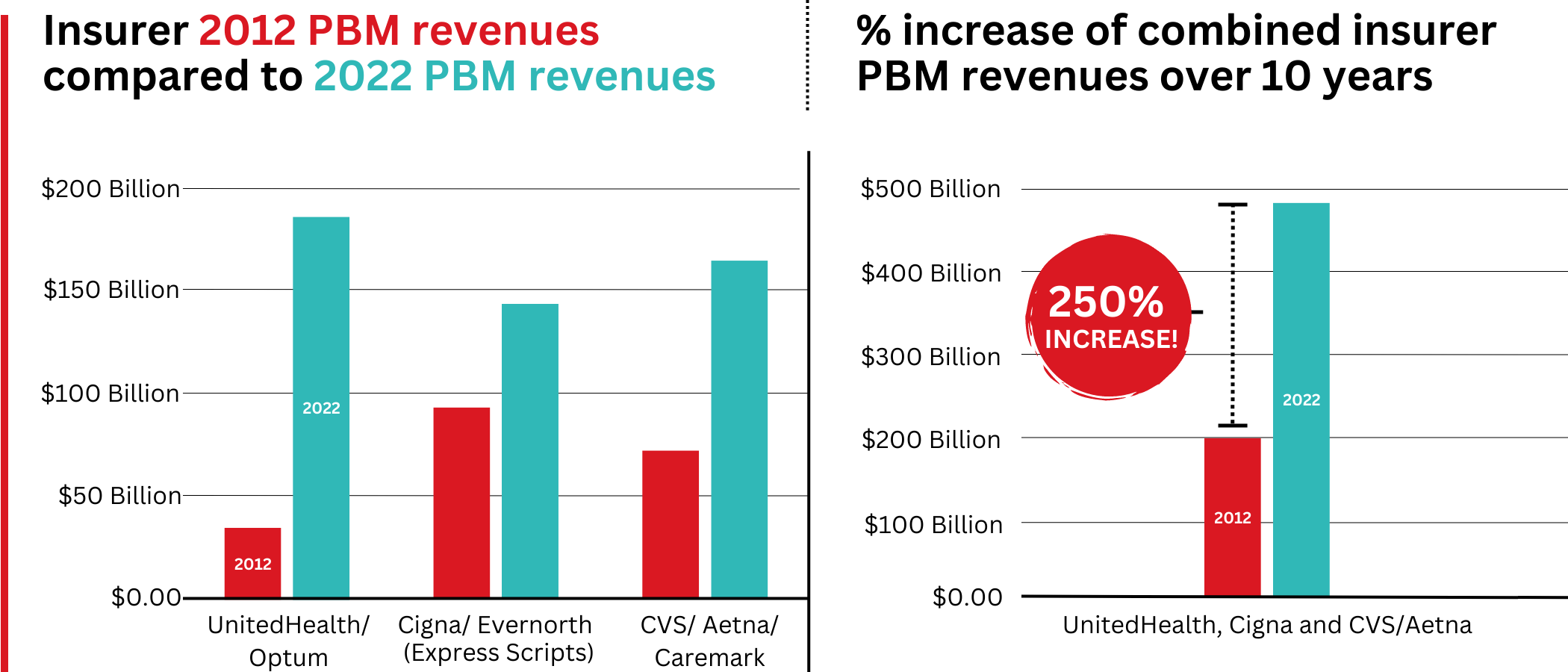
Ten years ago, PBMs contributed relatively little to the three companies’ revenues and profits. But since then, the rapid growth of PBMs has transformed all of the companies. The combined revenues from their PBM business units increased 250% between 2012 and 2022, from $196.7 billion to $492.4 billion.

Changes in PBM revenues between 2012 and 2022 for UnitedHealth Group, Cigna, and CVS/Aetna (Editor’s note: Cigna acquired PBM Express Scripts in 2018. To reflect revenue growth, Express Scripts’ pre-acquisition 2012 revenues are included in the Cigna total for that year.)

PBM Profit Generation

The PBM profit growth at the three companies over the past decade was even more dramatic than revenue growth. Collectively, their PBM profits increased 438%, from $6.3 billion in 2012 to $27.6 billion in 2022.

As a result of this fast growth, more than half (52%) of three companies’ profits in 2022 came from their PBM business units: Cigna’s Evernorth, CVS/Aetna’s Caremark, and UnitedHealth’s Optum. Cigna now gets far more revenue and profits from its PBM than from its health plans. And CVS gets more revenue from its PBM than from either Aetna’s health plans or its nearly 10,000 retail stores. (The companies’ business units that include their PBMs have also moved aggressively in recent years into health-care delivery through acquisitions of physician practices, clinics, dialysis centers, and other facilities. Notably, UnitedHealth Group is now the largest U.S. employer of physicians.)

Huge strides in privatizing both Medicare and Medicaid

GOVERNMENT PROGRAMS HIGHLIGHTS

  • More than 90% of health-plan revenues at three of the companies come from government programs as they continue to privatize both Medicare and Medicaid, through Medicare Advantage in particular.
  • Enrollment in government-funded programs increased by 261% in 10 years; by contrast commercial enrollment increased by just 10% over the past decade.
  • Commercial enrollment actually declined at both UnitedHealth and Humana.
  • 85% of Humana’s health-plan members are in government-funded programs; at Centene, it is 88%, and at Molina, it is 94%. 

The big insurers now manage most states’ Medicaid programs – and make billions of dollars for shareholders doing so – but most of the insurers have found that selling their privately operated Medicare replacement plans is even more financially rewarding for their shareholders.

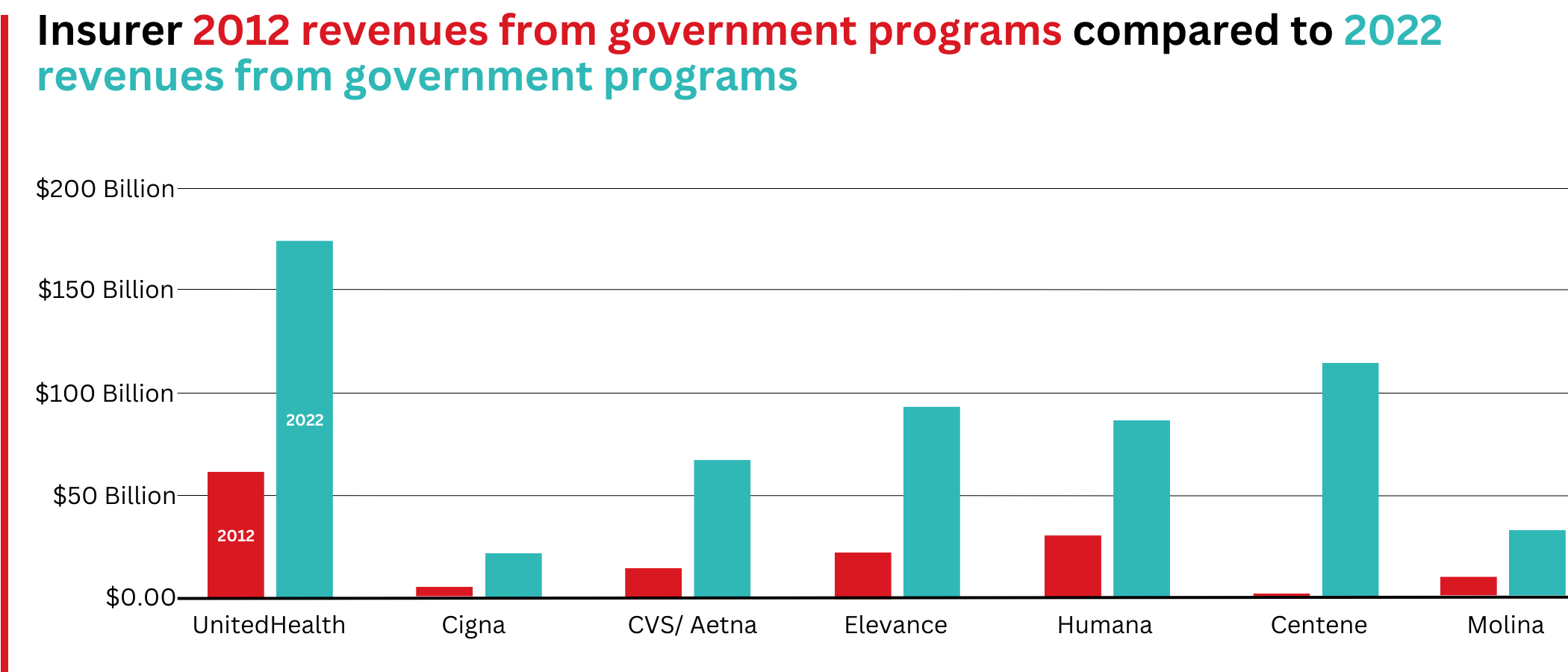
Revenue growth from government programs has been dramatic over the past 10 years. (Note the numbers do not include revenue from the Medicare Part D program, federal subsidy payments for many ACA marketplace plan enrollees, or Medicare supplement policies.)

This is especially apparent when you see that the Big Seven’s combined revenues from taxpayer-supported programs grew 500%, from $116.3 billion in 2012 to $577 billion in 2022.

These numbers should be of interest to the Biden administration and members of Congress, many of whom are calling for much greater scrutiny of the Medicare Advantage program. Numerous media and government reports have shown that the federal government is overpaying private insurers billions of dollars a year, largely because of loopholes in laws and regulations that enable them to get more taxpayer dollars by claiming their enrollees are sicker than they really are. The companies also make aggressive use of prior authorization, largely unknown in traditional Medicare, to avoid paying for doctor-ordered care and medications.

In addition to their focus on Medicare and Medicaid, the companies also profit from the generous subsidies the government pays insurers to reduce the premiums they charge individuals and families who do not qualify for either Medicare or Medicaid or who work for an employer that does not offer subsidized coverage. But many people enrolled in those types of plans – primarily through the health insurance “marketplaces” established by the Affordable Care Act – cannot afford the deductibles and other out-of-pocket requirements they must pay before their insurers will begin paying their medical claims. 

Dramatic Enrollment Shifts

Changes in health-plan enrollment over the past decade show how dramatic this shift has been. Between 2012 and 2022, enrollment in the companies’ private commercial plans increased by 10%, from 85.1 million in 2012 to 93.8 million in 2022. 

By comparison, growth in enrollment in taxpayer-supported government programs increased 261%, from 27 million in 2012 to 70.4 million in 2022. 

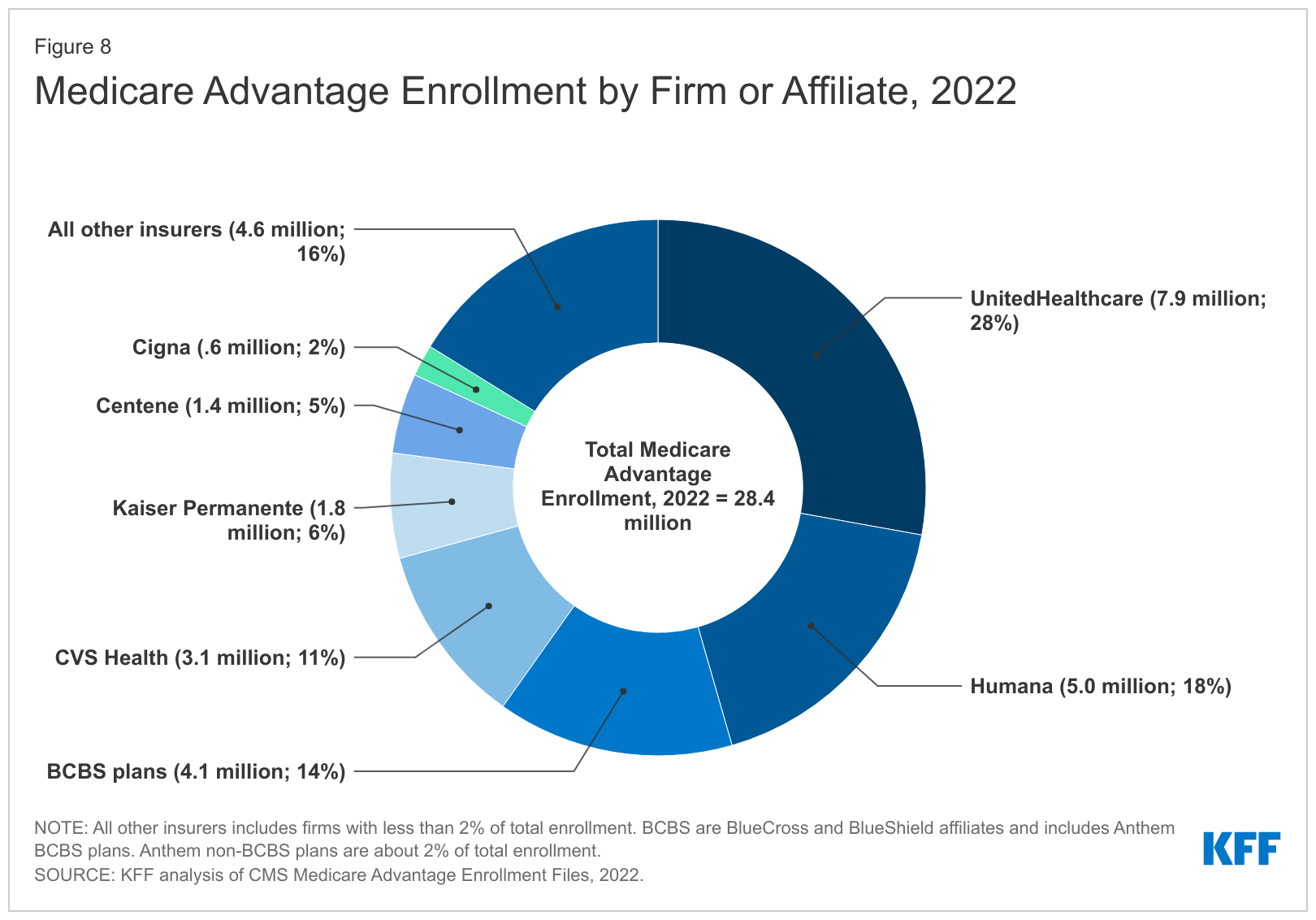
For-profit insurers dominate the Medicare Advantage market. Note that Anthem mentioned above is now known as Elevance. It owns 14 of the country’s Blue Cross Blue Shield plans. 

Within that category, Medicare Advantage enrollment among the Big Seven increased 252%, from 7.8 million in 2012 to 19.7 million in 2022. 

Nationwide, enrollment in Medicare Advantage plans increased to 28.4 million in 2022 (and to 30 million this year). That means that the Big Seven for-profit companies control more than 70% of the Medicare Advantage market. 

UnitedHealth, Humana, Elevance, and CVS/Aetna have captured most of the Medicare Advantage market since the Affordable Care Act was passed in 2010. 

The remaining growth in the government segment occurred in the Medicaid programs that a subset of the Big Seven (UnitedHealth, Elevance, Centene, and Molina in particular) manages for several states.

A few other facts and figures to keep in mind as Big Insurance thrives:

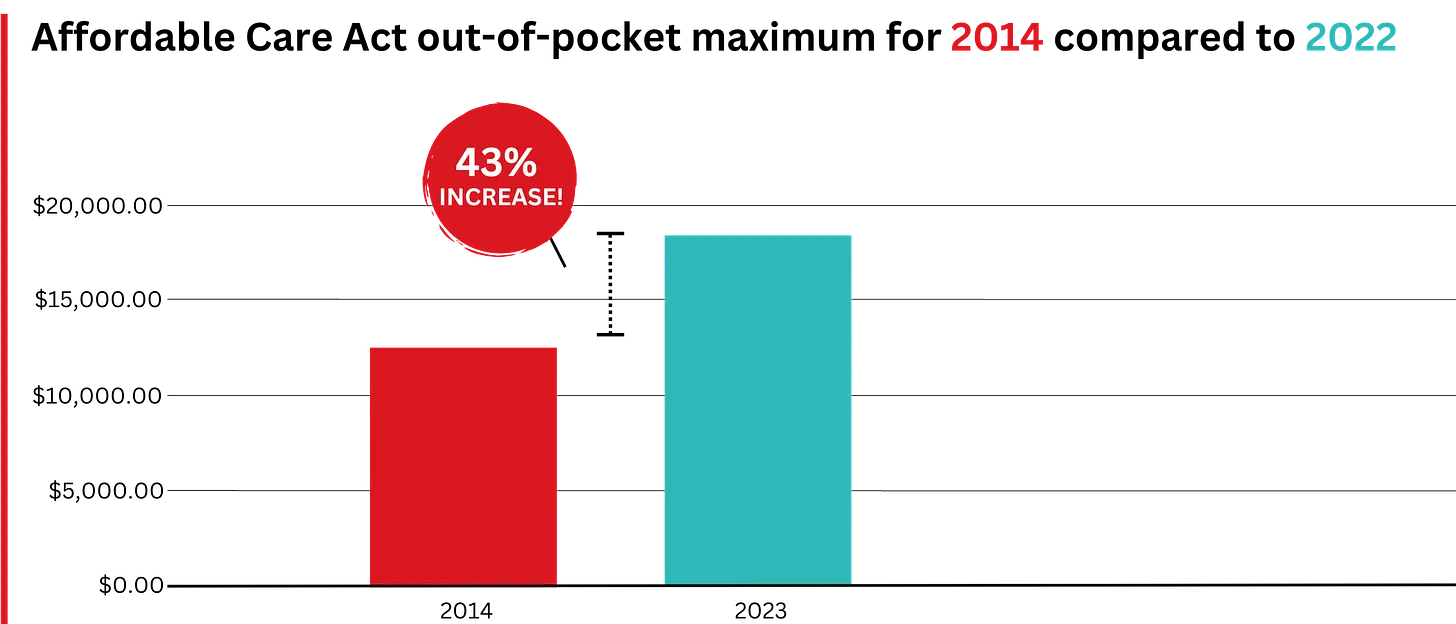
  • In 2023, U.S. families can be on the hook for up to $18,200 in out-of-pocket requirements before their coverage kicks in, up 43% since 2014 when it was $12,700.The Affordable Care Act allows the out-of-pocket maximum to increase annually – 43% since the maximum limit went into effect in 2014.
  • 44% of people in the United States who purchased coverage through the individual market and (ACA) marketplaces were underinsured or functionally uninsured.
  • 46% of those surveyed said they had skipped or delayed care because of the cost.
  • 42% said they had problems paying medical bills or were paying off medical debt.
  • Half (49%) said they would be unable to pay an unexpected medical bill within 30 days, including 68% of adults with low income, 69% of Black adults, and 63% of Latino/Hispanic adults. 
  • In 2021, about $650 million, or about one-third of all funds raised by GoFundMe, went to medical campaigns. That’s not surprising when you realize that in the United States, even people with insurance all too often feel they have no choice but to beg for money from strangers to get the care they or a loved one needs. 
  • 62% of bankruptcies are related to medical costs
  • Even as we spend about $4.5 trillion on health care a year, Americans are now dying younger than people in other wealthy countries. Life expectancy in the United States actually decreased by 2.8 years between 2014 and 2021, erasing all gains since 1996, according to the Centers for Disease Control and Prevention

BOTTOM LINE: 

The companies that comprise Big Insurance are vastly different from what they were just 10 years ago, but policymakers, regulators, employers, and the media have so far shown scant interest in putting their business practices under the microscope.

Changes in federal law, including the Medicare Modernization Act of 2003, which created the lucrative Medicare Advantage market, and the Affordable Care Act of 2010, which gave insurers the green light to increase out-of-pocket requirements annually and restrict access to care in other ways, opened the Treasury and Medicare Trust Fund to Big Insurance. In addition, regulators have allowed almost all of their proposed acquisitions to go forward, which has created the behemoths they are today.

CVS/Health is now the 4th largest company on the Fortune 500 list of American companies. UnitedHealth Group is now No. 5 – and all the others are climbing toward the top 10. 

New Senate Report on Prior Authorization in Medicare Advantage Begs a Question: Can Big Insurance Ever Be Regulated Adequately to Ensure Patient Care?

Last week, the Senate Permanent Subcommittee on Investigations, led by Sen. Richard Blumenthal (D-Connecticut), released a Majority Staff Report on rampant prior authorization (PA) abuses in Medicare Advantage (MA).

The report offers unique insight into recent trends in the use of prior authorization by Medicare Advantage plans and the strategy and motives behind insurance corporations’ use of it. 

While the findings won’t surprise those who’ve been following health policy trends, it is immensely concerning that between 2019 and 2022, the prior authorization denial rate for post-acute care in UnitedHealth’s Medicare Advantage plans doubled.

The denial rate for long-term acute care hospitals in Humana’s Medicare Advantage plans increased by 54% from 2020 to 2022. During this time, UnitedHealth, CVS/Aetna, and Humana increased their use of artificial intelligence (AI) for prior authorization reviews, often resulting in increasing denial numbers and decreasing (or absent) review time by human beings.

The report recommends that the Centers for Medicare and Medicaid Services (CMS) collect additional data, conduct audits of prior authorization processes, and expand regulations on the use of technology in PA reviews. While these recommendations would be positive steps, the report’s findings call into question whether Big Insurance can ever be trusted or regulated enough to prevent abuse of patients through prior authorization and other mechanisms. 

This report provides an in-depth look at insurers’ motivations. Sadly, those motivations are not to “make sure a service or prescription is a clinically appropriate option,” as UnitedHealth claims, but to decrease the amount spent on medical care to increase the corporations’ profits.

The report noted that CVS, which owns Aetna, saved $660 million in 2018 by denying Medicare Advantage patients’ claims for treatment at inpatient facilities. Around the same time, CVS found in its testing of a model to “maximize approvals,” which would be a good thing for patients, that the model jeopardized profits because it would lead to more care being covered. In 2022, CVS “deprioritized” a plan to increase auto-approvals because of the lost “savings” from denying patient care. 

The report found that the motivation to increase profits, without regard for patient care, was not unique to CVS/Aetna.

UnitedHealth’s naviHealth subsidiary provided this directive to its employees: “IMPORTANT: Do NOT guide providers or give providers answers to the questions” when speaking to a patient’s doctor about a prior authorization request. Instead of working collaboratively with doctors to get patients the care they need, UnitedHealth told its workers not to bother. In a training session offered to Humana employees involved in prior authorization reviews, the company explained that reviewers should deny a request for post-acute care even if a patient needed more intensive treatment. Humana told reviewers that the lack of an in-network lower-level care facility for patients to go to was not a reason to approve post-acute care and that usually the situations can be “sorted out,” presumably by the patient with no help from the insurer.

All three companies (UnitedHealth, Humana and CVS/Aetna), which dominate the Medicare Advantage program,  demonstrated a striking lack of motivation to protect and enhance patient care, instead showing a primary motivation to increase profits and margins. 

The subcommittee’s report also noted that UnitedHealth, CVS/Aerna, and Humana are increasingly using AI to make care decisions and cutting humans, especially doctors, out of the process. The researchers found that in 2022, UnitedHealth looked into how using AI and machine learning could aid in predicting which denials of post-acute care requests were most likely to be overturned.  One would hope this effort would be to decrease the number of wrongfully denied prior authorization requests and increase patient access to care.

However, the report includes a quote from a recap of a meeting on the project asking “what we could do in the clinical review process to change the outcome of the appeal,” meaning that UnitedHealth was interested in preventing the overturning of denials, not getting the decision right in the first place. The report also found evidence that naviHealth used artificial intelligence to help determine the coverage decisions for a patient’s post-acute care claim before any human post-acute care providers evaluated a case. The report’s authors found that denials for post-acute care facilities rose rapidly once naviHealth began managing these requests for UnitedHealth’s MA plans. 

These are just some of the findings in the 54-page report on Big Insurance’s use of prior authorization to deny Medicare Advantage patient requests for post-acute care.

The report’s findings demonstrate the abuse of prior authorization by the insurers, the motivation to increase profit and decrease patient care, and the use of AI to increase denials. Further, the findings underscore that prior authorization is a tool used by Big Insurance primarily to maximize profits. The report puts forward recommendations to cut down on abusive denials, which would have some positive impact.

More importantly, I believe the report provides more evidence that it is becoming exceedingly less likely that private and for-profit insurance companies can be regulated and act in a way that promotes patient health over profits.

Medicaid and Medicare Claims Managed by Insurers Are Rising. Why Aren’t They Worried About Their Profits?

One of the things I’ve always found most fascinating about news coverage and policymaker attention to health insurers is how little focus is placed on what these companies say to their investors.

It’s no secret that each quarter, all public companies update their shareholders and provide guidance for the future. When I was at Cigna, preparing the CEO to speak with reporters and investor analysts was arguably considered the most important role I had every three months.

Mining insights from those earnings reports has been a focus of mine since I became an insurance industry whistleblower. Recently, for example, we’ve highlighted how CVS/Aetna, in particular, has taken a beating on its stock price for reporting increased spending on medical care by seniors in Medicare Advantage plans.

Now, though, CEOs have become even more public and open, beyond their quarterly earnings calls, about the challenges they are having extracting further profit from the Medicaid and Medicare programs. This should be noted, particularly by the bipartisan group of lawmakers in Washington increasingly eyeing regulatory reform on insurer practices like prior authorization, as evidence that insurers are going to become even more aggressive in limiting care to preserve their 2024 profits.

Centene’s CEO said a few days ago that medical claims are increasing in the company’s managed Medicaid business. UnitedHealth and Elevance, which owns several Blue Cross Blue Shield companies that have converted to for-profit status, also recently reported they’re seeing similar results. Combined with increased medical spending on Medicare Advantage claims, one might guess this would begin to worry investors that insurers would lower their profit forecasts.

But none of these companies have so far expressed concern about not meeting their 2024 profit expectations.

So, medical claims in Medicaid and Medicare Advantage plans – now the majority of the business for many of the largest insurers – are rising, but these companies aren’t expecting to disappoint Wall Street with a drop in profits. How is that possible?

Because insurers can deploy the tools to prevent patients from accessing care. And their playbook isn’t secret, or complicated.

By further increasing prior authorization in Medicaid and Medicare Advantage plans, insurers can limit how many seniors and low-income Americans follow through with legitimate care and procedures. (Here’s a recent congressional report on increased hurdles insurers have put in place to prevent children from receiving preventive care in Medicaid plans. And insurers’ increasing use of prior authorization in Medicare Advantage is something we’ve regularly covered.)

Unlike their marketplace and employer-based plans, insurers can’t negotiate reimbursement rates for Medicaid and Medicare Advantage plans that they manage.

But beyond prior authorization, they can put other layers of bureaucracy in place that increase how long it takes a provider to be reimbursed for providing care – and to make it more complicated for doctors to ensure they’re reimbursed fully for the care they provide.

In effect, these tactics can amount to decreasing the already industry-low rate of reimbursement for doctors from the Medicaid and Medicare Advantage programs. Physicians, you should expect to see more hurdles to reimbursement in these programs throughout the balance of 2024 as insurers look to hoard as much cash as they can.

In Medicare Advantage plans, insurers can pursue the industry jargon of a “benefit buydown” to further shift costs onto plan enrollees and off insurers themselves. Because the federal government pays insurers a flat amount per Medicare Advantage enrollee, regardless of how much health care spending each patient has, it is in the insurers’ financial interest to claim that seniors and disabled people enrolled in their plans are sicker than they really are.

Rising out-of-pocket costs that seniors and disabled people in Medicare Advantage plans are facing is a consequence of insurers wanting to squeeze further profits out of the program, and is a way to maintain direct government payments per enrollee within the insurers’ coffers.

Here are the Five Areas the New DOJ Task Force on Monopolies in Health Care Should Focus On

Abuses by payers are myriad, but these five areas could bear the most fruit for federal antitrust investigators.

Earlier this month, the U.S. Department of Justice announced it has haunched an investigation into “issues regarding payer-provider consolidation” along with other problems associated with mergers and acquisitions in health care. This is significant. For years Washington has trained its oversight authority on pharmaceutical manufacturers, private equity investments in health care and, more recently, pharmacy benefits managers controlled by big insurers. This has held bad actors like Martin Skhreli and Steward Healthcare accountable. But, it has also let insurers grow ever larger, under the radar. 

No longer. 

This task force will specifically evaluate the following, as an example: “A health insurance company buys several medical practices that compete with each other. It also prohibits its medical practices from contracting with rival health insurance companies.” The government will also dig into “anticompetitive uses of health care data,” “preventing transparency,” “price fixing,” and other areas that could drag nefarious activities of insurers into the spotlight. 

I applaud the Department of Justice’s continued focus on these issues, building on the Department’s action announced in February to begin an antitrust investigation into UnitedHealth Group. (If you haven’t read the piece we published in February on UnitedHealth’s self-dealing that helped lead DOJ to open that antitrust inquiry, you can do so here.) The following are a few areas of low-hanging fruit that I hope the task force will focus on as they consider the impact insurers’ ongoing vertical integration has had on the overall health care system.

1. Insurers purchasing physician practices

Once a low-profile issue, Congress and the Biden administration alike have increasingly turned their focus to insurance companies – often referred to as payers – that now own and operate physician practices and clinics – those being paid. Even for someone without a law degree, it is easy to see the conflict this creates, particularly at scale. 

There is the oft-cited statistic that UnitedHealth has said that through its Optum division, the company employs or otherwise controls about 10 percent of doctors in the U.S. – around 130,000 physicians and other practitioners in 16 states. This prompted me to take a closer look at publicly available information on the number of doctors employed by other insurers to get a better handle on how much control of physician practices payers now have. 

It is difficult to put a percentage on physicians employed by each insurer, but it is clear that the others are following UnitedHealth’s lead. CVS/Aetna purchased Signify Health in 2023adding 10,000 clinicians to its portfolio. The company says it supports “more than 40,000 physicians, pharmacists, nurses and nurse practitioners.” 

Clearly taking a page out of UnitedHealth’s playbook, Elevance (formerly Anthem), which owns Blue Cross Blue Shield plans in 14 states announced last month a “strategic partnership” with 900 providers across several states. Elevance did not disclose the terms of the deal except to say it, “will primarily be through a combination of cash and our equity interest in certain care delivery and enablement assets of Carelon Health.” 

As insurers have acquired physician practices, they also have created a rinse-and-repeat strategy associated with kicking physicians they don’t own out of network, and in some cases targeting those same practices for acquisition. Aetna and Humana recently told investors they will be reviewing their networks of physicians, signaling they’ll soon be further narrowing their networks. A good question for this task force: when insurers review those contracts with doctors, do they ever kick the doctors they employ out of network? (Doubtful.) This could specifically draw attention from the task force’s focus on “health care contract language and other practices that restrict competition,” such as contract provisions that require or encourage patients to seek care from doctors directly employed or closely controlled by patients’ insurers.

Additionally, UnitedHealth CEO Andrew Witty recently told analysts, “As I think you see some of the funding changes play out across the — across the next few years, I suspect that may also create new opportunities for us as different companies assess their positions.” My translation: UnitedHealth’s burdensome business practices and the way it shortchanges doctors (those “funding changes” he referenced) contribute to the financial distress that is forcing many health care providers to “assess their positions.”

As the task force continues to consider the impact of private equity in health care monopolies, transactions like this one should receive equal consideration for their lack of transparency and overall impact on market consolidation.

2. Co-mingling of middlemen

I have watched with interest for over the past year as both Democrats and Republicans in Washington increasingly trained their fire on pharmacy benefit managers. The natural next area of focus in that space, which this new task force could advance, should be around how the

three PBMs that control 80 percent of market share are all combined with health insurance companies – namely CVS/Aetna (Caremark), UnitedHealth (Optum Rx), and Cigna (Express Scripts). 

An important, and politically popular, area where this consolidation has played out is in the squeeze placed on small, independent pharmacists across the country. More than 300 community pharmacies have closed in the past year alone, out of an inability to operate or push back on unfair margins pushed by these PBM-insurer monopolies. As we have written here, the fees these PBMs charge have increased more than 100,000 percent over the past decade, and are quietly contributing significantly to the profits of the largest health insurers. 

We still have little insight into how these business lines interact with each other, and the ultimate impact that has on patients. Given the enormous influence just three insurance companies have over what prescriptions Americans can receive, and how much should be paid for each prescription, the task force would do well to focus on what insurers and PBMs are doing behind the scenes to maximize profits and limit patient access to prescription drugs. It’s already gaining traction on Capitol Hill, with one Congressman recently saying, “I’ll continue to bust this up … this vertical integration in health care.”

3. Prior authorization requests

CVS/Aetna shares were hammered after the company reported a significant increase in payment of Medicare Advantage claims during the first three month is of this year. Expect all insurers to notice. And as they have seen their forecasts fall short of Wall Street’s expectations – particularly because of increasing scrutiny in Washington of Medicare Advantage – these corporations will look to increase their already aggressive use of prior authorization to limit claims payments.

It is not as though insurers make seeking the care you need easy. Far from it. Prior authorization has become “medical injustice disguised as paperwork,” as the New York Times said in a recent, excellent video detailing the widespread nature of this profiteering practice. 

While not a stated direct focus of this task force, the increased impact of prior authorization in care delivery is a direct outgrowth of a few large health insurers effectively controlling the marketplace. As insurers directly employ more doctors and enroll more Americans in their plans, they can use prior authorization to increasingly determine whether a patient can get care, period. 

Scrutiny in this space could add momentum to increasing activity in state legislatures and Washington to rein in excessive prior authorization. As of early March, nine states and the District of Columbia had passed bills to limit how far insurers could go with prior authorization. And earlier this year, the Centers for Medicare and Medicaid released a final rule that is expected to save physicians $15 billion over the next decade by putting limits on insurer prior authorization tactics. 

4. Rising out-of-pocket costs

Regular readers of this newsletter know one of my crusades is to ensure folks who pay good money for health insurance – out of their paychecks or through their tax dollars – can use it when they need it. It was a big win earlier this year for the Lower Out of Pockets Now coalition (which I lead) when President Biden called for a cap on prescription drug out-of-pocket costs of $2,000 annually for everybody, not just Medicare beneficiaries. 

If there was true competition and real consumer choice in health insurance, payers wouldn’t be able to get away with increasingly shifting patients into high-deductible plans. But the fact that a few big players control the health insurance market has allowed the oligopoly of payers to do just that, with ever-rising deductibles alongside ever-rising premiums. 

The task force’s focus on price fixing, collusion, and transparency in health care costs will, I hope, include some focus on how insurers use their size and clout to drive up out-of-pocket costs and premiums simultaneously – with little recourse to employers or their employees.

5. Implementing crystal clear laws and rules in health care

You know you’re a monopoly or close to it when you can pretty much do whatever you want and get away with it. Look no further than America’s health insurance companies and implementation of the No Surprises Act. 

As I wrote earlier this year, Congress and CMS have been clear about how out-of-network hospital bills should be negotiated between insurers and physicians. Yet in case after case, including many that have become the basis of lawsuits, insurers are clearly flouting the Act passed by Congress and the rules promulgated by CMS. Payers are doing this, doctors have said, simply because of their size and ability to weather criticism from physicians, regulators, and the courts – while doctors struggle to pay their bills with significant payments still owed pending out-of-network negotiations with insurers. 

One would hope, at a minimum, this task force, focused on rooting out the ills of monopolies, would document how insurers are well aware of how they are supposed to implement legislation like the No Surprises Act, but flout it anyway.

As a Nightmare Brews on Wall Street for CVS, Executives Scramble to Quell Investors

wrote Monday about how the additional Medicare claims CVS/Aetna paid during the first three months of this year prompted a massive selloff of the company’s shares, sending the stock price to a 15-year low.

During CVS’s May 1 call with investors, CEO Karen Lynch and CFO Thomas Cowhey assured them the company had already begun taking action to avoid paying more for care in the future than Wall Street found acceptable.

Among the solutions they mentioned: 

Ratcheting up the process called prior authorization that results in delays and denials of coverage requests from physicians and hospitals; kicking doctors and hospitals out of its provider networks; hiking premiums; slashing benefits; and abandoning neighborhoods where the company can’t make as much money as investors demand.

On Tuesday at the Bank of America Securities Healthcare Conference, Cowhey doubled down on that commitment to shareholders and provided a little more color about what those actions would look like and how many human beings would be affected. As Modern Healthcare reported:

Headed into next year, Aetna may adjust benefits, tighten its prior authorization policies, reassess its provider networks and exit markets, CVS Chief Financial Officer Tom Cowhey told investors. It will also reevaluate vision, dental, flexible spending cards, fitness and transportation benefits, he said. Aetna is also working with its employer Medicare Advantage customers on how to appropriately price their business, he said. 

Could we lose up to 10% of our existing Medicare members next year? That’s entirely possible, and that’s OK because we need to get this business back on track,” Cowhey said.

Insurers use the word “members” to refer to people enrolled in their health plans. You can apply for “membership” and pay your dues (premiums), but insurers ultimately decide whether you can stay in their clubs. If they think you’re making too many trips to the club’s buffet or selecting the most expensive items, your membership can–and will–be revoked.

That mention of “employer Medicare Advantage customers” stood out to me and should be of concern to people like New York Mayor Eric Adams, who was sold on the promise that the city could save millions by forcing municipal retirees out of traditional Medicare and into an Aetna Medicare Advantage plan. A significant percentage of Aetna’s Medicare Advantage “membership” includes people who retired from employers that cut a deal with Aetna and other insurers to provide retirees with access to care. Despite ongoing protests from thousands of city retirees, Adams has pressed ahead with the forced migration of retirees to Aetna’s club. He and the city’s taxpayers will find out soon that Aetna will insist on renegotiating the deal.

Back to that 10%. Aetna now has about 4.2 million Medicare Advantage “members,” but it has decided that around 420,000 of those human beings must be cut loose. Keep in mind that those humans are not among the most Internet-savvy and knowledgeable of the bewildering world of health insurance. Many of them have physical and mental impairments. They will be cast to the other wolves in the Medicare Advantage business.

Welcome to a world in which Wall Street increasingly calls the shots and decides which health insurance clubs you can apply to and whether those clubs will allow you to get the tests, treatments and medications you need to see another sunrise.

As Modern Healthcare noted, Aetna is not alone in tightening the screws on its Medicare Advantage members and setting many of them adrift. Humana, which has also greatly disappointed Wall Street because of higher-than-expected health care “utilization,” told investors it would be taking the same actions as Aetna.

But Aetna in particular has a history of ruthlessly cutting ties with humans who become a drain on profits. As I wrote in Deadly Spin in 2010:

Aetna was so aggressive in getting rid of accounts it no longer wanted after a string of acquisitions in the 1990s that it shed 8 million (yes, 8 million) enrollees over the course of a few years. The Wall Street Journal reported in 2004 that Aetna had spent more than $20 million to install new technology that enabled it “to identify and dump unprofitable corporate accounts.” Aetna’s investors rewarded the company by running up the stock price. 

I added this later in the book:

One of my responsibilities at Cigna was to handle the communication of financial updates to the media, so I knew just how important it was for insurers not to disappoint investors with a rising MLR [medical loss ratio, the ratio of paid claims to revenues]. Even very profitable insurers can see sharp declines in their stock prices after admitting that they had failed to trim medical expenses as much as investors expected. Aetna’s stock price once fell more than 20% in a single day after executives disclosed that the company had spent slightly more on medical claims during the most recent quarter than in a previous period. The “sell alarm” was sounded when the company’s first quarter MLR increased to 79.4% from 77.9% the previous year.

I could always tell how busy my day was going to be when Cigna announced earnings by looking at the MLR numbers. If shareholders were disappointed, the stock price would almost certainly drop, and my phone would ring constantly with financial reporters wanting to know what went wrong.

May 1 was a deja-vu-all-over-again day for Aetna. You can be certain the company’s flacks had a terrible day–but not as terrible as the day coming soon for Aetna’s members when they try to use their membership cards.

Speaking of Lynch, one of the people commenting on the piece I wrote Monday suggested I might have been a bit too tough on Lynch, who I know and liked as a human being when we both worked at Cigna. The commenter wrote that:

After finishing Karen S. Lynch’s book, “Taking Up Space,” I came to the conclusion that she indeed has a very strong conscience and sense of responsibility, not totally to shareholders, but more importantly to the insured people under Aetna and the customers of CVS.”

I don’t doubt Karen Lynch is a good person, and I know she is someone whose rise to become arguably the business world’s most powerful woman was anything but easy, as the magazine for alumni of Boston College, her alma mater, noted in a profile of her last year. Quoting from a speech she delivered to CVS employees a few years earlier, Daniel McGinn wrote

Lynch began with a story to illustrate why she was so passionate about health care. She described how she’d grown up on Cape Cod as the third of four children. Her parents’ relationship broke up when she was very young and her father disappeared, leaving her mom, Irene, a nurse who struggled with depression, as a single parent. In 1975, when Lynch was 12, Irene took her own life, leaving the four children effectively orphaned. 

During her speech, several thousand employees listened in stunned silence as Lynch explained how her mom’s life might have turned out differently if she’d had access to better medical treatment, or if there’d been less stigma and shame about getting help for depression. She then talked about how an insurance company like Aetna could play a role in reducing that stigma, increasing access to care, and helping people live with mental illness. 

I’m sure when she goes home at night these days, Lynch worries about what will happen to those 420,000 other humans who will soon be scrambling to get the care they need or to find another club that will take them. Their lives most definitely will turn out differently to appease the rich people who control her and the rest of us.

But she is stuck in a job whose real bosses–investors and Wall Street financial analysts–care far more about the MLR, earnings per share and profit margins than the fate of human beings less fortunate than they are.

DEATH BY PAPERWORK: Watch NYT Opinion video on health insurers’ “prior authorization” practices

If a picture is worth a thousand words, a video, if done well, can be worth thousands more. 

Regular readers of HEALTH CARE un-covered know we have published lots of words about the barriers health insurance companies have erected that make it harder and harder for patients to get the care their doctors know they need.

Well, the New York Times has put together one of the best videos I’ve come across to describe one of those barriers–prior authorization. I hope you’ll take a few minute to watch it.

As a former health insurance executive, I’ve seen firsthand how the health insurance industry’s use of prior authorization inflicts harm on patients.

It’s a perfect example of how something that was designed to protect patients from inappropriate and unnecessary care has been weaponized by health insurers to pad their bottom lines.

Prior authorization in today’s world all too often serves as a bureaucratic barrier, requiring patients and their doctors to obtain approval in advance from insurers before certain treatments, medications, or procedures will be covered.

While insurance companies argue that prior authorization helps control costs and ensure appropriate care, the reality is far grimmer.

Both patients and their health care providers suffer the consequences. Patients frequently face delays in receiving necessary treatments or medications, exacerbating their health conditions and causing unnecessary stress and anxiety. Many forgo needed care altogether due to the complexities and frustrations of navigating the prior authorization process. This practice not only undermines patients’ trust in their health care providers but also compromises their health, often leading to worsened conditions and, tragically, sometimes irreversible harm.

The burden of prior authorization falls heavily on clinicians and their office staff who must spend valuable time and resources navigating the bureaucratic red tape imposed by insurers. This administrative burden not only detracts from patient care but also contributes to physician burnout, dissatisfaction and moral crisis, according to many doctors.

Ultimately, the health insurance industry’s prioritization of profit over patient well-being is evident in its insistence on maintaining these barriers to care, perpetuating a system that defaults to financial gain at the expense of human lives.

The New York Times video cuts to the chase. Prior authorization, as practiced today by insurance companies, is “medical injustice disguised as paperwork.”

Five Medicare Advantage fixes we can all get behind (except the health insurance industry, of course)

It’s no secret I feel strongly that “Medicare Advantage for All” is not a healthy end goal for universal health care coverage in our country. But I also recognize there are many folks, across the political spectrum, who see the program as one that has some merit. And it’s not going away anytime soon. To say the insurance industry has clout in Washington is an understatement. 

As politicians in both parties increase their scrutiny of Medicare Advantage, and the Biden administration reviews proposed reforms to the program, I think it’s important to highlight common-sense, achievable changes with broad appeal that would address the many problems with MA and begin leveling the playing field with the traditional Medicare program. 

1. Align prior authorization MA standards with traditional Medicare 

Since my mother entered into an MA plan more than a decade ago, I’ve watched how health insurers have applied practices from traditional employer-based plans to MA beneficiaries. For many years, insurers have made doctors submit a proposed course of treatment for a patient to the insurance company for payment pre-approval — widely known as “prior authorization.” 

While most prior authorization requests are approved, and most of those denied are approved if they are appealed, prior authorization accomplishes two things that increase insurers’ margins.

The practice adds a hurdle between diagnosis and treatment and increases the likelihood that a patient or doctor won’t follow through, which decreases the odds that the insurer will ultimately have to pay a claim. In addition, prior authorization increases the length of time insurers can hold on to premium dollars, which they invest to drive higher earnings. (A considerable percentage of insurers’ profits come from the investments they make using the premiums you pay.)

Last year, the Kaiser Family Foundation found the level of prior authorization requests in MA plans increased significantly in recent years, which is partially the result of the share of services subject to prior authorization increasing dramatically. While most requests were ultimately approved (as they were with employer-based insurance plans), the process delayed care and kept dollars in insurers’ coffers longer. 

The outrage generated by older Americans in MA plans waiting for prior authorization approvals has moved the Biden administration to action. 

Beginning in 2024, MA plans may be no more restrictive with prior authorization requirements than traditional Medicare.

That’s a significant change and one for which Health and Human Services Secretary Xavier Becerra should be lauded. 

But as large provider groups like the American Hospital Association have pointed out, the federal government must remain vigilant in its enforcement of this rule. As I wrote about recently with the implementation of the No Surprises Act, well-intentioned legislation and implementation rules put in place by regulators can have little real-world impact if insurers are not held accountable. It’s important to note, though, that federal regulatory agencies must be adequately staffed and resourced to be able to police the industry and address insurers’ relentless efforts to find loopholes in federal policy to maximize profits. Congress needs to provide the Department of Health and Human Services with additional funding for enforcement activities, for HHS to require transparency and reporting by insurers on their practices, and for stakeholders, especially providers and patients, to have an avenue to raise concerns with insurers’ practices as they become apparent.

2. Protect seniors from marketing scams 

If it’s fall, it’s football season. And that means it’s time for former NFL quarterback Joe Namath’s annual call to action on the airwaves for MA enrollment. 

As Congresswoman Jan Schakowsky and I wrote about more than a year ago, these innocent-appearing advertisements are misleading at their best and fraudulent at their worst. Thankfully, this is another area the Biden administration has also been watching over the past year. 

CMS now prohibits the use of ads that do not mention a specific plan name or that use the Medicare name and logos in a misleading way, the marketing of benefits in a service area where they are not available, and the use of superlatives (e.g., “best” or “most”) in marketing when not substantiated by data from the current or prior year.

As part of its efforts to enforce the new marketing restrictions, the Center for Medicare and Medicaid Services for the first time evaluated more than 3,000 MA ads before they ran in advance of 2024 open enrollment. It rejected more than 1,000 for being misleading, confusing, or otherwise non-compliant with the new requirements. These types of reviews will, I hope, continue.

CMS has proposed a fixed payment to brokers of MA plans that, if implemented, would significantly improve the problem of steering seniors to the highest-paying plan — with the highest compensation for the insurance broker. I think we can all agree brokers should be required to direct their clients to the best product, not the one that pays the broker the most. (That has been established practice for financial advisors for many years.) CMS should see this rule through, and send MA brokers profiteering off seniors packing. 

A bonus regulation in this space to consider: banning MA plan brokers from selling the contact information of MA beneficiaries. Ever wonder why grandma and grandpa get so many spam calls targeting their health conditions? This practice has a lot to do with it. And there’s bipartisan support in Congress for banning sales of beneficiary contact information. 

In addition, just as drug companies have to mention the potential side effects of their medications, MA plans should also be required to be forthcoming about their restrictions, including prior authorization requirements, limited networks, and potentially high out-of-pocket costs, in their ads and marketing materials.

3. Be real about supplemental benefits 

Tell me if this one sounds familiar. The federal government introduced flexibility to MA plans to offer seniors benefits beyond what they can receive in traditional Medicare funded primarily through taxpayer dollars.

Those “supplemental” benefits were intended to keep seniors active and healthy. Instead, insurers have manipulated the program to offer benefits seniors are less likely to use, so more of the dollars CMS doles out to pay for those benefits stay with payers. 

Many seniors in MA plans will see options to enroll in wellness plans, access gym memberships, acquire food vouchers, pick out new sneakers, and even help pay for pet care, believe it or not — all included under their MA plan. Those benefits are paid for by a pot of “rebate” dollars that CMS passes through to plans, with the presumed goal of improving health outcomes through innovative uses. 

There is a growing sense, though, that insurers have figured out how to game this system. While some of these offerings seem appealing and are certainly a focus of marketing by insurers, how heavily are they being used? How heavily do insurers communicate to seniors that they have these benefits, once seniors have signed up for them? Are insurers offering things people are actually using? Or are insurers strategically offering benefits that are rarely used?

Those answers are important because MA plans do not have to pay unused rebate dollars back to the federal government. 

CMS in 2024 is requiring insurers to submit detailed data for the first time on how seniors are using these benefits. The agency should lean into this effort and ensure plan compliance with the reporting. And as this year rolls on, CMS should be prepared to make the case to Congress that we expect the data to show that plans are pocketing many of these dollars, and they are not significantly improving health outcomes of older Americans. 

4. Addressing coding intensity  

If you’re a regular reader, you probably know one of my core views on traditional Medicare vs. Medicare Advantage plans. Traditional Medicare has straightforward, transparent payment, while Medicare Advantage presents more avenues for insurers to arbitrarily raise what they charge the government. A good example of this is in higher coding per patient found in MA plans relative to Traditional Medicare. 

An older patient goes in to see their doctor. They are diagnosed, and prescribed a course of treatment. Under Traditional Medicare, that service performed by the doctor is coded and reimbursed. The payment is generally the same no matter what conditions or health history that patient brought into the exam room. Straightforward. 

MA plans, however, pay more when more codes are added to a diagnosis.

Plans have advertised this to doctors, incentivizing the providers to add every possible code to a submission for reimbursement. So, if that same patient described above has diabetes, but they’re being treated for an unrelated flu diagnosis, the doctor is incentivized by MA to add a code for diabetes treatment. MA plans, in turn, get paid more by the government based on their enrollee’s health status, as determined based on the diagnoses associated with that individual.

Extrapolate that out across tens of millions of seniors with MA plans, and it’s clear MA plans are significantly overcharging the federal government because of over-coding. 

One solution I find appealing: similar to fee-for-service, create a new baseline for payments in MA plans to remove the incentive to add more codes to submissions. Proposals I’ve seen would pay providers more than traditional Medicare but without creating the plan-driven incentive for doctors to over-code.  

5. Focusing in on Medicare Advantage network cuts in rural areas 

Rural America is older and unhealthier than the national average. This should be the area where MA plans should experience the highest utilization. 

Instead, we’re seeing that the aggressive practices insurers use to maximize profits force many rural hospitals to cancel their contracts with MA plans. As we wrote about at length in December, MA is becoming a ghost benefit for seniors living in rural communities. The reimbursement rates these plans pay hospitals in rural communities are significantly lower than traditional Medicare. That has further stressed the low margins rural hospitals face. 

As Congressional focus on MA grows, I predict more bipartisan recommendations to come forth that address the growing gap between MA plan payments and what hospitals need to be paid in rural areas.

If MA is not accepted by providers in older, rural America, then truly, what purpose does it serve? 

How America skimps on healthcare

https://www.linkedin.com/pulse/how-america-skimps-healthcare-robert-pearl-m-d–p1qnc/

Not long ago, I opened a new box of cereal and found a lot fewer flakes than usual. The plastic bag inside was barely three-quarters full.

This wasn’t a manufacturing error. It was an example of shrinkflation.

Following years of escalating prices (to offset higher supply-chain and labor costs), packaged-goods producers began facing customer resistance. So, rather than keep raising prices, big brands started giving Americans fewer ounces of just about everything—from cereal to ice cream to flame-grilled hamburgers—hoping no one would notice.

This kind of covert skimping doesn’t just happen at the grocery store or the drive-thru lane. It’s been present in American healthcare for more than a decade.

What Happened To Healthcare Prices?  

With the passage of the Medicare and Medicaid Act in 1965, healthcare costs began consuming ever-higher percentages of the nation’s gross domestic product.

In 1970, medical spending took up just 6.9% of the U.S. GDP. That number jumped to 8.9% in 1980, 12.1% in 1990, 13.3% in 2000 and 17.2% in 2010.  

This trajectory is normal for industrialized nations. Most countries follow a similar pattern: (1) productivity rises, (2) the total value of goods and services increases, (3) citizens demand better care, newer drugs, and more access to doctors and hospitals, (4) people pay more and more for healthcare.  

But does more expensive care equate to better care and longer life expectancy? It did in the United States from 1970 to 2010. Longevity leapt nearly a decade as healthcare costs rose (as a percentage of GDP).

Then American Healthcare Hit A Ceiling

Beginning in 2010, something unexpected happened. Both of these upward trendlines—healthcare inflation and longevity—flattened.

Spending on medical care still consumes roughly 17% of the U.S. GPD—the same as 2010. Meanwhile, U.S. life expectancy in 2020 (using pre-pandemic data) was 77.3 years—about the same as in 2010 when the number was 78.7 years.

How did these plateaus occur?

Skimping On U.S. Healthcare

With the passage of the Affordable Care Act of 2010, healthcare policy experts hoped expansions in health insurance coverage would lead to better clinical outcomes, resulting in fewer heart attacks, strokes and cancers. Their assumption was that fewer life-threatening medical problems would bring down medical costs.

That’s not what happened. Although the rate of healthcare inflation did, indeed, slow to match GDP growth, the cost decreases weren’t from higher-quality medical care, drug breakthroughs or a healthier citizenry. Instead, it was driven by skimping.

And as a result of skimping, the United States fell far behind its global peers in measures of life expectancy, maternal mortalityinfant morality, and deaths from avoidable or treatable conditions.

To illustrate this, here are three ways that skimping reduces medical costs but worsens public health:

1. High-Deductible Health Insurance

In the 20th century, traditional health insurance included two out-of-pocket expenses. Patients paid a modest upfront fee at the point of care (in a doctor’s office or hospital) and then a portion of the medical bill afterward, usually totaling a few hundred dollars.

Both those numbers began skyrocketing around 2010 when employers adopted high-deductible insurance plans to offset the rising cost of insurance premiums (the amount an insurance company charges for coverage). With this new model, workers pay a sizable sum from their own pockets—up to $7,050 for single coverage and $14,100 for families—before any health benefits kick in.

Insurers and businesses argue that high-deductible plans force employees to have more “skin in the game,” incentivizing them to make wiser healthcare choices.

But instead of promoting smarter decisions, these plans have made care so expensive that many patients avoid getting the medical assistance they need. Nearly half of Americans have taken on debt due to medical bills. And 15% of people with employer-sponsored health coverage (23 million people) have seen their health get worse because they’ve delayed or skipped needed care due to costs.

And when it comes to Medicaid, the government-run health program for individuals living in poverty, doctors and hospitals are paid dramatically lower rates than with private insurance.

As a result, even though the nation’s 90 million Medicaid enrollees have health insurance, they find it difficult to access care because an increasing number of physicians won’t accept them as patients.

2. Cost Shifting

Unlike with private insurers, the U.S. government unilaterally sets prices when paying for healthcare. And in doing so, it transfers the financial burden to employers and uninsured patients, which leads to skimping.

To understand how this happens, remember that hospitals pay the same amount for doctors, nurses and medicines, regardless of how much they are paid (by insurers) to care for a patient. If the dollars reimbursed for some patients don’t cover the costs, then other patients are charged more to make up the difference.

Two decades ago, Congress enacted legislation to curb federal spending on healthcare. This led Medicare to drastically reduce how much it pays for inpatient services. Consequently, private insurers and uninsured patients now pay double and sometimes triple Medicare rates for hospital services, according to a Kaiser Family Foundation report.

These higher prices generate heftier out-of-pocket expenses for privately insured individuals and massive bills for the uninsured, forcing millions of Americans to forgo necessary tests and treatments.

3. Delaying, Denying Care

Insurers act as the bridge between those who pay for healthcare (businesses and the government) and those who provide it (doctors and hospitals). To sell coverage, they must design a plan that (a) payers can afford and (b) providers of care will accept.

When healthcare costs surge, insurers must either increase premiums proportionately, which payers find unacceptable, or find ways to lower medical costs. Increasingly, insurers are choosing the latter. And their most common approach to cost reduction is skimping through prior authorization.

Originally promoted as a tool to prevent misuse (or overuse) of medical services and drugs, prior authorization has become an obstacle to delivering excellent medical care. Insurers know that busy doctors will hesitate to recommend costly tests or treatments likely to be challenged. And even when they do, patients weary of the wait will abandon treatment nearly one-third of the time.

This dynamic creates a vicious cycle: costs go down one year, but medical problems worsen the next year, requiring even more skimping the third year.

The Real Cost Of Healthcare Skimping

Federal actuaries project that healthcare expenses will rise another $3 trillion over the next eight years, consuming nearly 20% of the U.S. GDP by 2031.

But given the challenges of ongoing inflation and rapidly rising national debt, it’s more plausible that healthcare’s share of the GDP will remain at around 17%.

This outcome won’t be due to medical advancements or innovative technologies, but rather the result of greater skimping.

For example, consider that Medicare decreased payments to doctors 2% this year with another 3.3% cut proposed for 2024. And this year, more than 10 million low-income Americans have lost Medicaid coverage as states continue rolling back eligibility following the pandemic. And insurers are increasingly using AI to automate denials for payment. 

Currently, the competitive job market has business leaders leery of cutting employee health benefits. But as the economy shifts, employees should anticipate paying even more for their healthcare.

The truth is that our healthcare system is grossly inefficient and financially unsustainable. Until someone or something disrupts that system, replacing it with a more effective alternative, we will see more and more skimping as our nation struggles to restrain medical costs.

And that will be dangerous for America’s health.