Coronavirus live updates: New York activates quarantine for travelers from hotspots as Florida shatters daily record

https://www.cnbc.com/2020/06/24/coronavirus-live-updates.html?utm_source=&utm_medium=email&utm_campaign=30961

Chart of daily new coronavirus cases in the United States through June 23, 2020.

The coronavirus continues to surge in states around the country, mostly in the South and West. Testifying before members of Congress on Tuesday, White House health adviser Dr. Anthony Fauci said parts of the U.S. are beginning to see a “disturbing surge” and described the overall situation as a “mixed bag” across different regions and states.

  • Global cases: More than 9.29 million
  • Global deaths: At least 478,289
  • U.S. cases: More than 2.34 million
  • U.S. deaths: At least 121,279

The data above was compiled by Johns Hopkins University.

California reports more than 7,000 cases, biggest daily jump so far

3:30 p.m. ET — California reported an additional 7,149 Covid-19 cases since Tuesday, a 69% increase in two days, bringing the state’s total to 190,222 cases, according to the state’s health department.

While the daily case numbers are growing, Gov. Gavin Newsom said that the state performed a record number of tests in the last 24 hours. However, the percent of tests coming back positive has slightly increased in the last two weeks, sitting at 5.1% on a 14-day average, he said.

Hospitalizations from Covid-19 in California have also increased 29% in the last 14 days, totaling 4,095 as of Tuesday, Newsom said.

“We cannot continue to do what we have done over the last number of weeks. Many of us understandably developed a little cabin fever, some I would argue developed a little amnesia, others have frankly taken down their guard,” Newsom said at press briefing. —Noah Higgins-Dunn

The pandemic still hasn’t peaked in the Americas, WHO says

2:30 p.m. ET — Coronavirus outbreaks in the Americas, which include North, South and Central America, haven’t reached their peaks yet, the World Health Organization warned.

Over a third of the new cases reported Tuesday were from five countries in the Americas, according to WHO data. The U.S. reported the most cases and is the worst-hit country in the world with more than 2.3 million cases and at least 121,279 deaths as of Wednesday.

The comment by the WHO came a day after Dr. Anthony Fauci, the United States’ leading infectious disease expert, expressed concern a “disturbing surge” in coronavirus infections as states continue to reopen.

One WHO official said that parts of the Americas had not “reached a low enough level of transmission “with which we can achieve a successful exit of successful and social distancing measures.” —Berkeley Lovelace Jr.

The entrance to the Magic Kingdom at Disney World is seen on the first day of closure as theme parks in the Orlando area suspend operations for two weeks in an effort to curb the spread of the coronavirus (COVID-19). Paul Hennessy/SOPA Images/LightRocket via Getty Images)

1:04 p.m. ET — More than 7,000 people have signed an online petition urging Disney and local government officials to reconsider the reopening of Disney World next month.

The petition comes as coronavirus cases in the state are rapidly rising.

It is difficult to determine how many of the signees of the online petition are actually Walt Disney employees or if the petition is union-backed. There is no mention in the petition itself of any affiliation with an employee union.

“The safety and well being of our cast members and guests are at the forefront of our planning, and we are in active dialogue with our unions on the extensive health and safety protocols, following guidance from public health experts, which we plan to implement as we move toward our proposed, phased reopening,” Disney said in a statement to CNBC. —Sarah Whitten

Florida shatters record for new cases in a day

People wait for a health assessment check-in before entering Jackson Memorial Hospital, as Miami-Dade County eases some of the lockdown measures put in place during the coronavirus disease (COVID-19) outbreak, in Miami, Florida, U.S., June 18, 2020.

12:15 p.m. ET — The Florida Department of Health reported 5,508 new coronavirus cases, surpassing the previous record single-day increase of 4,049 new cases reported on Saturday.

Florida is among a handful of states that includes Arizona and Texas that are experiencing expanding outbreaks of the virus.

As cases continue to rise by the thousands every day in Florida, the percent of total tests coming back positive has also risen. On Wednesday, the state reported that 15.91% of all tests came back positive, up from 10.82%. That increase indicates that the surge in new cases is not due solely to ramped up testing. —Will Feuer

NY, NJ and CT impose quarantine on travelers from hotspot states

11:51 a.m. ET — The governors of New York, New Jersey and Connecticut jointly announced a 14-day quarantine for travelers entering the states from coronavirus hotspots.

The Northeastern bloc of states has successfully combated their own outbreaks, having brought peak infection rates down considerably, and are now worried about visitors reintroducing high transmission rates.

“We worked very hard to get the viral transmission rate down. We don’t want to see it go up because a lot of people come into this region and they can literally bring the infection with them,” New York Gov. Andrew Cuomo said at a press conference with New Jersey Gov. Phil Murphy and Connecticut Gov. Ned Lamont.

The hotspot states included in the advisory so far are: Alabama, Arizona, Arkansas, Florida, North Carolina, South Carolina, Texas, Utah and Washington. —Sara Salinas

New York City Marathon canceled

Lelisa Desisa of Ethiopia crosses the finish line to win the Men's Division during the 2018 TCS New York City Marathon in New York on November 4, 2018.

10:29 a.m. ET — The 2020 TCS New York City Marathon has been canceled amid the ongoing coronavirus pandemic, according to an announcement from the race’s organizers. Scheduled for Nov. 1, the event was supposed to commemorate the 50th running of the marathon.

New York Road Runners, which organizes the race, said the decision was made from a health perspective in partnership with the New York City Mayor’s Office.

“While the marathon is an iconic and beloved event in our city, I applaud New York Road Runners for putting the health and safety of both spectators and runners first,” said Mayor Bill de Blasio in a statement.

NYRR said runners will receive a full refund of their entry fee or complimentary entry for 2021, 2022 or 2023. They will also be invited to participate in a virtual marathon event taking place from Oct. 17 to Nov. 1.

The New York City race is the world’s largest marathon and counted 53,640 finishers in 2019, according to NYRR. —Hannah Miller

More states are reporting increases in new Covid-19 cases as U.S. 7-day average continues to grow

A patient is wheeled into Houston Methodist Hospital as storm clouds gather over the Texas Medical Center, amid the global outbreak of the coronavirus disease (COVID-19), in Houston, Texas, U.S., June 22, 2020.

0:11 a.m. ET — As of Tuesday, the seven-day average of daily new Covid-19 cases in the U.S. increased by more than 32% compared to one week ago, according to a CNBC analysis of data compiled by Johns Hopkins University.

Cases are growing by 5% or more in 30 states across the country, including Arizona, Texas, Montana and Idaho. Since Monday, four more states have seen growth in their 7-day average of daily new cases.

Texas health officials reported an all-time high of 5,489 new cases on Tuesday, surpassing 5,000 cases in a single day. The state has also been seeing record spikes in hospitalizations in recent weeks. As of Tuesday, there are 3,335 people currently hospitalized in Texas based on a 7-day moving average, which is a 49% increase compared with a week ago, according to Covid Tracking Project data.

California also broke its record for daily number of positive cases on Tuesday, adding 6,712 new cases, according to Johns Hopkins data. The state surpassed 6,000 new cases for the first time on Monday. —Jasmine Kim

IMF slashes forecasts for U.S. economy, GDP

9:47 a.m. ET — The International Monetary Fund slashed its economic estimates for global GDP and the U.S. economy amid the ongoing coronavirus pandemic, and warned that governments’ debt levels will continue to soar as they combat the crisis.

The IMF forecast a contraction of 4.9% in global GDP and estimated that the U.S. economy will contract by 8% in 2020, CNBC’s Silvia Amaro reports. The new estimates were downward revisions from what the IMF forecast in April.

The Washington-based institution said the new figures were due to expectations that social-distancing measures will likely remain in place during the second half of 2020, hurting productivity and supply chains.

The Fund also downgraded its 2020 estimates for the euro zone and its GDP forecast for 2021. —Hannah Miller

The U.S. will eclipse its first peak, Dr. Scott Gottlieb says

8:20 a.m. ET — Daily new cases of coronavirus will surpass the country’s first peak in April, former Food and Drug Administration Commissioner Dr. Scott Gottlieb told CNBC.

“We’re going to eclipse the totals in April, so we’ll eclipse 37,000 diagnosed infections a day,” he said on CNBC’s “Squawk Box.” “But in April we were only diagnosing 1 in 10 to 1 in 20 infections, so those 37,000 infections represented probably half a million infections at the peak.“

Since April, the U.S. has significantly ramped up the country’s capacity to test broadly for the virus, including among asymptomatic and pre-symptomatic patients. That means even though confirmed cases will likely peak again, the underlying outbreak probably isn’t as large as it was in April, Gottlieb said.

“The total number of deaths is falling because the total infection burden in the country is a lot lower now than it was in April,” he said. —Will Feuer

Most recent 1 million cases were reported in just a week, WHO says

Chart of global daily new coronavirus cases by region

8:08 am ET — The pandemic is still accelerating, with the most recent 1 million cases being reported in one week, World Health Organization Director-General Tedros Adhanom Ghebreyesus said, according to Reuters.

During a virtual conference on vaccine development and access across the continent, Tedros added that every country in Africa has now developed laboratory capacity to conduct diagnostic testing for the virus.

The virus has sickened more than 9.27 million people around the world and killed at least 477,807 people. There is still no U.S.-approved treatment or vaccine for the disease. —Will Feuer

India reports record single-day spike in cases
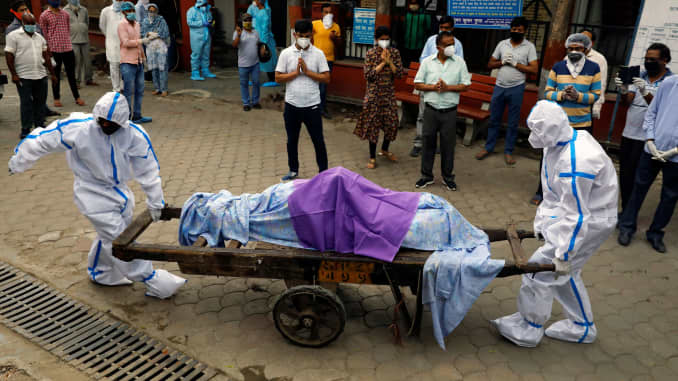
Health workers wearing Personal Protective Equipment (PPE) carry the body of a person who who died due to the coronavirus disease (COVID-19), at a crematorium in New Delhi, India, June 24, 2020.

7:12 a.m. ET — India has reported its highest spike of new cases of infections since the virus took hold in the country of more than 1.3 billion people, according to The Associated Press. 

In 24 hours, the country reported 15,968 new cases and 465 deaths, the AP reported. That means the virus has now infected more than 456,183 people in India, killing at least 14,476, according to data compiled by Johns Hopkins University.

Maharashtra, New Delhi and Tamil Nadu are the hardest-hit states, making up almost 60% of all confirmed cases in the country. New Delhi, in particular, is emerging as a cause for concern in the federal government, the AP reported, due to poor contact tracing infrastructure and limited hospital capacity.

India has the fourth worst coronavirus outbreak in the world, based on total number of confirmed cases, behind only the U.S., Brazil and Russia. —Will Feuer

The EU is discussing reopening its borders, but US citizens could remain barred

A general view of almost desert Pantheon square during Italy's lockdown due to Covid-19 pandemic.

6:51 a.m. ET — The European Union is discussing how to reopen its external borders as the region looks to revive its economies, but visitors from the U.S., and elsewhere, could be barred from entering the bloc for now.

Thirty European countries decided to close their external borders back in March to contain the spread of Covid-19, but that measure is due to be lifted on Tuesday. Representatives of the EU governments are discussing the criteria to lift the travel restrictions from abroad, and at the moment, the main requirement is the coronavirus infection rate in the country of origin.

This means that countries with high rates, such as the United States and Brazil, could remain barred from entering European nations, at least for some time. —Silvia Amaro


WHO Reports Largest Single-Day Spike In Coronavirus Cases

https://talkingpointsmemo.com/news/who-reports-largest-single-day-spike-in-coronavirus-cases

WHO reports largest single-day increase in coronavirus cases

The World Health Organization on Sunday reported the largest single-day increase in coronavirus cases by its count, at more than 183,000 new cases in the latest 24 hours.

The UN health agency said Brazil led the way with 54,771 cases tallied and the U.S. next at 36,617. Over 15,400 came in in India.

Experts said rising case counts can reflect multiple factors including more widespread testing as well as broader infection.

Overall in the pandemic, WHO reported 8,708,008 cases — 183,020 in the last 24 hours — with 461,715 deaths worldwide, with a daily increase of 4,743.

More than two-thirds of those new deaths were reported in the Americas.

In Spain, officials ended a national state of emergency after three months of lockdown, allowing its 47 million residents to freely travel around the country for the first time since March 14. The country also dropped a 14-day quarantine for visitors from Britain and the 26 European countries that allow visa-free travel.

But there was only a trickle of travelers at Madrid-Barajas Airport, which on a normal June day would be bustling.

“This freedom that we now have, not having to justify our journey to see our family and friends, this was something that we were really looking forward to,” Pedro Delgado, 23, said after arriving from Spain’s Canary Islands.

Spanish Prime Minister Pedro Sánchez urged people to take maximum precautions: “The virus can return and it can hit us again in a second wave, and we have to do whatever we can to avoid that at all cost.”

At a campaign rally in Tulsa, Oklahoma, Trump said Saturday the U.S. has tested 25 million people, but the “bad part” is that it found more cases.

“When you do testing to that extent, you’re going to find more people, you’re going to find more cases,” Trump said. “So I said to my people, ‘Slow the testing down, please.’″

White House trade adviser Peter Navarro said on CNN that Trump was being “tongue-in-cheek” and made the comment in a “light mood.”

Democratic rival Joe Biden’s campaign accused Trump of “putting politics ahead of the safety and economic well-being of the American people.”

The U.S. has the world’s highest number of reported infections, over 2.2 million, and the highest death toll, at about 120,000, according to Johns Hopkins. Health officials say robust testing is vital for tracking outbreaks and keeping the virus in check.

In England, lockdown restrictions prevented druids, pagans and party-goers on Sunday from watching the sun rise at the ancient circle of Stonehenge to mark the summer solstice, the longest day of the year in the Northern Hemisphere. English Heritage, which runs the site, livestreamed it instead. A few people gathered outside the fence.

“You can’t cancel the sunrise,” druid Arthur Pendragon told the BBC.

The number of confirmed virus cases is still growing rapidly not only in the U.S. but in Brazil, South Africa and other countries, especially in Latin America.

Brazil’s Health Ministry said the total number of cases had risen by more than 50,000 in a day. President Jair Bolsonaro has been downplaying the risks even as his country has seen nearly 50,000 fatalities, the second-highest death toll in the world.

South Africa reported a one-day high of almost 5,000 new cases on Saturday and 46 deaths. Despite the increase, President Cyril Ramaphosa announced a further loosening of one of the world’s strictest lockdowns. Casinos, beauty salons and sit-down restaurant service will reopen.

In the United States, the virus appears to be spreading across the West and South. Arizona reported over 3,100 new infections, just short of Friday’s record, and 26 deaths. Nevada also reported a new high of 445 cases.

In Europe, a single meatpacking plant in Germany has had over 1,000 cases, so the regional government issued a quarantine for all 6,500 workers, managers and family members.

In Asia, China and South Korea reported new coronavirus cases Sunday in outbreaks that threatened to set back their recoveries.

Chinese authorities recorded 25 new confirmed cases — 22 in Beijing. In the past week, Beijing tightened travel controls by requiring anyone who wants to leave the Chinese capital, a city of 20 million people, to show proof they tested negative for the virus.

In South Korea, nearly 200 infections have been traced to employees at a door-to-door sales company in Seoul, and at least 70 other infections are tied to a table tennis club there. But South Korean officials are reluctant to enforce stronger social distancing to avoid hurting the economy.


Cartoon – Flattening the I.Q. Curve

Editorial cartoons

Trump says Covid-19 is ‘dying out.’ Experts fear his dismissiveness could prolong the crisis

Trump says Covid-19 is ‘dying out.’ Experts fear his dismissiveness could prolong the crisis

The Trump Administration Paid Millions for Test Tubes — and Got ...

The White House is taking a new position on the coronavirus pandemic: a daily count of 750 deaths is a testament to the federal government’s successful pandemic response.

On Wednesday, when U.S. health officials reported nearly 27,000 new Covid-19 cases, President Trump said in a television interview that the virus was “dying out.” He brushed off concerns about an upcoming rally in Tulsa, Okla., because the number of cases there is “very miniscule,” despite the state’s surging infection rate. In a Wall Street Journal interview Wednesday, Trump argued coronavirus testing was “overrated” because it reveals large numbers of new Covid-19 cases, which in turn “makes us look bad,” and suggested that some Americans who wear masks do so not only to guard against the virus, but perhaps to display their anti-Trump animus.

But a range of public health experts told STAT that this messaging not only diverts attention from a pandemic that has already caused 120,000 U.S. deaths, but has more practical implications: It could make it difficult for local governments to enlist the public in the mitigation measures necessary to reduce the continued spread of the virus.

“The science behind how people process public warnings in a crisis supports this: You have to have people speaking with one voice,” said Monica Schoch-Spana, a medical anthropologist at the Johns Hopkins Center for Health Security. “You need a chorus.”

Conflicting directives can make it more difficult for recommendations coming from state and local leaders to have an impact, said Sara Bleich, a professor of public health policy at Harvard’s T.H. Chan School of Public Health.

“It sends a mixed message, which is confusing, particularly because while many people will get infected, most will not get severely sick, so it’s easy to say this won’t happen to me,” she said. “And it’s that sort of attitude that will keep us in this situation for a very long time.”

While the president has for weeks, if not months, underplayed the pandemic, his sharp and repeated remarks this week represent a remarkable attempt from the leader of American government to effectively declare the U.S. Covid-19 epidemic over.

The president’s rhetoric comes at a time that his coronavirus task force, which once conducted daily briefings, has not addressed the public since May. The president’s resumption of campaign rallies flouts federal guidance that encourages mask use (Trump’s campaign will hand out masks and hand sanitizer at the rally, but has not said it will require attendees to use them) and discourages large indoor gatherings. And the president has repeatedly claimed, misleadingly, that persistently high U.S. case totals are simply the result of increased testing.

Health experts say that political leaders preaching caution and modeling proper behavior — such as wearing a mask and demonstrating proper hand hygiene — can send a powerful signal to people that these steps can not only protect them, but their communities. They say that, essentially, national and state leaders need to walk the walk in a situation when individual behavior, like staying home when sick and cooperating with contact tracing, can make a large impact in curbing contagion.

Trump’s counterproductive behavior, Schoch-Spana said, extends far beyond the consistently dismissive tone he has taken toward the health risks of Covid-19. With few exceptions, the president has refused to wear a mask in public, and has insisted on continuing in-person briefings and White House events that effectively defy federal health guidance about gathering indoors in large groups.

“It’s not just words, it’s actions,” she said. “So when you have the nation’s top executive refusing to wear a mask, holding meetings where people are shoulder to shoulder, where he’s signing executive orders — that is also a form of communication.”

Experts also say continued federal commitments to combating the virus are crucial as the public grows tired of abatement measures. Instead, Trump has only elevated his monthslong campaign of downplaying the virus.

And Vice President Mike Pence, in a Wall Street Journal op-ed, framed the declines in cases and deaths since April as “testament to the leadership of President Trump” — even as hundreds of Americans are still dying every day and cases are not dropping further.

Rep. Donna Shalala (D-Fla.), who served as health secretary during the Clinton administration, said she hoped Americans would listen to public health guidance from local officials, not Trump and Pence.

“The president of the United States is dangerous to the health of the people of my district, because he’s giving out misinformation and false hope,” she said. “For those that believe him, they’re putting themselves and their families at risk.”

Public health experts have raised a number of issues with the administration’s messaging.

For one, a plateau of cases and deaths should not be celebrated, they say. While some countries in Europe and Asia have not only flattened their curve but driven them down, that hasn’t happened in the United States. Daily cases and deaths dipped from the peak in April, but have averaged about 20,000 and 800, respectively, for weeks.

Beyond those numbers representing real people getting sick and dying, there are other problems with sustained high levels of spread. The more cases there are, the more difficult it is for the surveillance system, including contact tracing, to keep up. It’s also more likely that some of the cases will spiral into explosive spread; 20,000 cases can turn into 40,000 a lot faster than one case can turn into 20,000.

Plus, a failure to suppress spread now could lead to more prolonged disruptions to daily life. If transmission rates come fall are still what they are now in certain communities, that makes it harder to reopen schools, for example.

Experts also point to evidence suggesting that the daily case and death numbers won’t stay flat for long. While new cases in the Northeast and Midwest are declining, a number of states in the West and South — Arizona, Texas, Florida, California, and Oregon among them — have reported record number of new cases this week. What worries public health officials is that, without measures to stem those increases, those outbreaks could keep growing. Those thousands of new cases also signal that, in a week or two, some portion of those people will show up in the hospital, and, about a week after that, a number of them will be dead, even as clinicians have learned more about treating severe Covid-19.

Some states in the South and West are already reporting record hospitalizations from Covid-19.

The White House’s shrug has been echoed by some governors, who insist, like Pence and Trump, that increased testing explains away the rise in cases. That is certainly one reason; testing has become more widespread, so states are capturing a more accurate reading of their true case burden.

But experts say increased testing can only account for some of the data states are reporting. Other metrics — including rising hospitalizations, filling ICUs, and the increasing rate of tests that are positive for the virus — signal broader spread.

Until Wednesday, leaders of Texas and Arizona also bristled at efforts from city and county officials to institute mask requirements, but acceded to growing pressure even as they have not ordered statewide mandates.

Cameron Wolfe, an infectious disease expert at Duke University, said he was seeing a growing “fatigue” among the public to keep up with precautionary steps like physical distancing and mask wearing. People letting down their guard was coinciding with an increase of cases in states, including North Carolina.

He said medical experts and health workers needed to model proper behavior to show others that the coronavirus epidemic was still something that required action. But, he added, “that also comes from political leaders buying into this.”

Federal and state authorities, he said, need to be “taking this to heart. That has not yet happened. That needs to change if we’re going to get people to buy into this.”


In countries keeping the coronavirus at bay, experts watch U.S. case numbers with alarm

https://www.washingtonpost.com/world/2020/06/19/countries-keeping-coronavirus-bay-experts-watch-us-case-numbers-with-alarm/?utm_campaign=wp_post_most&utm_medium=email&utm_source=newsletter&wpisrc=nl_most

Experts abroad watch U.S. coronavirus case numbers with alarm ...

As coronavirus cases surge in states across the South and West of the United States, health experts in countries with falling case numbers are watching with a growing sense of alarm and disbelief, with many wondering why virus-stricken U.S. states continue to reopen and why the advice of scientists is often ignored.

“It really does feel like the U.S. has given up,” said Siouxsie Wiles, an infectious-diseases specialist at the University of Auckland in New Zealand — a country that has confirmed only three new cases over the last three weeks and where citizens have now largely returned to their pre-coronavirus routines.

“I can’t imagine what it must be like having to go to work knowing it’s unsafe,” Wiles said of the U.S.-wide economic reopening. “It’s hard to see how this ends. There are just going to be more and more people infected, and more and more deaths. It’s heartbreaking.”

China’s actions over the past week stand in stark contrast to those of the United States. In the wake of a new cluster of more than 150 new cases that emerged in Beijing, authorities sealed off neighborhoods, launched a mass testing campaign and imposed travel restrictions.

Meanwhile, President Trump maintains that the United States will not shut down a second time, although a surge in cases has convinced governors in some states, including Arizona, to walk back their opposition to mandatory face coverings in public.

Commentators and experts in Europe, where cases have continued to decline, voiced concerns over the state of the U.S. response. A headline on the website of Germany’s public broadcaster read: “Has the U.S. given up its fight against coronavirus?” Switzerland’s conservative Neue Zürcher Zeitung newspaper concluded, “U.S. increasingly accepts rising covid-19 numbers.”

“The only thing one can say with certainty: There’s nothing surprising about this development,” a journalist wrote in the paper, referring to crowded U.S. beaches and pools during Memorial Day weekend in May.

Some European health experts fear that the rising U.S. caseloads are rooted in a White House response that has at times deviated from the conclusions of leading scientists.

“Many scientists appeared to have reached an adequate assessment of the situation early on [in the United States], but this didn’t translate into a political action plan,” said Thomas Gerlinger, a professor of health sciences at the University of Bielefeld in Germany. For instance, it took a long time for the United States to ramp up testing capacity.

Whereas the U.S. response to the crisis has at times appeared disconnected from American scientists’ publicly available findings, U.S. researchers’ conclusions informed the actions of foreign governments.

“A large portion of [Germany’s] measures that proved effective was based on studies by leading U.S. research institutes,” said Karl Lauterbach, a Harvard-educated epidemiologist who is a member of the German parliament for the Social Democrats, who are part of the coalition government. Lauterbach advised the German parliament and the government during the pandemic.

Despite its far older population, Germany has confirmed fewer than 9,000 coronavirus-linked deaths, compared to almost 120,000 in the United States. (Germany has about one-fourth of the United States’ population.)

Lauterbach cited in particular the work of Marc Lipsitch, a professor of epidemiology at Harvard University, whose research with colleagues recently suggested that forms of social distancing may have to remain in place into 2022. Lipsitch’s work, Lauterbach said, helped him to convince German Vice Chancellor Olaf Scholz that the pandemic will be “the new normal” for the time being, and it impacted German officials’ thinking on how long their strategy should be in place.

Regarding the effectiveness of face masks, Lauterbach added, “we almost entirely relied on U.S. studies.” Germany was among the first major European countries to make face masks mandatory on public transport and in supermarkets.

Lipsitch said Thursday that he was not previously aware of the impact of his research on German decision-making, but added that he has spoken to representatives of several other foreign governments in recent weeks, including Israeli Prime Minister Benjamin Netanyahu and officials or advisers from Canada, New Zealand and South Korea.

Even though Lipsitch cautioned it was impossible for him to say how or if his conversations influenced foreign governments’ thinking, he credited the overall European response as “science-based and a sincere effort to find out what experts in the field believe is a range of possible scenarios and consequences of decisions.”

Lipsitch said he presented some of his research to a White House group in the early stages of the U.S. outbreak but said the Trump administration’s response to the pandemic did not reflect his conclusions. “I think they have cherry-picked models that at each point looked the most rosy, and fundamentally not engaged with the magnitude of the problem,” he said.

The White House has defended its approach as science-based. After a study by Imperial College London predicted 510,000 deaths in Britain and 2.2 million in the United States if the pandemic remained fully uncontrolled, for instance, the Trump administration indicated that it was taking the research into account.

“If we didn’t act quickly and smartly, we would have had, in my opinion and in the opinion of others, anywhere from 10 to 20 and maybe even 25 times the number of deaths,” Trump said two months later,

But European researchers dispute that the U.S. government’s reliance on scientists to inform decision-making comes anywhere near the degree to which many European policymakers have relied on researchers.

After consulting U.S. research and German studies, for instance, German leaders agreed to make reopening dependent on case numbers, meaning restrictions snap back or reopening gets put on hold if the case numbers in a given region exceed a certain threshold.

Meanwhile, several U.S. states have reopened despite rising case numbers.

“I don’t understand that logic,” said Reinhard Busse, a health management professor a the Technical University of Berlin.

Lauterbach said that while most Germans disapproved of Trump before the pandemic, even his staunchest critics in Germany were surprised by how even respected U.S. institutions including the Centers for Disease Control and Prevention (CDC) struggled to respond to the crisis.

The CDC, for instance, initially botched the rollout of test kits in the early stages of the outbreak.

“Like many other aspects of our country, the CDC’s ability to function well is being severely handicapped by the interference coming from the White House,” said Harvard epidemiologist Lipsitch. “All of us in public health very much hope that this is not a permanent condition of the CDC.”

Some observers fear the damage will be difficult to reverse. “I’ve always thought of the CDC as a reliable and trusted source of information,” said Wiles, the New Zealand specialist. “Not anymore.”


Scientists caught between pandemic and protests

https://www.axios.com/black-lives-matter-protests-coronavirus-science-15acc619-633d-47c2-9c76-df91f826a73c.html

Scientists accused of double standards on coronavirus and Black ...

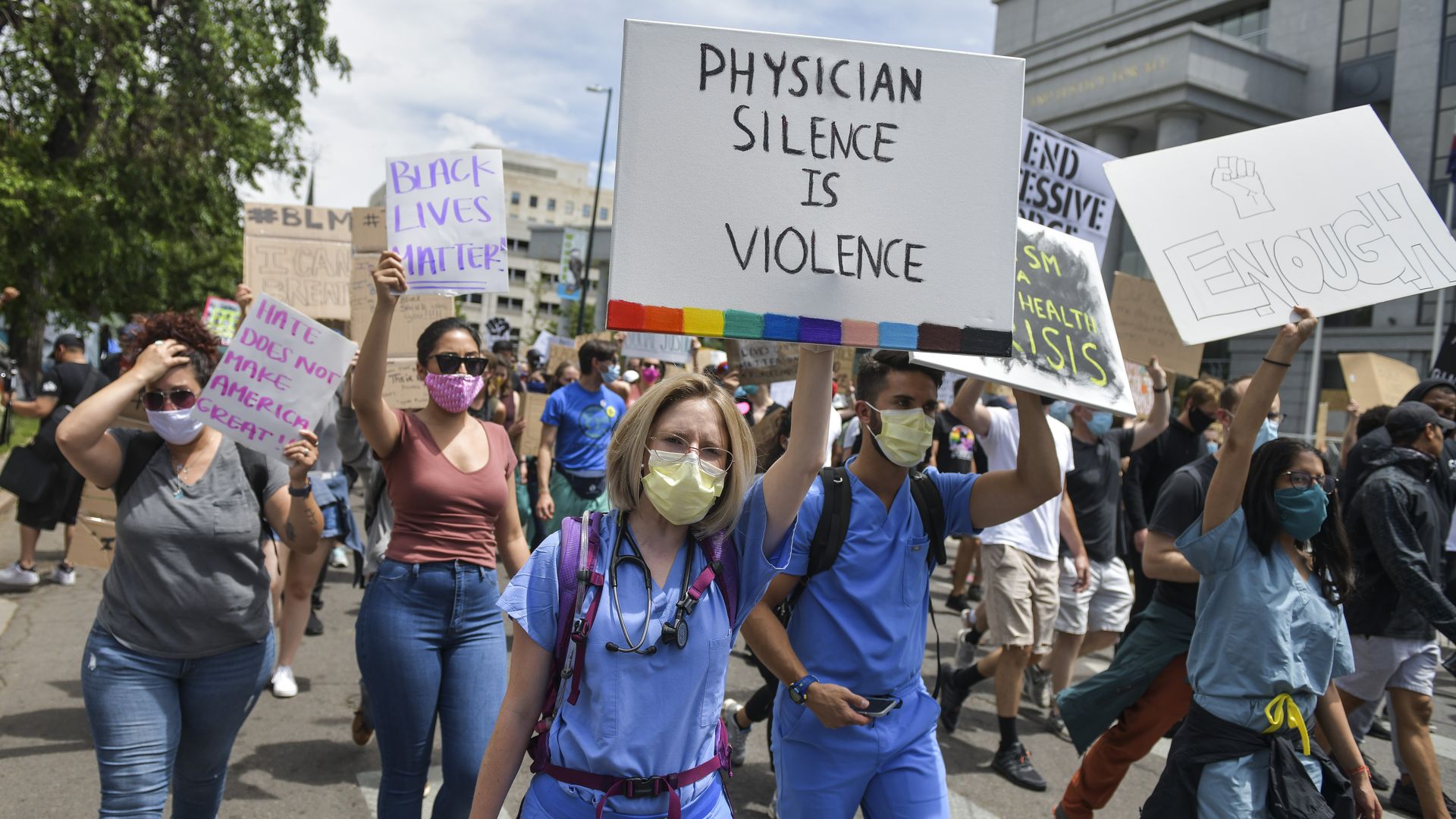
When protests broke out against the coronavirus lockdown, many public health experts were quick to warn about spreading the virus. When protests broke out after George Floyd’s death, some of the same experts embraced the protests. That’s led to charges of double standards among scientists.

Why it matters: Scientists who are seen as changing recommendations based on political and social priorities, however important, risk losing public trust. That could cause people to disregard their advice should the pandemic require stricter lockdown policies.

What’s happening: Many public health experts came out against public gatherings of almost any sort this spring — including protests over lockdown policies and large religious gatherings.

  • But some of the same experts are supporting the Black Lives Matter protests, arguing that addressing racial inequality is key to tackling the coronavirus epidemic.
  • The systemic racism that protesters are decrying contributes to massive health disparities that can be seen in this pandemic — black Americans comprise 13% of the U.S. population, but make up around a quarter of deaths from COVID-19. Floyd himself survived COVID-19 before he was killed by a now former police officer in Minneapolis.
  • “While everyone is concerned about the risk of COVID, there are risks with just being black in this country that almost outweigh that sometimes,” Abby Hussein, an infectious disease fellow at the University of Washington, told CNN last week.

Yes, but: Spending time in a large group, even outdoors and wearing masks — as many of the protesters are — does raise the risk of coronavirus transmission, says Michael Osterholm, director of the Center for Infectious Disease Research and Policy at the University of Minnesota.

  • In a Twitter thread over the weekend, coronavirus expert Trevor Bedford estimated that each day of protests would result in some 3,000 additional infections, which over time could lead to hundreds of additional deaths each day.
  • Public health experts who work in the government have struck a cautionary note. Mass, in-person protests are a “perfect setup” for transmission of the virus, Anthony Fauci told radio station WTOP last week. “It’s a delicate balance because the reasons for demonstrating are valid, but the demonstration puts one at additional risk.”

The difference in tone between how some public health experts are viewing the current protests and earlier ones focused on the lockdowns themselves was seized upon by a number of critics, as well as the Trump campaign.

  • “It will deepen the idea that the intellectual classes are picking winners and losers among political causes,” says Tom Nichols, author of the “The Death of Expertise.”
  • Politico reported that the Trump campaign plans to restart campaign rallies in the next two weeks, with advisers arguing that “recent massive protests in metropolitan areas will make it harder for liberals to criticize him” despite the ongoing pandemic.

The current debate underscores a larger question: What role should scientists play in policymaking?

  • “We should never try to harness the credibility of public health on behalf of our judgments as citizens,” writes Peter Sandman, a retired professor of environmental journalism. He tells Axios some scientists who supported one protest versus others “clearly damaged the credibility of public health as a scientific enterprise that struggles to be politically neutral.
  • But some are pushing back against the very idea of scientific neutrality. “Science is part of how we got to our racist system in the first place,” Susan Matthews wrote in Slate.
  • Medical science has often betrayed the trust of black Americans, who receive less, and often worse, care than white Americans. That means — as Uché Blackstock, a physician and CEO of Advancing Health Equity, told NPR — that the pandemic presents “a crisis within a crisis.”

The big picture: The debate risks exacerbating a partisan divide among Americans in their reported trust in scientists.

  • 53% of Democrats polled in late April — about a month before Floyd’s death — reported a “great deal of confidence in medical scientists to act in the public interests” versus 31% of Republicans.
  • If science-driven policymaking continues to be seen as biased, it will have repercussions for public trust in issues beyond the pandemic, including climate change, AI and genetic engineering.

What to watch: If there is a rise in new cases in the coming weeks, there will be pressure to trace them — to protests, rallies and the reopening of states. How experts weigh in could affect how their recommendations will be viewed in the future — and whether the public, whatever their political leanings, will follow them again.


White House goes quiet on coronavirus as outbreak spikes again across the U.S.

https://www.politico.com/news/2020/06/10/white-house-stops-talking-about-coronavirus-309993?utm_source=ActiveCampaign&utm_medium=email&utm_content=Mnuchin%3A+More+Stimulus++Definitely++Needed&utm_campaign=TFT+Newsletter+06102020

White House goes quiet on coronavirus as outbreak spikes again ...

The coronavirus is still killing as many as 1,000 Americans per day — but the Trump administration isn’t saying much about it.

It’s been more than a month since the White House halted its daily coronavirus task force briefings. Top officials like infectious disease expert Anthony Fauci have largely disappeared from national television — with Fauci making just four cable TV appearances in May after being a near fixture on Sunday shows across March and April — and are frequently restricted from testifying before Congress. Meanwhile, President Donald Trump is preparing to resume his campaign rallies after a three-month hiatus, an attempted signal to voters that normalcy is returning ahead of November’s election, and that he’s all but put the pandemic behind him.

“We’ve made every decision correctly,” Trump claimed in remarks in the Rose Garden Friday morning. “We may have some embers or some ashes or we may have some flames coming, but we’ll put them out. We’ll stomp them out.”

Inside the White House, top advisers like Jared Kushner privately assured colleagues last month that the outbreak was well in hand — citing data on declines in community spread — and that the long-feared “second wave” may have even been averted, according to three current and former officials.

However, new data from states like Florida and mass protests across the country are renewing concerns about the virus’s spread. Texas, for instance, has reported two straight days of record-breaking coronavirus hospitalizations — highs that come shortly after the state kicked off the third stage of its reopening plan.

Those officials also acknowledge that the Covid-19 task force has scaled back its once-daily internal meetings — the task force now meets twice per week — but insist that the pandemic response remains a priority. One official with direct knowledge of the administration’s strategy cited efforts to scale up testing, accelerate the development of treatments and vaccines and perform other behind-the-scenes work to get ready for a potential fall surge.

“We’re delivering the supplies and resources that states asked for,” said the official. “This doesn’t need to be the public ‘coronavirus show’ every day anymore.”

“You can’t win,” said a senior administration official. “Some people complained for weeks that ‘we don’t want so much White House involvement,’ and that ‘the President should stop doing daily briefings,’ and then they turn around and complain that there aren’t enough or as many briefings.”

But the White House’s apparent eagerness to change the subject comes as new coronavirus clusters — centered around meatpacking plants, prisons and other facilities — drive spikes in disparate states like Utah and Arkansas. Meanwhile, states and major cities are lifting lockdowns and reopening their economies, prompting public health experts to fret that additional outbreaks are imminent. And several Democratic governors also have defied their own states’ social distancing restrictions to join mass protests over police brutality, where hundreds of thousands of Americans have spilled into the streets, further raising public health risks.

The fear is that all the mixed signals will only confuse people, stoke public skepticism over the health threat and promote the belief the worst is over just as the outbreak enters a dangerous new phase.

“Cases are rising, including from cases in congregate settings,” said Luciana Borio, who led pandemic preparedness for the National Security Council between 2017 and 2019. “We still have a pandemic.”

Nine current and former administration officials, as well as outside experts, further detailed how the White House is steadily ramping down the urgency to fight a threat that continues to sicken more than 100,000 Americans per week and is spiking in more than 20 states.

For instance, the administration in recent days told state health officials that it planned to reorganize its pandemic response, with HHS and its agencies taking over the bulk of the day-to-day responsibilities from the Federal Emergency Management Agency.

“The acuity of the response is not what it was, so they’re trying to go back to a little more of a normal ongoing presence,” said Marcus Plescia, the chief medical officer of the Association of State and Territorial Health Officials.

The coronavirus task force, which used to send daily updates to state officials, has done so with less regularity over the last several weeks, Plescia said. And the CDC has restructured its daily conference calls with states, moving away from the practice of giving top-down briefings to encouraging state officials to offer updates on what they’re seeing in their parts of the country.

One current and one former FEMA official also said they’re keen to have HHS resume its leadership role in containing the coronavirus so FEMA can make contingencies for a summer of hurricanes, floods and other natural disasters.

“Given the likelihood that we will soon see both hurricanes and coronavirus, HHS should manage the ongoing pandemic response so FEMA can prepare for coming ‘coronacanes,’” Daniel Kaniewski, who served as the top deputy at FEMA through January, wrote last week. “But they need to act soon. Coronacanes are in the forecast.”

Meanwhile, officials in at least 19 states have recorded two-week trends of increasing coronavirus cases, including spikes of more than 200 percent in Arizona and more than 180 percent in Kentucky. Two months after the White House issued so-called gating criteria that it recommended states hit before resuming business and social activities, only a handful of states — like Connecticut, New Jersey, New York and South Dakota — currently meet all of those benchmarks, according to CovidExitStrategy.org.

Officials within Trump’s health department are strategizing over how to convey the current level of risk, given data that Americans have put off emergency care and other potential medical needs, fearful of contracting Covid-19. “Our message now is that people should start returning to their health care providers to get the screenings, vaccines, care, or emergency services that they need,” Laura Trueman, the HHS official in charge of external affairs, wrote in an office-wide email to colleagues and shared with external groups on June 3, which was obtained by POLITICO.

Dan Abel, a longtime Coast Guard vice admiral, also has been installed at HHS with a small team, where he’s coordinating daily Covid-19 calls with HHS Secretary Alex Azar and the department’s division leaders, according to four officials with knowledge of the calls — an arrangement that’s raised some questions.

“Why is a Coast Guard admiral leading meetings between the HHS secretary and his senior staff?” asked one senior official, suggesting it created an unnecessary layer of management.

Meanwhile, the department is steadily turning back to its many pre-Covid-19 priorities. At the Food and Drug Administration, officials are returning to hot-button issues like tobacco and CBD regulations. Some staff in the health department’s emergency response arm are pivoting away from Covid-19 and back toward natural disasters as hurricane season begins.

At the same time, the Centers for Disease Control — traditionally the beating heart of the nation’s infectious disease response — remains largely demoralized and often sidelined in fighting what CDC director Robert Redfield last week acknowledged as the nation’s biggest health challenge in more than a century, and one he said is “moving through our social consciousness, our outward expression, and our grief.” That grim message has conflicted with Trump’s frequent vows of victory over the coronavirus.

“We were able to close our country, save millions of lives, open,” Trump said in Friday’s Rose Garden remarks. “And now the trajectory is great.”

“I fully recognize the anguish our Nation is experiencing & am deeply saddened by the many lives lost to COVID19,” Redfield tweeted just minutes later. “I call upon the American people to remain vigilant in protecting the vulnerable – protect your community, grandparents and loved ones from COVID-19.”

Redfield and other top officials also have spent the past week reckoning with the implications of widespread protests over police brutality, from meeting with staff to discuss longstanding concerns about systemic racism in health care to acknowledging the probability that those protests will spark new outbreaks.

HHS also on Monday sent members of Congress a fact sheet on its response to racial disparities in Covid-19 care — a much scrutinized issue in public health, with African Americans contracting and dying from the virus at much higher rates.

But on Capitol Hill, watchdogs say that fact sheets don’t cut it, and they’re frustrated by the lack of access to experts and insight into how the administration is handling a historic pandemic.

“Some are acting like the battle has been won when in reality it’s just beginning,” said a senior Democratic staffer. “The White House still won’t let task force members testify at hearings in June even though they have disappeared from TV and it’s not clear how often they are meeting.”

Fauci, meanwhile, has continued to issue a string of dire warnings in his lower-profile media appearances and at an industry conference on Tuesday.

We have something that turned out to be my worst nightmare,” Fauci said in virtual remarks aired at a conference of the biotech industry’s Washington trade group, recounting how quickly the virus spread around the globe, outpacing Ebola and HIV. “And it isn’t over yet.”

The White House has maintained that chief of staff Mark Meadows has needed to clear officials like Fauci to testify, so they can stay focused on other priorities, and a spokesperson insisted that Trump has still prioritized the coronavirus fight even as the White House shifts toward focusing on revitalizing the economy.

Several officials have suggested that the task force’s lower profile has been helpful for the response, especially because the daily Covid-19 press briefings were often hijacked by Trump’s meandering remarks or the day’s other political news.

“In some ways, it actually has been easier to get Covid-related work done,” said one HHS staffer who’s helped support the Covid-19 response. “The task force briefings and the prep sessions for them took up a lot of principals’ time, and staff would sometimes have to crash on putting together materials for them.”

But the white-hot spotlight on the coronavirus also brought urgency and intensity, and the increasingly scattered nature of the current response could present new challenges if there’s an uptick in cases.

“This is when a one-government approach is needed more now than ever,” said Howard Koh, who served as President Barack Obama’s HHS assistant secretary for health. “Get all those people together in one room every day at the highest level and track outcomes and address all the questions and try to maximize coordination as much as possible.”


Coronavirus Live Updates: W.H.O. Walks Back Claim That Asymptomatic Transmission is Rare

Virus spreaders who never show symptoms 'very rare,' WHO says ...

Seven million people have been infected worldwide, and new cases hit a high globally on Sunday, according to the W.H.O. Central banks are seeking new tools to offset the downturn.

RIGHT NOW

New Jersey’s governor said on Tuesday that he was lifting the stay-at-home order that he issued in March. “With more and more of our businesses reopening, we’re no longer requiring you to stay at home,” he said.

The W.H.O. walked back an earlier assertion that asymptomatic transmission is ‘very rare.’

A top expert at the World Health Organization on Tuesday walked back her earlier assertion that transmission of the coronavirus by people who do not have symptoms is “very rare.”

Dr. Maria Van Kerkhove, who made the original comment at a W.H.O. briefing on Monday, said that it was based on just two or three studies and that it was a “misunderstanding” to say asymptomatic transmission is rare globally.

“I was just responding to a question, I wasn’t stating a policy of W.H.O. or anything like that,” she said.

Dr. Van Kerkhove said that the estimates of transmission from people without symptoms come primarily from models, which may not provide an accurate representation. “That’s a big open question, and that remains an open question,” she said.

Scientists had sharply criticized the W.H.O. for creating confusion on the issue, given the far-ranging public policy implications. Governments around the world have recommended face masks and social distancing measures because of the risk of asymptomatic transmission.

A range of scientists said Dr. Van Kerkhove’s comments did not reflect the current scientific research.

“All of the best evidence suggests that people without symptoms can and do readily spread SARS-CoV-2, the virus that causes Covid-19,” scientists at the Harvard Global Health Institute said in a statement on Tuesday.

“Communicating preliminary data about key aspects of the coronavirus without much context can have tremendous negative impact on how the public and policymakers respond to the pandemic.”

A widely cited paper published in April suggested that people are most infectious about two days before the onset of symptoms, and estimated that 44 percent of new infections are a result of transmission from people who were not yet showing symptoms.

Dr. Van Kerkhove and other W.H.O. experts reiterated the importance of physical distancing, personal hygiene, testing, tracing, quarantine and isolation in controlling the pandemic.

The debate over transmission erupted a day after the W.H.O. said that cases had reached a new single-day global high — 136,000 on Sunday, with three-quarters in just 10 countries, mostly in the Americas and South Asia. The coronavirus has already sickened more than seven million people worldwide and killed at least 405,400, according to a New York Times database.

The Pan American Health Organization said on Tuesday that 3.3 million people in South and Central America have been infected with the coronavirus. Dr. Carissa F. Etienne, the agency’s director, said that many areas are experiencing exponential growth in infections and death.

In India, health experts are warning of a looming shortage of hospital beds and doctors to treat patients as the country grapples with a sharp surge of infections. India reported 10,000 new infections in the past 24 hours, fortotal of at least 266,500, and has surpassed Spain to become one of the five countries with the highest caseloads.

Rajnish Sinha, the owner of an event management company in Delhi, struggled to find a hospital bed for his 75-year-old father-in-law, who tested positive for the virus on Tuesday.

“This is just the beginning of the coming disaster,” Mr. Sinha said. “Only God can save us.”


Shutdowns prevented 60 million coronavirus infections in the U.S., study finds

https://www.washingtonpost.com/health/2020/06/08/shutdowns-prevented-60-million-coronavirus-infections-us-study-finds/?fbclid=IwAR3J402h_abt63p-JDNEEBrNwrZ_nRjQza8OKxtV9xmtt4n5Oky-droY_-c&utm_campaign=wp_main&utm_medium=social&utm_source=facebook

Shutdowns prevented 60 million coronavirus infections in the U.S. ...

Shutdown orders prevented about 60 million novel coronavirus infections in the United States and 285 million in China, according to a research study published Monday that examined how stay-at-home orders and other restrictions limited the spread of the contagion.

A separate study from epidemiologists at Imperial College London estimated the shutdowns saved about 3.1 million lives in 11 European countries, including 500,000 in the United Kingdom, and dropped infection rates by an average of 82 percent, sufficient to drive the contagion well below epidemic levels.

The two reports, published simultaneously Monday in the journal Nature, used completely different methods to reach similar conclusions. They suggest that the aggressive and unprecedented shutdowns, which caused massive economic disruptions and job losses, were effective at halting the exponential spread of the novel coronavirus.

“Without these policies employed, we would have lived through a very different April and May,” said Solomon Hsiang, director of the Global Policy Laboratory at the University of California at Berkeley, and the leader of the research team that surveyed how six countries — China, the United States, France, Italy, Iran and South Korea — responded to the pandemic.

He called the global response to covid-19, the disease caused by the virus, “an extraordinary moment in human history when the world had to come together,” and said the shutdowns and other mitigation measures resulted in “saving more lives in a shorter period of time than ever before.”

The two reports on the effectiveness of the shutdowns come with a clear warning that the pandemic, even if in retreat in some of the places hardest hit, is far from over. The overwhelming majority of people remain susceptible to the virus. Only about 3 percent to 4 percent of people in the countries being studied have been infected to date, said Samir Bhatt, senior author of the Imperial College London study.

“This is just the beginning of the epidemic: we’re very far from herd immunity,” Bhatt said Monday in an email. “The risk of a second wave happening if all interventions and precautions are abandoned is very real.”

In a teleconference with reporters later, Bhatt said economic activity could return to some degree so long as some interventions to limit viral spread remain in place: “We’re not saying the country needs to stay locked down forever.”

The Berkeley study used an “econometric” model to estimate how 1,717 interventions, such as stay-at-home orders, business closings and travel bans, altered the spread of the virus. The researchers looked at infection rates before and after the interventions were imposed. Some of these interventions were local, and some regional or national. The researchers concluded that the six countries collectively managed to avert 62 million test-confirmed infections.

Because most people who are infected never get tested, the actual number of infections that were averted is much higher — about 530 million in the six countries, the Berkeley researchers estimated.

Timing is crucial, the Berkeley study found. Small delays in implementing shutdowns can lead to “dramatically different health outcomes.” The report, while reviewing what worked and what made little difference, is clearly aimed at the many countries still early in their battle against the coronavirus.

“Societies around the world are weighing whether the health benefits of anti-contagion policies are worth their social and economic costs,” the Berkeley team wrote. The economic costs of shutdowns are highly visible — closed stores, huge job losses, empty streets, food lines. The health benefits of the shutdowns, however, are invisible, because they involve “infections that never occurred and deaths that did not happen,” Hsiang said.

That spurred the researchers to come up with their estimates of infections prevented. The Berkeley team did not produce an estimate of lives saved.

One striking finding: School closures did not show a significant effect, although the authors cautioned that their research on this was not conclusive and the effectiveness of school closures requires further study. Banning large gatherings had more of an effect in Iran and Italy than in the other countries.

In discussing their findings Monday with reporters in the teleconference, leaders of the two research teams said challenges exist in crafting their models and thus there are uncertainties in the final estimates.

Bhatt, for example, said the model used by his team is highly sensitive to assumptions about the infection fatality rate, estimates for which have varied among researchers and from one country to another. He said his team was heartened to see that its estimates for the number of people infected so far is generally consistent with antibody surveys that attempt to calculate the attack rate of the virus.

Ian Bolliger, one of the Berkeley researchers, acknowledged the difficulty in obtaining reliable numbers for coronavirus infections given the haphazard pattern of testing for the virus. Both research teams said the peer review process had made their findings more robust.


The Essence of Big Pharma