Admininstration believes Coronavirus is “under control”

https://www.axios.com/newsletters/axios-vitals-65b6b9b9-ee8e-4b89-9688-c43c0146c4d6.html?utm_source=newsletter&utm_medium=email&utm_campaign=newsletter_axiosvitals&stream=top

Daily confirmed COVID-19 cases, rolling 3-day average - Our World ...

President Trump said in an interview with “Axios on HBO” that he thinks the coronavirus is as well-controlled in the U.S. as it can be, despite dramatic surges in new infections over the course of the summer and more than 150,000 American deaths.

  • “They are dying, that’s true. And you have — it is what it is. But that doesn’t mean we aren’t doing everything we can. It’s under control as much as you can control it. This is a horrible plague,” he told Axios’ Jonathan Swan.

Reality check: The U.S. is averaging roughly 65,000 new cases and 1,000 deaths per day, Axios’ Sam Baker writes. The virus has already killed nearly 150,000 Americans, and it spread largely unchecked through almost the entire country throughout June and July.

The big picture: In the interview, which took place last Tuesday, Trump returned to familiar themes and areas where the U.S. really has made significant progress. He cited the dramatic increase in ventilator production, the ramp-up in testing and treatment that has reduced the overall fatality rate from the virus.

  • Yes, but: He painted a far rosier picture of the pandemic than most data would support.

On testing, Trump said, “You know there are those that say you can test too much” — a view that no experts have advocated.

  • The U.S. is experiencing long turnaround times for coronavirus testing, as Trump acknowledged, because of the high demand for testing. But that is largely a function of the country’s high caseload and the number of people at risk of infection.

He also returned to his mantra that “because we’ve done more tests, we have more cases.”

  • The cases the U.S. has, we would have had with or without testing. We know we have them because of testing, but the massive outbreak here would be a massive outbreak whether we chose to know about it (through testing) or ignore it by not testing.


The Mask Slackers of 1918

As the influenza pandemic swept across the United States in 1918 and 1919, masks took a role in political and cultural wars.

The masks were called muzzles, germ shields and dirt traps. They gave people a “pig-like snout.” Some people snipped holes in their masks to smoke cigars. Others fastened them to dogs in mockery. Bandits used them to rob banks.

More than a century ago, as the 1918 influenza pandemic raged in the United States, masks of gauze and cheesecloth became the facial front lines in the battle against the virus. But as they have now, the masks also stoked political division. Then, as now, medical authorities urged the wearing of masks to help slow the spread of disease. And then, as now, some people resisted.

In 1918 and 1919, as bars, saloons, restaurants, theaters and schools were closed, masks became a scapegoat, a symbol of government overreach, inspiring protests, petitions and defiant bare-face gatherings. All the while, thousands of Americans were dying in a deadly pandemic.

The first infections were identified in March, at an Army base in Kansas, where 100 soldiers were infected. Within a week, the number of flu cases grew fivefold, and soon the disease was taking hold across the country, prompting some cities to impose quarantines and mask orders to contain it.

By the fall of 1918, seven cities — San Francisco, Seattle, Oakland, Sacramento, Denver, Indianapolis and Pasadena, Calif. — had put in effect mandatory face mask laws, said Dr. Howard Markel, a historian of epidemics and the author of “Quarantine!

Organized resistance to mask wearing was not common, Dr. Markel said, but it was present. “There were flare-ups, there were scuffles and there were occasional groups, like the Anti-Mask League,” he said, “but that is the exception rather than the rule.”

At the forefront of the safety measures was San Francisco, where a man returning from a trip to Chicago apparently carried the virus home, according to archives about the pandemic at the University of Michigan.

By the end of October, there were more than 60,000 cases statewide, with 7,000 of them in San Francisco. It soon became known as the “masked city.”

“The Mask Ordinance,” signed by Mayor James Rolph on Oct. 22, made San Francisco the first American city to require face coverings, which had to be four layers thick.

Resisters complained about appearance, comfort and freedom, even after the flu killed an estimated 195,000 Americans in October alone.

Alma Whitaker, writing in The Los Angeles Times on Oct. 22, 1918, reviewed masks’ impact on society and celebrity, saying famous people shunned them because it was “so horrid” to go unrecognized.

“The big restaurants are the funniest sights, with all the waiters and diners masked, the latter just raising their screen to pop in a mouthful of food,” she wrote.

When Ms. Whitaker herself declined to wear one, she was “forcibly taken” to the Red Cross as a “slacker,” and ordered to make one and put it on.

The San Francisco Chronicle said the simplest type of mask was of folded gauze affixed with elastic or tape. The police went for gauze masks, which resembled an unflattering “nine ordinary slabs of ravioli arranged in a square.”

There was room for creativity. Some of the coverings were “fearsome looking machines” that lent a “pig-like aspect” to the wearer’s face.

The penalty for violators was $5 to $10, or 10 days’ imprisonment.

On Nov. 9, 1,000 people were arrested, The San Francisco Chronicle reported. City prisons swelled to standing room only; police shifts and court sessions were added to help manage.

“Where is your mask?” Judge Mathew Brady asked offenders at the Hall of Justice, where sessions dragged into night. Some gave fake names, said they just wanted to light a cigar or that they hated following laws.

Jail terms of 8 hours to 10 days were given out. Those who could not pay $5 were jailed for 48 hours.

On Oct. 28, a blacksmith named James Wisser stood on Powell and Market streets in front of a drugstore, urging a crowd to dispose of their masks, which he described as “bunk.”

A health inspector, Henry D. Miller, led him to the drugstore to buy a mask.

At the door, Mr. Wisser struck Mr. Miller with a sack of silver dollars and knocked him to the ground, The San Francisco Chronicle reported. While being “pummeled,” Mr. Miller, 62, fired four times with a revolver. Passers-by “scurried for cover,” The Associated Press said.

Mr. Wisser was injured, as were two bystanders. He was charged with disturbing the peace, resisting an officer and assault. The inspector was charged with assault with a deadly weapon.

That was the headline for a report published in The Los Angeles Times when city officials met in November to decide whether to require residents to wear “germ scarers” or “flu-scarers.”

Public feedback was invited. Some supported masks so theaters, churches and schools could operate. Opponents said masks were “mere dirt and dust traps and do more harm than good.”

“I have seen some persons wearing their masks for a while hanging about their necks, and then apply them to their faces, forgetting that they might have picked up germs while dangling about their clothes,” Dr. E.W. Fleming said in a Los Angeles Times report.

An ear, nose and throat specialist, Dr. John J. Kyle, said: “I saw a woman in a restaurant today with a mask on. She was in ordinary street clothes, and every now and then she raised her hand to her face and fussed with the mask.”

Suffragists fighting for the right to vote made a gesture that rejected covering their mouths at a time when their voices were crucial.

At the annual convention of the Illinois Equal Suffrage Association, in October 1918, they set chairs four feet apart, closed doors to the public and limited attendance to 100 delegates, the Chicago Daily Tribune reported.

But the women “showed their scorn” for masks, it said. It’s unclear why.

Allison K. Lange, an associate history professor at Wentworth Institute of Technology, said one reason could have been that they wanted to keep a highly visible profile.

“Suffragists wanted to make sure their leaders were familiar political figures,” Dr. Lange said.

San Francisco’s mask ordinance expired after four weeks at noon on Nov. 21. The city celebrated, and church bells tolled.

A “delinquent” bent on blowing his nose tore his mask off so quickly that it “nearly ruptured his ear,” The San Francisco Chronicle reported. He and others stomped on their masks in the street. As a police officer watched, it dawned on him that “his vigil over the masks was done.”

Waiters, barkeeps and others bared their faces. Drinks were on the house. Ice cream shops handed out treats. The sidewalks were strewn with gauze, the “relics of a torturous month,” The Chronicle said.

The spread had been halted. But a second wave was on the horizon.

By December, the San Francisco Board of Supervisors was again proposing a mask requirement, meeting with testy opposition.

Around the end of the year, a bomb was defused outside the office of San Francisco’s chief health officer, Dr. William C. Hassler. “Things were violent and aggressive, but it was because people were losing money,” said Brian Dolan, a medical historian at the University of California, San Francisco. “It wasn’t about a constitutional issue; it was a money issue.”

By the end of 1918, the death toll from influenza had reached at least 244,681, mostly in the last four months, according to government statistics.

In January, Pasadena’s city commission passed a mask ordinance. The police grudgingly enforced it, cracking down on cigar smokers and passengers in cars. Sixty people were arrested on the first day, The Los Angeles Times reported on Jan. 22, in an article titled “Pasadena Snorts Under Masks.”

“It is the most unpopular law ever placed on the Pasadena records,” W.S. McIntyre, the chief of police, told the paper. “We are cursed from all sides.”

Some mocked the rule by stretching gauze across car vents or dog snouts. Cigar vendors said they lost customers, though enterprising aficionados cut a hole in the cloth. (They were still arrested.) Barbers lost shaving business. Merchants complained traffic dropped as more people stayed home.

Petitions were circulated at cigar stands. Arrests rose, even of the powerful. Ernest May, the president of Security National Bank of Pasadena, and five “prominent” guests were rounded up at the Maryland Hotel one Sunday.

They had masks on, but not covering their faces.

As the contagion moved into its second year, so did the skepticism.

On Dec. 17, 1918, the San Francisco Board of Supervisors reinstituted the mask ordinance after deaths started to climb, a trend that spilled over into the new year with 1,800 flu cases and 101 deaths reported there in the first five days of January.

That board’s decision led to the creation of the Anti-Mask League, a sign that resistance to masks was resurfacing as cities tried to reimpose orders to wear them when infections returned.

The league was led by a woman, E.J. Harrington, a lawyer, social activist and political opponent of the mayor. About a half-dozen other women filled its top ranks. Eight men also joined, some of them representing unions, along with two members of the board of supervisors who had voted against masks.

“The masks turned into a political symbol,” Dr. Dolan said.

On Jan. 25, the league held its first organizational meeting, open to the public at the Dreamland Rink, where they united behind demands for the repeal of the mask ordinance and for the resignations of the mayor and health officials.

Their objections included lack of scientific evidence that masks worked and the idea that forcing people to wear the coverings was unconstitutional.

On Jan. 27, the league protested at a Board of Supervisors meeting, but the mayor held his ground. There were hisses and cries of “freedom and liberty,” Dr. Dolan wrote in his paper on the epidemic.

Repeal came a few days later on Feb. 1, when Mayor Rolph cited a downturn in infections.

But a third wave of flu rolled in late that year. The final death toll reached an estimated 675,000 nationwide, or 30 for every 1,000 people in San Francisco, making it one of the worst-hit cities in America.

Dr. Dolan said the story of the Anti-Mask League, which has drawn renewed interest now in 2020, demonstrates the disconnect between individual choice and universal compliance.

That sentiment echoes through the century from the voice of a San Francisco railway worker named Frank Cocciniglia.

Arrested on Kearny Street in January, Mr. Cocciniglia told the judge that he “was not disposed to do anything not in harmony with his feelings,” according to a Los Angeles Times report.

He was sentenced to five days in jail.

“That suits me,” Mr. Cocciniglia said as he left the stand. “I won’t have to wear a mask there.”


State of the Union: by Paul Field

Image may contain: text that says 'Whoever Paul Field is he hit the nail on the head. Field PM own opinion, but you post Everyone entitled silly "Welcome Socialism... You Socialism. the wealthiest, geographically advantaged, productive people. about This failure our, "Booming economy," modest challenges. tis the market dissonance stores, farmers/producers and crisis about corporations needing emergency bailout longest history ending interest with being unable equipped provide healthcare, time post profits. crisis response depending antiquated systems nobody remembers operate. But all, politicization the for the benefit of education, science, natural lifestyles, lifestyles, charity, compassion, virtually else for brief gain gutted our society.'

Graphic of the Day: Citizens Who Lost Healthcare Coverage Since the Pandemic Began

Image may contain: text that says 'CITIZENS WHO LOST HEALTH CARE COVERAGE SINCE THE PANDEMIC BEGAN 27,000,000 US AUSTRALIA BELGIUM CANADA CHILE DENMARK FINLAND FRANCE GERMANY GREECE HUNGARY ITALY JAPAN NEW ZEALAND PORTUGAL SOUTH KOREA SPAIN SWEDEN TURKEY UK'

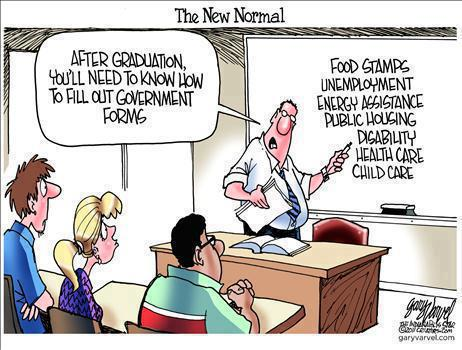
Cartoon – The New Normal

Education to employment: Getting Europe's youth into work - The ...

Cartoon – Jobless Economic Recovery

Unemployment Figure Cartoons and Comics - funny pictures from ...

Cartoon – Long-Term Unemployed (Please Give)

Sack cartoon: Unemployment benefits | Star Tribune

Cartoon – Unemployment Rate vs. Unemployed

Editorial cartoon: The shadow of unemployment

US weekly jobless claims hit 1.4 million, post second straight weekly increase

https://www.businessinsider.com/us-jobless-claims-unemployment-insurance-labor-market-filings-recession-coronavirus-2020-7

  • US jobless claims for the week that ended Saturday totaled 1.43 million, the Labor Department said Thursday. That came in slightly below the consensus economist estimate of 1.45 million.
  • It marked a second consecutive weekly increase after the prior week’s report ended a 15-week streak of declines. This week’s report brought total filings over a 19-week period to more than 54 million.
  • Continuing claims, the aggregate total of people receiving unemployment benefits, totaled 17 million for the week that ended July 18.

More than a million Americans filed for unemployment benefits last week, reflecting the continued high level of pandemic-induced layoffs as the US rolls back its economic-reopening efforts.

New US weekly jobless claims totaled 1.43 million in the week that ended Saturday, the Labor Department reported Thursday. That was slightly below the consensus economist estimate of 1.45 million compiled by Bloomberg. It also was a minor increase over the prior week’s 1.3 million filings, a reading that marked the first gain in 15 weeks.

In just a few months, the more than 54 million unemployment claims filed during the coronavirus pandemic have far surpassed the 37 million during the 18-month Great Recession. The latest figure is more than double the 665,000 filed during the Great Recession’s worst week.

“A combination of uncertainty from rising virus cases to the withdrawal of financial support is concerning for an already fragile recovery,” said Daniel Zhao, senior economist at Glassdoor. “The economy is still in deep risk of falling sideways – where conditions improve so sluggishly that the effects of the crisis become increasingly permanent.”

Continuing claims, which represent the aggregate total of people receiving unemployment benefits, came in at 17 million for the week that ended July 18, a decline from the prior period’s revised number.

Stubbornly high weekly claims for unemployment insurance add to growing concerns that the economic recovery from the pandemic-induced recession is stagnating as coronavirus cases increase. A number of states have had to pause or roll back their reopening plans to deal with COVID-19 spikes, harming the economic recovery.

Going forward, industry watchers will be waiting to see what the July jobs report shows. The report, due August 7, reflects a reference period that includes last week, when initial jobless claims ticked up for the first time in 15 weeks. That could foreshadow a negative headline jobs number in July, although the nonfarm payroll report has become increasingly difficult to predict.

Last week, the additional $600 unemployment benefit from the CARES Act expired, meaning that soon millions of Americans will see a significant decrease in weekly income. The GOP this week introduced its proposal, the HEALS Act, that would cut the weekly benefit to $200 until states could implement a program that’d replace 70% of wages for most filers.

In the week ending July 25, there were 829,697 initial claims from 50 states reporting for Pandemic Unemployment Assistance, the program that extended benefits to gig workers and independent contracts. The total applications for all state programs for the week ending July 11 was 30.2 million. 


A large racial divide exists in the concern over ability to pay for COVID-19 treatment

https://www.healthcarefinancenews.com/news/large-racial-divide-exists-concern-over-ability-pay-covid-19-treatment

Nonwhite adults say they’re either “extremely concerned” or “concerned” about the potential cost of care.

People of color are far more likely to worry about their ability to pay for healthcare if they are diagnosed with COVID-19 than their white counterparts, according to a new survey from nonprofit West Health and Gallup.

By a margin of almost two to one (58% vs. 32%), nonwhite adults report that they are either “extremely concerned” or “concerned” about the potential cost of care. That concern is three times higher among lower-income than higher-income households (60% vs. 20%).

The data come from an ongoing survey about Americans’ experiences with and attitudes about the healthcare system. The latest findings are based on a nationally representative sample of 1,017 U.S. adults interviewed between June 8 and June 30.

There’s also a disturbing trend when it comes to medication insecurity. Overall, 24% of U.S. adults say they lacked money to pay for at least one prescribed medicine in the past 12 months, an increase from 19% in early 2019. Among nonwhite Americans, the burden is growing even more quickly. Medication insecurity jumped 10 percentage points, from 21% to 31%, compared with a statistically insignificant three-point increase among white Americans (17% to 20%).

WHAT’S THE IMPACT?

All of this results in what Tim Lash, chief strategy officer for West Health, called a “significant and increasing racial and socioeconomic divide” in Americans’ views on the cost of healthcare and the impact it has on their lives. When polling started in 2019, one in five Americans were unable to pay for prescription medications within the past 12 months. That number now stands at one in four. The bottom line is that the situation is getting worse.

Amid broad concern about paying for the cost of COVID-19 or other medical expenses, health insurance benefits are likely more important than ever to U.S. workers. The survey found that 12% of workers are staying in a job they want to leave because they are afraid of losing healthcare benefits, a sentiment that is about twice as likely to be held by nonwhite workers as white workers (17% vs. 9%).

However, Americans step across racial lines in their overwhelming support for disallowing political contributions by pharmaceutical companies, and for government intervention in setting price limits for government-sponsored research and a COVID vaccine.

Nearly 9 in 10 U.S. adults (89%) think the federal government should be able to negotiate the cost of a COVID-19 vaccine, while only 10% say the drug company itself should set the price. Similarly, 86% of U.S. adults say there should be limits on the price of drugs that government-funded research helped develop.

Regarding the influence of pharmaceutical companies on the political process, 78% of adults say political campaigns should not be allowed to accept donations from pharmaceutical companies during the coronavirus pandemic.

THE LARGER TREND

Concerns over payment aren’t the only race-related disparities found in healthcare. Dr. Garth Graham, the vice president of community health at CVS Health, said during AHIP’s Institute and Expo in June that although African Americans make up 13% of the U.S. population, they account for about 24% of COVID-19 deaths.

He attributed some of the driving factors for these particular COVID-19-related disparities to the social determinants of health, the over-predominance of African American and Latino frontline workers, and the higher incidence-rates of chronic illness such as diabetes and hypertension in minority groups.

On June 19 – Juneteenth, as it’s known for many Black Americans – 36 Chicago hospitals penned an open letter declaring that systemic racism is a “public health crisis.”

“Systemic racism is a real threat to the health of our patients, families and communities,” the letter reads. “We stand with all of those who have raised their voices to capture the attention of Chicago and the nation with a clear call for action.”