State of the Union: by Paul Field

Image may contain: text that says 'Whoever Paul Field is he hit the nail on the head. Field PM own opinion, but you post Everyone entitled silly "Welcome Socialism... You Socialism. the wealthiest, geographically advantaged, productive people. about This failure our, "Booming economy," modest challenges. tis the market dissonance stores, farmers/producers and crisis about corporations needing emergency bailout longest history ending interest with being unable equipped provide healthcare, time post profits. crisis response depending antiquated systems nobody remembers operate. But all, politicization the for the benefit of education, science, natural lifestyles, lifestyles, charity, compassion, virtually else for brief gain gutted our society.'

Graphic of the Day: Citizens Who Lost Healthcare Coverage Since the Pandemic Began

Image may contain: text that says 'CITIZENS WHO LOST HEALTH CARE COVERAGE SINCE THE PANDEMIC BEGAN 27,000,000 US AUSTRALIA BELGIUM CANADA CHILE DENMARK FINLAND FRANCE GERMANY GREECE HUNGARY ITALY JAPAN NEW ZEALAND PORTUGAL SOUTH KOREA SPAIN SWEDEN TURKEY UK'

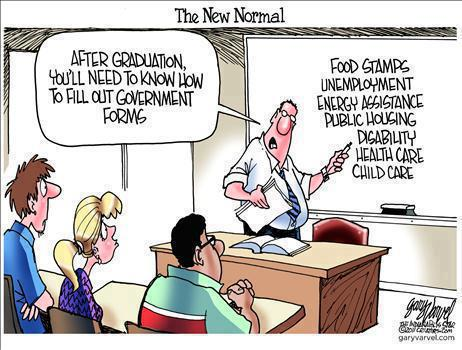
Cartoon – The New Normal

Education to employment: Getting Europe's youth into work - The ...

Cartoon – Jobless Economic Recovery

Unemployment Figure Cartoons and Comics - funny pictures from ...

Cartoon – Long-Term Unemployed (Please Give)

Sack cartoon: Unemployment benefits | Star Tribune

Cartoon – Unemployment Rate vs. Unemployed

Editorial cartoon: The shadow of unemployment

US weekly jobless claims hit 1.4 million, post second straight weekly increase

https://www.businessinsider.com/us-jobless-claims-unemployment-insurance-labor-market-filings-recession-coronavirus-2020-7

  • US jobless claims for the week that ended Saturday totaled 1.43 million, the Labor Department said Thursday. That came in slightly below the consensus economist estimate of 1.45 million.
  • It marked a second consecutive weekly increase after the prior week’s report ended a 15-week streak of declines. This week’s report brought total filings over a 19-week period to more than 54 million.
  • Continuing claims, the aggregate total of people receiving unemployment benefits, totaled 17 million for the week that ended July 18.

More than a million Americans filed for unemployment benefits last week, reflecting the continued high level of pandemic-induced layoffs as the US rolls back its economic-reopening efforts.

New US weekly jobless claims totaled 1.43 million in the week that ended Saturday, the Labor Department reported Thursday. That was slightly below the consensus economist estimate of 1.45 million compiled by Bloomberg. It also was a minor increase over the prior week’s 1.3 million filings, a reading that marked the first gain in 15 weeks.

In just a few months, the more than 54 million unemployment claims filed during the coronavirus pandemic have far surpassed the 37 million during the 18-month Great Recession. The latest figure is more than double the 665,000 filed during the Great Recession’s worst week.

“A combination of uncertainty from rising virus cases to the withdrawal of financial support is concerning for an already fragile recovery,” said Daniel Zhao, senior economist at Glassdoor. “The economy is still in deep risk of falling sideways – where conditions improve so sluggishly that the effects of the crisis become increasingly permanent.”

Continuing claims, which represent the aggregate total of people receiving unemployment benefits, came in at 17 million for the week that ended July 18, a decline from the prior period’s revised number.

Stubbornly high weekly claims for unemployment insurance add to growing concerns that the economic recovery from the pandemic-induced recession is stagnating as coronavirus cases increase. A number of states have had to pause or roll back their reopening plans to deal with COVID-19 spikes, harming the economic recovery.

Going forward, industry watchers will be waiting to see what the July jobs report shows. The report, due August 7, reflects a reference period that includes last week, when initial jobless claims ticked up for the first time in 15 weeks. That could foreshadow a negative headline jobs number in July, although the nonfarm payroll report has become increasingly difficult to predict.

Last week, the additional $600 unemployment benefit from the CARES Act expired, meaning that soon millions of Americans will see a significant decrease in weekly income. The GOP this week introduced its proposal, the HEALS Act, that would cut the weekly benefit to $200 until states could implement a program that’d replace 70% of wages for most filers.

In the week ending July 25, there were 829,697 initial claims from 50 states reporting for Pandemic Unemployment Assistance, the program that extended benefits to gig workers and independent contracts. The total applications for all state programs for the week ending July 11 was 30.2 million. 


A large racial divide exists in the concern over ability to pay for COVID-19 treatment

https://www.healthcarefinancenews.com/news/large-racial-divide-exists-concern-over-ability-pay-covid-19-treatment

Nonwhite adults say they’re either “extremely concerned” or “concerned” about the potential cost of care.

People of color are far more likely to worry about their ability to pay for healthcare if they are diagnosed with COVID-19 than their white counterparts, according to a new survey from nonprofit West Health and Gallup.

By a margin of almost two to one (58% vs. 32%), nonwhite adults report that they are either “extremely concerned” or “concerned” about the potential cost of care. That concern is three times higher among lower-income than higher-income households (60% vs. 20%).

The data come from an ongoing survey about Americans’ experiences with and attitudes about the healthcare system. The latest findings are based on a nationally representative sample of 1,017 U.S. adults interviewed between June 8 and June 30.

There’s also a disturbing trend when it comes to medication insecurity. Overall, 24% of U.S. adults say they lacked money to pay for at least one prescribed medicine in the past 12 months, an increase from 19% in early 2019. Among nonwhite Americans, the burden is growing even more quickly. Medication insecurity jumped 10 percentage points, from 21% to 31%, compared with a statistically insignificant three-point increase among white Americans (17% to 20%).

WHAT’S THE IMPACT?

All of this results in what Tim Lash, chief strategy officer for West Health, called a “significant and increasing racial and socioeconomic divide” in Americans’ views on the cost of healthcare and the impact it has on their lives. When polling started in 2019, one in five Americans were unable to pay for prescription medications within the past 12 months. That number now stands at one in four. The bottom line is that the situation is getting worse.

Amid broad concern about paying for the cost of COVID-19 or other medical expenses, health insurance benefits are likely more important than ever to U.S. workers. The survey found that 12% of workers are staying in a job they want to leave because they are afraid of losing healthcare benefits, a sentiment that is about twice as likely to be held by nonwhite workers as white workers (17% vs. 9%).

However, Americans step across racial lines in their overwhelming support for disallowing political contributions by pharmaceutical companies, and for government intervention in setting price limits for government-sponsored research and a COVID vaccine.

Nearly 9 in 10 U.S. adults (89%) think the federal government should be able to negotiate the cost of a COVID-19 vaccine, while only 10% say the drug company itself should set the price. Similarly, 86% of U.S. adults say there should be limits on the price of drugs that government-funded research helped develop.

Regarding the influence of pharmaceutical companies on the political process, 78% of adults say political campaigns should not be allowed to accept donations from pharmaceutical companies during the coronavirus pandemic.

THE LARGER TREND

Concerns over payment aren’t the only race-related disparities found in healthcare. Dr. Garth Graham, the vice president of community health at CVS Health, said during AHIP’s Institute and Expo in June that although African Americans make up 13% of the U.S. population, they account for about 24% of COVID-19 deaths.

He attributed some of the driving factors for these particular COVID-19-related disparities to the social determinants of health, the over-predominance of African American and Latino frontline workers, and the higher incidence-rates of chronic illness such as diabetes and hypertension in minority groups.

On June 19 – Juneteenth, as it’s known for many Black Americans – 36 Chicago hospitals penned an open letter declaring that systemic racism is a “public health crisis.”

“Systemic racism is a real threat to the health of our patients, families and communities,” the letter reads. “We stand with all of those who have raised their voices to capture the attention of Chicago and the nation with a clear call for action.”


Coronavirus threat rises across U.S.: ‘We just have to assume the monster is everywhere’

https://www.washingtonpost.com/health/coronavirus-threat-rises-across-us-we-just-have-to-assume-the-monster-is-everywhere/2020/08/01/cdb505e0-d1d8-11ea-8c55-61e7fa5e82ab_story.html?utm_campaign=wp_post_most&utm_medium=email&utm_source=newsletter&wpisrc=nl_most

The coronavirus is spreading at dangerous levels across much of the United States, and public health experts are demanding a dramatic reset in the national response, one that recognizes that the crisis is intensifying and that current piecemeal strategies aren’t working.

This is a new phase of the pandemic, one no longer built around local or regional clusters and hot spots. It comes at an unnerving moment in which the economy suffered its worst collapse since the Great Depression, schools are rapidly canceling plans for in-person instruction and Congress has failed to pass a new emergency relief package. President Trump continues to promote fringe science, the daily death toll keeps climbing and the human cost of the virus in America has just passed 150,000 lives.

“Unlike many countries in the world, the United States is not currently on course to get control of this epidemic. It’s time to reset,” declared a report released this week by Johns Hopkins University.

Another report from the Association of American Medical Colleges offered a similarly blunt message: “If the nation does not change its course — and soon — deaths in the United States could be well into the multiple hundreds of thousands.”

The country is exhausted, but the virus is not. It has shown a consistent pattern: It spreads opportunistically wherever people let down their guard and return to more familiar patterns of mobility and socializing. When communities tighten up, by closing bars or requiring masks in public, transmission drops.

That has happened in some Sun Belt states, including Arizona, Florida and Texas, which are still dealing with a surge of hospitalizations and deaths but are finally turning around the rate of new infections.

There are signs, however, that the virus is spreading freely in much of the country. Experts are focused on upticks in the percentage of positive coronavirus tests in the upper South and Midwest. It is a sign that the virus could soon surge anew in the heartland. Infectious-disease experts also see warning signs in East Coast cities hammered in the spring.

“There are fewer and fewer places where anybody can assume the virus is not there,” Gov. Mike DeWine (R) of Ohio said Wednesday. “It’s in our most rural counties. It’s in our smallest communities. And we just have to assume the monster is everywhere. It’s everywhere.”

Dire data

An internal Trump administration briefing document prepared by the Federal Emergency Management Agency and obtained Friday by The Washington Post counted 453,659 new infections in the past week.

Alaska is in trouble. And Hawaii, Missouri, Montana and Oklahoma. Those are the five states, as of Friday, with the highest percentage increase in the seven-day average of new cases, according to a Post analysis of nationwide health data.

“The dominoes are falling now,” said David Rubin, director of the PolicyLab at Children’s Hospital of Philadelphia, which has produced a model showing where the virus is likely to spread over the next four weeks.

His team sees ominous trends in big cities, including Baltimore, Chicago, Detroit, Indianapolis, Kansas City, Louisville, Philadelphia, St. Louis and Washington, with Boston and New York not far behind. And Rubin warns that the expected influx of students into college towns at the end of this month will be another epidemiological shock.

“I suspect we’re going to see big outbreaks in college towns,” he said.

Young people are less likely to have a severe outcome from the coronavirus, but they are adept at propelling the virus through the broader population, including among people at elevated risk. Numbers of coronavirus-related hospitalizations in the United States went from 36,158 on July 1 to 52,767 on July 31, according to The Post’s data. FEMA reports a sharp increase in the number of patients on ventilators.

The crisis has highlighted the deep disparities in health outcomes among racial and ethnic groups, and data from the Centers for Disease Control and Prevention this week showed that hospitalization rates due to the coronavirus are roughly five times higher among Black, Hispanic and Native Americans than Whites.

Thirty-seven states and Puerto Rico will probably see rising daily death tolls during the next two weeks compared with the previous two weeks, according to the latest ensemble forecast from the University of Massachusetts at Amherst that combines more than 30 coronavirus models.

There are glimmers of progress. The FEMA report showed 237 U.S. counties with at least two weeks of steady declines in numbers of new coronavirus cases.

But there are more than 3,100 counties in America.

“This is not a natural disaster that happens to one or two or three communities and then you rebuild,” said Beth Cameron, vice president for global biological policy and programs at the Nuclear Threat Initiative and a former White House National Security Council staffer focused on pandemics. “This is a spreading disaster that moves from one place to another, and until it’s suppressed and until we ultimately have a safe and effective and distributed vaccine, every community is at risk.”

A national strategy, whether advanced by the federal government or by the states working in tandem, will more effectively control viral spread than the current patchwork of state and local policies, according to a study from researchers at the Massachusetts Institute of Technology published Thursday in the Proceedings of the National Academy of Sciences.

The coordination is necessary because one state’s policies affect other states. Sometimes, that influence is at a distance, because states that are geographically far apart can have cultural and social ties, as is the case with the “peer states” of New York and Florida, the report found.

“The cost of our uncoordinated national response to covid-19, it’s dramatic,” said MIT economist Sinan Aral, senior author of the paper.

Some experts argue for a full six-to-eight-week national shutdown, something even more sweeping than what was instituted in the spring. There appears to be no political support for such a move.

Neil Bradley, executive vice president of the U.S. Chamber of Commerce, said fresh federal intervention is necessary in this second wave of closures. Enhanced federal unemployment benefits expired at the end of July, with no agreement on a new stimulus package in sight.

“Congress, on a bipartisan basis, was trying to create a bridge to help individuals and businesses navigate the period of a shutdown,” Bradley said. “Absent an extension of that bridge, in light of a second shutdown, that bridge becomes a pier. And then that’s a real problem.”

With the economy in shambles, hospitals filling up and the public frustrated, anxious and angry, the challenge for national leadership is finding a plausible sea-to-sea strategy that can win widespread support and simultaneously limit sickness and death from the virus.

Many Americans may simply feel discouraged and overtaxed, unable to maintain precautions such as social distancing and mask-wearing. Others remain resistant, for cultural or ideological reasons, to public health guidance and buy into conspiracy theories and pseudoscience.

DeWine is struggling to get Ohio citizens to take seriously the need to wear masks. A sheriff in rural western Ohio told the governor Wednesday that people didn’t think the virus was a big problem. DeWine informed the sheriff that the numbers in his county were higher per capita than in Toledo.

“The way I’ve explained to people, if we want to have Friday night football in the fall, if we want our kids back in school, what we do in the next two weeks will determine if that happens,” DeWine said.

The crucial metric

The coronavirus has always been several steps ahead of the U.S. government, the scientific community, the news media and the general public. By the time a community notices a surge in patients to hospital emergency rooms, the virus has seeded itself widely.

The virus officially known as SARS-CoV-2 can be transmitted by people who are infectious but not symptomatic. The incubation period is typically about six days, according to the CDC. When symptoms flare, they can be ambiguous. A person may not seek a test right away. Then, the test results may not come back for days, a week, even longer.

That delay makes contact tracing nearly futile. It also means government data on virus transmission is invariably out of date to some degree — it’s a snapshot of what was happening a week or two weeks before. And different jurisdictions use different metrics to track the virus, further fogging the picture.

The top doctors on the White House coronavirus task force, Deborah Birx and Anthony S. Fauci, are newly focused on the early warning signs of a virus outbreak. This week, they warned that the kind of runaway outbreaks seen in the Sun Belt could potentially happen elsewhere. Among the states of greatest concern: Indiana, Kentucky, Ohio and Tennessee.

Fauci and Birx have pointed to a critical metric: the percentage of positive test results. When that figure starts to tick upward, it is a sign of increasing community spread of the virus.

“That is kind of the predictor that if you don’t do something — namely, do something different — if you’re opening up at a certain pace, slow down, maybe even backtrack a little,” Fauci said in an interview Wednesday.

Without a vaccine, the primary tools for combating the spread of the virus remain the common-sense “non-pharmaceutical interventions,” including mask-wearing, hand-washing, staying out of bars and other confined spaces, maintaining social distancing of at least six feet and avoiding crowds, Fauci said.

“Seemingly simple maneuvers have been very effective in preventing or even turning around the kind of surges we’ve seen,” he said.

Thirty-three U.S. states have positivity rates above 5 percent. The World Health Organization has cited that percentage as a crucial benchmark for governments deciding whether to reopen their economy. Above 5 percent, stay closed. Below, open with caution.

Of states with positivity rates below 5 percent, nine have seen those rates rise during the last two weeks.

“You may not fully realize that when you think things are okay, you actually are seeing a subtle, insidious increase that is usually reflected in the percent of your tests that are positive,” Fauci said.

The shutdown blues

Some governors immediately took the White House warnings to heart. On Monday, Kentucky Gov. Andy Beshear (D) said at a news conference that he had met with Birx the previous day and was told he was getting the same warning Texas and Florida received “weeks before the worst of the worst happened.”

To prevent that outcome in his state, Beshear said, he was closing bars for two weeks and cutting seating in restaurants.

But as Beshear pleaded that “we all need to be singing from the same sheet of music,” discord and confusion prevailed.

Iowa Gov. Kim Reynolds (R) said Thursday she wasn’t convinced a mask mandate is effective: “No one knows particularly the best strategy.”

Earlier in the week, Tennessee Gov. Bill Lee (R) demurred on masks and bar closures even as he stood next to Birx and spoke to reporters.

“That’s not a plan for us now,” he said. He added emphatically, “We are not going to close the economy back down.”

The virus is spreading throughout his state, and not just in the big cities. Vacationers took the virus home from the honky-tonks of Nashville and blues clubs of Memphis to where they live in more rural areas, said John Graves, a professor at Vanderbilt University studying the pandemic.

“The geographical footprint of the virus has reached all corners of the state at this point,” Graves said.

In Missouri, Gov. Michael L. Parson (R) was dismissive of New York’s imposition of a quarantine on residents from his state as a sign of a worsening pandemic. “I’m not going to put much stock in what New York says — they’re a disaster,” he said at a news conference Monday.

Missouri has no mask mandate, leaving it to local officials to act — often in the face of hostility and threats. In the town of Branson, angry opponents testified Tuesday that there was no reason for a mask order when deaths in the county have been few and far between.

“It hasn’t hit us here yet, that’s what I’m scared of,” Branson Alderman Bill Skains said before voting with a majority in favor of the mandate. “It is coming, and it’s coming like a freight train.”

Democratic mayors in Missouri’s two biggest cities, Kansas City and St. Louis, said that with so many people needing jobs, they are reluctant to follow Birx’s recommendation to close bars.

“The whole-blanket approach to shut everybody down feels a little harsh for the people who are doing it right,” said Jacob Long, spokesman for St. Louis Mayor Lyda Krewson. “We’re trying to take care of some bad actors first.”

Minneapolis Mayor Jacob Frey also got a warning from Birx. On Wednesday, he said all bar drinking must move outside.

“We don’t want to be heading in the direction of everybody else,” said Kristen Ehresmann, director of the infectious-disease epidemiology division at the Minnesota Department of Health. She acknowledged that some options “are really pretty draconian.”

The problem is that less-painful measures have proven insufficient.

“The disease transmission we’re seeing is more than what would have been expected if people were following the guidance as it is laid out. It’s a reflection of the fact that they’re not,” she said.

‘A tremendous disappointment’

Wisconsin Gov. Tony Evers (D) tried to implement broad statewide measures early in the pandemic, only to have his “Safer at Home” order struck down by the state’s Supreme Court.

With cases in his state rising anew, he tried again Thursday, declaring a public health emergency and issuing a statewide mask mandate.

“While our local health departments have been doing a heck of a job responding to this pandemic in our communities, the fact of the matter is, this virus doesn’t care about any town, city or county boundary, and we need a statewide approach to get Wisconsin back on track,” Evers said.

Ryan Westergaard, Wisconsin’s chief medical officer, said he is dismayed by the failures of the national pandemic response.

“I really thought we had a chance to keep this suppressed,” Westergaard said. “The model is a good one: testing, tracing, isolation, supportive quarantine. Those things work. We saw this coming. We knew we had to build robust, flexible systems to do this in all of our communities. It feels like a tremendous disappointment that we weren’t able to build a system in time that could handle this.”

There is one benefit to the way the virus has spread so broadly, he noted: “We no longer have to keep track of people traveling to a hot spot if hot spots are everywhere.”


July ends on an uncertain note in the pandemic battle

https://mailchi.mp/0fa09872586c/the-weekly-gist-july-31-2020?e=d1e747d2d8

Fighting a losing battle - post - Imgur

After a week that brought the most disastrous economic data in modern history, the death of a former Presidential candidate from COVID, and signs of an alarming surge in virus cases in the Midwest, Congress left Washington for the weekend without reaching a deal on a new recovery bill. That left millions of unemployed Americans without supplemental benefit payments, business owners wondering whether more financial assistance would be forthcoming, and hospitals facing the requirement to begin repaying billions of dollars of advance payments from Medicare.

Also remaining on the table was funding to bolster coronavirus testing, with the top health official in charge of the testing effort testifying on Friday that the system is not currently able to deliver COVID test results to patients in a timely manner. While the surge in cases appears to be shifting to the Midwest, there were early indications of positive news across the Sun Belt, as the daily new case count in Florida, Louisiana, Texas, Arizona and California continued to decline, while daily death counts (a lagging indicator) continued to hit new records.

Nationally, the daily case count appears to have reached a new plateau of around 65,000, with daily deaths rising to a 7-day average above 1,150, matching a level last seen in May.

Meanwhile, new clinical findings continued to refine our understanding of how the virus attacks its victims. Reporting in JAMA Cardiology, researchers used cardiac MRI to examine heart function among 100 coronavirus patients, 67 of whom recovered at home without hospitalization, finding that 78 percent demonstrated cardiac involvement and 60 percent had evidence of active heart muscle inflammation—concerning signs pointing to possible long-term complications, even in patients with relatively mild courses of COVID infection.

And yesterday in JAMA, investigators reported that while young children are typically less affected by COVID-19 than adults, children under 5 may harbor 100 times as much active virus in their nose and throat as infected adults. While the study does not confirm that kids spread the virus to adults, it is sure to raise concerns about reopening schools, which has generally been considered relatively safer for younger children.

US coronavirus update: 4.8M cases; 151K deaths; 52.9M tests conducted.