The law, which was heavily backed by healthcare unions, is expected to affect approximately 469,000 healthcare workers and will be phased in over the next several years.
Dive Brief:
California Gov. Gavin Newsom on Friday signed a law raising the minimum wage for thousands of healthcare workers in the state from $15.50 an hour to $25 per hour.
State lawmakers argued in the law’s text that competitive wages are necessary to attract and retain healthcare workers who provide critical services, noting that “even before the COVID pandemic, California was facing an urgent and immediate shortage of healthcare workers, adversely impacting the health and well-being of Californians.”
Although wage increases will begin rolling out next year, the timeline for implementation depends on facility type. Large health systems with more than 10,000 workers and dialysis clinics must implement the law fully by 2026, while rural independent hospitals and those with a high mix of Medi-Cal and Medicare patients have until 2033 to implement the new wage minimums.
Dive Insight:
The law, backed by California healthcare unions, broadly defines healthcare workers as full-time or contract employees of a healthcare facility, including those in roles supporting the provision of healthcare, such as janitors, clerical workers, food service workers and medical billing personnel.
The wage increase is projected to impact approximately 469,000 employees, many of whom are currently living on the margins, according to an analysis from the University of California, Berkeley’s Labor Center.
Newsom signed the bill into law on the same day that Kaiser Permanente unions announced they had secured a tentative $25 per hour minimum wage for over 60,000 California-based Kaiser employees, pending ratification from members. California healthcare workers were represented by SEIU-United Healthcare Workers West president Dave Regan during Kaiser bargaining.
In Senate analyses of the minimum wage bill conducted in May and September, lawmakers said thatSEIU-UHW’s organizing elsewhere in the state had motivated the state-level analysis of pay. The unionspearheaded several similar local ordinances last year, including inLos Angeles and San Diego.
SEIU California, which sponsored the bill, released a statement on Friday saying that raising healthcare workers’ wages is a matter of equity. Three out of four workers who will see increases in wages thanks to the new law are women, and 76% are workers of color, according to SEIU California. Almost half of all healthcare workers affected are Latino, the union said.
“Governor Newsom signed SB 525 into law because he heard our call for change to a status quo that has left us exhausted and struggling to pay our bills,” Dr. Kelley Butler, resident physician at San Francisco General Hospital and member of SEIU California, said in a statement. “I’m proud of our collective advocacy as a union and proud of our Governor for doing right by the California healthcare workforce and the patients it serves.”
The law went through several edits since the beginning of the legislative session to make it more palatable to healthcare facilities, which largely opposed its passage earlier this year. An earlier version of the bill, debated in May, tasked all healthcare providers with instituting the new minimum by June 2025.
The final version of the law has a phase-in approach that grants some workers the new minimum by 2026 and leaves others waiting ten years to reap the full sum. Healthcare facilities that are in financial distress can also apply for a waiver program to temporarily delay payroll hikes. Tribal clinics are excluded from the new pay requirements entirely.
The California Hospital Association, a lobbying organization, ultimately supported the law, saying in a statement that it provided “stability and predictability for hospitals” by providing more reasonable phase-in requirements and “preempting city and county minimum wage measures for 10 years and local compensation measures for six years.”
The dialysis industry also got on board after lawmakers added an amendment which prevents SEIU from pushing for ballot measures targeting dialysis centers. The union’s unsuccessful lobbying for changes in the dialysis industry has cost the healthcare industry over 100 million dollars in recent years, according to reporting from CalMatters.
After decades of “doctor knows best,” the traditional physician-patient relationship is on the verge of a monumental shift. Generative AI tools like OpenAI’s ChatGPT, Google’s Bard and Microsoft’s Bing are poised to give people significantly more power and control—not just over their personal lives and professional tasks, but over their own medical health, as well.
As these tools become exponentially smarter, safer and more reliable (an estimated 32 times more powerful in the next five years), everyday Americans will gain access to unparalleled medical expertise—doled out in easily understandable terms, at any time, from any place.
Already, Google’s Med-PaLM 2 has scored an expert-level 86.5% on the U.S. medical license exam while other AI tools have matched the skill and accuracy of average doctors in diagnosing complex medical diseases.
Soon, AI tools will be able to give patients detailed information about their specific medical problems by integrating with health monitors and electronic medical records (such EHR projects are already underway at Oracle/Cerner and Epic). In time, people will be able to self-diagnose and manage their own diseases as accurately and competently as today’s clinicians.
This newfound expertise will shake the very foundation of clinical practice.
Although public health experts have long touted the concept of clinicians and patients working together through shared decision-making, this rarely happens in practice. Generative AI will alter that reality.
Building on part one of this article, which explained why generative AI constitutes a quantum leap ahead of all the tech that came before it, part two provides a blueprint for strengthening the doctor-patient alliance in the era of generative AI.
Patients Today: Sick And Confused
To understand how generative AI will impact the practice of medicine, it’s best to look closer at the current doctor-patient dynamic.
The relationship has undergone significant evolution. In the past century, patients and doctors held close, enduring relationships, built on trust and a deep understanding of the patient’s individual needs. These bonds were characterized by a strong sense of personal connection, as doctors had the time to listen to their patients’ concerns and provided not only medical treatment but also emotional support.
Today, the doctor-patient relationship remains vitally important, but it has undergone several meaningful changes. While medical advancements have greatly expanded the possibilities for diagnosis and treatment, the relationship itself has suffered from less trust and a more transactional focus. The average visit lasts just 15 minutes, barely enough time to address the patient’s current medical concerns.The doctor’s computer and electronic healthcare record systems sit, quite literally, between doctors and patients.The result is that patients feel rushed and find their medical care increasingly impersonal.Modern healthcare is characterized by time constraints, administrative burdens and a focus on efficiency. This can lead to a sense of impersonality and decreased communication between doctors and patients.
But throughout these changes, one thing has remained constant. The doctor-patient relationship, which dates back more than five millennia, has always existed on an uneven playing field, with patients forced to rely almost entirely on doctors to understand their diseases and what to do about them.
Though patients can and do access the internet for a list of possible diagnoses and treatment options, that’s not the same as possessing medical expertise. In fact, sorting through dozens of online sources—often with conflicting, inaccurate, outdated and self-serving information—proves more confusing than clarifying. Nowhere can web-surfers find personalized and credible advice based on their age, medical history, genetic makeup, current medications and laboratory results.
What’s needed now is modern doctor-patient relationship, one that is strong enough to meet the demands of medicine today and restore the vital, personal and emotional connections of the past.
Patients Tomorrow: Self-Diagnosing And Confident
In the future, generative AI will alter the doctor-patient dynamic by leveling the playing field.
Already, consumer AI tools can equip users with not just knowledge, but expertise. They allow the average person to create artistic masterpieces, produce hit songs and write code with unimagined sophistication. Next generations will offer a similar ability for patients, even those without a background in science or medicine.
Like a digitized second opinion, generative AI will shrink the knowledge gap between doctors and patients in ways that search engines can’t. By accessing millions of medical texts, peer-reviewed journals and scientific articles, ChatGPT will deliver accurate and unbiased medical expertise in layman’s language. And unlike internet sources, generative AI tools don’t have built-in financial incentives or advertising models that might skew responses.
To help patients and doctors navigate the upcoming era of generative AI, here’s a model for the future of medical practice based on proven approaches in education:
Introducing The ‘Flipped Healthcare’ Model
The “flipped classroom” can be traced back nearly four decades, but it became popularized in the United States in the early 2000s through the Khan Academy in Northern California.
Students begin the learning process by watching videos and engaging with interactive tools online rather than sitting through traditional lectures. This pre-class preparation (or “homework in advance”) allows people to learn at their own pace. Moreover, it enhances classroom discussions, letting teachers and students dive much deeper into topics than they ever could before. Indeed, students spend time in class applying knowledge and collaborating to solve problems—not merely listening and taking notes.
The introduction of generative AI opens the door to a similar approach in healthcare. Here’s how that might work in practice:
Pre-Consultation Learning: Before visiting a doctor, patients would use generative AI tools to understand their symptoms or medical conditions. This foundational knowledge would accelerate the diagnostic process and enhance patient understanding. Even in the absence of advanced diagnostic testing (X-rays or bloodwork), this pre-consultation phase allows the patient to understand the questions their clinicians will ask and the steps they will take.
In-Depth Human Interactions: With the patient’s knowledge base already established, consultations will dive deep into proactive health strategies and/or long-term chronic-disease management solutions, rather than having to start at square one. This approach maximizes the time patients and clinicians spend together. It also addresses the reality that at least 50% of patients leave the doctor’s office unsure of what they’ve been told.
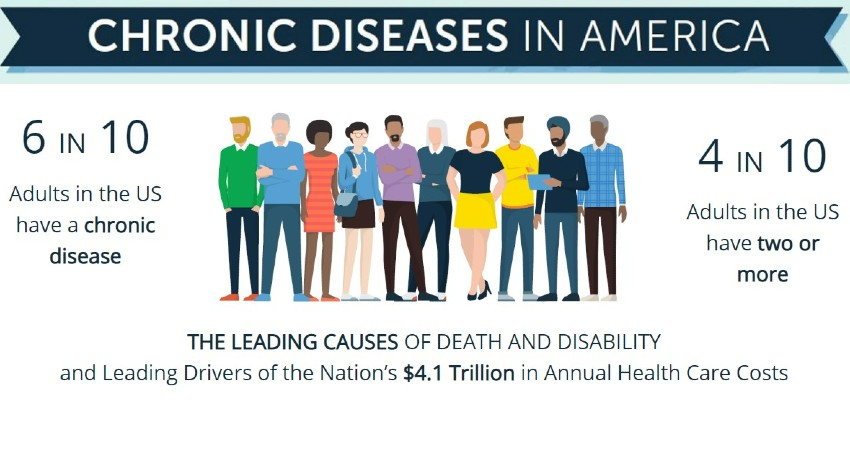
Home Monitoring: For the 60% of American patients living with chronic diseases, generative AI combined with wearable monitors will provide real-time feedback, thereby optimizing clinical outcomes. These patients, instead of going in for periodic visits (every three to six months), will obtain daily medical analysis and insights. And in cases where generative AI spots trouble (e.g., health data deviates from the doctor’s expectations), the provider will be able to update medications immediately. And when the patient is doing well, physicians can cancel follow-up visits, eliminating wasted time for all.
Hospital At Home: Inpatient (hospital) care accounts for 30% of all healthcare costs. By continuously monitoring patients with medical problems like mild pneumonia and controllable bacterial infections, generative AI (combined with home monitoring devices and telemedicine access) would allow individuals to be treated in the comfort of their home, safely and more affordably than today.
Lifestyle Medicine: Generative AI would support preventive health measures and lifestyle changes, reducing the overall demand for in-person clinical care. Studies confirm that focusing on diet, exercise and recommended screenings can reduce the deadliest complications of chronic disease (heart attack, stroke, cancer) by 30% or more. Decreasing the need for intensive procedures is the best way to make healthcare affordable and address the projected shortage of doctors and nurses in the future.
The Future: Collaborative Care For Superior Outcomes
The U.S. healthcare model often leaves patients feeling frustrated and overwhelmed. Meanwhile, time constraints placed on doctors lead to rushed consultations and misdiagnoses, which cause an estimated 800,000 deaths and disabilities annually.
The “flipped” approach, inspired by the Khan Academy, leverages the patient expertise that generative AI will create. Following this model will free up clinician time to make the most of every visit. Implementing this blueprint will require improvements in AI technology and an evolution of medical culture, but it offers the opportunity to make the doctor-patient relationship more collaborative and create empowered patients who will improve their health.
Talk with educators at the Khan Academy, and they will tell you how their innovative model results in better-educated students. They’ll also tell you how much more satisfied teachers and students are compared to those working in the traditional educational system. The same can be true for American medicine.
Last week, Kaiser Family Foundation (KFF) released its Annual Employer Health Benefits Survey which included a surprise:
The average annual single premium and the average annual family premium each increased by 7% over the last year.
In 2022 as post-pandemic recovery was the focus for employers, the average single premium grew by 2% and the average family premium increased by 1%. Health costs and insurance premiums were not top of mind concerns to employers struggling to keep employees paid and door open. But 7% is an eye-opener.
The rest of the findings in the 2023 KFF Report are unremarkable: they reflect employer willingness to maintain benefits at/near pre-pandemic levels and slight inclination toward expanded benefits beyond mental health:
“The average annual premium for employer-sponsored health insurance in 2023 is $8,435 for single coverage and $23,968 for family coverage. Comparatively, there was an increase of 5.2% in workers’ wages and inflation of 5.8%2. The average single and family premiums increased faster this year than last year (2% vs. 7% and 1% vs. 7% respectively).
Over the last five years, the average premium for family coverage has increased by 22% compared to an 27% increase in workers’ wages and 21% inflation.
For single coverage, the average premium for covered workers is higher at small firms than at large firms ($8,722 vs. $8,321). The average premiums for family coverage are comparable for covered workers in small and large firms ($23,621 vs. $24,104) …
Most covered workers contribute to the cost of the premium for their coverage. On average, covered workers contribute 17% of the premium for single coverage and 29% of the premium for family coverage, similar to the percentages contributed in 2022…
90% of workers with single coverage have a general annual deductible that must be met before most services are paid for by the plan, similar to the percentage last year (88%).
The average deductible amount in 2023 for workers with single coverage and a general annual deductible is $1,735, similar to last year…
In 2023, among workers with single coverage, 47% of workers at small firms and 25% of workers at large firms have a general annual deductible of $2,000 or more. Over the last five years, the percentage of covered workers with a general annual deductible of $2,000 or more for single coverage has grown from 26% to 31%.
While nearly all large firms (firms with 200 or more workers) offer health benefits to at least some workers, small firms (3-199 workers) are significantly less likely to do so. In 2023, 53% of all firms offered some health benefits, similar to the percentage last year (51%).”
My take:
These findings show that employers are not prone to drastic changes in health benefits for their employees despite recognition it is expensive and unaffordable to small companies and for many of their own employees. But many large self-insured employers (except those in government, education and healthcare) are poised to make significant changes next year. They recognize themselves as the primary source of profits enjoyed by insurers, hospitals, physicians, drug companies and others.
They’re developing multi-year at risk direct contracts, value-based purchasing arrangements, primary care gatekeeping, narrow networks, restricted formularies, alternative care models and more to that leverage their clout. They’re going on offense.
The KFF Benefits Survey is a snapshot of where employer benefits are today, but it’s likely not the same next year. It appears employers are ready to engage the health industry head on.
PS Last week, the feud between Senate Health, Education, Labor and Pensions (HELP) Committee Chair Bernie Sanders and Not-for-Profit Health Systems heated up. On Oct. 10, he released a Majority Staff Report that said NFP hospitals do not deserve their tax exemptions as they spend “paltry amounts” on charity care. “Hospitals have gladly accepted the tax benefits that come with nonprofit status but have failed to provide the required community benefits. Non-profit hospitals spent only an estimated $16 billion on charity care in 2020, or about 57% of the value of their tax breaks in the same year.”
The same day, the American Hospital Association (AHA) released its analysis of hospital Schedule H filings concluding that tax-exempt hospitals provided $130 billion in community benefits in 2020 and called the HELP report “just plain wrong”.
In response to the AHA report, Sanders noted that AHA had not included CEO Compensation for NFPs in its analysis though featured prominently in his Majority Staff Report: “In 2021, the most recent year for which data is available for all of the 16 hospital chains, those companies’ CEOs averaged more than $8 million in compensation and collectively made over $140 million…
The disparities between the paltry amounts these hospitals are spending on charity care and their massive revenues and excessive executive compensation demonstrates that they are failing to live up to their end of the non-profit bargain.”
This tit for tat between the Committee Chairman and AHA is notable for 2 reasons: it draws attention to the Schedule H information goldmine about how not-for-profit hospitals operate since they’re now required to attach their S-10 Medicare cost report worksheets. Quantifying charity care in Exhibit 3B (for which there’s no expectation of payment) and the myriad of claimed community benefits including bad debt in Schedule 3C will likely intensify scrutiny of NFPs even more. Second, it draws attention to Executive Pay in hospitals: in this regard the Majority Staff Report commentary on CEO pay is misleading: by combining Column B (wages, bonuses) with Columns C (Deferred compensation) and D (non-taxable benefits), the total is significantly higher than one-year’s actual take-home pay for the CEOs. But it makes headlines!
If not-for-profit systems wish to lead transformational change in U.S. healthcare, not-for-profit system boards and their trade associations must be prepared to address the storm clouds gathering above. The skirmish between the Senate HELP Chair and AHA mirrors an increasingly skeptical public who, with Congress, believe the system is being gamed.
Vancouver, Wash.-based PeaceHealth has notified state officials about layoffs associated with the closure of its Sacred Heart Medical Center University District hospital campus in Eugene, Ore.
“PeaceHealth will begin consolidating services at the [Sacred Heart Medical Center] RiverBend campus in Springfield, [Ore.], and will experience a reduction in our workforce through this process that will occur throughout the next few months,” Justin Thomas, senior director for human resources in the PeaceHealth Oregon network, wrote in a WARN notice filed Oct. 19 with the Oregon Higher Education Coordinating Commission’s Office of Community Colleges and Workforce Development. “We expect some aspects of that campus to be completely closed by Feb. 1, 2024.”
PeaceHealth told state officials there are currently 463 caregivers on the University District hospital campus, and the health system is looking to have opportunities for roughly 325 caregivers, displacing 129.
“However, some of those individuals may not choose to come work at the RiverBend hospital. We do have a severance policy in place for those that will be affected by this layoff,” Mr. Thomas said.
PeaceHealth also told state officials in the notice that it notified staff in August of these changes and recently received notice from Oregon officials that it can close the first department, the emergency department, on Dec. 1. The health system noted that most of these caregivers will have positions available at the RiverBend hospital.
“However, per the request from the [Service Employees International Union], we are considering this a lay off for those caregivers and not a reorganization, so I will be providing them notice, knowing that a large portion will still be coming to the RiverBend hospital,” said Mr. Thomas.
In August, PeaceHealth shared plans to close the “underutilized” University District campus and shift services to the RiverBend campus. The plans also include relocating an urgent care to a medical office building on the University District campus to maintain access to care for those who live in the area.
Artificial intelligence (AI) has long been heralded as an emerging force in medicine. Since the early 2000s, promises of a technological transformation in healthcare have echoed through the halls of hospitals and at medical meetings.
But despite 20-plus years of hype, AI’s impact on medical practice and America’s health remains negligible (with minor exceptions in areas like radiological imaging and predictive analytics).
As such, it’s understandable that physicians and healthcare administrators are skeptical about the benefits that generative AI tools like ChatGPT will provide.
They shouldn’t be. This next generation of AI is unlike any technology that has come before.
The launch of ChatGPT in late 2022 marked the dawn of a new era. This “large language model” developed by OpenAI first gained notoriety by helping users write better emails and term papers. Within months, a host of generative AI products sprang up from Google, Microsoft and Amazon and others. These tools are quickly becoming more than mere writing assistants.
In time, they will radically change healthcare, empower patients and redefine the doctor-patient relationship. To make sense of this bold vision for the future, this two-part article explores:
The massive differences between generative AI and prior artificial intelligences
How, for the first time in history, a technological innovation will democratize not just knowledge, but also clinical expertise, making medical prowess no longer the sole domain of healthcare professionals.
To understand why this time is different, it’s helpful to compare the limited power of the two earliest generations of AI against the near-limitless potential of the latest version.
Generation 1: Rules-Based Systems And The Dawn Of AI In Healthcare
The latter half of the 20th century ushered in the first generation of artificial intelligence, known as rule-based AI.
Programmed by computer engineers, this type of AI relies on a series of human-generated instructions (rules), enabling the technology to solve basic problems.
In many ways, the rule-based approach resembles a traditional medical-school pedagogy where medical students are taught hundreds of “algorithms” that help them translate a patient’s symptoms into a diagnosis.
These decision-making algorithms resemble a tree, beginning with a trunk (the patient’s chief complaint) and branching out from there. For example, if a patient complains of a severe cough, the doctor first assesses whether fever is present. If yes, the doctor moves to one set of questions and, if not, to a different set. Assuming the patient has been febrile (with fever), the next question is whether the patient’s sputum is normal or discolored. And once again, this leads to the next subdivision. Ultimately each end branch contains only a single diagnosis, which can range from bacterial, fungal or viral pneumonia to cancer, heart failure or a dozen other pulmonary diseases.
This first generation of AI could rapidly process data, sorting quickly through the entire branching tree. And in circumstances where the algorithm could accurately account for all possible outcomes, rule-based AI proved more efficient than doctors.
But patient problems are rarely so easy to analyze and categorize. Often, it’s difficult to separate one set of diseases from another at each branch point. As a result, this earliest form of AI wasn’t as accurate as doctors who combined medical science with their own intuition and experience. And because of its limitations, rule-based AI was rarely used in clinical practice.
Generation 2: Narrow AI And The Rise Of Specialized Systems
As the 21st century dawned, the second era of AI began. The introduction of neural networks, mimicking the human brain’s structure, paved the way for deep learning.
Narrow AI functioned very differently than its predecessors. Rather than researchers providing pre-defined rules, the second-gen system feasted on massive data sets, using them to discern patterns that the human mind, alone, could not.
In one example, researchers gave a narrow AI system thousands of mammograms, half showing malignant cancer and half benign. The model was able to quickly identify dozens of differences in the shape, density and shade of the radiological images, assigning impact factors to each that reflected the probability of malignancy. Importantly, this kind of AI wasn’t relying on heuristics (a few rules of thumb) the way humans do, but instead subtle variations between the malignant and normal exams that neither the radiologists nor software designers knew existed.
In contrast to rule-based AI, these narrow AI tools proved superior to the doctor’s intuition in terms of diagnostic accuracy. Still, narrow AI showed serious limitations. For one, each application is task specific. Meaning, a system trained to read mammograms can’t interpret brain scans or chest X-rays.
But the biggest limitation of narrow AI is that the system is only as good as the data it’s trained on. A glaring example of that weakness emerged when United Healthcare relied on narrow AI to identify its sickest patients and give them additional healthcare services.
In filtering through the data, researchers later discovered the AI had made a fatal assumption. Patients who received less medical care were categorized as healthier than patients who received more. In doing so, the AI failed to recognize that less treatment is not always the result of better health. This can also be the result of implicit human bias.
Indeed, when researchers went back and reviewed the outcomes, they found Black patients were being significantly undertreated and were, therefore, underrepresented in the group selected for additional medical services.
Media headlines proclaimed, “Healthcare algorithm has racial bias,” but it wasn’t the algorithm that had discriminated against Black patients. It was the result of physicians providing Black patients with insufficient and inequitable treatment. In other words, the problem was the humans, not narrow AI.
Generation 3: The Future Is Generative
Throughout history, humankind has produced a few innovations (printing press, internet, iPhone) that transformed society by democratizing knowledge—making information easier to access for everyone, not just the wealthy elite.
Now, generative AI is poised to go one step further, giving every individual access to not only knowledge but, more importantly, expertise as well.
Already, the latest AI tools allow users to create a stunning work of art in the style of Rembrandt without ever having taken a painting class. With large language models, people can record a hit song, even if they’ve never played a musical instrument. Individuals can write computer code, producing sophisticated websites and apps, despite never having enrolled in an IT course.
Future generations of generative AI will do the same in medicine, allowing people who never attended medical school to diagnose diseases and create a treatment plan as well as any clinician.
Already, one generative AI tool (Google’s Med-PaLM 2) passed the physician licensing exam with an expert level score. Another generative AI toolset responded to patient questions with advice that bested doctors in both accuracy and empathy. These tools can now write medical notes that are indistinguishable from the entries that physicians create and match residents’ ability to make complex diagnoses on difficult cases.
Granted, current versions require physician oversight and are nowhere close to replacing doctors. But at their present rate of exponential growth, these applications are expected to become at least 30 times more powerful in the next five years. As a result, they will soon empower patients in ways that were unimaginable even a year ago.
Unlike their predecessors, these models are pre-trained on datasets that encompass the near-totality of publicly available information—pulling from medical textbooks, journal articles, open-source platforms and the internet. In the not-distant future, these tools will be securely connected to electronic health records in hospitals, as well as to patient monitoring devices in the home. As generative AI feeds on this wealth of data, its clinical acumen will skyrocket.
Within the next five to 10 years, medical expertise will no longer be the sole domain of trained clinicians. Future generations of ChatGPT and its peers will put medical expertise in the hands of all Americans, radically altering the relationship between doctors and patients.
Whether physicians embrace this development or resist is uncertain. What is clear is the opportunity for improvement in American medicine. Today, an estimated 400,000 people die annually from misdiagnoses, 250,000 from medical errors, and 1.7 million from mostly preventable chronic diseases and their complications.
In the next article, I’ll offer a blueprint for Americans as they grapple to redefine the doctor-patient relationship in the context of generative AI. To reverse the healthcare failures of today, the future of medicine will have to belong to the empowered patient and the tech-savvy physician. The combination will prove vastly superior to either alone.
In Las Vegas this week, 10,000 healthcare entrepreneurs, investors, purchasers and industry onlookers are gathered to celebrate the business of U.S. healthcare. It follows the inaugural Nashville Healthcare Sessions last month that drew a crowd to Music City touting “the premier healthcare conference set in the most relevant, exciting, and welcoming city in the south.“
Besides their locations and exceptional marketing, three notable themes are prominent that speak volumes about where this industry is:
1- The focus is systemness—integrated, connected, data-driven and scalable. Traditional divides that separate health and social services, hospitals and insurers, biotherapeutics and companion diagnostics are obsolete and access to private capital and swift execution vitals. And embedded in systemness is an expanded role of human resources that create workforces that are right-sized, diverse, AI-enabled and productive. 2-Technologies focused on end user value are gaining traction. Solutions that enable better, quicker, more accurate and affordable transactions with consumers are prominent. While traditional providers—hospitals, physicians, long-term care providers and public health programs– see HIT and AI investments as ways to make their work more efficient and satisfying, disruptors are focused on the untapped consumer market that’s dissatisfied with the status quo. 3-Access to smart capital is key. The venture capital and private equity markets in healthcare services are weathering corrections that have deflated returns and forced many to pullback or exit. The possibility of regulatory reforms involving greater transparency, carried interest restrictions and minimum hold periods means stronger funds with experienced operating partners and stable LP funding will be advantaged. In Vegas, they’ll be working the hallways to find tuck-ins for their platform bets and courting not-for-profit hospitals needing non-operating income to fund their growth and diversification efforts.
Those attending recognize the U.S. health industry faces unprecedented challenges:
Growing employer activism against lack of price transparency and inexplicably high unit costs for hospital care, prescription drugs, insurer overhead and mal-effect of consolidation in each sector.
Medical inflation that’s persistent but disproportionately absorbed by fewer and fewer employers and individuals who lack bargaining power.
Value-based purchasing activities that have failed to achieve desired cost containment goals.
Public dissatisfaction with the “system” and growing receptivity to alternatives.
Growing hostility in media coverage about hospitals, especially large not-for-profit hospitals, deemed to be profitable and wasteful.
Increased tension between providers (hospitals, medical groups) and insurers.
Increased regulation in states and court rulings that change (or have the potential to alter) how care is defined, provided, funded and legally authorized.
HLTH and Session attendees recognize the uncertainties of the political, economic and global markets in which healthcare operates. Israel will be front of mind to all as the fast-paced HLTH proceedings continue this week.
The root causes of the system’s poor performance are understood and considered: they’re daunting. But that does not impede the willingness of private investors to make bets presuming the future of the U.S. healthcare is not a repeat of its past.
Contrary to pop culture, what happens in Vegas this week will not stay in Vegas: that’s the point. The health system is not working well. While some HLTH and Sessions attendees are no doubt focused on incremental innovations to improve the performance of their legacy organizations, others are looking beyond. And, if industries akin to healthcare like financial services and higher education are instructive, the latter are better prepared to respond than the former.
PS: Nearly 50 years to the day after the Yom Kippur War in 1973, Israel was again taken by surprise by a sudden attack. Unlike the series of clashes with Palestinian forces in Gaza over the past few years, this appears to be a full-scale conflict mounted by Hamas and its allies including Iran.
Thousands are dead, more are injured and the health systems in both will be overwhelmed by the need. Health systems matter!
There is a local urgent care chain that we frequented regularly when my kids were young and cycling through rounds of ear infections and strep throat. The experience was always solid, driven by online scheduling, efficient operations, and good customer service.
A few years ago, the clinics were bought by a local health system. We recently visited one for the first time post-acquisition, when my now teenage son needed to rule out a broken bone from a sports injury. This experience at the same urgent care left a very different impression.
In contrast to the “easy in, easy out” experience I expected, we sat in an exam room for hours, even though the place was not crowded. While this could be due to the staffing challenges pervasive across the industry, other elements of the acquisition left a different impression.
Gone was the advertised cash pricing (and I’m anticipating a higher bill once we get one). The new patient self-registration system was overly complex, built for a hospital, not an immediate care setting.
The only signs of “systemness”? Multiple prompts to sign up for the health system’s MyChart patient portal (not interested, they have few facilities close by), and a printed referral to an employed orthopedic surgeon a forty-minute drive from home (with no guidance as to whether or when we should seek it, given that no bones were broken).
A few days ago, a scheduler from the system called to book the appointment. With no inquiry as to whether my son’s pain had improved, the interaction felt like a business transaction, not clinical follow-up. I declined.
Just because a care site is acquired by a health system, that doesn’t mean that patients will feel any value from its being part of a system.
Right or wrong, my impression was that health system ownership has made for a worse experience: inefficient, more complicated, and possibly more expensive.
Nothing about the visit gave me confidence that there was a benefit to following up with an affiliated provider. The health system had failed to earn our referral.
Systems buy assets like urgent care to create entry points that will generate downstream demand and hopefully build loyalty to the brand. But capturing that must start with delivering an excellent experience in every encounter, not merely changing the name on the building.
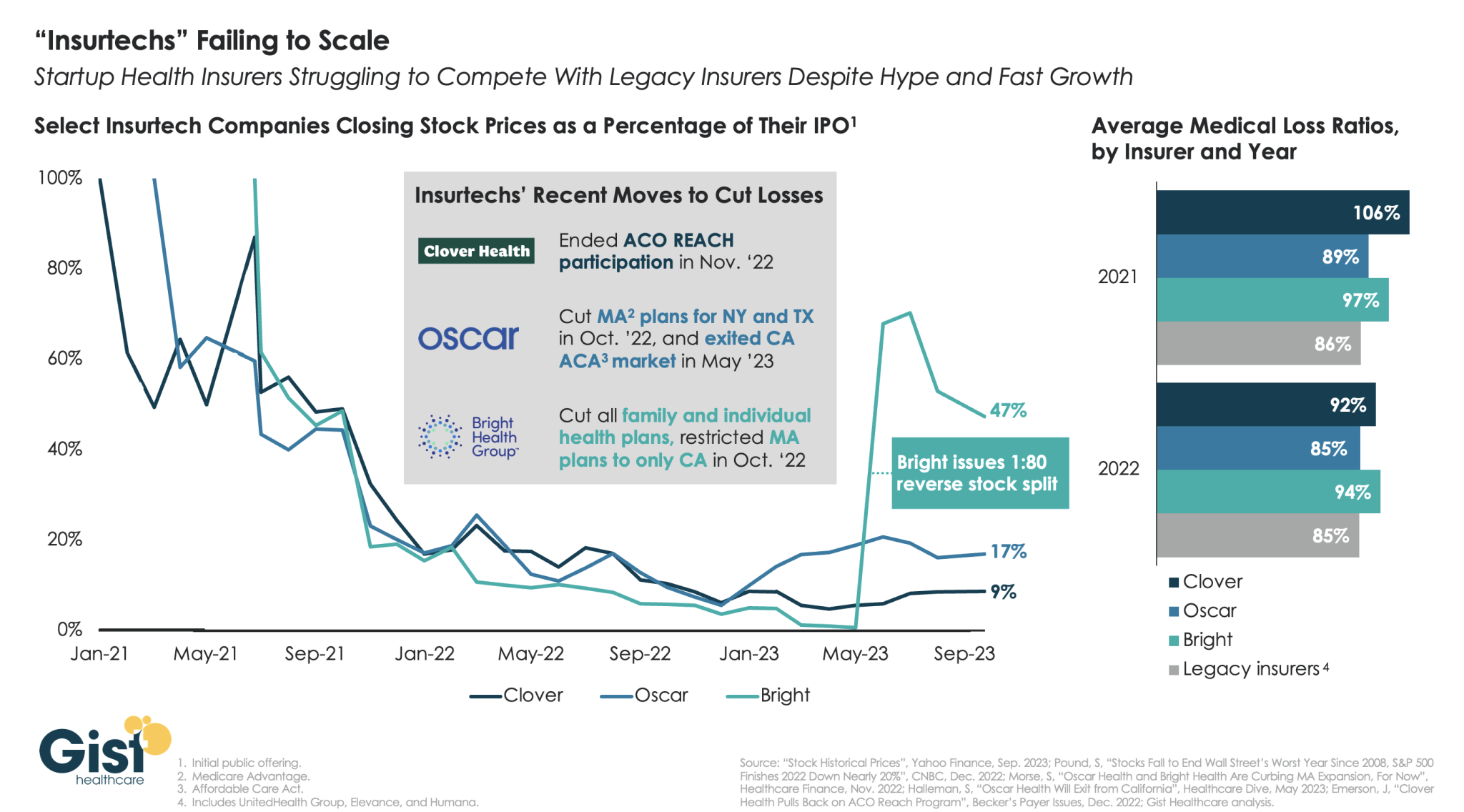
“Insurtechs” Clover Health, Oscar Health, and Bright Health all went public in the midst of the hot equity market of 2021. Investors were excited by the fast growth of these health insurer startups, and their potential to revolutionize an industry dominated by a few large players.
However, the hype has dissipated as financial performance has deteriorated. After growing at all costs during a period of low interest rates, changing market conditions directed investors to demand a pivot to profitability,which the companies have struggled to deliver—twoyears later,none of the three has turned a profit.
Oscar and Bright have cut back their market presence significantly, while Clover has mostly carried on while sustaining high losses. In the last two years, only Oscar has posted a medical loss ratio in line with other major payers, who meanwhile are reporting expectation-beating profits. While Oscar has shown signs of righting the ship since the appointment of former Aetna CEO Mark Bertolini,
the future of these small insurers remains uncertain. As their losses mount and they exit markets, they may become less desirable as acquisition targets for large payers.
Published this week in the Washington Post, this unsparing article packages a year of investigative reporting into a thorough accounting of why US life expectancy is undergoing a rapid decline.
After peaking in 2014, US life expectancy has declined each subsequent year, trending far worse than peer countries. In a quarter of US counties, working-age Americans are dying at the highest rates in 40 years, reversing decades of progress. While deaths from firearms and opioids play a role, chronic diseases remain our nation’s greatest killer, erasing more than double the years of life as all overdoses, homicides, suicides, and car accidents combined.
The drivers of this trend are too numerous to list, but experts suggest targeting “the causes of the causes”, namely social factors, as the death rate gap between the rich and poor has grown almost 15x faster than the income gap since 1980.
The Gist: This reporting is a sobering reminder of the responsibilities—and failures—borne by our nation’s healthcare system.
The massive death toll of chronic disease in this country is not an indictment of the care Americans receive, but of the care and other resources they cannot access or afford.
While it’s not the mandate of health systems to reduce systemic issues like poverty, there is no solution to the problem without health systems playing a key role in increasing access to care, while convening community resources in service of these larger goals.