Finances of older Americans being dinged by high health costs, survey finds

https://www.healthcaredive.com/news/finances-older-americans-being-dinged-high-health-costs-survey-finds/625545/

Dive Brief:

  • Healthcare costs are becoming an increasing source of stress for older Americans, leading to some paring back on treatment, medicines or other spending on food and utilities — or skipping them altogether — to cover medical costs, according to new research conducted by Gallup in partnership with West Health.
  • The survey of U.S. adults released Wednesday found that almost half of adults aged 50 to 64 and more than a third of adults 65 and older are concerned they won’t be able to pay for needed healthcare services in the next year. That’s nearly 50 million older Americans.
  • About 80 million adults above age 50 see healthcare costs as a financial burden. Becoming eligible for Medicare seems to assuage those worries slightly, however: 24% of adults aged 50 to 64, who are not yet eligible for the federal health insurance, said health costs were a major burden. That percentage fell to 15% for those aged 65 and above.

Dive Insight:

The West Health-Gallup survey, conducted in September and October of 2021, is the latest vignette of how exorbitant healthcare costs in the U.S. are increasingly impacting the financial stability of Americans, especially those of retirement age who are more likely to have expensive medical needs.

Out-of-pocket healthcare expenses for adults aged 65 and older increased 41% from 2009 to 2019, according to HHS data. That population spends on average almost double their total expenditures on healthcare costs compared with the general population, despite Medicare coverage.

That cost problem is only likely to worsen amid surging inflation raising the cost of groceries, gas and other needed items. Additionally, U.S. demographics shifts are an added stressor. By 2030, the percentage of Americans 65 years and older will outweigh those under the age of 18, a first in the country’s history, according to Census Bureau projections.

The resulting stress on the Medicare program could impact benefits and cost for beneficiaries.

As sizable numbers of Americans 65 and older face tangible tradeoffs to pay for healthcare, many more Americans in the next decade will incur health and financial consequences because of high costs,” researchers wrote in the report.

The West Health-Gallup poll found about one in four adults aged 65 and above cut back on food, utilities, clothing or medication to cover healthcare costs. That’s compared to three in 10 for adults aged 50 to 64.

Older women and Black adults were more likely to forgo basic necessities to pay for healthcare than other demographics.

More than 20 million Americans aged 50 years and above said there was a time within the last three months when they or a family member was sick, but didn’t seek treatment due to cost.

More than 15 million Americans said they or a family member skipped a pill or dose of prescribed medicine in order to save money.

Researchers urged policymakers to act to improve efficiency and reduce the costs of medical care and prescription drugs in the U.S. Congress has yet to take meaningful action to lower medical costs, despite rising support for government intervention and high-profile proposals from the Biden administration.

Megadeals lift healthcare M&A revenues to record in Q2

https://www.healthcaredive.com/news/Kaufman-Hall-second-quarter-healthcare-report-megadeal/627260/

Dive Brief:

  • Healthcare mergers reached a record-high $19.2 billion in total transacted revenue in the second quarter of this year, led by the planned tie-up of Advocate Aurora Health and Atrium Health and several other large deals, according to the latest quarterly M&A report from Kaufman Hall.
  • Still, the number of healthcare transactions announced during the second quarter remained below pre-pandemic levels at just 13 deals, one more than the record-low total seen in the first quarter of this year. Activity so far in 2022 underscores what could be a longer-term shift toward fewer but larger hospital deals, the industry consultants said.
  • Kaufman Hall also predicted continued interest in partnerships between health systems and skilled nursing facilities that can offer new services or more specialized care. Such facilities can support patients’ earlier discharge from inpatient care to a lower-cost setting and can help reduce hospital re-admissions, the report said.

Dive Insight:

Dealmaking in the first half of the year continues a sluggish pace established in 2021, when just 49 health system mergers were announced all year. Last year’s tally marked the lowest annual deal total in a decade, according to Kaufman Hall.

But deals are getting larger. The second quarter’s $19.2 billion in transacted revenue is more than double the total of $8.5 billion seen in the second quarter of 2021, when a similar number of transactions was announced.

Megamergers, in which the seller’s annual revenue tops $1 billion, remain an ongoing trend. Kaufman Hall tracked two such deals in the second quarter: the Advocate-Atrium transaction and Trinity Health’s planned acquisition of Iowa-based MercyOne.

The second quarter saw two additional transactions with smaller-party revenue above $500 million: Bellin Health System’s merger with Gundersen Health System and George Washington University Hospital’s combination with Universal Health Services.

All told, the average size of the smaller party in a deal reached a record $1.5 billion in the second quarter. This was more than double 2021’s record average size of $619 million, Kaufman Hall found.

A couple of recent transactions illustrate the trend toward partnerships with skilled nursing facilities, the report noted. Hackensack Meridian Health announced in late March that the majority of its long-term care facilities would be acquired by Complete Care, and in April, Virtua Health announced the sale of its two skilled nursing facilities to Tryko Partners. Kaufman Hall advised Virtua Health in the transaction.

Antibiotic-resistant infections rose in hospitals during pandemic, CDC data shows

https://www.healthcaredive.com/news/covid-pandemic-rise-hospital-infections-antibiotic-resistant-cdc/627109/

Exterior of the Center for Disease Control headquarters is seen on October 13, 2014, in Atlanta, Georgia.

Dive Brief:

  • Hospital-acquired, antibiotic-resistant infections grew 15% from 2019 to 2020, according to data out Tuesday from the Centers for Disease Control and Prevention.
  • Nearly 30,000 people died from infections associated with healthcare settings in the first year of the pandemic and about 40% were infected during a hospital stay, according to the CDC.
  • Personal protective equipment and staffing shortages; longer patient stays and use of devices like catheters and ventilators; and significant surges in antibiotic use contributed to the rise in infections, the CDC said.

Dive Insight:

The new data erases years of progress — from 2012 to 2017, hospital-acquired, antimicrobial-resistant infections fell 27%, according to data from the CDC.

Hospitals struggled to follow infection prevention and control guidance during the first year of the pandemic as they faced resource strains and treated sicker patients who needed longer stays. At the same time, hospitals boosted their use of antibiotics, reducing their effectiveness.

In many cases, patients who exhibited pneumonia-like symptoms at hospitals were given antibiotics as a first option even though they were infected with COVID-19. Antibiotics are not effective in treating COVID-19.

Nearly 80% of patients hospitalized with COVID-19 from March to October of 2020 received an antibiotic, according to the CDC.

Antimicrobrial resistance testing was also down in 2020. The CDC’s AR lab network reported receiving 23% fewer testing specimens during 2020 compared to 2019. Due to the pandemic, some CDC progams that focused on antimicrobrial resistance were also repurposed to offer surge capacity COVID-19 testing, the report said.

Without infrastructure and preparedness, it warned, critical data could be “delayed again when the next threat emerges.”

“This setback can and must be temporary,” Michael Craig, director of the CDC’s antibiotic resistance coordination and strategy unit, said in a report analyzing the data.

“The best way to avert a pandemic caused by an antimicrobial-resistant pathogen is to identify gaps and invest in prevention to keep our nation safe,” he said.

Hospitals need ‘transformational changes’ to stem margin erosion

https://www.healthcaredive.com/news/Fitch-ratings-nonprofit-hospital-changes/627662/

Dive Brief:

  • Nonprofit hospitals are reporting thinner margins this year, stretched by rising labor, supply and capital costs, and will be pressed to make big changes to their business models or risk negative rating actions, Fitch Ratings said in a report out Tuesday.
  • Warning that it could take years for provider margins to recover to pre-pandemic levels, Fitch outlined a series of steps necessary to manage the inflationary pressures. Those moves include steeper rate increases in the short term and “relentless, ongoing cost-cutting and productivity improvements” over the medium term, the ratings agency said.
  • Further out on the horizon, “improvement in operating margins from reduced levels will require hospitals to make transformational changes to the business model,” Fitch cautioned.

Dive Insight:

It has been a rough year so far for U.S. hospitals, which are navigating labor shortages, rising operating costs and a rebound in healthcare utilization that has followed the suppressed demand of the early pandemic. 

The strain on operations has resulted in five straight months of negative margins for health systems, according to Kaufman Hall’s latest hospital performance report.

Fitch said the majority of the hospitals it follows have strong balance sheets that will provide a cushion for a period of time. But with cost inflation at levels not seen since the late 1970s and early 1980s, and the potential for additional coronavirus surges this fall and winter, more substantial changes to hospitals’ business models could be necessary to avoid negative rating actions, the agency said.

Providers will look to secure much higher rate increases from commercial payers. However, insurers are under similar pressures as hospitals and will push back, using leverage gained through the sector’s consolidation, the report said.

As a result, commercial insurers’ rate increases are likely to exceed those of recent years, but remain below the rate of inflation in the short term, Fitch said. Further, federal budget deficits make Medicare or Medicaid rate adjustments to offset inflation unlikely.

An early look at state regulatory filings this summer suggests insurers who offer plans on the Affordable Care Act exchanges will seek substantial premium hikes in 2023, according to an analysis from the Kaiser Family Foundation. The median rate increase requested by 72 ACA insurers was 10% in the KFF study.

Inflation is pushing more providers to consider mergers and acquisitions to create economies of scale, Fitch said. But regulators are scrutinizing deals more strenuously due to concerns that consolidation will push prices even higher. With increased capital costs, rising interest rates and ongoing supply chain disruptions, hospitals’ plans for expansion or renovations will cost more or may be postponed, the report said.

Providence restructures leadership team, cuts executive jobs

https://www.healthcaredive.com/news/providence-job-cuts/627660/

Providence said Tuesday it is restructuring and reducing executive roles amid persistent operating challenges spurred by the COVID-19 pandemic.

Providence said it will reduce its regional executive teams to three divisions from seven. The Washington-based nonprofit health system also has plans to consolidate three clinical lines of business — physician enterprise, ambulatory care network and clinical institutes — down to one executive leadership team. 

“We began this journey before the pandemic, but it has become even more imperative today as health systems across the country face a new reality,” Providence President and CEO Rod Hochman said in a statement. 

The new operating model is aimed at protecting direct patient care staff and other essential roles, Melissa Tizon, vice president of communication, told Healthcare Dive. 

It’s unclear how many roles will be eliminated as part of the restructuring. Providence did not provide a specific number of job reductions. 

Erik Wexler, former president of strategy and operations in Providence’s southern regions, will step into a new role as chief operating officer and will oversee the three new divisions.

Kevin Manemann will serve as division chief executive of the South region, which includes operations in Southern and Northern California. 

Joel Gilbertson, division chief executive for the central region, will oversee operations in Eastern Washington, Montana, Oregon, Texas and New Mexico. 

Guy Hudson will lead the North Division, which includes operations in Western Washington and Alaska. Hudson will keep his role as president and CEO of Swedish Health Services in Seattle. 

David Kim, an executive vice president, will lead the three clinical business lines that were consolidated under one leadership team. 

The shakeup comes after Providence reported in March that its operating loss doubled in 2021, reaching $714 million as operating expenses climbed 8% for the year. 

The system said it treated more patients who were sicker and required a higher level of care than in 2020 and, at the same time, struggled with labor shortages.

Lawmakers urge HHS to fine drugmakers restricting 340B drug discounts

Dive Brief:

  • More than 180 members of the House of Representatives are urging the Biden administration to crack down on drugmakers restricting drug discounts in the 340B program.
  • Enforcement actions should include fines, the letter from a bipartisan group of House members to HHS Secretary Xavier Becerra and other administration officials said.
  • Currently, 18 drug manufacturers are limiting 340B discounts dispensed through pharmacies that contract with 340B providers, according to the letter.

Dive Insight:

The 340B program requires drugmakers to charge hospitals only the statutory ceiling prices for eligible outpatient drugs. The goal of the three-decade-old program is to have savings flow into care for low-income patients and underserved communities. But critics — notably, drugmakers and some lawmakers — argue the program doesn’t have enough oversight, as hospitals don’t need to account for what they do with any savings.

Drug manufacturers began imposing restrictions on 340B discounts as early as summer 2020, sparking legal challenges from regulators. The HHS sent nine warning letters to pharmaceutical companies, referring seven of them to the Office of the Inspector General for investigation and potential enforcement.

However, eight months later, the OIG has yet to take enforcement action, the new letter from 181 House members reads.

The letter asks the OIG to finish its ongoing review of seven drug manufacturers for potential noncompliance with federal law on 340B discounts “as soon as possible.”

The law allows the OIG to impose fines up to $6,000 per drug claim on companies that intentionally overcharge 340B providers, according to the Health Resources and Services Administration, which oversees the program.

Regulators should begin imposing civil monetary penalties against pharmaceutical companies found in violation, the congresspeople said.

The letter also argues that the Biden administration should pursue enforcement action against 11 drug companies restricting 340B pricing, which either haven’t received notice from the HHS that they’re in violation of law yet, or have received a notice but haven’t been referred to OIG for enforcement.

“Every day that drug manufacturers violate their obligation to provide these discounted drugs, vulnerable communities, federal grantees, and safety net health care providers are deprived of resources Congress intended to provide,” the letter reads.

A number of hospital associations came out in support of the letter, including the National Rural Health Association, the American Hospital Association, America’s Essential Hospitals and the National Association of Community Health Centers.

340B Health, which lobbies on behalf of hospitals in the 340B program, thanked the House members for the letter in a statement Monday, and reiterated calls for fines.

“HHS should impose steep financial penalties on all the companies that are ignoring their legal commitments to the health care safety net,” said Maureen Testoni, CEO of 340B Health, in a statement.

A survey of more than 500 hospitals by 340B Health released in May estimated that the annual financial impact from drug company restrictions has doubled since the end of 2021, costing hospitals millions of dollars per year.

Drugmakers that have imposed or announced restrictions on 340B discounts for drugs dispensed at community and specialty pharmacies include AbbVie, AstraZeneca, Johnson & Johnson, Merck and Pfizer.

The 340B discounts can range from 25% to 50% of the cost of the drugs.

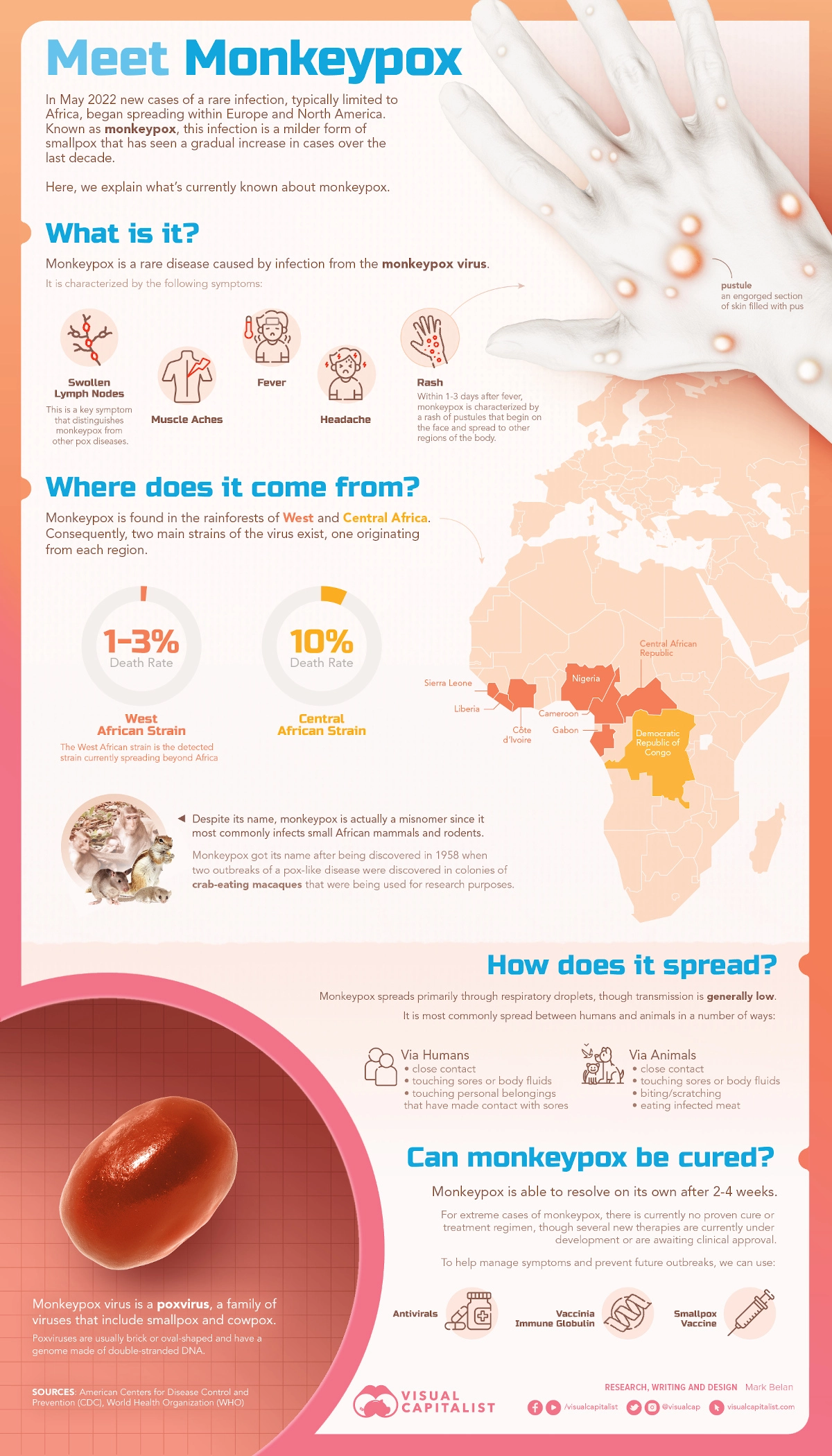
Explainer: What to Know About Monkeypox

Explainer: What to Know About Monkeypox

The COVID-19 pandemic is still fresh in the minds of the people around the world, so it comes as no surprise that recent outbreaks of another virus are grabbing headlines.

Monkeypox outbreaks have now been reported in multiple countries, and it has scientists paying close attention. For everyone else, numerous questions come to the surface:

  • How serious is this virus?
  • How contagious is it?
  • Could monkeypox develop into a new pandemic?

Below, we answer these questions and more.

What is Monkeypox?

Monkeypox is a virus in the Orthopoxvirus genus which also includes the variola virus (which causes smallpox) and the cowpox virus. The primary symptoms include fever, swollen lymph nodes, and a distinctive bumpy rash.

There are two major strains of the virus that pose very different risks:

  • Congo Basin strain: 1 in 10 people infected with this strain have died
  • West African strain: Approximately 1 in 100 people infected with this strain died

At the moment, health authorities in the UK have indicated they’re seeing the milder strain in patients there.

Where did Monkeypox Originate From?

The virus was originally discovered in the Democratic Republic of Congo in monkeys kept for research purposes (hence the name). Eventually, the virus made the jump to humans more than a decade after its discovery in 1958.

It is widely assumed that vaccination against another similar virus, smallpox, helped keep monkeypox outbreaks from occurring in human populations. Ironically, the successful eradication of smallpox, and eventual winding down of that vaccine program, has opened the door to a new viral threat. There is now a growing population of people who no longer have immunity against the virus.

Now that travel restrictions are lifting in many parts of the world, viruses are now able to hop between nations again. As of the publishing of this article, a handful of cases have now been reported in the U.S., Canada, the UK, and a number of European countries.

On the upside, contact tracing has helped authorities piece together the transmission of the virus. While cases are rare in Europe and North America, it is considered endemic in parts of West Africa. For example, the World Health Organization reports that Nigeria has experienced over 550 reported monkeypox cases from 2017 to today. The current UK outbreak originated from an individual who returned from a trip to Nigeria.

Could Monkeypox become a new pandemic?

Monkeypox, which primarily spreads through animal-to-human interaction, is not known to spread easily between humans. Most individuals infected with monkeypox pass the virus to between zero and one person, so outbreaks typically fizzle out. For this reason, the fact that outbreaks are occurring in several countries simultaneously is concerning for health authorities and organizations that monitor viral transmission. Experts are entertaining the possibility that the virus’ rate of transmission has increased.

Images of people covered in monkeypox lesions are shocking, and people are understandably concerned by this virus, but the good news is that members of the general public have little to fear at this stage.

I think the risk to the general public at this point, from the information we have, is very, very low.
–TOM INGLESBY, DIRECTOR, JOHNS HOPKINS CENTER FOR HEALTH SECURITY

A deadly virus was just identified in Ghana: What to know about Marburg

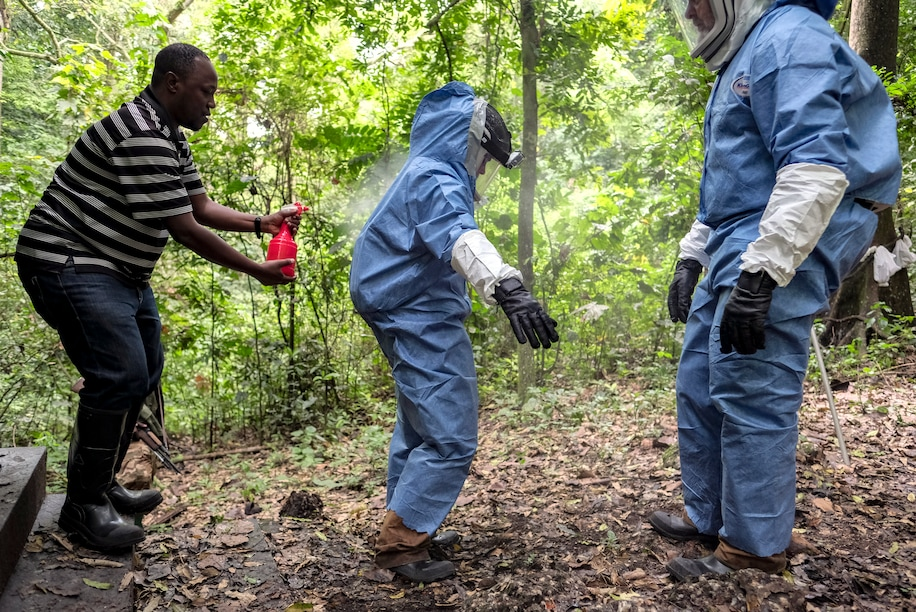
Epidemiologist Luke Nyakarahuka sprays disinfectant on scientists Jonathan Towner and Brian Amman in Queen Elizabeth National Park, Uganda, in 2018. The scientists were researching how bats transmit the Marburg virus to humans.

After the coronavirus pandemic and the rise of monkeypox cases, news of another virus can trigger nerves globally. The highly infectious Marburg virus has been reported in the West African country of Ghana this week, according to the World Health Organization.

Two unrelated people died after testing positive for Marburg in the southern Ashanti region of the country, the WHO said Sunday, confirming lab results from Ghana’s health service. The highly infectious disease is similar to Ebola and has no vaccine.

Health officials in the country say they are working to isolate close contacts and mitigate the spread of the virus, and the WHO is marshaling resources and sending specialists to the country.

“Health authorities have responded swiftly, getting a head start preparing for a possible outbreak. This is good because without immediate and decisive action, Marburg can easily get out of hand,” said the WHO’s regional director for Africa, Matshidiso Moeti.

Fatality rates from the disease can reach nearly 90 percent, according to the WHO.

Here’s what we know about the virus:

What is the Marburg virus?

Marburg is a rare but highly infectious viral hemorrhagic fever and is in the same family as Ebola, a better-known virus that has plagued West Africa for years.

The Marburg virus is a “genetically unique zoonotic … RNA virus of the filovirus family,” according to the Centers for Disease Control and Prevention. “The six species of Ebola virus are the only other known members of the filovirus family.”

Fatality rates range from 24 percent to 88 percent, according to the WHO, depending on the virus strain and quality of case management.

Marburg has probably been transmitted to people from African fruit bats as a result of prolonged exposure from people working in mines and caves that have Rousettus bat colonies. It is not an airborne disease.

Once someone is infected, the virus can spread easily between humans through direct contact with the bodily fluids of infected people such as blood, saliva or urine, as well as on surfaces and materials. Relatives and health workers remain most vulnerable alongside patients, and bodies can remain contagious at burial.

The first cases of the virus were identified in Europe in 1967. Two large outbreaks in Marburg and Frankfurt in Germany, and in Belgrade, Serbia, led to the initial recognition of the disease. At least seven deaths were reported in that outbreak, with the first people infected having been exposed to Ugandan imported African green monkeys or their tissue while conducting lab research, the CDC said.

Where has Marburg been detected?

The Ghana cases are only the second time Marburg has been detected in West Africa. The first reported case in the region was in Guinea last year. The virus can spread quickly. More than 90 contacts, including health workers and community members, are being monitored in Ghana. The WHO said it has also reached out to neighboring high-risk countries to put them on alert.

Cases of Marburg have previously been reported elsewhere in Africa, including in Uganda, the Democratic Republic of Congo, Kenya, South Africa and Zimbabwe. The largest outbreak killed more than 200 people in Angola in 2005.

The virus is not known to be native to other continents, such as North America, and the CDC says cases outside Africa are “infrequent.” In 2008, however, a Dutch woman died of Marburg disease after visiting Uganda. An American tourist also contracted the disease after a Uganda trip in 2008 but recovered. Both travelers had visited a well-known cave inhabited by fruit bats in a national park.

What are the symptoms?

The illness begins “abruptly,” according to the WHO, with a high fever, severe headache and malaise. Muscle aches and cramping pains are also common features.

In Ghana, the two unrelated individuals who died experienced symptoms such as diarrhea, fever, nausea and vomiting. One case was a 26-year-old man who checked into a hospital on June 26 and died a day later. The second was a 51-year-old man who went to a hospital on June 28 and died the same day, the WHO said.

In fatal cases, death usually occurs between eight and nine days after onset of the disease and is preceded by severe blood loss and hemorrhaging, and multi-organ dysfunction.

The CDC has also noted that around day five, a non-itchy rash on the chest, back or stomach may occur. Clinical diagnosis of Marburg “can be difficult,” it says, with many of the symptoms similar to other infectious diseases such as malaria or typhoid fever.

Can Marburg be treated?

There are no vaccines or antiviral treatments approved to treat the Marburg virus.

However, supportive care can improve survival rates such as rehydration with oral or intravenous fluids, maintaining oxygen levels, using drug therapies and treating specific symptoms as they arise. Some health experts say drugs similar to those used for Ebola could be effective.

Some “experimental treatments” for Marburg have been tested in animals but have never been tried in humans, the CDC said.

Virus samples collected from patients to study are an “extreme biohazard risk,” the WHO says, and laboratory testing should be conducted under “maximum biological containment conditions.”

Anything else to know?

The WHO said this week it is supporting a “joint national investigative team” in Ghana and deploying its own experts to the country. It is also sending personal protective equipment, bolstering disease surveillance and tracing contacts in response to the handful of cases.

More details are likely to be shared at a WHO Africa online briefing scheduled for Thursday.

“It is a worry that the geographical range of this viral infection appears to have spread. This is a very serious infection with a high mortality rate,” international public health expert and professor Jimmy Whitworth of the London School of Hygiene and Tropical Medicine told The Washington Post on Monday.

“It is important to try to understand how the virus got into the human population to cause this outbreak and to stop any further cases. At present, the risk of spread of the outbreak outside of Ashanti region of Ghana is very low,” he added.

BA.5 spurs new calls to fund next-generation COVID-19 vaccines

The rise of the BA.5 variant is spurring new calls for funding for an Operation Warp Speed 2.0 to accelerate development of next-generation COVID-19 vaccines that can better target new variants. 

The BA.5 subvariant of omicron that now makes up the majority of U.S. COVID-19 cases is sparking concern because it has a greater ability to evade the protection of current vaccines than past strains of the virus did.

Pfizer and Moderna are working on updated vaccines that target BA.5 that could be ready this fall, but experts say that by the time they are ready, a new variant very well could have taken hold.  

As alternatives to vaccine makers chasing each variant, experts point to research on “pan-coronavirus” vaccines that are “variant-proof,” targeting multiple variants, as well as nasal vaccines that could drastically cut down on transmission of the virus.

There is ongoing research on these next-generation vaccines, but unlike in 2020, when the federal government’s Operation Warp Speed helped speed the development of the original vaccine, there is less funding and assistance this time around.  

COVID-19 funding that could help develop and manufacture new vaccines more quickly has been stalled in Congress for months.

“There’s no Operation Warp Speed,” said Eric Topol, professor of molecular medicine at Scripps Research. “So it’s moving very slowly. But at least it’s moving.” 

Leana Wen, a public health professor at George Washington University, wrote in a Washington Post op-ed this week that the U.S. needs “urgent investment” in next-generation vaccines and “we need an ‘Operation Warp Speed Part 2.’” 

Pfizer and Moderna are working on updated vaccines that target BA.5 that could be ready this fall, but experts say that by the time they are ready, a new variant very well could have taken hold.  

As alternatives to vaccine makers chasing each variant, experts point to research on “pan-coronavirus” vaccines that are “variant-proof,” targeting multiple variants, as well as nasal vaccines that could drastically cut down on transmission of the virus.

There is ongoing research on these next-generation vaccines, but unlike in 2020, when the federal government’s Operation Warp Speed helped speed the development of the original vaccine, there is less funding and assistance this time around.  

COVID-19 funding that could help develop and manufacture new vaccines more quickly has been stalled in Congress for months.

“There’s no Operation Warp Speed,” said Eric Topol, professor of molecular medicine at Scripps Research. “So it’s moving very slowly. But at least it’s moving.” 

Leana Wen, a public health professor at George Washington University, wrote in a Washington Post op-ed this week that the U.S. needs “urgent investment” in next-generation vaccines and “we need an ‘Operation Warp Speed Part 2.’” 

Administration health officials pointed to funding when asked about next-generation vaccines at a press briefing on Tuesday.

“We need resources to continue that effort and to accelerate that effort,” said Anthony Fauci, the government’s top infectious disease expert. “So although we’re doing a lot and the field looks promising, in order to continue it, we really do need to have a continual flow of resources to do that.” 

But COVID-19 funding has been stuck in Congress for months. Republicans have long said they do not see any urgency in approving the money. Democrats, while generally calling for the funding, have been caught up in their own internal divisions, like when a group of House Democrats objected to a way to pay for the new funding in March.

“Of course more funding would accelerate some parts of the development,” Karin Bok, acting deputy director of the National Institutes of Health’s (NIH) Vaccine Research Center, said in an interview.  

She also cautioned that development of next-generation vaccines like nasal vaccines would take longer than the original vaccines, because less groundwork has been laid over the preceding years.  

Experts stress that even for BA.5, the current vaccines still provide important protection against severe disease and hospitalization, and are urging people to get their booster shots now. But there is potential for further improvement in the vaccines as well.

Aside from funding, another obstacle is obtaining copies of the existing COVID-19 vaccines for use in research, said Pamela Bjorkman, a California Institute of Technology professor working on a next-generation vaccine. 

“I would say we’ve wasted at least six months,” with various procedural hurdles on that front, she said. “It’s just ridiculous.” 

For example, she said at one point when her team was able to get access to the AstraZeneca COVID-19 vaccine, it then took two or three months to get an import permit to send it from the United Kingdom.

“This is a hot topic,” Bok, of the NIH, said of access to existing vaccine doses for researchers. “The government is working very hard on an agreement with the companies to provide it to us and to all the investigators…that are funded by NIH.” 

Asked about providing vaccine doses for researchers and any talks with the administration on that front, a Moderna spokesperson said: “We do provide vaccine in certain investigator-initiated studies where physicians and scientists propose research they have designed and want to conduct with our support,” pointing to a South African study as an example.  

More broadly, the White House says it is working on accelerating next-generation vaccine research and will have more announcements soon.  

“Let me be very clear: We clearly need a true next-generation vaccine,” White House COVID-19 response coordinator Ashish Jha told reporters on Tuesday. 

“You’ll hear more from us in the days and weeks ahead,” he added. “This is something that we have been working quite assiduously on.” 

COVID is not done with us, part six (…seven? eight?)

https://mailchi.mp/30feb0b31ba0/the-weekly-gist-july-15-2022?e=d1e747d2d8

The rise of ubiquitous self-testing and the paucity of accurate, timely data from the CDC on COVID numbers has left us feeling our way in the dark in terms of the current state of the pandemic. Clearly there’s a new surge underway, driven by the BA.5 variant. What we can report from our experiences on the road over the past few weeks is that the wave is significant. 

We’re hearing from our health system members that inpatient COVID volumes and COVID-related ED visits are significantly up again—often double or more what they were just two months agoalthough still well below levels of past surges. Length of stay for COVID inpatients is shorter, with fewer ICU visits than during the Delta surge—about the same intensity, proportionally, as during Omicron.

But COVID-related staffing shortages are once again having a real impact on hospitals’ ability to deliver care—clinical and non-clinical staff callouts are at high levels again, as during Omicron.

One piece of good news: masking is back in vogue among many health system executive teams, likely in response to a number of “superspreader” events: gatherings of hospital staff over the past few weeks that resulted in clusters of cases. One system described an all-hands session for anesthesiologists that resulted in more than a dozen cases across the next week—forcing the hospital to cancel procedures. 

We’re worried that this BA.5 surge is just getting started, and with booster uptake stagnating and masking all but nonexistent in the general population, the late summer and early autumn situation could be significantly worse.

Be careful out there.