

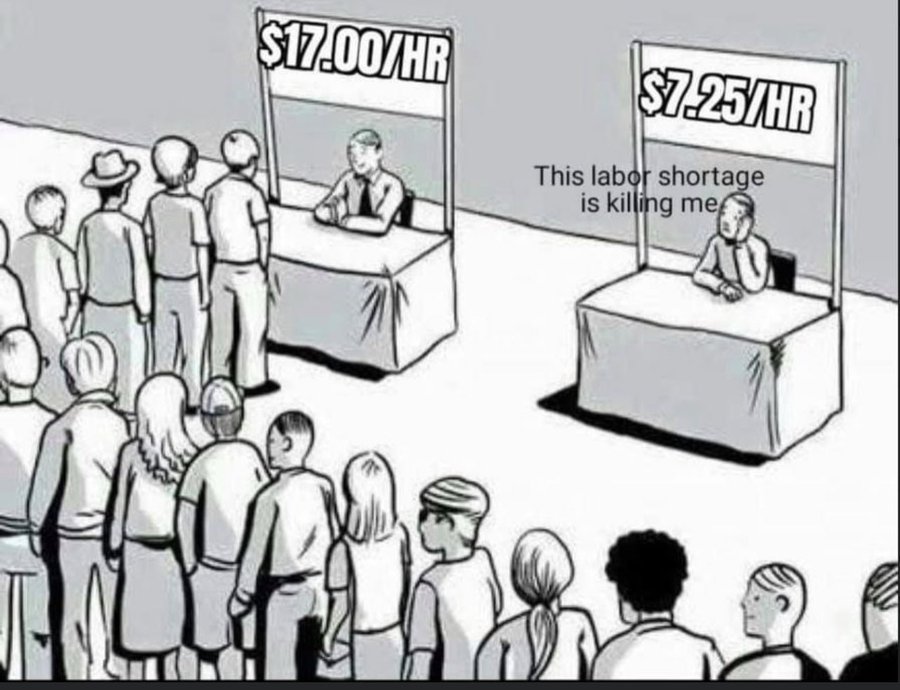
Cartoon – This Labor Shortage is Killing Me

Health economists study the economic determinants of health. They also analyze how health care resources are utilized and allocated, and how health care policies and quality of care can be improved. In this episode, we discuss what exactly a healthcare system would look like if these professionals were calling all the shots.
Medicare for All, which would extend health coverage to all Americans, has been a hot topic of debate in recent years. Researchers have looked into the many ways that a switch to Medicare for All might change our lives, and one of those areas of change might be wages. Employer provided healthcare is baked into our current system of healthcare, and there are a lot of studies that look at how employer paid premiums can depress wages, and how our paychecks might shift in a M4A-type situation.

Labor shortages from the COVID-19 pandemic will continue to worsen the financial performance of nonprofit and for-profit hospitals into 2022, an October Moody’s quarterly report found.
As nurses and other workers deal with burnout and resign from positions, some hospitals are limiting elective procedures, which is reducing revenue. They’re also increasing minimum wage and using contract nurses with much higher hourly wages.
Physician staffing companies like Envision Healthcare Corp. and TeamHealth will also struggle with profitability as it becomes more difficult to fill open positions because of fewer available physicians, the report said.
An Association of American Medical Colleges study in 2020 found that more than 2 out of 5 physicians will be 65 or older by 2030; COVID-19 is accelerating retirement.
Meanwhile, health insurers are not as affected by labor shortages, wage pressure and inflation, according to the report. Because their product is more short-term and premiums reset every year, they have more flexibility when it comes to inflation.




The FDA could greenlight a vaccine for kids as soon as Friday and more workers now have vaccine mandates. But first:
The White House says Democrats have clinched a deal.
The $1.75 trillion framework for Biden’s massive social spending bill temporarily funds several of the party’s health care ambitions. But it includes big misses on health care, such as significantly paring back progressives’ goal of adding new benefits to Medicare — instead including only coverage for hearing services — and excluding Democrats’ plan aimed at lowering the sky-high prices of prescription drugs.
Will all Democrats get on board? Senior administration officials projected confidence that they would, and characterized the framework as the biggest expansion of health care in a decade. Yet, it includes major defeats for the party’s more liberal members, who have been reticent to draw red lines on what they would or wouldn’t support.
It’s a critical day. President Biden is heading to huddle privately with House Democrats this morning. House Speaker Nancy Pelosi announced plans for the chamber’s Rules Committee to hold a hearing, although legislative text hasn’t yet been released. And before leaving for his trip overseas, Biden will speak publicly about the path forward for his legislative agenda, per a White House official.
Early this morning, senior administration officials spoke to reporters on the condition of anonymity to detail the framework.
Prescription drug negotiation: OUT
Democrats campaigned on reducing prices of prescription drugs — and letting Medicare directly force lower prices is a key plank of that effort. But the party couldn’t overcome fierce divisions amid a lobbying storm.
The House’s signature drug proposal faced resistance from a trio of House moderates who instead backed more limited drug negotiation. On the other side of the Capitol, Sen. Kyrsten Sinema had raised objections and other senators had concerns with a bill as sweeping as the one the House passed in 2019. The industry’s main trade group has been working furiously to keep the proposal out of Democrats’ economic package.
Medicare expansion: mostly OUT
Sen. Bernie Sanders (I-Vt.) and the House Congressional Progressive Caucus have been bullish on two main health policies: allowing the federal government to negotiate drug prices, and using those savings to expand Medicare to cover dental, vision and hearing.
The framework only creates a new Medicare benefit for hearing.
Closing the Medicaid coverage gap: IN
The framework extends coverage for 2.2 million adults in the dozen, mostly GOP-led states that have refused Obamacare’s Medicaid expansion. They’ll get tax credits to receive premium-free health coverage on the Obamacare health exchanges through 2025.
Earlier this week, Manchin raised concerns with allowing the federal government to pay for health coverage for 2.2 million adults in the dozen, mostly GOP-led states refusing Obamacare’s Medicaid expansion. His own colleagues — such as Georgia Sens. Raphael Warnock and Jon Ossoff — lobbied heavily to change his mind.
Obamacare subsidies: IN
The framework would extend more generous financial help to Obamacare consumers through 2025, building on an effort that began in Biden’s coronavirus relief bill passed this spring.
In-home care: IN
Biden has pushed for a $400 billion investment in home care for seniors and the disabled. It’s been clear for weeks that his ask will be significantly pared back. Administration officials said funding for home and community-based services is included in the framework, but didn’t detail how much money would go toward the program helping keep seniors and those with disabilities out of institutional settings.

Some Democrats say it’s possible that pieces of their social policy agenda end up being enacted or extended for only a year or two, including major Affordable Care Act and Medicaid provisions.
Why it matters: Limited terms may be the only way Democrats can strike a deal within their budget. But the risk is that Republicans will be able to undo these temporary programs if they’re able to regain control of Congress through next year’s midterms.
What they’re saying: Extending programs for only a year or two is a “possibility,” Senate Majority Whip Dick Durbin (D-Ill.) told Axios.
The big picture: Political, budgetary and practical factors are all at play as Democrats try to figure out what’s in and what’s out of their reconciliation bill.
The other side: Republicans may encounter political pressures similar to the ones they did in 2017, when they struggled — and ultimately failed — to repeal and replace the ACA.
Yes, but: But inaction is different from voting to end a benefit, Buck said.
The bottom line: At this point, Democrats will take any party-wide agreement they can get. And temporary health coverage expansions may have their upside.

