Hospital and Health System M&A: Q1 2024 Review

M&A Volume Up in Q1 2024 vs. Q1 2023: $10 billion Target Revenues


The number of hospital and health system M&A deals announced in the first quarter of 2024 was significantly higher than in the same period in 2023: 18 announced transactions with $10 billion in total revenues for the targets vs. 12 deals in Q1 2023 with a total of $3.4 billion in revenues for the targets. The 81 deals announced in the last 12 months is the highest it
has been over the last few years, building upon the recent momentum of hospital and health system mergers, acquisitions, and divestitures across the country.

Other observations by the Cain Brothers M&A team:

  • Significant number of for-profit conversions to not-for-profit (e.g., divestitures by Tenet and HCA)
  • Significant number of divestitures by national systems to regional health systems
  • Accelerated closing timeline for 3 deals in CA: closed in 30-60 days — prior to new hospital merger review process going into effect April 1, 2024 in CA
  • Q1 2024 total volume of 18 transactions with $10 billion in revenues for targets vs. $3.4 billion for Q1 2023
    This quarter saw transformative deals that may reshape how healthcare is delivered, reflecting creative partnerships that continue to form in a changing healthcare environment. Academic medical centers continue to make investments in assets
    of high strategic value to expand their clinical, teaching, and research capabilities. Large regional systems were quite active, with large cross regional mergers and smaller strategic acquisitions. With the Consumer Price Index (CPI) holding steady with the previous quarter, alleviation of supply cost pressures will benefit health system financials and allow them to deploy more capital.

In early January, General Catalyst’s healthcare investment subsidiary, Health
Assurance Transformation Corporation (“HATCo”),
announced its intent to
acquire Summa Health, one of the largest integrated health delivery systems in
Ohio. This announcement made waves in the healthcare industry, not just
because of the size of the acquisition, but because it is the first major health system
investment for newly formed HATCo. General Catalyst, a venture capital firm
formed in 2000,
is known for its investments in global companies including Airbnb,
Warby Parker, Snap, and Kayak. General Catalyst launched HATCo in October
2023 as a vehicle to enable health systems to enhance technological health
capabilities, improve financial results, and assist in meeting the shift to value based care, creating a sustainable and quality-driven healthcare model for providers and patients.

Under the terms of the deal, Summa Health will become a subsidiary of HATCo
and transition from a not-for-profit to a for-profit corporation
. A community
foundation will be formed to continue to invest in the social determinants of health
to enhance community outcomes in the Akron-Canton region. With its first
acquisition, HATCo aims to become a chassis for future acquisitions and growth
for General Catalyst. The deal is expected to close by the end of 2024.

Academic medical centers were active acquirers in the first quarter of 2024. On
the West Coast, two University of California systems announced acquisitions from
for-profit operators. In January, UCLA Health announced it is the process to
acquire West Hills Hospital and Medical Center from HCA. The 260-bed hospital
is located in the San Fernando Valley, north of Los Angeles, and will be UCLA’s
first acute care hospital in the area. In February, UC Irvine Health signed a
definitive agreement to acquire Tenet’s Pacific Coast Network, which include
four hospitals in Los Angeles and Orange counties (see below for transaction
multiples). The acquisition greatly expands UCI Health’s presence and inpatient
bed capacity to complement their flagship UCI Medical Center in Orange. These
deals come off the heels of two other University of California deals announced in
2023; UC San Diego Health’s acquisition of Alvarado Hospital from Prime
Healthcare, and UCSF’s announcement to acquire two San Francisco hospitals
from Dignity Health, further demonstrating the UC system’s mandate to grow and
provide greater access to care in California.


Further east, the University of Minnesota announced in February its intent to
reacquire the University of Minnesota Medical Center from Fairview Health.

The University of Minnesota Regents voted to support a nonbinding letter of intent
with Fairview that would provide the ability for the University’s eventual ownership
of the medical center by 2027. The University of Minnesota previously sold the
medical center to Fairview in 1997.


In January, Penn Medicine announced it intends to acquire Doylestown Health,
a single-hospital system in Bucks County, PA. The seventh hospital for Penn
Medicine, the acquisition of Doylestown Health follows a trend of expansion for
Penn Medicine, with the acquisition of Chester County Hospital, Lancaster General
Health, and Princeton Health all within the past 10 years.
The transactions by
academic health systems this quarter continue to follow the trend of AMC
expansion through development of new entry points into their care network,
investments in community health, and developing the ability to expand their
teaching and research capabilities.

In addition to the sale of its Pacific Coast Network to UC Irvine Health, Tenet also
sold Sierra Vista Regional Medical Center and Twin Cities Community
Hospital to Adventist Health in California.
The two hospitals, located in San Luis
Obispo County in Central California, were sold to Adventist Health for
approximately $550 million, implying a Revenue and EBITDA multiple of 1.6x and
14.5x, respectively. The Pacific Coast Network transaction to UCI Health
announced in February came with a $975 million price tag, reflecting a 1.0x
multiple of revenue and 13.7x multiple of EBITDA. These transactions follow trends
of Tenet’s strategic divestitures in high value deals and reflect a broader trend of
acquisitions of targets of high strategic value to health systems. It is worth noting
that part of the reason for higher multiples in these California transactions is that
buying is still cheaper than the high cost to build.


Regional expansion continued this quarter in the Northeast with Nuvance Health’s
announcement in February that it will be joining Northwell Health. With seven
hospitals in Nuvance and the largest in the State of New York with Northwell, the
organizations would merge to form an integrated healthcare delivery system of 28
hospitals, 15,000 physicians, and over 1,000 care sites. In July 2023, Nuvance
received a credit downgrade from Moody’s driven by weakened operating
performance and reduced liquidity.
As stated by both organizations, the merger
also allows Northwell to expand into Connecticut while making significant
investments in Nuvance’s existing clinical care footprint.


On the other hand, a number of regional mergers in recent years have been called
off,
including this quarter with the cancellation of the proposed merger between
Essential Health and Marshfield Clinic. Previously announced in July 2023, the
health systems formally ended merger discussions in January, determining that
the affiliation was not the right path for the organizations. Marshfield previously
paused merger discussions with Gundersen Health System in 2019.

There were also a number of single hospital acquisitions and tuck-in transactions for larger systems. Below are highlights of a few other notable transactions announced this quarter:

In February, St. Louis- based Mercy announced its plans to acquire Via Christi Hospital, its
related physicians and other ancillary healthcare locations from Ascension. 152-bed Via Christi
hospital will be Mercy’s third hospital in Kansas, as Mercy continues to grow westward. In 2023,
Mercy acquired SoutheastHEALTH followed by its acquisition of Hermann Area District Hospital.

In January, Northern New Jersey health systems, CarePoint Health and Hudson Regional
Hospital
announced they are seeking to form a new combined entity that will merge the for-profit and not-for-profit hospitals together. Hudson Health System will be the new namesake of the four hospital system. Under the proposed agreement, two of the four hospitals will remain not-for-profit safety net hospitals. The unique arrangement comes after the New Jersey Department of Health confirmed that CarePoint was in financial distress and began to work with local government leaders on a solution. CarePoint executive leaders confirmed the arrangement with Hudson Regional will improve the organization’s operational and financial strength.

Also in New Jersey, Atlantic Health System announced in January its intent to merge with Saint
Peter’s Healthcare
. Atlantic Health, located in Morristown, NJ, is a seven-hospital health system
with locations across New Jersey and Pennsylvania. Saint Peter’s Healthcare is a catholic not-forprofit system with a 478-bed flagship hospital in New Brunswick, NJ. The announcement follows a 2022 judgment by the FTC to block a proposed merger between Saint Peter’s Healthcare and RWJBarnabas Health, citing the deal would cause anti-competitive concerns with merging New Brunswick’s only two hospitals.

WellSpan Health signed a definitive agreement to acquire Evangelical Community Hospital, a
131-bed acute care hospital in Lewisburg, PA. With the pending acquisition, the hospital will
become WellSpan Evangelical Hospital and will continue to serve the Central Susquehanna Valley. WellSpan is an eight-hospital system, serving six counties in Pennsylvania and two counties in Maryland. The deal is expected to close in July.

Each quarter, health system acquirers typically cite the need to grow and the desire to enchance clinical outcomes as motivating factors for deal activity. On the other hand, as we are seeing play out in real time, financial challenges area key driver of M&A for sellers. California-based Pipeline Health faces financial challenges as it retrenches its existing portfolio. In late 2023, Pipeline exited the Texas market driven by unsustainable financial losses. This example highlights the need for health systems to match mission-driven growth objectives with the reality of a harsh and volitile operating environment.


Portfolio rationalization, AMCs with the capital to make big bets, and inter-regional consolidations are major trends that will continue into 2024. With an election looming and an uncertain healthcare and regulatory landscape, affiliation opportunities will need to be thoughtful and metric driven.

The Press Is Beginning to Take Notice of How Health Insurers Are Raiding The Medicare Trust Fund

Sometimes a health policy story comes along that should be shouted from the rafters — well at least reported by media that cover the subject. Brett Arends’ story for Dow Jones’ MarketWatch is one of those stories. 

In “Medicare Advantage is overbilling Medicare by 22%,” Arends introduces readers to a government agency that in its latest report exposed Medicare Advantage plans to light.

The revelations about overpayments come from the Medicare Payment Advisory Commission, MedPAC for short, some of whose recommendations over the years have resulted in high rate increases for Advantage plan sellers that helped make it possible for them to offer groceries, bits of dental care, and other goodies seniors have snapped up. The media’s role in revealing and dissecting those overpayments is long overdue.

The last several months news outlets have been paying more attention to the downsides of Medicare Advantage plans.

Arends’ story focused on one thread in the story: MedPAC’s latest report to Congress that revealed something health policy wonks — but not the public — have known for a long time. Medicare Advantage plans are taking advantage of the federal gravy train.

“The private insurers who now run more than half of all Medicare plans are overcharging the taxpayers by a staggering $83 billion a year,” Arends wrote. “They are charging us taxpayers 22% more than it would cost us to provide the same health insurance to seniors directly if we just cut out the private insurance companies as middlemen.”

MedPAC was set up by the Balanced Budget Act of 1997, “back when people in Washington were actually doing their jobs,” Arends points out. The commission’s job is to advise Congress on issues involving Medicare. MedPAC reports discuss the financial situation of the Medicare trust funds, and over the years those reports often revealed that the private health plans have been overpaid. Until recently, there has been little to no pushback from the government or most of the media, in effect leaving the insurance industry a clear path to sell Medicare Advantage plans to more than half of the Medicare market. The media have recently begun to ask why. 

Arends calls the Medicare Advantage arrangement “a rip-off, pure and simple,” noting that what sellers of the plan are paid “is more than twice as much as it would cost simply to provide free dental, hearing and vision care to all traditional Medicare beneficiaries, not just those in private ‘Medicare Advantage’ plans.”

I have covered Medicare for decades now and have often asked the experts why there couldn’t be a level playing field that would allow beneficiaries in the traditional program to receive vision and dental benefits. The answer was always, “We can’t afford that.” 

Arends debunks that thinking by directly quoting the MedPAC report:

“It reads: ‘We estimate that Medicare spends approximately 22 percent more for MA enrollees than it would spend if those beneficiaries were enrolled in FFS (fee for service or traditional) Medicare, a difference that translates into a projected $83 billion in 2024.’ MedPAC reported that its review of private plan payments suggests that over the 39-year history with private plans, they “have never yielded aggregate savings for the Medicare program. Throughout the history of Medicare managed care, the program (Medicare Advantage) has paid more than it would have paid if beneficiaries had been in FFS (fee for service) Medicare.”

I checked in with Fred Schulte, who now writes for KFF Health News, and who over his career has written many prize-winning stories documenting the shenanigans insurers have used to enhance their reimbursements from Medicare, such as upcoding. That’s the practice of billing Medicare for ailments that are more serious than what patients actually have. “For example, instead of reporting a patient has diabetes, the insurers would say diabetes with neuropathy or eye problems and receive higher reimbursement,” he explained.

“It took a very long time for the government and the Justice Department to understand what was going on here with this coding,” Schulte said. “The codes just kept getting higher and higher, and profits kept going up and up.”

A year ago, Paul Ginsburg, a senior fellow at the University of Southern California’s Schaffer Center, said, “The current Medicare Advantage structure results in overpayments, markedly higher than previously understood.” 

Even Michael Chernow, who heads the Medicare Payment Advisory Commission authorized by Congress in 1997, recently admitted on Twitter that Medicare Advantage “has never saved Medicare money.” But he added, “that doesn’t mean Medicare Advantage isn’t a key pillar of Medicare sustainability. At its best it can provide better care at lower cost.” 

Arends’ story doesn’t sound hopeful about the direction of Medicare. He concludes, “Medicare Advantage isn’t making the rest of Medicare better. It is putting the rest of Medicare out of business. And not by being more efficient, but by being less efficient. It is driving up the overall cost of Medicare by 22%. And not by being more efficient but by being less efficient. 

The logical outcome is that traditional Medicare ceases to exist and that Medicare dollars pass through the hands of private insurance companies at 122 cents on the dollar.”

Arends’ prediction may well come true, but perhaps not without a fight. David Lipschutz, associate director at the Center for Medicare Advocacy, says a “confluence of factors have come together to make it harder to ignore the problems of Medicare Advantage by the press and policymakers.”

Walmart announces closing of clinics and virtual care

https://www.healthcarefinancenews.com/news/walmart-announces-closing-clinics-and-virtual-care?mkt_tok=NDIwLVlOQS0yOTIAAAGSzraKE5ynKelzJqN_u6PkS2uiDa7kDhU8buZUg2FuUp8WbSLrwsIS6LTs5r1vnMTtXeXfGhlUj3HuY2B-390Y8ldBKzh1mYa3OKZNPISlq1s

Walmart is closing Walmart Health and Walmart Health Virtual Care, saying the business model was not profitable nor sustainable. 

The Walmart Health centers opened in 2019.

“Through our experience managing Walmart Health centers and Walmart Health Virtual Care, we determined there is not a sustainable business model for us to continue,” the company said by statement. “The decision to close all 51 health centers across five states and shut down the virtual care offering was not easy.”

WHY THIS MATTERS

Walmart said the challenging reimbursement environment and escalating operating costs created a lack of profitability.

It does not yet have a specific date for when each center will close, but would share that information “as soon as decisions are made.”

Its priority, Walmart said, was “ensuring the people and communities who are impacted are treated with the utmost respect, compassion and support throughout the transition. Today and in the coming days, we are focused on continuity of care for patients and providing impacted associates with respect and assistance as we begin the closing process of the healthcare centers.”

The clinics will continue to serve patients while they are open.

“Through their respective employers, these providers will be paid for 90 days, after which eligible providers will receive transition payments,” Walmart said.

All associates are eligible to transfer to any other Walmart or Sam’s Club location. They will be paid for 90 days, unless they transfer to another location during that time or leave the company, Walmart said. After 90 days, if they do not transfer or leave, eligible associates will receive severance benefits.

“We understand this change affects lives – the patients who receive care, the associates and providers who deliver care and the communities who supported us along the way,” Walmart said. 

THE LARGER TREND

Moving forward, Walmart said it would take what it has learned to provide health and wellness services across the country through its nearly 4,600 pharmacies and more than 3,000 vision centers. Both have been in operation for 40 years.

“Over the past few years, the importance of pharmacies has continued to grow, and we have expanded the clinical capabilities of the services we provide,” Walmart said. “We continue to offer immunizations and have grown to provide testing and treatment services, access to specialty pharmacy medication and care, as well as other essential services such as medication therapy management and a variety of health screenings. With more than 4,000 of our stores in medical provider shortage areas, our pharmacies are often the front door of healthcare.”

Walmart said it plans to launch more services such as the Walmart Healthcare Research Institute and health programs to join its fresh food and over-the-counter offerings.

Among the country’s largest grocers, Walmart plans this year to introduce a line of premium food called Bettergoods to compete against Trader Joe’s and Whole Foods, according to The Wall Street Journal.

However, share prices last week fell for Walmart and Kroger after Amazon unveiled a low-cost grocery delivery program, according to Seeking Alpha. Amazon is expanding its fresh-food business through a delivery subscription benefit in the United States for its Prime members and customers using an EBT (electronic benefits transfer) card. It outlined the $9.99 monthly plan last Tuesday, according to the report. Share prices for Walmart were down 1.55% as of this morning.

The hospital of the future

Economists say in an ideal world, different hospitals will specialize in different forms of care while others — particularly in rural areas — will focus on providing basic services.

Why it matters: 

The hospital of the future will likely mean a significantly different patient experience, in ways both obvious (it’ll have better technology) and potentially disruptive (it could require more travel).

  • “My own view of what it’s going to look like in the longer run is much, much fewer hospitals that are much, much bigger,” said Yale’s Cooper.

Where it stands: 

Many health systems are already cutting service lines — maternity care is a common one — or closing altogether, especially rural hospitals.

  • To some extent, that may be OK, some experts say. The reality created by shifting demographics is that some places just don’t have the population necessary to support certain services.
  • Not only do the economics not work, but a handful of specialized procedures every year probably isn’t enough to keep providers well-trained.

Between the lines: 

Instead of consolidation, there should be more of a divergence between hospitals that provide basic care to local communities and those that specialize in more complex care, Cooper said.

  • That model, of course, would mean many patients would have to travel for certain care instead of receiving it at their local hospital.

And as technology broadly changes the consumer experience, patients will have similar expectations for their care.

  • “People’s gold standard is buying stuff on Amazon at 2 in the morning, and when they compare their health care experience, they say, ‘Why can’t my health care experience be more like that?'” Kaufman said.
  • Emerging medical technologies will also impact the care that people receive, and hospitals are positioning themselves at the forefront of that change.
  • “Patients right now — and in the future — can expect more care delivery that is driven by 3D modeling; predictive analytics; advanced robotics for surgeries and treatments; and personalized therapies based on genomics,” American Hospital Association president and CEO Rick Pollack wrote in a blog post last year.

Yes, but: 

Hospitals that serve higher populations of vulnerable people, who are more likely to have lower-paying government insurance, are the most financially exposed.

  • That means if they don’t adapt, care could become even less accessible for these patients.

Some economists’ ideal version of the future may mean lower profits for health systems.

  • Hospitals “should do what they do best, which is inpatient care and emergency care … and other people should do things that they do best, like the physicians working together as a multi-specialty group but not part of the hospital,” said Johns Hopkins’ Anderson.
  • “They wouldn’t make the substantial profits they’re making, but for the nonprofits, that’s not the goal,” he added.

The bottom line: 

“Is there going to be disruption? Yes,” Cooper said. “I think there’s a romanticism about local hospitals. They’re where our kids were born and where our parents spent their final days.”

  • “But I firmly believe the local hospital of the future is not doing everything for everyone.”

The emerging divide

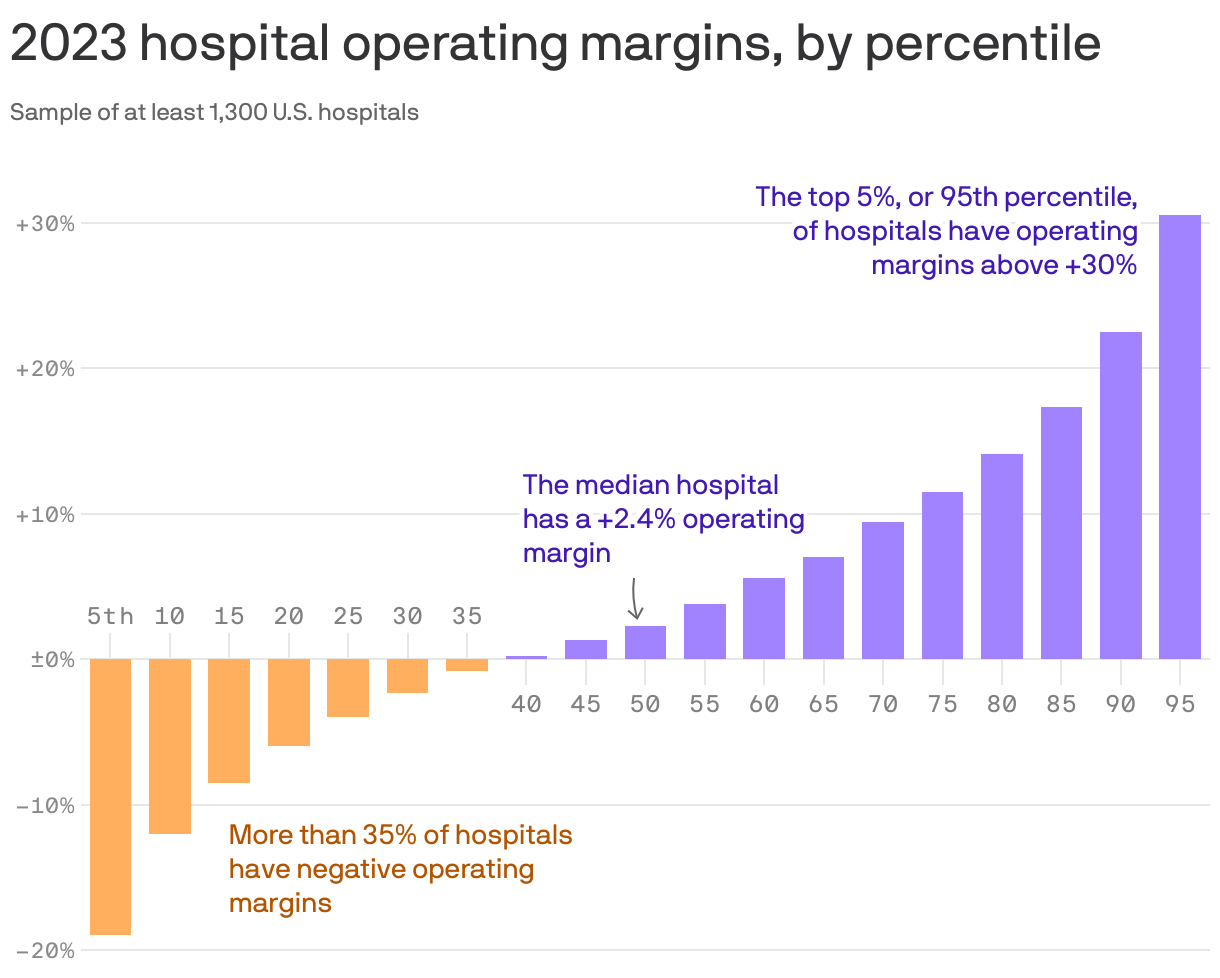
Some health systems have recovered from the pandemic much better than others, and those with healthier margins tend to be the ones that made a stronger push into outpatient care.

By the numbers: 

There’s a wildly large and growing difference between the operating margins of top-performing health systems and those at the bottom, according to Kaufman Hall data shared with Axios. (Go deeper on their analysis.)

  • “The hospitals that are not performing well are performing worse, but the hospitals that are recovering are performing extremely well,” firm co-founder Kaufman told Axios.
  • “I would say hospitals that are not doing particularly well … they’re not capturing that outpatient work, or at least not at the level that they need to,” he added.

Yes, but: 

Operating margin is only one measure of a hospital’s financial health, and total margins are often much higher, said Anderson, the Johns Hopkins professor.

  • “You diversify where there is potential profit, and they have moved into all sorts of things where there is profit,” he added. “They have a whole portfolio of ways to make money now that they didn’t have 20 years [ago].”
  • Some experts also say that hospitals aren’t disciplined about keeping costs down.
  • “I think partly what happened over time is that … investments were not treated as investments, but as costs,” said Cooper, the Yale economist.

Hospitals’ forced makeover

Hospitals’ business models are being upended by fundamental changes within the health care system, including one that presents a pretty existential challenge: People have far more options to get their care elsewhere these days.

Why it matters: 

Health systems’ responses to major demographic, social and technological change have been controversial among policymakers and economists concerned about the impact on costs and competition.

  • Communities depend on having at least some emergency services available, making the survival of hospitals’ core services crucial.
  • But without adaptation — which is already underway in some cases — hospitals may be facing deep red balance sheets in the not-too-distant future, leading to facility closures and shuttered services.

The big picture: 

Many hospitals have recovered from the sector’s post-pandemic financial slump, which was driven primarily by staffing costs and inflation. But systemic, long-term trends will continue to challenge their traditional business model.

  • Many of the services that are shifting toward outpatient settings — like oncology, diagnostics and orthopedic care — are the ones that typically make hospitals the most money and effectively subsidize less profitable departments.
  • When hospitals lose these higher-margin services, “you’re starving the system that needs profits to provide services that we all might need, but particularly uninsured or underinsured people might need,” said UCLA professor Jill Horwitz.

And hospitals have long claimed that much higher commercial insurance rates make up for what they say are inadequate government rates.

  • But as the population ages and moves out of employer-sponsored health plans, fewer people will have commercial insurance, forcing hospitals to either cut costs or find new sources of revenue.

By the numbers: 

Consulting firms are projecting a bleak decade for health systems.

  • Oliver Wyman recently predicted that under the status quo, hospitals will need to reduce their expenses by 15-20% by 2030 “to stay viable.”
  • Boston Consulting Group last year projected that health systems’ annual financial shortfall will total more than $200 billion by 2027, and their operating margins will have dropped by 10 percentage points.
  • To break even in 2027, a “typical” health system would need payment rate increases of between 5-8% annually — twice the rate growth over the last decade, according to BCG. If the load is borne solely by private insurers, hospitals will need a 10-16% year-over-year increase.

Between the lines: 

This is the lens through which to view health systems’ spree of mergers and acquisitions, which have increasingly drawn criticism from policymakers, regulators and economists as being anticompetitive.

  • For better or worse, when hospitals have a larger market share, they are in a better position to negotiate and bring in more patients, and they can dilute some of the financial pain of poorer-performing facilities.
  • And when they acquire physician practices or other outpatient clinics, they’re still getting paid for delivering care even when patients aren’t receiving it in a traditional hospital setting.
  • “I think the hospitals have sort of said … ‘We can keep doing things the same way and we can just merge and get higher markups,'” said Yale economist Zack Cooper. “That push to consolidate is saying, ‘Let’s not move forward, let’s dig in.'”

Yes, but: 

A big bonus of outpatient care is that it’s supposed to be cheaper. But when hospitals charge more for care than an independent physician’s office would have, or they tack on facility fees, costs don’t go down.

  • And there’s a growing body of research showing that when hospitals consolidate, costs go up.
  • “They’ve protected their portfolio, and that’s added to the cost of health care,” said Johns Hopkins professor Gerard Anderson.

The other side: 

Hospitals are typically on the losing end of negotiations with insurers right now, thanks to how large insurers have become, and are “in an extremely difficult competitive position,” said Ken Kaufman, co-founder of consulting agency Kaufman Hall.

  • Criticizing their mergers and acquisitions as anticompetitive is a “complete misunderstanding of the situation,” he said, and moving toward a new care model will take “an incredible amount of resources.”

Reality check: 

Hospitals account for 30% of the country’s massive health spending tab, and they’ll have to be at the forefront of any real efforts to contain costs.

  • They’re also anchors in their communities and are powerful lobbyists, which helps explain why Congress has struggled to modestly reduce what Medicare pays hospital outpatient departments.

Amid losses, UPMC says it’s laying off roughly 1,000 workers, cutting open positions

UPMC is laying off about 1,000 employees in a “realignment” the nonprofit said will help it face “the realities of a still-evolving, post-pandemic marketplace.”

The layoffs reflect about 1% of UPMC’s total workforce of over 100,000 people and are primarily among nonclinical and administrative staff, Vice President and Chief Communications Officer Paul Wood said in an emailed statement. He said the system will be offering those impacted “enhanced severance pay and benefits coverage.”

The “limited reductions” will also involve the closing of open positions, the elimination of redundancies and “other actions,” Wood said.

“This realignment will not alter UPMC’s investments in our communities, facilities, commitment to clinical care and research, strategic growth or to offering those throughout our workforce industry-leading benefits,” Wood wrote in the statement.

Pittsburgh-based UPMC is an integrated health system and one of Pennsylvania’s largest employers. Its provider, insurance and other business arms logged $27.7 billion of revenue across 2023 as volumes rose and insurance membership grew.

However, the nonprofit reported a $198.3 million operating loss (-0.7% operating margin) last year as insurance claims expenses jumped 13.6% and labor costs rose 6.4%. It had posted a $162 million operating gain (0.6% operating margin) the year before.


UPMC reports almost $200M operating loss as expenses rise

The system did narrow its 2023 bottom line loss to $31 million thanks to its investment returns, though it had logged roughly a billion in net losses during the 2022 fiscal year.

In its year-end financial report, UPMC’s management wrote that “even with increased expenses to deliver high-quality care as a result of various economic factors, in 2023 UPMC continued to forge ahead with investments to grow access to world-class clinical care … advance healthcare excellence through quality and innovation, care for our communities, grow our insurance services and invest in our future workforce.”

43 health systems ranked by long-term debt

Long-term debt has long been a staple in healthcare, but many hospitals and health systems are responding to the increasing cost of debt and debt service in the rising rates environment. 

Highly levered health systems are looking to sell hospitals, facilities or business lines to reduce their debt leverage and secure long-term sustainability, which creates significant growth opportunities for systems with balance sheets on a more solid financial footing. 

Forty-three health systems ranked by their long-term debt:

Note: This is not an exhaustive list. The following long-term debt figures are taken from each health system’s most recent financial report. 

1. HCA Healthcare (Nashville, Tenn.): $37.2 billion

2. CommonSpirit (Chicago): $15.3 billion

3. Tenet Healthcare (Dallas): $14.9 billion

4. Community Health Systems (Franklin, Tenn.): $11.5 billion

5. Kaiser Permanente (Oakland, Calif.): $10.6 billion

6. Providence (Renton, Wash.): $8.1 billion

7. Trinity Health (Livonia, Mich.): $6.8 billion

8. UPMC (Pittsburgh): $6.6 billion

9. Ascension (St. Louis): $6.1 billion

10. Mass General Brigham (Boston): $5.5 billion

11. Universal Health Services (King of Prussia, Pa.): $4.7 billion

12. Banner Health (Phoenix): $4.4 billion

13. Cleveland Clinic: $4.3 billion

14. Bon Secours Mercy Health (Cincinnati): $4.2 billion

15. Mayo Clinic (Rochester, Minn): $4.1 billion

16. Intermountain Health (Salt Lake City): $3.8 billion

17. Baylor Scott & White (Dallas): $3.8 billion

18. NYU Langone (New York City): $3.1 billion

19. Advocate Health (Charlotte, N.C.): $2.9 billion

20. IU Health (Indianapolis): $2.3 billion

21. Stanford Health Care (Palo Alto, Calif.): $2.3 billion

22. Orlando (Fla.) Health: $2.7 billion

23. Montefiore (New York City): $2 billion

24. BJC HealthCare (St. Louis): $1.9 billion

25. Christus Health (Irving, Texas): $1.9 billion

26. MedStar Health (Columbia, Md.): $1.8 billion

27. ProMedica (Toledo, Ohio): $1.8 billion

28. Northwestern Medicine (Chicago): $1.7 billion

29. Geisinger (Danville, Pa.): $1.7 billion

30. Allina Health (Minneapolis): $1.7 billion

31. OSF HealthCare (Peoria, Ill.): $1.7 billion

32. Norton Healthcare (Louisville, Ky.): $1.6 billion

33. Beth Israel Lahey Health (Cambridge, Mass.): $1.6 billion

34. SSM Health (St. Louis): $1.6 billion

35. Scripps Health (San Diego): $1.5 billion

36. Henry Ford Health (Detroit): $1.4 billion

37. Sanford Health (Sioux Falls, S.D.): $1.4 billion

38. Prisma Health (Greenville, S.C.): $1.4 billion

39. Allegheny Health Network (Pittsburgh): $910.5 million

40. HonorHealth (Scottsdale, Ariz.): $898.7 million

41. Sharp HealthCare (San Diego): $866.5 million

42. Premier Health (Dayton, Ohio): $850 million

43. Tufts Medicine (Boston): $782.3 million

FTC bans noncompete agreements for workers

The Federal Trade Commission banned noncompete agreements for most U.S. workers Tuesday with a new rule that will bar employers from enforcing clauses that restrict workers from switching employers within their industry, which the agency said suppresses wages and gums up labor markets.

The FTC voted 3 to 2 Tuesday to issue the rule it proposed more than a year ago. The new rule makes it illegal for employers to include the agreements in employment contracts and requires companies with active noncompete agreements to inform workers that they are void. The agency received more than 26,000 comments about the rule after it was proposed some 16 months ago. The rule will take effect after 180 days, although business groups have promised to challenge it in court, which could delay implementation.

Scholars cite a body of research that shows the agreements suppress worker pay and entrepreneurship while also imposing costs on firms wanting to hire workers bound by the agreements. A Labor Department study published in June 2022 estimated that 18 percent of Americans are bound by noncompete agreements, while other research suggests it could be closer to 5o percent. They are used in a wide range of industries, including technology, hairstyling, medicine and even dance instruction, while imposing restrictions on both high- and low-wage earners.

The FTC estimates that banning noncompete agreements could create jobs for 30 million Americans and raise wages by nearly $300 billion per year.

“I think the FTC has done a real public service here by compiling all this evidence, making a really strong case for a complete ban and establishing a new gold standard for policymaking in this area,” said Sandeep Vaheesan, legal director at the Open Markets Institute, which proposed a noncompete ban to the agency in 2019. “No employee or professional should be made to sign one of these contracts.”

Business groups opposed to the rule, such as the U.S. Chamber of Commerce, have said that the contracts are necessary to protect proprietary information and training, and justify investing in workers who might otherwise immediately jump to a competitor. The Chamber has argued the rule represents a “radical expansion” of the FTC’s authority and has vowed the challenge the rule in court.

Noncompete agreements have been prohibited in three states — California, North Dakota and Oklahoma — for more than a century. In recent years, 11 states and Washington, D.C., have passed laws that prohibit the agreements for hourly wage workers or those who fall below a salary threshold.

But the patchwork nature of the legal landscape has made bans difficult to enforce. Some legal experts said that companies include noncompete clauses in employee contracts regardless of state prohibitions, knowing workers and competitors will be wary of litigation.

Some observers fear that employers will also find workarounds to the FTC rule, but Vaheesan said that a federal rule will provide legal clarity and send a strong message.

“It establishes, in the place of this mushy standard that exists in most states, a bright line,” he said. “So everyone will know these contracts are illegal.”