NEW COVENANT HEALTH CFO AIMS TO LEAD ORGANIZATION’S FINANCIAL TURNAROUND

https://www.healthleadersmedia.com/finance/new-covenant-health-cfo-aims-lead-organizations-financial-turnaround

Image result for turnaround


The Tewksbury, Massachusetts–based health system strives to post its first positive balance sheet in more than five years.

Stephen Forney, MBA, CPA, FACHE, excels in fixing “broken” organizations and he has built a track record of achieving financial turnarounds at seven healthcare facilities, he tells HealthLeaders in a recent interview.

Forney has over three decades of experience as a healthcare executive, with a primary focus on problem-solving. He began his career fixing problems in areas such as information technology and supply chain, an approach and skill he has carried over into financial operations in the C-suite.

“In finance, it wound up being the same thing. Pretty much every organization I’ve gone to has been broken in some way, shape, or form,” Forney says. “I’ve developed a specialty doing turnarounds and this will be my eighth.”

Forney speaks about his new CFO role at the Tewksbury, Massachusetts–based Catholic nonprofit health system Covenant Health, which he joined in mid-September, and how driving revenue and reducing expenses must go hand-in-hand to achieve financial balance.

This transcript has been lightly edited for brevity and clarity.

HealthLeaders: Covenant is coming off its fifth straight year of operating losses. What is contributing to those losses and how do you plan to address those financial challenges?

Forney: The thing is, most turnarounds—to a greater or lesser extent—look a lot alike. With organizations that have [financial] issues, there are obviously always unique aspects to every situation, but virtually every healthcare organization that’s not doing well is because of the same relatively small handful of issues.

[For example,] revenue cycle is probably No. 1. Productivity has not been well attended to; expenses haven’t had a lot of discipline around them in a broad sense. That’s not to say that all decisions are bad, but in a systematic fashion, things haven’t been looked at. Frequently, driving volume and growing the business needs a better focus. 

In the case of Covenant … there has been a plan developed to address all those areas and we are addressing them already, even though we will be posting another operating loss in fiscal [year] 2019. But the trajectory is good and some of the things that we’re now looking at are what I would consider to be phase two–type initiatives. How do we accelerate and move them to the next level?

On October 1, we outsourced our revenue cycle. I’m pleased that we were able to get that accomplished. Obviously, it’s early but, at least anecdotally, initial trends look good.

HL: Where do you fall on the dynamic between focusing on expense control measures or revenue generation?

Forney: I always feel like you need to do both. Expense management and working towards expense strategies is easier, quicker, and more straightforward.

[Revenue growth strategies] take time, take effort, and tend to [have] a much higher degree of uncertainty around the volume projection. Those are necessary and they’re things that we need to invest in because, at some point, you can’t cut any more from your organization, you’ve got to grow the top line. To me, it’s sort of like step one is stabilize your revenue cycle and stabilize your expenses. Then while you’re doing that, work on growth that’s going to take place 12 to 18 months down the road.

HL: Are you optimistic about the federal government’s efforts to move the industry toward value-based care?

Forney: Going back about a decade, I thought the ACE program, which was [the federal government’s] bundled payment program, was a solid step in the right direction. It gave organizations a chance to collaborate in compliant fashion with physicians to bend the cost curve and have beneficiaries participate in the bending of the cost curve as well. I was with one of the pilot health systems that [participated], and it was a remarkable success.

Everybody got to win; CMS, patients, physicians, and systems won by creating value. Yes, I think that the government has a good role to play in [value-based care] because they have such a large group of patients that they’re willing to experiment like that. [The federal government] can come up with potentially novel ways to get people to buy into this.

HL: What is it like to be at the helm of a Catholic nonprofit system and how does it affect your leadership style?

Forney: From a philosophical standpoint, the principle of creating shareholder wealth and good stewardship are not significantly different. You’ve got an end goal in mind, which is, you’re taking care of the patients and a community. In one case, whatever excess is left goes to a private equity fund or shareholders. In the other case, [the excess] stays in your balance sheet and gets reinvested in the community.

HL: Given your three decades of healthcare experience, do you have advice for your fellow provider CFOs, especially some of the younger ones?

Forney: Focus on being that strategic right-hand person to the CEO. In my experience, that has been one of the things that marks a successful CFO from one that isn’t as successful.

CEOs are going to get ideas from everywhere. They’re outward and inward facing. They deal with the doctors and the community, and they’re going to get all sorts of great ideas.

The CFO needs to be that person [who is] grounded and says, ‘Well, what about this?’ That doesn’t mean saying no. The whole idea is how do you make it [sound] like a yes. To me, the CFO role just grounds all the discussions, from working with physicians to working with the community. 

CFOs over the last couple of decades have been operationally oriented. Now they need to start becoming clinically oriented.

There’s a real benefit in being able to sit down and talk with a physician and understand [what] they’re doing. … It winds up becoming a way to help ground the clinicians in the hospital operations because now you’re having a dialogue with them instead of them just saying, ‘You don’t understand. You’re not a clinician.’ That would be something that I would have a young CFO try to stay focused on, even though it’s dramatically outside the comfort zone for people that typically go into accounting.

 

Temple will sell Fox Chase Cancer Center

https://www.beckershospitalreview.com/hospital-transactions-and-valuation/temple-will-sell-fox-chase-cancer-center.html?origin=CFOE&utm_source=CFOE&utm_medium=email

Image result for Temple will sell Fox Chase Cancer Center

Philadelphia-based Temple University has signed a binding definitive agreement to sell the Fox Chase Cancer Center and its bone marrow transplant program to Thomas Jefferson University in Philadelphia.

The announcement comes after nearly a year of negotiations. Temple expects to complete the sale of the cancer center and bone marrow transplant program in the spring of 2020.

Temple also entered into an agreement to sell its membership interest in Health Partners Plan, a Philadelphia-based managed care program, to Jefferson. A closing date for the transaction has not yet been determined.

With the agreements in place, Temple and Jefferson are looking for other ways to collaborate. The two organizations are exploring a broad affiliation that would help them address social determinants of health, enhance education for students at both universities, collaborate on healthcare innovation, and implement a long-term oncology agreement that would expand access to resources for Temple residents, fellows and students.

“Healthcare is on the cusp of a revolution and it will require creative partnerships to have Philadelphia be a center of that transformation,” Stephen Klasko, MD, president of Thomas Jefferson University and CEO of Jefferson Health, said in a news release. “For Jefferson, our relationship with Temple will accelerate our mission of improving lives and reimagining health care and education to create unparalleled value.”


Fifth Circuit Appeals Court Strikes Down the Affordable Care Act’s Individual Mandate

https://www.commonwealthfund.org/blog/2019/fifth-circuit-appeals-court-strikes-down-affordable-care-acts-individual-mandate

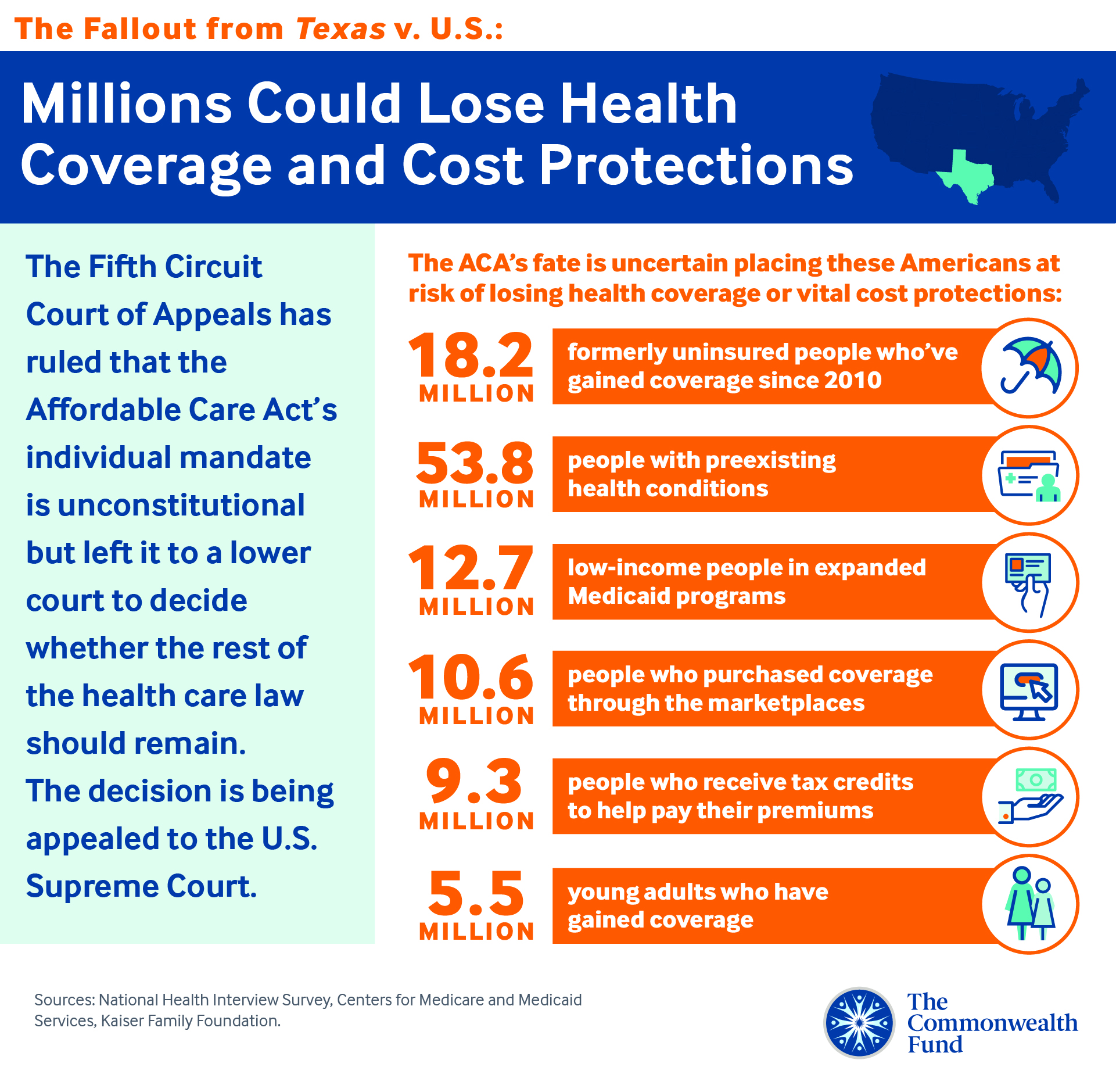
The Fallout from Texas v. U.S.:

Yesterday, a three-judge panel from the Fifth Circuit Court of Appeals struck down the Affordable Care Act (ACA)’s individual mandate. The judges agreed with a lower court decision issued in the case, Texas v. U.S., in December 2018 that the individual mandate is unconstitutional but, unlike the lower court, did not decide that the rest of the ACA is also unconstitutional. Instead, the judges remanded, or sent back, the decision to the same lower court judge to consider. California Attorney General Xavier Becerra, who is leading the 21 Democratic state attorneys general defending the law, along with the U.S. House of Representatives, immediately announced he would appeal the decision to the Supreme Court.

Whether the Supreme Court will decide to take the case now or wait for the decision of Judge O’Connor’s, of the lower court, is uncertain. If the Court decides to take the case now, they could expedite the briefing process and issue a decision in 2020. If it does not take the case now, a ruling will be delayed until after the 2020 presidential election.

No one knows how the Supreme Court will ultimately rule. But we do know that if the Court decides to strike down the ACA, the human toll will be immense and tragic. The law has granted unprecedented health security to millions:

  • 18.2 million formerly uninsured people have gained coverage since 2010
  • 53.8 million Americans with preexisting health conditions are now protected
  • 12.7 million low-income people are insured through expanded Medicaid
  • 10.6 million people have coverage through the ACA marketplaces, 9.3 million of whom receive tax credits to help them pay their premiums
  • 5.5 million young adults have gained coverage, many by staying on their parents’ plans
  • 45 million Medicare beneficiaries have much better drug coverage.

Such a decision will also trigger massive disruption throughout the U.S. health system. The health care industry represents nearly 20 percent of the nation’s economy; the ACA has touched every corner of it. The law restructured the individual and small-group health insurance markets, expanded and streamlined the Medicaid program, improved Medicare benefits, and reformed the way Medicare pays doctors, hospitals, and other providers. It was a catalyst for the movement toward value-based care and established a regulatory pathway for biosimilars — less expensive versions of biologic drugs. States have rewritten laws to incorporate the ACA’s provisions. Insurers, hospitals, physicians, and state and local governments have invested billions of dollars in adjusting to these changes.

The law’s popular preexisting health condition protections have made it possible for people with minor-to-serious health problems to apply for coverage in the same way healthier people have always done. These protections have given the estimated 53.8 million Americans with preexisting health conditions the peace of mind that they will never be denied health insurance because of their health.

More than 150 million people who get coverage through their employers now are eligible for free preventive care, and their children can stay on their policies to age 26.

The wide racial and income inequities in health insurance coverage that have been partly remedied by the ACA would return. Hospitals and providers, especially safety-net institutions, would struggle with mounting uncompensated care burdens and sicker and more costly patients who are not receiving the preventive care they need.

The ACA tore down financial barriers to health care for millions, many of whom were uninsured for most of their lives. It has demonstrably helped people get the health care they need in states across the country. Research indicates that Medicaid expansion has led to improved health status and lower mortality risk.

To date, neither the Trump administration, which has sided with the plaintiffs in the case, nor its Republican colleagues in Congress have offered a replacement plan in the event the law is struck down. The historic progress made by Americans, particularly those with middle and lower incomes and people of color, could unravel. Voters are already telling policymakers they are worried about their ability to afford health care. Yesterday’s decision and the uncertain path forward to the Supreme Court is certain to escalate those worries. With the nation entering the 2020 presidential election year, the Supreme Court may decide to take up the case this term.


Britain’s Bold Move Toward Healthcare

https://www.kornferry.com/institute/britain-election-healthcare-leadership?utm_campaign=12-19-19-twil&utm_source=marketo&utm_medium=email&mkt_tok=eyJpIjoiTnpBek5UVmpOR0UyTkRVeSIsInQiOiJVV2tpTzNyRjlpXC9xS2gweDJSckUxRThIK0F6b2VxeDBNNzRDcDFhTVVEVUpqY2hXdG1ucGc0ZHVFYmFkY1V0WlwvbDhuWFdsNFpqZWVnXC9rdE93SldkY3lqTERSdzZGMW41ZWNOTHJJc0VIQUNycStRa0pkM2ZvaUhJd08wUU5sbyJ9

Just days after a landslide election victory for the Conservative Party, Britain’s Prime Minister Boris Johnson just made a massive and bold announcement: He’ll get laws passed to guarantee plenty of cash for the state-run healthcare system.

The official announcement will likely come Thursday when the Queen, who is the official head of state, will reopen Parliament and outline the coming legislative agenda. Tucked within her speech will be a call for £34 billion ($45 billion) in annual taxpayer money for the National Health Service (NHS).

While other countries embrace their private health systems, the British love their publicly funded NHS, an employer of 1.5 million people, which services the population of 66 million. In general, the people are concerned about the quality of care provided by the NHS and look to the government for solutions, says Mary Macleod, a senior client partner for Korn Ferry’s Board and CEO Services practice and a former Conservative Party MP. “The NHS does become a bit of a political football,” she says. “And to a large extent, everyone in the UK feels that they are stakeholders in it.”

The pledge to secure NHS money will likely bolster Johnson’s political leadership versus the opposition Labour Party. And the move also neutralizes critics that have barraged the Conservative Party with allegations that it would sell parts of the NHS to foreign investors. In other words, pushing a new funding law through Parliament could partially neutralize political opponents.

But the politics of the matter is only part of the announcement’s strength, Macleod says. Promising the NHS years of generous financing will allow the organization to develop a strategy for how it will care for the country’s population for years into the future. In short, Macleod says, it sends a message to the NHS leadership: You can get busy now. “If you now know you are getting the funding, you can plan ahead,” she says.

Johnson’s lack of specifics about how the NHS should spend the money could be a strength. In a sense, he has empowered the organization’s leadership to make the decisions that they deem suitable. “What the prime minister is not doing is defining the solutions,” Macleod says. But she also notes that he will want results in the form of improved service from the organization. “He will hold them accountable,” she says.

While there are benefits when leaders take bold steps, there are also risks, says Christina Harrington, Korn Ferry’s head of advisory services in Stockholm, Sweden. She says it is good for leaders to act quickly and with conviction, as the public expects that of its leaders. But that alone isn’t enough. She says the problem comes when there’s too much ego involved. “You need an egoless conviction to drive a decision making the greater good,” she says.

Ideally, the driver of proposed changes needs to have a long-term vision of something better than the current situation. If that vision is lacking, then the leader may lack the required stamina to get the job done. Indeed, if headline-grabbing is all that the boss wants, then he or she might wind up doing a U-turn. “If there isn’t a long-term vision, then another fast decision may come in the other direction,” Harrington says. “And that’s what we see a lot of.”


Moffitt Cancer Center CEO, center director step down; conflicts of interest cited

https://www.beckershospitalreview.com/hospital-executive-moves/moffitt-cancer-center-ceo-center-director-step-down-conflicts-of-interest-cited.html?origin=CEOE&utm_source=CEOE&utm_medium=email

Related image

Tampa, Fla.-based H. Lee Moffitt Cancer Center & Research Institute on Dec. 18 accepted the resignations of President and CEO Alan F. List, MD, and Thomas Sellers, an executive vice president and center director at Moffitt, the cancer center announced.

In a news release, Moffitt said the resignations were due to violations of conflict-of-interest rules through the work the center director and CEO did in China. An internal compliance review led up to the resignations.

“Moffitt initiated an internal review of team members’ collaborations with research institutions in China after the National Institutes of Health warned all its grant recipients of foreign efforts to influence or compromise U.S. researchers,” Moffitt said. “Moffitt found several compliance violations that also prompted separation of four additional researchers.”

Timothy Adams, Moffitt’s board chairman, will become interim CEO and president.

The Tampa Bay Times reports that the compliance violations were primarily associated with cancer center employees’ personal involvement in China’s “Thousand Talents” program, which aims to recruit global researchers and academics. 

Mr. Adams said in the news release: “At Moffitt, we pride ourselves not only on our lifesaving research and world-class patient care, but also on transparency and integrity among all our employees. This was an unfortunate but necessary decision.”

“Going forward, this will not damage the future of our research or the care of our patients. We will continue to be careful stewards of the public money entrusted to us for cancer research. Moffitt is proud to have 7,000 of the finest medical professionals in the world fighting every day to treat and cure cancer. That is what mattered yesterday, and that is what will matter tomorrow,” he added.

Former Florida House Speaker H. Lee Moffitt, the cancer center’s namesake, also addressed the matter, saying in the news release: “This great institution did its job. We listened to the warnings from NIH, conducted a proactive review, and took strong action when it was needed.”

Dr. List, who previously was Moffitt’s executive vice president and physician-in-chief as well as chief of the malignant hematology division, could not immediately be reached by the Times for comment.

Moffitt continues to conduct a review, including examining its research and education partnership with China’s Tianjin Medical University Cancer Institute and Hospital. Moffitt said nothing indicates that the cancer center’s research was compromised or patient care affected.