The Affordable Care Act is Back on Stage: What to Expect

In the last 2 weeks, the Affordable Care Act (ACA) has been inserted itself in Campaign 2024 by Republican aspirants for the White House:

  • On Truth Social November 28, former President Trump promised to replace it with something better: “Getting much better Healthcare than Obamacare for the American people will be a priority of the Trump Administration. It is not a matter of cost; it is a matter of HEALTH. America will have one of the best Healthcare Plans anywhere in the world. Right now, it has one of the WORST! I don’t want to terminate Obamacare, I want to REPLACE IT with MUCH BETTER HEALTHCARE. Obamacare Sucks!!!!” 
  • Then, on NBC’s Meet the Press December 3, Florida Governor Ron DeSantis offered “We need to have a healthcare plan that works,” Obamacare hasn’t worked. We are going to replace and supersede with a better plan….a totally different healthcare plan… big institutions that are causing prices to be high: big pharma, big insurance and big government.”

It’s no surprise. Health costs and affordability rank behind the economy as top issues for Republican voters per the latest Kaiser Tracking Poll. And distaste with the status quo is widespread and bipartisan: per the Keckley Poll (October 2023), 70% of Americans including majorities in both parties and age-cohorts under 65 think “the system is fundamentally flawed and needs major change.” To GOP voters, the ACA is to blame.

Background:

The Affordable Care Act (aka Obamacare aka the Patient Protection and Affordable Care Act) was passed into law March 23, 2013. It is the most sweeping and controversial health industry legislation passed by Congress since Lyndon Johnson’s Medicare and Medicaid Act (1965). Opinions about the law haven’t changed much in almost 14 years: when passed in 2010, 46% were favorable toward the law vs. 40% who were opposed. Today, those favorable has increased to 59% while opposition has stayed at 40% (Kaiser Tracking Poll).

Few elected officials and even fewer voters have actually read the law. It’s understandable: 955 pages, 10 major sections (Titles) and a plethora of administrative actions, executive orders, amendments and legal challenges that have followed. It continues to be under-reported in media and misrepresented in campaign rhetoric by both sides. Campaign 2024 seems likely to be more of the same.

In 2009, I facilitated discussions about health reform between the White House Office of Health Reform and the leading private sector players in the system (the American Medical Association, the American Hospital Association, America’s Health Insurance Plans, AdvaMed, PhRMA, and BIO). The impetus for these deliberations was the Obama administration’s directive that systemic reform was necessary with three-aims:  reduce cost, increase access via insurance coverage and improve the quality of care provided by a private system. In parallel, key Committees in the House and Senate held hearings ultimately resulting in passage of separate House and Senate versions with the Senate’s becoming the substance of the final legislation. Think tanks on the left (I.e. the Center for American Progress et al.) and on the right (i.e. the Heritage Foundation) weighed in with members of Congress and DC influencers as the legislation morphed. And new ‘coalitions, centers and institutes’ formed to advocate for and against certain ACA provisions on behalf of their members while maintaining a degree of anonymity.

So, as the ACA resurfaces in political discourse in coming months, it’s important it be framed objectively. To that end, 3 major considerations are necessary to have a ‘fair and balanced’ view of the ACA:

1-The ACA was intended as a comprehensive health reform legislative platform. It was designed to be implemented between 2010 and 2019 in a private system prompted by new federal and state policies to address cost, access and quality. It allowed states latitude in implementing certain elements (like Medicaid expansion, healthcare marketplaces) but few exceptions in other areas (i.e.individual and employer mandates to purchase insurance, minimum requirements for qualified health plans, et al). The CBO estimated it would add $1.1 trillion to overall healthcare spending over the decade but pay for itself by reducing demand, administrative red-tape and leveraging better data for decision-making. The law included provisions to…

  • To improve quality by modernizing of the workforce, creating an Annual Quality Report obligation by HHS, creating the Patient Centered Outcome Research Institute and expanding the the National Quality Forum, adding requirements that approved preventive care be accessible at no cost, expanding community health centers, increasing residency programs in primary care and general surgery, implementing comparative effectiveness assessments to enable clinical transparency and more.
  • To increase access to health insurance by subsidizing coverage for small businesses and low income individuals (up to 400% of the Federal poverty level), funding 90% of the added costs in states choosing to expand their Medicaid enrollments for households earning up to 138% of the poverty level, extending household coverage so ‘young invincibles’ under 26 years of age could stay on their parent’s insurance plan, requiring insurers to provide “essential benefits” in their offerings, imposing medical loss ratio (MLR) mandates (80% individual, 85% group) and more.
  • To lower costs by creating the CMS Center for Medicare and Medicaid Innovation to construct 5-year demonstration pilots and value-based purchasing programs that shift provider incentives from volume to value, imposing price and quality reporting and transparency requirements and more.

The ACA was ambitious: it was modeled after Romneycare in MA and premised on the presumption that meaningful results could be achieved in a decade. But Romneycare (2006) was about near-universal insurance coverage for all in the Commonwealth, not the triple aim, and the resistance calcified quickly among special interests threatened by its potential.

2-The ACA passed at a time of economic insecurity and hyper-partisan rancor and before many of the industry’s most significant innovations had taken hold. The ACA was the second major legislation passed in the first term of the Obama administration (2009-2012); the first was the $831 billion American Recovery and Reconstruction Act (ARRA) stimulus package that targeted “shovel ready jobs” as a means of economic recovery from the 2008-2010 Great Recession. But notably, it included $138 billion for healthcare including requirements for hospitals and physicians to computerize their medical records, extension of medical insurance to laid off workers and additional funding for states to offset their Medicaid program expenses. The Obama-Biden team came to power with populist momentum behind their promises to lower health costs while keeping the doctors and insurance plans they had. Its rollout was plagued by miscues and the administration’s most popular assurances (‘keep your doctor and hospitals’) were not kept. The Republican Majority in the 111th Congress’ (247-193)) seized on the administration’s miss fueling anti-ACA rhetoric among critics and misinformation.

3-Support for the ACA has grown but its results are mixed. It has survived 7 Supreme Court challenges and more than 70 failed repeal votes in Congress.  It enjoys vigorous support in the Biden administration and among the industry’s major trade groups but remains problematic to outsiders who believe it harmful to their interests. For example, under the framework of the ACA, the administration is pushing for larger provider networks in the 18 states and DC that run their own marketplaces, expanded dental and mental health coverage, extended open enrollment for Marketplace coverage and restoration of restrictions on “junk insurance’ but its results to date are mixed: access to insurance coverage has increased. Improvements in quality have been significant as a result of innovations in care coordination and technology-enabled diagnostic accuracy. But costs have soared: between 2010 and 2021, total health spending increased 64% while the U.S. population increased only 7%.

So, as the ACA takes center stage in Campaign 2024, here are 4 things to watch:

1-Media attention to elements of the ACA other than health insurance coverage. My bet: attention from critics will be its unanticipated costs in addition to its federal abortion protections now in the hands of states. The ACA’s embrace of price and quality transparency is of particular interest to media and speculation that industry consolidation was an unintended negative result of the law will energize calls for its replacement. Thus, the law will get more attention. Misinformation and disinformation by special interests about its original intent as a “government takeover of the health system” will be low hanging fruit for antagonists.

2- Changes to the law necessary intended to correct/mitigate its unintended consequences, modernize it to industry best practice standards and responses to court challenges will lend to the law’s complex compliance challenges for each player in the system. New ways of prompting Medicaid expansion, integration of mental health and social determinants with traditional care, the impact of tools like ChatGPT, quantum computing, generative AI not imagined as the law was built, the consequences of private equity investments on prices and spending, and much more.

3-Public confusion. The ACA is a massive law in a massive industry. Cliff’s Notes are accessible but opinions about it are rarely based on a studied view of its intent and structure. It lends itself to soundbites intended to obscure, generalize or misdirect the public’s attention.  

4-The ACA price tag. In 2010, the CBO estimated its added cost to health spending at $1.1 trillion (2010-2019) but its latest estimate is at least $3 trillion for its added insurance subsidies alone. The fact is no one knows for sure what its costs are nor the value of the changes it has induced into the health system. The ranks of those with insurance coverage has been cut in half. Hospitals, physicians, post-acute providers, drug manufacturers and insurers are implementing value-based care strategies and price transparency (though reluctantly) but annual health cost increases have consistently exceeded 4% annually as the cumulative impact of medical inflation, utilization, consolidation and price increases are felt.

Final thought:

I have studied the ACA, and the enabling laws, executive orders, administrative and regulatory actions, court rulings and state referenda that have followed its passage. Despite promises to ‘repeal and replace’ by some, it is more likely foundational to bipartisan “fix and repair’ regulatory reforms that focus more attention to systemness, technology-enabled self-care, health and wellbeing and more.

It will be interesting to see how the ACA plays in Campaign 2024 and how moderators for the CNN-hosted debates January 10 in Des Moines and January 21 in New Hampshire address it. In the 2-hour Tuscaloosa debate last Wednesday, it was referenced in response to a question directed to Gov. DeSantis about ‘reforming the system’ 101 minutes into the News Nation broadcast. It’s certain to get more attention going forward and it’s certain to play a more prominent role in the future of the system.

The ACA is back on the radar in U.S. healthcare. Stay tuned.

PS The resignations under pressure of Penn President Elizabeth Magill and Board Chair Scott Bok over inappropriate characterization of Hamas’ genocidal actions toward Jews are not surprising. Her response to Congressional questioning was unfortunate. The eventuality turned in 4 days, sparked by student outrage and adverse media attention that tarnished the reputations of otherwise venerable institutions like Penn, MIT and Harvard.

The lessons for every organization, including the big names in healthcare, are not to be dismissed: Beyond the issues of genocide, our industry is home to a widening number of incendiary issues like Hamas.

They’re increasingly exposed to public smell tests that often lead to more: Workforce strikes. CEO compensation. Fraud and abuse. Tax exemptions and community benefits. Prior authorization and coverage denial. Corporate profit. Patient collection and benevolent use policies. Board independence and competence and many more are ripe for detractors and activist seeking attention. 

Public opinion matters. Reputations matter. Boards of Directors are directly accountable for both.  

ChatGPT will reduce clinician burnout, if doctors embrace it

Clinician burnout is a major problem. However, as I pointed out in a previous newsletter post, it is not a distinctly American problem.

A recent report from the Commonwealth Fund compared the satisfaction of primary care physicians in 10 high-income nations. Surprisingly, U.S. doctors ranked in the middle, reporting higher satisfaction rates than their counterparts in the U.K., Germany, Canada, Australia and New Zealand.

A Surprising Insight About Burnout

In self-reported surveys, American doctors link their dissatisfaction to problems unique to the U.S. healthcare system: excessive bureaucratic tasks, clunky computer systems and for-profit health insurance. These problems need to be solved, but to reduce clinician burnout we also need to address another factor that negatively impacts doctors around the globe.

Though national healthcare systems may vary greatly in their structure and financing, clinicians in wealthy nations all struggle to meet the ever-growing demand for medical services. And that’s due to the mounting prevalence and complications of chronic disease.

At the heart of the burnout crisis lies a fundamental imbalance between the volume and complexity of patient health problems (demand) and the amount of time that clinicians have to care for them (supply). This article offers a way to reverse both the surge in chronic illnesses and the ongoing clinician burnout crisis.

Supply vs. Demand: Reframing Burnout

When demand for healthcare exceeds doctors’ capacity to provide it, one might assume the easiest solution is to increase the supply of clinicians. But that outcome remains unlikely so long as the cost increases of U.S. medicine continue to outpace Americans’ ability to afford care.

Whenever healthcare costs exceed available funds, policymakers and healthcare commentators look to rationing. The Oregon Medicaid experiment of the 1990s offers a profound reminder of why this approach fails. Starting in 1989, a government taskforce brought patients and providers together to rank medical services by necessity. The plan was to provide only as many as funding would allow. When the plan rolled out, public backlash forced the state to retreat. They expanded the total services covered, driving costs back up without any improvement in health or any relief for clinicians.

Consumer Culture Can Drive Medical Culture

Ultimately, to reduce burnout, we will have to find a way to decrease clinical demand without raising costs or rationing care.

The best—and perhaps only viable—solution is to embrace technologies that empower patients with the ability to better manage their own medical problems.

American consumers today expect and demanded greater control over their lives and daily decisions. Time and again, technology has made this possible.

Take stock trading, for example. Once the sole domain of professional brokers and financial advisors, today’s online trading platforms give individual investors direct access to the market and a wealth of information to make prudent financial decisions. Likewise, technology transformed the travel industry. Sites like Airbnb and Expedia empowered consumers to book accommodations, flights and travel experiences directly, bypassing traditional travel agents.

Technology will soon democratize medical expertise, as well, giving patients unprecedented access to healthcare tools and knowledge. Within the next five to 10 years, as ChatGPT and other generative AI applications become significantly more powerful and reliable, patients will gain the ability to self-diagnose, understand their diseases and make informed clinical decisions.

Today, clinicians are justifiably skeptical of outsized AI promises. But as technology proves itself worthy, clinicians who embrace and promote patient empowerment will not only improve medical outcomes, but also increase their own professional satisfaction.

Here’s how it can happen:

Empowering Patients With Generative AI

In the United States, health systems (i.e., large hospitals and medical groups) that heavily prioritize preventive medicine and chronic-disease management are home to healthier patients and more satisfied clinicians.

In these settings, patients are 30% to 50% less likely to die from heart attack, stroke and colon cancer than patients in the rest of the nation. That’s because their healthcare organizations provide effective chronic-disease prevention programs and assist patients in managing their diabetes, hypertension, obesity and asthma. As a result, patients experience fewer complications like heart attacks, strokes, and cancer.

Most primary care physicians, however, don’t have the time to accomplish this by themselves. According to one study, physicians would need to work 26.7 hours per day to provide all the recommended preventive, chronic and acute care to a typical panel of 2,500 adult patients.

GenAI technologies like ChatGPT can help lessen the load. Soon, they’ll be able to offer patients more than just general advice about their chronic illnesses. They will give personalized health guidance. By connecting to electronic health records (EHR)—even when those systems are spread across different doctors’ offices—GenAI will be able to analyze a patient’s specific health data to provide tailored prevention recommendations. It will be able to remind patients when they need a health screening, and help schedule it, and even sort out transportation. That’s not something Google or any other online platform can currently do.

Moreover, with new tools (like doctor-designed plugins expected in future ChatGPT updates) and data from fitness trackers and home health monitors, GenAI will be capable of not just displaying patient health data, but also interpreting it in the context of each person’s health history and treatment plans. These tools will be able to provide daily updates to patients with chronic conditions, telling them how they’re doing based on their doctor’s plan.

When the patient’s health data show they’re on the right track, there won’t be a need for an office visit, saving time for everyone. But if something seems off—say, blood pressure readings remain excessively high after the start of anti-hypertensive drugs—clinicians will be able to quickly adjust medications, often without the patient needing to come in. And when in-person visits are necessary, GenAI will summarize patient health information so the doctor can quickly understand and act, rather than starting from scratch.

ChatGPT is already helping people make better lifestyle choices, suggesting diets tailored to individual health needs, complete with shopping lists and recipes. It also offers personalized exercise routines and advice on mental well-being.

Another way generative AI can help is by diagnosing and treating common, non-life-threatening medical problems (e.g., musculoskeletal, allergic or viral issues). ChatGPT and Med-PaLM 2 have already demonstrated the capability in diagnosing a range of clinical issues as effectively and safely as most clinicians. Looking ahead, GenAI’s will offer even greater diagnostic accuracy. When symptoms are worrisome, GenAI will alert patients, speeding up definitive treatment. Its ability to thoroughly analyze symptoms and ask detailed questions without the time pressure doctors feel today will eradicate many of our nation’s 400,000 annual deaths from misdiagnosis.

The outcomes—fewer chronic diseases, fewer heart attacks and strokes and more medical problems solved without an office visit—will decrease demand, giving doctors more time with the patients they see. As a result, clinicians will leave the office feeling more fulfilled and less exhausted at the end of the day.

The goal of enhanced technology use isn’t to eliminate doctors. It’s to give them the time they desperately need in their daily practice, without further increasing already unaffordable medical costs. And rather than eroding the physician-patient bond, the AI-empowered patient will strengthen it, since clinicians will have the time to dive deeper into complex issues when people come to the office.

A More Empowered Patient Is Key To Reducing Burnout

AI startups are working hard to create tools that assist physicians with all sorts of tasks: EHR data entry, organizing office duties and submitting prior authorization requests to insurance companies.

These function will help clinicians in the short run. But any tool that fails to solve the imbalance between supply (of clinician time) and demand (for medical services), will be nothing more than a temporary fix.

Our nation is caught in a vicious cycle of rising healthcare demand, leading to more patient visits per day per doctor, producing higher rates of burnout, poorer clinical outcomes and ever-higher demand. By empowering patients with GenAI, we can start a virtuous cycle in which technology reduces the strain on doctors, allowing them to spend more time with patients who need it most. This will lead to better health outcomes, less burnout for clinicians and further decreases in overall healthcare demand.

Physicians and medical societies have the opportunity to take the lead. They’ll have to educate the public on how to use this technology effectively, assist in connecting it to existing data sources and ensure that the recommendations it makes are reliable and safe. The time to start this process is now.

Executive Intelligence and Its Relationship to Management Competence

These days I have been reading From Strength to Strength: Finding Success, Happiness, and Deep Purpose in the Second Half of Life by Arthur C. Brooks. Brooks is the former President of the American Enterprise Institute and is currently a professor at both the Harvard Kennedy School and the Harvard Business School. 

From Strength to Strength is a book about intelligence and aging and the relationship of those aspects to personal happiness. The book is part sociology, part psychology, and part self-help. But if you read carefully, the book also offers important lessons in contemporary management.

The central theme of From Strength to Strength is how our intelligence changes over time and how individuals must change to make the best use of this changing intelligence. To make this point, Brooks cites Raymond Cattell, a British-American psychologist, who in 1971 suggested that there are two types of intelligence: “fluid intelligence” and “crystallized intelligence.”

Cattell and Brooks define fluid intelligence as the ability to “reason, think flexibly, and solve novel problems.” This is the kind of smarts and intelligence that is associated with young Nobel Prize winners and the tech titans of Silicon Valley. Crystallized intelligence is different. Brooks defines crystallized intelligence as the ability to use a stock of knowledge accumulated and learned in the past. Fluid intelligence is a characteristic of the young while crystallized intelligence is more closely associated with our aging process.

At its best, fluid intelligence is “raw smarts” or what I might term “mental athleticism.” Crystallized intelligence at its best is what we recognize as “wisdom.”

Extrapolating from Brooks’ observations and analysis, one can conclude that complex organizations, both not-for-profit and for-profit, require both kinds of executive intelligence. Fluid intelligence generates new ideas, top-shelf innovation, and executive solutions to the most difficult business problems. But crystallized intelligence provides organizations with “the wisdom and experience of people who have seen a lot.”

To further paraphrase Brooks, crystallized intelligence can teach the organization how not to make flagrant, self-defeating, and avoidable errors.

Reading Brooks and thinking about Cattell’s research led me to two observations. First, in our general corporate environment, including hospitals, we very much de-emphasize the value of crystallized intelligence. Just at the moment when many “older” executives are at the highest point of institutional wisdom, our modern corporate structure tends to react in two ways:

  • In general, we no longer give these so-called older executives jobs of responsibility and/or importance. These jobs are reserved for younger executives whose critical qualification is powerful levels of fluid intelligence.
  • Also, many corporate organizations demand what I would characterize as “early retirement.” This is especially true in many prominent American companies when long-tenured executives are required to retire in their late fifties or early sixties. If you place these retirements in the context of crystallized intelligence, then such retirements inevitably lead to a significant loss of human capital to our overall national economy. This includes the loss of long-term accumulated smarts, and most importantly, a loss of organizational wisdom.

Turning this discussion more specifically to hospital management leads to my second observation. Since Covid, the number of hospital CEO resignations has significantly increased when compared to previous years. Additionally, not only has CEO turnover increased but a number of important, influential, and highly capable CEOs—who previously might have been expected to work into their mid-sixties or, perhaps, even into their early seventies—have also decided to leave hospital leadership.

If we come back then to the central observations of Brooks and Cattell, we can see that hospital leadership and management, which is already challenged by so many external and difficult factors, is now losing critically required crystallized intelligence and wisdom.

Having said all this, it is still patently obvious that your organization requires the fluid intelligence of the next generation and the generation after that. That kind of intelligence is necessary and essential to solve today’s and tomorrow’s hardest healthcare problems. And, of course, to innovate and then to innovate some more.

But at the same time, your hospital or health system must also preserve a prominent place for older executives who possess the crystallized intelligence that assures your hospital will prioritize caring, thoughtfulness, and an essential level of managerial balance—all things that come along with executive wisdom.

From Strength to Strength signals a new way of looking at your executive team. This includes understanding that executives of differing tenures bring very different types of intelligence to the organization. And, it requires finding the proper balance between fluid and crystallized intelligence to give your hospital the very best opportunity to re-find its way to a much-needed new vision of hospital success.

Health System Chief Strategy Officer Roundtable Assessment: ‘The Near-Term is Tough, the Long-Term is Uncertain and the Deck is Stacked against Hospitals’

On November 2-3 in Austin, I moderated the 4th Annual CSO Roundtable* in which Chief Strategy/Growth Officers from 12 mid-size and large multi-hospital systems participated. The discussion centered on the future: the issues and challenges they facing their organizations TODAY and their plans for their NEAR TERM (3-5 years) and LONG-TERM (8-10 years) future. Augmenting the discussion, participants rated the likelihood and level of disruptive impact for 50 future state scenarios using the Future State Diagnostic Survey. *

Five themes emerged from this discussion:

1-Major change in the structure and financing of U.S. health system is unlikely.

  • CSOs do not believe Medicare for All will replace the current system. They anticipate the existing public-private delivery system will continue with expanded government influence likely.
  • Public funding for the system remains problematic: private capital will play a larger role.
  • CSOs think it is unlikely the public health system will be fully integrated into the traditional delivery system (aka health + social services). Most hospital systems are expanding their outreach to public health programs in local markets as an element of their community benefits strategy.
  • CSOs recognize that states will play a bigger role in regulating the system vis a vis executive orders and referenda on popular issues. Price controls for hospitals and prescription drugs, restraints on hospital consolidation are strong possibilities.
  • Consensus: conditions for hospitals will not improve in the immediate and near-term. Strategies for growth must include all options.

2-Health costs, affordability and equitable access are major issues facing the health industry overall and hospitals particularly.

  • CSOs see equitable access as a compliance issue applicable to their workforce procurement and performance efforts and to their service delivery strategy i.e., locations, patient experiences, care planning.
  • CSOs see reputation risk in both areas if not appropriately addressed in their organizations.
  • CSOs do not share a consensus view of how affordability should be defined or measured.
  • There is consensus among CSOs that hospitals have suffered reputation damage as a result of inadequate price transparency and activist disinformation campaigns. Executive compensation, non-operating income, discrepancies in charity care and community benefits calculations and patient “sticker shock” are popular targets of criticism.
  • CSO think increased operating costs due to medical inflation, supply chain costs including prescription drugs, and labor have offset their efforts in cost reduction and utilization gains.
  • CSO’s are focusing more of their resources and time in support of acute clinical programs where streamlining clinical processes and utilization increases are achievable near-term.
  • Consensus: the current financing of the system, particularly hospitals, is a zero-sum game. A fundamental re-set is necessary.

3-The regulatory environment for all hospitals will be more challenging, especially for not-for-profit health systems.

  • Most CSOs think the federal regulatory environment is hostile toward hospitals. They expect 340B funding to be cut, a site neutral payment policy in some form implemented, price controls for hospital services in certain states, increased federal and state constraints on horizontal consolidation vis a vis the FTC and State Attorneys General, and unreasonable reimbursement from Medicare and other government program payers.
  • CSOs believe the challenges for large not-for-profit hospital systems are unique: most CSOs think not-for-profit hospitals will face tighter restrictions on their qualification for tax-exempt status and tighter accountability of their community benefits attestation. Most expect Congress and state officials to increase investigations about for-profit activities, partnerships with private equity, executive compensation and other issues brought to public attention.
  • CSOs think rural hospital closures will increase without significant federal action.
  • Consensus: the environment for all hospitals is problematic, especially large, not-for-profit multi-hospitals systems and independent rural facilities.

4-By contrast, the environment for large, national health insurers, major (publicly traded) private equity sponsors and national retailers is significantly more positive.

  • CSOs recognize that current monetary policy by the Fed coupled with tightening regulatory restraints for hospitals is advantageous for national disruptors. Scale and access to capital are strategic advantages enjoyed disproportionately by large for-profit operators in healthcare, especially health insurers and retail health.
  • CSOs believe publicly traded private equity sponsors will play a bigger role in healthcare delivery since they enjoy comparably fewer regulatory constraints/limitations, relative secrecy in their day-to-day operations and significant cash on hand from LPs.
  • CSOs think national health insurer vertical consolidation strategies will increase noting that all operate integrated medical groups, pharmacy benefits management companies, closed networks of non-traditional service providers (i.e. supplemental services like dentistry, home care, et al) and robust data management capabilities.
  • CSOs think national retailers will expand their primary care capabilities beyond traditional “office-based services” to capture market share and widen demand for health-related products and services
  • Consensus: national insurers, PE and national retailers will leverage their scale and the friendly regulatory environment they enjoy to advantage their shareholders and compete directly against hospital and medical groups.

5-The system-wide shift from volume to value will accelerate as employers and insurers drive lower reimbursement and increased risk sharing with hospitals and medical groups.

  • CSOs think the pursuit of value by payers is here to stay. However, they acknowledge the concept of value is unclear but they expect HHS to advance standards for defining and measuring value more consistently across provider and payer sectors.
  • CSOs think risk-sharing with payers is likely to increase as employers and commercial insurers align payment models with CMS’ alternative payment models: the use of bundled payments, accountable care organizations and capitation is expected to increase.
  • CSOs expect network performance and data management to be essential capabilities necessary to an organization’s navigation of the volume to value transition. CSOs want to rationalize their current acute capabilities by expanding their addressable market vis a vis referral management, diversification, centralization of core services, primary and preventive health expansion and aggressive cost management.
  • Consensus: successful participation in payer-sponsored value-based care initiatives will play a bigger role in health system strategy.

My take:

The role of Chief Strategy Officer in a multi-hospital system setting is multi-functional and unique to each organization. Some have responsibilities for M&A activity; some don’t. Some manage marketing, public relations and advocacy activity; others don’t. All depend heavily on market data for market surveillance and opportunity assessments. And all have frequent interaction with the CEO and Board, and all depend on data management capabilities to advance their recommendations about risk, growth and the future. That’s the job.

CSOs know that hospitals are at a crossroad, particularly not-for-profit system operators accountable to the communities they serve. In the 4Q Keckley Poll, 55% agreed that “the tax exemption given not-for-profit hospitals is justified by the community benefits they provide”  but 45% thought otherwise. They concede their competitive landscape is more complicated as core demand shifts to non-hospital settings and alternative treatments and self-care become obviate traditional claims-based forecasting. They see the bigger players getting bigger: last week’s announcements of the Cigna-Humana deal and expansion of the Ascension-LifePoint relationship cases in point. And they recognize that their reputations are under assault: the rift between Modern Healthcare and the AHA over the Merritt Research ’s charity care study (see Hospital section below) is the latest stimulant for not-for-profit detractors.

In 1937, prominent literary figures Laura Riding and Robert Graves penned a famous statement in an Epilogue Essay that’s especially applicable to hospitals today: “the future is not what it used to be.”

For CSO’s, figuring that out is both worrisome and energizing.

Health systems risk being reduced to their core

https://mailchi.mp/9b1afd2b4afb/the-weekly-gist-december-1-2023?e=d1e747d2d8

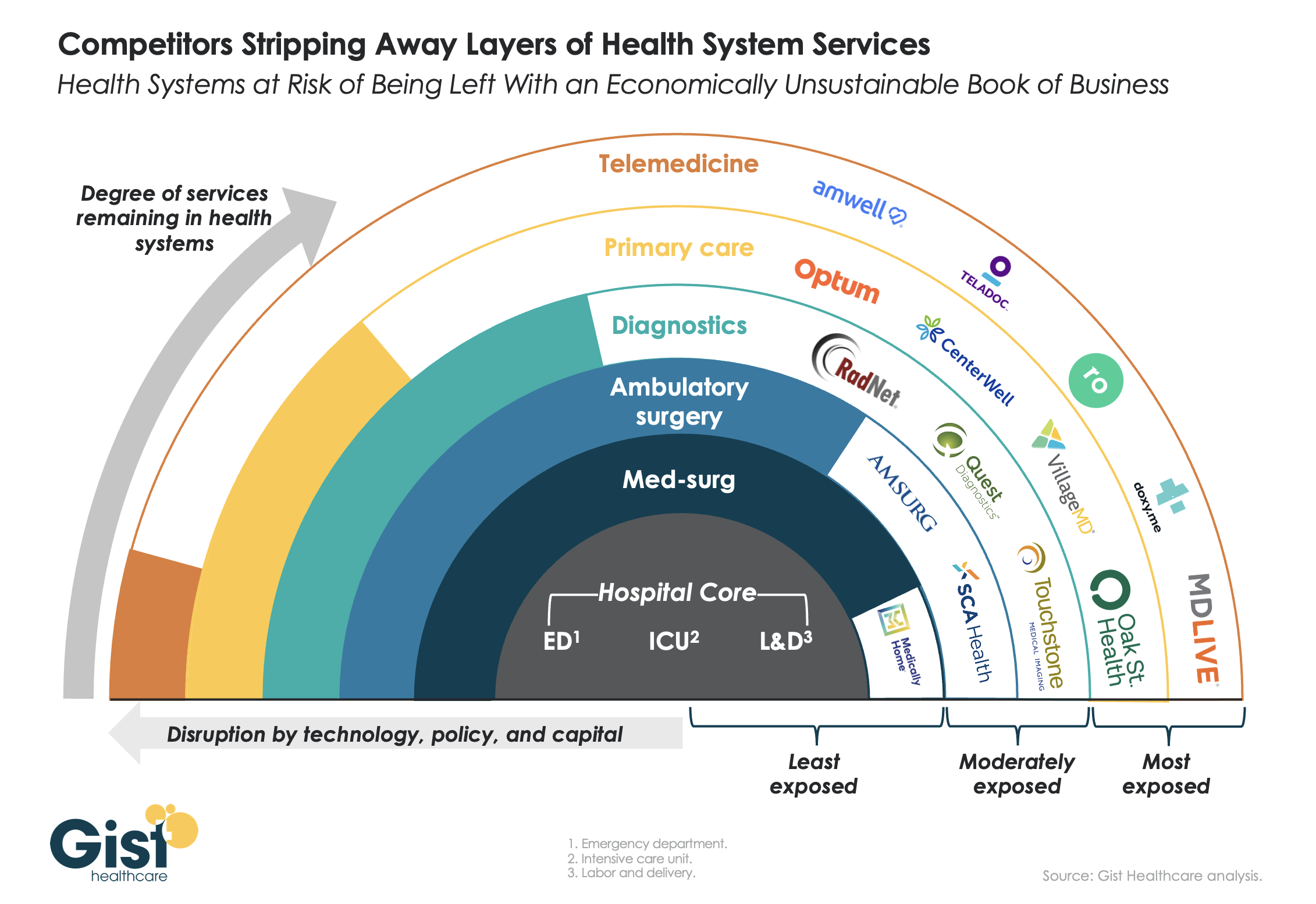
This week’s graphic features our assessment of the many emerging competitive challenges to traditional health systems.

Beyond inflation and high labor costs, health systems are struggling because competitors—ranging from vertically integrated payers to PE-backed physician groups—are effectively stripping away profitable services and moving them to lower-cost care sites. The tandem forces of technological advancement, policy changes, and capital investment have unlocked the ability of disruptors to enter market segments once considered safely within health system control. 

While health systems’ most-exposed services, like telemedicine and primary care, were never key revenue sources (although they are key referral drivers), there are now more competitors than ever providing diagnostics and ambulatory surgery, which health systems have relied on to maintain their margins. 

Moving forward, traditional systems run the risk of being “crammed down” into a smaller portfolio of (largely unprofitable) services: the emergency department, intensive care unit, and labor and delivery. 

Health systems cannot support their operations by solely providing these core services, yet this is the future many will face if they don’t emulate the strategies of disruptors by embracing the site-of-care shift, prioritizing high-margin procedures, rethinking care delivery within the hospital, and implementing lower-cost care models that enable them to compete on price.

Higher-risk patients paying more for colonoscopies

https://mailchi.mp/9b1afd2b4afb/the-weekly-gist-december-1-2023?e=d1e747d2d8

Published this week in Stat, this article explores the confusing payment landscape patients must navigate when receiving colonoscopies. While the Affordable Care Act requires that preventative care services be covered without cost-sharing, this only applies to the “screening” colonoscopies that low-risk patients are recommended to get every ten years.

But when procedures are performed at more frequent intervals for higher-risk patients, they are called “surveillance” or “diagnostic” colonoscopies, for which patients have no guarantees of cost-sharing protections, despite being essentially the same procedure, done for the same purpose.

If a gastroenterologist finds and excises one or more precancerous polyps during a screening colonoscopy, the procedure can leave the patient—especially one with a high deductible health plan—with a large, unexpected bill. 

The Gist: Against the backdrop of a sharp rise in colorectal cancer rates among US adults under 65, articles like this are a frustrating demonstration of how insurance incentive structures can work against optimal care delivery. 

Incentives should be carefully designed such that proven, preventative screenings—at the discretion of their doctor—are widely available to patients with minimal financial barriers. Surely, no one is “choosing” to have an “unnecessary” colonoscopy—as the procedure is notoriously disliked by patients.