Supreme Court to hear ACA arguments after November election

https://www.healthcaredive.com/news/supreme-court-will-hear-aca-case-after-november-election/583804/?utm_source=Sailthru&utm_medium=email&utm_campaign=Issue:%202020-08-20%20Healthcare%20Dive%20%5Bissue:29204%5D&utm_term=Healthcare%20Dive

Dive Brief:

  • The Supreme Court will hear oral arguments in the Republican-led case seeking to overturn the Affordable Care Act on November 10, exactly one week after the presidential election, according to the court’s online docket on Wednesday.
  • A hearing post-election was the likeliest choice from the outset. The justices’ October schedule did not include the highly anticipated case, leaving just one day for arguments to potentially be heard before the election.
  • Still, Wednesday’s news does not mean the Supreme Court will make a ruling on the case in 2020. Legal experts say a final ruling is still expected next year.


Dive Insight:

The ACA court case has loomed large as the nation has been ravaged by the novel coronavirus pandemic that has sickened millions, killed thousands and severed millions of people from their employer-sponsored health insurance coverage. 

Alternative coverage options introduced or strengthened by the ACA, such as expanded Medicaid coverage or marketplace plans, have served as an important safety net for those who have lost coverage as a result of the pandemic. 

Onlookers have long been waiting for the court to set a date for final arguments in the case against the ACA. Wednesday’s updated docket means the country is one step closer to knowing whether the ACA and its popular provisions, such as protections for pre-existing conditions, will remain the law of the land. 

Waiting to schedule oral arguments until after the election may have been intentional, legal experts say.

The highly unusual decision by the Trump administration’s DOJ to refuse to defend the law is likely to change with the election result, if former Vice President Joe Biden, the Democratic presidential nominee and a staunch ACA backer, wins the White House.

Republicans for years have been trying to dismantle President Barack Obama’s landmark health law, including by eliminating the financial penalty for not holding insurance.

The central argument in the case, brought primarily by a group of red states, is whether the entire law is invalid because it no longer contains the so-called individual mandate. The red states have argued that because Congress lowered the penalty to zero that the individual mandate can no longer be considered a tax and therefore renders the entire law unconstitutional.

Lower courts have ruled in favor of the red state plaintiffs, though the appeals court did not weigh in on whether the rest of the law could be severed from the mandate.


Payers win again, court rules Admininistration violated law in axing ACA cost-sharing payments

https://www.healthcaredive.com/news/payers-win-again-court-rules-trump-admin-violated-law-in-axing-aca-cost-sh/583565/?utm_source=Sailthru&utm_medium=email&utm_campaign=Issue:%202020-08-17%20Healthcare%20Dive%20%5Bissue:29123%5D&utm_term=Healthcare%20Dive

Payers win again, court rules Trump admin violated law in axing ...

Dive Brief:

  • A federal court ruled Friday that insurers are owed subsidies mandated by the Affordable Care Act to help them cover people with low incomes in the exchanges and the Trump administration violated the law when it halted the payments in 2017.
  • In a separate but related ruling, the same court found that payers that were able to raise premiums to offset the loss of those payments in 2018, however, should not receive the entire unpaid amount.
  • The judges with the U.S. Court of Appeals for the Federal District in their decision relied on a recent ruling in favor of insurers from the U.S. Supreme Court on a separate cost-sharing program in the ACA. “We see no sufficient basis for reaching a different conclusion,” they wrote.

Dive Insight:

The Affordable Care Act took into account that payers participating in the exchanges it created would be somewhat flying blind when setting premium rates for a new population. To safeguard them, multiple programs were established to help manage the inherent risk.

One of them was the risk corridors program, which was supposed to redistribute some of the profits insurers received in the exchanges to other companies seeing losses. But far more companies reported losses than profits, and the program quickly ran out of funds to pay out.

The Trump administration argued the ACA does not properly appropriate the funding anyway. 

The high court, however, ruled in April those insurers are owed about $12 billion from the program and that the language indeed creates what is called a money-mandating provision.

The decisions released Friday use that precedent for one of the other risk programs, which provided the subsidies for coverage of people with low-incomes, called cost-sharing reduction payments.

HHS abruptly stopped making the payments in October 2017, making the argument that the money had not been appropriated. But litigation of the issue goes back farther. Republicans in Congress sued HHS in 2014 making the same claim.

In 2018, with the payments still halted, payers increased their premium rates to help account for the lack of cost-sharing reduction payments, and thus received additional premium tax credits (a practice known as silver loading). The judges Friday said that although they agreed with a February 2019 decision from the U.S. Court of Federal Claims that the payers were owed the payments, they disagreed that insurers should be reimbursed in full despite the 2018 premium adjustments.

“The complexity of the process cannot obscure the underlying economic reality that the government is paying at least some of the increased costs that the insurers incurred as a result of the government’s failure to make cost-sharing reduction payments,” they wrote.

The judges remanded the case back to the Court of Federal Claims to determine the amount Maine Community Health Options is owed, and instructed them to take into account what amount of silver loading can be attributed to the loss of the payments.

Montana Co-op is owed $1.23 million for missed 2017 payments and Sanford Health Plan is owed $360,254.


Survey finds nearly one-third of rehired workers laid off again

Survey finds nearly one-third of rehired workers laid off again

Survey finds nearly one-third of rehired workers laid off again

Nearly a third of the laid off workers who were able to go back to their previous jobs have been laid off again, according to a Cornell survey released Tuesday.

The survey was conducted by RIWI from July 23 to Aug. 1, as a slew of states experiencing major COVID-19 outbreaks slammed the breaks on their economic reopenings and reimposed social distancing restrictions.

Danielle Goldfarb, head of global research at RIWI, said it was a sign that a second wave of layoffs was well underway.

“Official and private sectors jobs data have not yet picked up the significant share of American workers that have already been re-laid off,” said Goldfarb.

“Since the impact is actually worse in states that have not seen COVID surges, these data indicate a systemic problem and a much deeper recession than the mainstream data suggest,” she said.

The survey found that about 37 percent of people who were not self-employed were laid off after the pandemic struck in March, but over half (57 percent) had been called back to work since then.

But of those, 31 percent had been laid off again and another 26 percent had been told there was a possibility they would lose their jobs.

A deeper dive into the data, however, suggested that the second round of layoffs may be less about the resurgence of the virus than the loss of aid. It found only small differences in “healthier” states, those not experiencing a surge, than in places with new outbreaks.

One possible reason for the additional layoffs are problems with businesses that had remained afloat with the help of forgivable loans from the federal Paycheck Protection Program (PPP).

The funds, which started rolling out the door in April, were supposed to be enough to cover eight weeks of salary and expenses.

“The RIWI dataset output clearly shows that a substantial portion of the job growth experienced in May and June resulted from anomalies associated with PPP requirements, as opposed to underlying economic strength,” said Daniel Alpert, a senior fellow and adjunct professor of macroeconomics at Cornell Law School.

Congress has made scant progress in negotiating a new COVID-19 response bill which is expected to include an extension of the PPP and may allow businesses to apply for a second loan.

The survey was completed by 6,383 respondents, though some questions had smaller samples because they were only applicable to some people.

The margins of error for the survey questions ran from plus or minus 1.5 percent to plus or minus 3.9 percent.


Graphic of the Day: Citizens Who Lost Healthcare Coverage Since the Pandemic Began

Image may contain: text that says 'CITIZENS WHO LOST HEALTH CARE COVERAGE SINCE THE PANDEMIC BEGAN 27,000,000 US AUSTRALIA BELGIUM CANADA CHILE DENMARK FINLAND FRANCE GERMANY GREECE HUNGARY ITALY JAPAN NEW ZEALAND PORTUGAL SOUTH KOREA SPAIN SWEDEN TURKEY UK'

ACA Section 1332 State Innovation Waivers Update

https://www.healthaffairs.org/do/10.1377/hblog20200729.217545/full/

Tracking Section 1332 State Innovation Waivers | KFF

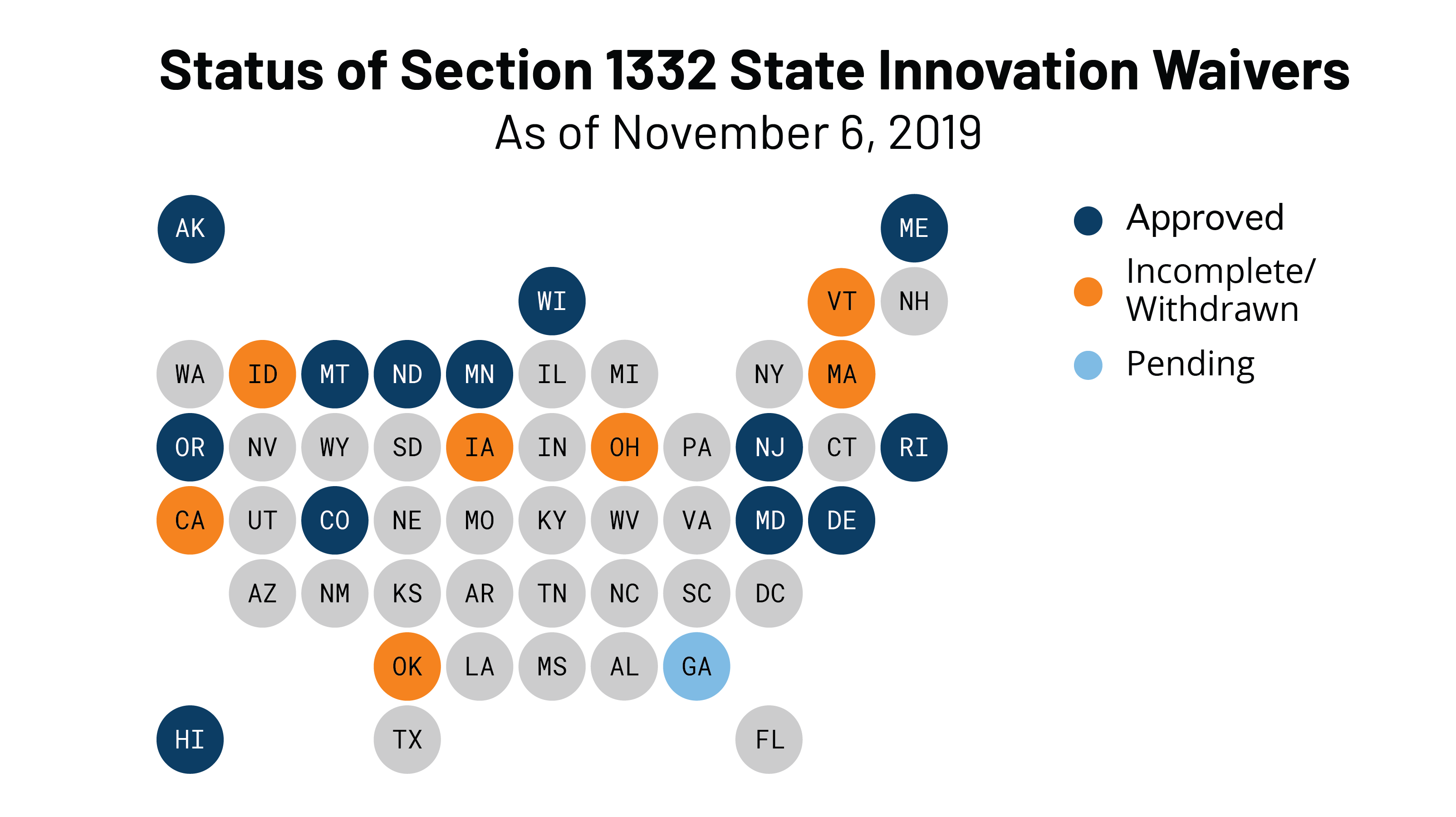
On July 24, 2020, the Centers for Medicare and Medicaid Services (CMS) and the Treasury Department approved Pennsylvania’s waiver application to operate a state-based reinsurance program under Section 1332 of the Affordable Care Act (ACA). This makes Pennsylvania the thirteenth state to be approved for a state-based reinsurance program. This post also summarizes the newest waiver proposal in Georgia.

Pennsylvania’s Waiver And More On Section 1332 Waivers

In late June, Pennsylvania received federal approval for a five-year reinsurance program beginning with the 2021 plan year. The state’s $139.3 million reinsurance program is expected to reduce premiums by about 4.6 percent (relative to what premiums would have been in the absence of the waiver) and increase enrollment in the individual market by about 0.5 percent in 2021. The federal government will contribute $95.1 million while state funds would account for about $44.2 million.

Implementation of the reinsurance program will coincide with a transition away from the federal marketplace to the new state-based marketplace, the Pennsylvania Health Insurance Exchange (Exchange). Both the reinsurance program and the Exchange were created in the same piece of 2019 legislation, which requires the Exchange to assess and collect fees—up to 3.5 percent of total monthly premiums—to support the reinsurance program. Pennsylvania expects to set the initial user fee at 3 percent of total monthly premiums. Each year, the Exchange will collect the user fee from insurers, deduct its operating expenses, and transfer the remaining funds to a reinsurance fund. In making reinsurance payments to insurers, Pennsylvania intends to first exhaust federal pass-through funding and then user fee revenue.

Based on CMS data, Pennsylvania insurers paid HealthCare.gov user fees of about $98.1 million for 2018 and about $83.1 million for 2019. (CMS has released 2018 and 2019 user fee data for each state that uses HealthCare.gov.) User fees in 2018 and 2019 were set at 3.5 percent of premiums, although the federal user fee was reduced to 3 percent for 2020.

Like nearly all states with reinsurance programs, Pennsylvania will use an overall attachment point model with parameters set annually by the insurance department. For 2021, the program is expected to reimburse insurers for 60 percent of claims between $60,000 and $100,000. To ensure program flexibility, the insurance department can make payments on a pro rata basis if funding is insufficient. Pennsylvania also intends to leverage the EDGE server maintained by CMS to determine how much each insurer is due. (This issue—whether and how states could leverage EDGE server infrastructure for reinsurance—has come up in at least one other state as well.)

Pennsylvania’s waiver application was submitted on February 11 and deemed complete on March 12. Federal regulators received and considered two supportive comments on the state’s application. In an approval letter to Commissioner Jessica Altman on July 24, the Departments laid out specific terms and conditions that the state must accept within 30 days for the waiver to go into effect. Once the waiver is accepted, the Departments will notify Pennsylvania of its amount of pass-through funding for 2021.

With Pennsylvania, 14 states have approved Section 1332 waivers. All but one approved waiver has been for a state-based reinsurance program, and CMS released a report on the effect of the 12 already-established state-based reinsurance programs. The report identifies the funding source for each state, program parameters, the impact on premiums by state and year, insurer participation, and enrollment. The average premium reduction for 2020 across all states was 17.7 percent. New Hampshire may be soon added to this list for 2021: the state’s waiver application was submitted in late April.

Latest On Georgia’s Waiver Application

Georgia submitted a waiver application in late December 2019. As discussed more here, Georgia’s application had two phases: phase one is for a reinsurance program and phase two involves much broader changes to the state’s individual market known as the “Georgia Access” model. Phase one was deemed complete on February 6, and review of phase two was “paused” to Georgia leaders could submit additional information.

Under the original Georgia Access Model, Georgia would have eliminated the use of HealthCare.gov, transitioned consumers to decentralized enrollment through private web-brokers and insurers, established its own subsidy structure, enabled the subsidization of plans that do not comply with all the ACA’s requirements, and capped enrollment if subsidy costs exceed federal and state funds. The proposal was criticized for jeopardizing access to comprehensive coverage and failing to satisfy Section 1332’s statutory guardrails.

About five months after review was “paused,” Georgia modified its waiver application, requesting that its reinsurance program be approved for 2022 (rather than 2021) and abandoning some initial components of phase two. The new waiver application was posted in early July and exposed for public comment until July 23.

The main change for phase two is that Georgia would no longer develop its own state-specific subsidy structure. Georgia would validate a consumer’s eligibility for premium tax credits and then send this information to the federal government. The federal government would then issue the subsidies to insurers and reconcile subsidies during tax season. Subsidies would only be available for qualified health plans under the ACA, as they are now. But Georgia wants to conduct its own eligibility determinations because it believes doing so will be more accurate: the state can leverage existing infrastructure, use more recent employment data, and integrate Medicaid eligibility determinations.

The waiver would, however, still eliminate the use of HealthCare.gov, which would make Georgia the only state to do so. Marketplace consumers would be forced to transition to a highly decentralized enrollment system that uses web-brokers and insurers. As a summary of the revised application puts it, Georgia will “transition responsibility for front-end functions of consumer outreach, customer service, plan shopping, selection, and enrollment from the [federal marketplace] to the commercial market.”

While federal subsidies could not be used towards non-ACA plans, Georgia continues to note that a benefit of moving away from HealthCare.gov to web-brokers and insurers is that residents could “view the full range of health plans” offered in the state. Georgia would leverage enhanced direct enrollment (EDE) standards which, as discussed more below, can lead to significant consumer confusion.

From here, Georgia will presumably respond to the latest round of public comment on its new proposal and then submit its revised application.


A large racial divide exists in the concern over ability to pay for COVID-19 treatment

https://www.healthcarefinancenews.com/news/large-racial-divide-exists-concern-over-ability-pay-covid-19-treatment

Nonwhite adults say they’re either “extremely concerned” or “concerned” about the potential cost of care.

People of color are far more likely to worry about their ability to pay for healthcare if they are diagnosed with COVID-19 than their white counterparts, according to a new survey from nonprofit West Health and Gallup.

By a margin of almost two to one (58% vs. 32%), nonwhite adults report that they are either “extremely concerned” or “concerned” about the potential cost of care. That concern is three times higher among lower-income than higher-income households (60% vs. 20%).

The data come from an ongoing survey about Americans’ experiences with and attitudes about the healthcare system. The latest findings are based on a nationally representative sample of 1,017 U.S. adults interviewed between June 8 and June 30.

There’s also a disturbing trend when it comes to medication insecurity. Overall, 24% of U.S. adults say they lacked money to pay for at least one prescribed medicine in the past 12 months, an increase from 19% in early 2019. Among nonwhite Americans, the burden is growing even more quickly. Medication insecurity jumped 10 percentage points, from 21% to 31%, compared with a statistically insignificant three-point increase among white Americans (17% to 20%).

WHAT’S THE IMPACT?

All of this results in what Tim Lash, chief strategy officer for West Health, called a “significant and increasing racial and socioeconomic divide” in Americans’ views on the cost of healthcare and the impact it has on their lives. When polling started in 2019, one in five Americans were unable to pay for prescription medications within the past 12 months. That number now stands at one in four. The bottom line is that the situation is getting worse.

Amid broad concern about paying for the cost of COVID-19 or other medical expenses, health insurance benefits are likely more important than ever to U.S. workers. The survey found that 12% of workers are staying in a job they want to leave because they are afraid of losing healthcare benefits, a sentiment that is about twice as likely to be held by nonwhite workers as white workers (17% vs. 9%).

However, Americans step across racial lines in their overwhelming support for disallowing political contributions by pharmaceutical companies, and for government intervention in setting price limits for government-sponsored research and a COVID vaccine.

Nearly 9 in 10 U.S. adults (89%) think the federal government should be able to negotiate the cost of a COVID-19 vaccine, while only 10% say the drug company itself should set the price. Similarly, 86% of U.S. adults say there should be limits on the price of drugs that government-funded research helped develop.

Regarding the influence of pharmaceutical companies on the political process, 78% of adults say political campaigns should not be allowed to accept donations from pharmaceutical companies during the coronavirus pandemic.

THE LARGER TREND

Concerns over payment aren’t the only race-related disparities found in healthcare. Dr. Garth Graham, the vice president of community health at CVS Health, said during AHIP’s Institute and Expo in June that although African Americans make up 13% of the U.S. population, they account for about 24% of COVID-19 deaths.

He attributed some of the driving factors for these particular COVID-19-related disparities to the social determinants of health, the over-predominance of African American and Latino frontline workers, and the higher incidence-rates of chronic illness such as diabetes and hypertension in minority groups.

On June 19 – Juneteenth, as it’s known for many Black Americans – 36 Chicago hospitals penned an open letter declaring that systemic racism is a “public health crisis.”

“Systemic racism is a real threat to the health of our patients, families and communities,” the letter reads. “We stand with all of those who have raised their voices to capture the attention of Chicago and the nation with a clear call for action.”


Administration keeps promising an overhaul of the nation’s health-care system that never arrives

https://www.washingtonpost.com/politics/trump-obamacare-promise/2020/08/01/856ce250-d348-11ea-8d32-1ebf4e9d8e0d_story.html

Conversations About Health Reform - Dr. Susan Mazer Blog

It was a bold claim when President Trump said that he was about to produce an overhaul of the nation’s health-care system, at last doing away with the Affordable Care Act, which he has long promised to abolish.

“We’re signing a health-care plan within two weeks, a full and complete health-care plan,” Trump pledged in a July 19 interview with “Fox News Sunday” anchor Chris Wallace.

Now, with the two weeks expiring Sunday, there is no evidence that the administration has designed a replacement for the 2010 health-care law. Instead, there is a sense of familiarity.

Repeatedly and starting before he took office, Trump has vowed that he is on the cusp of delivering a full-fledged plan to reshape the health-care system along conservative lines and replace the central domestic achievement of Barack Obama’s presidency.

No total revamp has ever emerged.

Trump’s latest promise comes amid the outbreak of the novel coronavirus, which has infected millions, caused more than 150,000 deaths and cost Americans their work and the health benefits that often come with jobs. His vow comes three months before the presidential election and at a time when Trump’s Republican allies in Congress may least want to revisit an issue that was a political loser for the party in the 2018 midterm elections.

Yet Trump has returned to the theme in recent days.

“We’re going to be doing a health-care plan. We’re going to be doing a very inclusive health-care plan. I’ll be signing it sometime very soon,” Trump said during an exchange with reporters at an event in Belleair, Fla., on Friday. When a reporter noted that he told Fox’s Wallace that he would sign it in two weeks, Trump added: “Might be Sunday. But it’s going to be very soon.”

Trump’s decision to revive a health-care promise that he has failed to deliver on — this time with less than 100 days before Election Day — carries political risks. Although it may appeal to voters who don’t like the ACA, it also highlights his party’s inability to come up with an alternative, despite spending almost a decade promising one.

It also raises questions about what exactly his plan would look like and whether it would cover fewer Americans than the current system as the pandemic ravages the country.

Nonetheless, some of Trump’s allies said floating health-care ideas is a smart move by the president.

Sen. Lindsey O. Graham (R-S.C.), who regularly meets and golfs with the president, said the health-care plan that Trump has referred to would come in the form of an executive order that Graham called “fairly comprehensive.” However broad, an executive order would fall short of a full legislative overhaul.

Graham said what Trump has in mind now would ensure that consumers do not risk losing their health plans if they get sick, but he did not give details.

“He’s pretty excited about it,” Graham said of the president. The ACA’s consumer protections for people with preexisting medical conditions is one its most popular facets with the public, and it is the one part of the law Trump consistently says he would preserve if he could get rid of the rest. How he could do that while containing costs after he and congressional Republicans remove the law’s requirement that everyone has to purchase health insurance remains the question.

Graham said it is politically astute for the White House to present an alternative to Democratic proposals close to the election, including the idea of Joe Biden, the party’s presumptive nominee, to build on the ACA so that more people could get coverage.

Still, senior Republican aides on Capitol Hill who are steeped in health care said they had little knowledge of any White House planning for a comprehensive replacement of the ACA.

The White House did not offer details or parse the president’s terminology, which has included saying that the forthcoming plan would be a bill. That implied legislation rather than an executive order.

“President Trump continues to act in delivering better and cheaper health care, protecting Americans with preexisting conditions, lowering prescription drug costs, and defending the right of Americans to keep their doctors and plans of their choice,” White House press secretary Kayleigh McEnany said in a statement to The Washington Post.

McEnany pointed out that Trump issued four executive orders in late July intended to lower prescription drug prices. “There will be more action to come in the coming weeks,” she said without identifying any.

On Capitol Hill, the president’s promises of health plans and legal efforts by the administration to scrap the ACA have created dilemmas for some Republicans. Of the GOP senators facing competitive races this fall, only Susan Collins (Maine) has said that she opposes the Justice Department’s decision to back an effort to gut the law in the courts. Other Republicans have struggled to answer directly, walking a tightrope between embracing a position that would go against popular provisions in the health-care law and risking the wrath of conservatives who want Obamacare repealed.

And the pandemic has also only sharpened the relevance of health care in the eyes of voters — increasing Republican anxiety about doing anything that could limit coverage ahead of the election. Republican Sens. John Cornyn (Tex.), Dan Sullivan (Alaska), Steve Daines (Mont.) and Martha McSally (Ariz.) — all on the ballot this November — this past week drafted legislation that would provide assistance through COBRA for people who lose their employer-sponsored health care as jobs continue to vanish during the pandemic.

“I think there’s definitely things we need to do,” Cornyn said. “But I think our focus ought to be on giving people more choices.”

The ACA — politically polarizing throughout the decade it has existed — is favored by a slim majority of Americans. A Kaiser Family Foundation survey in July found that 51 percent support the law while 36 percent oppose it. A Fox News survey in June showed 56 percent support and 38 percent opposition.

For Trump, saying that he is about to produce a health-care plan to replace the ACA has become a recurrent mantra of his presidency.

During his 2016 campaign, condemning the law was central to Trump’s candidacy. During that campaign’s final days, Trump said he was so eager to repeal and replace the 2010 law that he might ask Congress to convene a special session to do it.

“It will be such an honor for me, for you and for everybody in this country,” the then-Republican nominee said, “because Obamacare has to be replaced. And we will do it, and we will do it very, very quickly.”

The ACA was a significant theme of the president’s joint address to Congress just over a month into his tenure. “Tonight I am calling on this Congress to repeal and replace Obamacare,” he said, calling for measures that would “expand choice, increase access, lower costs and, at the same time, provide better health care.”

With GOP majorities in both the House and the Senate, Congress devoted much of 2017 to trying to get rid of substantial parts of the law. But a succession of repeal bills ultimately faltered in the Senate. When the last one did, Trump said nothing.

Near the end of the year, Congress took one big whack at the health law. As part of a major change in tax law, it eliminated the penalty the ACA levied on most Americans if they failed to carry health insurance. The penalty’s end neutralized the law’s insurance mandate.

With little appetite after that among Senate Republicans to continue trying to gut the law, and a Democratic House majority a year later, the momentum for replacing the ACA fell back to the Trump administration. Cabinet departments have, by turns, undercut specific parts of the law and tried to have it invalidated in the courts, while emphasizing that their concern for the nation’s health-care system and America’s patients reaches beyond the ACA.

And the president? He has continued to periodically vow that he would come up with a better health plan.

In the fall of 2017, Trump took a major swipe at the law by ending payments to insurance companies that had helped them afford to offer lower-income customers discounts on their deductibles and other out-of-pocket costs, as the ACA requires.

During 2018, health officials sought to shrink the law in several other ways. They wrote rules that gave states greater latitude in defining a set of 10 “essential health benefits” that the ACA requires many health plans to cover. They widened the availability of short-term health plans — originally intended as bridge coverage when someone was, say, between jobs — that do not meet consumer protections or benefits that the law otherwise requires.

The administration has joined with a group of Republican attorneys general who are pursuing a lawsuit, now before the Supreme Court, that contends the entire ACA is unconstitutional. At first, the Justice Department argued that only part of the law is invalid, but the administration hardened its position to argue that the entire law should be thrown out.

As these and other administration health-care actions have played out, the drumbeat has continued that the president was about to reveal an ACA replacement plan.

In June 2019, Trump said in an interview with ABC News that he would announce a “phenomenal” new health-care plan “in about two months, maybe less.”

Two months later, White House counselor Kellyanne Conway told reporters that the president was preparing to introduce an elaborate plan to redesign the nation’s health-care system in a speech the following month. “We’re working every single day here,” Conway said last August. “I’ve already been in meetings this morning on the president’s health-care plan. It’s pretty impressive.”

No speech or plan came.

In June, Health and Human Services Secretary Alex Azar suggested that the administration would develop a health-care plan only if the nation’s highest court, which has upheld the law in two earlier cases over the past eight years, overturns it this time. “We’ll work with Congress on a plan if the ACA is struck down,” Azar said on NBC’s “Meet the Press.” “We’ll see what the Supreme Court rules.”

That was three weeks before the president told Fox that he was about to issue a plan.

The administration’s antipathy toward the law has not produced much real-world change for the approximately 20 million people who have coverage through the insurance marketplaces the ACA created for those who cannot get affordable health benefits through a job and those insured through Medicaid expansions.

Early on, HHS slashed federal funding for advertising and other outreach efforts to encourage people to buy ACA health plans during the annual enrollment period. Critics of the administration predicted that sign-ups would ebb. They have not.

The most recent enrollment figures document the number of people choosing an ACA health plan who had followed up by paying insurance premiums last winter so their coverage was in place as of February. The figures, released last week, show that 10.7 million consumers have such plans, slightly more than the 10.6 million a year earlier.

Despite the administration’s steps to undercut parts of the law, and the elimination of the penalty for not having insurance, some of the ACA’s main features remain in place. They include federal subsidies for more than 8 in 10 people who buy health plans in the marketplaces created under the law, the expansion of Medicaid in most states, many consumer insurance protections, and a rule that young adults can stay on their parents’ insurance until they turn 26.

Against existing evidence, Trump says that will soon change.

“We’re getting rid of it because we’re going to replace it with something much better,” Trump told Wallace two weeks ago.


The COVID-19 Downturn Triggers Jump in Medicaid Enrollment

https://khn.org/news/the-covid-19-downturn-triggers-jump-in-medicaid-enrollment/

Reversing a three-year decline, the number of people covered by Medicaid nationwide rose markedly this spring as the impact of the recession caused by the outbreak of COVID-19 began to take hold.

Yet, the growth in participation in the state-federal health insurance program for low-income people was less than many analysts predicted. One possible factor tempering enrollment: People with concerns about catching the coronavirus avoided seeking care and figured they didn’t need the coverage.

Program sign-ups are widely expected to accelerate through the summer, reflecting the higher number of unemployed. As people lose their jobs, many often are left without workplace coverage or the money to buy insurance on their own.

Medicaid enrollment was 72.3 million in April, up from 71.5 million in March and 71 million in February, according to the latest enrollment figures released last week by the Centers for Medicare & Medicaid Services. The increase in March was the first enrollment uptick since March 2017.

About half of the people enrolled in Medicaid are children.

The increases varied widely around the country. Kentucky had the largest jump at nearly 7% from March to April. In addition, enrollment rose to 1.4 million in April from 1.2 million in February, according to the CMS data. That has continued, and today it’s up to 1.5 million, state officials said in an interview.

Kentucky has an aggressive outreach strategy using email or phone calls to contact thousands of residents who applied for state unemployment insurance, designed to make sure they know about Medicaid. “It’s been very effective, and in the past few weeks we’ve been enrolling 8,000 to 10,000 people a week,” said Eric Friedlander, secretary of the Kentucky Cabinet for Health and Family Services, which oversees Medicaid.

The Bluegrass State has also made enrollment easier by developing a one-page online form instead of having people fill out a 20-page application, he added.

“This is the right thing to do to help people get signed up for health care coverage and it supports the health industry in our state,” Friedlander said. “The health industry would collapse without Medicaid.”

Joan Alker, executive director of the Center for Children and Families at Georgetown University in Washington, D.C., said she expects Medicaid enrollment to keep rising this summer. “Given that there are no signs that the virus is coming under control anytime soon, job losses will become more permanent, and more folks will become eligible for Medicaid over time,” she said.

One reason Medicaid numbers have not grown faster, she suggested, is because people have more immediate needs than securing health coverage, especially if they are feeling well.

Many people are worried about getting unemployment insurance or getting evicted from their home, she noted. “That’s combined with the fact that many people are reluctant to go to their doctor because of safety concerns,” she said. “And, as a consequence, applying for Medicaid may not be at the top of their list.”

Chris Pope, a senior fellow at the Manhattan Institute for Policy Research, a conservative think tank, said the slower-than-expected growth in Medicaid could signal that people who were laid off had coverage through a spouse or a parent.

In addition, he said, “many jobs that went away did not offer health insurance,” citing millions of service-sector positions in industries such as hotels and restaurants that have been lost.

Beyond the surge in unemployment, Medicaid rolls have risen because states cannot discontinue coverage to people enrolled as of March 18, 2020, as a condition of receiving higher federal Medicaid funding included in a coronavirus relief package passed by Congress.

Medicaid is a countercyclical program, meaning enrollment typically rises during an economic downturn. But that forces states to face the fiscal challenge of paying for their share of the program even as tax revenue dries up.

An exception to this rule was the jump in enrollment starting in 2014 when the Affordable Care Act allowed states to expand Medicaid to cover everyone with incomes below 138% of the federal poverty level, or about $17,609 for an individual this year.

Enrollment soared by about 15 million people from 2014 to 2017, peaking at about 75 million as nearly three dozen states expanded the program. Since then, a strong economy and steadily declining unemployment levels led to a drop in Medicaid rolls until April.

Enrollment changes in April varied across the country.

California, which has the highest Medicaid enrollment in the country, saw its level hold relatively steady at 11.6 million people in April.

Nevada and Oklahoma posted nearly 4% enrollment growth rates between March and April’s data.

Florida’s Medicaid numbers jumped to 3.7 million in April from 3.6 million in March, nearly a 2.5% increase, the CMS data showed. Since then, Florida data shows enrollment has topped 4.1 million.

The Trump administration has been criticized by consumer advocates for not establishing a national campaign to promote Medicaid during the economic downturn and health crisis.

One indicator that Medicaid enrollment is still going up is the growing number of recipients in managed care plans in 16 states that reported data from March to May. Those plans have increased by a total of nearly 4%, according to a KFF report. (KHN is an editorially independent program of KFF.) Most states have shifted many of their Medicaid enrollees into these private health plans.

KFF estimated that nearly 13 million people who became uninsured after losing their jobs in March are eligible for Medicaid.

Robin Rudowitz, a KFF vice president, said there is typically a lag time of weeks or months before people who have lost their jobs and health coverage seek to enroll in Medicaid. The impact on Medicaid enrollment also lasts well after the immediate effect of a downturn, she said.

“There is a long tail,” she said.


KHN’s ‘What The Health?’: Trump Twists on Virus Response

https://khn.org/news/khn-podcast-what-the-health-trump-twists-on-virus-response/

KHN's 'What The Health?': Trump Twists on Virus Response | Kaiser ...

President Donald Trump — who has spent the past six months trying to play down the coronavirus pandemic — seems to have pivoted. In back-to-back briefings on July 21 and 22, Trump cautioned that the U.S. is in a dangerous place vis-a-vis the pandemic. He urged the public to wear masks — although he has rarely worn one in public.

Meanwhile, Republicans in the Senate are scrambling to put together a package for the next COVID-19 relief bill, facing a July 31 deadline, when some of the benefits passed in the spring expire. House Democrats passed their bill in May.

This week’s panelists are Julie Rovner of Kaiser Health News, Joanne Kenen of Politico, Margot Sanger-Katz of The New York Times and Tami Luhby of CNN.

Among the takeaways from this week’s podcast:

  • Although Trump’s renewed emphasis on COVID-19 has surprised some of his critics, it may persuade his supporters to take actions promoted by public health officials. Trump’s emphasis on the importance of face coverings, perhaps coupled with the rising number of cases in parts of the country, could convince people who were otherwise dismissive of masks. People who do not necessarily trust public health officials may listen to Trump.
  • Republicans on Capitol Hill are in disarray on how to approach the next coronavirus relief bill. They are not in lockstep with the White House and are not supporting Trump’s call for a payroll tax cut.
  • One reason members of Congress are not eager to cut the payroll taxes is that the economic downturn has spurred concerns the Medicare and Social Security trust funds are being depleted faster than expected. However, analysts point out that when employment rises again, some of those concerns could dissipate.
  • A key sticking point in the economic relief package is whether to extend the bump in unemployment benefits that Congress approved in the spring. Lawmakers are facing a hard deadline on the issue because that money runs out next week, and the prohibition on evictions that was also part of an earlier COVID-19 relief bill ends even sooner. With rent, mortgages and other bills coming due Aug. 1, unemployed consumers could face a tough beginning of the month.
  • The Food and Drug Administration has approved limited use of pool testing for COVID-19. That allows approved labs to put together a small number of tests to run at once, thus conserving some of the materials needed for the process. If the pool tests positive, then those people whose results were pooled have to be tested again individually. The efforts have limited usefulness when rates of transmission are high in a community, but they may be helpful in specific settings, such as schools or workplaces.
  • New data shows that opioid addiction ticked back up in 2019, after a slight decline. Part of the problem is the growing use of the powerful — and dangerous — drug fentanyl. Economic woes also play a role. Addiction is often referred to as an epidemic of despair.
  • Although it’s unlikely the judicial system will overrule the administration’s efforts to bolster short-term insurance plans — which are generally less expensive but don’t offer as much protection for consumers as policies sold on the Affordable Care Act’s marketplaces — they could be circumvented if Democrats take over the White House. Even still, Democrats would likely have to find a way to make ACA plans more affordable.


Administration’s talking health care again, with 2020 in mind

https://www.politico.com/news/2020/07/26/trumps-health-care-again-with-2020-election-381473?utm_source=ActiveCampaign&utm_medium=email&utm_content=Republicans+Roll+Out+%241+Trillion+Coronavirus+Relief+Plan&utm_campaign=TFT+Newsletter+07272020

Tell us: How has Trump handled healthcare in his first 100 days ...

Polls show voters say Joe Biden would handle the issue better. And Trump is running short on options to make concrete changes before November.

President Donald Trump is suddenly talking about health care again.

He signed several executive orders on drug pricing on Friday. He vowed to unveil some new health plan by the end of next week, although he hasn’t provided specifics or an explanation of how he’ll do it. His aides are touting a speech in which Trump will lay out his health care vision. White House counselor to the president Kellyanne Conway has been calling Trump “the health care president.”

Yet it’s unlikely to amount to much in terms of policy ahead of the election. There’s almost no chance Congress will enact any legislation on the issue before November and policy specialists say the executive orders in question will make changes only at the margins — if they make any changes at all. Trump has also previously vowed to roll out a grand health care plan without following through.

That leaves Trump with mostly rhetorical options — even if he insists otherwise — cognizant that voters consistently rank health care as a top priority and say Joe Biden, Trump’s presumptive 2020 rival, would handle the issue better than the president. Meanwhile, Trump is running for reelection having not replaced Obamacare or presented an alternative — all while urging the Supreme Court to overturn the decade-old health law. And millions of Americans are currently losing their health insurance as the coronavirus-gripped economy sputters.

“I think politically, the main objective will be to have something he can call a plan, but it will be smaller than a plan. Just something that he can talk about,” said Drew Altman, president and CEO of the Kaiser Family Foundation, a nonpartisan health policy organization. “But it’s almost inconceivable that anything can be delivered legislatively before the election.”

Trump has long stumped on his pledges to kill Obamacare, the law his predecessor implemented that expanded Americans’ access to health insurance, set baseline standards for coverage, introduced penalties for not having insurance and guaranteed coverage for preexisting conditions. But conservatives say the law introduced too many mandates and drove up costs.

But after winning election in 2016, Trump failed to overturn the law in Congress — or even offer an agreed upon alternative to the law — despite holding the majority in both chambers on Capitol Hill. Democrats then retook the House in the 2018 midterms, essentially ending any chances the law, formally known as the Affordable Care Act, would be repealed.

Even some conservatives said the ongoing failure to present a concrete replacement plan is helping the Democrats politically.

Republicans, said Joe Antos, a health expert at the conservative American Enterprise Institute, “spent basically 2010 to today arguing that the ACA is no good. After 10 years, clearly there are some problems with starting all over again. I haven’t detected very strong interest, at least among elected officials, in revisiting that.”

But the coronavirus pandemic has added pressure to address health care costs, and Trump has lagged behind Biden on his handling of the issue in polls. Fifty seven percent of registered voters recently polled by Quinnipiac said Biden would do a better job on health care than Trump, while only 35 percent approved of Trump’s handling of health care as president. And on the issue of affordability, a CNBC poll found 55 percent of battleground voters favored Biden and the Democrats, compared with 45 percent who preferred Trump and the Republicans.

“At this point, there are two huge issues, jobs and the economy, and health care, i.e., the coronavirus. If anything that’s simply been magnified,” said David Winston, a Republican pollster and strategist. “Given the fact that it’s one of the top issues, it’s not like there’s a choice but to talk about it. If candidates aren’t making statements and proposing solutions around that, it’s a requirement. Both candidates have to address it.”

Biden has campaigned on expanding Obamacare while also promising to implement a “public option” similar to Medicare, which is government-run health insurance for seniors. On drug pricing, he and Trump embrace some of the same ideas, like allowing the safe importation of drugs from other countries where they are cheaper. Biden also supports direct Medicare negotiation of drug prices, a Democratic priority that Trump supported during the 2016 campaign before reversing course.

“Donald Trump has spent his entire presidency working to take health care away from tens of millions of Americans and gut coverage for preexisting conditions,” said Andrew Bates, a Biden campaign spokesman. “If the Trump campaign wants to continue their pattern of highlighting the worst possible contrasts for Donald Trump, we certainly won’t stop them.”

The Trump administration insists it can point to several health care victories during Trump’s term.

Trump frequently notes the removal of the penalty for Americans who do not purchase insurance as a major victory, falsely claiming it is equivalent to overturning Obamacare.

Trump also signed an executive order last year to fight kidney disease to encourage home dialysis and increase the amount of kidney transplants, and he expanded telehealth medicine during the pandemic.

More recently, the U.S. Court of Appeals for the District of Columbia upheld a Trump administration rule expanding the availability of short-term health plans, which Trump has touted as an alternative to Obamacare but Democrats deride as “junk.” The plans are typically cheaper than Obamacare coverage because they don’t provide the same level of benefits or consumer protections for preexisting conditions.

A federal judge in June similarly upheld another Trump administration rule requiring hospitals to disclose the prices they have negotiated with insurers. Price transparency in the health care system has long been a significant issue, with Americans rarely having clarity over how much their treatments will cost ahead of time. Trump called the win “bigger than health care itself,” in an apparent reference to Obamacare. It’s unclear whether transparency will force down health care prices, and hospitals opposing the rule have appealed the judge’s decision.

And on Friday at the White House, Trump held an event to sign four executive orders aimed at slashing drug pricing. The move aimed to tackle a largely unfulfilled signature campaign promise — that he would stop pharmaceutical companies from “getting away with murder.”

“We are ending the sellouts, betrayals and broken promises from Washington,” Trump said Friday.“You have a lot of broken promises from Washington.”

But the orders appeared largely symbolic for now, as they were not immediately enforceable, contained notable caveats and may not be completed before the election anyway. For instance, an order requiring drugmakers to pass along any discounts directly to seniors requires the health secretary to confirm the plan won’t result in higher premiums or drive up federal spending. But the White House had shelved that plan last summer over worries the move might hike seniors’ Medicare premiums ahead of the election and cost taxpayers $180 billion over the next decade.

Conway disputed that Trump had not made progress on issues like drug pricing.

“President Trump is directing the development of therapeutics and vaccines, has delivered lower prescription drug costs, increased transparency in pricing for consumers and is committed to covering preexisting conditions and offering higher quality health care with lower costs and more choices,” she said.

Yet a number of Trump’s other health care initiatives have faced hurdles — especially amid the coronavirus pandemic.

The opioid crisis, which the president had touted as a top priority and campaigned on in 2016, is getting worse. Drug overdose deaths hit a record high in 2019 and federal and state data shows they are skyrocketing in 2020.

“The overdose epidemic will not take a back seat simply because Covid-19 has hit us hard, and that needs to be reflected in policy,” said Andrew Kessler, founder and principal of Slingshot Solutions, a behavioral health consulting firm.

The president’s plan to end HIV by 2030 has similarly receded during the pandemic. And Trump’s proposal on improving kidney care — an issue that affects roughly 15 percent of American adults — is still in its early stages and will not be finalized until next year.