


In the six months since the World Health Organization (WHO) detected a cluster of atypical pneumonia cases at a hospital in Wuhan, China, the coronavirus pandemic has touched every corner of the globe, carving a trail of death and despair as humankind races to catch up.
At least 10.4 million confirmed cases have been diagnosed worldwide, and the true toll is likely multiples of that figure. In the United States, health officials believe more than 20 million people have likely been infected.
A staggering 500,000 people around the globe have died in just six months. More people have succumbed to the virus in the U.S. — 126,000 — than the number of American troops who died in World War I.
But even after months of painful lockdowns worldwide, the virus is no closer to containment in many countries. Public health officials say the pandemic is getting worse, fueled by new victims in both nations that have robust medical systems and poorer developing countries.
“We all want this to be over. We all want to get on with our lives. But the hard reality is this is not even close to being over,” WHO Director-General Tedros Adhanom Ghebreyesus said Monday. “Globally, the pandemic is actually speeding up.”
In the U.S., the fierce urgency of March and April has given way to the complacency of summer, as bars and restaurants teem with young people who appear largely convinced the virus poses no threat to them. New outbreaks, especially among younger Americans, have forced 16 states to pause or roll back their reopening plans.
“You have people who have reached that point of pandemic fatigue where they just don’t want to hear it anymore, they just want to go back to their life,” he added.
The number of new U.S. cases has risen sharply in recent weeks, led disproportionately by states in the South, the Midwest and the Sun Belt. More than a quarter-million people tested positive for the coronavirus last week, and more than 40,000 tested positive on three consecutive days over the weekend.
“We are now having 40-plus thousand new cases a day. I would not be surprised if we go up to 100,000 a day if this does not turn around. And so I am very concerned,” Anthony Fauci, director of the National Institute for Allergy and Infectious Diseases, told a Senate panel on Tuesday.
Public health experts now worry that a rising tide of death is about to crest across the United States. Officials in Alabama, Arizona, California, Mississippi and Texas are reporting a surging number of COVID-19 hospitalizations, leading to fears that health systems could soon be overrun.
“If you’re over the hospital capacity, people will start dying faster,” said Eric Feigl-Ding, an epidemiologist and health economist at the Harvard T.H. Chan School of Public Health and a senior fellow at the Federation of American Scientists.
Already, Arizona has reported more coronavirus deaths per million residents in the last week, at 4.77, than any nation on Earth except Chile and Peru.
The response to the coronavirus pandemic has varied widely, and in some parts of the world, both wealthy and developing nations have brought it under control. In the U.S., some states hit hard early on have wrangled transmission under control.
But even in states that have achieved some measure of success, the spikes in cases stand in stark contrast to countries that have bent the epidemiological curves to manageable levels.
Mass screenings in South Korea crushed the spread, and quick action to identify and isolate contacts in more recent hot spots have meant new outbreaks are quickly contained. South Korea, with a population of 51 million, has reported just 316 new cases in the past week, fewer than the number of new cases reported in Rhode Island, a state with slightly more than 1 million residents.
Germany raced to protect its elderly population and rapidly expanded its hospital capacity. It deployed the world’s most successful diagnostics test, developed at a Berlin hospital, on a massive scale. With a population of 83 million, the country has reported 78 coronavirus deaths in the past week; Mississippi, population 3 million, reported 96 coronavirus-related deaths during the same period.
Vietnam imposed mandatory quarantines on contacts, including international travelers, in government-run centers to stop the spread. Among its 95 million residents, Vietnam has confirmed 355 total cases since the outbreak began. Alabama, population 4.9 million, reported 358 cases on Sunday alone.
Those countries have begun loosening restrictions on their populations and their economies, with few signs of major flare-ups.
The United States has begun to open up too but without bending the curve downward, and the results have been disastrous. The number of daily confirmed cases has more than doubled in nine states over the past two weeks and has increased by more than half in 17 more.
“I have really grave concerns that viral transmission is going to get out of control,” Besser said.
In interviews, public health experts and epidemiologists confess to feelings of depression and disgust over the state of the nation’s response. Some remain exasperated that there is still no coordinated national response from the White House or federal agencies.
President Trump has rarely mentioned the virus in recent weeks, aside from using racial epithets and suggesting his administration would slow testing to reduce the number of confirmed cases. He later said he was joking.
“There should be some sort of federal leadership,” Feigl-Ding said. “Every state’s on its own, for the most part.”
Left to their own devices, some states are trending in the right direction. Connecticut, Maryland, New Hampshire, New York, North Dakota, Rhode Island, South Dakota and the District of Columbia have seen their case counts decline for two consecutive weeks or more. New York reported 4,591 new cases in the last week — a startlingly high figure but only a fraction of the 65,000 cases infecting the state during its worst week, in early April.
States with their numbers on the decline have benefited from fast action and strict measures. They’re also viewed as role models for states that are now experiencing surges.
“States who are now on the rapid upslope need to act quickly, take the advice and example of states that have already been through this,” said Abraar Karan, an internist at Brigham and Women’s Hospital and Harvard Medical School. “We know what needs to be done to win this in the short run, and we are working on what needs to happen for the longer term.”
If there is a silver lining, it is that the number of tests American states are conducting on a daily basis has grown to about 600,000, on its way toward the millions the nation likely needs to fully control the spread.
But that silver lining frames a darkening cloud: As the virus spreads, even the higher testing capacity has been strained, and state and local governments are hitting their limits and running low on supplies.
The greater number of tests does not account for the speed of the spread, as Trump has suggested. The share of tests that come back positive has averaged almost 7 percent over the last week, according to The Hill’s analysis of national figures; in the first week of June, just 4.6 percent of tests were coming back positive.
If greater testing were responsible for more cases, the percentage coming back positive should decrease rather than increase. The higher positive rates are an indication the virus is spreading more rapidly.
As with so much else in American life, the coronavirus has become a political battleground. The new front is over face masks, which studies show dramatically reduce transmission. States that have mandated wearing masks in public saw the number of new cases decline by a quarter between the first and third weeks of June; states that do not require masks in any setting saw the number of cases rise by 84 percent over that same span.
“From a public health perspective, it’s demoralizing, it’s tragic … because our public health leaders know what to do to get this under control, but we’re in a situation where the CDC is not out front in a leadership role. We’re not hearing from them every day. They’re not explaining and capturing people’s hearts and minds,” said Besser, the former CDC chief. “If we have a vaccine, that will be terrific if it’s safe and effective. But until that point, these are the only tools we have, these tools of public health, and they’re very crude tools.”

The real number of U.S. coronavirus cases could be as high as 23 million — 10 times the 2.3 million currently confirmed cases — the Centers for Disease Control and Prevention told reporters yesterday, Axios’ Marisa Fernandez reports.
Between the lines: The new estimate is based on antibody testing, which indicates whether someone has previously been infected by the virus regardless of whether they had symptoms.
The agency also expanded its warnings of which demographic groups are at risk, which now include younger people who are obese and who have underlying health problems.
The new guidance also categorizes medical conditions that can affect the severity of illness:
https://www.axios.com/political-divide-coronavirus-masks-1053d5bd-deb3-4cf4-9570-0ba492134f3e.html
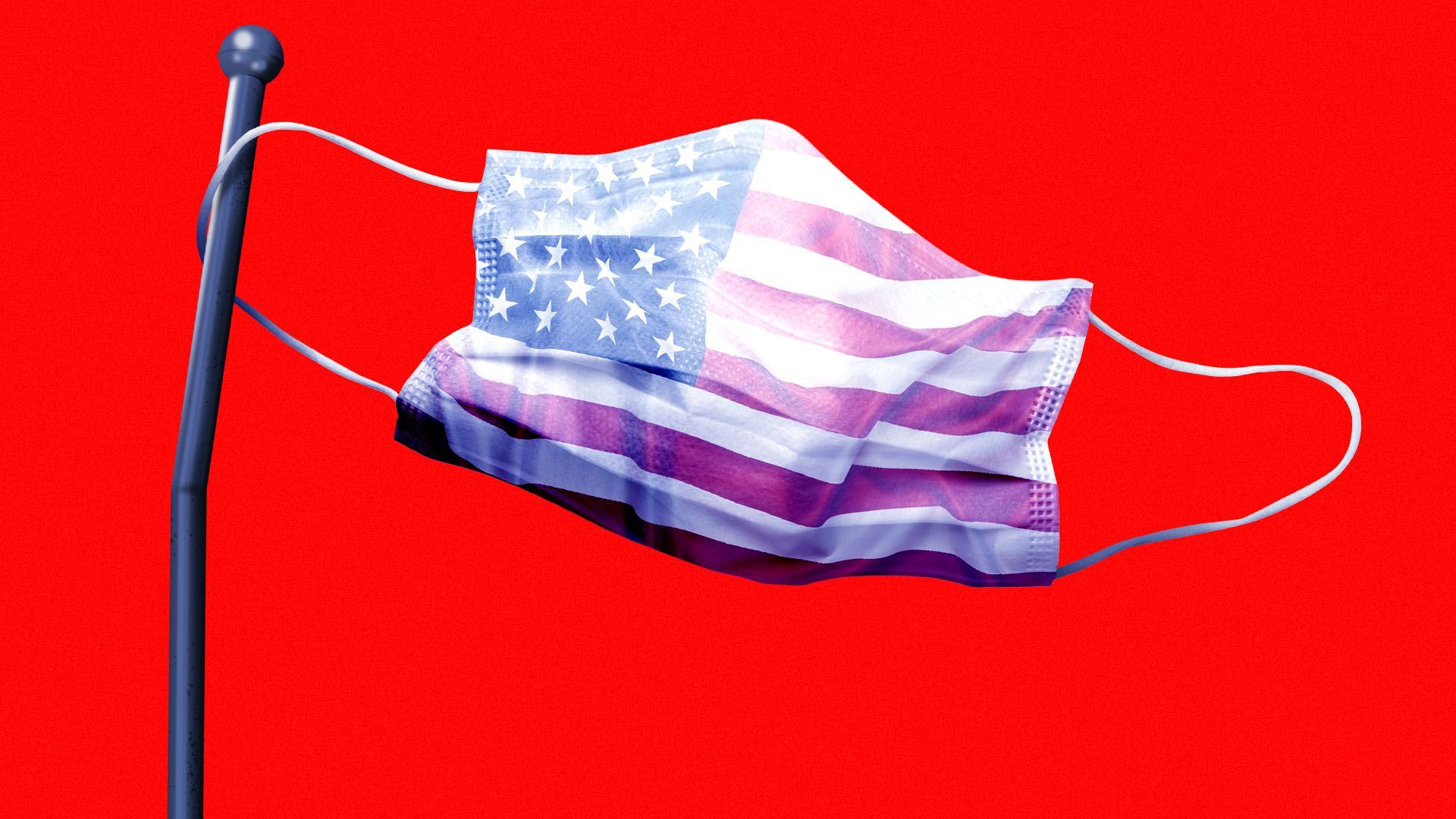
Mask-wearing has become the latest partisan division in an increasingly politically divided pandemic.
Why it matters: It’s becoming increasingly clear that wearing even a basic cloth mask is one of the most effective ways to prevent the spread of COVID-19. But whether or not people are willing to wear one has less to do with the risk of the pandemic than their political affiliation.
By the numbers: Results from months of the Axios-Ipsos coronavirus polls show a clear and growing political divide between Democrats and Republicans on mask-wearing habits.
Context: The political divide Americans are reporting on mask use echoes one seen within nearly all levels of the government.
Flashback: Some of the blame for the divide can be traced back to muddled public health messaging on mask use in the early stages of the pandemic, when Americans were urged not to go out and buy masks in bulk because of concerns that there wasn’t enough personal protective equipment for front-line health care workers.
Health experts now know that cloth masks are most effective not so much at protecting individuals from infection as protecting the community from infected individuals. But that makes masks as much about social signaling as they are about public health.
What to watch: The one factor that seems capable of breaking the political deadlock is the outbreak itself. As cases have skyrocketed in red states like Arizona recently, there’s been a significant increase in Google searches for masks.

The coronavirus continues to surge in states around the country, mostly in the South and West. Testifying before members of Congress on Tuesday, White House health adviser Dr. Anthony Fauci said parts of the U.S. are beginning to see a “disturbing surge” and described the overall situation as a “mixed bag” across different regions and states.
The data above was compiled by Johns Hopkins University.
3:30 p.m. ET — California reported an additional 7,149 Covid-19 cases since Tuesday, a 69% increase in two days, bringing the state’s total to 190,222 cases, according to the state’s health department.
While the daily case numbers are growing, Gov. Gavin Newsom said that the state performed a record number of tests in the last 24 hours. However, the percent of tests coming back positive has slightly increased in the last two weeks, sitting at 5.1% on a 14-day average, he said.
Hospitalizations from Covid-19 in California have also increased 29% in the last 14 days, totaling 4,095 as of Tuesday, Newsom said.
“We cannot continue to do what we have done over the last number of weeks. Many of us understandably developed a little cabin fever, some I would argue developed a little amnesia, others have frankly taken down their guard,” Newsom said at press briefing. —Noah Higgins-Dunn
2:30 p.m. ET — Coronavirus outbreaks in the Americas, which include North, South and Central America, haven’t reached their peaks yet, the World Health Organization warned.
Over a third of the new cases reported Tuesday were from five countries in the Americas, according to WHO data. The U.S. reported the most cases and is the worst-hit country in the world with more than 2.3 million cases and at least 121,279 deaths as of Wednesday.
The comment by the WHO came a day after Dr. Anthony Fauci, the United States’ leading infectious disease expert, expressed concern a “disturbing surge” in coronavirus infections as states continue to reopen.
One WHO official said that parts of the Americas had not “reached a low enough level of transmission “with which we can achieve a successful exit of successful and social distancing measures.” —Berkeley Lovelace Jr.

1:04 p.m. ET — More than 7,000 people have signed an online petition urging Disney and local government officials to reconsider the reopening of Disney World next month.
The petition comes as coronavirus cases in the state are rapidly rising.
It is difficult to determine how many of the signees of the online petition are actually Walt Disney employees or if the petition is union-backed. There is no mention in the petition itself of any affiliation with an employee union.
“The safety and well being of our cast members and guests are at the forefront of our planning, and we are in active dialogue with our unions on the extensive health and safety protocols, following guidance from public health experts, which we plan to implement as we move toward our proposed, phased reopening,” Disney said in a statement to CNBC. —Sarah Whitten

12:15 p.m. ET — The Florida Department of Health reported 5,508 new coronavirus cases, surpassing the previous record single-day increase of 4,049 new cases reported on Saturday.
Florida is among a handful of states that includes Arizona and Texas that are experiencing expanding outbreaks of the virus.
As cases continue to rise by the thousands every day in Florida, the percent of total tests coming back positive has also risen. On Wednesday, the state reported that 15.91% of all tests came back positive, up from 10.82%. That increase indicates that the surge in new cases is not due solely to ramped up testing. —Will Feuer
11:51 a.m. ET — The governors of New York, New Jersey and Connecticut jointly announced a 14-day quarantine for travelers entering the states from coronavirus hotspots.
The Northeastern bloc of states has successfully combated their own outbreaks, having brought peak infection rates down considerably, and are now worried about visitors reintroducing high transmission rates.
“We worked very hard to get the viral transmission rate down. We don’t want to see it go up because a lot of people come into this region and they can literally bring the infection with them,” New York Gov. Andrew Cuomo said at a press conference with New Jersey Gov. Phil Murphy and Connecticut Gov. Ned Lamont.
The hotspot states included in the advisory so far are: Alabama, Arizona, Arkansas, Florida, North Carolina, South Carolina, Texas, Utah and Washington. —Sara Salinas

10:29 a.m. ET — The 2020 TCS New York City Marathon has been canceled amid the ongoing coronavirus pandemic, according to an announcement from the race’s organizers. Scheduled for Nov. 1, the event was supposed to commemorate the 50th running of the marathon.
New York Road Runners, which organizes the race, said the decision was made from a health perspective in partnership with the New York City Mayor’s Office.
“While the marathon is an iconic and beloved event in our city, I applaud New York Road Runners for putting the health and safety of both spectators and runners first,” said Mayor Bill de Blasio in a statement.
NYRR said runners will receive a full refund of their entry fee or complimentary entry for 2021, 2022 or 2023. They will also be invited to participate in a virtual marathon event taking place from Oct. 17 to Nov. 1.
The New York City race is the world’s largest marathon and counted 53,640 finishers in 2019, according to NYRR. —Hannah Miller

0:11 a.m. ET — As of Tuesday, the seven-day average of daily new Covid-19 cases in the U.S. increased by more than 32% compared to one week ago, according to a CNBC analysis of data compiled by Johns Hopkins University.
Cases are growing by 5% or more in 30 states across the country, including Arizona, Texas, Montana and Idaho. Since Monday, four more states have seen growth in their 7-day average of daily new cases.
Texas health officials reported an all-time high of 5,489 new cases on Tuesday, surpassing 5,000 cases in a single day. The state has also been seeing record spikes in hospitalizations in recent weeks. As of Tuesday, there are 3,335 people currently hospitalized in Texas based on a 7-day moving average, which is a 49% increase compared with a week ago, according to Covid Tracking Project data.
California also broke its record for daily number of positive cases on Tuesday, adding 6,712 new cases, according to Johns Hopkins data. The state surpassed 6,000 new cases for the first time on Monday. —Jasmine Kim
IMF slashes forecasts for U.S. economy, GDP
9:47 a.m. ET — The International Monetary Fund slashed its economic estimates for global GDP and the U.S. economy amid the ongoing coronavirus pandemic, and warned that governments’ debt levels will continue to soar as they combat the crisis.
The IMF forecast a contraction of 4.9% in global GDP and estimated that the U.S. economy will contract by 8% in 2020, CNBC’s Silvia Amaro reports. The new estimates were downward revisions from what the IMF forecast in April.
The Washington-based institution said the new figures were due to expectations that social-distancing measures will likely remain in place during the second half of 2020, hurting productivity and supply chains.
The Fund also downgraded its 2020 estimates for the euro zone and its GDP forecast for 2021. —Hannah Miller

8:20 a.m. ET — Daily new cases of coronavirus will surpass the country’s first peak in April, former Food and Drug Administration Commissioner Dr. Scott Gottlieb told CNBC.
“We’re going to eclipse the totals in April, so we’ll eclipse 37,000 diagnosed infections a day,” he said on CNBC’s “Squawk Box.” “But in April we were only diagnosing 1 in 10 to 1 in 20 infections, so those 37,000 infections represented probably half a million infections at the peak.“
Since April, the U.S. has significantly ramped up the country’s capacity to test broadly for the virus, including among asymptomatic and pre-symptomatic patients. That means even though confirmed cases will likely peak again, the underlying outbreak probably isn’t as large as it was in April, Gottlieb said.
“The total number of deaths is falling because the total infection burden in the country is a lot lower now than it was in April,” he said. —Will Feuer

8:08 am ET — The pandemic is still accelerating, with the most recent 1 million cases being reported in one week, World Health Organization Director-General Tedros Adhanom Ghebreyesus said, according to Reuters.
During a virtual conference on vaccine development and access across the continent, Tedros added that every country in Africa has now developed laboratory capacity to conduct diagnostic testing for the virus.
The virus has sickened more than 9.27 million people around the world and killed at least 477,807 people. There is still no U.S.-approved treatment or vaccine for the disease. —Will Feuer
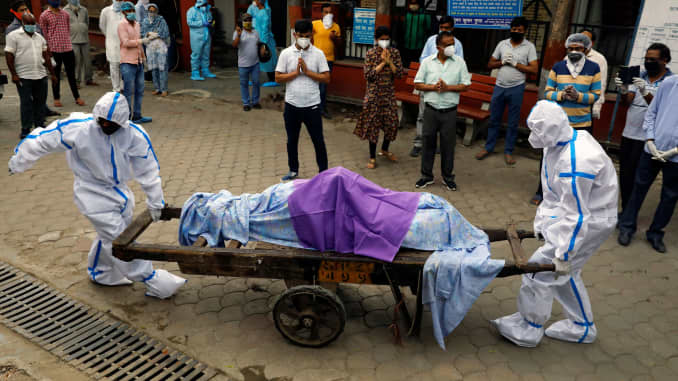
7:12 a.m. ET — India has reported its highest spike of new cases of infections since the virus took hold in the country of more than 1.3 billion people, according to The Associated Press.
In 24 hours, the country reported 15,968 new cases and 465 deaths, the AP reported. That means the virus has now infected more than 456,183 people in India, killing at least 14,476, according to data compiled by Johns Hopkins University.
Maharashtra, New Delhi and Tamil Nadu are the hardest-hit states, making up almost 60% of all confirmed cases in the country. New Delhi, in particular, is emerging as a cause for concern in the federal government, the AP reported, due to poor contact tracing infrastructure and limited hospital capacity.
India has the fourth worst coronavirus outbreak in the world, based on total number of confirmed cases, behind only the U.S., Brazil and Russia. —Will Feuer

6:51 a.m. ET — The European Union is discussing how to reopen its external borders as the region looks to revive its economies, but visitors from the U.S., and elsewhere, could be barred from entering the bloc for now.
Thirty European countries decided to close their external borders back in March to contain the spread of Covid-19, but that measure is due to be lifted on Tuesday. Representatives of the EU governments are discussing the criteria to lift the travel restrictions from abroad, and at the moment, the main requirement is the coronavirus infection rate in the country of origin.
This means that countries with high rates, such as the United States and Brazil, could remain barred from entering European nations, at least for some time. —Silvia Amaro
https://talkingpointsmemo.com/news/who-reports-largest-single-day-spike-in-coronavirus-cases

The World Health Organization on Sunday reported the largest single-day increase in coronavirus cases by its count, at more than 183,000 new cases in the latest 24 hours.
The UN health agency said Brazil led the way with 54,771 cases tallied and the U.S. next at 36,617. Over 15,400 came in in India.
Experts said rising case counts can reflect multiple factors including more widespread testing as well as broader infection.
Overall in the pandemic, WHO reported 8,708,008 cases — 183,020 in the last 24 hours — with 461,715 deaths worldwide, with a daily increase of 4,743.
More than two-thirds of those new deaths were reported in the Americas.
In Spain, officials ended a national state of emergency after three months of lockdown, allowing its 47 million residents to freely travel around the country for the first time since March 14. The country also dropped a 14-day quarantine for visitors from Britain and the 26 European countries that allow visa-free travel.
But there was only a trickle of travelers at Madrid-Barajas Airport, which on a normal June day would be bustling.
“This freedom that we now have, not having to justify our journey to see our family and friends, this was something that we were really looking forward to,” Pedro Delgado, 23, said after arriving from Spain’s Canary Islands.
Spanish Prime Minister Pedro Sánchez urged people to take maximum precautions: “The virus can return and it can hit us again in a second wave, and we have to do whatever we can to avoid that at all cost.”
At a campaign rally in Tulsa, Oklahoma, Trump said Saturday the U.S. has tested 25 million people, but the “bad part” is that it found more cases.
“When you do testing to that extent, you’re going to find more people, you’re going to find more cases,” Trump said. “So I said to my people, ‘Slow the testing down, please.’″
White House trade adviser Peter Navarro said on CNN that Trump was being “tongue-in-cheek” and made the comment in a “light mood.”
Democratic rival Joe Biden’s campaign accused Trump of “putting politics ahead of the safety and economic well-being of the American people.”
The U.S. has the world’s highest number of reported infections, over 2.2 million, and the highest death toll, at about 120,000, according to Johns Hopkins. Health officials say robust testing is vital for tracking outbreaks and keeping the virus in check.
In England, lockdown restrictions prevented druids, pagans and party-goers on Sunday from watching the sun rise at the ancient circle of Stonehenge to mark the summer solstice, the longest day of the year in the Northern Hemisphere. English Heritage, which runs the site, livestreamed it instead. A few people gathered outside the fence.
“You can’t cancel the sunrise,” druid Arthur Pendragon told the BBC.
The number of confirmed virus cases is still growing rapidly not only in the U.S. but in Brazil, South Africa and other countries, especially in Latin America.
Brazil’s Health Ministry said the total number of cases had risen by more than 50,000 in a day. President Jair Bolsonaro has been downplaying the risks even as his country has seen nearly 50,000 fatalities, the second-highest death toll in the world.
South Africa reported a one-day high of almost 5,000 new cases on Saturday and 46 deaths. Despite the increase, President Cyril Ramaphosa announced a further loosening of one of the world’s strictest lockdowns. Casinos, beauty salons and sit-down restaurant service will reopen.
In the United States, the virus appears to be spreading across the West and South. Arizona reported over 3,100 new infections, just short of Friday’s record, and 26 deaths. Nevada also reported a new high of 445 cases.
In Europe, a single meatpacking plant in Germany has had over 1,000 cases, so the regional government issued a quarantine for all 6,500 workers, managers and family members.
In Asia, China and South Korea reported new coronavirus cases Sunday in outbreaks that threatened to set back their recoveries.
Chinese authorities recorded 25 new confirmed cases — 22 in Beijing. In the past week, Beijing tightened travel controls by requiring anyone who wants to leave the Chinese capital, a city of 20 million people, to show proof they tested negative for the virus.
In South Korea, nearly 200 infections have been traced to employees at a door-to-door sales company in Seoul, and at least 70 other infections are tied to a table tennis club there. But South Korean officials are reluctant to enforce stronger social distancing to avoid hurting the economy.

Anthony Fauci, the administration’s top infectious disease doctor, told a House panel on Tuesday that the country’s response to the COVID-19 pandemic has been a “mixed bag,” adding that a new increase in cases is “disturbing.”
“In some respects, we’ve done very well,” Fauci said during an Energy and Commerce Committee hearing, specifically praising the way New York has been containing the worst outbreak in the country to date.
“However, in other areas of the country, we are now seeing a disturbing surge of infections that looks like it’s a combination, but one of the things is an increase in community spread. And that’s something I’m really quite concerned about,” Fauci said.
There are now about 30,000 new cases per day in the United States. The number of new cases had leveled off at about 20,000, and stayed there for weeks before rising this past weekend.
The rise in the U.S. comes as the Trump administration has sought to paint a rosier picture of the U.S. outlook. Both President Trump and Vice President Pence have inaccurately tried to attribute the increase in cases to more tests being performed.
The new spike in the U.S. is being driven in part by worsening outbreaks across the South and Southwest, including in Arizona, Texas, Florida and the Carolinas, even as the situation has greatly improved in once hard-hit states in the Northeast like New York and Massachusetts.
Many of the states now being hit hard were on the more aggressive side in reopening their economies.
“Right now, the next couple of weeks are going to be critical in our ability to address those surgings in Florida, in Texas, in Arizona, and in other states,” Fauci said on Tuesday.

At first, people delayed medical care for fear of catching Covid. But as the pandemic caused staggering unemployment, medical care has become unaffordable for many.
At first, Kristina Hartman put off getting medical care out of concern about the coronavirus. But then she lost her job as an administrator at a truck manufacturer in McKinney, Texas.
While she still has health insurance, she worries about whether she will have coverage beyond July, when her unemployment is expected to run out.
“It started out as a total fear of going to the doctor,” she said.
“I definitely am avoiding appointments.”
Ms. Hartman, who is 58, skipped a regular visit with her kidney doctor, and has delayed going to the endocrinologist to follow up on some abnormal lab results.
While hospitals and doctors across the country say many patients are still shunning their services out of fear of contagion — especially with new cases spiking — Americans who lost their jobs or have a significant drop in income during the pandemic are now citing costs as the overriding reason they do not seek the health care they need.
“We are seeing the financial pressure hit,” said Dr. Bijoy Telivala, a cancer specialist in Jacksonville, Fla. “This is a real worry,” he added, explaining that people are weighing putting food on the table against their need for care. “You don’t want a 5-year-old going hungry.”
Among those delaying care, he said, was a patient with metastatic cancer who was laid off while undergoing chemotherapy. He plans to stop treatments while he sorts out what to do when his health insurance coverage ends in a month.
The twin risks in this crisis — potential infection and the cost of medical care — have become daunting realities for the millions of workers who were furloughed, laid off or caught in the economic downturn. It echoes the scenarios that played out after the 2008 recession, when millions of Americans were unemployed and unable to afford even routine visits to the doctor for themselves or their children.
Almon Castor’s hours were cut at the steel distribution warehouse in Houston where he works about a month ago. Worried that a dentist might not take all the precautions necessary, he had been avoiding a root canal.
But the expense has become more pressing. He also works as a musician. “It’s not feasible to be able to pay for procedures with the lack of hours,” he said.
Nearly half of all Americans say they or someone they live with has delayed care since the onslaught of coronavirus, according to a survey last month from the Kaiser Family Foundation. While most of those individuals expected to receive care within the next three months, about a third said they planned to wait longer or not seek it at all.
While the survey didn’t ask people why they were putting off care, there is ample evidence that medical bills can be a powerful deterrent. “We know historically we have always seen large shares of people who have put off care for cost reasons,” said Liz Hamel, the director of public opinion and survey research at Kaiser.
And, just as the Great Recession led people to seek less hospital care, the current downturn is likely to have a significant impact, said Sara Collins, an executive at the Commonwealth Fund, who studies access to care. “This is a major economic recession,” she said. “It’s going to have an effect on people’s demand for health care.”
The inability to afford care is “going to be a bigger and bigger issue moving forward,” said Chas Roades, the co-founder of Gist Healthcare, which advises hospitals and doctors. Hospital executives say their patient volumes will remain at about 20 percent lower than before the pandemic.
“It’s going to be a jerky start back,” said Dr. Gary LeRoy, a physician in Dayton, Ohio, who is the president of the American Academy of Family Physicians. While some of his patients have returned, others are staying away.
But the consequences of these delays can be troubling. In a recent analysis of the sharp decline in emergency room visits during the pandemic, officials from the Centers for Disease Control and Prevention said there were worrisome signs that people who had heart attacks waited until their conditions worsened before going to the hospital.
Without income, many people feel they have no choice. Thomas Chapman stopped getting paid in March and ultimately lost his job as a director of sales. Even though he has high blood pressure and diabetes, Mr. Chapman, 64, didn’t refill any prescriptions for two months. “I stopped taking everything when I just couldn’t pay anymore,” he said.
After his legs began to swell, and he felt “very, very lethargic,” he contacted his doctor at Catalyst Health Network, a Texas group of primary care doctors, to ask about less expensive alternatives. A pharmacist helped, but Mr. Chapman no longer has insurance, and is not sure what he will do until he is eligible for Medicare later this year.
“We’re all having those conversations on a daily basis,” said Dr. Christopher Crow, the president of Catalyst, who said it was particularly tough in states, like Texas, that did not expand Medicaid. While some of those who are unemployed qualify for coverage under the Affordable Care Act, they may fall in the coverage gap where they do not receive subsidies to help them afford coverage.
Even those who are not concerned about losing their insurance are fearful of large medical bills, given how aggressively hospitals and doctors pursue people through debt collections, said Elisabeth Benjamin, a vice president at Community Service Society of New York, which works with people to get care.
“Americans are really very aware that their health care coverage is not as comprehensive as it should be, and it’s gotten worse over the past decade,” Ms. Benjamin said. After the last recession, they learned to forgo care rather than incur bills they can’t pay.
Geralyn Cerveny, who runs a day care in Kansas City, Mo., said she had Covid-19 in early April and is recovering. But her income has dropped as some families withdrew their children. Although her daughter is urging her to get some follow-up testing because she has some lingering symptoms from the virus, she is holding off because she does not want to end up with more medical bills if her health plan will not cover all of the care she needs. She said she would dread “a fight with the insurance company if you don’t meet their guidelines.”
Others are weighing what illness or condition merits the expense of a doctor or tests and other services. Eli Fels, a swim instructor and personal trainer who is pregnant, has been careful to stay up-to-date with her prenatal appointments in Cambridge, Mass. She and her doctor have relied on telemedicine appointments to reduce the risk of infection.
But Ms. Fels, who also lost her jobs but remains insured, has chosen not to receive care for her injured wrist in spite of concern over lasting damage. “I’ve put off medical care that doesn’t involve the baby,” she said, noting that her out-of-pocket cost for an M.R.I. to find out what was wrong “is not insubstantial.”
At Maimonides Medical Center in Brooklyn, doctors have already seen the impact of delaying care. During the height of the pandemic, people who had heart attacks and serious fractures avoided the emergency room. “It was as if they disappeared, but they didn’t disappear,” said Dr. Jack Choueka, the chair of orthopedics. “People were dying in home; they just weren’t coming into the hospital.”
In recent weeks, people have begun to return, but with conditions worsened because of the time they had avoided care. A baby with a club foot will now need a more complicated treatment because it was not addressed immediately after birth.
Another child who did not have imaging promptly was found to have a tumor. “That tumor may have been growing for months unchecked,” Dr. Choueka said.


 HENRY KOTULA