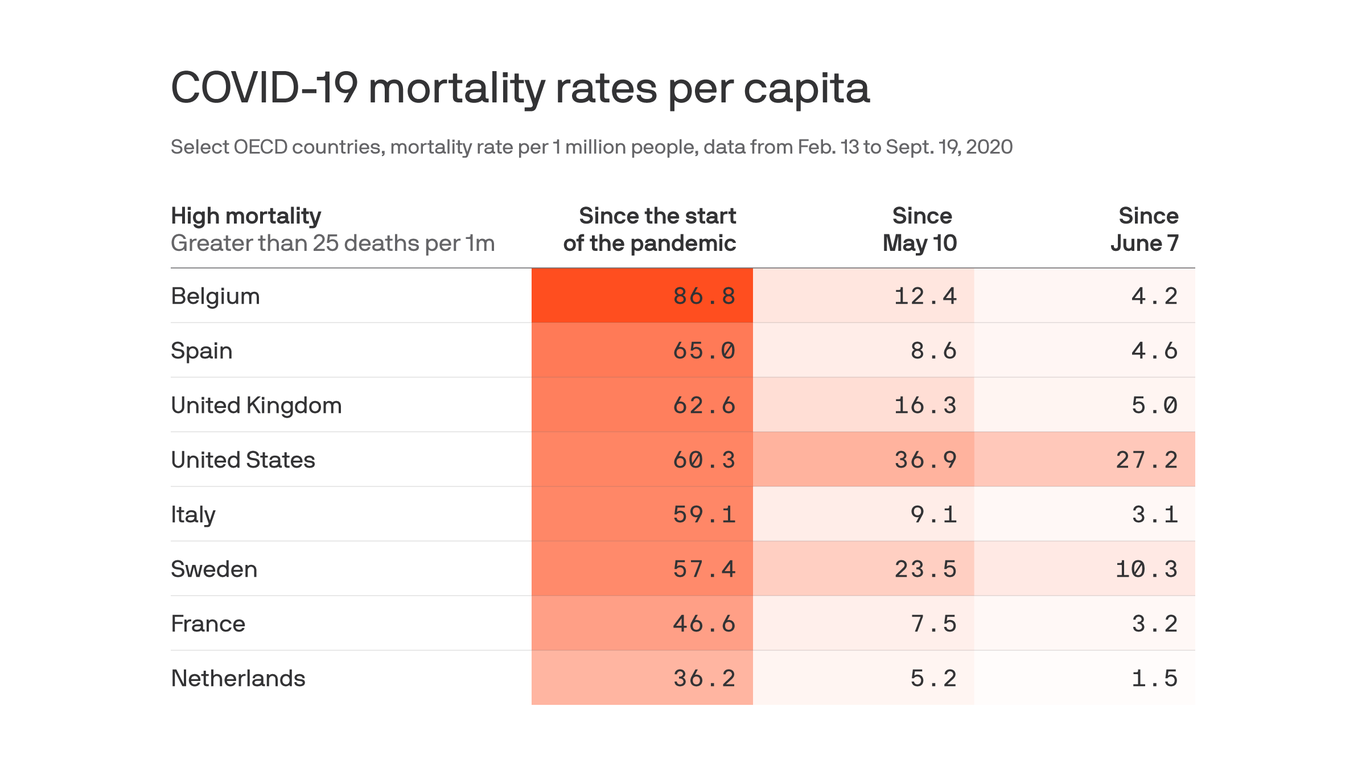
Although other wealthy countries have higher overall coronavirus mortality rates than the United States, the U.S. death rate since May is unrivaled among its peers, according to a new study published in JAMA.
Between the lines:After the first brutal wave of outbreaks, other countries did much better than the U.S. at learning from their mistakes and preventing more of their population from dying.
Why it matters:“If the U.S. had comparable death rates with most high-mortality countries beginning May 10, it would have had 44,210 to 104,177 fewer deaths,” the authors conclude.
Excess deaths have followed a similar pattern: The hardest-hit European countries had similar or higher rates of excess deaths of all causes to the U.S. early on, but these fell much lower than the America did after the first wave.
Yes, but: Death rates are not static, as this study proves, and outbreaks in several European countries have taken a turn for the worse lately.
The head of the World Health Organization said Monday that allowing the novel coronavirus to spread in an attempt to reach herd immunity was “simply unethical.”
The remark was a sharp rebuke of the approach amid mounting new infections around the world. Recent days have seen the most rapid rise in cases since the pandemic began in March.
“Never in the history of public health has herd immunity been used as a strategy for responding to an outbreak, let alone a pandemic,” WHO Director-General Tedros Adhanom Ghebreyesus said at a Monday media briefing. “It is scientifically and ethically problematic.”
In a public health context, herd immunity typically describes a scenario in which a large enough share of the population is vaccinated against a disease to prevent it from spreading widely, thereby providing default protection to a minority of people who have not been vaccinated.
But as there is still no vaccine for the coronavirus, achieving herd immunity in the current environment would require a large number of people to contract the virus, survive covid-19, and then produce sufficient antibodies to provide long-term protection.
While the scientific community has roundly rejected herd immunity the approach, public interest in it has waxed and waned amid pressure to reopen schools and economies.
Last month, President Trump appeared to praise the idea during a town hall in Pennsylvania.
“You’ll develop herd — like a herd mentality,” he said. “It’s going to be — it’s going to be herd developed — and that’s going to happen.”
British Prime Minister Boris Johnson’s government initially expressed interest in the theory before backtracking amid public outcry over the dangers of letting the virus spread. Johnson himself was hospitalized with a severe case of covid-19, which he said could have killed him.
Tedros, noting that there had been “some discussion” about the concept recently, told reporters Monday that allowing people to be exposed to a deadly virus whose effects are still not fully known was “not an option.”
“Most people who are infected with the virus that causes covid-19 develop an immune response within the first few weeks, but we don’t know how strong or lasting that immune response is, or how it differs for different people,” he said.
Though rare, there are multiple documented instances of people being infected for a second time after recovering from covid-19. An 89-year-old woman in the Netherlands died after being infected with the coronavirus for a second time, Dutch news reported Monday.
Antibody studies suggest that less than 10 percent of people in most countries have contracted covid-19, Tedros said, which is nowhere near the majority that would be needed for herd immunity.
With the “vast majority” of the world’s population susceptible, letting the virus spread “means allowing unnecessary infections, suffering and death,” he said.
Just in the last four days, Tedros said Monday, the global coronavirus count has continued to break its daily record for the number of new confirmed infections.
“Many cities and countries are also reporting an increase in hospitalizations and intensive care bed occupancy,” he added.
Tedros has urged governments to pursue comprehensive plans that include widespread testing, social distancing, and other preventive measures, such as face-mask wearing, alongside a global push to develop a vaccine. The WHO is spearheading an effort to distribute coronavirus vaccines equitably once they are available, which Trump declined to join.
A new wave of Covid-19 cases is building across the United States, a harbinger of difficult winter months ahead.
America is now averaging nearly 48,000 new confirmed cases every day, the highest numbers since mid-August, according to the Covid Tracking Project. More than 34,500 Americans are currently hospitalized with Covid-19 in the US, up from less than 30,000 a week ago. Nearly 700 new deaths are being reported on average every day, too — and while that is down from August, when there were often more than 1,000 deaths a day, deaths are going to eventually start increasing if cases and hospitalizations continue to rise. It’s a pattern we have seen before.
Public health experts have been warning for months that fall and winter could lead to a spike in Covid-19 cases. Why? Because the best way to slow down the coronavirus’s spread is to keep your distance from other people and, if you are going to be around others, to be outside as much as possible — and both become harder when the weather gets cold.
We may now be seeing those predictions start to come true. The US already has more than 7.7 million confirmed cases and 214,000 deaths. Both numbers will continue to climb.
Eight months into the pandemic, America’s failures to contain Covid-19, and states’ eagerness to reopen even if they haven’t gotten their outbreaks under control, is once again leading to a surge in cases and hospitalizations.
Covid-19 cases are rising everywhere across the country
Earlier in the year, there was limited value to discussing “waves” because some states would have a decline in cases while other states were experiencing surges. What distinguishes this autumn wave is that it seems to be happening everywhere.
Case numbers are up in the Northeast, the Midwest, and the West. The South appears to be, at best, plateauing at a level even higher than that which the Northeast endured during the worst of New York’s outbreak.
What’s so worrisome is that no one state or region can be blamed for this new wave. Just 13 states have seen their number of new Covid-19 cases drop over the last two weeks, according to Covid Exit Strategy. Cases are up in all the others.
Raw case numbers can, of course, obscure important differences in population; 100 new cases means something different for California than it does for Wyoming. Experts will use another metric — new cases per million people — to gauge how saturated a given state is with Covid-19.
The goal would be to have fewer than 40 new cases per million people. But just three states — Maine, Vermont, and New Hampshire — meet that threshold. Meanwhile, North Dakota (627 cases per million), South Dakota (596), Montana (474), and Wisconsin (434) are some of the states seeing very high levels of new infections.
As Vox’s German Lopez reported this week, just one state — Maine — meets all of the benchmarks established by experts for a state to consider its Covid-19 outbreak contained. And yet, most states have reopened many of the businesses that were closed in the spring: 40 or so states have reopened restaurants, bars, gyms, movie theaters, and nonessential retail.
“Part of the problem is America never really suppressed its Covid-19 cases to begin with,” Lopez wrote, explaining why experts were anticipating a new surge in cases. “Think of a disease epidemic like a forest fire: It’s going to be really difficult to contain the virus when there are still flames raging in parts of the forest and small embers practically everywhere. The country always risks a full blaze with each step toward reopening and with each failure to take precautions seriously.”
Too many Covid-19 tests are coming back positive right now
Another closely watched indicator for renewed Covid-19 spread is the percentage of coronavirus tests that come back positive. The number of tests being conducted doesn’t actually tell you all that much; if a high percentage of them are positive, that suggests that many others aren’t being caught at all and the virus could continue to spread unchecked.
So while the US is now averaging nearly 1 million tests every day, that is not quite the triumph it might sound like (or President Donald Trump would like to believe it is). The country’s positive test rate is 5 percent, right at the threshold experts say would reflect adequate testing. Ideally, it would be even lower, 2 percent or less.
But even with that passable national positivity rate, most states are still not conducting nearly enough testing. Here are the 10 states with the highest positive test rates, according to Covid Exit Strategy:
Idaho (25 percent)
South Dakota (20.6 percent)
Wisconsin (19.5 percent)
Iowa (17.1 percent)
Kansas (16.1 percent)
Wyoming (15.5 percent)
Utah (14.7 percent)
Nevada (14.4 percent)
Indiana (13.6 percent)
Alabama (13.3 percent)
It’s really only a handful of better-performing states — namely, New York, with more than 115,000 tests conducted per day and a 1.2 percent positivity rate — that’s keeping the US’s overall positive test rate from looking a lot worse.
America has never had a cohesive Covid-19 testing strategy. Since February, there have been regular supply shortages delaying test results. States have been fighting each other for precious testing resources. Contact tracing has not been a priority for the federal government, and most states have still not hired nearly enough people to perform that work.
Wealthy countries like Germany and South Korea have used effective test-trace-isolate programs to keep their Covid-19 outbreaks in check. The US, meanwhile, is still struggling to perform enough tests or scale up its contact tracing capabilities. Just 11 states, plus the District of Columbia, could realistically expect to perform adequate contact tracing, according to Covid Exit Strategy, considering their positivity rate.
Without improvement in both of those areas, it will continue to be difficult for the US to contain the coronavirus before a vaccine becomes available.
More Americans are being hospitalized with Covid-19 too
Both case numbers and the positive test rate can be a little deceptive, depending on how many tests are being performed. They suggest what’s happening on the ground — in this case, Covid-19 is spreading — but they do have their limitations. There is some truth to the president’s claim that more tests will mean more cases, though that is not a reason to stop testing.
Hospitalizations, on the other hand, are more concrete. If more people are developing symptoms severe enough to warrant being hospitalized, that is a strong indicator that the real number of people being infected with Covid-19 is growing, regardless of whether they are getting tested.
And after a dip in September, the number of Americans currently in the hospital with Covid-19 is higher than it’s been in a month. That trend has been seen across the country.
The worry becomes that if hospitals take in too many patients, they’ll have to turn other people away, or that overwhelmed staff and facilities could lead to some patients receiving substandard care. According to Covid Exit Strategy, 20 states currently have reduced ICU capacity that puts them in a danger zone; 21 states have an elevated occupancy rate in their regular hospital beds.
Wisconsin,where the number of hospitalized Covid-19 patients has risen over the last month from about 300 to 876 today, recently established a new field hospital on its state park fairgrounds over fears that the state’s hospitals wouldn’t have enough beds given the recent surge in cases.
Fortunately, hospitals have gotten much better at treating Covid-19. They have proven treatments, like remdesivir and dexamethasone, that reduce the length of hospital stays and reduce mortality in patients with severe symptoms. They have learned techniques like putting patients on their stomach to improve breathing. Hospitals that have endured multiple spikes of Covid-19 cases report patients in the later waves are spending less time in the hospital and dying less frequently.
Nevertheless, more people developing severe symptoms, as we are starting to see, will inevitably lead to more deaths. Over the summer, people wondered why deaths were falling while cases and hospitalizations rose — until deaths did start to increase. There is a long lag between cases rising and deaths rising, because it can take a month or more between when a person first contracts Covid-19 and, if they die, when their death is reported.
That’s why these new Covid-19 trends in the US are so worrisome. Cases are rising, as are hospitalizations. It could be only a matter of time before deaths start to spike as well.
Philadelphia-based Jefferson Health is taking steps to reduce costs to help offset losses tied to the COVID-19 pandemic.
The 14-hospital system plans to eliminate between 500 and 600 positions through attrition and will cut pay for its “most senior executives,” according to the Philadelphia Business Journal.
Jefferson Health is making cuts after reporting a net loss of $298.7 million in the fiscal year ended June 30. The system posted a loss after receiving $320 million in grants made available under the Coronavirus Aid, Relief and Economic Security Act to help cover lost revenue and expenses linked to the pandemic, according to The Philadelphia Inquirer.
“As one of the health systems in the United States with the largest amount of Covid patients during the surge, and one of the lowest employee infectivity rates, we took a ‘no expense is too much to protect our employees’ approach with PPE and other measures that drove up short-term expenses,” Stephen Klasko, MD, president of Thomas Jefferson University and CEO of Jefferson Health, told the Philadelphia Business Journal.
Dr. Klasko said patient volumes are beginning to rebound, and the health system is ahead of budget for fiscal year 2021.
“We made a conscious decision, as the region’s second-largest employer, to do no furloughs and only very few pre-planned layoffs during the pandemic surge,” Dr. Klasko told the Philadelphia Business Journal. “Due to our financial stewardship and growth over the past five years, our balance sheet was very stable and remains very stable despite the pandemic tsunami.”
In addition to cutting unfilled positions and reducing executive pay, the health system is taking a few other steps to achieve savings, including a pay freeze and a one-year suspension of employer contributions to employee retirements plans beginning Jan. 1.
For its first 208 years, the New England Journal of Medicine has never endorsed a political candidate. But this week the journal published an editorial outlining its political position in the upcoming Presidential election, signed unanimously by all editors who are US citizens.
The editors did not explicitly endorse former Vice President Biden, but rather offered a scathing condemnation of the current administration’s performance during the COVID pandemic:“Reasonable people will certainly disagree about the many political positions taken by candidates.
But truth is neither liberal nor conservative. When it comes to the response to the largest public health crisis of our time, our current political leaders have demonstrated that they are dangerously incompetent. We should not abet them and enable the deaths of thousands more Americans by allowing them to keep their jobs.” (Formally endorsing Biden last month, Scientific American also made the first political endorsement in its 175-year history.)
Much of the media coverage of the NEJM statement has centered on the question of whether medicine should involve itself in politics, or “live above it”.
Medicine has been drawn into political disputes before, but now the nature of the involvement has changed. In the past, debates largely centered around regulation, payment or policy—but now the science itself has become a fundamentally political issue.
The very nature of the coronavirus has become a matter of political belief, not just an indisputable scientific fact.
Public trust in both scientific institutions and the government, and their ability to work together, has been damaged. We fear this will lead to poorer health outcomes regardless of who wins the upcoming election.
While it sometimes seems like the coronavirus has been with us forever, it’s worth remembering that there are still parts of the country that are only now experiencing their first big spike in cases—that’s the nature of a “patchwork” pandemic working its way across a vast country.
One of our health system members in the Midwest, with whom we recently spent time, is in just this situation: they’re seeing their highest inpatient COVID census to date, just this month. As they shared with us, there are advantages and drawbacks to being a “late follower” on the epidemic curve. The good news is that they’re ready.
Back in March, like most systems, they stood up an “incident command center”, and began preparing for a wave of COVID patients, designating a floor of the hospital as a “hot zone”, creating negative pressure rooms, cross-training staff, developing treatment protocols, stockpiling protective equipment, and securing a pipeline of critical therapeutics and testing supplies. There was a moderate but manageable number of cases across the late spring and summer, but never to an extent that stressed the system.
Eventually, recognizing that they couldn’t ask their doctors, nurses, and administrators to stay on high alert indefinitely, they “stood down” to a more normal operational tempo, only to watch with dismay as the surrounding community seemingly forgot about the virus, and lessened precautions (masking, distancing, and so forth), wanting life to return to “normal”. And now, the post-Labor Day, post-return-to-school spike has arrived.
The challenge now is getting everyone, inside and outside the system, to stop talking about COVID in the past tense, as though they’ve already “gotten through it.”The preparations they’ve made are paying off now. Hospital operations continue to run smoothly even with a high COVID census, but the workforce is exhausted, and citizens aren’t stepping outside to bang gratefully on pots every night anymore.
Asking the team to return to war footing is no easy task, given the fatigue of the past seven months. A question looms: what is the trigger to restart “incident command”? As cases begin to increase again in some of the original COVID hot spots—New York, New England, the Pacific Northwest—healthcare leaders there will need to learn from the experiences of their colleagues in the newly-hit Midwest, about how to take an already virus-weary clinical workforce back onto the battlefield.
The D.C. Health Department is trying to jump-start contact tracing efforts around the White House’s coronavirus outbreak. Tracing has been inadequate so far even as cases spread deeper into the city, Axios’ Marisa Fernandez writes.
The big picture:The White House has decided not to move forward with recommended public health protocols of contact tracing and testing since President Trump tested positive for the virus.
The state of play: Tracing has been done for people who had direct contact with Trump, White House spokesman Judd Deere told the Washington Post.
On Capitol Hill, there’s also no formalized contact tracing program in place, even as lawmakers themselves test positive.
Two infected staffers in Rep. Doug Lamborn’s (R-Colo.) office were told to not disclose to roommates they may have been exposed, WSJ reports.
The bottom line:The White House’s refusal to contact trace is “a missed opportunity to prevent additional spread,” Emily Wroe, a co-leader of a contact-tracing team at Partners in Health, told Nature.
Tens of millions of people have been on unemployment at some point in the last seven months, since the pandemic began. Now, thousands are being told they have to pay some or all of that money back, either because they made an error when they applied for benefits, or the state did.
“People are terrified by these messages, and they’re coming in swarms,” said Anne Paxton of the Unemployment Law Project. “We’re hearing about this all the time.”
Many people receiving overpayment notices have already used their benefits to pay for basic living expenses.
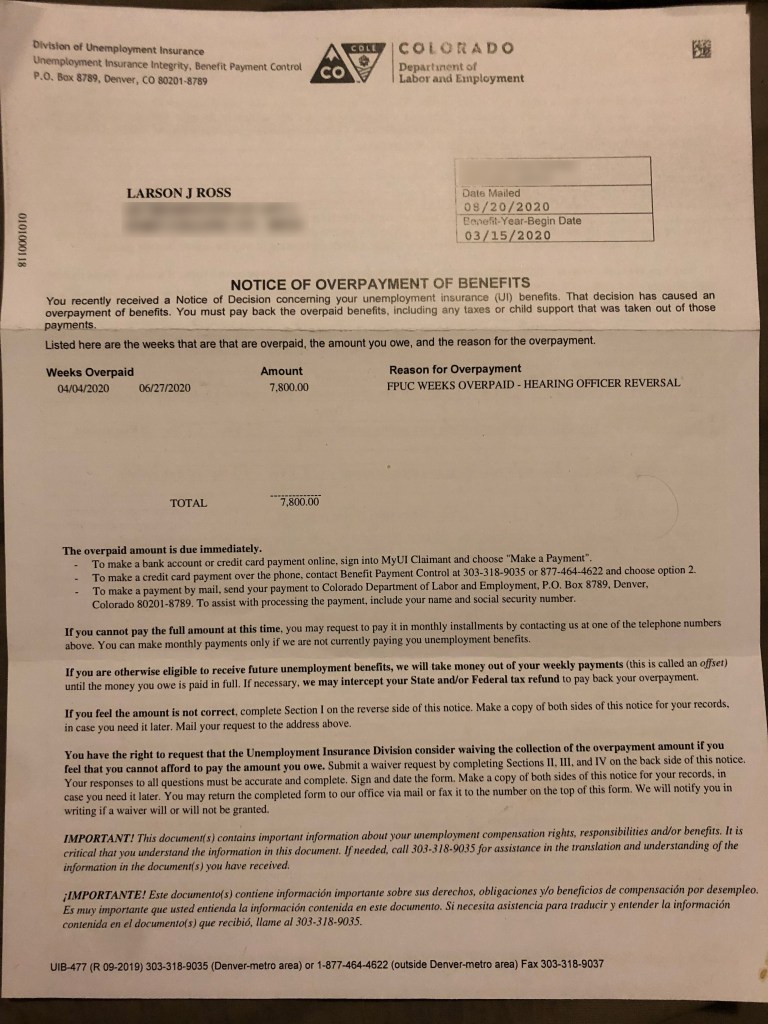
“I don’t have $10,000 sitting around,” said Larson Ross, 25, who got a notice of overpayment from the state of Colorado in late August. “I was a low-wage tea house worker who was unemployed for four months. I was using the money from unemployment for food and rent. So it’s spent.”
He has no idea what he’s going to do. He’s never been so stressed in his life.
“The few days after I first received the letter I found it really hard to get out of bed at all,” Ross said. “It’s really tough.”
The state of Colorado is telling Larson Ross he has to repay the $10,800 he got in unemployment benefits during the pandemic, after his employer successfully contested his eligibility. He has already spent the money on rent, bills and groceries. (Courtesy Larson Ross)
There are a variety of reasons people might get an overpayment of benefits notice. In Ross’ case, his employer successfully contested his eligibility for unemployment, saying he quit, which he disputes. In some cases, it’s because an applicant misunderstood or mischaracterized something on their application. In other cases, the state may have miscalculated a benefit, or approved an application before verifying all the information.
While this also happened in pre-pandemic times, the issue is particularly acute now given the historic number of claims that have flooded state unemployment offices since March — and the state of the economy.
“The circumstances for returning to work are just not the same,” said Kathy White, deputy director of the Colorado Fiscal Institute. “Congress needs to recognize that, and make sure that the systems that they’re putting in place for workers to help them through this time, that are just immediate relief … they cannot be punitive. Coming out of COVID with a $15,000 debt that you cannot repay is not helpful.”
With traditional unemployment insurance benefits and with Federal Pandemic Unemployment Compensation, if someone has been overpaid, states have the discretion to waive repayment, as long as there was no fraud involved — particularly if repayment would cause financial hardship. But that is not the case with Pandemic Unemployment Assistance. Under current federal law, states do not have the authority to waive repayment of PUA benefits if a person was overpaid, according to Michele Evermore of the National Employment Law Project.
“This is honestly the biggest reason that Congress needs to do something on COVID relief,” she said. “If this issue doesn’t get solved, this is going to be more explosive than people losing the $600 in some ways, because they’ll have to pay back six months of Pandemic Unemployment Assistance. Nobody who qualified for PUA is going to have that much money sitting around.”
Andrew Tolch applied for PUA in the spring, on the advice of both his bank and his accountant, when he had to temporarily close down his toy store in St. Louis, Missouri because of COVID.
He was approved, and used all the money he got — less than $200 a week in PUA, plus the extra $600 a week in FPUC — to pay utilities and rent for the store.
Then, over the summer, he got an overpayment notice from the state of Missouri: he owed a big chunk of that money back — $2,376 in total.
“I was shocked, and I didn’t understand it,” he said. “I followed the rules correctly. We should have qualified, and according to the rules they gave us, we qualified.”
When Andrew Tolch had to close down his toy store, Andy’s Toys, in St. Louis this spring, he applied for and got Pandemic Unemployment Assistance. Now, the state of Missouri wants most if it back. (Courtesy Andrew Tolch)
Tolch has since connected with a number of other small business owners in Missouri who also got notices of overpayment, and he said none of them understands why the state is now saying they didn’t qualify for pandemic assistance. They’re considering the possibility of a class action lawsuit.
“It will sink a lot of people if they would have to give it all back,” Tolch said. “Just one more blow from 2020 to small businesses.”
People who think they got an overpayment notice in error, or who can’t afford to repay the benefits, can always appeal — and should, according to Eric Salinger, director of the Employment Law Project at Alaska Legal Services.
But for people who do not win on appeal, or do not get a repayment waiver, states can find ways to recoup that money. Some are more aggressive than others, according to Evermore.
“Every state has different recoupment authority,” she said. “In some states, other benefits can be garnished to pay for that. Taxes could be garnished, future wages could be garnished.”
Larson Ross is afraid that will happen to him. He finally found a seasonal job in northern Colorado, and is making enough money to get by this month, at least — as long as the state doesn’t garnish his wages. Then, he doesn’t know.
Kathy White is hoping that Colorado and other states will use their discretion to waive repayment in cases where there was no fraud, and that Congress will change the law so states can waive overpayment recoupment of Pandemic Unemployment Assistance.
“It should be just forgiveness for error or overpayment in these unusual circumstances,” she said. “You don’t want to put people in a worse position because of the aid you’re trying to give them.”
The quarantining of most of the Joint Chiefs of Staff, coming on the heels of President Trump’s COVID-19 diagnosis, is raising fears that U.S. adversaries might seek to exploit a perceived weakness.
Few expect any sort of overt military action, but there are other ways to wreak havoc on the United States.
Chief among them is disinformation. Experts have been warning ever since Trump tested positive for the coronavirus last week that disinformation is likely to kick into overdrive.
Now, with six of the seven members of the Joint Chiefs of Staff waylaid at home, warnings are being amplified about the national security implications of the growing COVID-19 outbreak among U.S. leadership.
“All these kinds of things are just a huge distraction for us where our national security apparatus is consumed with matters domestic and internal,” former Director of National Intelligence James Clapper said at a Washington Post event after news broke of the Joint Chiefs quarantining. “So this is an ideal time for adversaries, particularly in adversary intelligence services, to look for ways to further confuse us, to distract us.”
Adding that “you can bet particularly our good friends the Russians are doing this,” Clapper warned of them “further sowing seeds of disinformation.”
“They will appeal to all the various tribes and continue to capitalize on the polarization in this country,” he said. “So it is a vulnerable time, and it’s an opportunity for them while we’re not looking and not being alert to further sow seeds of disinformation, casting doubt, discord, distrust in the country.”
The quarantining of top military officers stems from the Coast Guard’s No. 2 admiral contracting COVID-19. The Coast Guard announced Tuesday that its vice commandant, Adm. Charles Ray, tested positive for the coronavirus on Monday after feeling mild symptoms over the weekend.
The test result came after Ray met with most of the Joint Chiefs of Staff at the Pentagon on Friday.
That put Joint Chiefs of Staff Chairman Gen. Mark Milley into quarantine, as well as the chiefs of the Army, Navy, Air Force, Space Force and National Guard. The vice chairman, Gen. John Hyten, was also in the meetings and is quarantining.
The only member of the Joint Chiefs who didn’t meet with Ray was Marine Corps Commandant Gen. David Berger, who was traveling.
Berger’s deputy, Gen. Gary Thomas, met with Ray instead and went into quarantine Tuesday. The Marine Corps announced Wednesday evening that he has tested positive for the virus.
Gen. Paul Nakasone, commander of U.S. Cyber Command and director of the National Security Agency, also met with Ray and went into quarantine.
It’s unclear exactly where Ray caught the virus, but his schedule within the incubation period included a visit to the White House, which is now considered the epicenter of a coronavirus outbreak that includes Trump himself.
Ray — along with Milley, Defense Secretary Mark Esper and other top defense officials — attended a White House ceremony for Gold Star families on Sept. 27.
The event happened the day after Trump announced he was nominating Amy Coney Barrett for the Supreme Court, a gathering for which several attendees have since been diagnosed with COVID-19.
Since Trump’s diagnosis, the Department of Defense has sought to allay any national security concerns.
When Trump’s positive test was first announced last week, the Pentagon insisted there has been “no change to DoD alert levels.”
After news broke Tuesday of the Joint Chiefs quarantining, chief Pentagon spokesman Jonathan Hoffman reiterated that “there is no change to the operational readiness or mission capability of the U.S. Armed Forces.”
“Senior military leaders are able to remain fully mission capable and perform their duties from an alternative work location,” Hoffman said in a statement.
The military chiefs are well-equipped to work from home, and besides Ray and Thomas, none have tested positive for the virus yet.
But the development has raised questions about whether adversaries will try to take advantage of the situation nonetheless.
After the military quarantines were revealed, House Armed Services Committee Chairman Adam Smith (D-Wash.) said “the national security implications of the president’s recklessness cannot be overstated” even though the military “can still operate while leadership is quarantined.”
“Since announcing that he tested positive for the virus, the president’s antics have been downright reckless and harmful,” Smith said in a statement. “Our adversaries are always looking for any weakness to exploit. President Trump’s pathetic attempts to exude strength aren’t fooling anyone — Americans know he is weak and so do those who wish us harm.”
Rep. Jackie Speier (D-Calif.), another senior member of the Armed Services Committee, questioned why so many senior military leaders were meeting in person in the first place, as well as attending a White House reception in which they were pictured maskless.
“What if the Joint Chiefs’ responsibilities cannot be done remotely while they are isolating?” Speier wrote in a series of questions on Twitter. “How many other senior military leaders have tested positive? Why weren’t we safeguarding the health of senior military leaders like the natural security asset that it clearly is?”
Barry Pavel, senior vice president and director of the Atlantic Council’s Scowcroft Center for Strategy and Security, stressed that there is “no degradation in operational command and control” from the Joint Chiefs quarantining.
But, he added, adversaries such as Russia and China could misperceive that the United States is distracted and decide to act. For example, he cited concerns about China moving against Taiwan or Russia trying to grab more territory.
Pavel also listed what he called Russia’s “non-kinetic war” against the United States in the cybersecurity, influence and disinformation realm.
“This is a KGB officer’s most wildest dream coming true almost on a daily basis,” he said. “And so I think it’s a big threat. Who knows what proportion of our current public divisions are sown by Russian influence and bots or are just part of our current division. I don’t know the answer to that question. But they’re certainly right now exploiting it.”
To diminish those concerns, Pavel said, the Pentagon should keep emphasizing its military readiness, as well as demonstrating it by taking actions like publicizing a previously planned exercise.
“It’s probably a good idea to keep repeating those messages,” he said, “to be reiterating those messages, sending them publicly, privately, by third parties and through various forms of military activity so adversaries have no misunderstanding about our readiness and capabilities despite the chairman being quarantined in his quarters.”
U.S. states saw another 840,000 jobless claims filed last week, as the number of Americans applying for first-time unemployment insurance benefits each week continues to hover at a historically high level.
The U.S. Department of Labor (DOL) released its weekly jobless claims report at 8:30 a.m. ET Thursday. Here were the main metrics from the report, compared to Bloomberg estimates:
Initial jobless claims, week ended Oct. 3: 840,000 vs. 820,000 expected and 849,000 during the prior week
Continuing claims, week ended Sept. 26: 10.976 million vs. 11.4 million expected and 11.979 million during the prior week
New weekly unemployment insurance claims have held below the psychologically important 1 million mark for the past six consecutive weeks, but have so far failed to break below 800,000 since the start of the pandemic. At 840,000 last week’s new claims remained at a level still handily above the pre-pandemic record high of 695,000 from 1982.
The past two weeks’ jobless claims totals have also been flattered by an absence of updated new claims out of California. The state – which has consistently been one of the biggest contributors to new weekly claims – announced last week it was taking a two-week pause in processing initial claims to “reduce its claims processing backlog and implement fraud prevention technology,” according to the Labor Department’s statement.
Across all programs, the total number of jobless claims decreased for the week ending Sept. 19. Total claims came in at 25.5 million, down from the about 26.5 million during the previous week, as a smaller number of self-employed or gig workers not eligible for regular state programs claimed Pandemic Unemployment Assistance. But the number of workers collecting benefits through the Pandemic Emergency Unemployment Compensation Program – which offers an extra 13 weeks’ worth of federal benefits to those who had exhausted previous state or federal compensation – rose by 154,000 to 1.96 million.
Continuing jobless claims, which are reported on a one-week lag and represent the total number of individuals still receiving state unemployment benefits, continued their gradual downtrend last week. But as with new jobless claims, continuing claims have held well above pre-pandemic levels, and have not broken below the 10 million mark in more than 6 months.
“Net, initial filings fell less than expected last week. The improvement in continuing claims is reflecting people being hired but also individuals exhausting their benefits,” Rubeela Farooqi, chief economist for High Frequency Economics, said in an email. “Overall, the signal from the claims data is still one of ongoing weak conditions in the labor market. Even as filings are declining, levels remain extraordinarily high. Employment growth has already slowed and without fiscal support that protected jobs, risks are skewed to the downside for payrolls going forward.”
President Donald Trump said Tuesday he had asked his negotiators to halt further stimulus talks until after the election, but added that he would support standalone measures providing tens of billions of dollars for airline payroll support and the Paycheck Protection Program. House Democrats, however, have previously balked at the notion of passing slimmed down versions of a stimulus package – meaning the prospect of further fiscal stimulus in the next month remains unlikely.


:format(webp):no_upscale()/cdn.vox-cdn.com/uploads/chorus_asset/file/21952241/1R_Reg_Positive__1_.png)
:no_upscale()/cdn.vox-cdn.com/uploads/chorus_asset/file/21952308/5R_Reg_Hospitalized.png)





 HENRY KOTULA