About 1.9 million people filed for unemployment benefits last week, the Department of Labor announced Thursday, bringing the total for initial claims over the last 11 weeks to 42.6 million.
Continuing claims rose by 649,000 over the previous week, for a total of 21.5 million. Adding independent contractors, the number of people receiving unemployment benefits comes to roughly 30 million.
The good news: Initial jobless claims for state benefits continue to fall.Torsten Slok, chief economist at Deutsche Bank Securities, said the job market appears to have bottomed out and is “crawling out of the hole now,” adding that we “have the worst behind us.”
Earlier this week, Mark Zandi, chief economist at Moody’s Analytics, said he thinks the coronavirus recession is technically over, with growth resuming this month. “This Covid recession will go down as the shortest and arguably the most severe in history,” Zandi told The Washington Post.
The bad news: The unemployment numbers are still shockingly high, and the economy is in bad shape by any measure. “Even as states reopen, claims in the millions are an indicator that the economic pain of the Covid-19 crisis is still acute,” Daniel Zhao, senior economist at Glassdoor, told CNBC.
Recovery is expected to be slow and painful. Economist Ed Yardeni said Thursday in a note to clients that he expects it to take more than two years to recover all of the lost jobs, with a return to the February 2020 employment peak not coming until October 2022.
The even worse news: The official unemployment numbers are almost certainly underestimating the damage.
In addition to the state unemployment filings, there were about 623,000 newly reported claims from independent contractors, who are eligible to receive federal aid temporarily under the Pandemic Unemployment Assistance program. But at least half a million filings for pandemic relief payments have yet to show up in the official data, Bloomberg reported Thursday, due to lags in the system. And the weekly unemployment reports tell us nothing about the people who may still be working but are earning far less than they were just a few months ago.
Up next: On Friday the Labor Department will release its employment numbers for May. Economists surveyed by Dow Jones project 8.3 million job losses and an unemployment rate of 20.5%.
Board directors and executives can pool their wisdom to help companies grapple with the challenge of a lifetime.
As Winston Churchill said, “Now this is not the end. It is not even the beginning of the end. But it is, perhaps, the end of the beginning.” We are seeing some faint signs of progress in the struggle to contain the pandemic. But the risk of resurgence is real, and if the virus does prove to be seasonal, the effect will probably be muted. It is likely never more important than now for boards of directors and executive management teams to tackle the right questions and jointly guide their organizations toward the next normal.
Recently, we spoke with a group of leading nonexecutive chairs and directors at companies around the world who serve on the McKinsey Resilience Advisory Council. They generously shared the personal insights and experiences gained from their organizations’ efforts to manage through the crisis and resume work. The 15 themes that emerged offer a guide to boards and executive teams everywhere. Together, they can debate these issues and set an effective context for the difficult decisions now coming up as companies plan their return to full activity.
Managing through the crisis
1. Boards must strike the right balance between hope for the future and the realism that organizations need to hear. There are many prognostications on what comes after COVID-19. Many will be helpful. Some will be right. Boards and managers may have some hopes and dreams of their own. Creating value and finding pockets of growth are possible. It is important to have these aspirations, because they form the core of an inner optimism and confidence that organizations need. However, leaders should not conflate aspirations with a prescience about the future.
2. The unknown portion of the crisis may be beyond anything we’ve seen in our professional lives. Boards and managers feel like they might be grappling with only 5 percent of the issues, while the vast majority are still lurking, unknown. Executives are incredibly busy, fighting fires in cash management and other areas. But boards need to add to their burden and ask them to prepare for a “next normal” strategy discussion. Managers need to do their best to find out what these issues are, and then work with boards to ensure that the organization can navigate them. The point isn’t to have a better answer. The point is to build the organizational capability to learn quickly why your answer is wrong, and pivot faster than your peers do. Resilience comes through speed. This may be a new capability that very few organizations have now, and they will likely need to spend real time building it.
3. Beware of a gulf between executives and the rank and file. Top managers are easily adapting to working from home and to flexible, ill-defined processes and ways of working, and they see it as being very effective and also the wave of the future. Many people in the trenches think it is the worst thing to happen to them (even those that are used to working remotely). Remote working is raising the divide between elites and the common man and woman. There is a real risk of serious tension in the social fabric of organizations and in local and national communities.
4. Don’t overlook the risks faced by self-employed professionals, informal workers, and small businesses. These groups are often not receiving sufficient support. But their role in the economy is vital, and they may be noticed only later, when it is too late.
5. Certain industries and sectors are truly struggling and require support. Several disrupted industries and many organizations in higher education, the arts, and sports are severely struggling and require support to safeguard their survival.
Return to work—the path ahead
6. Mid- to long-term implications and scenarios vary considerably. It’s important to differentiate between industries and regions. Some industries may never come back to pre-COVID-19 levels.
7. What went wrong? Boards and executives, but also academics, need to debate the question. Where should we have been focusing? Take three examples. Why did companies ignore the issue of inadequate resilience in their supply chain? The risks of single sourcing were well known and transparent. Also, why did we move headlong toward greater specialization in the workforce, when we knew that no single skill was permanently valuable? Finally, why did we refuse to evolve our business models, although we knew that technology and shifts in societal preferences were forcing us down a treadmill of ever decreasing value-creation potential?
8. How can we prevent a backlash to globalization? The tendency toward nationalism was already strong and is growing during the crisis. The ramifications will be challenging. For example, in pharmaceutical development, residents of the country where a pharma company has its headquarters may expect to get the drug first. Global companies, despite their experience, may find it harder to address and engage directly with diverse, volatile, and potentially conflicting stakeholders. In such times, societies may need someone to mediate between the private sector and some of these stakeholders.
9. Companies need help with government relations. Strong government interventions are occurring on the back of a serious loss of confidence in free-market mechanisms. There is little question that different governments will land on different answers to the debate around how free markets really ought to be structured. The corporate community has been thrust into a new relationship with government, and it is struggling. The government landscape is fragmented, with highly varied approaches and competencies. Companies are looking for a playbook; no one has an infrastructure to manage this complexity.
10. Where will the equity come from, and with what strings attached? Governments are propping up various sectors with new capital. What will they receive in return? Will they distort markets? How can companies manage this process carefully to emerge from the crisis with a stronger balance sheet? Further, much more capital is likely needed; presumably some of it will come from the private sector. Will capital markets be effective and trusted in such times? Who governs this overall process, and what role should the government play? Is it the time for more state funds?
11. The balance between profits and cash flow is tricky, and essential to get right. Many companies are caught right now and are sacrificing their bottom line in order to pay for their financing. That’s not sustainable; companies will need guidance on how to balance the two.
12. It may be time for responsible acquisitions, including to help restructure certain industries. Many “resilients” have “kept their powder dry,” and are now ready to acquire. But they need to be sensitive and allow sellers a good path to exit. We need guidelines for responsible acquisitions.
13. Cyberrisk is growing. Remote working increases the “attack surface” for criminals and state actors. Both are more active. Chief information officers and chief information security officers are grappling with the overwhelming demand for work-from-home technology and the need for stringent cybersecurity.
14. Innovation may never have been so important. Innovation has always been essential to solving big problems. The world is looking not just for new things but also for new ways of doing things (especially on the people side, where we need new behaviors, long-term rather than short-term), capabilities, and work ethics.
15. The path ahead will surely have ups and downs and will require resilience. As lockdowns are relaxed, and segments of the economy reopen, viral resurgences and unforeseen events will keep growth from being a straight line going up. It will likely be a lengthy process of preserving “lives and livelihoods” over several months, if not years. The reality is that many or even most business leaders made choices over the past decades that traded resilience for a perceived increase in shareholder value. Now may be the moment to consider that the era of chipping away at organizational resilience in the name of greater efficiency may have reached its limits. This is not to say that there are no efficiencies to be sought or found, but more that the trade-off between efficiency and resiliency needs to be defined far more clearly than it has been in recent years.
It is the board’s responsibility to coach and advise its management team, especially when the terrain is trickier than usual. However, boards should not mistake the need for vigorous debate with the need for consensus. More than ever, a bias to action is essential, which will frequently mean getting comfortable with disagreement. Apart from all the operational focus needed for the return to work, it is even more important that boards and management teams take a step back to reflect upon these 15 core themes. In summary:
Take the time to recognize how the people who (directly or indirectly) depend on the company feel.
Have aspirations about the post-COVID world, but build the resilience to make them a reality.
Strengthen your capability to engage and work with regulators and the government.
Watch out for non-COVID risks, and make sure to carve out time to dedicate to familiar risks that have never gone away.
Find out what went wrong, and answer the uncomfortable truths that investigation uncovers.
But a Vox analysis suggests that most states haven’t made the preparations needed to contain future waves of the pandemic — putting themselves at risk for a rise in Covid-19 cases and deaths should they continue to reopen.
Experts told me states need three things to be ready to reopen.State leaders, from the governor to the legislature to health departments, need to ensure the SARS-CoV-2 virus is no longer spreading unabated. They need the testing capacity to track and isolate the sick and their contacts. And they need the hospital capacity to handle a potential surge in Covid-19 cases.
More specifically, states should meet at least five basic criteria. They should see a two-week drop in coronavirus cases, indicating that the virus is actually abating. They should have fewer than four daily new cases per 100,000 people per day — to show that cases aren’t just dropping, but also below dangerous levels. They need at least 150 new tests per 100,000 people per day, letting them quickly track and contain outbreaks. They need an overall positive rate for tests below 5 percent — another critical indicator for testing capacity. And states should have more than 40 percent of their ICU beds free to actually treat an influx of people stricken with Covid-19 should it be necessary.
These metrics line up with experts’ recommendations, as well as the various policy plans put out by both independent groups and government officials to deal with the coronavirus.
Meeting these metrics doesn’t mean that a state is ready to reopen its economy — a process that describes a wide range of local and state actions. And failing them doesn’t mean a state is in immediate danger of a coronavirus outbreak if it starts to reopen; with Covid-19, there’s always an element of luck and other factors.
But with these metrics, states can gauge if they have repressed the coronavirus while building the capacity to contain future outbreaks should they come. In other words, the benchmarks show how ready states are for the next phase of the fight.
So far, most states are not there. As of May 27, just three states — Alaska, Kentucky, and New York — met four or five of the goals, which demonstrates strong progress. Thirty states hit two or three of the benchmarks. The other 17, along with Washington, DC, achieved zero or one.
Even the states that have made the most progress aren’t necessarily ready to safely reopen. There’s a big difference between Alaska — which has not suffered from a high number of coronavirus cases — and New York, and no expert would say that all of New York is ready to get back to normal.
Nor do the metrics cover everything that states should do before they can reopen. They don’t show, for example, if states have the capacity to do contact tracing, in which people who came into contact with someone who’s sick with Covid-19 are tracked down by “disease detectives” and quarantined. Contact tracing is key to containing an epidemic, but states don’t track how many contact tracers they’ve hired in a standardized, readily available way.
They also don’t have ready data for health care workers’ access to personal protective equipment, such as masks and gloves — a critical measure of the health care system’s readiness that is difficult to track.
But the map gives an idea of how much progress states have made toward containing the coronavirus and keeping it contained.
States will have to follow these kinds of metrics as they reopen. If the numbers — especially coronavirus cases — go in the wrong direction again, experts said governments should be ready to bring back restrictions. If states move too quickly to reopen or respond too slowly to a turn for the worse, they could see a renewed surge in Covid-19 cases.
“Planning for reclosing is part of planning for reopening,” Mark McClellan, a health policy expert at Duke, told me. “There will be outbreaks, and there will be needs for pauses and going back — hopefully not too much if we do this carefully.”
So this will be a work in progress, at least until we get a Covid-19 vaccine or the pandemic otherwise ends, whether by natural or human means. But the metrics can at least help give states an idea of how far along they are in finally starting to open back up.
Goal 1: A sustained two-week drop in coronavirus cases
What’s the goal? A 10 percent drop in daily new coronavirus cases compared to two weeks ago and a 5 percent drop in cases compared to one week ago, based on data from the New York Times.
Which states meet the goal? Colorado, Connecticut, Delaware, Hawaii, Indiana, Kansas, Kentucky, Massachusetts, Michigan, Missouri, Nebraska, New Jersey, New York, Oregon, Pennsylvania, Rhode Island, and Texas — 17 states in all. Washington, DC, did as well.
Why is this important? Guidance from the White House and several independent groups emphasize that states need to see coronavirus cases drop consistently over two weeks before they can say they’re ready to begin reopening. After all, nothing shows you’re out of an outbreak like a sustained reduction in infections.
“The first and foremost [metric] is you want to have a continued decrease in cases,” Saskia Popescu, an infectious disease epidemiologist, told me. “It’s a huge piece.”
A simple reduction in cases compared to two weeks prior isn’t enough; it has to be a significant drop, and it has to be sustained over the two weeks. So for Vox’s map, states need at least a 10 percent drop in daily new cases compared to two weeks prior and at least a 5 percent drop compared to one week prior.
Reported cases can be a reflection of testing capacity: More testing will pick up more cases, and less testing will pick up fewer. So it’s important that the decrease occur while testing is either growing or already sufficient. And since states have recently boosted their testing abilities, increases in Covid-19 cases can also reflect improvements in testing.
Even after meeting this benchmark, continued caution is warranted. If a state meets the goal of a reduction in cases compared to one and two weeks ago but cases seemed to go up in recent days, then perhaps it’s not time to reopen just yet. “You have to use common sense,” Cyrus Shahpar, a director at the public health policy group Resolve to Save Lives, told me.
For states with small outbreaks, this goal is infeasible. Montana has seen around one to two new Covid-19 cases a day for several weeks. Getting that down to zero would be nice, but the current level of daily new cases isn’t a big threat to the whole state. That’s one reason Vox’s map lets states meet four or five of the five goals — in case they miss one goal that doesn’t make sense for them but hit others.
Still, the two-week reduction in cases is the most cited by experts and proposals to ease social distancing.
Goal 2: A low number of daily new Covid-19 cases
What’s the goal? Fewer than four daily new coronavirus cases per 100,000 people per day, based on data from the New York Times and Census Bureau.
Which states meet the goal? Alaska, Florida, Hawaii, Idaho, Kentucky, Maine, Michigan, Missouri, Montana, Oklahoma, Oregon, South Carolina, Texas, Vermont, Washington, West Virginia, and Wyoming — 17 states.
Why is this important? One of the best ways to know you’re getting away from a disease outbreak is to no longer see a high number of daily new infections. While there’s no universally accepted number, experts said that four daily new coronavirus cases per 100,000 people is a decent ceiling.
“If I go from one to two to three [coronavirus cases a day], it’s different than going from 1,000 to 2,000 to 3,000, even though the percent difference is the same,” Shahpar said. “That’s why you have to take into account the overall level, too.”
This number can balance out the shortcomings in other metrics on this list. For example, New York — which has suffered the worst coronavirus outbreak in the country — has seen its reported daily new coronavirus cases drop for weeks, meeting the goal of a sustained drop in cases. But since that’s coming down from a huge high, even a month of sustained decreases may not be enough. New York has to make sure it falls below a threshold of new cases, too.
At the same time, if your state is now below four daily new cases per 100,000 but it’s seen a recent uptick in cases, that’s a reason for caution. New York, after all, saw just a handful of confirmed coronavirus cases before an exponential explosion of the disease took the state to thousands of new cases a day.
But if your state is below the threshold, it’s in a pretty solid place relative to most other states.
Which states meet the goal? Alaska, Connecticut, Delaware, Georgia, Illinois, Louisiana, Nevada, New Jersey, New Mexico, New York, North Dakota, and Rhode Island — for a total of 12 states.
Why is this important? Since the beginning of the coronavirus pandemic, experts have argued that the US needs the capacity for about 500,000 Covid-19 tests a day. Controlling for population, that adds up to about 150 new tests per 100,000 people per day.
Testing is crucial to getting the coronavirus outbreak under control. When paired withcontact tracing, testing lets officials track the scale of the outbreak, isolate the sick, quarantine those the sick came into contact with, and deploy community-wide efforts as necessary. Testing and tracing are how other countries, like South Korea and Germany, have managed to control their outbreaks and started to reopen their economies.
The idea, experts said, is to have enough surveillance to detect embers before they turn into full wildfires.
“States should be shoring up their testing capacity not just for what it looks like right now while everyone’s in their homes, but as people start to move more,” Jen Kates, the director of global health and HIV policy at the Kaiser Family Foundation, told me. “As people start doing more movement, you’ll have to test more, because people are going to come into contact with each other more.”
This goal is supposed to be for diagnostic tests, not antibody tests. Diagnostic tests gauge whether a person has the virus in their system and is, therefore, sick right at the moment of the test. Antibody tests check if someone ever developed antibodies to the virus to see if they had ever been sick in the past. Since diagnostic tests give a more recent gauge of the level of infection, they’re seen as much more reliable for evaluating the current state of the Covid-19 outbreak in a state.
But some states have included antibody tests in their overall counts. Experts said states shouldn’t do this. But since the data they report and the Covid Tracking Project collects is the best testing data we have, it’s hard to tease out how much antibody tests are skewing the total.
In particular, Georgia’s data suggested it met the goal of 150 daily tests per 100,000 people, but the state only started separating antibody tests from its total after the data was collected. Without the antibody tests, Georgia very likely wouldn’t meet the goal.
Some states’ numbers, like Missouri’s, also may appear significantly worse than they should due to recent efforts to decouple diagnostic testing data from antibody testing data, which can temporarily warp the overall test count.
“The virus isn’t going to care whether they were manipulating the numbers or not in order to look more favorable; it’s going to continue to spread,” Crystal Watson, a senior scholar at the Johns Hopkins Center for Health Security, told me. “It’s better to really understand what’s going on and report that accurately.”
For states honestly reporting these numbers, though, they’re a critical measure of their ability to detect, control, and contain coronavirus outbreaks.
Goal 4: A low test-positive rate
What’s the goal? Below 5 percent of coronavirus tests coming back positive over the past week, based on data from the Covid Tracking Project.
Which states meet the goal? Alaska, California, Florida, Georgia, Hawaii, Kentucky, Louisiana, Maine, Michigan, Montana, Nevada, New Hampshire, New Mexico, New York, North Dakota, Oklahoma, Oregon, South Carolina, Tennessee, Vermont, Washington, West Virginia, and Wyoming — for a total of 23 states.
Why is this important? The positive or positivity rate, which tracks how many tests come back positive for Covid-19, is another way to measure testing capacity.
Generally, a higher positive rate suggests there’s not enough testing happening. An area with adequate testing should be testing lots and lots of people, many of whom don’t have the disease or don’t show severe symptoms. The positive testing rate in South Korea, for example, is below 2 percent. High positive rates indicate only people with obvious symptoms are getting tested, so there’s not quite enough testing to match the scope of an outbreak.
The positive rate data is subject to the same limitations as the overall testing data from the Covid Tracking Project. So if a state includes antibody tests in its test count, it could skew the positive rate to look better than it is. States only risk hurting themselves if they do this.
Which states meet the goal? Alaska, Arizona, Arkansas, California, Connecticut, Delaware, Idaho, Illinois, Indiana, Iowa, Kansas, Kentucky, Minnesota, Missouri, Montana, New Hampshire, New Jersey, New Mexico, New York, North Dakota, Ohio, Oklahoma, Pennsylvania, South Dakota, Utah, Vermont, Virginia, Washington, Wisconsin, and Wyoming — for a total of 30 states.
Why is this important? If a pandemic hits, the health care system needs to be ready to treat the most severe cases and potentially save lives. That’s the key goal of “flattening the curve” and “raising the line,” in which social distancing helps reduce the spread of the disease so the health care system can maintain and grow its capacity to treat an influx of Covid-19 patients.
“There’s this idea that in six weeks we can open more things,” Amesh Adalja, a senior scholar at the Johns Hopkins Center for Health Security, told me. “But the virus is still there. It’s all about making sure that the case count isn’t too immense for our hospital system to deal with.”
The aim is to avoid the nightmare scenario that Italy went through when it had more Covid-19 cases than its health care system could handle, leading to hospitals turning away even dangerously ill patients.
To gauge this, experts recommended looking at ICU capacity, with states aiming to have less than 60 percent occupancy in their ICUs.
A big limitation in the metric: It’s based on data collected by the Centers for Disease Control and Prevention of only some hospitals in each state. So it might not be fully representative of hospital capacity throughout an entire state. But it’s the best current data available, and it suggests that the majority of states meet that standard.
That’s extremely good news. It shows that America really has flattened the curve, at least for now. But it’s done that so far through extreme social distancing. If the next step is to keep the curve flattened while easing restrictions, that will require meeting the other metrics on this list.
Hitting the benchmarks is the beginning, not the end
Vox’s map is just one way of tracking success against the coronavirus. Other groups have come up with their own measures, including Covid Act Now, Covid Exit Strategy, and Test and Trace. Vox’s model uses more up-to-date data than some of these other examples, while focusing not just on the state of the pandemic but states’ readiness to contain Covid-19 outbreaks in the future.
Very few states hit all the marks recommended by experts. But even those that do shouldn’t consider the pandemic over. They should continue to improve — for example, getting the positive rate below even 1 percent, as in New Zealand — and look at even more granular metrics, such as at the city or county level.
Meeting the benchmarks, however, indicates a state is better equipped to contain future coronavirus outbreaks as it eases previous restrictions.
Experts emphasized that states have to keep hitting all these goals week after week and day after day — Covid-19 cases must remain low, testing ability needs to stay high, and hospital capacity should be good enough for an influx of patients — until the pandemic is truly over, whether thanks to a vaccine or other means. Otherwise, a future wave of coronavirus cases, as seen in past pandemics, could kill many more people.
“You need to have all the metrics met,” Popescu said. “This needs to be a very incremental, slow process to ensure success.”
And if the numbers do start trending in the wrong direction, states should be ready to shut down at least some parts of the economy again. Maybe not as much as before, as we learn which places are truly at risk of increasing spread. But experts caution that future shutdowns will likely be necessary to some extent.
“I do worry we’re going to see surges of cases and hot spots,” Watson said. “We do need to keep pushing on building those capacities. … Otherwise, we’re just rolling the dice on the spread of the virus. It’s better if we have more control of the spread.”
That’s another reason these metrics, along with broader coronavirus surveillance, are so important: They not only help show how far along states are in dealing with their current Covid-19 outbreaks, but will help track progress to stop and prevent future crises as well.
PCR tests are precise, but they can also detect the presence of the virus well after it’s no longer contagious.
Dr. Matthew Binnicker, an expert in the diagnosis of infectious disease, explains why someone might still test positive for Covid-19 weeks after they’ve recovered.
To date, the majority of patients with Covid-19 have been diagnosed using a laboratory test called PCR, which detects the virus’ genetic material (i.e., RNA) in clinical samples (e.g., nasal swabs). PCR is a very sensitive laboratory method – meaning it can detect minute amounts of viral RNA – and has been used for nearly 2 decades to diagnose a variety of infectious diseases, including influenza and strep throat. Despite being a rapid and inherently sensitive test, PCR has certain limitations that need to be carefully considered when interpreting the results.
One of those key limitations of PCR is its inability to determine whether a patient is infectious, or not. This is because the test is designed to detect the virus’ RNA, which is generally present when a virus is causing an active infection. However, RNA can also be present, and therefore, detected by PCR after a virus has broken down (i.e., become non-infectious) and released its genome into host cells or body fluids. From prior experience with other infectious diseases, we know that PCR tests can be positive for days or weeks after a patient has recovered from the illness and is no longer infectious.
As more testing is being performed for Covid-19, we are learning that some patients can test positive for weeks following their initial diagnosis. A recent study showed that 16% of patients with Covid-19 continued to test positive for SARS-CoV-2 RNA up to 24 days after resolution of symptoms and discharge from the hospital. In addition, some Covid-19 patients who recover from their illness and test negative by PCR may again test positive (i.e., go from PCR positive to negative to positive). So does this mean they never fully recovered? Are they still infectious? Or did they become reinfected with a new strain of the virus?
Here are some things to understand.
RNA from SARS-CoV-2 might be found in your body long after you’ve recovered from the disease.
Even though they inform isolation and return-to-work decisions, PCR tests don’t measure if someone is contagious
When an individual tests positive for Covid-19, it is a common policy to require that they remain in isolation for a period of 10-14 days. In fact, the Centers for Disease Control and Prevention (CDC) recommends that those who test positive for Covid-19 remain in isolation until they have received two negative PCR results on samples collected at least 24 hours apart.
This is a conservative approach, but has been justified during the early stages of the Covid-19 pandemic due to the lack of data on the period of infectiousness of SARS-CoV-2, as well as the significant repercussions of allowing an infected individual to return-to-work or interact with others before there is confidence they are no longer infectious. However, PCR is not typically used as a ‘test of cure’ for other infectious diseases, since it can remain positive after a patient has cleared an infection.
What does it mean when a patient tests positive after recovering from Covid-19?
While studies are being performed to definitively answer this question, new data are emerging that suggest the period of SARS-CoV-2 infectiousness may not correlate with PCR positivity. In other words, an individual may not be able to infect others for as long as they test positive by PCR. To determine this, researchers have investigated two important questions. First, can the virus be cultured, or grown, from samples that are collected weeks after resolution of a patient’s symptoms but test positive by PCR? And second, do close contacts (e.g., family members, coworkers) of patients with persistently positive PCR tests become sick with Covid-19?
Last week, the South Korean CDC published important data aimed at addressing these questions. The study followed approximately 800 contacts of Covid-19 patients after they had recovered from their illness, tested negative, but once again tested positive by PCR. The researchers found no evidence that the contacts became ill with Covid-19. In addition, the South Korean scientists were unable to grow the virus from samples that were PCR positive at the latest time point.
Although these results suggest that Covid-19 patients may not be infectious for weeks or months following resolution of their symptoms, the exact timeframe over which an individual can transmit the virus to others remains unclear. Additional studies are needed to better define the period of viral infectivity, so that we can prevent the spread of Covid-19 but allow recovered patients the opportunity to emerge from isolation as soon as it is safe to do so.
Percent change of the 7-day average of new cases on May 19 and May 26, 2020
Overall, new coronavirus infections in the U.S. are on the decline. But a small handful of states, mainly clustered in the South, aren’t seeing any improvement.
The big picture: Our progress, nationwide, is of course good news. But it’s fragile progress, and it’s not universal. Stubborn pockets of infection put lives at risk, and they can spread, especially as state lockdowns continue to ease.
Where it stands: Each week, Axios is tracking the change in confirmed coronavirus infections in every state.
We’re using a seven-day average, to minimize the distortions of reporting delays or similar technical issues.
Ten states have not seen a single week of significant improvement — their caseloads have either gotten worse or have held steady all month.
Most of them are in the South: Alabama, Mississippi, North Carolina, South Carolina and Virginia.
But a handful of other, more populous states —California, Minnesota and Wisconsin — also stand out for their consistently lagging progress. Maine and Utah also have not reported a single week of significant improvement.
Neither has Puerto Rico.
Between the lines: The number of total cases is a flawed but important metric.
The number of confirmed cases will go up as testing improves, so spikes in some areas may simply reflect a more accurate handle on the situation, and not a situation that’s getting worse.
Even so, to get this pandemic under control and safely continue getting back out into the world, we still need the total number of new cases to decline.
The other side: The areas making the most progress — those reporting the biggest, steadiest declines in new cases — are, for the most part, the places that had it worse to begin with.
New York, New Jersey and Massachusetts— all one-time hotspots — have reported fewer cases every week.
A handful of other states, including Colorado and Pennsylvania, have either gotten better or held steady each week.
What we’re watching: This analysis is a snapshot. Any number of states have seen their case numbers yo-yo — up one week and down the next, or vice versa.
Every reduction in new cases is a good sign, and there are a lot of those good signs, but we’re still not quite to the point of a sustained, across-the-board improvement.
The numbers publicized Wednesday “represent the largest segment of layoffs” that are expected, a Boeing spokesperson said.
Boeing said Wednesday that nearly 7,000 of its U.S. employees will be involuntarily laid off, a bloodletting that is part of a plan for the aerospace giant to shrink its overall workforce by 10 percent amid the new aviation landscape created by Covid-19.
In addition, about 5,500 U.S. workers are being laid off voluntarily.
In a message to employees sent Wednesday, Boeing CEO Dave Calhoun said the pandemic’s impact “means a deep cut in the number of commercial jets and services our customers will need over the next few years, which in turn means fewer jobs on our lines and in our offices.”
“We have done our very best to project the needs of our commercial airline customers over the next several years as they begin their path to recovery,” Calhoun said. “I wish there were some other way.”
The numbers publicized Wednesday “represent the largest segment of layoffs” that are expected, a Boeing spokesperson said. “The several thousand remaining layoffs will come in additional tranches over the next few months.”
The coronavirus pandemic has crushed demand for passenger airline travel, and the Boeing spokesperson said its biggest workforce cuts are to “areas that are most exposed to the condition of our commercial customers,” but that “our defense, space and related services businesses will help us limit overall impact.”
In his message to workers, Calhoun pointed to some initial indications of recovery for the industry, saying some airlines are “reporting that reservations are outpacing cancellations on their flights for the first time since the pandemic started,” and a number of “countries and U.S. states are starting cautiously to open their economies again.”
Still, it will take years for the industry to “return to what it was just two months ago,” Calhoun said.
He said Boeing will need to work with airlines to “assure the traveling public that it can fly safe from infection.”
“We also will have to adjust our business plans constantly until the global pandemic stops whipsawing our markets in ways that are still hard to predict,” he said.
Later Wednesday, Boeing said it had restarted production of its beleaguered 737 MAX in Renton, Wash., after a monthslong suspension. The MAX has been grounded around the world since March 2019, following two fatal crashes.
As states begin to reopen, employers need guidance to ensure safe, COVID-free operations, and are beginning to call local health systems for advice on how to manage this daunting task. Providing this support is uncharted territory for most systems, and they’re learning on the fly as they bring back shuttered outpatient services and surgery centers themselves. This week we convened leaders from across our Gist Healthcare membership to share ideas on how to assist employers in bringing businesses safely back online—and to discuss whether the pandemic might create broader opportunities for working with the employer community.
It’s no surprise some companies are hoping that providers can step in to test their full workforce, but as several systems shared, “Even if we thought that was the right plan, testing supplies and PPE are still too limited for us to deliver on it now.” Better to support businesses in creating comprehensive screening strategies (with some offering their own app-based solutions), coupled with a testing plan for symptomatic employees.
Health systems have been surprised by the hunger for information on COVID-19 among the business community. Hundreds of companies have registered for informational webinars, hosted by systems through their local chambers of commerce. They’re excited to receive distilled information on local COVID-19 impact and response. As one leader said, the system isn’t really creating new educational content, but rather summarizing and synthesizing CDC, state and local guidance.
Business leaders are looking for “a source of truth” from their local health system amid conflicting guidelines and media reports. Case in point: employers are asking about the need for antibody testing, having been approached by testing vendors and feeling pressure from employees. Guidance from system doctors provides a plain-spoken interpretation on testing utility (great for looking at a population, meaningless right now for an individual), and helps them make smarter decisions and educate their workforce.
Health systems are hopeful that helping employers through the coronavirus crisis will lay the foundation for longer-term partnerships with employers, allowing them to continue to provide benefits through lower cost, coordinated care and network options.
Timing is critical, and it may be smaller businesses that have the ability to change more quickly. Large companies have mostly locked in their benefits for 2021, whereas many mid-market businesses are looking for alternative options now.
Worksite health, telemedicine, and direct primary care arrangements are all on the table. One system surveyed local brokers and employers and found that 20 percent of mid-market employers are open to narrow-network partnerships. “The number seems low,” they reported, “but it’s up from five percent last year, a huge jump.” For systems seeking direct partnerships with employers, there’s a window of opportunity right now to find those businesses committed to continuing to offer benefits, who are looking for a creative, local alternative—and to get that first Zoom meeting on the calendar.
With all 50 states now in the process of reopening, data reported by public health agencies on coronavirus testing is under increased scrutiny. The issue is not how many tests are being conducted—that number has dramatically increased nationwide (although experts still caution that total testing should be about three times higher than the current 300,000 per day).
Rather, as reported this week, the issue is what kind of tests are being included in public reporting. It emerged this week that several states—including Georgia, Texas, Pennsylvania, Vermont, and Virginia—have been combining statistics on polymerase chain reaction (PCR) tests, used to diagnose current infection, with antibody blood tests, used to detect past infection.
More troublingly,The Atlanticreported on Wednesday that the Centers for Disease Control and Prevention (CDC) has been doing the same thing, which artificially inflates the number of tests conducted, and makes the numbers difficult to interpret. Among other experts, Dr. Ashish Jha, director of Harvard’s Global Public Health Institute, was stunned: “You’ve got to be kidding me. How could the CDC make that mistake? This is a mess.”
Accurate testing data is critical to determine the pace and scope of reopening, and to monitor for resurgences of the virus that might necessitate future restrictions. It’s important to know who’s infected now for clinical reasons, and it’s essential to understand who’s already been sick for public health purposes. Combining the two datasets is positively unhelpful, and likely only serves a political purpose.
Testing problems have proven to be this country’s original sin in the way the coronavirus pandemic has evolved, but it’s not too late to make sure that we have ample, accurate, and well-reported testing to guide critical public health decisions.
US coronavirus update: 1.62M cases, 95K+ confirmed deaths, 12.9M tests conducted (of some type).
With over 38 million U.S. unemployment claims in nine weeks, one economist says the situation is “grimmer than we thought.”
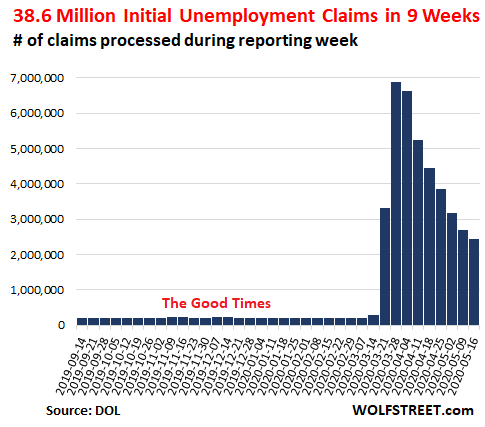
Even as restrictions on businesses began lifting across the United States, another 2.4 million workers filed for jobless benefits last week, the government reported Thursday, bringing the total to 38.6 million in nine weeks.
“I hate to say it, but this is going to take longer and look grimmer than we thought,” Nicholas Bloom, an economist at Stanford University, said of the path to recovery.
Mr. Bloom, a co-author of an analysis of the coronavirus epidemic’s effects on the labor market, estimates that 42 percent of recent layoffs will result in permanent job loss.
In this case, the economy that comes back is likely to look quite different from the one that closed. If social distancing rules become the new normal, causing thinner crowds in restaurants, theaters and stores, at sports arenas, and on airplanes, then fewer workers will be required.
Large companies already expect more of their workers to continue to work remotely and say they plan to reduce their real estate footprint, which will, in turn, reduce the foot traffic that feeds nearby restaurants, shops, nail salons and other businesses.
Concerns about working in close quarters and too much social interaction could also accelerate the trend toward automation, some economists say.
New jobs, mostly at low wages — as delivery drivers, warehouse workers and cleaners — are being created. But many more jobs will vanish.
“I think we’re in for a very long haul,” Mr. Bloom said.
In the meantime, the Labor Department’s latest data on unemployment claims, for new filings last week, reflects the shutdown’s continuing damage to the labor force.
“The hemorrhaging has continued,” Torsten Slok, chief economist for Deutsche Bank Securities, said of the mounting job losses. He expects the official jobless rate for May to approach 20 percent, up from the 14.7 percent reported by the Labor Department for April.
A household survey from the Census Bureau released Wednesday suggested that the pain was widespread: 47 percent of adults said they or a member of their household had lost employment income since mid-March. Nearly 40 percent expected the loss to continue over the next four weeks.
In testimony before the Senate on Tuesday, the Federal Reserve chair, Jerome H. Powell, emphasized how devastating prolonged joblessness can be for individual households and for the economy.
“There is clear evidence that when you have a situation where people are unemployed for long periods of time, that can permanently weigh on their careers and their ability to go back to work,” he said.
Emergency relief and expanded unemployment benefits that Congress approved in late March have helped tide households over. Roughly three-quarters of people who are eligible for a $1,200 stimulus payment from the federal government have received it, according to the Treasury Department.
Workers who have successfully applied for unemployment benefits are getting the extra $600 weekly supplement from the federal government, and most states have finally begun to carry out the Pandemic Unemployment Assistance program, which extends benefits to freelancers, self-employed workers and others who don’t routinely qualify. The total number of new pandemic insurance claims reported, though, was inflated by nearly a million because of a data entry mistake from Massachusetts, according to the state’s Executive Office of Labor and Workforce Development.
Mistakes, lags in reporting and processing, and weeding out duplicate claims and reports have clouded the unemployment picture in some places.
What is clear, though, is that many states are still struggling to keep up with the overwhelming demand, drawing desperate complaints from jobless workers who have been waiting two months or more to receive their first benefit check. Indiana, Wyoming, Hawaii and Missouri are among the states with large backlogs of incompletely processed claims. Another is Kentucky, where nearly one in three workers are unemployed.
Sami Adamson, a freelance scenic artist for theater, events and television shows, received the letter with her login credentials to collect benefits from New Jersey only Monday, more than two months after she first applied.
She said her partner, who is in the same line of work, had filed for jobless benefits in New York and quickly received his payments.
By the time she heard from New Jersey, a design studio had called her for a temporary assignment. She plans to eventually reclaim the lost weeks of benefits, but for now she is helping to make face shields in a large warehouse where assembly-line workers are spaced apart, handling plastic, foam and elastic.
“I don’t think I’ll need aid for the next two or three weeks,” Ms. Adamson said, “but I’m not sure too far ahead of that.”
Nearly half of the states have yet to provide the additional 13 weeks of unemployment insurance that the federal government has promised to those who exhausted their state benefits. Workers in Florida — which provides just 12 weeks of benefits, the fewest anywhere — are particularly feeling this pinch. And while several states, including those that pay the average of 26 weeks, have offered additional weeks of coverage during the pandemic, Florida has not.
Small-business owners who were hoping the Paycheck Protection Program would enable them to keep their workers on the payroll contend the program is not operating as intended.
Roy Surdej, who owns Peaches Boutique in Chicago, applied for a loan after he was forced to close and the pandemic eliminated the season’s wave of proms, quinceañeras and graduation celebrations were canceled.
Under the program, the loan turns into a grant if he rehires the 100-person staff he had built up in February in anticipation of selling thousands of ruffled, sequined and strappy dresses during the spring rush. But he said that would be impossible, given the income he had lost and the restrictions that continue to pre-empt social gatherings.
“No way can I qualify for full forgiveness,” said Mr. Surdej, who said revenue had dried up. “It’s devastating for us,” he added, saying he had no clue when he would be able to reopen and begin rehiring. “If the government can’t adjust the dates to allow us to use it properly so we can survive, then I won’t use it.”
At the same time, the Congressional Budget Office warned that businesses able to use the Paycheck Protection Program might end up laying off workers when the program expires at the end of June.
Several states have warned workers that they risk losing their benefits if they refuse an offer to work. Federal rules enacted during the pandemic say that workers are not compelled to return to unsafe working conditions, but just what constitutes such conditions is not necessarily clear.
On Tuesday, Democratic senators sent a letter to Labor Secretary Eugene Scalia to “clarify the circumstances” so that workers are not “forced to choose between going back to work in unsafe conditions, or continuing to social distance and losing their only source of income.”
Workers with child care responsibilities can stay on unemployment if public schools are closed, but once the term ends, a lack of day care or summer programs is not considered a legitimate reason. Nor are self-imposed quarantines.
Officials can lift stay-at-home and business restrictions, but then what happens? “There are lingering concerns about health, family situations, kids not in school, relatives who are sick and needing care,” said Carl Tannenbaum, chief economist at Northern Trust. “There’s going to be a very slow and gradual process of reopening and restoring employment beyond just a declaration from the statehouse or the county seat.”


/cdn.vox-cdn.com/uploads/chorus_image/image/66858616/GettyImages_1220891781.0.jpg)
:no_upscale()/cdn.vox-cdn.com/uploads/chorus_asset/file/20005583/coronavirus_reopen_map.png)
:no_upscale()/cdn.vox-cdn.com/uploads/chorus_asset/file/20007678/coronavirus_cases_map.png)
:no_upscale()/cdn.vox-cdn.com/uploads/chorus_asset/file/20005708/coronavirus_cases_per_capita_map.png)
:no_upscale()/cdn.vox-cdn.com/uploads/chorus_asset/file/20005705/coronavirus_test_map.png)
:no_upscale()/cdn.vox-cdn.com/uploads/chorus_asset/file/20005702/coronavirus_positive_rate_map.png)
:no_upscale()/cdn.vox-cdn.com/uploads/chorus_asset/file/20005695/coronavirus_icu_maps.png)





 HENRY KOTULA