Barr urges Trump administration to back off call to fully strike down Obamacare

https://www.cnn.com/2020/05/05/politics/william-barr-obamacare-supreme-court/index.html?fbclid=IwAR0H0M_pTi9V9W4iEAqWTWKJzopzznh6202z0FgsMbthJS7oS-pDowVGc3M

Barr urges Trump administration to back off call to fully strike ...

Attorney General William Barr made a last-minute push Monday to persuade the administration to modify its position in the Obamacare dispute that will be heard at the Supreme Court this fall, arguing that the administration should pull back from its insistence that the entire law be struck down.

With a Wednesday deadline to make any alterations to its argument looming, Barr made his case in a room with Vice President Mike Pence, White House counsel Pat Cipollone, members of the Domestic Policy Council, press secretary Kayleigh McEnany and several other officials. The meeting ended without a decision and it was not immediately not clear if any shift in the Trump administration’s position will emerge.
Barr and other top advisers have argued against the hard-line position for some time, warning it could have major political implications if the comprehensive health care law appears in jeopardy as voters head to the polls in November.
According to four sources familiar with the meeting, Barr argued for modifying the administration’s current stance to preserve parts of the law, rather than fully back the lawsuit filed by a group of Republican states. As it stands now, the Trump administration’s position seeks to invalidate the entire Affordable Care Act, signed by President Barack Obama in 2010 and commonly known as Obamacare.
Barr and Health and Human Services Secretary Alex Azar have argued against supporting invalidating the law in full, engaging in a heated debate on this point with then-acting White House chief of staff Mick Mulvaney and policy officials allied with him, CNN reported last year. But Barr and others have recently brought an additional dimension to their efforts, highlighting the coronavirus pandemic that has swept the nation. If the justices were to accept the Trump administration position, its decision could cause substantial disruptions to the health care of millions of Americans and cause the uninsured rate to spike.
The Affordable Care Act is expected to serve as an important safety net for the millions of people who lose their jobs and work-based health insurance amid the pandemic. If the unemployment rate hits 15%, nearly 17.7 million Americans could lose their employer-sponsored policies, according to a recent Urban Institute report. More than 8 million people could enroll in Medicaid, particularly in states that expanded the program to more low-income adults under the sweeping health care law. Also, more than 4 million people could obtain coverage through the Affordable Care Act exchanges or other private policies, leaving just over 5 million uninsured, the report found.
Even before the pandemic, more than 11.4 million people signed up for Obamacare coverage for 2020 and roughly 12.5 million were enrolled in Medicaid expansion.
Trump’s domestic policy aides have resisted any change in the Trump administration’s legal arguments at this point, contending that the legal position should move forward without changes because Republicans have campaigned on repealing Obamacare for a decade. Those aides have brushed off the possibility of any new political repercussions, and pushed back on Barr in the meeting Monday.
The Justice Department declined to comment.
The divide has been a long-running battle inside the administration, but it has a new sense of urgency because the administration is up against a deadline on Wednesday if it wants to modify its argument.
The administration currently contends that the individual insurance requirement is unconstitutional, and because that mandate is tied to other provisions of the law, the entire Affordable Care Act must fall. If the administration is going to back off that absolute position, it would likely submit a filing to the Supreme Court within the next 48 hours, based on the court’s current briefing schedule for the dueling parties. Otherwise, the administration’s brief would not be due to the high court until June.
Barr has long favored tempering the administration’s position, which has shifted multiple times since the lawsuit began in early 2018. The administration argued that only two key provisions that protect Americans with pre-existing conditions should fall, but the rest of the law could remain. In a dramatic reversal soon after Barr became attorney general in early 2019, the Justice Department said the entire Affordable Care Act should be invalidated. Several months later, the administration argued before a federal appeals court that the law should only be struck as it applies to the coalition of Republican-led states that brought the challenge.
The argument that the entire law should be struck down already might have been a tough one to make to a Supreme Court majority that has twice rejected broad-scale challenges.
After a decade, the Affordable Care Act has affected nearly every aspect of the health care system. It required all Americans obtain coverage and created a marketplace for purchasing insurance. It also expanded Medicaid for poor people and protected diabetics, cancer patients and other individuals with pre-existing conditions from being denied coverage or charged higher premiums.
The current Supreme Court dispute began when Texas and other Republican-led states sued after the Republican-led Congress in 2017 cut the tax penalty for those who failed to obtain insurance to zero. Because the individual mandate is no longer tied to a specific tax penalty, the states argue, it is unconstitutional. They also say that because the individual mandate is intertwined with a multitude of ACA provisions, invalidating it should bring down the entire law, including protections for people with preexisting conditions.
On the other side are California and other Democratic-led states and the now Democratic-controlled US House of Representatives. The Affordable Care Act has remained in effect through the litigation.
The Supreme Court agreed earlier this year to take up the ACA dispute. The case is likely to be heard in the fall, but a decision would not be expected until 2021, after the November presidential election.
The case will mark the third time that the Supreme Court takes up a major ACA dispute. In 2012, the justices upheld the law, by a 5-4 vote, with Chief Justice John Roberts casting the deciding vote with the four liberal justices over the dissent of four conservatives. Roberts grounded his opinion in Congress’ taxing power.




Molina readies for ‘significant’ Medicaid member bump as more lose jobs

https://www.healthcaredive.com/news/molina-readies-for-significant-medicaid-member-bump-as-more-lose-jobs/577191/

Molina Healthcare's purchase of Medicaid managed care provider ...

Dive Brief:

  • Molina executives said it will likely experience a “significant” increase of Medicaid and exchange members as the pandemic continues to wash over the country and forces more out of work and job-based coverage, according to comments made during Friday’s first quarter earnings call.   
  • The company reaffirmed its 2020 earnings outlook with “enhanced confidence” given the “net-positive” effects likely to stem from the impact of novel coronavirus, as executives noted a steep decline in elective procedures and utilization very late in March and the limited impact COVID-19 has had on costs so far.
  • Overall for the first quarter, Molina beat Wall Street expectations on earnings per share and revenue which increased to $4.5 billion. Yet, it was only one of two managed care organizations to miss on medical loss ratio targets, which increased to 86.3% due to higher costs in its marketplace business. 

Dive Insight:

Another 3.8 million Americans filed for unemployment last week, bringing the total of out-of-work Americans to more than 30 million since the outbreak unfolded.

That presents an opportunity for insurers like Molina that are primarily positioned in Medicaid and Affordable Care Act exchange lines of business. Medicaid coverage is based on income and reserved for low-income Americans and the marketplace, or exchanges, tie coverage to income and financial help for those with incomes below a certain threshold.

Although its membership is likely to swell due to current economic conditions, Molina CEO Joe Zubretsky cautioned investors Friday by saying, “by how much we do not yet know.”

Zubretsky said Medicaid has proven it’s a stress-tested model that works in both robust economies and those in a recession.

So far, through April 27, 950 of Molina’s members have been hospitalized with COVID-19, a small fraction of Molina’s 3.4 million membership base. The average length of stay was about 10 days for these members, but they have not been able to assess the costs per episode yet, executives said Friday.

Its plans in Washington, California and Michigan were most affected. However, its Michigan plans have experienced the highest number of cases. 

By business line, Medicare members have experienced the highest percentage of COVID-19 diagnoses followed by Medicaid and marketplace members, in line with reports of the disease disproportionately affecting older Americans.

Molina also said it had entered into a definitive agreement to acquire Magellan Complete Care for $820 million in cash. The deal is expected to close in the first quarter of 2021. The deal gives Molina about 155,000 more members. Last year, Magellan generated more than $2.7 billion in revenue, according to Molina.

Magellan operates in six states, three of which would be new for Molina, including Arizona, Virginia and Massachusetts. 


Employers split from health care industry

https://www.axios.com/newsletters/axios-vitals-d589549c-1967-44b1-af0b-528fb345c48b.html?utm_source=newsletter&utm_medium=email&utm_campaign=newsletter_axiosvitals&stream=top

Employers split from health care industry over coronavirus demands ...

Several large employer groups this week refused to sign on to funding requests they consider a “handout” for hospitals and insurers, according to three people close to the process.

The big picture: Coronavirus spending bills are sharpening tensions between the employers that fund a significant portion of the country’s health care system and the hospitals, doctors and insurers that operate it, Bob reports.

Driving the news: The industry’s most recent request — written primarily by the large hospital and health insurance lobbying groups — focused on a few items for the next coronavirus legislation:

  • Providing subsidies to maintain employer-sponsored insurance, which already receives a large tax break, as well as providing subsidies for COBRA for people who have lost their jobs.
  • Increasing subsidies for Affordable Care Act plans and creating a special ACA enrollment window.
  • Opposing the use of the industry’s bailout funds to pay for uninsured COVID-19 patients at Medicare rates.

Between the lines: Employers know they get charged a lot more for health care services compared with public insurers, but many weren’t keen about urging Congress to “set up a government program to pay commercial reimbursements,” said an executive at a trade group that represents large corporations.

The other side: Several health care groups that signed the letter dismissed the idea of any disagreement with employers.


U.S. Supreme Court sides with insurers in battle over risk corridor payments

https://www.fiercehealthcare.com/payer/scotus-sides-insurers-battle-over-risk-corridor-payments?mkt_tok=eyJpIjoiWXpNMlpXUTVaakpoTmpJMSIsInQiOiJzU3ViK3ZwV0oyMUxOS3N5T0tXY3h1anlUSW5ndTJ0MDlEMkE1S3BGRDg1Mlc1eDdpY3hGaHRCV0U1eUpFbWxhR3ZoSVlRdlU5M1NCek5FamxZZ0NLMEhxQ25teFwvNVwvSFEzYnlETEpuMnlZM0FJYThWeEhTcUFodElZUEcwS1RlIn0%3D&mrkid=959610

Supreme Court seems to side with insurers in ACA risk corridor ...

The Supreme Court sided with insurers in a years-long battle over billions in payments promised under the Affordable Care Act.

The nation’s highest court ruled (PDF) 8-1 on Monday that the ACA’s risk corridor program created an obligation for the federal government to pay health plans promised funds.

The insurers suing for damages sought $12 billion in unpaid funds from the program.

The ACA established the risk corridors to encourage health plans to participate in the exchanges. If an insurer earned massive profits through the individual market, the government would claim some of those funds and pay it out to insurers that are performing poorly.

The government did collect those funds, but did not pay out money to struggling insurers. The risk corridor program closed in 2016 after three years.

The justices argued that the government was compelled to make the payments.

“The plain terms of the risk corridors provision created an obligation neither contingent on nor limited by the availability of appropriations or other funds,” the court argued.

Justice Samuel Alito was the lone dissent in the case.

The justices also disputed the government’s argument that Congress implied a repeal of the risk corridors through appropriations riders. The justices said that any riders did not actually change the payment methodology or suggest the payments were not required.

The court also argued that the health plans had standing to sue under the Tucker Act.

“Petitioners clear each hurdle: The risk corridors statute is fairly interpreted as mandating compensation for damages, and neither exception to the Tucker Act applies,” the court said.

In his dissent, Alito blasts the opinion as a bailout for health plans.

America’s Health Insurance Plans CEO Matt Eyles praised the ruling in a statement.

“The federal government made a clear commitment in the interest of building stable markets and making coverage more affordable for individuals and small employers,” Eyles said. “Health insurance providers kept their commitments while incurring substantial losses.”

Today’s decision, as the Supreme Court observes, reflects ‘a principle as old as the Nation itself: The Government should honor its obligations,’” he added. “We appreciate that today’s Supreme Court 8-1 decision ensures that the federal government honors the obligations it made for services the private sector already delivered.”


A landmark post-COVID physician group acquisition in California

https://mailchi.mp/39947afa50d2/the-weekly-gist-april-17-2020?e=d1e747d2d8

Brown & Toland Reviews | Glassdoor

Blue Shield of California announced last Friday that its healthcare services division, Altais, is acquiring Brown & Toland Physicians, a multispecialty network of 2,700 physicians serving 350,000 patients in the greater San Francisco Bay Area. Brown & Toland, formed in 1993, is a clinically-integrated network of independent physicians that has received much attention nationally for its risk-based contracting as both a Medicare Pioneer Accountable Care Organization, as well for its landmark contract to manage state workers and retirees in the California Public Employees’ Retirement System (CalPERS).

While few details of the deal have been released, Altais says it will provide Brown & Toland with both capital for growth, and a technology platform that includes practice management, analytics tools, telehealth and electronic health record assistance. Brown & Toland’s CEO, Kelly Robinson, said the partnership would enable the group to expand geographically.

While Blue Shield’s purchase of Brown & Toland is the first noteworthy payer acquisition of physician practices we’ve seen in the post-COVID era, it’s likely just the first of many to follow in coming months. As we reported last week, the majority of physician groups—especially smaller independent practices—are suffering significant financial strain, which will likely make groups of all sizes more open to partnership options.

Recent reports suggest that payers in particular may be weathering the economic shocks of the crisis relatively well. This week UnitedHealth Group (UHG) announced it exceeded Q1 earnings targets, and would maintain its pre-COVID earnings guidance for the year, citing savings from cancelled routine care and elective procedures. Should payers continue to fare well, it’s likely that UHG and other health plans could enjoy an advantage in deploying the capital necessary to roll up distressed physician practices.


When the coronavirus lockdowns end, we will live in a shrunken world

https://www.yahoo.com/news/coronavirus-lockdowns-end-live-shrunken-122800321.html

Flipboard: When the coronavirus lockdowns end, we will live in a ...

  • A projection from the Department of Homeland Security, published by the New York Times, shows coronavirus cases spiking again at the end of summer.
  • It’s a stark reminder that American life after lockdown will still be one of limited human interaction. And that means we’ll have to live with a smaller economy too. 
  • The economy will be packed with uncertainty given the possibility of another shelter-in-place order.
  • Until we can all hang out again with confidence, the US economy is going to be a shell of its former self.

When the US emerges from its various shades of shelter-in-place orders, it will emerge to a shrunken global economy. One that will not easily be inflated living within parameters the coronavirus demands.

Financial transactions are a form of human interaction, and even after strict orders to stay at home are lifted, Americans will need to limit human interaction to mitigate the spread of coronavirus. One projection from the Department of Homeland Security, first reported by the New York Times, imagines a world where schools remain closed, 25% of Americans work from home, and social distancing remains in place through the summer.

And people will still be scared. They will know that there is an deadly virus infecting people who interact with other people.

In this scenario, back to work doesn’t mean back to growth because people won’t be spending money the way they did before. Back to work simply means finding a more sane, stable way to maintain society until we get a vaccine. There will be no V-shaped recovery. This is a marathon, and if we’re lucky, we will limp across the finish line.

As incomplete as it is, China is the best picture we have for understanding what a life after lockdown looks like, and it doesn’t look like a booming economy. 460,000 businesses closed permanently in China during the first quarter.

One Chinese county has gone back into lockdown already. In Beijing — where state media says epidemic prevention and control will “probably” become “long-term normal” — restaurants have been ordered to maintain social distance by cutting seating in half and limiting tables to three people. Customers have been slow to come back anyway.

All of this is to say that even if we’re out of lockdown, this saga isn’t remotely over.

Deflation strikes back

What China’s economy is telling us is that once this weird supply funk brought on by everyone staying home is over, and some people are able to go back to work, we’ll still have a demand crisis. Even though the virus has been contained analysts at Oxford Economics told clients it expects to see “basically no growth” in China this year. With other global economies weakened it will sell fewer exports. 

Zhu Jun, director of the international department of the People’s Bank of China, said that there’s a small chance the world risks another Great Depression. Cheery, I know, but until there’s a vaccine, optimism will be in short supply.

Here in the US, just as in China, people will be broke and businesses will be broken. Money will be scarce. Demand will be depressed not just because of a lack of funds, but because people will have changed their behavior to avoid getting sick. 

Wall Street it seems, hasn’t processed this bad news yet. It’s taking this pandemic day-by-day, not looking at life after lockdown. This week the market rallied on news that all over the US, even New York City, the curve is flattening. It was a silly rally.

It’s silly for the market to declare victory before we’ve even seen how much damage has been done (that will take months at least). It’s silly to expect any kind of stability until we know what kind of demand a post-shelter-in-place, pre-vaccine American economy will have.

Finally, we don’t know how long Washington will be in a giving mood. So far the Federal Reserve has pulled out all the stops, and Congress has approved trillions in aid. But will Washington keep sending checks to unemployed Americans until we have a vaccine? 

US employment by industry who can work from home

We thought we knew uncertainty

I think back to all the times I’ve heard CEOs and Wall Street types talk about uncertainty around regulations, or elections, or literally anything else that has happened in my life time, and I have to laugh. All of it seems silly compared to the uncertainty before us right now.

It is quite possible that sometime this summer scientists will develop a treatment for COVID-19 that makes the symptoms much more mild — something more like a standard, week-long flu. That discovery could make things a lot easier, and really bolster confidence enough to bring the economy back until we have a vaccine. But government officials obviously can’t plan with that in mind. Neither can businesses.

And so, those charged with imagining the worst case scenario must imagine a world where Americans are again forced to shelter-in-place to flatten the curve. Homeland Security’s projections put a resurgence of the virus somewhere around the end of summer to the beginning of fall. It’s not unreasonable to think certain populations may have to go back into shelter-in-place then.

Singapore has a robust system of testing for and tracking the coronavirus and its citizens went back into shelter-in-place this week. Here in the US we don’t have such a system. Last week the White House ended federal funding for its drive-thru testing site program.

On Friday New York Governor Andrew Cuomo urged the President to invoke the Defense Production Act to ramp up production of antibody tests that can show who has been infected with the coronavirus and built up immunity. That would allow people to go back to work, but the federal government will only be able to produce 2,000 a day in the next two weeks. 

As a nation, we need to be doing everything we can to ensure that when this lockdown is over, those who can go out can do so with as much confidence as possible. We need to inject as much certainty into this situation as possible Without testing, that’s not happening.

In an interview with CNBC, Bill Gates — the Microsoft founder and billionaire philanthropist who has dedicated a significant chunk of his charitable efforts to studying pandemics — said the federal government simply doesn’t seem interested in a unified testing system. This is one of the few variables in this pandemic the government can control, and it’s blowing it.

Testing is one of the only things that will make our beleaguered, shrunken coronavirus economy a little bit bigger. It’s one of the only ways we can impact the ugly twist of this economic downturn, behavior.

Even then, though, the possibility of an outbreak in a workplace, city, or state will change the way our economy works in ways that will make money scarce. We need to be ready for that.


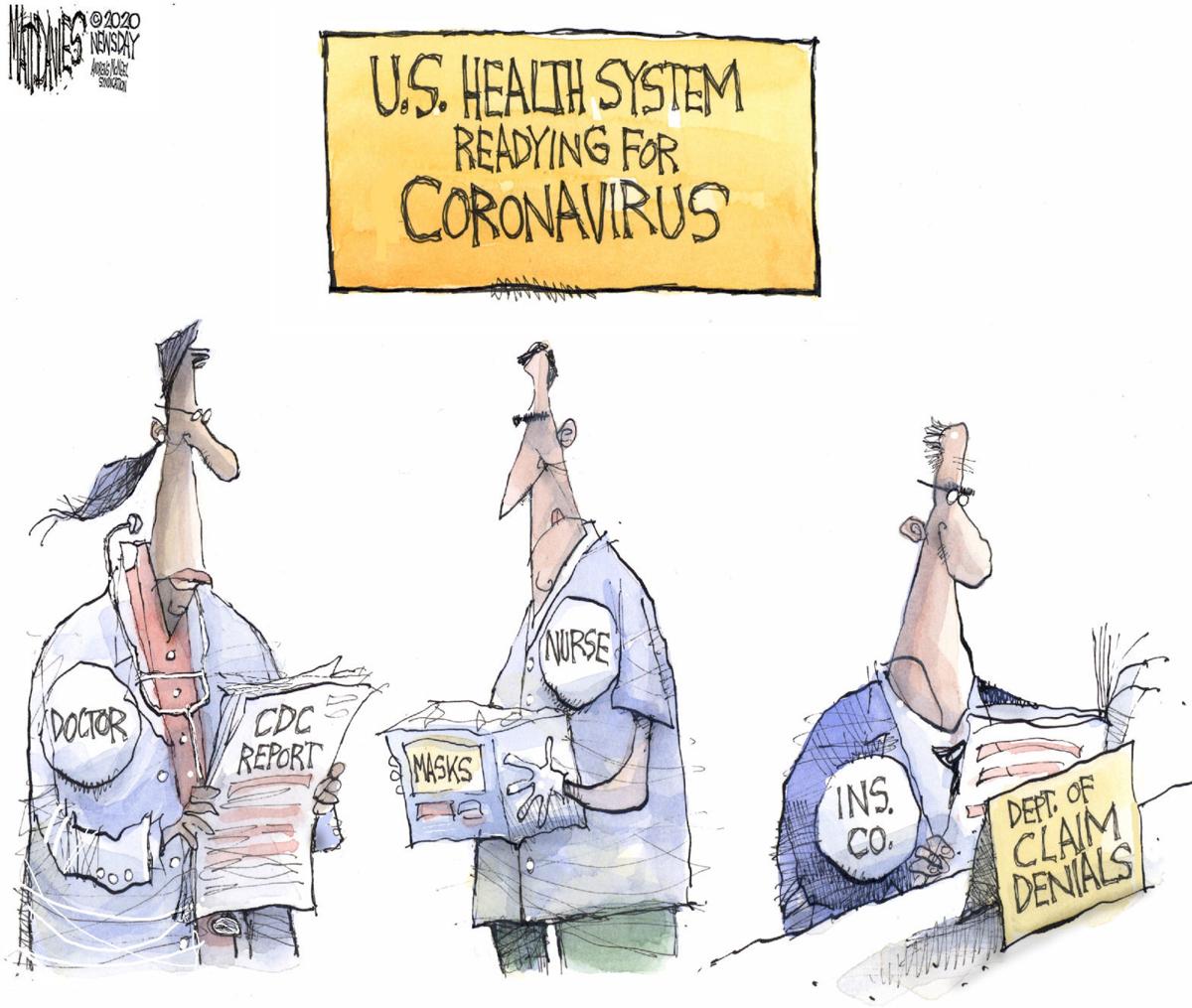
Cartoon – U.S Health System Readying for Coronavirus

Corona response | Cartoons | postregister.com

How insurers are covering COVID-19

https://www.healthcaredive.com/news/how-insurers-are-covering-covid-19/575372/

Private Health Coverage of COVID-19: Key Facts and Issues | The ...

Insurers are weighing how best to respond to the outbreak of the novel coronavirus as cases swell in the U.S. Here is a tracker to follow the latest policy and coverage decisions from the nation’s largest insurers.

The nation’s health insurers are responding to the coronavirus pandemic with changes to coverage associated with COVID-19 as the number of cases continues to swell across the U.S.

The biggest payers have said they will waive patient cost-sharing — copays, coinsurance and deductibles — for testing. Although some, such as Cigna and Humana, have gone farther by eliminating cost-sharing for all COVID-19 treatment.

In addition to coverage decisions, insurers are weighing the ways they can reduce administrative barriers to promote quicker access to care for those infected with the novel coronavirus. All are cutting back on prior authorization in various ways to ease access to care.

Hospitals say that’s not enough, and are calling on the biggest payers to follow actions taken by Congress and CMS to help resolve cash flow issues, by accelerating payments or opting into releasing interim periodic payments. The American Hospital Association also is urging payers to eliminate administrative burdens such as prior authorizations.

“This crisis is challenging for all of us, and everyone has a role to play,” AHA said in its letter to the nation’s largest insurers. “You could make a significant difference in whether a hospital or health system keeps their doors open during this critical time.”

Despite the policy changes by payers, employers with self-funded plans can opt out of these policies. A majority of workers are covered by self-insured plans, which essentially allow employers to decide coverage decisions given they’re paying for the claims and having insurers simply perform administrative services.

Below is a tracker with the latest coverage decisions for the nation’s largest insurers.

Blue Cross Blue Shield Association

The BCBSA is eliminating cost-sharing for COVID-19 diagnostic testing. It will also waive cost-sharing for treatment at in-network or Medciare rates through May 31, including inpatient stays.

BCBSA will remove prior authorization requirements for testing and for services that are medically necessary to treat an infected patient. BCBSA also is waiving limits on early refills to make it easier to access medications and expanding access to telehealth services.

Molina

Molina is halting cost-sharing for testing and treatment. That policy applies to Medicare, Medicaid and marketplace members nationwide.

Aetna (CVS)

Aetna will waive cost-sharing for certain members admitted to an in-network hospital with COVID-19 or complications from the disease. The policy applies to all of Aetna’s commercial plans, though self-insured members can opt out. The policy will apply to admissions through June 1. Aetna also is waiving cost-sharing for testing and associated visits, including telehealth.

Aetna also is attempting to make access to hospitalization faster for those with COVID-19 by easing prior authorization requirements, particularly in areas hard hit by the outbreak like New York and Washington.

Anthem

The nation’s second largest commercial insurer will waive cost-sharing for COVID-19 treatment and will reimburse providers at either in-network or Medicare rates through May 31. The policy applies to Anthem’s fully insured, individual, Medicaid and Medicare Advantage members. Self-insured plans can opt out. Anthem also is waiving cost-sharing for COVID-19 testing and in-network visits associated with testing whether it’s conducted at a physician’s office, urgent care or ER.

Anthem also is easing its limits on early refills for 30-day prescriptions. Anthem said it would waive cost sharing for telehealth visits, including those for mental health for a period of 90 days starting March 17. Self-insured plans have the option to opt in the new virtual care policy.

Centene

Centene will waive cost-sharing for COVID-19 related screening, testing and treatment for its Medicaid, Medicare and Marketplace members through June 30.

Centene also will eliminate prior authorization requirements for care for all its Medicare, Medicaid and Marketplace members. The company is also working to supply federally qualified health centers with personal protective equipment and assistance in providing small business loans to behavioral health providers and long-term service support organizations.

Cigna

Cigna will waive cost-sharing for all COVID-19 treatment, including testing and telehealth screenings through May 31. The policy applies to Cigna’s fully-insured group plans, individual coverage and Medicare Advantage plans. Self-insured plans can opt out.

Cigna will reimburse providers either at in-network or Medicare rates depending on the member. Cigna also is easing access to maintenance medication by offering free shipping for a 90-day supply. Cigna is easing prior authorization requirements for patients being discharged from the hospital to post-acure stays.

Humana

Humana is waiving cost-sharing for testing and treatment, including hospital admissions for COVID-19 cases. The policy applies to its Medicare Advantage plans, fully-insured commercial plans, Medicare supplement and its Medicaid plans. The policy is indefinite with no current end date. Cost-sharing will be waived for all telehealth visits and members can opt to refill prescriptions early.

Humana also is easing administrative barriers to allow infected patients to easily move from a hospital to post-acute care settings. It’s suspending prior authorization and referral requirements and requesting notification within 24 hours. It’s also implementing an expedited claims process to reimburse providers faster, Humana said.

UnitedHealthcare

The nation’s largest commercial insurer, will waive cost-sharing for COVID-19 treatment through May 31. The policy applies to its fully-insured commercial, Medicare Advantage and Medicaid plans. United also is waiving cost-sharing for COVID-19 testing at approved locations in accordance with Centers for Disease Control guidelines. There will be no cost-sharing for visits related to testing including at physician offices, urgent care, ERs and telehealth visits. The policy applies to United’s commercial, Medicare Advantage and Medicaid members.

UnitedHealthcare is opening a special enrollment period for some of its commercial members who opted out of coverage during the traditional enrollment period with their employers. This enrollment period will end April 6. The insurer also is easing prior authorization requirements through May 31, suspending prior approval for post-acute care and switching to a new provider.


Trump rejects Obamacare special enrollment period amid pandemic

https://www.politico.com/news/2020/03/31/trump-obamacare-coronavirus-157788?fbclid=IwAR1nbCE7Uwvo2CNi6d6W5NG9zEIQulyh-noy1RXdk_0RJstMM0C5VYJ8mO4

Trump rejects opening ObamaCare special enrollment period amid ...

Before the coronavirus outbreak, nearly 30 million Americans were uninsured and as many as 44 million were under-insured, paying for bare-bones plans with soaring deductibles and copays. Today, millions more Americans will begin losing their employer-based health insurance because they’ve lost their jobs during this pandemic.

Meanwhile, the Trump administration is still actively trying to repeal the entirety of the Affordable Care Act in court, which would cause an additional 20 million people to lose insurance *in the middle of a pandemic*.

And today, Trump refused to reopen ACA enrollment to those millions of uninsured Americans for a special enrollment window, leaving them without any affordable options to get covered. People are going to die because they can’t afford to seek treatment or end up saddled with thousands of dollars of medical debt if they do. Remember this the next time someone tries to tell you Medicare for All is too radical.

What do you think?

The Trump administration has decided against reopening Obamacare enrollment to uninsured Americans during the coronavirus pandemic, defying calls from health insurers and Democrats to create a special sign-up window amid the health crisis.

President Donald Trump and administration officials recently said they were considering relaunching HealthCare.gov, the federal enrollment site, and insurers said they privately received assurances from health officials overseeing the law’s marketplace. However, a White House official on Tuesday evening told POLITICO the administration will not reopen the site for a special enrollment period, and that the administration is “exploring other options.”

The annual enrollment period for HealthCare.gov closed months ago, and a special enrollment period for the coronavirus could have extended the opportunity for millions of uninsured Americans to newly seek out coverage. Still, the law already allows a special enrollment for people who have lost their workplace health plans, so the health care law may still serve as a safety net after a record surge in unemployment stemming from the pandemic.

Numerous Democratic-leaning states that run their own insurance markets have already reopened enrollment in recent weeks as the coronavirus threat grew. The Trump administration oversees enrollment for about two-thirds of states.

Insurers said they had expected Trump to announce a special enrollment period last Friday based on conversations they had with officials at the Centers for Medicare and Medicaid Services, which runs HealthCare.gov enrollment. It wasn’t immediately clear why the Trump administration decided against the special enrollment period. CMS deferred comment to the White House.

Trump confirmed last week he was seriously considering a special enrollment period, but he also doubled down on his support of a lawsuit by Republican states that could destroy the entire Affordable Care Act, along with coverage for the 20 million people insured through the law.

People losing their workplace coverage have some insurance options outside of the law’s marketplaces. They can extend their employer plan for up to 18 months through COBRA, but that’s an especially pricey option. Medicaid is also an option for low-income adults in about two-thirds of states that have adopted Obamacare’s expansion of the program.

Short-term health insurance alternatives promoted by Trump, which allow enrollment year-round, is also an option for many who entered the crisis without coverage. Those plans offer skimpier coverage and typically exclude insurance protections for preexisting conditions, and some blue states like California and have banned them or severely restricted them. The quality of the plans vary significantly and, depending on the contract, insurers can change coverage terms on the fly and leave patients with exorbitant medical bills.

Major insurers selling Obamacare plans were initially reluctant to reopen the law’s marketplaces, fearing they would be crushed by a wave of costs from Covid-19, the disease caused by the novel coronavirus. But the main insurance lobby, America’s Health Insurance Plans, endorsed the special enrollment period roughly two weeks ago while also urging lawmakers to expand premium subsidies to make coverage more affordable for middle-income people.

Congress in last week’s $2 trillion stimulus passed on that request, as well as insurers’ petition for an open-ended government fund to help stem financial losses from an unexpected wave in coronavirus hospitalizations.

Democrats pushing for the special enrollment period are also grappling with the high costs facing many people with insurance despite new pledges from plans to waive cost-sharing. Obamacare plans and a growing number of those offered by employers impose hefty cost-sharing and high deductibles that could still burden infected Americans with thousands of dollar in medical bills.

House Energy and Commerce Chairman Frank Pallone (D-N.J.) on a press call Monday contended that “we also need to have free treatment” after Congress eliminated out-of-pocket costs for coronavirus tests.

“We did the testing, which is now free, and everybody, regardless of their insurance, gets it,” Pallone said. “But that has to be for the treatment as well.”


Cartoon – Modern Prayer

12535