Inside the Midyear Panic at UnitedHealth

https://healthcareuncovered.substack.com/p/inside-the-midyear-panic-at-unitedhealth

Imagine you’re facing your midyear performance review with your boss. You dread it, even though you’ve done all you thought possible and legal to help the company meet Wall Street’s profit expectations, because shareholders haven’t been pleased with your employer’s performance lately.

Now let’s imagine your employer is a health insurance conglomerate like, say, UnitedHealth Group. You’ve watched as the stock price has been sliding, sometimes a little and on some days crashing through lows not seen in years, like last Friday (down almost 5% in a single day, to $237.77, which is down a stunning 62% since a mid-November high of $630 and change).

You know what your boss is going to say. We all have to do more to meet the Street’s expectations. Something has changed from the days when the government and employers were overly generous, not questioning our value proposition, always willing to pick up the tab and pay many hidden tips, and we could pull our many levers to make it harder for people to get the care they need. 

Despite government and media reports for years that the federal government has been overpaying Medicare Advantage plans like UnitedHealth’s – at least $84 billion this year alone – Congress has pretended not to notice. There is evidence that might be changing, with Republicans and Democrats alike making noises about cracking down on MA plans. 

Employers have complained for ages about constantly rising premiums, but they’ve sucked it up, knowing they could pass much of the increase onto their workers – and make them pay thousands of dollars out of their own pockets before their coverage kicks in. Now, at least some of them are realizing they don’t have to work with the giant conglomerates anymore.

Doctors and hospitals have complained, too, about burdensome paperwork and not getting paid right and on time, but they’ve largely been ignored as the big conglomerates get bigger and are now even competing with them.

UnitedHealth is the biggest employer of doctors in the country. But doctors and hospitals are beginning to push back, too. 

Since last fall, UnitedHealth and its smaller but still enormous competitors have found that “headwinds” are making it harder for them to maintain the profit margins investors demand. That is mainly because, despite the many barriers patients have to overcome to get the care they need, many of them are nevertheless using health care, often in the most expensive setting – the emergency room. They put off seeing a doctor so long because of insurers’ penny-wise-pound-foolishness that they had some kind of event that scared them enough to head straight to the ER. 

It’s not just you who is dreading your midyear review. Everybody, regardless of their position on the corporate ladder, and even the poorly paid folks in customer service, are in the same boat. And so is your boss. Nobody will put the details of what has to be done in writing. They don’t have to. Your boss will remind you that you have to do your part to help the company achieve the “profitable growth” Wall Street demands, quarter after quarter after quarter. It never, ever ends. You know this because you and most other employees watch what happens after the company releases quarterly financials. You also watch your 401K balance and you see the financial consequences of a company that Wall Street isn’t happy with. And Wall Street is especially unhappy with UnitedHealth these days.

And when things are as bad as they are now at UnitedHealth’s headquarters in Minnesota, you know that a big consulting firm like McKinsey & Company has been called in, and that those suits will recommend some kind of “restructuring” and changes in leadership to get the ship back on course. You know the drill. Everybody already is subject to forced ranking, meaning that at the end of the year, some of your colleagues, regardless of job title, will fall below a line that means automatic termination. You pedal as fast as you can to stay above that line, often doing things you worry are not in the best interest of millions of people and might not even be lawful. But you know that if you have any chance of staying employed, much less getting a raise or bonus, you have to convince your superiors you are motivated and “engaged to win.” No one is safe. Look what happened to Sir Andrew Witty, whose departure as CEO to spend more time with his family (in London) was announced days after shareholders turned thumbs down on the company’s promises to return to an acceptable level of profitability. 

If you are at UnitedHealth, you listened to what the once and again CEO, Stephen Hemsley, and CFO John Rex, who got shuffled to a lesser role of “advisor” to the CEO last week, laid out a new action plan to their bosses – big institutional investors who have been losing their shirts for months now. You know that what the C-Suite promised on their July 29 call will mean that you will have to “execute” to enable the company to deliver on those promises. And you know that you and your colleagues will have to inflict a lot more pain on everybody who is not a big shareholder – patients, taxpayers, employers, doctors, hospital administrators. That is your job. And you will try to do it because you have a mortgage, kids in college and maxed-out credit cards.  

Here’s what Hemsley and his leadership team said, out loud in a public forum, although admittedly one that few people know about or can take an hour-and-a-half to listen to:

  • Even though UnitedHealth took in billions more in revenue, its margins shrank a little because it had to pay more medical claims than expected.
  • Still, the company made $14.3 billion in profits during the second quarter. That’s a lot but not as much as the $15.8 billion in 2Q 2024, and that made shareholders unhappy.
  • Enrollment in its commercial (individual and employer) plans increased just 1%, but enrollment in its Medicare Advantage plans increased nearly 8%. That’s normally just fine, but something happened that the company’s beancounters couldn’t stop.
  • Those seniors figured out how to get at least some care despite the company’s high barriers to care (aggressive use of prior authorization, “narrow” networks of providers, etc.)

To fix all of this, Hemsley and team promised:

  • To dump 600,000 or so enrollees who might need care next year
  • To raise premiums “in the double digits” – way above the “medical trend” that PriceWaterhouseCoopers predicts to be 8.5% (high but not double-digit high)
  • Boot more providers it doesn’t already own out of network
  • Reduce benefits

Throughout the call with investors (actually with a couple dozen Wall Street financial analysts, the only people who can ask questions), Hemsley and team went on and on about the “value-based care” the company theoretically delivers, without providing specifics. But here is what you need to know: If you are enrolled in a UnitedHealth plan of any nature – commercial, Medicare or Medicaid or VA (yes, VA, too) – expect the value of your coverage to diminish, just as it has year after year after year.  

The term for this in industry jargon is “benefit buydown.”

That means that even as your premiums go up by double digits, you will soon have fewer providers to choose from, you likely will spend more out-of-pocket before your coverage kicks in, you might have to switch to a medication made by a drug company UnitedHealth will get bigger kickbacks from, and you might even be among the 600,000 policyholders who will get “purged” (another industry term) at the end of the year.

Why do we and our employers and Uncle Sam keep putting up with this?

Yes, we pay more for new cars and iPhones, but we at least can count on some improvements in gas mileage and battery life and maybe even better-placed cup holders. You can now buy a massive high-def TV for a fraction of what it cost a couple of years ago. Health insurance? Just the opposite. 

As I will explain in a future post, all of the big for-profit insurers are facing those same headwinds UnitedHealth is facing. You will not be spared regardless of the name on your insurance card. If you still have one come January 1. Pain is on the way. Once again. 

Health Insurance Industry Promises Reforms After $476 Million PR and Lobbying Campaign

Health insurers and their lobbying arms have spent $476.5 million since 2020 to block reform, protect profits, and mislead the public — and it’s coming straight from our premiums and tax dollars.

AHIP, the big PR and lobbying outfit for most health insurers, undoubtedly believes the praise it got from Trump administration officials and some members of Congress this week – when it announced changes insurers presumably will make voluntarily to alleviate the burden of prior authorization demands on patients and health care providers – has taken the heat off insurers. AHIP’s message to Washington politicos: You don’t need to pass any new laws to make us do the right thing. You can trust us, despite our decades of engaging in untrustworthy behavior to maximize profits.

As former health insurance executive Seth Glickman, M.D., explained yesterday, nobody should believe this hen-house guarding fox.

After all, AHIP is nothing more than a PR and lobbying shop with millions of our dollars to play with. It has zero ability to force insurers to do what AHIP claims they will do. I know this because I worked closely with AHIP during my 20 years in the industry and represented Cigna on its strategic communications committee.

From Fox to “Fixer”?

AHIP pulled off its big show on Monday – and got plenty of generally fawning press coverage – because of all the money it and affiliated insurers throw around Washington every year to protect what has become an incredibly profitable status quo.

Collectively, the seven biggest for-profit insurers reported $70 billion in profits last year.

(Beleauered UnitedHealth alone reported $34.4 million in operating earnings.) And that’s just seven among dozens. One way they make that kind of dough, for their shareholders and top executives, is by using prior authorization to avoid paying for patients’ medically necessary care. Many people die as a result, while investors get richer. It’s that simple and that cold.

So just how much money does AHIP and the insurance industry spend to bamboozle members of Congress and the White House every year? We’re talking stupid money. And orders of magnitude more than nonprofits that advocate for reforms that would benefit patients instead of shareholders.

Nearly Half a Billion Ways They Tip the Scale

To find out just how much, I turned to OpenSecrets and did some math. OpenSecrets, as a reminder, is the well-named organization that keeps tabs on campaign contributions and lobbying expenses.

What I discovered is that AHIP has spent almost $65 million lobbying Congress and the Biden and Trump administrations since 2020. Its cousin, the Blue Cross Blue Shield Association, has spent even more. More than twice as much more.

And that, folks, is just the tip of the iceberg, and it doesn’t even include the tens of millions the industry spends on massive advertising campaigns inside the DC beltway that it’s not required to report. Or the dark money ads and advocacy the industry bankrolls.

But just the lobbying totals are mind-blowing. When you factor in the money spent by the big seven insurers and the other PR and lobbying groups that insurers funnel money to, the total grows to almost $500 million. You read that right: nearly half a billion dollars.

Most of that spending was during the Biden administration, but the industry is on track to break spending records during the first year of the current Trump administration. They are lobbying not only to beat back new laws and regulations that could constrain their prior authorization practices but also to protect their biggest cash cows: Medicare Advantage and their pharmacy benefit managers (PBMs).

Three PBMs – owned by Cigna, CVS/Aetna and UnitedHealth –control 80% of the pharmacy benefit market and determine which drugs we’ll have access to and how much we have to pay out of pocket even with insurance.

The Big Number

$476.5 million – That’s the amount of money health insurance corporations and four of their PR and lobbying groups – AHIP, BCBSA (which includes contributions from Elevance/Anthem as well as numerous other BCBS companies), the Pharmaceutical Care Management Association and the Better Medicare Alliance – have collectively spent on lobbying Congress and federal regulators between January 1, 2020, and March 31, 2025.

The Breakdown

Lobby dollars spent by AHIPBCBSABMAPCMACenteneCignaCVS/AetnaHumanaMolina; and UnitedHealth between January 1, 2020, and March 31, 2025.

Keep in mind that that money is not coming out of executives’ paychecks. It’s coming out of our pockets. Insurers skim money from our premiums and taxes to finance their propaganda and lobbying efforts to keep the gravy train rolling. And it’s in addition to all the campaign cash they dole out every year, which I tabulated recently.

This is not to say that reform is impossible. Scrappy advocacy groups with a tiny fraction of that total have scored important victories over the years. But it is why progress is so slow and setbacks are so frequent.

But just imagine how all that money could be put to better use to ensure that all Americans, including those with insurance, are able to get the care they need when they need it. It’s clear that in addition to reforming our health care system, we need political reforms that make it more difficult for big corporations and their trade groups to influence elections and public policy.

Tariffs drive health plan premium hikes

https://www.axios.com/2025/06/18/tariffs-health-insurance-premium-hikes

Health insurers are starting to notify states that tariffs will drive up the premiums they plan to charge individual and small group market enrollees next year.

Why it matters: 

The Trump administration’s trade policy is adding another layer of uncertainty for health costs as Congress considers Medicaid cuts and is expected to sunset enhanced subsidies for Affordable Care Act coverage.

  • “There are sort of a perfect storm of factors that are driving prices up,” said Sabrina Corlette, research professor at Georgetown’s Center on Health Insurance Reforms.

The big picture: 

Health insurers calculate monthly premiums in advance of each year based on the expected price of goods and services and projected demand for them.

  • Tariffs announced by President Trump are expected to drive up the cost of prescription drugs, medical devices and other medical products and services. Some of that difference ultimately would be passed down to enrollees.

Where it stands: 

A handful of health insurers administering individual and small group plans have already explicitly told state regulators that tariffs are forcing plans to raise enrollee premiums more than they otherwise would next year, KFF policy analyst Matt McGough wrote in an analysis published Monday.

  • Independent Health Benefits Corporation told New York regulators in a filing last month that it plans to raise premiums for its individual market enrollees 38.4% next year.
  • About 3% of that is directly due to tariffs, based on projections of how much they’ll increase drug prices and the use of imported drugs, Frank Sava, a spokesperson for Independent Health, told Axios.
  • Similarly, UnitedHealthcare of Oregon said in a filing that nearly 3% of its planned 19.8% premium increase for small group enrollees next year is due to uncertainty around tariffs, particularly on how they’ll affect pharmaceutical prices.

Insurers “don’t have any historical precedent or data to project what this is going to mean for their business and health costs,” McGough said to Axios. “I think it really makes sense that they’re trying to hedge their bets.”

  • Insurers can’t change their premiums throughout the year. But if health plans do overshoot their premium estimates in rate filings, they have to pay enrollees back the difference in rebates.
  • While there may be a competitive advantage to keeping premiums lower, there isn’t really a way for insurers to make up for extra unplanned costs after the fact.

Yes, but: 

Some insurers indicated that while they’re keeping a close eye on tariff-related impacts, they aren’t baking them into their premium rates yet.

  • “There is uncertainty around inflation and the economy due to possible tariffs however we did [not] put anything for this in this filing,” Kaiser Foundation Health Plan of the Northwest’s report to Oregon reads.
  • State regulators can also push back on insurers’ premium calculations before they’re finalized, McGough noted.

What we’re watching: 

While some states have earlier deadlines, insurers have to submit their 2026 ACA marketplace plan rates to the federal regulators by July 16, and proposed rates will be posted by August 1.

  • That’s when we’ll get a better picture of how seriously tariffs are concerning health insurers.

Cost to insure a family tops $35,000

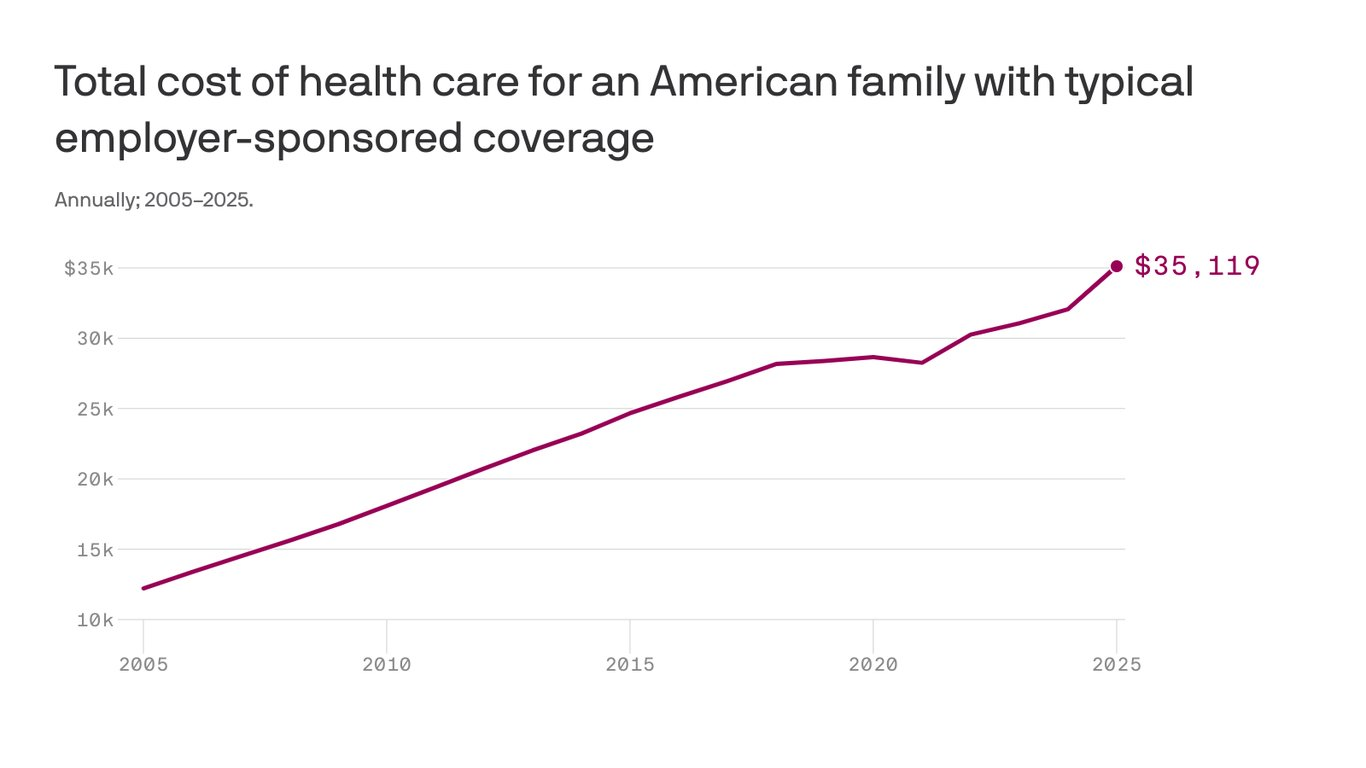
The cost to cover a family of four through workplace insurance now exceeds $35,000, nearly triple what it cost 20 years ago as annual growth in health costs have far outpaced wages.

The big picture: 

Growing pharmacy and outpatient facility costs drove most of the increase, which includes employee and employer shares, according to the 2025 Milliman Medical Index.

  • Employers have been wary of passing health cost hikes to workers in a tight labor market, but the rising demand for costly care may force a reckoning.

State of play: 

The $35,119 annual cost to cover a hypothetical family of four this year factors in drug costs, inpatient and outpatient care, and professional services, along with an “other” category that includes home health, ambulance transport, medical equipment and prosthetics.

  • A year of health care cost a family of four $12,214 in 2005, the year Milliman launched the index. The 20-year cumulative gain of 188% outpaced the 84% growth in wages over the same time.
  • Health costs have increased about 6% per year on average over the past two decades, according to Milliman, compared with an average inflation rate of 2.5% over that time.

Between the lines: 

Employers in 2025 still shoulder 58% of employee health care costs, but their share has shrunk since 2005, when it was more than 60%.

Reality check: 

Health care costs vary significantly by age, geography and pharmacy rebate arrangements.

  • Milliman calculates family cost based on a family with a 47-year-old male, 37-year-old female, and children ages 4 and under 1.
  • This was a “mathematically average” family in 2005, and Milliman continues to use that formula to keep data comparable year-to-year.
  • The firm has an online tool that allows readers to input other family configurations to see their estimated 2025 health care costs.

The analysis is based on Milliman’s proprietary research tools and analyzes commercial claims data. The family cost figure reflects nationwide average negotiated provider fees and average PPO benefit levels.

Medicare Scramble: Wall Street Wants Insurers to Dump Costly Seniors

Wall Street is speaking loudly to Medicare Advantage insurers: If you want us to stick with you, keep dumping seniors who are pinching your profit margins. 

Investors continue to punish UnitedHealth Group since the company downgraded its 2025 profit expectations on April 17. On Friday, UnitedHealth’s stock price hit not only a 52-week low—$393.11—but its lowest point in years. The last time UnitedHealth’s stock price went below $400 a share was on October 14, 2021. 

The company’s shares lost nearly 4.5% of their value during the past week, contributing to a decline that started soon after the company set an all-time high of $630.73 last November. UnitedHealth’s shares have lost more than 33% of their value since then. 

Wall Street Sends a Message

Meanwhile, investors have once again embraced UnitedHealth’s top two rivals in the Medicare Advantage business–Humana and CVS/Aetna. Those companies told investors last year, when both were in the Wall Street dog house for spending more than investors expected on patients’ medical care, that they would dump hundreds of thousands of their costliest Medicare Advantage enrollees to improve their profits. They made good on that promise, shedding almost 650,000 seniors and people with disabilities by the end of the year. 

Many of those people enrolled in a UnitedHealth Medicare Advantage plan. The company reported 400,000 more Medicare Advantage enrollees in the first quarter of 2025 than in the fourth quarter of 2024. That used to be a good thing, but UnitedHealth’s executives told investors on April 17 that it wouldn’t make as much money for them as the company had assured them just three months earlier because it likely will have to spend more than they expected on those new MA enrollees’ medical care. Investors responded by immediately dispatching the company’s shares to the cellar. Those shares lost about 23% of their value in a single day.

The Street had also punished Humana and CVS last year when they said they were paying more for seniors’ medical care than they’d expected. Shares of both companies cratered, losing around half their value. So, executives at both Humana and CVS started identifying Medicare markets to get out of entirely. The culling was ruthless. CVS shed 227,000 MA enrollees. Humana got rid of 419,000.

Locked Out of Traditional Medicare

Those seniors and disabled people had to scramble to find a new Medicare Advantage insurer because it is difficult for most people to go back to traditional Medicare and find an affordable Medicare supplement policy. Medicare supplement insurers must waive underwriting during the first six months of applicants’ eligibility for Medicare, but people who enroll in a Medicare Advantage plan and want or need to make a change months later find out that insurers will charge them more unless their health is nearly perfect. 

Of the seven big for-profit health insurers, four (Cigna, CVS/Aetna, Humana and Centene) collectively cut 1.3 million of their Medicare Advantage enrollees adrift at the end of 2024 in an effort to stay in Wall Street’s good graces. Cigna dumped all 600,000 of its MA enrollees, selling them to the Blue Cross corporation HCSC. For-profit Blue Cross insurer Elevance picked up 227,000; Molina added 18,000, and, as noted, UnitedHealth signed up 400,000 new MA enrollees. 

While UnitedHealth’s shares have lost a third of their value, CVS’s shares have increased more than 50%  since the first of this year. They even set a 52-week high of $72.51 on Thursday. Humana’s shares closed Friday at $258.48, up 1.88% since January 1. They are out of the Wall Street dog house – for now, anyway. 

Profits, Lobbying Soar

I trust you are not feeling sorry for UnitedHealth because of its misfortune on Wall Street. It is still a hugely profitable company–just not profitable enough lately to please investors. This huge corporation, the fourth largest in America, reported $9.1 billion in profits in just the first quarter of this year. If the company makes it more difficult for its health plan enrollees to get the care they need this year, it could make even more than the $34.4 billion in profits it made last year

And as a group, the seven big for-profits, including those that spent more than Wall Street felt was necessary on patients’ medical care, made $70 billion in profits last year. (UnitedHealth made nearly as much as the other six combined.)

And collectively, those giant corporations took in a record $1.5 trillion in revenue from us as customers and taxpayers last year. They are doing quite well. But that won’t stop them from trying to keep lawmakers and Trump administration officials from cracking down this year on the widespread waste, fraud and abuse in the Medicare Advantage program. You can expect them to spend a record amount of our money on lobbying expenses in Washington this year to keep their Medicare Advantage cash cow well fed. 

ACA premiums set to rise in 2025

https://www.axios.com/2024/08/06/aca-plan-2025-premium-increases

Growing demand for GLP-1 drugs like Ozempic and Wegovy and hospital consolidation could help drive up the cost of Affordable Care Act coverage next year by 9% or more, according to a preliminary review by the Peterson Center on Healthcare and KFF.

Why it matters: 

While most enrollees in the market get subsidies and won’t have to foot the added bill, premium increases generally result in higher federal spending on subsidies, the analysis notes.

What they found: 

Rate filings by 61 insurers across 10 states and D.C. show ongoing hospital consolidation and workforce shortages are having an inflationary effect on premiums.

  • So, too, is the explosion in demand for drugs used for diabetes treatment and weight loss.
  • Though few ACA plans cover drugs that are approved only for weight loss, several insurers singled out GLP-1s as a driving force behind premium increases for 2025.
  • The analysis notes insurers are using strategies like prior authorization, step therapy and limiting quantities to control demand of Ozempic and other GLP-1s that are approved for diabetes but have potential for off-label use to lose weight.
  • Specialty drugs and biologics, including pricey gene therapies, are also becoming more prevalent and driving premiums upward.

Most insurers say ongoing state Medicaid redeterminations, COVID-19 treatment and tests and the federal surprise billing ban are not having a major effect on 2025 premiums.

Context: 

Last year, insurers proposed rate increases for 2024 coverage that were between 2% and 10%, with a median increase of 6%, Peterson-KFF notes.

  • This year’s detailed review of factors driving premium changes for 2025 found insurers have somewhat higher proposed rate increases, with a median of 9%.
  • The basis for the federal subsidies is the percent change in the benchmark ACA silver plan.

The bottom line: 

Medical inflation has picked up and now exceeds the growth of non-medical prices — a big change from 2021 to 2023. ACA plans are adjusting to keep pace and reflect their higher costs and overhead.

CVS CEO to Wall Street: People in Medicare Advantage Are in for a World of Hurt as We Focus on Profits

ALSO: We’re premiering our Magic Translation Box to help you decipher corporate jargon and understand what’s coming down the pike.

If you are enrolled in an Aetna Medicare Advantage plan, now might be a good time to get more nervous than usual.

Wall Street is not happy with Aetna’s parent, CVS Health. In response to that unhappiness, triggered by the company’s admission that it has been paying more claims than usual, CVS execs have promised to do whatever it takes to get profit margins back to a level investors deem suitable. 

That means the odds have increased that Aetna will refuse to cover the treatments and medications your doctor says you need. It also means CVS/Aetna likely will increase your premiums next year and might dump you altogether. The company has a long history of doing just that, as you’ll see below. 

Medicare Advantage companies in general are facing what Wall Street financial analysts call headwinds, and those winds are now coming from several sources: increased Congressional scrutiny of insurers’ business practices, Biden administration efforts to end years of overpayments that have cost taxpayers hundreds of billions of dollars, enrollee discontent, and a gathering storm of negative press. 

To understand the pressures CVS CEO Karen Lynch and her C-Suite team are under to satisfy the company’s remaining shareholders (many have fled), you need to know and understand what they told them in recent weeks–and what she undoubtedly will have to say again, with conviction, this coming Thursday when CVS holds its annual meeting of shareholders. You can be certain Lynch’s staff has prepared a binder chock full of the rudest questions she could face from rich folks (mostly institutional investors) who’ve become a little less rich in recent months as the golden calf calf called Medicare Advantage has lost some of its luster. (My former colleagues and I used to put together such a CEO-briefing binder during my Cigna days, which coincided with Lynch’s years at Cigna.)

To help with that understanding, we’re introducing the HEALTH CARE un-covered Magic Translation Box (MTB). We’ll fire it up occasionally to decipher the coded language executives use when they have to deal with analysts and investors in a public setting. We’ll start with what Lynch and her team told analysts on May 1 when CVS announced first-quarter 2024 results that caused a stampede at the New York Stock Exchange.

Lynch: We recently received the final 2025 (Medicare Advantage) rate notice (from the Center for Medicare and Medicaid Services), and when combined with the Part D changes prescribed by the Inflation Reduction Act, we believe the rate is insufficient. This update will result in significant added disruption to benefit levels and choice for seniors across the country. While we strive to deliver benefit stability to seniors, we will be adjusting plan-level benefits and exiting counties as we construct our bid for 2025. We are committed to improving margins.

Magic Translation Box: Can you believe it? CMS did not bend to industry pressure to pay MA plans what we demanded for next year. We only got a modest increase, not enough, in our opinion, to protect our profit margins. To make matters worse, starting next year we won’t be able to make people enrolled in Medicare prescription drug plans (Part D) pay more than $2,000 out of their own pockets, thanks to the Inflation Reduction Act President Biden signed in 2022. So, to make sure you, our most important stakeholder, once again have a good return on your investment, we will notify CMS next month that we will slash the value of Medicare Advantage plans by reducing or eliminating some benefits, like dental, hearing and vision, that attract people to MA plans in the first place. And, for good measure, we’ll be dumping Medicare Advantage enrollees who live in zip codes where we can’t make as much money as we’d like. For them: too bad, so sad. For you: more money in your bank account. And for extra good measure, to keep seniors from blaming greedy us for what we have in store for them, our industry will be bankrolling dark money ads to persuade voters that Biden and the Democrats are the bad guys cutting Medicare. 

Later during CVS’s earnings call, CFO Thomas Cowhey reiterated Lynch’s remarks about reducing benefits.

Cowhey: So, we’ve given you all the pieces to kind of understand why we think it (Medicare Advantage) will lose a significant amount of money this year. But as you think about improvement there, obviously there’s a lot of work that we still need to do to understand what benefits we’re going to adjust and what ones we can and can’t…To the extent that we don’t believe we can credibly recapture margin in a reasonable period of time, we will exit those counties…(And) as we’ve all mentioned we’re going to be taking significant pricing actions and really it’s going to depend on what our competitors do.

Magic Translation Box: We’re under the gun to figure this out because we have to notify CMS by June 3 how much we will increase Medicare Advantage premiums and cut benefits next year and which counties we’ll abandon altogether. We’ll also be watching what our competitors do, but we know from what they’ve been telling you guys that they, too, will be dumping enrollees, hiking premiums and slashing benefits. 

To make sure investors couldn’t miss what they were saying, Lynch jumped back into the conversation to make clear they knew they were #1 in her book:

Lynch: I’m just going to reiterate what I said in my prepared remarks. (You can bet what follows were prepared, too.) We are committed to improving margin in Medicare Advantage [emphasis added] and we will do so by pricing for the expected trends. We will do so by adjusting benefits and exiting service counties. And we are committed to doing that.

Magic Translation Box: Have I made myself clear? We will do whatever it takes to deliver the profits you expect. We will keep a closer eye on how much care people are trying to get and we’ll swing into action faster next time if we see evidence of an uptick. There will be carnage, but you guys rule. You mean a lot more to us than those old and disabled people who don’t have nearly as much money as you do in their bank accounts. 

This will not be the first time Aetna has dumped health plan enrollees who were a drain on profits. In 2000, when Medicare Advantage was called Medicare+Choice, Aetna notified the Clinton administration it would stop offering Medicare plans in 14 states, affecting 355,000 people, more than half of Aetna’s total Medicare enrollment at the time. Other companies, including Cigna, did the same thing. My team and I wrote a press release to announce that Cigna would be bailing from almost all the markets where we sold private Medicare plans.

We of course blamed the federal government (i.e., the Democrats) for being the skinflints that made it necessary to bail. Our CEO at the time, Ed Hanway, said the government just couldn’t be relied upon to be a reliable “partner.” 

Back then, just a relatively small percentage of Medicare beneficiaries were in private plans. Today, more than half of Medicare-eligible Americans are enrolled in a Medicare Advantage plan, which means the disruption could be much worse this time. Some people in counties where Aetna and other companies stop offering plans likely will not find a replacement plan with the same provider network, premiums and benefits.

But in most places, those who get dumped will be stuck in the volatile, often nightmarish Medicare Advantage world, unable to return to traditional Medicare and buy a Medicare supplement policy to cover their out-of-pocket obligations.

That’s because in all but a handful of states, seniors and disabled people will not be able to buy a Medicare supplement policy as cheaply as they could within six months of becoming eligible for Medicare benefits. After that, Medicare supplement insurers, including Aetna, get their underwriters involved. If your health isn’t excellent, expect to pay a king’s ransom for a Medigap policy.

The Coming Insurance Storm

Employers face a brutal increase in health-insurance premiums for 2023, Axios’ Arielle Dreher writes from a Kaiser Family Foundation report out this morning.

  • Why it matters: Premiums stayed relatively flat this year, even as wages and inflation surged. That reprieve was because many 2022 premiums were finalized last fall, before inflation took off.

“Employers are already concerned about what they pay for health premiums,” KFF president and CEO Drew Altman said.

  • “[B]ut this could be the calm before the storm … Given the tight labor market and rising wages, it will be tough for employers to shift costs onto workers when costs spike.”

🧠 What’s happening: Nearly 159 million Americans get health coverage through work — and coverage costs and benefits have become a critical factor in a tight labor market.

🔎 Between the lines: In the tight labor market, some employers absorbed rising costs of coverage instead of passing them on to workers.

  • An October survey of 1,200 small businesses found that nearly half had raised prices to offset rising costs of health care.

🧮 By the numbers: It cost an average of $22,463 to cover a family through employer-sponsored health insurance in 2022, KFF found.

  • Workers contributed an average of $6,106.

Read the report

CFOs need to prep for healthcare’s lagging inflation

Healthcare costs are expected to jump 6.0% next year. CFOs must prepare accordingly, advises WTW’s Tim Stawicki.

CFOs need to be prepared for a “higher tail” of medical inflation — even if general inflation eases in the near future, Tim Stawicki, chief actuary, North America health & benefits of Willis Towers Watson (WTW) told CFO Dive.

With the Consumer Price Index (CPI)  rising to 8.5% in July and the recent rise in the core Producer Price Index (PPI), the Federal Reserve will probably look to hike interest rates even farther. 

“CFOS need to be prepared for the case that if general inflation eases, there may be two or three more years where they need to think about how they are managing the costs of health care plans,” he said in an interview. 

Inflation, which can more immediately impact consumer prices, works somewhat differently when it comes to costs of medical care. “Employers are paying healthcare costs based on contracts that their insurer has with providers, which are multiple years in length. So if a deal with the hospital or contract does not come up until 2023, then that provider has the opportunity to renegotiate higher prices for three years,” said Stawicki. 

The recent Best Practices in Healthcare Survey by WTW consisting of 455 U.S. employers found that employers project their healthcare costs will jump 6.0% next year compared with an average 5.0% increase expected by the end of this year.

Further, employers see little relief in sight — seven in 10 (71%) expect moderate to significant increases in costs over the next three years. Additionally, over half of respondents (54%) expect their costs will be over budget this year.

Balancing talent retention and healthcare costs

Talent retention has also remained an entrenched challenge for CFOs over recent months and continues to be top of mind. 

Given inflationary pressures and a potential looming recession, employers are having trouble finding the workers they need to run their businesses. A rise in healthcare benefit costs will make this all the more challenging, said Stawicki. “Employers are looking around and saying ‘I need to find talent to help me run my business and I can’t do that if I have an ineffective program in healthcare benefits,’” he said. 

There is a direct link between business outcomes and in particular employee productivity and employees’ ability to manage their health and financial environment, according to WTW’s Global Benefits Attitude Survey. “Losing the ability to offer programs and benefits that meet employee needs is impacting business,” said Stawicki.

It comes down to finding the balance between cost management in an environment where talent is hard to come by, he said. In order for CFOs to be successful in financing benefit programs they need to look at finding ways to partner with their counterparts in human resources, said Stawicki. 

Sixty-seven percent of employers said that managing company costs was a top priority in the company’s August Best Practices in Healthcare Survey, versus the 42% who said that achieving affordability for employees was a top priority. In the near future, CFOs need to establish a relationship with HR counterparts that can facilitate “ways to manage company costs without shifting it to employees,” said Stawicki. 

Ultimately, company costs remain paramount for employers but running a successful business will also require keeping employee affordability top of mind.

Insurers raise Affordable Care Act (ACA) plan premiums next year

https://mailchi.mp/efa24453feeb/the-weekly-gist-july-22-2022?e=d1e747d2d8

After a few years of relatively unchanged monthly premiums, a Kaiser Family Foundation analysis of 72 rate filings for 2023 finds a median 10 percent increase. Insurers say the biggest driver is rising medical costs, driven by higher rates for provider services and pharmaceuticals, as well as a return to pre-pandemic utilization levels. Insurers aren’t expecting COVID-19 or federal policy changes—including a potential extension of enhanced subsidies—to have much of an impact on rates. 

The Gist: High inflation and the growing wage-price spiral have left providers with much higher costs, which is sure to drive up the overall cost of healthcare. Where provider systems have the leverage to demand higher rates from insurers, this will inevitably drive up premiums—an effect that is already starting to show up in the individual insurance market.

If Congressional Democrats are able to extend ACA subsidies, most ACA enrollees won’t actually feel these premium increases, but as contracts in the group market come up for renewal, we’d expect inflation in employer-sponsored premiums as well. Given the cost-sharing now built into most benefit plans, individual consumers will likely see healthcare join gas, food, and housing as household costs that are experiencing unsustainable inflationary increases.