Administration’s Handling of Coronavirus Threatens a Long Unemployment Crisis

https://www.americanprogress.org/issues/economy/news/2020/05/07/484795/trump-administrations-handling-coronavirus-threatens-long-unemployment-crisis/

The Trump Administration's Handling of Coronavirus Threatens a ...

On Friday, the Bureau of Labor Statistics will release employment numbers for April that are expected to show a tragic and historic increase in unemployment. Consensus estimates anticipate more than 20 million jobs lost and an unemployment rate of 16 percent—a figure that may well be an underestimate given that millions of people may not be looking for jobs, effectively exiting the labor force and reducing the labor force participation rate. Moreover, state-level unemployment claims data show that this economic pain is being felt across the country, with sharp rises in joblessness in every state. And Thursday’s jobless claims release suggests that job losses have continued at high levels since the April unemployment survey was taken.

While the immediate cause of this spike in joblessness is, of course, the necessary stay-at-home orders and social distancing measures taken to respond to the crisis, the rise in unemployment—and how long it lasts—cannot be separated from choices made by the Trump administration. In understanding the state of the economy, as well as what comes next, the following three elements of this crisis must be understood:

  1. The economic crisis we are facing—and the economic pain we expect in the months ahead—is the result of a failed public health response. The Trump administration ignored early warnings, misled the public, and made the coronavirus crisis worse. The fact that the administration bungled the testing regime early on in the crisis meant that the United States could never contain the virus, as other countries such as South Korea, New Zealand, and Taiwan have done. As a consequence of that failure, the United States has had to engage in social distancing that has meant economic shock in order to avoid significantly greater levels of infections and deaths. The depth and scope of the economic pain being felt is a consequence of the administration’s delayed response and complete failure take leadership during this crisis.
  2. The administration’s inability to put in place appropriate public health measures going forward—combined with its insistence that efforts to contain the virus should be lifted in the absence of those measures—is likely to not only prolong the public health crisis but also extend the economic pain. Rather than provide workers, businesses, and families the confidence that they can return to activity safely, the administration is taking steps that try to ignore the risk of infection, such as absolving employers of responsibility for worker safety through a liability shield or forcing workers to return to work even when they have concerns about their health. In this environment, we are likely to see decreased demand for some time to come because people will have little confidence in individual state reopening strategies disconnected from science—as we are already seeing across the country.
  3. By rejecting efforts that would support families, workers, and communities during this crisis, the administration and its allies in Congress are putting us on a path for continued double-digit unemployment even after the pandemic finally ends. Indeed, the Congressional Budget Office (CBO) projects that the unemployment rate—absent additional action—will be near 10 percent at the end of 2021, several months after they project social distancing as a result of the health crisis abates. By opposing efforts to provide sufficient aid to states and localities; relief to families and unemployed workers; and assistance to those struggling the most, President Donald Trump, Majority Leader Mitch McConnell (R-KY), and their allies are insisting on making this extended period of double-digit unemployment a reality.

There is an alternative path, however: Taking the necessary steps to address the public health crisis and ensure that people can go back to work safely and doing what is needed to address the immediate economic pain and avoid prolonged unemployment. As Congress and the administration consider an additional stimulus package, they should put in place necessary public health protections while providing robust aid to families, workers, and communities for as long as the crisis lasts. This will allow us to avoid double-digit unemployment from being a devastating reality for American families for the next year and a half or more.

Public health failures has driven unemployment up

The rise in unemployment over the past two months is a direct consequence of the public health crisis—one that could have taken a far less severe toll under an administration that had been better prepared for it and that had approached it more wisely. The Trump administration has failed to develop an evidence-based plan to end the coronavirus crisis. Instead, its mismanagement has resulted in widespread fear and uncertainty as to when it might be appropriate to reopen parts of the economy. President Trump did not take the pandemic seriously when cases first emerged in the United States; his administration failed to use the month of April—when the nation was largely shut down—to ramp up the testing, contact tracing, and other pieces necessary for the public health response. And now, Trump is pushing states to reopen too soon. Before people feel comfortable enough to once again venture out of their homes and reengage in work and other economic activities, we need to ensure the country has developed the necessary health infrastructure to allow us to gradually reopen our economy without sparking a second wave of infections.

The economic crisis cannot end until public health crisis is solved

The Trump administration and its allies are arguing that the way to solve the economic crisis is to open up the country, ending stay-at-home orders and engaging in aggressive efforts to force business to return to normal. But in the absence of public health measures that actually allow activity to return safely, the administration’s strategy appears to be one of “ignore and press on,” with potentially devastating results for workers and communities. This strategy includes:

  • Pushing communities to lift stay-at-home orders and other public health measures before sufficient testing, tracing, isolation and ongoing surveillance is in place
  • Forcing workers back on the job, even without sufficient personal protective equipment or workplace safety protections—whether by removing unemployment insurance for those who are recalled to unsafe situations or through executive actions such as those taken for the meatpacking industry
  • Proposing to absolve employers of the responsibility to keep workers and communities safe through blanket immunity from liability—a measure that would do nothing to keep workers safe or build confidence in economic reopening

These steps reflect an acceptance of elevated risks of transmission, and ultimately, death. And despite the president’s rhetoric, it will make it less likely that the economy can return faster.

First, it is clear that the public isn’t going to feel safe to return to normal economic activity absent additional public health measures. A recent Washington Post-University of Maryland poll found that “67 percent say they would be uncomfortable shopping at a retail clothing store, and 78 percent would be uncomfortable eating at a sit-down restaurant.” These results were similar both in states that had loosened restrictions and those that had not and is consistent with other data. As long as people are anxious that returning to normal activities could put them at risk of contracting the virus, the economy will be unable to recover.

Second, a strategy that fails to put in place the necessary protections against spreading the virus will increase transmission among the public, and especially workers, in ways that may force additional shutdowns and prolong the period of public health crisis. In sum, prolonged public health crisis equals a prolonged state of economic distress—extending the number of months with a job market like April’s. The best approach—an approach adopted by other countries who are faring better both with their health outcomes and their economic impacts—is a national plan to fight the virus that is based on testing, tracing, and isolation.

After the pandemic ends, double-digit unemployment will persist under the current course

The CARES act provided large, necessary relief to most Americans, including assistance for workers, families, and small businesses. But this assistance will run out before the economic emergency is behind us, forcing the economy into unnecessarily prolonged hardship.

Indeed, the measures in the CARES Act both leave important gaps and will expire long before the economy is expected to return to normal. States and localities are facing extreme budget shortfalls. If action is not taken before state budget deadlines on July 1, states are likely to begin implementing layoffs of teachers and first responders and service cuts in the coming months that will cause additional job loss. Expanded unemployment insurance benefits expire at the end of July, removing an important lifeline for those out of work. While the direct payments in the CARES Act provided important assistance to families, the $1,200 per person payment will not be enough to sustain households through a prolonged crisis. The initial Paycheck Protection Program (PPP) support for small businesses has run out, and a second round of funding may soon run out too. And in important areas such as housingfood assistancechild care, and health coverage, among others, the CARES Act failed to do enough to address the hardship being felt today, let alone over a prolonged crisis—even as it provided generous aid to corporations.

As a result, under baseline projections—those that assume no further action on the part of the government—double-digit unemployment is expected to be a feature of the economy for at least the next year and a half. As noted above, the CBO estimates that the unemployment rate will remain near 10 percent at the end of 2021—many months after they predict that social distancing due to the pandemic itself ends.

Yet the Trump administration and congressional Republicans have indicated that they are prepared to accept this reality, or at best, offer solutions that do nothing to shift it. White House economic adviser Kevin Hassett said that another round of coronavirus relief legislation might not be necessary, and chief economic adviser Larry Kudlow said on Sunday that nothing has been decided yet and that “there’s kind of a pause period right now” and that “we will wait and see.” Senator McConnell has dismissed state and local aid as a “blue state bailout,” despite pain being felt in all states.

To the extent the administration or its allies have signaled a desire to act, they have focused on measures that would be woefully insufficient to address the economic challenges we face. Aside from the liability shield, Trump has signaled a push for poorly targeted corporate tax cuts or a payroll tax cut that would fail to benefit those who are out of work. An illustrative example of Trump’s approach is his call for removing limits on corporate deductions for meals and entertainment—effectively allowing companies to deduct expenses for sports tickets, golf trips, or visits to casinos—which would provide a benefit to corporations and their wealthiest executives but do little to help put money in the hands of those who need it.

A better path: a response that meets the public health and economic challenge

As it considers another package to address this crisis, Congress has the opportunity to take a path that rejects double-digit unemployment as a lasting feature of this crisis. The approach Congress should take would allow economic activity to restart safely and ensure that, as the economy restarts, we are actually getting people back to work rather than accepting a recession that keeps millions unemployed.

First, that requires a sufficient public health response. The purpose of stay-at-home orders in the first place was to suppress transmission to low levels and buy time to put in place extensive testing and contact tracing programs, but we have yet to meet those goals. Nationally, we still need to increase our testing capacity and reach at least 500,000 tests a day; scale up contact tracing—both manually and by apps that meet privacy standards—in order to isolate people who test positive as well as their contacts; and have in place a far more robust disease surveillance system.

And second, it requires an economic response that offers relief that both addresses immediate pain that families, small businesses, and communities are facing and is sufficient to build back to a stronger economy.

In particular, the package must be:

  1. At a scale necessary to address the crisis. We need to pursue a fiscal response that is proportional to both the public health and economic threat posed by COVID-19. The economic consequences of this crisis are staggering. Children are going hungry; households are piling massive debts; millions of homeowners are delaying their mortgage payments; small businesses in hard hit states received fewer loans than others; minority small business owners are struggling to stay open; and state and local governments are preparing for significant layoffs of teachers and first responders in the absence of federal aid. Action needs to be sufficiently large to both address the immediate hardship that families are facing and get the economy back to work. This big push for aid has to be coordinated at the national, state, and local levels. An important lesson form the Great Recession was that austerity at the level of states and localities was a key factor in delaying economic recovery for years, since states were in austerity mode from 2008 until 2012, contributing to lower GDP growth. And, in contrast to concerns raised by some congressional Republicans—concerns that were absent during the passage of nearly $2 trillion in tax cuts in 2017—we have the fiscal capacity to respond robustly, especially with interest rates near zero. Indeed, evidence suggests that increased fiscal stimulus may increase fiscal sustainability.
  2. Sustained for the duration of the crisis. Relief must be sustained, automatic, and available with certainty for as long as it is needed. We should learn from the Great Recession, when stimulus was insufficient and removed too soon. During that crisis, unemployment insurance expired for many workers long before the crisis had passed; fiscal aid ended long before state and fiscal budget cuts ceased being a drag on the recovery. Key measures to support the economy, such as unemployment insurance, state and local aid, and direct relief to families, should automatically extend for the duration of the economic crisis—ensuring that we are providing sufficient relief and necessary stimulus as long as is needed to support a robust recovery.
  3. Targeted to all the areas where Americans are feeling economic hardship. There is no silver bullet that will bring the economy back. We need a multilayered attack that addresses the root cause of the problem—the spread of the virus—and ameliorates its symptoms in the form of hardship for families, workers, small businesses, and communities. Building off the CARES Act, additional aid needs to make sure it is reaching those who have been excluded. That requires ensuring that aid is more completely available—for example, ensuring that immigrant families can access needed relief or closing loopholes that prevent workers from having access to paid leave. It also means providing much needed assistance in areas such as food assistance, child care, housing, and for people with disabilities—areas that would both address concentrated harm and support the economy going forward. Finally, the package should be designed so that—rather than exacerbating structural problems in our economy that benefited corporations over workers—it puts us on a path for a stronger economy once the crisis ends.

The administration and its allies appear content to accept a prolonged period of public health and economic harm that is a result of the mismanagement of the COVID-19 crisis to date—essentially condemning the nation to a greater toll from the virus itself and a much longer period of economic distress. It must be clear that the harsh reality of the April jobs report—and the much broader pain that has been felt over recent weeks—was the result of both failed policy decisions and mismanagement. By the same token, we have the choice going forward as to whether we accept further pain or take steps that would both keep people healthy and get Americans back to work.



1.4 million healthcare jobs lost in April

https://www.beckershospitalreview.com/workforce/1-4-million-healthcare-jobs-lost-in-april.html?utm_medium=email

1.4 million health-care workers lost their jobs due to the ...

Healthcare lost 1.4 million jobs in April amid the COVID-19 pandemic, primarily in ambulatory healthcare services, according to the latest jobs report from the U.S. Bureau of Labor Statistics.

The April count compares to 43,000 healthcare jobs lost in March.

Within ambulatory healthcare services, April job losses included offices of dentists (503,300), offices of physicians (243,300), and offices of other healthcare practitioners (205,100).

Hospitals lost 134,900 jobs last month, compared to the 200 positions they added to the U.S. economy in March.

The April jobs report marks the second consecutive month that healthcare employment did not grow. In the 12 months prior to March — the month the World Health Organization declared the COVID-19 spread a pandemic — industry employment had grown by 374,000, according to the bureau.

Bloomberg reported the number of healthcare workers has doubled to 16 million in the last three decades, and until March, the industry has lost jobs in only four months during that period.

Overall, the U.S. lost 20.5 million jobs in April, and the unemployment rate reached 14.7 percent, the highest since the Great Depression, according to the bureau.

The unemployment rate does not reflect Americans still working who have had their hours or pay reduced, The New York Times noted.


14 health systems receiving biggest CARES Act payments

https://www.beckershospitalreview.com/finance/14-health-systems-receiving-biggest-cares-act-payments.html?utm_medium=email

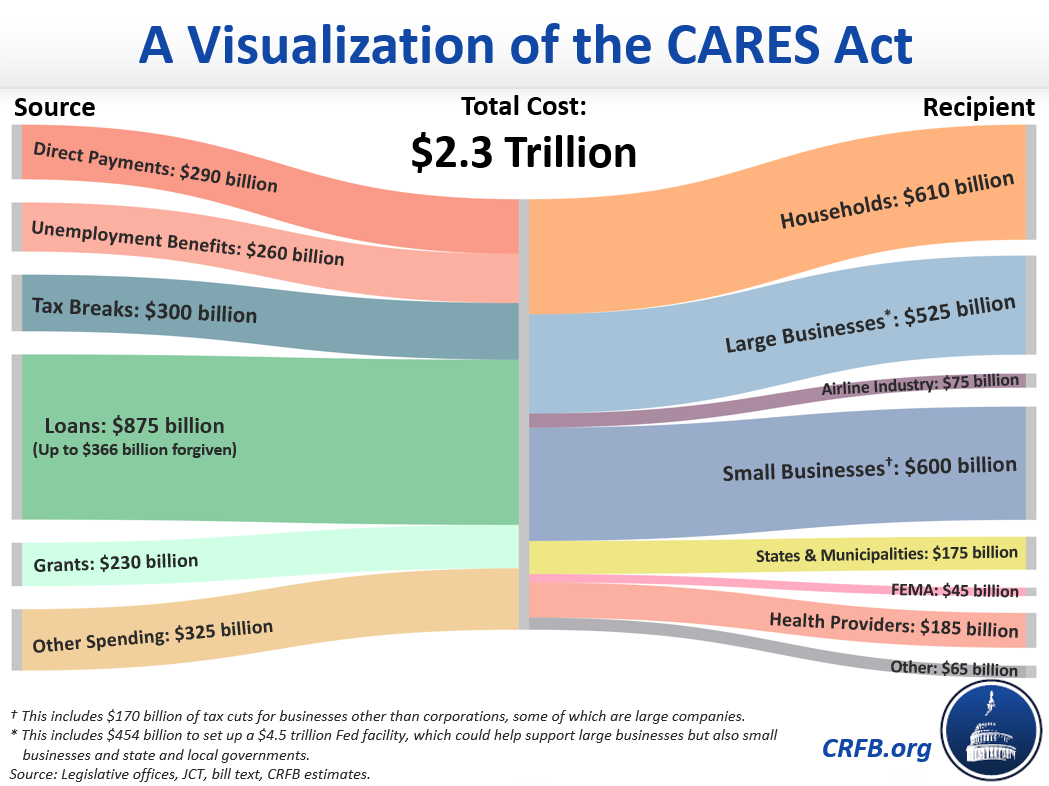
A Visualization of the CARES Act | Committee for a Responsible ...

Hospitals across the U.S. received their first payments in April from the $175 billion in relief aid Congress allocated to cover expenses or lost revenues tied to the COVID-19 pandemic. 

The first $50 billion in funding from the Coronavirus Aid, Relief and Economic Security Act was delivered to hospitals last month. HHS distributed $30 billion based on Medicare fee-for-service reimbursements and another $20 billion based on hospitals’ share of net patient revenue.

HHS released new data May 7, sharing where the $50 billion in funding went. The department provided a list of hospitals that received payments and agreed to the terms and conditions for receiving the relief aid as of May 4. As part of those terms, hospitals agreed not to balance bill COVID-19 patients and to submit documents showing the funds were used for expenses or lost revenue attributable to COVID-19.

Here are the 10 health systems that received the most funding: 

1. Dignity Health (San Francisco): $180.3 million

2. Cleveland Clinic: $103.3 million

3. Stanford Health Care (Palo Alto, Calif.): $102.4 million

4. Memorial Hermann Health System (Houston): $92.4 million

5. NYU Langone Hospitals (New York City): $92.1 million

6. The County of Los Angeles: $80.9 million (Los Angeles County operates four hospitals)

7. Hackensack (N.J.) Meridian Health: $76.8 million

8. Florida Cancer Specialists & Research Institute (Fort Myers): $67.3 million

9. Memorial Hospital for Cancer and Allied Diseases (New York City): $64 million

10. Massachusetts General Hospital (Boston): $58.1 million


Separately, major publicly traded hospital operators disclosed how much funding they received from the CARES Act. Each company received at least $195 million. 

1. HCA Healthcare (Nashville, Tenn.): $700 million

2. Tenet Healthcare (Dallas): $345 million

3. Community Health Systems (Brentwood, Tenn.): $245 million

4. Universal Health Services (King of Prussia, Pa.): $195 million


Coronavirus’ double whammy on vulnerable populations

https://www.axios.com/newsletters/axios-vitals-e6483366-26b3-4f34-99c1-f2b356e47b4a.html?utm_source=newsletter&utm_medium=email&utm_campaign=newsletter_axiosvitals&stream=top

The coronavirus' double whammy on minorities and low-income ...

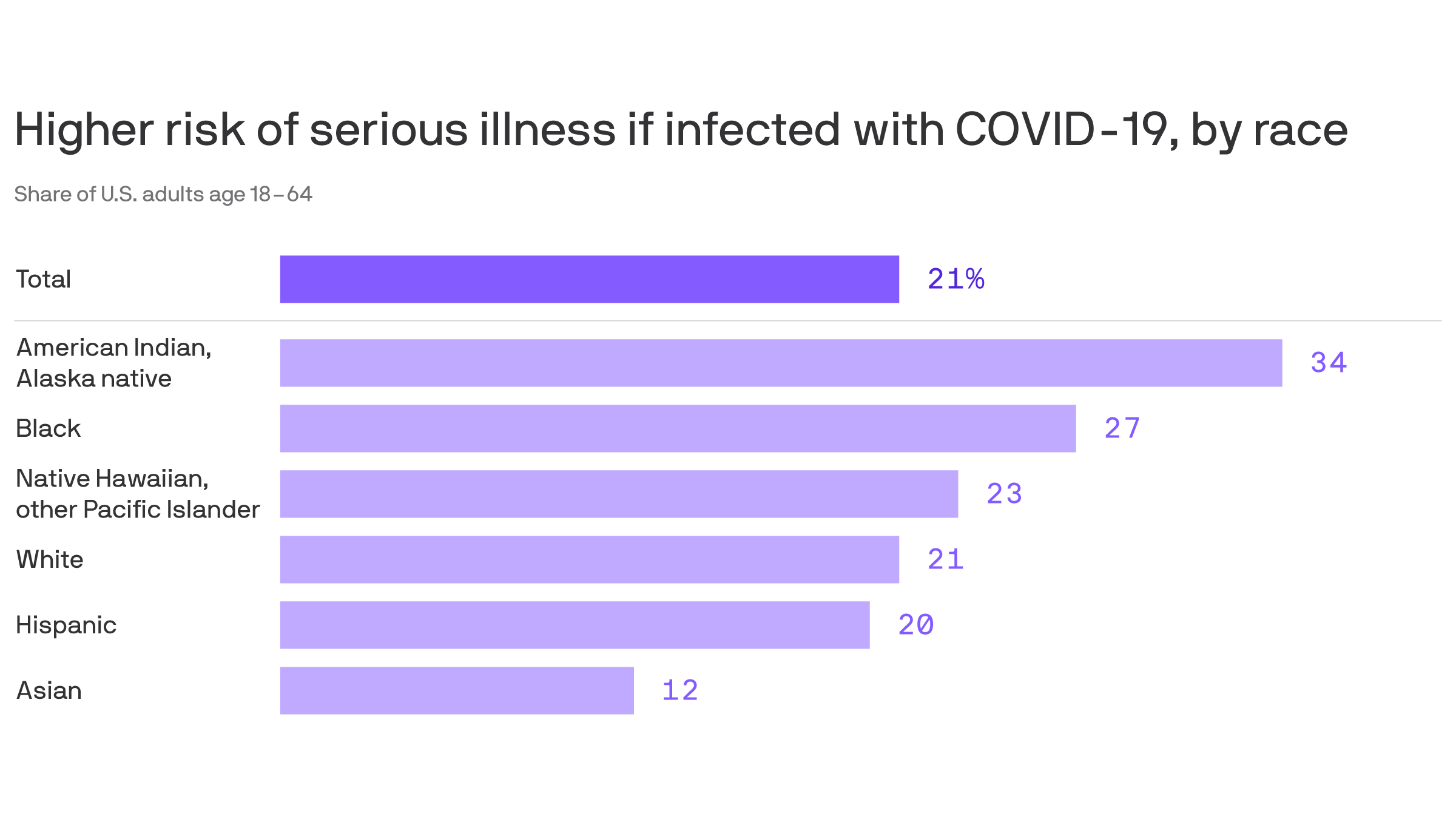
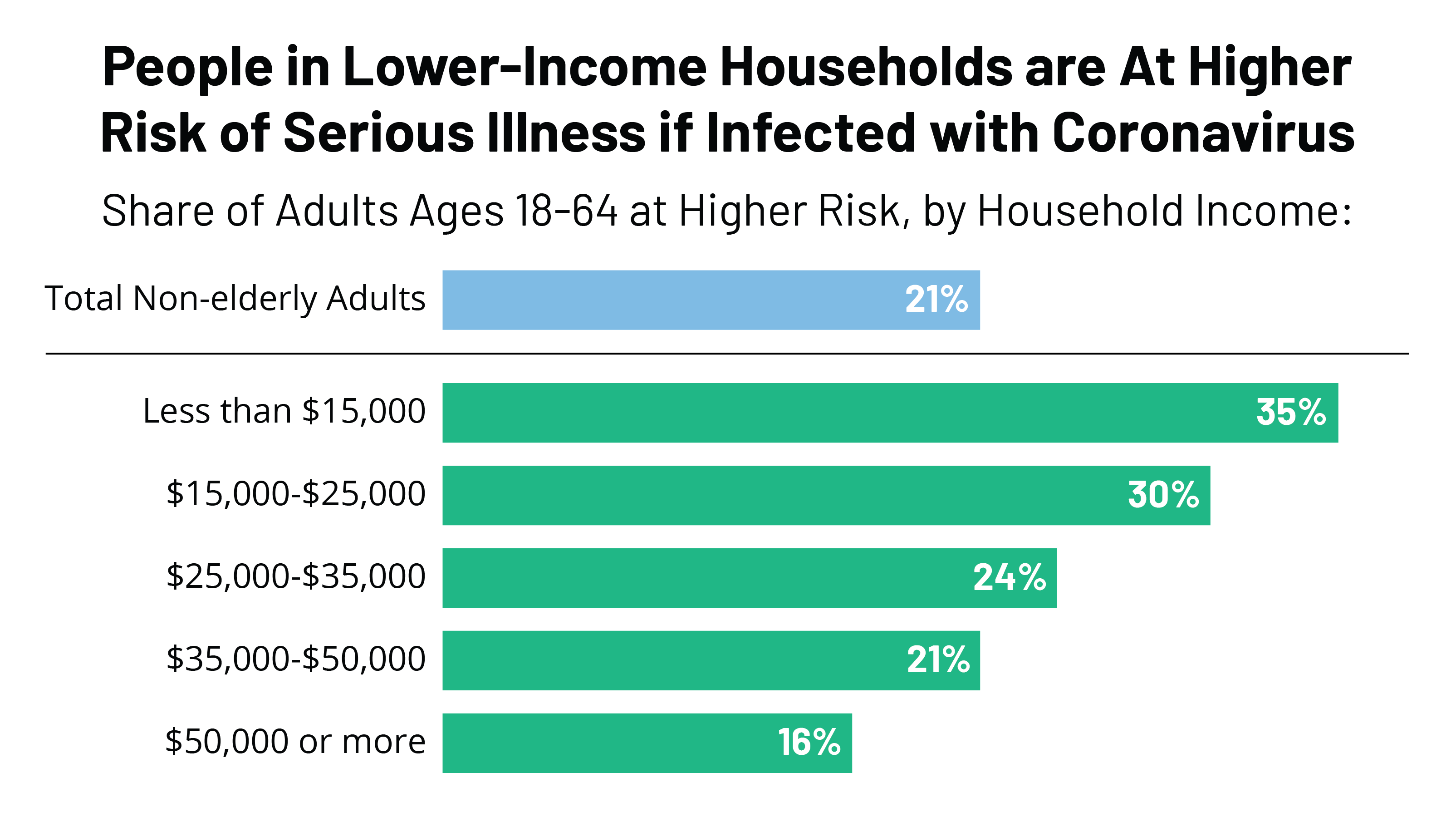
Minorities and low-income people are more likely to become seriously ill if infected with the coronavirus, according to a new Kaiser Family Foundation analysis.

Why it matters: These populations are also less likely to be able to social distance, or have been hit hardest economically by doing so. The coronavirus may be a national problem, but its impact is most devastating to the people who were already worse off.

Kaiser Family Foundation - Health Policy Research, Analysis ...


The big picture: Even before the virus hit, minorities suffered from worse health outcomes, in part because they’re more likely to be low-income — which is also correlated with higher rates of chronic conditions.

  • People with underlying health conditions — like heart disease, chronic obstructive pulmonary disease (COPD), uncontrolled asthma, diabetes or obesity — are more vulnerable to severe illness from the novel coronavirus.
  • Health care and socioeconomic disparities also exacerbate Native Americans’ and black Americans’ risk.
  • And “even though the shares of Hispanic and Native Hawaiian or Pacific Islander nonelderly adults at higher risk for serious illness if infected are similar to that of White adults, these groups face disparities in other health, social, and economic factors that may contribute to barriers to health care associated with coronavirus,” KFF adds.

Between the lines: People with low-income jobs deemed essential — like grocery store workers, home health aides or delivery drivers — are also at higher risk of contracting the virus.

  • Those in other low-income jobs, like in retail or restaurants, are more likely to be out of work right now or working fewer hours.
  • As the fight between businesses and workers heats up in states reopening sooner than public health experts advise, low-income workers have less of an option to quit if they feel unsafe.


States face economic death spiral from Coronavirus

https://www.axios.com/coronavirus-states-economy-295ac091-9dc2-4852-be67-d070ec268d8c.html

YEAR-OVER-YEAR CHANGE IN STATE TAX REVENUES

April 2020 vs. April 2019, select states

States face economic death spiral from coronavirus - Business Insider


Early numbers show how significantly the coronavirus is devastating states’ revenue streams — and could force choices between raising taxes or gutting services and laying off public employees.

Why it matters: Even as some states move toward reopening, the economic ramifications of having shut down will haunt them far into the future.

  • When states can reopen, and how quickly industries are able to bounce back, could either worsen or improve projections.

What to watch: Sens. Bob Menendez (D-N.J.) and Bill Cassidy (R-La.) plan to introduce bipartisan legislation as soon as next week that would create a $500 billion fund designed to help struggling state and municipality budgets in the wake of COVID-19.

  • “If there was another way to do this, I’d rather do it the other way,” Cassidy tells Axios. “But what I don’t want to happen is all this money spent for families and for employers to go to waste because cities cannot provide essential services.”
  • Menendez tells Axios: “This is the time to step up to the plate.”

By the numbers: The Urban Institute has been compiling lost revenue data as states make it publicly available. So far, there are figures for about one in four states that compare this April’s state income and sales tax revenue collections against those from April 2019.

  • The data shows collections dropping between 20% and more than 50%, depending on the state, senior researcher Lucy Dadayan tells Axios — and those figures could get worse as new data comes in.
  • South Dakota is an outlier in the states the Urban Institute has tracked so far, in that revenues actually appear up for April. That may be largely because it is one of very few states that did not issue a stay at home order. But experts expect to see revenue declines next month.
  • Although it has not yet released April sales tax numbers to enable a year-over-year comparison, California’s staggering tax revenue loss due to COVID-19 has led to an expected $54.3 billion budget shortfall through FY 2021 — including a $13.4 billion shortfall this fiscal year, the governor announced Thursday. That’s with a $21 billion surplus last year.
  • New York also has yet to release April tax revenue data, but its latest budget projection has the state short as much as $13.3 billion in FY 2021, according to Dadayan’s analysis of most recent state budget projections. Illinois is looking at a more than $4.6 billion shortfall for next fiscal year.
  • Arizona is projecting to be short more than half a billion dollars for this fiscal year.
  • The projected shortfalls for FY 2020, which ends at the end of June for most states, is arguably a bigger problem because there isn’t much time left to make changes, per Axios’ Dan Primack.

The big picture: Democratic-leaning cities have seen the highest case and death rates. But red and blue states alike are facing serious budget shortfalls.

  • That’s why some Republican senators are getting behind efforts to provide federal dollars to help states balance budgets.
  • Even after accounting for state emergency savings accounts — which in many states were at an all-time high — 33 states will likely need to fill budget gaps of 5% or more, according to a recent analysis by Moody’s Analytics.
  • 21 states would need to fill gaps of 10% or more.
  • “Anybody is going to be overwhelmed by this — even states who were well prepared,” Dan White, director of government consulting and fiscal policy research at Moody’s Analytics, tells Axios.

Between the lines: Much of the burden will likely be pushed on struggling local governments’ plates, White said.

  • Cities have also lost smaller revenue sources such as hotel occupancy fees, inspection fees and construction fees.
  • Some could be forced to lay off public workers needed to combat the virus and keep the public safe — such as firefighters, paramedics, public hospital workers.
  • It’s either that or raise taxes in the midst of high unemployment and financial insecurity. “That’s the death spiral,” said Menendez, who has been talking with mayors across his state.
  • New York City Mayor Bill de Blasio has already said he may have to start furloughing municipal employees if the city doesn’t receive federal funds to help fill budget gaps.

Some state and local governments will wait to make tough budget decisions in the hopes that they get needed funds from Congress, which is in heated negotiations around the fourth stimulus package.

Republican lawmakers have been hesitant to provide this much federal help to states, but they’ve been warming to the idea.

  • Menendez says he expects several Republican senators besides Cassidy to sign on to their proposal.


Bankrupt hospitals sue feds

https://www.axios.com/newsletters/axios-vitals-e6483366-26b3-4f34-99c1-f2b356e47b4a.html?utm_source=newsletter&utm_medium=email&utm_campaign=newsletter_axiosvitals&stream=top

Stifel CEO: Hospitals Will Go Bankrupt in Overlooked Threat

Small hospitals going through bankruptcy are suing the Small Business Administration, arguing it is unlawful for the federal government to deny them loans under the Paycheck Protection Program, Axios’ Bob Herman reports.

Why it matters: Allowing bankrupt hospitals access to PPP loans could keep their doors open, and could force the federal government to reverse its stance and allow other bankrupt firms to get PPP loans.

Driving the news: Faith Community Health System, a small rural hospital in Texas that filed for bankruptcy in February, sued the SBA Thursday.

  • The hospital wants to apply for a $2.4 million PPP loan to pay staff and remain open while it goes through bankruptcy and handles the coronavirus pandemic.
  • However, the SBA says bankrupt companies will not be approved for the bailout money because of their “high risk.”
  • Faith Community argues the government agency doesn’t have the authority to exclude bankrupt firms from PPP funding because the law doesn’t spell out those eligibility requirements.

The big picture: Courts are starting to take hospitals’ side.

  • A bankruptcy judge in Maine said the funding was a “grant of aid necessitated by a public health crisis,” and that two hospitals that sued the federal government are entitled to PPP loans.
  • A separate bankrupt hospital in Vermont also should be eligible for PPP funds, a judge ruled this week.

The bottom line: Rural hospitals have been in dire straits for years, and for those that are on the precipice of or are going through bankruptcy, they may be eligible for this bailout funding despite SBA exclusions.


The New Culture War

American Identity Is The New Culture War - Auburn Seminary

You’re either a liberal snowflake controlled by big government or a greedy conservative willing to sacrifice Grandma for the economy. It took less than two months for Americans to get here.

Wear a mask? You’re a liberal snowflake controlled by big government. Want to reopen restaurants? You’re a greedy conservative willing to sacrifice Grandma for the economy.

It took less than two months for the coronavirus pandemic to become just the latest battle in the culture wars.

With the country still in the firm grip of the coronavirus pandemic, conservatives are on social media and Fox News stoking protests that argue masks, stay-at-home orders and social distancing violate constitutional rights and are causing unacceptable harm to the economy.

Liberals, at the same time, say personal liberties must be sacrificed for public health, even as millions file for unemployment and more than a quarter of the work force is jobless in some states.

Take a look at what two governors — one from a reliably Republican state and another from a reliably Democratic state — said this week.

“We have a public health crisis in this country, there’s no doubt about it,” Gov. Tate Reeves of Mississippi said in an appearance on “Fox News Sunday.” “But we also have an economic crisis.”

“We have turned the corner and we are on the decline,” Gov. Andrew M. Cuomo said, citing an article showing that the death rate has fallen by half in New York City, in his daily briefing on Wednesday. “To me, that vindicates what we are doing here in New York, which says: Follow the science, follow the data, put the politics aside and the emotion aside. What we’re doing here shows results.”

The problem with all these politics? Epidemiology.

So far, the virus has hit Democratic states the hardest, with the most cases per capita in five deeply Democratic states — New York, New Jersey, Massachusetts, California and Illinois. Cities have borne the brunt of the caseload. And African-Americans and Latinos — a key part of the Democratic coalition — are getting sick and dying of the virus at higher rates.

But anyone who believes this virus is fading away — or somehow contained to urban areas — is engaging in some serious magical thinking.

At least 25,000 new coronavirus cases are identified almost daily, meaning that the total in the United States — which has the highest number of known cases in the world — is expanding daily by 2 to 4 percent.

New York Times analysis found that 18 of the states that are reopening had an increase of daily average cases over the last two weeks. Fifteen of those states are led by Republican governors.

Three of the top five states where the virus is spreading the fastest — Texas, Georgia and Ohio — have Republican governors and Republican-controlled legislatures. All three have moved toward reopening.

In the Midwest and South, smaller towns and more rural areas have suddenly been hit hard as the virus tears through nursing homes, meatpacking plants and prisons.

The nation’s highest per capita infection rate can be found in Trousdale County, Tenn., a rural county where a prison has become a hot spot. Businesses in the county are reopening this week.

In the Trump era, rural counties like Trousdale have represented the backbone of the Republican base. In Trousdale, nearly 67 percent of the county supported President Trump in 2016. Over all, the average margin of victory in rural counties won by Republicans was nearly 47 percent in 2016.

Rural areas tend to be older and have a larger share of the population with pre-existing medical conditions, making them far more vulnerable to the worst health effects of the virus.

Republican governors and conservative activists may think the coronavirus is an urban problem. Or a density problem. Or, quite frankly, a Democratic problem.

They may soon find out that it’s not.


Reopening the U.S. Economy

https://www.goldmansachs.com/insights/pages/reopening-the-us-economy.html

Click to access report.pdf

Allison Nathan, senior strategist for Goldman Sachs Research, discusses her latest Top of Mind report where she speaks with leading experts across health and policy to understand how well-positioned the U.S. is to achieve a safe reopening of the economy and how quickly it would translate into economic recovery. 

With COVID-19 mitigation measures leading to an apparent leveling off of case
growth globally at the same time that the economic costs of such measures continue
to mount, several countries around the world have begun to plan for—or have
already started to implement—economic reopening. But absent herd immunity or
a vaccine for the virus, such reopenings increase the risk of disease resurgence.
With this in mind, what a safe reopening might look like, how well-positioned the
US is to achieve one and how quickly reopening would really translate into economic
recovery is Top of Mind. We consult three experts on these questions: University of
Pennsylvania’s Dr. Zeke Emanuel, Duke University’s Dr. Mark McClellan and Harvard
University’s Dr. Barry Bloom. And we share our own take on a potential US recovery path, informed by lessons from
China’s reopening experience so far. Finally, with more complete economic normalization only likely with an effective
testing regime, treatments, or a widely available vaccine for COVID-19-we discuss where we are on all of the above.


The White House said it was following health experts’ advice. Then we learned it isn’t approving a key CDC document.

https://www.washingtonpost.com/politics/2020/05/07/white-house-said-it-was-following-health-experts-advice-then-we-learned-it-isnt-approving-key-cdc-document/?fbclid=IwAR1TRmiDX4IF5WgkAEVT0BeV0qnYxHCZhF1YwfWrmM79FmS6UOivaFbNBA4&utm_campaign=wp_main&utm_medium=social&utm_source=facebook

Diseases & Conditions | CDC

White House press secretary Kayleigh McEnany made a point at the start of Wednesday’s news briefing to emphasize that President Trump is following health experts’ advice as we enter what Trump has labeled the “next stage” of the coronavirus response — reopening the economy.

“As you are well aware, President Trump has consistently sided with the experts and always prioritized the health and safety of the American people,” McEnany said.

Several hours later, we got another example of the White House resisting what those health experts are advising.

The Associated Press reported around midnight that the White House had shelved planned guidelines from the Centers for Disease Control and Prevention. The document, which was due nearly a week ago, was aimed at providing local authorities with step-by-step guidance on how to reopen:

The 17-page report by a Centers for Disease Control and Prevention team, titled “Guidance for Implementing the Opening Up America Again Framework,” was researched and written to help faith leaders, business owners, educators and state and local officials as they begin to reopen.
It was supposed to be published last Friday, but agency scientists were told the guidance “would never see the light of day,” according to a CDC official. The official was not authorized to talk to reporters and spoke to The Associated Press on the condition of anonymity.

A coronavirus task force official told The Washington Post that the document has not been completely shelved but was in the process of being revised because it was “overly specific.” The official also indicated that it was felt the document was too broad, as “guidance in rural Tennessee shouldn’t be the same guidance for urban New York City.”

The denial, though, reinforces that the White House is reluctant to submit to the CDC’s more detailed prescriptions for reopening the economy. And it’s difficult to divorce the delay in this document’s publication from Trump’s anxiety to reopen the economy — and the tension that has created with past guidelines.

The administration in mid-April issued phased advice on when areas should start to reopen places such as restaurants and other nonessential businesses. But many states have moved forward with certain elements of reopening without actually satisfying those guidelines. Most notably, they have begun to reopen without meeting the Phase One guideline that they should see a decrease in confirmed coronavirus cases over a 14-day period.

As The Post’s Philip Bump reported, some states that have pushed forward with reopening have also seen an increase in cases — which would prevent them from satisfying the requirement for moving into Phase Two. That requirement is that the decline should continue for another 14 days after Phase One begins.

Issuing a detailed document would seemingly complicate further reopenings, because it would again restrict what states and local authorities are supposed to do.

The Washington Post’s Lena H. Sun and Josh Dawsey previewed what the document was set to look like last week. And they also obtained a draft of the document. The new guidelines were to go beyond the initial ones in prescribing specific actions that could be taken in each phase of the reopening. Advocates for reopening have worried that strict guidance could make it difficult for businesses, churches, child-care centers and other facilities to actually function.

Trump, who has long signaled a desire to begin reopening that economy sooner rather than later, has doubled down on that rhetoric in recent days. Despite a steady national death rate that approached previous highs on Tuesday and Wednesday, and even though cases continue to increase outside the major U.S. hotbed of New York City, Trump on Tuesday signaled that we are entering the “next stage” of reopening the economy.

“Thanks to the profound commitment of our citizens, we’ve flattened the curve, and countless American lives have been saved,” Trump said. “Our country is now in the next stage of the battle: a very safe phased and gradual reopening. So, reopening of our country — who would have ever thought we were going to be saying that? A reopening. Reopening.”

Trump has been resistant to the advice of the health officials around him, from the early days of the outbreak when he continuously downplayed the severity of the situation. On several occasions, this tension has boiled over.

We’re also hearing from those officials less and less. The CDC long ago ceased holding briefings on the coronavirus outbreak, and the White House coronavirus task force briefings, which often featured health experts Anthony S. Fauci and Deborah Birx, have now been halted in favor of less-frequent and less-coronavirus-focused briefings from McEnany. Fauci has also been prevented from testifying to the Democratic-controlled House, although he is still slated to testify in the GOP-controlled Senate and has continued doing some interviews. The cumulative effect is that these health experts aren’t on the record as much as the effort to reopen the economy begins in earnest.

In the place of those public comments, the CDC guidelines were to provide firm and detailed advice from those officials for the new stage. But for reasons that seem pretty conspicuous, we still don’t have them.


Trump will urge Supreme Court to strike down Obamacare

https://www.politico.com/news/2020/05/06/trump-supreme-court-obamacare-240366?utm_source=The+Fiscal+Times&utm_campaign=f343554e9c-EMAIL_CAMPAIGN_2020_05_06_09_42&utm_medium=email&utm_term=0_714147a9cf-f343554e9c-390702969

Trump will urge Supreme Court to strike down Obamacare - YouTube

Attorney General Bill Barr had urged the White House to soften its attack on the law during the pandemic.

President Donald Trump on Wednesday said his administration will urge the Supreme Court to overturn Obamacare, maintaining its all-out legal assault on the health care law amid a pandemic that will drive millions of more Americans to depend on its coverage.

The administration appears to be doubling down on its legal strategy, even after Attorney General William Barr this week warned top Trump officials about the political ramifications of undermining the health care safety net during the coronavirus emergency.

Democrats two years ago took back the House of Representatives and statehouses across the country by promising to defend Obamacare, in particular its insurance protections that prevent sick people from being denied coverage or charged more because of a health condition. The issue may prove to be even more salient in November amid the Covid-19 outbreak that health experts believe will persist through the fall.

The Justice Department had a Wednesday deadline to change its position in a case brought by Republican-led states, but Trump told reporters Wednesday afternoon his administration would stand firm. DOJ declined to comment.

“Obamacare is a disaster, but we’ve made it barely acceptable,” Trump said.

The Supreme Court later this fall will hear a lawsuit from the GOP-led states that argue the Affordable Care Act was rendered invalid after Congress eliminated its tax penalty for not having health insurance. A coalition of Democratic state attorneys general and the Democratic-led House of Representatives are defending the law in court.

The Trump administration had previously shifted its legal position in this case, but appears to have decided against doing so again. DOJ originally argued the courts should throw out just Obamacare’s preexisting condition protections, before last year urging that the entire law be struck down.

The Supreme Court is expected to hear the case during its next term starting in October, but it hasn’t scheduled arguments yet. A decision is unlikely before the Nov. 3 election. The court has previously upheld Obamacare in two major challenges that threatened the law’s survival.

About 20 million people have been covered by Obamacare, and the law is expected to provide a major safety net during the economic freefall brought on by the coronavirus. Millions more are expected to join the Medicaid rolls, especially in states that joined Obamacare’s expansion to poor adults. Others who lost workplace health insurance can sign up on the law’s health insurance marketplaces, though the Trump administration isn’t doing much to advertise coverage options.

House Democrats in a filing to the Supreme Court on Wednesday said the pandemic showcased why justices should preserve the law.

“Although Congress may not have enacted the ACA with the specific purpose of combatting a pandemic, the nation’s current public-health emergency has made it impossible to deny that broad access to affordable health care is not just a life-or death matter for millions of Americans, but an indispensable precondition to the social intercourse on which our security, welfare, and liberty ultimately depend,” their brief read.

Obamacare has grown more popular since the GOP’s failed repeal bid during Trump’s first year in office, though the law is still broadly disliked by Republicans. Many Democrats are eager to again run on their defense of Obamacare this fall. That includes presumptive presidential nominee Joe Biden, who has advocated for building on the health care law rather than pursuing a comprehensive progressive overhaul like “Medicare for All.”

Top Trump officials have long been split on the legal strategy in the Obamacare lawsuit. Barr and Alex Azar, the Health and Human Services secretary, both opposed a broader attack on the law, but White House officials have been more supportive, seeing it as a chance to fulfill Trump’s pledge to repeal Obamacare. Barr, in a Monday meeting with Vice President Mike Pence and other White House officials, made an eleventh-hour plea for the administration to soften its legal stance ahead of the Supreme Court’s briefing deadline.