Beaufort (S.C.) Memorial Hospital has created a homebuyer assistance program to help staff purchase a home or refinance mortgages, with up to $10,000 in assistance.
To be eligible for the program, employees must be full time, have worked at the hospital for at least six months, attend a homebuyer education workshop and meet household income requirements, among other criteria, according to a Jan. 10 news release from the hospital.
Additionally, properties must be within a 15-mile radius of a designated Beaufort Memorial campus, be the buyer’s primary residence and have monthly mortgage payments of no more than 33 percent of monthly income.
Recipients can use the funds for down payments and closing costs, the release said.
The hospital is partnering with development financial institution CommunityWorks for the program.
“We know that homeownership provides stability, security and a means to building financial health and wealth for future generations,” Beaufort Memorial President and CEO Russell Baxley said. “We also recognize that a major obstacle can be coming up with the money needed for a down payment or closing costs. This assistance program will help our employees bridge that financial gap.”
A top Medicare advisory board did not recommend any new payment hikes for acute care hospitals or doctors for 2023, stating that targeted relief funding has helped blunt the impact of the COVID-19 pandemic.
The Medicare Payment Advisory Commission (MedPAC), which makes recommendations to Congress and the federal government on Medicare issues, voted on the payment changes to Congress during its Thursday meeting. The panel decided against recommending any pay hikes.
The commission unanimously voted to update 2023 rates for acute care hospitals by the amounts determined under current law. The Centers for Medicare & Medicaid Services will publish its update to the current law payment rates this summer.
MedPAC estimated that the rates will increase 2% and that there would be 3.1% growth in hospital wages and benefits, but these “may be higher or lower by the time this is finalized,” said MedPAC staff member Alison Binkowski.
She added there will be another estimated 0.5% increase in inpatient rates.
MedPAC decided not to recommend any pay rates beyond current law after looking at the financial picture for hospitals and found the indicators of payment adequacy are generally positive.
“Hospitals maintained strong access to capital thanks to substantial federal support, including targeted federal relief funds to rural hospitals which raised their all-payer total margin to a near-record total high,” Binkowski said.
She added fewer hospitals closed, and facilities continued to have positive marginal Medicare profits.
It was also difficult to interpret changes in quality that traditionally would determine whether a payment boost would be needed.
“For example, mortality rates increased in 2020, but this reflects the tragic effects of the pandemic on the elderly rather than a change in the quality of care provided to Medicare beneficiaries or the adequacy of Medicare payments,” Binkowski said.
Even though commission members agreed with the recommendation for hospitals, they were concerned whether it was enough to help facilities meet drastic increases in labor expenses.
“With labor, it is more than just a salary increase these hospitals are seeing,” said commission member Brian DeBusk.
He noted that hospitals haven’t just seen an increase in rates for contract or temporary nurses, but in nursing education as well.
MedPAC also recommended no changes to the statutory payment update for dialysis facilities and shouldn’t give a payment update to ambulatory surgery centers (ASCs) due to confidence in payment adequacy for the facilities.
“Despite the public health emergency, the number of ASCs increased by 2% in 2020,” said MedPAC staff member Daniel Zabinski. “The growth that we saw in the number of ASCs also suggests access to capital remains adequate.”
Physician fee schedule recommendation
The commission decided to take a similar estimate with the physician fee schedule, calling for any update to be tied to current law, which is estimated to have no change in spending.
Medicare payments to clinicians declined by $9 billion in 2020 but were offset thanks to congressional relief funds. Physicians also got a 4% bump to payments through 2022 compared to prior law.
The temporary rate hike is expected to go away at the start of 2023, but physician groups are likely to lobby Congress to keep the pay bump intact.
Physician groups already blasted the recommendation from MedPAC.
Anders Gilberg, senior vice president of government affairs for the Medical Group Management Association, tweeted that the recommendation was out of touch, especially after new reports of inflation.
“Hard to conceive of a more misguided recommendation to Congress at a time when practices face massive staffing shortages and skyrocketing expenses,” he tweeted.
Health systems that employed fewer primary care physicians, have higher bed counts or are investor owned were more likely to provide more unnecessary or low-value care, a study published Jan. 14 in JAMAfound.
For the study, researchers from Baltimore-based Johns Hopkins University analyzed Medicare claims data at 3,745 hospitals for 17 low-value services. The low-value services were previously identified as unnecessary and included services such as pap smears for women older than 65, an abdominal CT scan with and without contrast and spinal fusions for back pain, according to the study.
The researchers then rated the hospitals using an overuse index, which was based on the Medicare claims for the low-value healthcare services. Health systems rated at least 1.5 standard deviations or more above the average in the overuse index were considered over-users of low-value services.
Below is a breakdown of the 20 hospitals that provided the most unnecessary care based on the overuse index.
1. St. Dominic Health Services (Jackson, Miss.)
2. USMD Health System (Irving, Texas)
3. Community Medical Centers (Clovis, Calif.)
4. Care New England Health System (Providence, R.I.)
5. East Alabama Medical Center (Opelika)
6. Pocono Health System (East Stroudsburg, Pa.)
7. University Health Care System (Augusta, Ga.)
8. Deaconess Health System (Evansville, Ind.)
9. Congregation of the Sisters of St Joseph of Peace (Englewood Cliffs, N.J.)
10. Iredell Health System (Statesville, N.C.)
11. Sacred Heart HealthCare System (Allentown, Pa.)
12. Southeast Health (Dothan, Ala.)
13. Chesapeake (Va.) Regional Medical Center
14. Butler (Pa.) Health System
15. CarolinaEast Health System (New Bern, N.C.)
16. Ohio Valley Health Services and Education Corp. (Wheeling, W.Va.)
17. Slidell (La.) Memorial Hospital
18. Lakeland (Fla.) Regional Health System
19. North Kansas City (Mo.) Hospital
20. Temple University Health System (Philadelphia)
We’ve been having “year ahead” discussions with our health system members over the past few weeks, although it’s been difficult for some to carve out time for planning in the midst of the Omicron surge.
One common theme is that, from a financial perspective, 2022 is expected to be a more difficult year. For many systems, despite the trying COVID situation, the past two years have been financial record-setters. In 2020, systems benefited from a massive infusion of COVID relief funding from the government, and in 2021, they continued to enjoy enhanced reimbursement due to COVID, plus had a resurgence of volume as patients sought care that was previously postponed.
2022 looks to be a more “normal” year—meaning a return to the financial pressures of pre-pandemic times. Those include mounting price compression from payers, an accelerating shift of care from inpatient to outpatient settings, and increasing competition for patients from disruptors and others. At the same time, patient acuity will continue to rise, with patients presenting sicker and with more comorbidities. The cost of caring for those patients will escalate, as the workforce shortage drives labor costs higher and supply chain woes persist.
We’d anticipate a year or more of belt-tightening among many health systems, as they adjust to the post-pandemic environment.
As COVID hospitalizations surge to new highs, healthcare workers have become the rate-limiting factor for most hospitals’ ability to deliver care. Using self-reported data collected by the Department of Health and Human Services, the graphic above shows that hospital staffing concerns reached an all-time high this month, with nearly one in three hospitals reporting a critical shortage. (Anecdotal evidence from our conversations with hospital leaders suggests that the actual number in crisis may be even higher, with every system we’ve spoken to in the past month reporting severe staffing challenges.)
During previous surges, COVID hospitalizations and reported staffing shortages have ebbed and flowed together. However, staffing challenges and case numbers became decoupled during the Delta surge, as the percentage of hospitals reporting staffing shortages did not go down as the Delta wave subsided.
With a growing number of nurses and other staff choosing early retirement or looking for jobs in other sectors, health systems are navigating the Omicron spike with a smaller pool of workers. And now the high transmissibility of the Omicron variant is forcinghealthcare workers to quarantine in droves.
As shown on the map, this is playing out both in highly vaccinated states like Vermont and California, and less-vaccinated places like West Virginia and Wyoming. That’s leading some state health officials and health systems to allow COVID-positive staff who are asymptomatic or experiencing mild symptoms to continue working—a policy which is being sharply criticized by nurses.
While the end of the Omicron surge should bring some relief, longer-term staffing challenges will surely remain for most health systems.
Some pundits claim that current reporting on COVID hospital admissions is overly pessimistic, failing to account for a distinction between patients admitted explicitly “for COVID”, and those admitted for other reasons who also, incidentally, have COVID. The latter now comprise up to half of some health systems’ COVID patients.
In an article in The Atlantic this week, reporter Ed Yong rejects this dichotomy, on the grounds that it ignores both the significant number of people for whom COVID exacerbates underlying chronic conditions, as well as the challenges any patient with COVID poses to hospitals. As he points out, those patients still require isolation and special safety measures, further worsening the burden on an already-strained staff.
The Gist: For hospitals, dealing with endemic COVID will mean establishing strategies to manage COVID-positive patients without postponing much needed non-emergency care, and without overly taxing a stretched workforce. Downplaying the burden of “incidental COVID” is not helpful, but sustaining operations while on perpetual crisis footing will prove untenable.
Every hospital in America has been affected by the growing shortage of nursing talent as the pandemic persists. This week a health system chief operating officer shared her greatest concern about the future of the nursing workforce: “We’re under immense pressure to find any nurses we can to keep units and operating rooms open. But if I think about the long-term impact, what I am most worried about is losing our most experienced nurses en masse.”
The average age of a nurse is 52, and 19 percent of nurses are over 65. Health systems have been facing a wave of retirements of Baby Boomer nurses, and the stresses of the pandemic, both in the workplace and at home, have dramatically accelerated the rate of tenured nurses leaving the profession, taking their well-honed clinical acumen with them.
“We’re looking at ways to increase the nursing pipeline, but you can’t replace a nurse with decades of experience one-to-one with someone just out of school, and expect the same level of clinical management, particularly for complex patients,” our COO colleague shared.
In the near term, her system is looking at two sets of strategies to maintain the nursing “brain trust”.
First, they hope to retain tenured nurses with job flexibility: “We’re not just losing nurses to retirement, we’re losing them to Siemens and Aetna—not because they are excited about that work, but because they don’t want to work a 12-hour shift. We have to be better about creating part-time, flexible schedules.”
Second, they are piloting telenursing and decision-support solutions to provide guidance and a second set of eyes for new nurses. These tools have also helped in new nurse recruitment. We’d predict the workforce crisis will persist far beyond the pandemic, and require rethinking of training, process automation, and the boundaries of practice license. But in the near-term, retaining and upskilling the talent we have is essential to maintaining access and quality.
The incredibly contagious new coronavirus variant is sidelining healthcare workers with breakthrough infections and quarantines, as patients flood into hospitals across the country. While hospitals are reporting that most infected patients are less sick, the sheer number of patients is pushing an already stressed system into crisis.
The Gist: Given mounting evidence that Omicron is both causing less severe disease and evading vaccines, health systems will need tobalance employee COVID testing and quarantine protocols against the constraints caused by mounting numbers of otherwise asymptomatic care workers out sick. As COVID becomes endemic, health systems must find a way to normalize operations even as they manage employee infections. It won’t be sustainable to continually revert to canceling non-emergent procedures (many of which carry clinical consequences to patients if they are delayed) and shifting to crisis standards of care.
While Omicron’s rapid spread is causing COVID hospitalizations to surge once again, the impact on consumer confidence may be different this time around. Drawing on the most recent data from analytics firm Strata Decision Technology, the graphic above shows how hospital volumes have fluctuated throughout the pandemic. Hospital volumes mostly returned to pre-COVID levels early last summer, until the Delta surge caused patients to begin avoiding care across all settings once again.
It remains to be seen if the forty percent of consumers who said they were less likely to seek non-emergency care during the Delta surge feel similarly about the Omicron spike. So far, consumer sentiment seems to be holding steady at last summer’s levels, though we’re still a few weeks away from Omicron’s expected peak.
As the pandemic enters its third year, it’s also likely that consumers who have been delaying care will simply be unwilling or unable to hold off any longer. But even if Omicron doesn’t dissuade consumers from seeking non-COVID care, health systems will be hard pressed to accommodate both COVID and non-COVID care amid worrisome staffing shortages.
Hospitals across the U.S. are feeling the wrath of the omicron variant and getting thrown into disarray that is different from earlier COVID-19 surges.
This time, they are dealing with serious staff shortages because so many health care workers are getting sick with the fast-spreading variant. People are showing up at emergency rooms in large numbers in hopes of getting tested for COVID-19, putting more strain on the system. And a surprising share of patients — two-thirds in some places — are testing positive while in the hospital for other reasons.
At the same time, hospitals say the patients aren’t as sick as those who came in during the last surge. Intensive care units aren’t as full, and ventilators aren’t needed as much as they were before.
The pressures are nevertheless prompting hospitals to scale back non-emergency surgeries and close wards, while National Guard troops have been sent in in several states to help at medical centers and testing sites.
Nearly two years into the pandemic, frustration and exhaustion are running high among health care workers.
“This is getting very tiring, and I’m being very polite in saying that,” said Dr. Robert Glasgow of University of Utah Health, which has hundreds of workers out sick or in isolation.
About 85,000 Americans are in the hospital with COVID-19, just short of the delta-surge peak of about 94,000 in early September, according to the Centers for Disease Control and Prevention. The all-time high during the pandemic was about 125,000 in January of last year.
But the hospitalization numbers do not tell the whole story. Some cases in the official count involve COVID-19 infections that weren’t what put the patients in the hospital in the first place.
Dr. Fritz François, chief of hospital operations at NYU Langone Health in New York City, said about 65% of patients admitted to that system with COVID-19 recently were primarily hospitalized for something else and were incidentally found to have the virus.
At two large Seattle hospitals over the past two weeks, three-quarters of the 64 patients testing positive for the coronavirus were admitted with a primary diagnosis other than COVID-19.
Joanne Spetz, associate director of research at the Healthforce Center at the University of California, San Francisco, said the rising number of cases like that is both good and bad.
The lack of symptoms shows vaccines, boosters and natural immunity from prior infections are working, she said. The bad news is that the numbers mean the coronavirus is spreading rapidly, and some percentage of those people will wind up needing hospitalization.
This week, 36% of California hospitals reported critical staffing shortages. And 40% are expecting such shortages.
Some hospitals are reporting as much as one quarter of their staff out for virus-related reasons, said Kiyomi Burchill, the California Hospital Association’s vice president for policy and leader on pandemic matters.
In response, hospitals are turning to temporary staffing agencies or transferring patients out.
University of Utah Health plans to keep more than 50 beds open because it doesn’t have enough nurses. It is also rescheduling surgeries that aren’t urgent. In Florida, a hospital temporarily closed its maternity ward because of staff shortages.
In Alabama, where most of the population is unvaccinated, UAB Health in Birmingham put out an urgent request for people to go elsewhere for COVID-19 tests or minor symptoms and stay home for all but true emergencies. Treatment rooms were so crowded that some patients had to be evaluated in hallways and closets.
As of Monday, New York state had just over 10,000 people in the hospital with COVID-19, including 5,500 in New York City. That’s the most in either the city or state since the disastrous spring of 2020.
New York City hospital officials, though, reported that things haven’t become dire. Generally, the patients aren’t as sick as they were back then. Of the patients hospitalized in New York City, around 600 were in ICU beds.
“We’re not even halfway to what we were in April 2020,” said Dr. David Battinelli, the physician-in-chief for Northwell Health, New York state’s largest hospital system.
Similarly, in Washington state, the number of COVID-19-infected people on ventilators increased over the past two weeks, but the share of patients needing such equipment dropped.
In South Carolina, which is seeing unprecedented numbers of new cases and a sharp rise in hospitalizations, Gov. Henry McMaster took note of the seemingly less-serious variant and said: “There’s no need to panic. Be calm. Be happy.”
Amid the omicron-triggered surge in demand for COVID-19 testing across the U.S., New York City’s Fire Department is asking people not to call for ambulance just because they are having trouble finding a test.
In Ohio, Gov. Mike DeWine announced new or expanded testing sites in nine cities to steer test-seekers away from ERs. About 300 National Guard members are being sent to help out at those centers.
In Connecticut, many ER patients are in beds in hallways, and nurses are often working double shifts because of staffing shortages, said Sherri Dayton, a nurse at the Backus Plainfield Emergency Care Center. Many emergency rooms have hours-long waiting times, she said.
“We are drowning. We are exhausted,” Dayton said.
Doctors and nurses are complaining about burnout and a sense their neighbors are no longer treating the pandemic as a crisis, despite day after day of record COVID-19 cases.
“In the past, we didn’t have the vaccine, so it was us all hands together, all the support. But that support has kind of dwindled from the community, and people seem to be moving on without us,” said Rachel Chamberlin, a nurse at New Hampshire’s Dartmouth-Hitchcock Medical Center.
Edward Merrens, chief clinical officer at Dartmouth-Hitchcock Health, said more than 85% of the hospitalized COVID-19 patients were unvaccinated.
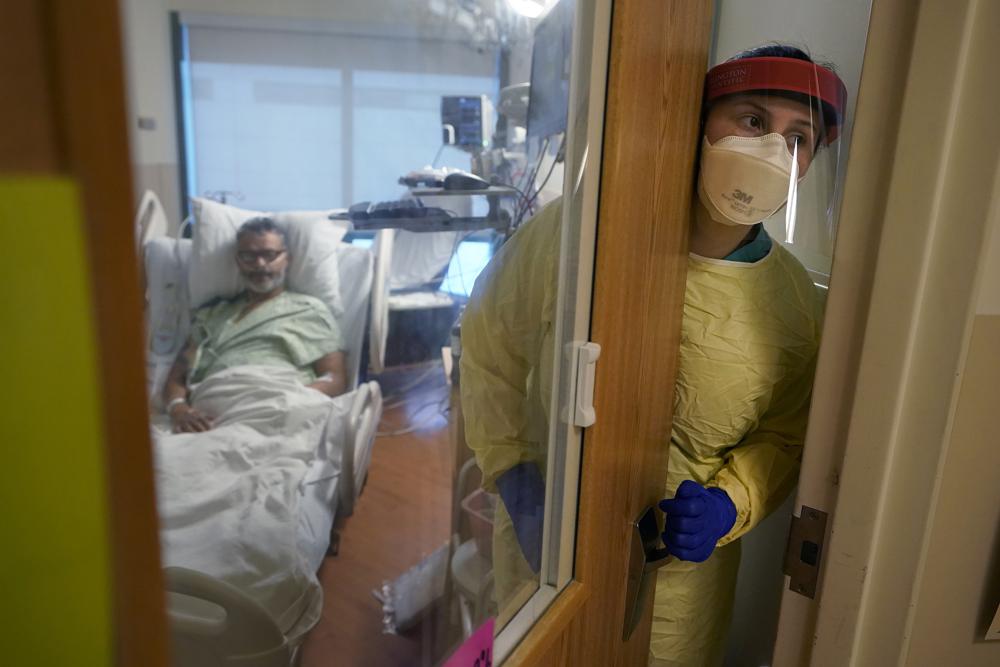
Several patients in the hospital’s COVID-19 ICU unit were on ventilators, a breathing tube down their throats. In one room, staff members made preparations for what they feared would be the final family visit for a dying patient.
One of the unvaccinated was Fred Rutherford, a 55-year-old from Claremont, New Hampshire. His son carried him out of the house when he became sick and took him to the hospital, where he needed a breathing tube for a while and feared he might die.
If he returns home, he said, he promises to get vaccinated and tell others to do so too.
“I probably thought I was immortal, that I was tough,” Rutherford said, speaking from his hospital bed behind a window, his voice weak and shaky.
But he added: “I will do anything I can to be the voice of people that don’t understand you’ve got to get vaccinated. You’ve got to get it done to protect each other.”








 HENRY KOTULA