There’s been a lot of hand wringing over the ongoing feeding frenzy among private equity (PE) firms for physician practice acquisition, which has caused health system executives everywhere to worry about the displacement effect on physician engagement strategies (not to mention the inflationary impact on practice valuations).
While we’ve long believed that PE firms are not long-term owners of practices, instead playing a roll-up function that will ultimately end in broader aggregation by vertically-integrated insurance companies, a recent conversation with one system CEO reframed the phenomenon in a way we hadn’t thought of before. It’s all about ademographic shift, she argued.
There’s a generation of Boomer-aged doctors who followed their entrepreneurial calling and started their own practices, and are now nearing retirement age without an obvious path to exit the business. Many didn’t plan for retirement—rather than a 401(k), what they have is equity in the practice they built.
What the PE industry is doing now is basically helping those docs transition out of practice by monetizing their next ten years of income in the form of a lump-sum cash payout. You could have predicted this phenomenon decades ago.
The real question is what happens to the younger generations of doctors left behind, who have another 20 or 30 years of practice ahead of them? Will they want to work in a PE-owned (or insurer-owned) setting, or would they prefer health system employment—or something else entirely?
The answer to that question will determine the shape of physician practice for decades to come…at least until the Millennials start pondering their own retirement.
The hourly mean wage for registered nurses in the U.S. is $38.47, according to the U.S. Bureau of Labor Statistics’ latest occupational employment and wage statistics survey.
Among 10 metropolitan areas with the highest employment level in registered nurses, registered nurses have the highest hourly mean wage in the Los Angeles area and the lowest in the Miami area.
Ten hourly mean wages for RNs by metropolitan area, in descending order:
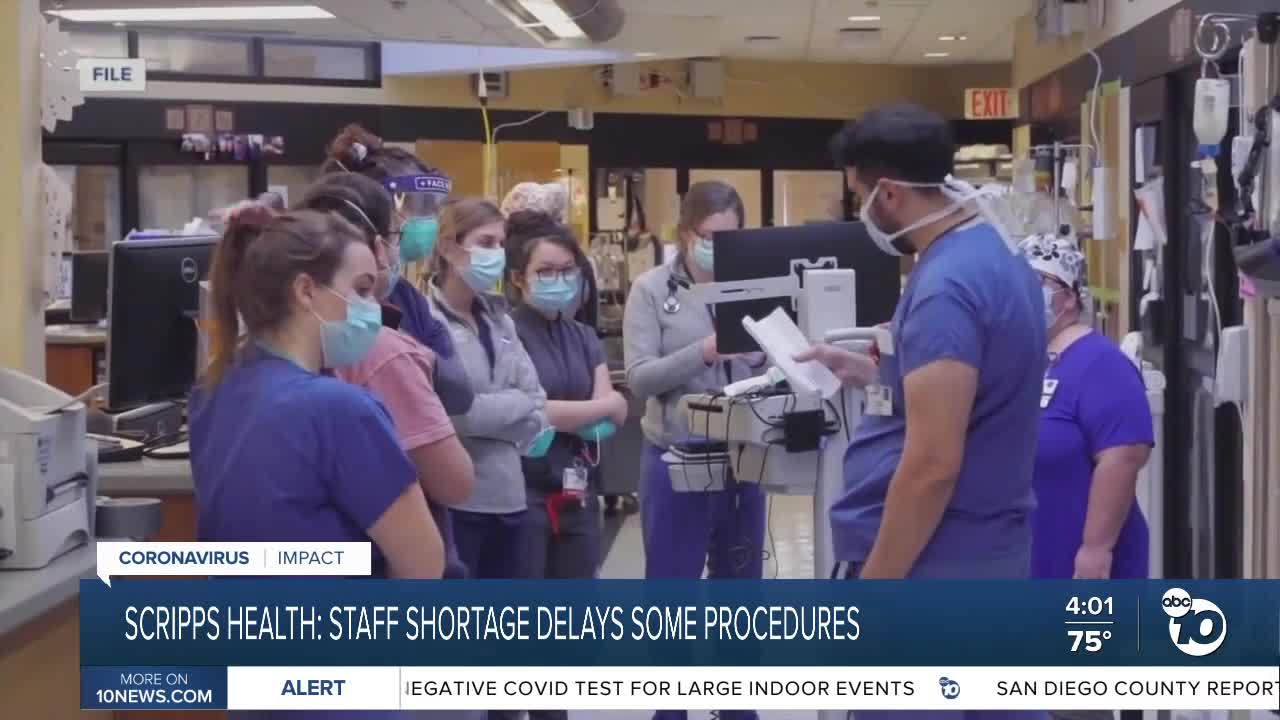
Scripps Health is temporarily postponing some medical procedures because of significant staffing shortages and a jump in COVID-19 cases, the San Diego, Calif.-based system said Aug. 20, according to CBS News 8.
Medical staff is deciding which procedures to delay based on clinical factors and emergency status, with time-sensitive care still being delivered, Scripps leaders said.
The health system said it is also considering temporarily consolidating some ambulatory care sites due to workforce shortages.
At present, Scripps said it is looking to fill 1,309 open positions. In August 2019, the system had just 832 openings. About 430 of the openings are for nursing positions, up from 220 open positions in 2019, according to the report.
At the same time, the health system is seeing its COVID-19 patient volume grow. Scripps has 173 patients admitted at its five hospitals, up from 13 patients on June 13.
“The COVID pandemic has taken a serious toll on healthcare workers across the nation, and many have decided to leave the field entirely for reasons such as fatigue and burnout,” said Scripps’ President and CEO Chris Van Gorder, according to CBS News 8. “We’re doing all we can to fill open positions and shifts, but options are currently limited across the board in healthcare, so we’re doing what’s necessary to ensure we have staff available for our most urgent cases.”
Janesville, Wis.-based Mercyhealth has fired a vice president in charge of marketing and public relations over an alleged kickback scheme with a vendor, the Janesville Gazette reported Aug.16, citing a letter from the health system’s CEO.
The vice president, Barb Bortner, was fired after health system leaders learned of a $3 million fraudulent invoice and kickback scheme that she was allegedly involved in, Mercyhealth President and CEO Javon Bea said in the letter obtained by the Gazette.
“Our patients and communities we serve expect us to conduct our business affairs with the highest degree of integrity. We are all deeply saddened and disappointed that a member of our team has betrayed that trust,” Mr. Bea wrote in the letter, according to the Rockford Register Star.
Mr. Bea said Mercyhealth officials suspect Ms. Bortner is responsible for fraudulent and “improper” arrangements with an unnamed vendor, and the alleged fraud was linked to the system’s marketing division. Mercyhealth is severing ties with the vendor believed to be involved, the Gazette reported.
The fraud does not appear to have impacted patient care, and the system is taking “all necessary steps to improve Mercyhealth procedures,” Mr. Bea wrote, according to the report.
As some states set Covid-19 hospitalization records, many overwhelmed hospitals are outsourcing patients on planes, helicopters, and ambulances to distant cities and states for treatment, Heather Hollingsworth and Jim Salter write for the Associated Press.
Transfers hundreds of miles away
As of last week, the number of Covid-19 patients in most hospitals remained below winter surge levels, Hollingsworth and Salter report. However, Florida, Arkansas, Oregon, Hawaii, Louisiana, and Mississippi recently set pandemic hospitalization records.
And unlike in the winter surge, many hospitals were already strained this summer due to patients catching up on previously deferred care, according to Hollingsworth and Salter.
“We are seeing Covid patients and we are seeing car accidents and we are seeing kids come in with normal seasonal viral infections. And we are seeing normal life come into the emergency department along with the extra surge of Covid patients, so it is causing that crisis,” said Mark Rosenberg, president of the American College of Emergency Physicians.
Amid the influx of patients, many of these overwhelmed hospitals are looking to neighboring cities and states for relief. For instance, in Arizona, a Covid-19 hotline is receiving calls from hospitals in Wyoming, Arkansas, Texas, and California in search of bed space, Hollingsworth and Salter report—although the hotline often cannot provide any help.
In Kansas, officials at the Wilson Medical Center in Kansas had to call 40 other facilities in several states seeking a bed for a Covid-19 patient before finally finding an available bed about 220 miles away. Across the state, according to Motient, a company contracting with Kansas to manage transfers, Covid-19 patients generally have to wait an average of 10 hours before being flown to another hospital location, which could be in Wisconsin, Illinois, Colorado, or Texas. “That is just the worst day that you can have in the emergency room as a provider,” Richard Watson, Motient’s founder, said, “to be taking care of a patient that you are totally helpless to give them what you know they need.”
Similarly, in Washington state, the 25-bed Prosser Memorial Hospital, doesn’t have an intensive care unit, so critically ill patients are being sent as far as eastern Idaho—600 miles away.
Staffing shortages, low vaccination rates add to the problem
Finding a hospital to take in patients has become more difficult due to recent staffing shortages, according to Robin Allaman, CNO at the Kearny County Hospital in Kansas.
“Most [hospitals] are saying it isn’t that they don’t have an open bed, it is that they don’t have nursing staff to care for them,” he said. Officials at his hospital called health systems in Nebraska, Oklahoma, and New Mexico before one in Colorado Springs, Colo.—200 miles away—agreed to take a recent patient.
Watson said these delayed transfers can have dire consequences for patients, especially those who need to see specialists, who often are available only in larger hospitals. “Imagine being with your grandma in the ER who is having a heart attack in western Kansas and you are saying, ‘Why can’t we find a bed for her?’ We are watching this happen right in front of us. ‘This is America. Why don’t we have hospital bed for her?’ Well, here we are,” he said.
And while experts had hoped that the vaccines would prevent hospitals from becoming overwhelmed again, Justin Lessler, a professor of epidemiology at Johns Hopkins University, said there hasn’t been the reduction in hospitalizations that officials had hoped for. That’s in part because the delta variant seems to be more severe, particularly in younger people, whose vaccination rates are lower.
Steve Edwards—CEO of CoxHealth, whose hospital in Springfield, Mo., is treating patients from as far away as Alabama—added, “Just imagine not having the support of your family near, to have that kind of anxiety if you have someone grow acutely ill.”
After a calmer start to the summer, the Delta variant is eroding consumer confidence as COVID-19 surges across many parts of the US once again. Using the latest data from Morning Consult’s Consumer Confidence Index, the graphic above shows the fluctuations in consumer confidence levels across the last year.
The most recent COVID surge has caused a five-point drop in confidence in the past month and, with cases still rising, we expect this trend to continue into the fall. Notably, with renewed masking guidance and increasing reports of breakthrough infections, confidence has dropped more among fully vaccinated individuals than among the unvaccinated.
Consumers’ comfort levels aren’t only dropping when it comes to daily activities, like grocery shopping or dining at a restaurant, but also with respect to healthcare. A recent survey from Jarrard Phillips Cate & Hancock finds that while consumers feel safer visiting healthcare settings in August 2021 than they did back in January, more than a third of consumers report the current COVID situation is making them less likely to seek non-emergency care, and 44 percent say they are more likely to pursue virtual care alternatives.
Health systems must be able to seamlessly “dial up” or “dial down” their virtual care capabilities in order to meet fluctuating consumer demand and avoid another wave of missed or deferred care.
From the largest global meat producer to a major gas pipeline company, cyberattacks have been on the rise everywhere—and with copious amounts of valuable patient data, healthcare organizations have become a prime target.
The graphic above outlines the recent wave of data attacks plaguing the sector. Healthcare data breaches reached an all-time high in 2020, and hacking is now the most common type of breach, tripling from 2018 to 2020. This year is already on pace to break last year’s record, with nearly a third more data breaches during the first half of the year, compared to the same period last year.
Recovering from ransomware attacks is expensive for any business, but healthcare organizations have the highest average recovery costs, driven by the “life and death” nature of healthcare data, and need to quickly restore patient records. A single healthcare record can command up to $250 on the black market, 50 times as much as a credit card, the next highest-value record. Healthcare organizations are also slower to identify and contain data breaches, further driving up recovery costs.
A new report from Fitch Ratings finds cyberattacks may soon threaten hospitals’ bottom lines, especially if they affect a hospital’s ability to bill patients when systems become locked or financial records are compromised. The rise in healthcare hacking is shining a light on many health systems’ lax cybersecurity systems, and use of outdated technology.
And as virtual delivery solutions expand, health systems must double down on performing continuous risk assessments to keep valuable data assets safe and avoid disruptions to care delivery.
With vaccine mandates on the rise among healthcare organizations, including many of the health systems we work with, we’ve begun to hear a new argument in favor of getting staff vaccinated—one that weighs against the worry that mandates will drive scarce clinical workers away.
With staffing already stretched, some systems have been concerned that implementing mandates could worsen shortages and force an increase in the use of costly agency labor. But, some executives are now telling us, so could not vaccinating staff. As the highly contagious Delta variant continues to sweep through unvaccinated populations, clinical workers who haven’t gotten their shots are especially susceptible to contracting the virus.
That’s driven a sharp increase in unvaccinated nurses and other workers calling out sick with COVID symptoms, which has made a difficult staffing situation even worse.
Some of the high-profile reports of hospitals running out of beds in the face of the Delta variant are actually driven by running out of staff to keep those beds in use—making it even more critical to ensure that frontline workers are protected against the virus.
As a growing number of hospitals and other care facilities mandate that their workers get vaccinated, we’d hope this unwelcome pressure on an already stretched workforce begins to wane.




 HENRY KOTULA