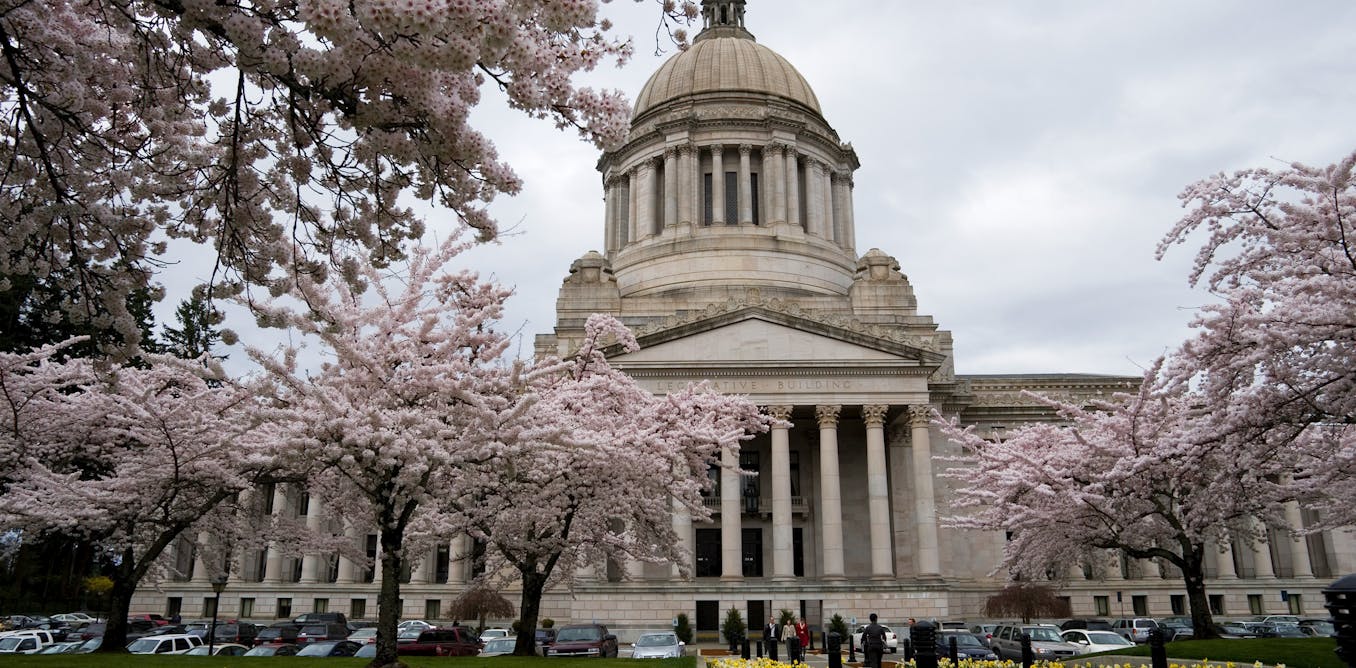
Coronavirus’s painful side effect is deep budget cuts for state and local government services

https://theconversation.com/coronaviruss-painful-side-effect-is-deep-budget-cuts-for-state-and-local-government-services-141105

Coronavirus's painful side effect is deep budget cuts for state ...

Nationwide, state and local government leaders are warning of major budget cuts as a result of the pandemic. One state – New York – even referred to the magnitude of its cuts as having “no precedent in modern times.”

Declining revenue combined with unexpected expenditures and requirements to balance budgets means state and local governments need to cut spending and possibly raise taxes or dip into reserve funds to cover the hundreds of billions of dollars lost by state and local government over the next two to three years because of the pandemic.

Without more federal aid or access to other sources of money (like reserve funds or borrowing), government officials have made it clear: Budget cuts will be happening in the coming years.

And while specifics are not yet available in all cases, those cuts have already included reducing the number of state and local jobs – from firefighters to garbage collectors to librarians – and slashing spending for education, social services and roads and bridges.

In some states, agencies have been directed to cut their budget as much as 15% or 20% – a tough challenge as most states prepared budgets for a new fiscal year that began July 1.

As a scholar of public administration who researches how governments spend money, here are the ways state and local governments have reduced spending to close the budget gap.

Cutting jobs

State and local governments laid off or furloughed 1.5 million workers in April and May.

They are also reducing spending on employees. According to surveys, government workers are feeling personal financial strain as many state and local governments have cut merit raises and regular salary increases, frozen hiring, reduced salaries and cut seasonal employees.

Washington state, for example, cut both merit raises and instituted furloughs.

survey from the National League of Cities shows 32% of cities will have to furlough or lay off employees and 41% have hiring freezes in place or planned as a result of the pandemic.

Employment reductions have met some resistance. In Nevada, for example, a state worker union filed a complaint against the governor to the state’s labor relations board for violating a collective bargaining statute by not negotiating on furloughs and salary freezes.

Most of the employee cuts have been made in education. Teachers, classroom aids, administrators, staff, maintenance crews, bus drivers and other school employees have seen salary cuts and layoffs.

The job loss has hurt public employees beyond education, too: librarians, garbage collectors, counselors, social workers, police officers, firefighters, doctors, nurses, health aides, park rangers, maintenance crews, administrative assistants and others have been affected.

Residents also face the consequences of these cuts: They can’t get ahold of staff in the city’s water and sewer departments to talk about their bill; they can’t use the internet at the library to look for jobs; their children can’t get needed services in school.

Most of these cuts have been labeled temporary, but with the extensions to stay-at-home orders and a mostly closed economy, it will be some time before these employees are back to work.
Suspending road, bridges, building and water system projects

As another way to reduce costs quickly, a National League of Cities survey shows 65% of the municipalities surveyed are stopping temporarily, or completely, capital expenditure and infrastructure projects like roads, bridges, buildings, water systems or parking garages.

In New York City, there is a US$2.3 billion proposed cut to the capital budget, a fund that supports large, multiyear investments from sidewalk and road maintenance, school buildings, senior centers, fire trucks, sewers, playgrounds, to park upkeep. There are potentially serious consequences for residents. For example, New York housing advocates are concerned that these cuts will hurt plans for 21,000 affordable homes.

Suspending these big money projects will save the government money in the short term. But it will potentially harm the struggling economy, since both public and private sectors benefit from better roads, bridges, schools and water systems and the jobs these projects create.

Delaying maintenance also has consequences for the deteriorating infrastructure in the U.S. The costs of unaddressed repairs could increase future costs. It can cost more to replace a crumbling building than it does to fix one in better repair.

Cities and towns hit

In many states, the new budgets severely cut their aid to local governments, which will lead to large local cuts in education – both K-12 and higher education – as well as social programs, transportation, health care and other areas.

New York state’s budget proposes that part of its fiscal year 2021 budget shortfall will be balanced by $8.2 billion in reductions in aid to localities. This is the state where the cuts were referred to in the budget as “not seen in modern times.” This money is normally spent on many important services that residents need everyday –mass transit, adult and elderly care, mental health support, substance abuse programs, school programs like special education, children’s health insurance and more. Lacking any of these support services can be devastating to a person, especially in this difficult time.

Fewer workers, less money

As teachers and administrators figure out how to teach both online and in person, they and their schools will need more money – not less – to meet students’ needs.

Libraries, which provide services to many communities, from free computer use to after-school programs for children, will have to cut back. They may have fewer workers, be open for fewer hours and not offer as many programs to the public.

Parks may not be maintained, broken playground equipment may stay that way, and workers may not repave paths and mow lawns. Completely separate from activists’ calls to shift police funding to other priorities, police departments’ budgets may be slashed just for lack of cash to pay the officers. Similar cuts to firefighters and ambulance workers may mean poorly equipped responders take longer to arrive on a scene and have less training to deal with the emergency.

To keep with developing public safety standards, more maintenance staff and materials will be needed to clean and sanitize schools, courtrooms, auditoriums, correctional facilitiesmetro stations, buses and other public spaces. Strained budgets and employees will make it harder to complete these new essential tasks throughout the day.

To avoid deeper cuts, state and local government officials are trying a host of strategies including borrowing money, using rainy day funds, increasing revenue by raising tax rates or creating new taxes or fees, ending tax exemptions and using federal aid as legally allowed.

Colorado was able to hold its budget to only a 3% reduction, relying largely on one-time emergency reserve funds. Delaware managed to maintain its budget and avoided layoffs largely through using money set aside in a reserve account.

Nobody knows how long the pandemic, or its economic effects, will last.

In the worst-case scenario, budget officials are prepared to make steeper cuts in the coming months if more assistance does not come from the federal government or the economy does not recover quickly enough to restore the flow of money that governments need to operate.




U.S. Coronavirus Pandemic Status: It’s about to get a lot worse

https://www.axios.com/coronavirus-pain-getting-worse-cd329f4c-9962-4f40-b401-7a7ac1a393cf.html

The pain of the coronavirus is about to get a lot worse - Axios

For months now, American workers, families and small businesses have been saying they can’t keep up their socially distanced lives for much longer. We’ve now arrived at “much longer” — and the pandemic isn’t going away anytime soon.

The big picture: The relief policies and stopgap measures that we cobbled together to get us through the toughest weeks worked for a while, but they’re starting to crumble just as cases are spiking in the majority of states.

Next week, the extra $600 per week in expanded unemployment benefits will expire. And there’s no indication that Congress has reached a consensus on extending this assistance or providing anything in its place.

  • But nearly half of the U.S. population is still jobless, and millions will remain jobless for the foreseeable future. There are 14 million more unemployed people than there are jobs, per the Economic Policy Institute.
  • Nearly a third of Americans missed a housing payment in July — and that was with the additional $600. Plus, most Americans have already spent the stimulus checks they received at the beginning of the pandemic.
  • “We should be very concerned about what’s going to happen in August and beyond” — starting with a spike in evictions, Mathieu Despard, who leads the Social Policy Institute at the Washington University in St. Louis, tells Axios.

Expect more furloughs and layoffs as more small businesses are pushed off the pandemic cliff.

  • By economists’ estimates, more than 100,000 small businesses have permanently closed since the pandemic began.
  • For those that are hanging on, loans from the Paycheck Protection Program (PPP) have not been enough, and the back and forth between re-opening and then closing again as states deal with new case waves has been devastating. In fact, rates of closure have started increasing, the New York Times reports, citing Yelp data.
  • The big firms aren’t immune either. Just last week, behemoths like United Airlines, Wells Fargo, Walgreens and Levi’s either cut jobs or told workers their jobs were at risk, Axios’ Dion Rabouin writes.

And the question of whether schools will reopen looms.

  • Since schools sent kids home in March, and most summer camps didn’t open their doors for the summer, working parents have been dealing with a child care crisis — attempting to do their jobs, care for their kids and homeschool all at once — and hoping that the stress will be temporary.
  • The situation is more dire for low-income families with kids who rely on school lunches or for single parents who are juggling work and parenting without any help.
  • Now the public heath crisis hasn’t abated, and school districts are running out of time to figure out what the fall will look like. Some, starting with Los Angeles, have already decided to go online.

The bottom line: “It’s the uncertainty that is anxiety-inducing,” says Despard. “If you give people a time horizon and say, ‘Look you have to get through these next 8 weeks of extreme shutdown,’ they’ll do it. Now it’s like, ‘How much longer?'”


U.S. Coronavirus Response: We blew it

https://www.axios.com/coronavirus-america-blew-it-b3d84ea3-78b3-4fe0-8dce-1c4ed0ec0a4c.html

We blew it: Why America still hasn't gotten the coronavirus under ...

America spent the spring building a bridge to August, spending trillions and shutting down major parts of society. The expanse was to be a bent coronavirus curve, and the other side some semblance of normal, where kids would go to school and their parents to work.

The bottom line: We blew it, building a pier instead.

There will be books written about America’s lost five months of 2020, but here’s what we know:

We blew testing. President Trump regularly brags and complains about the number of COVID-19 tests conducted in the U.S., but America hasn’t built the infrastructure necessary to process and trace the results.

  • Quest Diagnostics says its average turnaround time for a COVID-19 test has lengthened to “seven or more days” — thus decreasing the chance that asymptomatic or mildly symptomatic carriers will self-quarantine.
  • The testing delays also make it harder for public health officials to understand current conditions, let alone implement effective contact tracing.
  • Speaking of contact tracing, it remains a haphazard and uncoordinated process in many parts of the country.

We blew schools. Congress allocated $150 billion for state and local governments as part of the CARES Act, but that was aimed at maintaining status quo services in the face of plummeting tax revenue.

There was no money earmarked for schools to buy new safety equipment, nor to hire additional teachers who might be needed to staff smaller class sizes and hybrid learning days.

  • U.S. Education Secretary Betsy DeVos was not among the 27 officials included in the White House Coronavirus Task Force.
  • The administration insists that schools should reopen this fall because kids are less likely to get very sick from the virus, but it has not yet offered detailed plans to protect older teachers, at-risk family members, or students with pre-existing respiratory or immune conditions.
  • Silicon Valley provided some free services to schools, but there was no coordinated effort to create a streamlined virtual learning platform. There also continue to be millions of schoolkids without access to broadband and/or Internet-connected devices.

We blew economics. The CARES Act was bold and bipartisan, a massive stimulus to meet the moment.

  • It’s running out, without an extension plan not yet in place.
  • Expanded unemployment benefits expire in days. Many small businesses have already exhausted their Paycheck Protection Program loans, including some that reopened but have been forced to close again.
  • There has been no national effort to pause residential or commercial evictions, nor to give landlords breathing room on their mortgage payments.

We blew public health. There’s obviously a lot here, but just stick with face masks. Had we all been directed to wear them in March — and done so, even makeshift ones while manufacturing ramped up — you might not be reading this post.

We blew goodwill. Millions of Americans sheltered in place, pausing their social lives for the common good.

  • But many millions of other Americans didn’t. Some were essential workers. Some were deemed essential workers but really weren’t. Some just didn’t care, or didn’t believe the threat. Some ultimately decided that protesting centuries of racial injustice was a worthy trade-off.
  • All of this was complicated by mixed messages from federal and state leaders. Top of that list was President Trump, who claimed to adopt a wartime footing without clearly asking Americans to make sacrifices necessary to defeat the enemy.
  • Five months later, many of those who followed the “rules” are furious at what they perceive to be the selfishness of others.

The bottom line: America has gotten many things right since March, including the development of more effective hospital treatments for COVID-19 patients.

  • But we’re hitting daily infection records, daily deaths hover around 900, and many ICUs reports more patients than beds. It didn’t have to be this way.


12 hospitals laying off workers in response to COVID-19

https://www.beckershospitalreview.com/finance/12-hospitals-laying-off-workers-in-response-to-covid-19.html?utm_medium=email

Facing a financial squeeze, hospitals nationwide are cutting jobs

To address the financial fallout from the COVID-19 pandemic, hospitals across the nation are looking to cut costs by implementing furloughs, layoffs or pay cuts. 

U.S. hospitals are expected to lose $323.1 billion this year due to the pandemic, according to a recent report from the American Hospital Association. The total includes $120.5 billion in financial losses that hospitals are projected to see from July through December, as well as $202.6 billion in losses that were projected between March and June. The losses were largely due to a lower patient volume after canceling elective procedures. 

Although Congress allocated $175 billion to help hospitals offset some of the revenue losses and expense increases to prepare for the pandemic, hospitals have said it is not enough.

Nearly 270 hospitals and health systems have furloughed workers in response to the pandemic and several others have implemented layoffs. 

Below are 12 hospitals and health systems that have announced layoffs since June 1:

1. Trinity Health furloughs, lays off another 1,000 workers
Trinity Health, a 92-hospital system based in Livonia, Mich., will lay off and reduce work schedules of 1,000 employees.

2. Ohio children’s hospital cuts jobs
Dayton (Ohio) Children’s Hospital said it has cut jobs to help offset financial losses due to the COVID-19 pandemic.

3. Munson Healthcare to cut 25 leadership positions
Traverse City, Mich.-based Munson Healthcare cut 25 leadership positions to help offset financial losses amid the COVID-19 pandemic.

4. Erlanger lays off 93 nonclinical employees
Chattanooga, Tenn.-based Erlanger Health System has cut 93 nonclinical positions to help offset financial damage from the COVID-19 pandemic. The layoffs come after the health system cut 11 leadership positions June 12, including the CEO of Erlanger Western Carolina Hospital in Murphy, N.C., and made staff and pay cuts in March.

5. Michigan Medicine to lay off 738 employees by end of June
Ann Arbor-based Michigan Medicine planned to eliminate 738 positions by the end of June amid financial challenges from the COVID-19 pandemic.

6. Pennsylvania health system cuts 10% of workforce amid pandemic losses
As part of a restructuring effort to cut pandemic-related losses, State College, Pa.-based Mount Nittany Health System plans to lay off 10 percent of its workforce, or about 250 employees.

7. TriHealth eliminates 440 positions to cut costs
Cincinnati-based TriHealth cut 440 positions as part of a plan to trim at least $140 million in expenditures this year.

8. Layoffs hit U of Kansas Health System
The University of Kansas Health System St. Francis Campus in Topeka laid off employees after previously implementing furloughs.

9. Tower Health to cut 1,000 jobs
Citing a $212 million loss in revenue through May due to the COVID-19 pandemic, West Reading, Pa.-based Tower Health plans to cut 1,000 jobs.

10. Colorado hospital cuts 22 positions
Parkview Medical Center in Pueblo, Colo., eliminated 22 positions in response to the COVID-19 pandemic.

11. Arkansas Children’s cuts 42 positions
Little Rock-based Arkansas Children’s Hospital said it is eliminating 42 jobs as part of cost-savings measures in response to the COVID-19 pandemic.

12. North Carolina health system cuts 10% of workforce, closes clinics
Citing a financial hit from the COVID-19 pandemic, Lumberton, N.C.-based Southeastern Health will permanently close several clinics, cut 10 percent of its workforce and reduce executive pay.