The No. 1 lesson from the 2021 JP Morgan Healthcare Conference: Healthcare is ‘too vital to fail’

Chronic Conditions | HENRY KOTULA

The annual J.P. Morgan Healthcare Conference is one of the best ways to diagnose the financial condition of the healthcare industry. Every January, every key stakeholder — providers, payers, pharmaceutical companies, tech companies, medical device and supply companies as well as bankers, venture capital and private equity firms — comes together in one exam room, even when it is virtual, for their annual check-up. But as we all know, this January is unlike any other as this past year has been unlike any other year.

You would have to go back to the banking crisis of 2008 to find a similar moment from an economic perspective. At the time, we were asking, “Are banks too big to fail?” The concern behind the question was that if they did fail, the economic chaos that would follow would lead to a collapse with the consumer ultimately picking up the tab. The rest is history.

Healthcare is “Too Vital to Fail” 

2020 was historic in too many ways to count. But in a year when healthcare providers faced the worst financial crisis in the history of healthcare, the headline is that they are still standing. And what they proved is that in contrast to banks in 2008 that were seen by many as “too big to fail,” healthcare providers in 2020 proved that they were “too vital to fail.” 

One of the many unique things about the COVID-19 pandemic is we are simultaneously experiencing a health crisis, where healthcare providers are the front line in the battle, and an economic crisis, felt in a big way in healthcare given the unique role hospitals play as the largest employer in most communities. Hospitals and health systems have done the vast majority of testing, treating, monitoring, counseling, educating and vaccinating all while searching for PPE and ventilators, and conducting clinical trials. And that’s just the beginning of the list.

Stop and think about that for a minute. What would we have done without them? Thinking through that question will give you some appreciation for the critical, challenging and central role that healthcare providers have had to play over the past year.

Simply stated, healthcare providers are the heart of healthcare, both clinically (essentially 100 percent of the care) and financially (over 50 percent of the $4 trillion annual spend on U.S. healthcare). Over the last year they stepped up and they stepped in at the moment where we needed them the most. This was despite the fact that, like most businesses, they were experiencing calamitous losses with no assurances of any assistance. 

Healthcare is “Pandemic-Proof”

This was absolutely the worst-case scenario and the biggest test possible for our nation’s healthcare delivery system. Patient volume and therefore revenue dropped by over 50 percent when the panic of the pandemic was at its peak, driving over $60 billion in losses per month across hospitals and healthcare providers. At the same time, they were dramatically increasing their expenses with PPE, ventilators and additional staff. This was not heading in a good direction. While failure may not have been seen as an option, it was clearly a possibility. 

The CARES Act clearly provided a temporary lifeline, providing funding for our nation’s hospitals to weather the storm. While there are more challenging times ahead, it is now clear that most are going to make it to the other side. The system of care in our country is often criticized, but when faced with perhaps the most challenging moment in the history of healthcare, our nation’s hospitals and health systems stepped up heroically and performed miraculously. The work of our healthcare providers on the front line and those who supported them was and is one thing that we all should be exceptionally proud of and thankful for. In 2020, they proved that not only is our nation’s healthcare system too vital to fail, but also that it is “pandemic proof.” 

Listening to Front Line at the 2021 J.P. Morgan Healthcare Conference 

There has never been a more important year to listen to the lessons from healthcare providers. They are and were the front line of our fight against COVID-19. If there was a class given about how to deal with a pandemic at an institutional level, this conference is where those lessons were being taught.  

This year at the J.P. Morgan Healthcare Conference, CEOs, and CFOs from many of the most prestigious and most well-respected health systems in the world presented including AdventHealth, Advocate Aurora Health, Ascension, Baylor Scott & White Health, CommonSpirit Health, Henry Ford Health System, Intermountain Healthcare, Jefferson Health, Mass General Brigham, Northwell Health, OhioHealth, Prisma Health, ProMedica Health System, Providence, Spectrum Health and SSM Health.

I’ve been in healthcare for 30 years and this is my fifth year of writing up the summary of the non-profit provider track of the conference for Becker’s Healthcare to help share the wisdom of the crowd of provider organizations that share their stories. Clearly, this year was different and not because the presentations were virtual, but because they were inspirational. 

What did we learn? The good news is that they have made many changes that have the potential to move healthcare in a much better direction and to get to a better place much faster. So, this year instead of providing you a nugget from each presentation, I am going to take a shot at summarizing what they collectively have in motion to stay vital after COVID.

10 Moves Healthcare Providers are Making to Stay Vital After-COVID

As a leader in healthcare, you will never have a bigger opportunity to drive change than right now. Smart leaders are framing this as essentially “before-COVID (BC)” and “after-COVID (AC)” and using this moment as their burning platform to drive change. Credit to the team at Providence for the acronym, but every CEO talked about this concept. As the saying goes, “never let a good crisis go to waste.” Well, we’ve certainly had a crisis, so here is a list of what the top health systems are doing to ensure that they don’t waste it and that they stay vital after-COVID:

1. Take Care of Your Team and They’ll Take Care of You: In a crisis, you can either come together as a team or fall apart. Clearly there has been a significant and stunning amount of pressure on healthcare providers. Many are fearing that mental health might be our nation’s next pandemic in the near future because they are seeing it right now with their own team. Perhaps one of their biggest lessons from this crisis has been the need to address the mental, physical and spiritual health of both team members as well as providers. They have put programs in place to help and have also built a tremendous amount of trust with their team by, in many cases, not laying off and/or furloughing employees. While they have made cuts in other areas such as benefits, this collective approach proved incredibly beneficial. And the last point here that relates to thinking differently about their team is that similar to other businesses, many health systems are making remote arrangements permanent for certain administrative roles and moving to a flexible approach regarding their team and their space in the future. 

2. Focus on Health Equity, Not Just Health Care: This was perhaps the most notable and encouraging change from presentations in past years at J.P. Morgan. I have been going to the conference for over a decade, and I’ve never heard someone mention this term or outline their efforts on “health equity” — this year, nearly everyone did. In the past, they have outlined many wonderful programs on “social determinants of health,” but this year they have seen the disproportionate impact of COVID on low-income communities bringing the ongoing issue of racial disparities in access to care and outcomes to light. As the bedrock of employment in their community, this provides an opportunity to not just provide health care, but also health equity, taking an active role to help make progress on issues like hunger, homelessness, and housing. Many are making significant investments in a number of these and other areas. 

3. Take the Lead in Public Health — the Message is the Medicine: One of the greatest failings of COVID, perhaps the greatest lesson learned, is the need for clear and consistent messaging from a public health perspective. That is a role that healthcare providers can and should play. In the pandemic, it represented the greatest opportunity to save lives as the essence of public health is communication — the message is the medicine. A number of health systems stepped into this opportunity to build trust and to build their brand, which are essentially one in the same. Some organizations have created a new role — a Chief Community Health Officer — which is a good way to capture the work that is in motion relative to social determinants of health as well as health equity. Many understand the opportunity here and will take the lead relative to vaccine distribution as clear messaging to build confidence is clearly needed.

4. Make the Home and Everywhere a Venue of Care: A number of presenters stated that “COVID didn’t change our strategy, it accelerated it.” For the most part, they were referring to virtual visits, which increased dramatically now representing around 10 percent of their visits vs. 1 percent before-COVID. One presenter said, “Digital has been tested and perfected during COVID,” but that is only considering the role we see digital playing in this moment. It is clear some organizations have a very narrow tactical lens while others are looking at the opportunity much more strategically. For many, they are looking at a “care anywhere and everywhere” strategy. From a full “hospital in the home” approach to remote monitoring devices, it is clear that your home will be seen as a venue of care and an access point moving forward. The pandemic of 2020 may have sparked a new era of “post-hospital healthcare” — stay tuned.

5. Bury Your Budget and Pivot to Planning: The budget process has been a source of incredible distrust, dissatisfaction and distraction for every health system for decades. The chaos and uncertainty of the pandemic forced every organization to bury their budget last year. With that said, many of the organizations that presented are now making a permanent shift away from a “budget-based culture” where the focus is on hitting a now irrelevant target set that was set six to nine months ago to a “performance-based culture” where the focus is on making progress every day, week, month and quarter. Given that the traditional annual operating budget process has been the core of how health systems have operated, this shift to a rolling forecast and a more dynamic planning process is likely the single most substantial and permanent change in how hospitals and health systems operate due to COVID. In other words, it is arguably a much bigger headline than what’s happened with virtual visits.

6. Get Your M&A Machine in Motion: It was clear from the presentations that activity around acquisitions is going to return, perhaps significantly. These organizations have strong balance sheets and while the strong have gotten stronger during COVID, the weak have in many cases gotten weaker. Many are going to be opportunistic to acquire hospitals, but at the same time they have concluded that they can’t just be a system of care delivery. They are also focused on acquiring and investing in other types of entities as well as forming more robust partnerships to create new revenue streams. Organizations that already had diversified revenue streams in place came through this pandemic the best. Most hospitals are overly reliant on the ED and surgical volume. Trying to drive that volume in a value-based world, with the end of site of service differentials and the inpatient only list, will be an even bigger challenge in the future as new niche players enter the market. As I wrote in the headline of my summary two years ago,It’s the platform, stupid.” There are better ways to create a financial path forward that involve leveraging their assets — their platform — in new and creative ways. 

7. Hey, You, Get into the Cloud: With apologies for wrapping a Rolling Stones song into a conference summary, one of the main things touted during presentations was “the cloud” and their ability to pull clinical, operational and financial dashboards together to monitor the impact of COVID on their organization and organize their actions. Focus over the last decade has been on the clinical (implementing EHRs), but it is now shifting to “digitizing operations” with a focus on finance and operations (planning, cost accounting, ERPs, etc.) as well as advanced analytics and data science capabilities to automate, gather insight, manage and predict. It is clear that the cloud has moved from a curiosity to a necessity for health systems, making this one of the biggest areas of investment for every health system over the next decade.

8. Make Price Transparency a Key Differentiator: One of the great lessons from Amazon (and others) is that you can make a lot of money when you make something easy to buy. While many health systems are skeptical of the value of the price transparency requirements, those that have a deep understanding of both their true cost of care and margins are using this as an opportunity to prove their value and accelerate their strategy to become consumer-centric. While there is certainly a level of risk, no business has ever been unsuccessful because they made their product easier to understand and access. Because healthcare is so opaque, there is an opening for healthcare providers to build trust, which is their main asset, and volume, which is their main source of revenue, by becoming stunningly easy to do business with. This may be tough sledding for some as this isn’t something healthcare providers are known for. To understand this, spend a few minutes on Tesla’s website vs. Ford’s. The concept of making something easy, or hard, to buy will become crystal clear as fast as a battery-driven car can go from zero to 60.

9. Make Care More Affordable: This represents the biggest challenge for hospitals and health systems as they ultimately need to be on the right side of this issue or the trust that they have will disappear and they will remain very vulnerable to outside players. All are investing in advanced cost accounting systems (time-driven costing, physician costing, supply, and drug costing) to truly understand their cost and use that as a basis to price more strategically in the market. Some are dropping prices for shoppable services and using loss leader strategies to build their brand. The incoming Secretary of Health and Human Services has a strong belief regarding the accountability of health systems to be consumer centric. The health systems that understand this are working to get ahead of this issue as it is likely one of their most significant threats (or opportunities) over the next decade. This means getting all care to the right site of care, evaluating every opportunity to improve, and getting serious about eliminating the need for expensive care through building healthy communities. If you’re worried about Wal-Mart or Amazon, this is your secret weapon to keep them on the sideline.

10. Scale = Survival: One of the big lessons here is that the strong got stronger, the weak got weaker. For the strong, many have been able to “snapback” in financial performance because they were resilient. They were able to designate COVID-only facilities, while keeping others running at a higher capacity. To be clear, while most health systems are going to get to the other side and are positioned better than ever, there are many others that will continue to struggle for years to come. According to our data at Strata, we see 25 percent operating at negative margins right now and another 50 percent just above breakeven. They key to survival moving forward, for those that don’t have a captive market, will be scale. If this pandemic proved one thing relative to the future of health systems it is this — scale equals survival. 

When Will We Return to Normal?

Based on what the projections that these health systems shared, the “new normal” for health systems for the first half of 2021 will be roughly 95 percent of prior year inpatient volume with a 20 percent year-over-year drop in ED volume and a drop of 10-15 percent in observation visits. So, the pain will continue, but given the adjustments that were already made in 2020, it looks like they will be able to manage through COVID effectively. While there will be a pickup in the second half of 2021, the safe bet is that a “return to normal” pre-COVID volumes likely won’t occur until 2022. And there are some who believe that some of the volume should have never been there to begin with and we might see a permanent shift downward in ED volume as well as in some other areas.

With that said, I’ll steal a quote from Bert Zimmerli, the CFO of Intermountain Healthcare, who said, “Normal wasn’t ever nearly good enough in healthcare.” In that spirit, the goal should be to not return to normal, but rather to use this moment as an opportunity to take the positive changes driven by COVID — from technology to processes to areas of focus to a sense of responsibility — and make them permanent.

Thanking Our “Healthcare Heroes”

We’ll never see another 2020 again, hopefully. With that said, one of the silver linings of the year is everything we learned in healthcare. The most important lesson was this — in healthcare there are literally heroes everywhere. To each of them, I just want to say “thank you” for being there for us when we needed you the most. We should all be writing love letters to those on the front line who risked their lives to save others. Our nation’s healthcare system has taken a lot of criticism through the years from those on the outside, often with a blind eye to how things work in practice vs. in concept. But this year we all got to see first-hand what’s happening inside of healthcare — the heroic work of our healthcare providers and those who support them. 

They faced the worst crisis in the history of healthcare. They responded heroically and were there for our families and friends.

They proved that healthcare is too vital to fail. They proved that healthcare is pandemic-proof.

Thank you to our healthcare heroes.
As thousands of athletes get coronavirus tests, nurses wonder: What about us?

On her day off not long ago, emergency room nurse Jane Sandoval sat with her husband and watched her favorite NFL team, the San Francisco 49ers. She’s off every other Sunday, and even during the coronavirus pandemic, this is something of a ritual. Jane and Carlos watch, cheer, yell — just one couple’s method of escape.

“It makes people feel normal,” she says.

For Sandoval, though, it has become more and more difficult to enjoy as the season — and the pandemic — wears on. Early in the season, the 49ers’ Kyle Shanahan was one of five coaches fined for violating the league’s requirement that all sideline personnel wear face coverings. Jane noticed, even as coronavirus cases surged again in California and across the United States, that Levi’s Stadium was considering admitting fans to watch games.

But the hardest thing to ignore, Sandoval says, is that when it comes to coronavirus testing, this is a nation of haves and have-nots.

Among the haves are professional and college athletes, in particular those who play football. From Nov. 8 to 14, the NFL administered 43,148 tests to 7,856 players, coaches and employees. Major college football programs supply dozens of tests each day, an attempt — futile as it has been — to maintain health and prevent schedule interruptions. Major League Soccer administered nearly 5,000 tests last week, and Major League Baseball conducted some 170,000 tests during its truncated season.

Sandoval, meanwhile, is a 58-year-old front-line worker who regularly treats patients either suspected or confirmed to have been infected by the coronavirus. In eight months, she has never been tested. She says her employer, California Pacific Medical Center, refuses to provide testing for its medical staff even after possible exposure.

Watching sports, then, no longer represents an escape from reality for Sandoval. Instead, she says, it’s a signal of what the nation prioritizes.

“There’s an endless supply in the sports world,” she says of coronavirus tests. “You’re throwing your arms up. I like sports as much as the next person. But the disparity between who gets tested and who doesn’t, it doesn’t make any sense.”

This month, registered nurses gathered in Los Angeles to protest the fact that UCLA’s athletic department conducted 1,248 tests in a single week while health-care workers at UCLA hospitals were denied testing. Last week National Nurses United, the country’s largest nursing union, released the results of a survey of more than 15,000 members. About two-thirds reported they had never been tested.

Since August, when NFL training camps opened, the nation’s most popular and powerful sports league — one that generates more than $15 billion in annual revenue — has conducted roughly 645,000 coronavirus tests.

“These athletes and teams have a stockpile of covid testing, enough to test them at will,” says Michelle Gutierrez Vo, another registered nurse and sports fan in California. “And it’s painful to watch. It seemed like nobody else mattered or their lives are more important than ours.”

Months into the pandemic, and with vaccines nearing distribution, testing in the United States remains something of a luxury. Testing sites are crowded, and some patients still report waiting days for results. Sandoval said nurses who suspect they’ve been exposed are expected to seek out a testing site on their own, at their expense, and take unpaid time while they wait for results — in effect choosing between their paycheck and their health and potentially that of others.

“The current [presidential] administration did not focus on tests and instead focused on the vaccine,” says Mara Aspinall, a professor of biomedical diagnostics at Arizona State University. “We should have focused with the same kind of ‘warp speed’ on testing. Would we still have needed a vaccine? Yes, but we would’ve saved more lives in that process and given more confidence to people to go to work.”

After a four-month shutdown amid the pandemic’s opening wave, professional sports returned in July. More than just a contest on television, it was, in a most unusual year, a symbol of comfort and routine. But as the sports calendar has advanced and dramatic adjustments have been made, it has become nearly impossible to ignore how different everything looks, sounds and feels.

Stadiums are empty, or mostly empty, while some sports have bubbles and others just pretend their spheres are impermeable. Coaches stand on the sideline with fogged-up face shields; rosters and schedules are constantly reshuffled. On Saturday, the college football game between Clemson and Florida State was called off three hours before kickoff. Dodger Stadium, home of the World Series champions, is a massive testing site, with lines of cars snaking across the parking lot.

Sports, in other words, aren’t a distraction from a polarized nation and its response to a global pandemic. They have become a constant reminder of them. And when some nurses turn to sports for an attempt at escape, instead it’s just one more image of who gets priority for tests and, often, who does not.

“There is a disconnect when you watch sports now. It’s not the same. Covid changed everything,” says Gutierrez Vo, who works for Kaiser Permanente in Fremont, Calif. “I try not to think about it.”

Sandoval tries the same, telling herself that watching a game is among the few things that make it feel like February again. Back then, the coronavirus was a distant threat and the 49ers were in the Super Bowl.

That night, Sandoval had a shift in the ER, and between patients, she would duck into the break room or huddle next to a colleague checking the score on the phone. The 49ers were playing the Kansas City Chiefs, and Sandoval would recall that her favorite team blowing a double-digit lead represented the mightiest stress that day.

Now during shifts, Sandoval sometimes argues with patients who insist the virus that has infected them is a media-driven hoax. She masks up and wears a face shield even if a patient hasn’t been confirmed with the coronavirus, though she can’t help second-guessing herself.

“Did I wash my hands? Did I touch my glasses? Was I extra careful?” she says.

If Sandoval suspects she has been exposed, she says, she doesn’t bother requesting a test. She says the hospital will say there aren’t enough. So instead she self-monitors and loads up on vitamin C and zinc, hoping the tickle in her throat disappears. If symptoms persist, which she says hasn’t happened yet, she plans to locate a testing site on her own. But that would mean taking unpaid time, paying for costs out of pocket and staying home — and forfeiting a paycheck — until results arrive.

National Nurses United says some of its members are being told to report to work anyway as they wait for results that can take three to five days. Sutter Health, the hospital system that oversees California Pacific Medical Center, said in a statement to The Washington Post that it offers tests to employees whose exposure is deemed high-risk and to any employee experiencing symptoms. Symptomatic employees are placed on paid leave while awaiting test results, according to the statement.

“As long as an essential healthcare worker is asymptomatic,” Sutter’s statement read, “they can continue to work and self-monitor while awaiting the test result.”

Sandoval said employees have been told the hospital’s employee health division will contact anyone who has been exposed. Though she believes she’s exposed during every shift, Sandoval says employee health has never contacted her to offer a test or conduct contact tracing.

“If you feel like you need to get tested, you do that on your own,” she says. Sandoval suspects the imbalance is economic. In September, Forbes reported NFL team revenue was up 7 percent despite the pandemic. Last week Sutter Health reported a $607 million loss through the first nine months of 2020.

Sandoval tries to avoid thinking about that, so she keeps heading back to work and hoping for the best. Though she says her passion for sports is less intense now, she nonetheless likes to talk sports when a patient wears a team logo. She asks about a star player or a recent game. She says she is looking forward to the 49ers’ next contest and the 2021 baseball season.

Sometimes, Sandoval says, patients ask about her job and the ways she avoids contracting the coronavirus. She must be tested most every day, Sandoval says the patients always say.

And she just rolls her eyes and chuckles. That, she says, only happens if you’re an athlete.

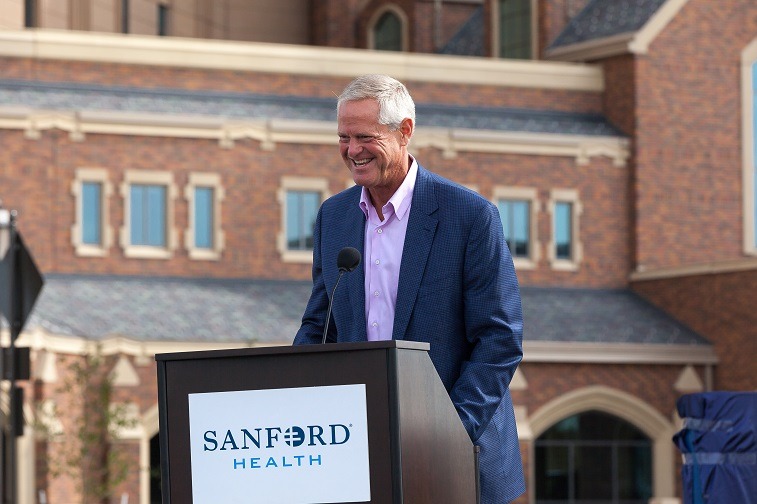
Sanford Health CEO out after two decades following mask controversy

Sanford Health, CEO Kelby Krabbenhoft part ways
  • Sanford Health’s CEO Kelby Krabbenhoft is leaving the top exec role after almost 25 years, according to a Tuesday announcement from the Sioux Falls, South Dakota-based system, following controversial statements the outgoing CEO made about mask wearing during the coronavirus pandemic.

Krabbenhoft, who has served as CEO since 1996, sent an internal memo to Sanford’s 50,000 employees on Wednesday arguing wearing a mask would defeat its purpose, as he’d already contracted COVID-19 and was therefore immune for at least seven months, as first reported by Forum News Service.

Experts dispute, however, that people previously infected with the novel coronavirus are entirely immune, as the data is not yet definitiveOther Sanford executives sent an email to employees Friday recommending mask wearing and contradicting Krabbenhoft’s claims.

On the heels of the news, Sanford’s board of trustees and Krabbenhoft have now “mutually agreed to part ways,” according to the release. The turnover comes at an acutely crucial time for the major Midwest health system, as it signed a letter of intent last month to merge with Salt Lake City-based Intermountain Healthcare.

If the deal closes, the two would operate 70 hospitals and 435 clinics — many of which will be located in rural communities across the country — and insure 1.1 million people. The merger would form one of the nation’s largest nonprofit health systems with more than $13 billion in combined annual revenue. It’s expected to close in 2021, pending regulatory approvals.

While Intermountain CEO Marc Harrison is slated to lead the combined organization, Krabbenhoft was poised to serve as president emeritus. It’s unclear what the plans are now after Krabbenhoft’s exit.

Sanford, which operates 46 hospitals in 26 states, did not reply to requests for comment by time of publication.

Sanford Health CEO: I’ve had COVID-19, won’t wear a mask as ‘symbolic gesture’

Sanford Health CEO to be inducted into SD Hall of Fame

Sioux Falls, S.D.-based Sanford Health President and CEO Kelby Krabbenhoft shared his thoughts about having COVID-19 and why he won’t be wearing a mask in an email to health system staff, according to the Grand Forks Herald

In the 1,000-word email sent Nov. 18, Mr. Krabbenhoft said he had COVID-19, but he’s now back in his office working without a mask. He said he won’t be wearing a mask because doing so would only be a “symbolic gesture.” He considers himself immune from the virus.

“The information, science, truth, advice and growing evidence is that I am immune for at least seven months and perhaps for years to come, similar to that of chicken pox, measles, etc. For me to wear a mask defies the efficacy and purpose of a mask and sends an untruthful message that I am susceptible to infection or could transmit it,” Mr. Krabbenhoft wrote. “I have no interest in using masks as a symbolic gesture when I consider that my actions in support of our family leave zero doubt to my support of all 50,000 of you. My team and I have a duty to express the truth and facts and reality and not feed the opposite.” 

The CDC says those who have had COVID-19 should take steps to reduce the risk of spreading the virus, including wearing a mask in public places and staying at least 6 feet away from other people. 

In his email, Mr. Krabbenhoft argues the “on-again, off-again” use of masks is absurd. “Masks have been a symbolic issue that frankly frustrates me,” he wrote. 

“On the other hand, for people who have not contracted the virus and may acquire it and then spread it … it is important for them to know that masks are just plain smart to use and in their best interest,” Mr. Krabbenhoft wrote. 

The health system CEO concluded his letter by sharing his optimism for the future, noting that some Sanford Health workers would be among the first to get a COVID-19 vaccine once it is available. 

Sanford Health didn’t respond to Becker’s Hospital Review‘s request for comment by deadline. 

Read the Grand Forks Herald article here, which includes full text of the email Mr. Krabbenhoft sent to employees.

President-elect Biden announces coronavirus task force made up of physicians and health experts

Joe Biden Live Updates: President-Elect Talks Mask Wearing, Pandemic - The  New York Times

President-elect Joe Biden on Monday announced the members of his coronavirus task force, a group made up entirely of doctors and health experts, signaling his intent to seek a science-based approach to bring the raging pandemic under control.

Biden’s task force will have three co-chairs: Vivek H. Murthy, surgeon general during the Obama administration; David Kessler, Food and Drug Administration commissioner under Presidents George H.W. Bush and Bill Clinton; and Marcella Nunez-Smith, associate dean for health equity research at the Yale School of Medicine. Murthy and Kessler have briefed Biden for months on the pandemic.

Biden will inherit the worst crisis since the Great Depression, made more difficult by President Trump’s refusal to concede the election and commit to a peaceful transition of power. The Trump administration has not put forward national plans for testing, contact tracing and resolving shortages in personal protective equipment that hospitals and health-care facilities are experiencing again as the nation enters its third surge of the virus.

“Dealing with the coronavirus pandemic is one of the most important battles our administration will face, and I will be informed by science and by experts,” Biden said in a statement. “The advisory board will help shape my approach to managing the surge in reported infections; ensuring vaccines are safe, effective, and distributed efficiently, equitably, and free; and protecting at-risk populations.”

The United States is recording more than 100,000 new coronavirus cases a day and, on many days, more than 1,000 deaths, a toll expected to worsen during the crucial 10-week stretch of the transition. It remains unclear whether Trump or his top aides will oversee and lead a robust response to the pandemic during the transition, which could further exacerbate the crisis Biden and Vice President-elect Kamala D. Harris inherit.

The 13-member task force also includes former Trump administration officials, including Rick Bright, former head of the Biomedical Advanced Research and Development Authority, who, after being demoted, spoke out against the administration’s approach to the pandemic. Luciana Borio, director for medical and biodefense preparedness on Trump’s National Security Council until 2019, is also on the panel.

The group includes several other prominent doctors:

· Ezekiel Emanuel, chair of the Department of Medical Ethics and Health Policy at the University of Pennsylvania.

· Atul Gawande, a surgeon at Brigham and Women’s Hospital and a professor at Harvard Medical School who is a prolific author.

· Michael T. Osterholm, director of the Center for Infectious Disease Research and Policy at the University of Minnesota.

· Eric Goosby, global AIDS coordinator under President Barack Obama and professor of medicine at the University of California at San Francisco School of Medicine.

· Celine R. Gounder, clinical assistant professor of medicine and infectious diseases at New York University’s Grossman School of Medicine.

· Julie Morita, executive vice president of the Robert Wood Johnson Foundation, a philanthropy focused on health issues.

· Loyce Pace, president and executive director of the Global Health Council, a U.S.-based nonprofit organization dedicated to global health issues.

· Robert Rodriguez, professor of emergency medicine at the UCSF School of Medicine.

Rebecca Katz, director of the Center for Global Health Science and Security at Georgetown University Medical Center, and Beth Cameron, director for global health security and biodefense on the White House National Security Council during the Obama administration, are serving as advisers to the transition task force.

Task force members will work with state and local officials to craft public health and economic policies to address the virus and racial and ethnic disparities, while also working to reopen schools and businesses, the transition team said in a news release.

While the makeup of the task force garnered widespread praise, Peter Hotez, dean of the National School of Tropical Medicine at the Baylor College of Medicine, said the group needs more geographic diversity.

“They are all from the Acela corridor or the [San Francisco] Bay Area,” he said. “Who is going to be the field marshal or the supreme allied commander who goes into middle of the country and get this done? The coasts are doing okay but the red states are being hammered and the deaths are going to be extraordinary. There needs to be a frank reckoning between leaders of the two parties, to say we cannot let this happen.”

Public health experts said Biden should use the transition to provide leadership as the pandemic continues through a deadly stretch and begin communicating a strong national message.

“Clearly from the election outcomes, half the country doesn’t believe we’re in a crisis,” said Kavita Patel, a fellow at the Brookings Institution who worked on health policy in the Obama administration. Biden and Harris “have an incredible platform that can be used for communication. The country needs clear daily briefings that we thought we’d get from the White House coronavirus task force. They have an incredible platform, if not an official platform.”

Biden plans to call Republican and Democratic governors to ask for their help in developing a consistent message from federal and state leaders, according to three Biden advisers who spoke on the condition of anonymity because they were not authorized to speak publicly about these matters. He will urge governors to adopt statewide mask mandates and to provide clear public health guidance to their constituents, including about social distancing and limiting large gatherings.

The task force will have subgroups that focus on issues related to the response, including testing, vaccine distribution and personal protective equipment, according to two people familiar with the plans who spoke on the condition of anonymity to reveal plans that were not yet public.

In his victory speech Saturday, Biden addressed challenges in bringing the pandemic under control.

We cannot repair the economy, restore our vitality or relish life’s most precious moments — hugging a grandchild, birthdays, weddings, graduations, all the moments that matter most to us — until we get this virus under control,” Biden said. “That plan will be built on a bedrock of science. It will be constructed out of compassion, empathy and concern. I will spare no effort — or commitment — to turn this pandemic around.”

Yet the plans Biden laid out on the campaign trail are set to collide with political realities. That includes a deeply divided nation in which more than 71 million people voted for Trump and the possibility of having to navigate a Republican-controlled Senate disinclined to support a greater federal role in testing and contact tracing, among other responsibilities now left mostly to the states.

Biden’s most ambitious plans will require significant congressional funding. Senate Majority Leader Mitch McConnell (R-Ky.) has said he would like to pass new coronavirus relief measures during Congress’s lame-duck session, and Congress faces a Dec. 11 government funding deadline. Biden and his team are poised to begin engaging with congressional Democrats on their priorities.

Biden’s plans include dramatically expanding testing and building a U.S. public health jobs corps to have 100,000 Americans conduct contact tracing. They also include ramping up production of personal protective equipment and implementing a vaccine distribution plan.

Murthy, who served as the 19th U.S. surgeon general, is a physician whose nomination was stalled in the Senate for more than a year because of his view that gun violence is a public health issue. Three months into the Trump administration, he was replaced as “the nation’s doctor” with more than two years left on his four-year term.

In 2016, he wrote a landmark report on drug and alcohol addiction, which put that condition alongside smoking, AIDS and other public health crises that previous surgeons general addressed. The report called the addiction epidemic “a moral test for America.” Murthy’s office sent millions of letters to doctors asking for their help to combat the opioid crisis.

The son of immigrants from India, he earned medical and MBA degrees at Yale before joining the faculty at Harvard Medical School, where his research focused on vaccine development and the participation of women and minorities in clinical trials.

After leaving his post as surgeon general, he wrote a book on loneliness and social isolation, including their implications for health, that grew out of his conversations with people in clinical practice and as surgeon general.

Several public health officials celebrated Nunez-Smith’s leadership role on the task force. Her research focuses on promoting health and health-care equity in marginalized populations, according to her Yale biography. She has also studied discrimination that patients endure in the health-care system — expertise that many said was welcome in an epidemic that is disproportionately affecting people of color.

Kessler was FDA commissioner from 1990 to 1997, during the George H.W Bush and Clinton administrations. He is well-known for his attempts to regulate cigarettes — an effort that resulted in a loss in the Supreme Court, which ruled that the agency did not have the authority. That prompted Congress to pass a law, enacted in 2009, that explicitly gave the agency that power.

Kessler, a pediatrician and lawyer, worked at the FDA to accelerate AIDS treatments and on food and nutrition issues. He oversaw the FDA’s development of standardized nutrition labels and notably ordered the seizure of orange juice labeled “fresh” because it was made from concentrate. He has written several books on diet, mental illness and other topics, and has served as dean of the medical schools at Yale and UCSF.

Top Trump adviser bluntly contradicts president on covid-19 threat, urging all-out response

https://www.washingtonpost.com/health/2020/11/02/deborah-birx-covid-trump/

“This is not about lockdowns. … It’s about an aggressive balanced approach that is not being implemented,” says internal White House report that challenges many of Trump’s pronouncements.

A top White House coronavirus adviser sounded alarms Monday about a new and deadly phase in the health crisis, pleading with top administration officials for “much more aggressive action,” even as President Trump continues to assure rallygoers that the nation is “rounding the turn” on the pandemic.

“We are entering the most concerning and most deadly phase of this pandemic … leading to increasing mortality,” said the Nov. 2 report from Deborah Birx, coordinator of the White House coronavirus task force. “This is not about lockdowns — it hasn’t been about lockdowns since March or April. It’s about an aggressive balanced approach that is not being implemented.”

Birx’s internal report, shared with top White House and agency officials, contradicts Trump on numerous points: While the president holds large campaign events with hundreds of attendees, most without masks, she explicitly warns against them. While the president blames rising cases on more testing, she says testing is “flat or declining” in many areas where cases are rising. And while Trump says the country is “rounding the turn,” Birx notes that the country is entering its most dangerous period yet and will see more than 100,000 new cases a day this week.

Through a spokesperson, Birx did not respond to a request for comment.

Other health experts, including Anthony S. Fauci, director of the National Institute of Allergy and Infectious Diseases, have warned of record surges in cases and hospitalizations as the United States records more than 9 million cases and 230,000 deaths.

“We’re in for a whole lot of hurt,” Fauci told The Washington Post late Friday, predicting a long and potentially deadly winter unless there’s an “abrupt change” — prompting Trump to suggest that he planned to fire the scientist after the election.

But Birx’s daily missives go further, revealing how much the administration’s internal reports are in direct conflict with Trump’s public pronouncements that downplay the seriousness of the threat and erroneously suggest that few people are dying. They also speak to the increasing desperation of health officials to spotlight the risks of a pandemic that is forecast to take thousands more lives as the weather worsens unless people change their behaviors. Some officials are also concerned about recouping their reputations in a post-Trump era.

The increasingly dire tone of Birx’s reports has gotten little traction, according to an administration official who works with her and spoke on the condition of anonymity to share sensitive information. “She feels like she’s being ignored,” the official said.

Birx’s message “has been urgent for weeks,” said another administration official, “as has the plea for the administration to ask the American people to use masks, avoid gatherings and socially distance, basically since it became apparent that we were heading into a third surge.”

The report hits hard on the worsening situation: “Cases are rapidly rising in nearly 30 percent of all USA counties, the highest number of county hotspots we have seen with this pandemic,” it said. “Half of the United States is in the red or orange zone for cases despite flat or declining testing.”

Sounding a similar theme to past reports, it calls for “much more aggressive action from messaging, to testing, to surging personnel around the country before the crisis point.”

What is “essential at this time point,” the report said, is “consistent messaging about uniform use of masks, physical distancing and hand washing with profound limitation on indoor gatherings especially with family and friends.”

It adds: “This is about empowerment Americans with the knowledge and data for decision-making to prevent community spread and save lives.”

The president appears unpersuaded by such messages, convinced by new medical adviser Scott Atlas, a neuroradiologist with no infectious-disease experience, that allowing healthy people to return to daily activities without restrictions will hasten herd immunity and bolster the economy, say some advisers who spoke on the condition of anonymity because they were not authorized to speak publicly.

Trump plans to hold a large indoor gathering for 300 to 400 guests at the White House on Tuesday to watch the election returns, only a few weeks after a White House event to announce his Supreme Court nominee Amy Coney Barrett became a superspreader event.

White House communications director Alyssa Farah disputed the report’s suggestion that the administration’s response has been inadequate to the crisis. She said the White House has “significantly increased” the U.S. national stockpile to ensure the country has sufficient personal protective equipment; bought 150 million coronavirus tests and distributed them to the most vulnerable populations, including nursing homes, assisted-living facilities and Native American tribal areas; and sent special teams to states and nursing homes with the most cases.

In addition, she said, the administration continues to work to “safely rush therapeutics” to the sick and develop vaccines. “We are working around-the-clock to safely treat the virus and ultimately defeat it,” Farah said.

Birx’s report goes to pains to dispute Trump’s false claims that coronavirus cases are increasing only because of increases in testing. Monday’s report notes that although testing is flat, a rising number of tests are positive, suggesting “community spread is much worse than is evident by current [measurements].”

An earlier, Oct. 17 report sounded the same theme: It cited increasing daily hospital admissions, rising fatalities and emergency room visits, and bluntly stated, “this is not due to increased testing but broad and ever-increasing community spread.”

That report added these words highlighted in bold: “There is an absolute necessity of the Administration to use this moment to ask the American people to wear masks, physical distance and avoid gatherings in both public and private spaces.” On that day, Trump held two large rallies, according to his public schedule, one in Michigan and one in Wisconsin.

Birx’s report goes to pains to dispute Trump’s false claims that coronavirus cases are increasing only because of increases in testing. Monday’s report notes that although testing is flat, a rising number of tests are positive, suggesting “community spread is much worse than is evident by current [measurements].”

An earlier, Oct. 17 report sounded the same theme: It cited increasing daily hospital admissions, rising fatalities and emergency room visits, and bluntly stated, “this is not due to increased testing but broad and ever-increasing community spread.”

That report added these words highlighted in bold: “There is an absolute necessity of the Administration to use this moment to ask the American people to wear masks, physical distance and avoid gatherings in both public and private spaces.” On that day, Trump held two large rallies, according to his public schedule, one in Michigan and one in Wisconsin.

Officials describe Birx as frustrated with Atlas’s growing influence. She has challenged his views in task force meetings, suggesting that reopening society without any restrictions would lead to thousands of deaths.

In recent weeks, Birx has crisscrossed the country, traveling to dozens of virus hot spots, where she has urged state and local officials to mandate masks, close bars and restaurants and encourage distancing.

Birx is said to be close to Vice President Pence, but he’s been on the road campaigning in recent weeks, taking his attention away from the coronavirus, according to a senior administration official who spoke on the condition of anonymity to share internal discussions.

Unlike Fauci, a highly regarded civil servant who Trump has criticized as a “Democrat,” Birx was chosen by the administration to helm the response and has been lavishly praised in the past by Trump.

Fauci said in his interview Friday that he and Birx lost the president’s ear as Trump worried increasingly about a sputtering economy and his reelection prospects.

“They needed to have a medical message that was essentially consistent with what they were saying, and one of the ways to say: ‘The outbreak is over. [Mitigation strategies are] really irrelevant because it doesn’t make any difference. All you need to do is prevent people from dying and protect people in places like the nursing homes,’ ” Fauci said.