The pandemic isn’t hurting health care companies

https://www.axios.com/newsletters/axios-vitals-d0f987be-1f6b-4b4b-bcb6-0132dc0e7e3f.html?utm_source=newsletter&utm_medium=email&utm_campaign=newsletter_axiosvitals&stream=top

The pandemic isn't dampening Wall Street's view of health care - Axios

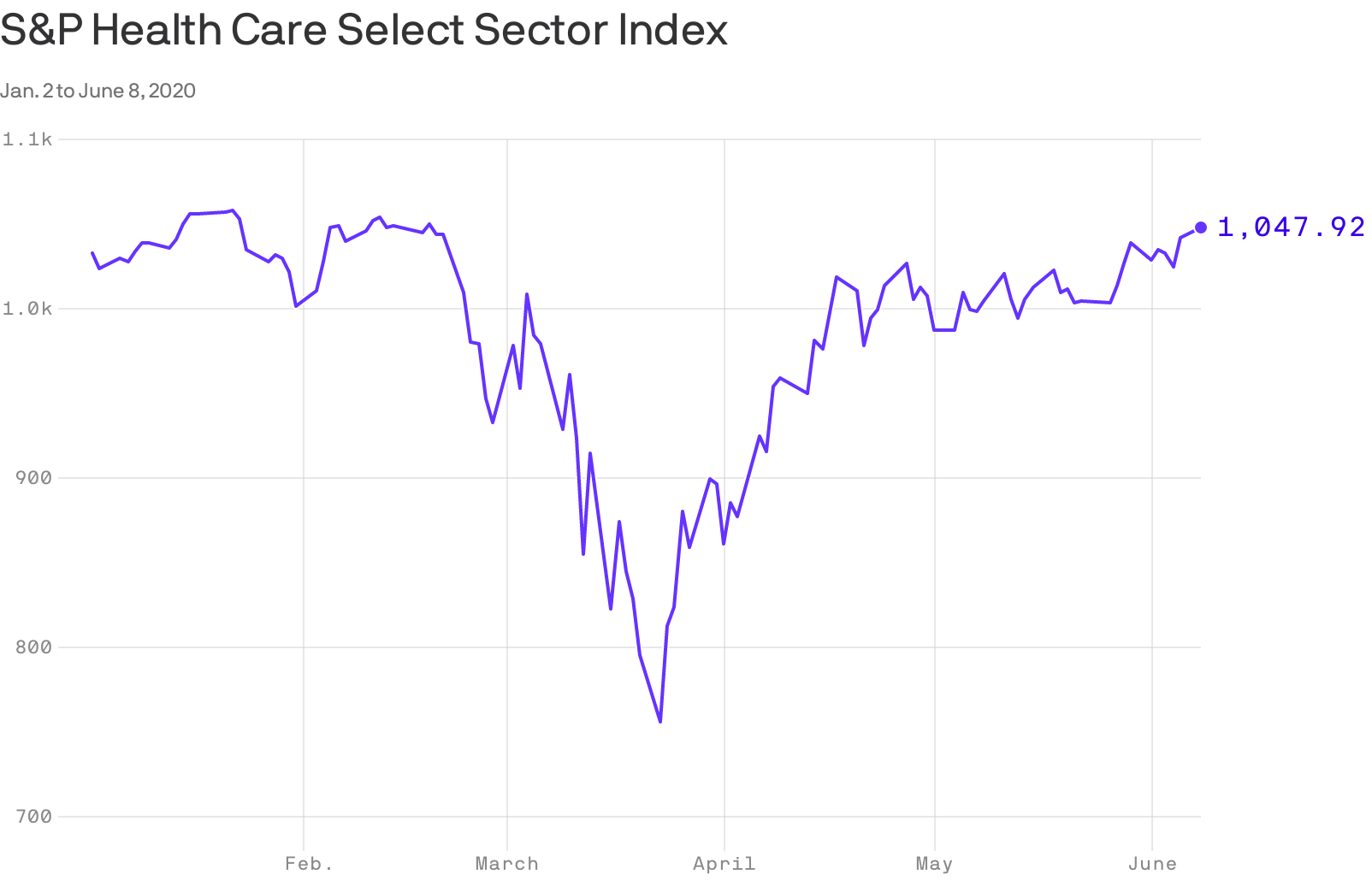
The S&P index of top health care companies finished Monday higher than where it opened the year, Axios’ Bob Herman reports.

The big picture: A global coronavirus pandemic, social unrest, mass unemployment, and the halting of medical procedures haven’t been enough to derail Wall Street’s rosy view of the health care industry.

Where things stand: The coronavirus started to affect the economy toward the tail end of the first quarter, but the health care industry was relatively unscathed.

  • Among the 109 publicly traded health care companies tracked by Axios, first-quarter profits exceeded $50 billion, good for a 7.4% net profit margin.
  • Pharmaceutical companies and health insurers generated the highest returns. Wall Street believes drug companies stand to benefit from potential coronavirus treatments or vaccines.
  • The stock price of Gilead Sciences, for example, is up 18% so far this year, partially on the assumption its coronavirus drug, remdesivir, will produce billions of dollars of revenue — even though the drug has showed only modest benefit for patients.

Between the lines: The second quarter likely will be worse, as the brunt of the coronavirus lockdown was felt in April and May. But normal operations have already started resuming for some health care sectors, regardless of the virus’ spread.


Chart of the Day: The Dire State of State Tax Revenues

https://www.thefiscaltimes.com/2020/06/02/Chart-Day-Dire-State-State-Tax-Revenues

Chart of the Day: The Dire State of State Tax Revenues | The ...

Lucy Dadayan of the Urban-Brookings Tax Policy Center breaks down the good, the bad and the ugly of the fiscal crisis facing states as the coronavirus pandemic crushes revenues and raises costs.

“Prior to the onset of the COVID-19 pandemic, most states were generating solid revenue growth. And many built up robust rainy day funds. But the pandemic has largely wiped out earlier revenue gains and most states now anticipate substantial revenue shortfalls for the current fiscal year and for fiscal year 2021,” she writes.

The good: Preliminary April tax revenue data show a steep drop in estimated and final annual tax payments as the tax-filing deadline got pushed back from April 15 to July 15. But taxes withheld from paychecks grew in 17 states compared to April 2019. “Tax withholding is usually a better indicator of the current strength of the economy and of the path for personal income tax revenue because it comes largely from current wages,” Dadayen explains. On the other hand, 16 states reported declines of less than 10%, while five states posted double-digits drops, so the bright spots are limited.

The bad: “Declines in sales tax revenues have been fast, steep, and widespread across the states,” Dadayen writes. How steep? April sales tax revenues fell by 16% across 42 states for which the Tax Policy Center has complete data. Twenty-three states reported double-digit declines, while just five states reported year-over-year growth. And since the April data mostly reflect March sales, the May numbers are likely to be even worse.

The ugly: For the fiscal year so far, total state tax revenue has fallen sharply — and next year is expected to be worse. “With two months remaining in the fiscal year for 46 states, total state tax revenues are now down about $57 billion, compared to last year,” Dadayen writes.

After the sharp pandemic-related plunge in April, tax revenues have fallen in 34 states compared to 2019 and risen in 12. (New York, the state hit hardest by the virus, is surprisingly among those dozen, but Dadayen says that’s only because its fiscal year 2020 ended in March, so April’s devastation isn’t reflected in the data. The state reported that net taxes and fees collected in April, the first month of its new fiscal year, fell by 69% compared with April 2019.)

Chart of the Day: The Dire State of State Tax Revenues | The ...


A Third of Unemployment Benefits Haven’t Been Paid Out: Report

https://www.thefiscaltimes.com/2020/06/02/Third-Unemployment-Benefits-Haven-t-Been-Paid-Out-Report

A Third of Unemployment Benefits Haven't Been Paid Out: Report

The U.S. Treasury paid out $146 billion in jobless benefits in the three months ending in May as tens of millions of Americans lost their jobs due to the coronavirus pandemic. Although the number is massive – larger than all of the unemployment benefits provided during the depths of the Great Recession in 2009 – it’s smaller than it should have been, according to a new analysis by Bloomberg News. Crunching the numbers on weekly unemployment filings and average claim size, Bloomberg found that total jobless benefits should have come to roughly $214 billion during that time.

“The estimated gap of some $67 billion shows how emergency efforts to boost payments, and deliver them via creaking state-level systems, are lagging the needs of a jobs crisis that’s seen more than 40 million people file for unemployment as the economy shut down,” Bloomberg’s Shawn Donnan and Catarina Saraiva wrote Tuesday.

A tough calculation: Although it’s hard to put a precise number on the shortfall – the Labor Department pushed back against the method used by Bloomberg to develop its estimate – there is general agreement that there are many people who still haven’t received the unemployment assistance they are entitled to. “There’s a lot more money that should have gone out that has not gone out,” said Jay Shambaugh, an economist at the Brookings Institution who has been studying the issue.

And Bloomberg says its analysis likely provides a conservative estimate of the shortfall. Some states are still working through backlogs of unemployment claims – Texas alone is waiting to verify nearly 650,000 cases – and more than 7 million people are still owed retroactive benefits under the Pandemic Unemployment Assistance program for independent contractors.

Why it matters: In addition to the unnecessary suffering the delays are causing, the shortfall is reducing the positive economic effect that unemployment benefits are intended to provide. “On paper the U.S. strategy is very generous,” Ernie Tedeschi, a former U.S. Treasury economist now at Evercore ISI, told Bloomberg. “But that generosity on paper is meaningless if it doesn’t translate into actual money in people’s pockets when they need it.”

Diane Swonk, chief economist at the accounting firm Grant Thornton, said she is worried that lawmakers are experiencing “fiscal fatigue” as the crisis wears on, risking a falloff in aid that could prolong the recession. “We’re really talking about an economy that is going to be operating at a fraction of its capacity for a long period of time,” she told Bloomberg.


Sluggish patient volume could jeopardize hospitals repaying advanced Medicare funds, report suggests

https://www.healthcaredive.com/news/outpatient-visits-rebounding-transunion-report/578894/

CMS Suspends Advance Payment Program to Clinicians for COVID-19

Dive Brief:

  • Though hospital volumes are expected to remain below pre-pandemic levels for quite some time, rebounding outpatient visits seem to be outpacing those for inpatient care or emergency department visits, according to a Transunion Healthcare survey of more than 500 hospitals.
  • During the week of May 10-16, outpatient visits were down 31% and emergency visits were down 40% compared to pre-COVID-19 levels. Inpatient volumes were down 20% and continue to trend upward, though at a slower rate than outpatient or ER visit volumes. Outpatient visits plunged between April 5 and 11, hitting a bottom of 64% down from typical volume.​
  • Baby boomers (born between 1944 and 1964) and the what the report calls the silent generation (born before 1944) are returning to ERs faster than younger generations. Millennials (born between 1980 and 1994) and Generation Z (born between 1995 and 2002) patients, however, are driving positive trends in inpatient and outpatient rebounds.

Dive Insight:

The report echos several others suggesting patients are still cautious about returning to the hospital and other care settings. The Kaiser Family Foundation found that the pandemic has forced nearly half of patients to postpone medical care. About 32% of those who have postponed care said they would get the service in the next three months and 10% said they will do so in four months to a year.

The overall sluggish outlook led Transunion to suggest patient volumes may not be restored to pre-pandemic levels soon enough to both sustain operational and clinical functions and repay advanced Medicare payments that many systems large and small have taken advantage of from CMS.

Because of the demographic trends, systems may have greater success scheduling appointments by checking in first with younger generations, the report suggests.

“We think as providers are beginning to really drive their patient engagement strategies that it’s best if they start reaching out to them, because it’s likely they’ll be willing to re-enter the care setting,” John Yount, vice president for TransUnion Healthcare, told Healthcare Dive.

Providers are taking steps to ease patient fears upon returning to medical settings by implementing temperature checks, spacing out waiting rooms to allow for social distancing and taking other safety measures.

But a sluggish recovery is still likely as patients plan to continue delaying care, especially older adults who are at higher risk for COVID-19 and in some states have been told to continue following stay at home orders.

The slowest return to growth in emergency room visits raises concerns that patients who need emergency care may be avoiding hospital settings due to COVID-19 fears, according to the report.

Older patients are leading the pack in returning to ERs, and they also experienced the largest decline in inpatient volumes from March 1-7 and April 5-11.

Comparatively, younger generations had smaller declines in visit activity overall and are returning to care settings faster, Yount said.

“These deferrals will have implications for both patients and providers — high-acuity and chronically-ill patients risk waiting too long to seek care, and a continued reduction in visit volume will further amplify existing financial challenges for hospitals,” David Wojczynski, president of TransUnion Healthcare, said in a statement.


Fitch Q2 outlook for nonprofit hospitals: ‘worst on record’

https://www.healthcaredive.com/news/fitch-analysts-hospital-worries-FY-2020/577875/
7 Ways to Survive a Cash Flow Crunch | SCORE

UPDATE: May 15, 2020: This article has been updated to include information from a Moody’s Investors Service report.

From the Mayo Clinic to Kaiser Permanente, nonprofit hospitals are posting massive losses as the coronavirus pandemic upends their traditional way of doing business.

Fitch Ratings analysts predict a grimmer second quarter: “the worst on record for most,” Kevin Holloran, senior director for Fitch, said during a Tuesday webinar.​

Over the past month, Fitch has revised its nonprofit hospital sector outlook from stable to negative. It has yet to change its ratings outlook to negative, though the possibility wasn’t ruled out.

Some have already seen the effects. Mayo estimates up to $3 billion in revenue losses from the onset of the pandemic until late April — given the system is operating “well below” normal capacity. It also announced employee furloughs and pay cuts, as several other hospitals have done.

Data released Tuesday from health cost nonprofit FAIR Health show how steep declines have been for larger hospitals in particular. The report looked at process claims for private insurance plans submitted by more than 60 payers for both nonprofit and for-profit hospitals.

Facilities with more than 250 beds saw average per-facility revenues based on estimated in-network amounts decline from $4.5 million in the first quarter of 2019 to $4.2 million in the first quarter of 2020. The gap was less pronounced in hospitals with 101 to 250 beds and not evident at all in those with 100 beds or fewer.

Funding from federal relief packages has helped offset losses at those larger hospitals to some degree.

Analysts from the ratings agency said those grants could help fill in around 30% to 50% of lost revenues, but won’t solve the issue on their own.

They also warned another surge of COVID-19 cases could happen as hospitals attempt to recover from the steep losses they felt during the first half of the year.

Anthony Fauci, the nation’s top infectious disease expert, warned lawmakers this week that the U.S. doesn’t have the necessary testing and surveillance infrastructure in place to prep for a fall resurgence of the coronavirus, a second wave that’s “entirely conceivable and possible.”

“If some areas, cities, states or what have you, jump over these various checkpoints and prematurely open up … we will start to see little spikes that may turn into outbreaks,” he told a Senate panel.

That could again overwhelm the healthcare system and financially devastate some on the way to recovery.

“Another extended time period without elective procedures would be very difficult for the sector to absorb,” Holloran said, suggesting if another wave occurs, such procedures should be evaluated on a case-by-case basis, not a state-by-state basis.

Hospitals in certain states and markets are better positioned to return to somewhat normal volumes later this year, analysts said, such as those with high growth and other wealth or income indicators. College towns and state capitols will fare best, they said.

Early reports of patients rescheduling postponed elective procedures provide some hope for returning to normal volumes.

“Initial expectations in reopened states have been a bit more positive than expected due to pent up demand,” Holloran said. But he cautioned there’s still a “real, honest fear about returning to a hospital.”

Moody’s Investors Service said this week nonprofit hospitals should expect the see the financial effects of the pandemic into next year and assistance from the federal government is unlikely to fully compensate them.

How quickly facilities are able to ramp up elective procedures will depend on geography, access to rapid testing, supply chains and patient fears about returning to a hospital, among other factors, the ratings agency said.

“There is considerable uncertainty regarding the willingness of patients — especially older patients and those considered high risk — to return to the health system for elective services,” according to the report. “Testing could also play an important role in establishing trust that it is safe to seek medical care, especially for nonemergency and elective services, before a vaccine is widely available.”

Hospitals have avoided major cash flow difficulties thanks to financial aid from the federal government, but will begin to face those issues as they repay Medicare advances. And the overall U.S. economy will be a key factor for hospitals as well, as job losses weaken the payer mix and drive down patient volumes and increase bad debt, Moody’s said.

Like other businesses, hospitals will have to adapt new safety protocols that will further strain resources and slow productivity, according to the report.​

Another trend brought by the pandemic is a drop in ER volumes. Patients are still going to emergency rooms, FAIR Health data show, but most often for respiratory illnesses. Admissions for pelvic pain and head injuries, among others declined in March.

“Hospitals may also be losing revenue from a widespread decrease in the number of patients visiting emergency rooms for non-COVID-19 care,” according to the report. “Many patients who would have otherwise gone to the ER have stayed away, presumably out of fear of catching COVID-19.”


Hospitals to face bumpy recovery with depressed margins into 2021, S&P predicts

https://www.healthcaredive.com/news/SP-ratings-hospital-margins-historic-lows-until-2021/578815/

April was the worst month ever for hospital operating margins

Dive Brief:

  • Despite rebounding patient volumes at some health systems, an overall slow and bumpy recovery period is most likely to last into next year, according to analysts with S&P Global Ratings. Operating margins will remain below historic levels for the rest of 2020 and into early 2021.
  • The ratings agency took negative action against companies in health sub-sectors facing more sudden and dramatic declines in business and now face less certain paths to recovery than others, such as dental companies, along with physical therapy and ambulatory surgery centers.
  • Medical staffing and physician groups were also downgraded or had their outlooks revised, due to major declines in emergency room and doctors office visits​ coupled with declining demand for anesthesia and radiology services related to delayed surgeries.

Dive Insight:

Federal relief grants are helping offset major financial losses for some health systems in the short-term, but factors like a second surge causing another total lockdown, rising unemployment and hesitancy from patients as they return to medical settings make long-term prospects unpredictable.

S&P Global Ratings said in a report this week that it took 36 negative actions in health services companies during the pandemic. The most affected sub-sector was dental companies. It also changed outlooks on ambulatory surgery centers given significant volume declines.

Hospitals and home healthcare were rated at moderate to high financial risk, though analysts expect those businesses to recover faster due to the more essential nature of their services, according to the report. And in the short-term, government relief funds will help bolster hospitals’ liquidity as they attempt to return to normal operations and recover from steep losses.

Delayed elective care that’s just restarting in some states led most hospitals to the financial fallout. But even hospitals treating a large number of COVID-19 patients will be hurt, as these patients are expensive to treat due to higher supply and labor costs, the report said.

It also found that nonprofit and for-profit operators could fare differently in their financial recoveries. Non-profit hospitals generally have larger cash reserves than for profit systems, which rely instead almost exclusively on cash flow and borrowings for liquidity.

Providers are relying specifically on the Coronavirus Aid, Relief and Economic Security Act which allocated $100 billion for providers that they don’t have to pay back, though there has been some criticism about how the money was distributed and whether it advantages some providers over others.

Kaiser Family Foundation report found that CARES funding tends to favor for profit, higher margin hospitals with a higher mix of private payer revenue compared to those that rely on government payers such as Medicare and Medicaid.

Other legislation to help financially struggling health systems include advanced Medicare payments in the form of loans that must be paid back roughly four months after they are received.

The Paycheck Protection and Healthcare Enhancement Act passed in late April gave providers an additional $75 billion, though calculation and distribution methods have yet to be determined.

The U.S. House of Representatives also passed a $3 trillion bill dubbed the Health and Economic Recovery Omnibus Emergency Solutions (HEROES) Act that allocates $100 billion for provider reimbursement and creates special enrollment periods for Medicare and Affordable Care Act plans, though the Trump administration said it’s too soon for additional relief funding.

Lab companies were put in the moderate risk category, and seeing a “40% decline in lab tests net of COVID testing,” S&P said.

Still, it said despite the drop in overall testing for LabCorp and Quest Diagnostics, S&P predicted “their services to become even more important, and for their services to recover reasonably well as testing related to the pandemic continues to grow and as medical procedures and physician visits ramp-up through the rest of the year and into 2021.”


2M more Americans file new jobless claims, pushing coronavirus toll past 40M

https://finance.yahoo.com/news/coronavirus-covid-weekly-initial-jobless-claims-may-23-164848387.html

(Yahoo Finance/David Foster)

COVID-19’s impact on the U.S. labor market was in focus after the U.S. Labor Department released weekly initial jobless claims data Thursday morning.

Another 2.123 million Americans filed for unemployment benefits in the week ending May 23, exceeding economists’ expectations for 2.1 million initial jobless claims. The prior week’s figure was revised higher to 2.446 million from 2.438 million jobless claims. Over the past 10 weeks, more than 40 million Americans have filed for unemployment insurance.

Continuing claims, which lags initial jobless claims data by one week, totaled 21.05 million in the week ending May 16, down from the prior week’s record 24.91 million. Consensus estimates were for 25.68 million continuing claims for the week.

“This marked the first weekly decline in the [continuing claims] data since the end of February. Continuing claims are still up substantially relative to the pre-virus norms but it will be important to see if this recent weekly decline marks a turning point in the data,” J.P.Morgan wrote in a note Thursday. “Moves down in continuing claims generally suggest that the number of unemployed people is moving lower, but we also want to keep in mind that unemployed people might not be receiving unemployment insurance through the regular state programs.”

After hitting a record in the week ending March 28, the weekly initial jobless claims figure has been on a steady decline.

“Although initial claims are declining, the pace may only be plateauing. If UI claims remain in the millions for the next few weeks, it may signal that relaxed state-mandated restrictions alone aren’t enough to staunch the flow of unemployed Americans,” Glassdoor Senior Economist Daniel Zhao said in an email Thursday.

In the week ending May 23, California reported the highest number of jobless claims at an estimated 212,000 on an unadjusted basis, down from 244,000 in the previous week. New York had 192,000, down from 224,000. Florida reported 174,000 and Georgia had roughly 164,000 jobless claims.

Economists have been paying close attention to the Pandemic Unemployment Assistance (PUA) program figures, which include those who were previously ineligible for unemployment insurance such as self-employed and contracted workers.

In the week ending May 23, the Labor Department reported 1.19 million initial PUA claims, following 1.2 million in the week prior.

“The 2.2 million in new claims reported for last week was a reporting error: the actual number was closer to 1.2 million. More than a dozen states have not reported their initial PUA claims and could be a source of increase in coming weeks,” UBS economist Seth Carpenter explained in a note May 22.

The Bureau of Labor Statistics will release the May jobs report June 5, and the unemployment rate is expected to have skyrocketed to 19.5% from 14.7% in April.

“Since the May employment report reference period started, roughly 15.8mn initial jobless claims have been filed, 10.9mn through regular state programs and 4.9mn in PUA,” Nomura economist Lewis Alexander wrote in a note May 22.

The employment crisis in the U.S. will likely weigh on the economy for some time, according to Goldman Sachs.

“The U.S. unemployment crisis will not stand in the way of a near-term economic recovery but is also unlikely to go away quickly. Although the uncertainty is unusually large, we still see the U.S. unemployment rate around 8% in late 2021, well above the levels in most other advanced economies,” the firm wrote in a note Tuesday.

As of Thursday morning, there were 5.72 million coronavirus cases and 356,000 deaths worldwide, according to Johns Hopkins University data. In the U.S., there were 1.7 million cases and 100,400 deaths.


Boeing laying off 6,770 employees, with more to come

https://www.politico.com/news/2020/05/27/boeing-layoffs-coronavirus-284453

Boeing (BA) Layoffs Start With 6,770 Jobs in U.S. This Week ...

The numbers publicized Wednesday “represent the largest segment of layoffs” that are expected, a Boeing spokesperson said.

Boeing said Wednesday that nearly 7,000 of its U.S. employees will be involuntarily laid off, a bloodletting that is part of a plan for the aerospace giant to shrink its overall workforce by 10 percent amid the new aviation landscape created by Covid-19.

In addition, about 5,500 U.S. workers are being laid off voluntarily.

In a message to employees sent Wednesday, Boeing CEO Dave Calhoun said the pandemic’s impact “means a deep cut in the number of commercial jets and services our customers will need over the next few years, which in turn means fewer jobs on our lines and in our offices.”

“We have done our very best to project the needs of our commercial airline customers over the next several years as they begin their path to recovery,” Calhoun said. “I wish there were some other way.”

The numbers publicized Wednesday “represent the largest segment of layoffs” that are expected, a Boeing spokesperson said. “The several thousand remaining layoffs will come in additional tranches over the next few months.”

The coronavirus pandemic has crushed demand for passenger airline travel, and the Boeing spokesperson said its biggest workforce cuts are to “areas that are most exposed to the condition of our commercial customers,” but that “our defense, space and related services businesses will help us limit overall impact.”

In his message to workers, Calhoun pointed to some initial indications of recovery for the industry, saying some airlines are “reporting that reservations are outpacing cancellations on their flights for the first time since the pandemic started,” and a number of “countries and U.S. states are starting cautiously to open their economies again.”

Still, it will take years for the industry to “return to what it was just two months ago,” Calhoun said.

He said Boeing will need to work with airlines to “assure the traveling public that it can fly safe from infection.”

“We also will have to adjust our business plans constantly until the global pandemic stops whipsawing our markets in ways that are still hard to predict,” he said.

Later Wednesday, Boeing said it had restarted production of its beleaguered 737 MAX in Renton, Wash., after a monthslong suspension. The MAX has been grounded around the world since March 2019, following two fatal crashes.


Goldman Sachs Forecasts Unemployment To Peak At 25%, Remain High For Next Two Years

https://www.forbes.com/sites/sergeiklebnikov/2020/05/27/goldman-sachs-forecasts-unemployment-to-peak-at-25-remain-high-for-next-two-years/?utm_source=newsletter&utm_medium=email&utm_campaign=news&utm_campaign=news&cdlcid=#7fd6f24de01c

Goldman Sachs Forecasts Unemployment To Peak At 25%, Remain High ...

With the coronavirus pandemic wreaking havoc on the U.S. economy, the unemployment rate has skyrocketed, and it could remain high for the next two years as many job losses won’t recover quickly, Goldman Sachs says in a recent note.

KEY FACTS

Goldman expects the U.S. unemployment rate to peak at 25% amid the coronavirus pandemic, according to a recent note from its chief economist Jan Hatzius.

The national jobless rate is likely to remain high for longer than expected: While many workers are on “temporary layoff,” not all of them will be rehired quickly, the firm points out.

High unemployment will linger because of policies that discourage workers from returning to their jobs, Goldman says: “Compared with a European-style system that is more focused on job preservation [via wage subsidies], many more will thus have to find truly new jobs.”

Countries like the United States that rely on enhanced unemployment benefits have thus “created significant incentives against maintaining existing employment relationships,” which will weaken over time. 

A majority of American workers now get higher incomes from unemployment than they do from being employed, especially in low-wage sectors, Hatzius notes.

That will result in a situation where the U.S. jobless rate will stay around 12% by the end of 2020 and still be at 8% through 2021—“well above the levels in most other advanced economies,” Goldman’s top economist predicts.

CRUCIAL QUOTE

“We conclude that the U.S. unemployment crisis will not stand in the way of a near-term economic recovery but is also unlikely to go away quickly,” Hatzius summarized.

SURPRISING FACT

Unemployment rose to record highs in nearly every state last month: 43 of them surged to historic levels of joblessness in April, according to a recent breakdown from the Bureau of Labor Statistics.

BIG NUMBER: OVER 38 MILLION.

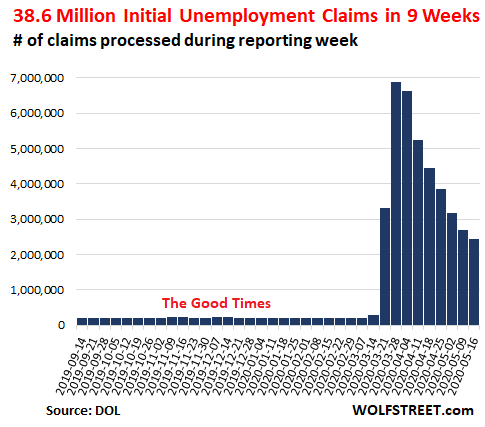
That’s how many Americans have filed for unemployment benefits over the past nine weeks, according to the Labor Department’s weekly jobless claims reports.

KEY BACKGROUND

The coronavirus has caused the highest rate of U.S. unemployment seen since the 1929 Great Depression. The national jobless rate hit a post-World War II era high, soaring to 14.7% last month—up from 4.4% in March. Before the outbreak hit the U.S. in late February, the unemployment rate had been at a 50-year low of 3.5%.


Many Jobs May Vanish Forever as Layoffs Mount

Week 9 of the Collapse of the U.S. Labor Market: Still Getting ...

With over 38 million U.S. unemployment claims in nine weeks, one economist says the situation is “grimmer than we thought.”

Even as restrictions on businesses began lifting across the United States, another 2.4 million workers filed for jobless benefits last week, the government reported Thursday, bringing the total to 38.6 million in nine weeks.

And while the Labor Department has found that a large majority of laid-off workers expect their joblessness to be temporary, there is growing concern among economists that many jobs will never come back.

“I hate to say it, but this is going to take longer and look grimmer than we thought,” Nicholas Bloom, an economist at Stanford University, said of the path to recovery.

Mr. Bloom, a co-author of an analysis of the coronavirus epidemic’s effects on the labor market, estimates that 42 percent of recent layoffs will result in permanent job loss.

“Firms intend to hire these people back,” Mr. Bloom said, referring to a recent survey of businesses done by the Federal Reserve Bank of Atlanta. “But we know from the past that these aspirations often don’t turn out to be true.”

In this case, the economy that comes back is likely to look quite different from the one that closed. If social distancing rules become the new normal, causing thinner crowds in restaurants, theaters and stores, at sports arenas, and on airplanes, then fewer workers will be required.

Large companies already expect more of their workers to continue to work remotely and say they plan to reduce their real estate footprint, which will, in turn, reduce the foot traffic that feeds nearby restaurants, shops, nail salons and other businesses.

Concerns about working in close quarters and too much social interaction could also accelerate the trend toward automation, some economists say.

New jobs, mostly at low wages — as delivery drivers, warehouse workers and cleaners — are being created. But many more jobs will vanish.

“I think we’re in for a very long haul,” Mr. Bloom said.

In the meantime, the Labor Department’s latest data on unemployment claims, for new filings last week, reflects the shutdown’s continuing damage to the labor force.

“The hemorrhaging has continued,” Torsten Slok, chief economist for Deutsche Bank Securities, said of the mounting job losses. He expects the official jobless rate for May to approach 20 percent, up from the 14.7 percent reported by the Labor Department for April.

A household survey from the Census Bureau released Wednesday suggested that the pain was widespread: 47 percent of adults said they or a member of their household had lost employment income since mid-March. Nearly 40 percent expected the loss to continue over the next four weeks.

In testimony before the Senate on Tuesday, the Federal Reserve chair, Jerome H. Powell, emphasized how devastating prolonged joblessness can be for individual households and for the economy.

“There is clear evidence that when you have a situation where people are unemployed for long periods of time, that can permanently weigh on their careers and their ability to go back to work,” he said.

Emergency relief and expanded unemployment benefits that Congress approved in late March have helped tide households over. Roughly three-quarters of people who are eligible for a $1,200 stimulus payment from the federal government have received it, according to the Treasury Department.

Workers who have successfully applied for unemployment benefits are getting the extra $600 weekly supplement from the federal government, and most states have finally begun to carry out the Pandemic Unemployment Assistance program, which extends benefits to freelancers, self-employed workers and others who don’t routinely qualify. The total number of new pandemic insurance claims reported, though, was inflated by nearly a million because of a data entry mistake from Massachusetts, according to the state’s Executive Office of Labor and Workforce Development.

Mistakes, lags in reporting and processing, and weeding out duplicate claims and reports have clouded the unemployment picture in some places.

What is clear, though, is that many states are still struggling to keep up with the overwhelming demand, drawing desperate complaints from jobless workers who have been waiting two months or more to receive their first benefit check. Indiana, Wyoming, Hawaii and Missouri are among the states with large backlogs of incompletely processed claims. Another is Kentucky, where nearly one in three workers are unemployed.

The $600 supplement has become a point of contention, drawing criticism from Republican politicians who object to the notion that some workers — particularly low-wage ones — are getting more money in unemployment benefits than they would on the job. But many have also lost their employer-provided health insurance and other benefits.

Sami Adamson, a freelance scenic artist for theater, events and television shows, received the letter with her login credentials to collect benefits from New Jersey only Monday, more than two months after she first applied.

She said her partner, who is in the same line of work, had filed for jobless benefits in New York and quickly received his payments.

By the time she heard from New Jersey, a design studio had called her for a temporary assignment. She plans to eventually reclaim the lost weeks of benefits, but for now she is helping to make face shields in a large warehouse where assembly-line workers are spaced apart, handling plastic, foam and elastic.

“I don’t think I’ll need aid for the next two or three weeks,” Ms. Adamson said, “but I’m not sure too far ahead of that.”

Nearly half of the states have yet to provide the additional 13 weeks of unemployment insurance that the federal government has promised to those who exhausted their state benefits. Workers in Florida — which provides just 12 weeks of benefits, the fewest anywhere — are particularly feeling this pinch. And while several states, including those that pay the average of 26 weeks, have offered additional weeks of coverage during the pandemic, Florida has not.

Small-business owners who were hoping the Paycheck Protection Program would enable them to keep their workers on the payroll contend the program is not operating as intended.

Roy Surdej, who owns Peaches Boutique in Chicago, applied for a loan after he was forced to close and the pandemic eliminated the season’s wave of proms, quinceañeras and graduation celebrations were canceled.

Under the program, the loan turns into a grant if he rehires the 100-person staff he had built up in February in anticipation of selling thousands of ruffled, sequined and strappy dresses during the spring rush. But he said that would be impossible, given the income he had lost and the restrictions that continue to pre-empt social gatherings.

“No way can I qualify for full forgiveness,” said Mr. Surdej, who said revenue had dried up. “It’s devastating for us,” he added, saying he had no clue when he would be able to reopen and begin rehiring. “If the government can’t adjust the dates to allow us to use it properly so we can survive, then I won’t use it.”

At the same time, the Congressional Budget Office warned that businesses able to use the Paycheck Protection Program might end up laying off workers when the program expires at the end of June.

Several states have warned workers that they risk losing their benefits if they refuse an offer to work. Federal rules enacted during the pandemic say that workers are not compelled to return to unsafe working conditions, but just what constitutes such conditions is not necessarily clear.

On Tuesday, Democratic senators sent a letter to Labor Secretary Eugene Scalia to “clarify the circumstances” so that workers are not “forced to choose between going back to work in unsafe conditions, or continuing to social distance and losing their only source of income.”

Workers with child care responsibilities can stay on unemployment if public schools are closed, but once the term ends, a lack of day care or summer programs is not considered a legitimate reason. Nor are self-imposed quarantines.

Officials can lift stay-at-home and business restrictions, but then what happens? “There are lingering concerns about health, family situations, kids not in school, relatives who are sick and needing care,” said Carl Tannenbaum, chief economist at Northern Trust. “There’s going to be a very slow and gradual process of reopening and restoring employment beyond just a declaration from the statehouse or the county seat.”