Sam Altman’s wild year offers 3 critical lessons for healthcare leaders in 2024

https://www.linkedin.com/pulse/sam-altmans-wild-year-offers-3-critical-lessons-2024-pearl-m-d–sj1kc/?trackingId=G7JzFhoHSvuK7BRMyo4gcQ%3D%3D

What a wild end to the year it was for Sam Altman, CEO of OpenAI.

In the span of five white-knuckle days in November, the head of Silicon Valley’s most advanced generative AI company was fired by his board of directors, replaced by not one but two different candidates, hired to lead Microsoft’s AI-research efforts and, finally, rehired back into his CEO position at OpenAI with a new board.

A couple weeks later, TIME selected him “CEO of the Year.” Altman’s saga is more than a tale of tech-industry intrigue. His story provides three valuable lessons for not only aspiring and current healthcare leaders, but also everyone who works with and depends on them.

1. Agree On The Goal, Define It, Then Pursue It Tirelessly

OpenAI’s governance structure presented a unique case: a not-for-profit board, whose stated mission was to protect humanity, found itself overseeing an enterprise valued at more than $80 billion. Predictably, this setup invited conflict, as the company’s humanitarian mission began to clash with the commercial realities of a lucrative, for-profit entity.

But there’s little evidence the bruhaha resulted from Altman’s financial interests. According to IRS filings, the CEO’s salary was only $58,333 at the time of his firing, and he reportedly owns no stock.

While Altman clearly knows the company needs to raise money to fund the creation of ever-more-powerful AI tools, his primary goal doesn’t appear to revolve around maximizing shareholder value or his own wealth.

In fact, I believe Altman and the now-disbanded board shared a common mission: to save humanity. The problem was that the parties were 180 degrees apart when it came to defining how exactly to protect humanity.

Altman’s path to saving humanity involved racing forward as fast as possible. As CEO, he understands generative AI’s potential to radically enhance productivity and alleviate threats like world hunger and climate change.

By contrast, the board feared that breakneck AI development could spiral out of control, posing a threat to human existence. Rather than perceiving AGI (artificial general intelligence) as a savior, much of the board worried that a self-learning system might harm humanity.

This dichotomy pitted a CEO intent on changing the world against a board intent to progress at a cautious, incremental pace.

For Healthcare Leaders: Like OpenAI, American healthcare leaders share a common goal. Be they doctors, insurers or government health agencies, all tout the importance of “value-based care” (VBC), which in general terms, constitutes a financial and care-delivery model based on paying healthcare professionals for the quality of clinical outcomes they achieve rather than the quantity of services they provide. But despite agreeing on the target, leaders differ on what it means and how best to accomplish it. Some think of VBC as “pay for performance,” whereby doctors are paid small incentives based on metrics around prevention and patient satisfaction. These programs fail because clinicians ignore the metrics without incentives and total health suffers.

Other leaders believe VBC means paying insurers a set, annual, upfront fee to provide healthcare to a population of patients. This, too, fails since the insurers turn around and pay doctors and hospitals on a fee-for-service basis, and implement restrictive prior authorization requirements to keep costs down.

Instead of making minor financial tweaks that keep falling short of the goal, leaders who want to transform American medicine must play to win. This will require them to move quickly and completely away from fee-for-service payments (which rewards volume of care) to capitation at the delivery-system level (rewarding superior results by prepaying doctors and hospitals directly without insurers playing the part of middlemen).

Like OpenAI’s former board members, today’s healthcare leaders are playing “not to lose.” They avoid making big changes because they fear the backlash of risk-averse providers. But anything less than all in won’t make a dent given the magnitude of problems. To be effective, leaders must make hard decisions, accept the risks and be confident that once the changes are in place, no one will want to go back to the old ways of doing things.

2. Hire Visionary Leaders Who Inspire Boldly

Many tech-industry commentators have drawn comparisons between Altman and Steve Jobs. Both leaders possess(ed) the rare ability to foresee a better future and turn their visions into reality. And both demonstrate(d) passion for exceeding people’s wants and expectations—not for their own benefit but because they believe in a greater mission and purpose.

Altman and Jobs are what I call visionary leaders, who push their organizations and people to accomplish remarkable outcomes few could’ve believed possible. These types of leaders always challenge conservative boards.

When the OpenAI board realized it’s hard to constrain a CEO like Sam Altman, they fired him.

On day one of that decision, the board might have assumed their action would protect humanity and, therefore, earn the approval of OpenAI’s employees. But the story took a sharp turn when nearly all the company’s 770 workers signed a letter to the board in support of Altman, threatening to quit unless (a) their visionary leader was brought back immediately and (b) the board resigned.

Five days after the battle began, the board was facing a rebellion and had little choice but to back down.

For Healthcare Leaders: The American healthcare system is struggling. Half of Americans say they can’t afford their out-of-pocket expenses, which max out at $16,000 for an insured family. American health is languishing with average life expectancy virtually unchanged since the start of this century. Maternal and infant mortality rates in the U.S. are double what they are in other wealthy nations. And inside medicine, burnout runs rampant. Last year, 71,000 physicians left the profession.

Visionary leadership, often sidelined in favor of the status quo, is crucial for transformative change. In healthcare, boards typically prioritize hiring CEOs with the ability to consolidate market control and achieve positive financial results rather than the ability to drive excellence in clinical outcomes. The consequence for both the providers and recipients of care proves painful.

Like OpenAI’s employees, healthcare professionals want leaders who are genuine, who have the courage to abandon bureaucratic safety in favor of innovative solutions, and who can ignite their passion for medicine. For a growing number of clinicians, the practice of medicine has become a job, not a mission. Without that spark, the future of medicine will remain bleak.

3. Embrace Transformative Technology

OpenAI’s board simultaneously promoted and feared ChatGPT’s potential. In this era of advanced technology, the dilemma of embracing versus restraining innovation is increasingly common.

The board could have shut down OpenAI or done everything in its power to advance the AI. It couldn’t, however, do both. When organizations in highly competitive industries try to strike a safe “balance,” choosing the less-contentious middle ground, they almost always fail to accomplish their goals.

For Healthcare Leaders: Despite being data-driven scientists, healthcare professionals often hesitate to embrace information technologies. Having been burned by tools like electronic healthcare records, which were designed to maximize revenue and not to facilitate medical care, their skepticism is understandable.

But generative AI is different because it has the potential to simultaneously increase quality, accessibility and affordability. This is where technology and skilled leadership must combine forces. It’s not enough for leaders to embrace generative AI. They must also inspire clinicians to apply it in ways that promote collaboration and achieve day-to-day operational efficiency and effectiveness. Without both, any other operational improvements will be incremental and clinical advances minimal at best.

If the boards of directors and other similar decision-making bodies in healthcare want their organizations to lead the process of change, they’ll need to select and support leaders with the vision, courage, and skill to take radical and risky leaps forward. If not, as OpenAI’s narrative demonstrates, they and their organizations will become insignificant and be left behind.


Michael Dowling: The most pressing question to start the year

The new year is always an ideal time for healthcare leaders to reflect on the state of our industry and their own organizations, as well as the challenges and opportunities ahead.

As the CEO of a large health system, I always like to reflect on one basic question at the end of each year: Are we staying true to our mission? 

Certainly, maintaining an organization’s financial health must always be a priority but we should also never lose sight of our core purpose. In a business like ours that has confronted and endured a global pandemic and immense financial struggles over the past several years, I recognize it’s increasingly difficult to maintain our focus on mission while trying to find ways to pay for rising labor and supply costs, infrastructure improvements needed to remain competitive and other pressures on our day-to-day operations. 

After all, the investments we need to make to promote community wellness, mental health, environmental sustainability and health equity receive little or no reimbursement, negatively impacting our financial bottom lines. During an era of unprecedented expansion of Medicaid and Medicare, we get less and less relief from commercial insurers, whose denial and delay tactics for reimbursing medical claims continue to erode the stability of many health systems and hospitals, especially those caring for low-income communities. 

Despite those enormous pressures, it’s imperative that we continue to support underserved communities, military veterans struggling with post-traumatic stress, and intervention programs that help deter gun violence and addiction. 

The list of other worthy investments goes on and on: charity care to uninsured or underinsured patients who can’t pay their medical bills, funding for emergency services that play such a critical role during public health emergencies, nutritional services for families struggling to put food on the table, programs that combat human trafficking and support women’s health, the LGBTQIA+ community and global health initiatives that aid Ukraine, the Middle East and other countries torn apart by war, famine and natural disasters. 

We must also recognize the key role of healthcare providers as educators. School-based mental health programs are saving lives by identifying children exhibiting suicidal behaviors, anger management issues and other troublesome behaviors. School outreach efforts have the added benefit of helping health systems and hospitals address their own labor shortages by introducing young people to career paths that will help shape the future healthcare workforce. 

Without a doubt, the “to-do” list of community health initiatives that support our mission is daunting. We can’t do it all alone, but as the largest employers in cities and towns across America, health systems and hospitals can serve as a catalyst to get all sectors of our society — government, businesses, schools, law enforcement, churches, social service groups and other community-based organizations — to recognize that “health” goes far beyond the delivery of medical care. 

The health of individuals, families and communities hinges on the prevalence of good-paying jobs, decent and affordable housing, quality education, access to healthy foods, medical care, transportation, clean air and water, low prevalence of crime and illicit drugs, and numerous other variables that typically depend on the zip codes where we live. Those so-called social determinants of health are the driving factors that enable communities and the people who live there to either prosper or struggle, resulting in disparities that are the underlying cause of why so many cities and towns across the country fall into economic decay and become havens for crime and hotbeds for gun violence, which shamefully is now the leading cause of death for children and adolescents. 

To revive these underserved communities, many of which are in our own backyards, we have to look at all of the socioeconomic issues they struggle with through the prism of health and use the collective resources of all stakeholders to bring about positive change. 

Health is how we work together to build a sense of community. Having a healthy community also requires everyone doing what they can to tone down the political rhetoric and social media-fueled anger that is polarizing our society. Health is bringing back a sense of civility and respect in our public discourse, and promoting the values of honesty, decency and integrity. 

As healthcare providers and respected business leaders, we should all make a New Year’s resolution to stay true to our mission and do what we can within our communities to bring oxygen to hope, optimism and a healthier future. 

The Tit for Tat Game in Healthcare produces No Winners

Tit for Tat battles in healthcare are nothing new. Last week, they were on full display.

  • Health insurers and drug manufacturers squared off in national ad campaigns accusing the other of complicity in keeping drug costs high.
  • The House Energy and Commerce and Ways and Means Committees held hearings challenging non-profit hospital tax exemptions as momentum builds for a new site neutral payment policy opposed by the American Hospital Association. In tandem, Indiana Republican Rep. Victoria Spartz reintroduced “Combatting Hospital Monopolies Act,”– a bill April 20 that would allow the FTC to enforce antitrust rules among the nation’s more than 2,900 nonprofit hospitals.

The intensity of these battles is likely to increase because healthcare affordability is a kitchen-table issue and the public’s paying attention.

Executive compensation in hospitals, drug companies and health insurers is a flashpoint: the disparity between pay packages for healthcare CEOs and their rank-and-file employees is widening. Books and documentaries about healthcare rogue operators like Theranos and Purdue draw wide audiences. And announcements like the Kaiser Permanente-Geisinger deal last week lend to the industry’s growing kinship with BIG BUSINESS.

The corporatization of U.S. healthcare has endangered its future.  The time has come to revisit its purpose, refresh its structure and re-organize its finances.

  • Revisit it’s purpose:
  • The modern health system has evolved through economic cycles, population growth, scientific explosion and shifting demand. Regulations, roles and money has followed. The integration of artificial intelligence is the next threshold in its evolution unlocking efficiencies heretofore unimagined and capabilities that enable self-care and customization. Might the system’s purpose shift from producing products and services for patients to enabling individuals to care for themselves and others more effectively? Might price and cost transparency in each sector be without pre-condition and barriers? And might the system’s true north be health and wellbeing rather than utilization and revenue growth?
  • Refresh its structure:
  • The system’s fundamental flaw is structural: the U.S. operates a health system of caregivers and facilities that serve its majority and a separate system of 3000 public health programs that serve the rest. Though long acknowledged, social determinants of health play second fiddle to specialized services to populations that are insured. The destination for the system must be health + social services, not health or human services, and the fiduciary role of its prominent non-profit institutions to steward the transition. In tandem, the system’s financing (through insurance) and delivery (through services and facilities) must necessarily be integrated so investments in prevention, population health management and care coordination are optimized.
  • Re-organize its finances:
  • The health system’s primary financing is derived primarily from direct government appropriations (vis a vis tax collections from individuals and employers) and profits earned by its operators and suppliers. Its capital investing is increasingly dependent on private equity that seeks profits in 5-6 years for its limited partner investors. In systems of the world with better outcomes and lower costs, government financing plays a bigger role balancing prevention and social services with the needs of the sick. The U.S. financing system rewards taking care of health problems after they’re manifest in hospitalization or medication management and insignificant investment elsewhere. Capitalizing innovation across the system is an imperative: otherwise, risk-taking by private investors in the system will default to short-term returns. And the public’s long-term wellbeing is compromised.

Most of the food fights in healthcare like last week’s revolve around each sector’s unique response to the three challenges above. That’s why they exist: to protect the interests of their members and advocate on their behalf. All believe their mission and vision is essential to the greater good and the moral high ground theirs. Some are imperiled more than others: not for profit, rural and safety net hospitals, long-term care operators, direct caregivers and public health programs at the top of this list.

Educating lawmakers is necessary but what’s needed is serious, objective forward-looking definition of the U.S. health system’s future. The tit for tat game will not solve anything. That’s where we are.

Paul

PS: Bipartisanship in Congress is rare.

Hospitals, particularly non-profit hospitals, may be the exception. Bipartisan headwinds are swelling and adversaries organizing. Members of Congress appear keen to assert more influence in how hospitals operate.

Price transparency, cost controls, site-neutral payments, charity care, pay equity and funding for non-patient care activity are on their radar. Hospitals, especially large not-for-profit multi-hospital systems, have joined drug manufacturers and pharmacy benefits managers as targets for reformers seeking lower cost and greater accountability.

As the debt ceiling is debated and FY24 federal budget is crafted, softening support for healthcare will take its toll across the industry and create unintended negative consequences for all.

Healthcare’s Wicked Problems

One of the great things about my job is getting the opportunity to talk with healthcare CEOs around the country on a regular basis.

Lately, every CEO I talk with tells me how hard it is to run a healthcare organization in 2023.

These are people with long experience, people who over time have pushed the right buttons and pulled the right levers to make their organizations successful and to give their communities the care they need.

Hearing these recent comments from CEOs takes us back to the concept of “wicked problems,” which we’ve referred to in the past, and suggests that the current hospital operating environment is overwhelmed by wicked problems.

As a reminder, the wicked problem concept was developed in 1973 by social scientists Horst Rittel and Melvin Webber.

Unlike math problems, wicked problems have no single, correct solution. In fact, a solution that improves one aspect of a wicked problem usually makes another aspect of the problem worse.

Poverty is a common example of a wicked problem.

According to Rittel and Webber, all wicked problems have these five characteristics:

  1. They are hard to define.
  2. It’s hard to know when they are solved.
  3. Potential solutions are not right or wrong, only better or worse.
  4. There is no end to the number of solutions or approaches to a wicked problem.
  5. There is no way to test the solution to a wicked problem—once implemented, solutions are not easily reversable, and those solutions affect many people in profound ways.

Healthcare is one of our nation’s critical wicked problems, and the broad and persistent effects of COVID have made that problem worse.

Like all wicked problems, the wicked problem of healthcare can be defined in many different ways and from many different perspectives.

If we were to frame the wicked problem of healthcare just in the context of hospitals and health systems coming off of their worst financial year in memory, it could look something like this:

Hospitals and health systems need to make a margin in order to carry out their “duty of care”—that is, their responsibility to improve health for communities, which increasingly include public health undertakings.

However, in 2022, more than half of hospitals in America had negative margins due largely to macroeconomic factors related to labor, inflation, utilization, and insufficient revenue growth.

The actions then needed to improve financial performance likely involve reducing labor costs and eliminating unprofitable services.

But these solutions in the hospital world are seen as another wicked problem, and actions taken to improve financial and clinical operations are often cautiously approached in order to protect the organization’s duty of care.

As you can see, the very actions to solve the wicked problem of provider healthcare may likely make aspects of the strategic problem worse.

Everyone reading this blog is dedicated to solving these and other wicked problems related to health and healthcare and the provision of sufficient care to the American community.

Solutions to healthcare’s wicked problems are never clear, and those solutions are not easily tested and eventually can affect many.

And in the wicked problem lexicon, once uncertain solutions have been implemented they are very hard to undo.

And healthcare’s many and varied dissatisfied stakeholders demand rapid solutions and then complain loudly when those solutions fall short, as any one solution inevitably will when the problem is as wicked as the current healthcare environment.

This is the new role of healthcare leaders: solvers of wicked problems.

What Hospital Systems Can Take Away From Ford’s Strategic Overhaul

On today’s episode of Gist Healthcare Daily, Kaufman Hall co-founder and Chair Ken Kaufman joins the podcast to discuss his recent blog that examines Ford Motor Company’s decision to stop producing internal-combustion sedans, and talk about whether there are parallels for health system leaders to ponder about whether their traditional strategies are beginning to age out.

Consumers are skeptical of “hospitals”—just not their own

https://mailchi.mp/89b749fe24b8/the-weekly-gist-february-17-2023?e=d1e747d2d8

Health systems have recently been the subject of high-profile media accusations that they prioritize “profits over patients”, as an unflattering New York Times series has framed it.

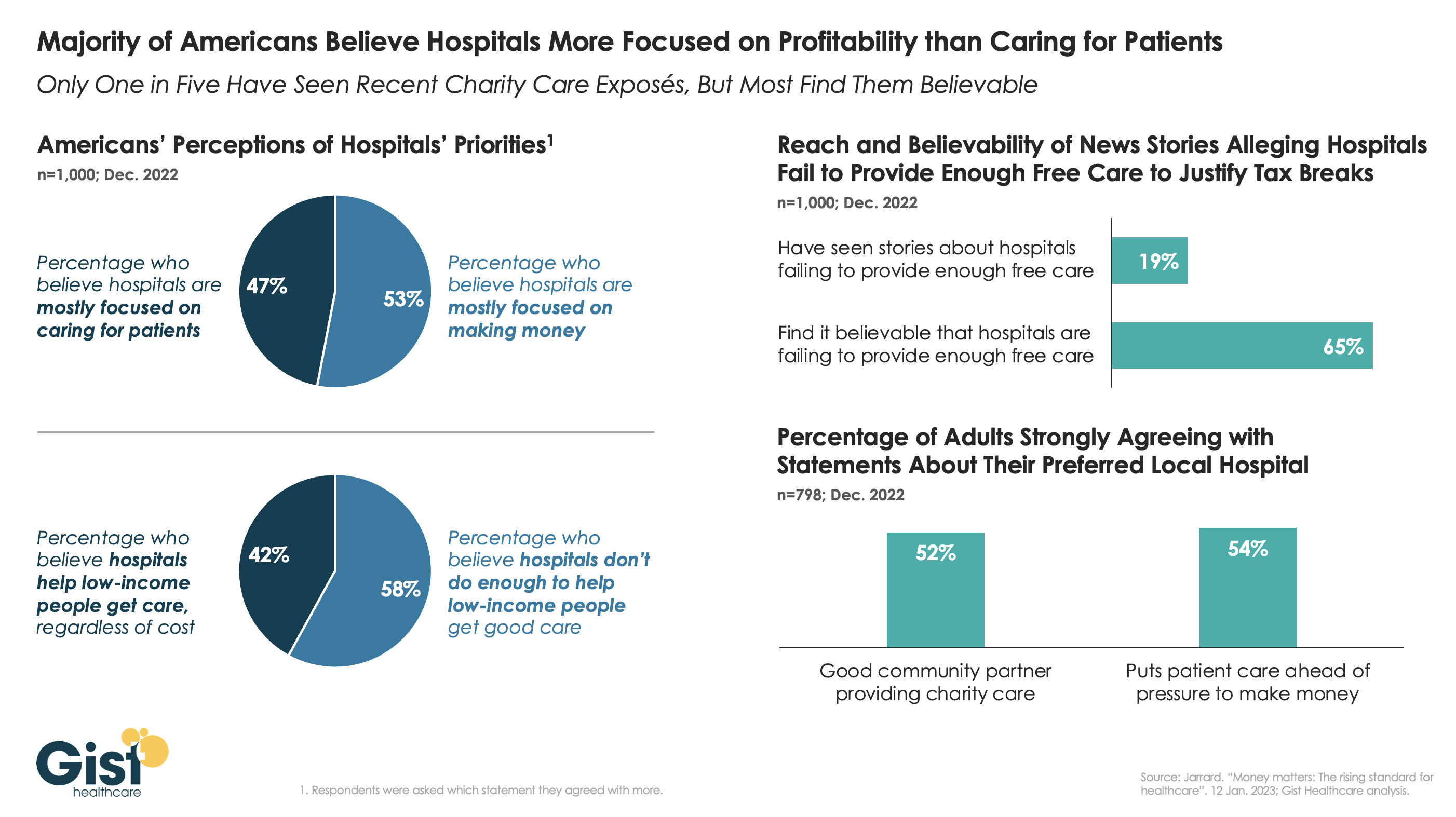
New consumer survey data from strategic healthcare communications consulting firm Jarrard Inc. shows that while consumers find some merit in these claims, they tend to see their local hospital in a better light. As shown in the graphic above, a majority of US adults believe that, on a national level, hospitals are more focused on making money than caring for patients, and that they don’t do enough to help low-income people access high quality care.

Despite only one in five survey participants having seen news stories alleging hospitals fail to provide enough charity care in exchange for tax breaks, 65 percent of survey respondents find those allegations believable.

But while the consumer perception of hospitals may be suffering nationally, the responses were quite different when consumers were asked about their preferred local hospital. More than half strongly agreed that their preferred local hospital is a good community partner—one that puts patient care ahead of making money.

(Just as with Congress: people love to criticize the institution, while continuing to return their own representatives to Washington.) While the negative national attention can be disheartening, at the end of the day, to consumers, healthcare is local, and health systems must continue to build direct consumer relationships to strengthen patient loyalty. 

Is ‘toxic positivity’ a healthcare problem? One CEO thinks so.

Writing for Forbes, Sachin Jain, president and CEO of SCAN Group and Health Plan, argues that “toxic positivity,” or the idea that one should only focus on what’s going right rather than identifying and working on the underlying causes of a problem, is rampant throughout the healthcare industry and offers a few ideas on how to fix it.

Toxic positivity in healthcare

Jain writes that toxic positivity is a “somewhat understandable reaction to seemingly insurmountable obstacles, which perhaps explains toxic positivity’s ascendancy in the healthcare industry.” But now, toxic positivity is “bleeding into situations involving challenging but fully solvable problems.”

For example, Jain writes that nearly every company in the healthcare industry eventually pays a marketing agency to craft “glorious-sounding mission statements” that are then used by leaders whenever they are confronted with their shortcomings.

“Your health system just christened a new billion-dollar hospital, but is unleashing bill collectors on the indigent? Our mission is clear: Patients first!” Jain writes. “Your startup appears to be serving only the wealthiest and healthiest retirees, while pulling no cost from the healthcare system? We’re proudly committed to doing right by seniors by offering value-based care!”

Jain clarifies that he doesn’t believe all healthcare executives are cynically trying to avoid hard issues. Rather, they are “often too far removed from the front lines of the system, and even their own companies’ patient-facing operations, to witness the flaws.”

Often executives don’t notice the flaws in their health systems until a loved one needs help, Jain writes. “Only then do the industry’s leaders confront the reality that, at a person’s most vulnerable point in life, healthcare companies often treat you like a consumer … instead of just taking care of you.”

Without that reality check, it’s easy for executives to rely on their lofty mission statements and value propositions, and to “see their companies as distinct from, rather than intrinsically connected to, the industry’s biggest issues,” Jain writes.

How to fix toxic positivity

One simple intervention won’t fix toxic positivity in the healthcare industry, Jain writes, but companies can start by talking about their flaws.

“In a perfect world, the healthcare industry would commit to a culture of relentless interrogation of its flaws as a means of driving to better results,” Jain writes. Healthcare leaders need to “stop hiding behind company mission statements and ‘just-so stories’ about their impact and start speaking publicly about the steep challenges we each face as we fall short of fulfilling our specific corporate mission,” Jain adds. That means publicly addressing issues at events and discussing strategies for addressing them.

Private behavior within a company can also help reverse toxic positivity, Jain writes. Leaders should continue celebrating the accomplishments of frontline healthcare providers, but they should also “bring a critical eye to their operations and demand — not just encourage — that their colleagues help them uncover ways they can individually and collectively do better.”

That means asking questions like, “If our organization disappeared tomorrow and people were forced to find their healthcare insurance or services or devices elsewhere, would anyone be truly worse off and why?” Jain writes. If your company doesn’t have an answer for that, then you should work harder to increase your replacement value and drive competitive differentiation.

Addressing toxic positivity also means addressing the flaws in value-based care and having “honest, authentic conversations about what works and what doesn’t and why,” Jain writes. “About whether companies that proclaim to improve care are merely benefitting from arbitrage opportunities in reimbursement systems or are actually, meaningfully improving service to patients.”

Executives need to stop treating the healthcare industry like all other industries and “call BS on the idea that it’s somehow okay to be financially successful without making an actual difference in anyone’s lives,” Jain writes.

The healthcare industry needs to welcome thoughtful, critical, and reflective voices to every table, Jain writes. “Because nothing — absolutely nothing — will actually get better without them.” 

Physician burnout as a symptom of our ailing healthcare system

https://mailchi.mp/d62b14db92fb/the-weekly-gist-february-10-2023?e=d1e747d2d8

 In a guest essay for the New York Times this week, Dr. Eric Reinhart argues that physician burnout is not solely a product of physicians’ deteriorating working conditions, but is also driven by a loss of faith in the larger US healthcare system.

He notes that physicians have begun to lose hope in their ability to improve the system in which they work. As outpourings of appreciation for heroic healthcare workers have ended, physicians find themselves working in a system whose myriad structural flaws have been exacerbated by the pandemic. While the system might serve certain physician groups well (particularly specialists who are advantaged by the American Medical Association’s billing code structures), it often fails the patients who trust them for their care, and doctors “are now finding it difficult to quash the suspicion that our institutions, and much of [their] work inside them, primarily serve a moneymaking machine”.

The Gist: While elevating burnout to the level of culture, ideology, and faith in the US healthcare system may be met with skepticism by health system leaders interested in concrete solutions to their workforce problems, it’s important to acknowledge that material benefits and operational improvements may not fully solve engagement challenges.

Compared to peer nations, our healthcare system can be uniquely seen as unfair and unequal, whether because of medical debt, maternal mortality, or declining life expectancies—and many providers feel ill-equipped to address these concerns in their daily work.

This piece serves as a reminder of why most clinicians chose healthcare in the first place: to save lives and help people. The younger generation of physicians is rethinking what that mission means, and how it should include more than just care delivery—and they’re more open to aggressive policy solutions to address systemic inequalities

5 trillion-dollar questions hanging over hospitals

Big questions tend to have no easy answers. Fortunately, few people would say they went into healthcare for its ease.

The following questions about hospitals’ culture, leadership, survival and opportunity come with a trillion-dollar price tag given the importance of hospitals and health systems in the $4.3 trillion U.S. healthcare industry. 

1. How will leaders insist on quality first in a world where it’s increasingly harder to keep trains on time? 

Hospitals and health systems have had no shortage of operational challenges since the COVID-19 pandemic began. These organizations at any given time have been or still are short professionals, personal protective equipment, beds, cribs, blood, helium, contrast dye, infant formula, IV tubing, amoxicillin and more than 100 other drugs. After years of working in these conditions, it is understandable why healthcare professionals may think with a scarcity mindset

This is something strong leaders recognize and will work to shake in 2023, given the known-knowns about the psychology of scarcity. When people feel they lack something, they lose cognitive abilities elsewhere and tend to overvalue immediate benefits at the expense of future ones. Should supply problems persist for two to three more years, hospitals and health systems may near a dangerous intersection where scarcity mindset becomes scarcity culture, hurting patient safety and experience, care quality and outcomes, and employee morale and well-being as a result. 

The year ahead will be a great test and an opportunity for leaders to unapologetically prioritize quality within every meeting, rounding session, budgetary decision, huddle and town hall, and then follow through with actions aligned with quality-first thinking and commentary. Working toward a long-term vision and upholding excellence in the quality of healthcare delivery can be difficult when short-term solutions are available. But leaders who prioritize quality throughout 2023 will shape and improve culture.

2. Who or what will bring medicine past the scope-of-practice fights and turf wars that have persisted for decades? 

It is naive to think these tensions will dissolve completely, but it would be encouraging if in 2023 the industry could begin moving past the all-too-familiar stalemates and fears of “scope creep,” in which physicians oppose expanded scope of practice for non-physician medical professionals. 

Many professions have political squabbles and sticking points that are less palpable to outsiders. Scope-of-practice discord may fall in that category — unless you are in medicine or close to people in the field, it can easily go undetected. But just as it is naive to think physicians and advanced practice providers will reach immediate harmony, so too is it naive to think that aware Americans who watch nightly news segments about healthcare’s labor crisis and face an average wait of 26 days for a medical appointment will have much sympathy for physicians’ staunch resistance to change. 

The U.S. could see an estimated shortage of between 37,800 and 124,000 physicians by 2034, according to the Association of American Medical Colleges. Ideally, 2023 is the year in which stakeholders begin to move past the usual tactics, arguments and protectionist thinking and move toward pragmaticism about physician-led care teams that empower advanced practice providers to care for patients to the extent of the education and training they have. The leaders or organizations who move the needle on this stand to make a name for themselves and earn a chapter or two in the story of American healthcare. 

3. Which employers will win and which will lose in lowering the cost of healthcare? 

Employers have long been incentivized to do two things: keep their workers healthy and spend less money doing it. News of companies’ healthcare ventures can be seen as cutting edge, making it easy to forget the origins of integrated health systems like Oakland, Calif.-based Kaiser Permanente, which dates back to one young surgeon establishing a 12-bed hospital in the height of the Great Depression to treat sick and injured workers building the Colorado River Aqueduct. 

Many large companies have tried and failed, quite publicly, to improve healthcare outcomes while lowering costs. Will 2023 be the year in which at least one Fortune 500 company does not only announce intent to transform workforce healthcare, but instead point to proven results that could make for a scalable strategy? 

Walmart is doing interesting things. JPMorgan seems to have learned a good deal from the demise of Haven, with Morgan Health now making some important moves. And just as important are the large companies paying attention on the sidelines to learn from others’ mistakes. Health systems with high-performing care teams and little variation in care stand to gain a competitive advantage if they draw employers’ attention for the right reasons. 

4. Who or what will stabilize at-risk hospitals? 

More than 600 rural hospitals — nearly 30 percent of all rural hospitals in the country — are at risk of closing in the near future. Just as concerning is the growing number of inner-city hospitals at increased risk of closure. Both can leave millions in less-affluent communities with reduced access to nearby emergency and critical care facilities. Although hospital closures are not a new problem, 2022 further crystalized a problem no one is eager to confront. 

One way for at-risk hospitals to survive is via mergers and acquisitions, but the Federal Trade Commission is making buying a tougher hurdle to clear for health systems. The COVID-19 public health emergency began to seem like a makeshift hospital subsidy when it was extended after President Joe Biden declared the pandemic over, inviting questions about the need for permanent aid, reimbursement models and flexibilities from the government to hospitals. Recently, a group of lawmakers turned to an agency not usually seen as a watchdog for hospital solvency — HHS — to ask if anything was being done in response to hospital closures or to thwart them. 

Maintaining hospital access in rural and urban settings is a top priority, and the lack of interest and creativity to maintain it is strikingly stark. As a realistic expectation for 2023, it would be encouraging to at least have an injection of energy, innovation and mission-first thinking toward a problem that grows like a snowball, seemingly bigger, faster and more insurmountable year after year.

Look at what Mark Cuban was able to accomplish within one year to democratize prescription drug pricing. Remember how humble and small the origins of that effort were. Recall how he — albeit being a billionaire — has put profit secondary to social mission. There’s no one savior that will curb hospital closures in the U.S., but it would be a good thing if 2023 brought more leadership in problem-solving and matching a big problem with big energy and ideas. 

5. Which hospital and health system CEOs will successfully redefine the role? 

Many of the largest and most prominent health systems in the country saw CEO turnover over the past two years. With that, health systems lost decades of collective industry and institutional knowledge. Their tenure spanned across numerous milestones and headwinds, including input and compliance with the Affordable Care Act, the move from paper to digital records, and major mergers and labor strikes. The retiring CEOs had been top decision-makers as their organizations met the demands of COVID-19 and its consequences. They set the tone and had final say in how forcefully their institutions condemned racism and what actions they took to address health inequities. 

To assume the role of health system CEO now comes with a different job description than it did when outgoing leaders assumed their posts. Many Americans may carry on daily life with little awareness as to who is at the top of their local hospital or health system. The pandemic challenged that status quo, throwing hospital leaders into the limelight as many Americans sought leadership, expertise and local voices to make sense of what could easily feel unsensible. The public saw hospital CEOs’ faces, heard their voices and read their words more within the past two years than ever. 

In 2023, newly named CEOs and incoming leaders will assume greater responsibility in addition to a fragile workforce that may be more susceptible to any slight change in communication, transparency or security. They will need to avoid white-collar ivory towers, and earn reputations as leaders who show up for their people in real, meaningful ways. Healthcare leaders who distance themselves from their workforce will only let the realistic, genuine servant leaders outshine them. In 2023, watch for the latter, emulate them and help up-and-comers get as much exposure to them as possible. 

Achieving True Health Care Transformation Requires Rethinking Compensation Models and Executive Performance Metrics

https://medcitynews.com/2023/01/

Healthcare leaders now need to strike a delicate balance that requires managing financial and growth metrics, increasing the speed of transformation, and building the health systems of tomorrow. So how do we redefine compensation models to reward all these behaviors?

Executive compensation might not spring to mind as a key driver of healthcare transformation, nor does it seem naturally connected to critical issues such as health equity, patient safety, or quality of care – just a few of the areas where significant changes can be made to transform healthcare. But, in fact, executives leading not-for-profit health systems today are tasked with delivering measurable results that improve the health status of their patients and their communities. And to ensure that these new performance metrics are met, we must change how we think about —and deliver—compensation.

Defining a new model

While executive compensation has always been tied to specific objectives, they have historically leaned heavily toward financial performance, volume and margins, with a modest portion of compensation aligned to quality of care and patient outcomes. But transformative approaches such as population health, value-based care, patient wellness and health outcomes are shifting the mark.

Healthcare leaders now need to strike a delicate balance that requires managing financial and growth metrics, increasing the speed of transformation, and building the health systems of tomorrow. So how do we redefine compensation models to reward all these behaviors?

Some might say that the answer lies in adjusting incentive plans. While incentive plans across health care have not changed significantly in the past decade, the sophistication of the plans has changed, reflecting greater attention to delivering a better patient experience. But delivering better experiences does not imply that health systems have transformed from the top down. In my mind, adjusting incentive plans only solves part of the problem.

If we want true health care transformation—and we should, in order to best serve patients and communities—health systems need to re-evaluate the outcomes for each stakeholder and create incentives to evolve leadership as a whole. We need to rethink executive compensation models to align with value-based care, patient experience, and the resulting outcomes, along with traditional performance measurements.

Leading through lingering disruption 

But rethinking executive compensation models won’t be an easy task, especially given the external challenges and changes thrust upon the health care system over the last few years.

As with nearly every other aspect of health care, pay for performance was disrupted during the pandemic. Demand for health services changed dramatically, labor and attrition issues intensified, and supply chain problems and operational costs increased. These new pressures required executives to manage through long periods of uncertainty where meeting operational pay-for-performance goals was nearly impossible. Fast-forward to today, the executive talent market remains extraordinarily competitive. Demand outpaces supply due to higher-than-typical retirements, effects of the great resignation, the need for new skill sets and overall burnout.

As a result, there has been upward pressure on compensation to address and fulfill unexpected but immediate needs such as rewarding executives for managing in a unique and challenging performance environment, increasing efforts to recruit and retain, and recognizing leaders for their hard-won accomplishments.

Considerations and changes

When considering adjusting models for 2023 and beyond, CEOs and compensation committees need to take these pressures and disruptions into account. They should look closely at their own compensation data from the past two years – not as a lighthouse for future compensation, but as data that may need to be set aside due to the volume of performance goals and achievements that were up-ended by the pandemic. When relying on external industry data, the same rules apply; smaller data sets or those that don’t account for the past two years may be misleading, so review carefully before using limited data sets to inform adjusted models.

Just as important, CEOs and compensation committees should consider new performance measurements tied to both financial and quality or value-based transformation metrics. We don’t need to eliminate traditional financial and operational goals because viability is still a business mandate. But how can we articulate compensation-driven KPIs for stewardship of patient and community health, improved outcomes and reduced cost of care? Too many measures are akin to having no measures at all.

The compensation mix should take into account a more focused approach to long-term measures. The old paradigm of 12-month incentive cycles is not enough to address the time required to truly transform health care. Another consideration should be performance-based funding of deferred compensation based on achieving transformation goals, and greater use of retention programs to support the maintenance of a stable executive team during the transformation period. Covid-19 proved how crisis can be an accelerator for change. True transformation should blend the skills gained from crisis management with planful, thoughtful and intentional change.

In addition, some metrics may need to incorporate a discretionary component, considering ongoing disruption within the workforce, supply chain limitations, and energy, equipment and labor cost increases. More organizations are also including health equity, DE&I, and ESG goals in incentive programs to tighten alignment with mission-critical board-mandated goals.

Transformative change 

There are four elements that are vital in the journey to transform health care from “heads in beds” to the public-service-oriented organizations that they were meant to be—and can be again. With mounting pressure from patients, communities, and payers to boards and employees, CEOs and compensation committees must become key drivers of change, setting the right goals and incentives from the top down.

  • Affordability: can patients afford the care they need?
  • Quality: is the care being delivered of the utmost quality?
  • Usability: how can we reduce hurdles to undertaking the care plan?
  • Access: are all community members able to access needed care?

Solving for each of these elements is one of the biggest challenges we face, and as we begin to emerge from the disruption of the pandemic, leaders will be watched closely to ensure that they deliver—and can clearly show the path to delivery.

Ideally, end achievements would include patients spending less to achieve better health; payers controlling costs and reducing risk; providers realizing efficiencies and greater patient satisfaction; and alignment of medical supplier pricing to patient outcomes. And when you zoom out to reveal the bigger picture, all of these pieces come together to achieve healthier populations and lower overall health care costs, while still meeting the financial goals of the organization.

We’re asking a lot of already-overburdened health care executives. Stakeholders must prove that we value leaders with the right mindset and skillset in order to attract executives who can shepherd organizations through the transformation journey. This requires a setting where there is supportive leadership, a compelling mission and opportunity for personal growth and development. It will not be easy, but without rethinking how we design compensation models from the top down, it will be unnecessarily challenging.