Pros and Cons of Different Public Health Insurance Options

https://www.commonwealthfund.org/publications/journal-article/2018/nov/pros-cons-public-options-2020-democratic

Image result for Pros and Cons of Different Public Health Insurance Options

Options for Expanding Health Care Coverage

It is more than likely that Democratic candidates for the 2020 presidential election will propose some type of public health insurance plan. In one of two Commonwealth Fund–supported articles in Health Affairs discussing potential Democratic and Republican health care plans for the 2020 election, national health policy experts Sherry Glied and Jeanne Lambrew assess the potential impact and trade-offs of three approaches:


  • Incorporating public-plan elements into private plans through mechanisms such as limits on profits, additional rules on how insurers operate, or the use of Medicare payment rates.
  • Offering a public plan — some version of Medicare or Medicaid, for example — alongside private plans. Such a plan could be offered to specific age groups, like adults 50 to 64 who are not yet eligible for Medicare, to enrollees in the Affordable Care Act’s (ACA) marketplaces, or to everyone under 65, including those working for self-insured employers. It also could be made available in regions of the country where there is little health care competition.
  • Replacing the current health care financing system with a “Medicare for all” single-payer system administered by the federal government. Some single-payer proposals would allow consumers to purchase supplementary private insurance to help pay for uncovered services.


Issues for Consideration in 2020

The authors find trade-offs in each type of public plan. First, a single-payer system would significantly increase the federal budget and require new taxes, a politically challenging prospect. On the other hand, federal spending might decrease if a public plan were added to the marketplace or if public elements were added to private plans. In 2013, the Congressional Budget Office estimated that a public plan, following the same rules as private plans, would reduce federal spending by $158 billion over 10 years, while offering premiums 7 percent to 8 percent lower than private plans. A single-payer approach would lower administrative costs and profits, and likely reduce health care prices as well. By assuming control over the financing of health care, the federal government could reduce administrative complexity and fragmentation. On the flip side, the more than 175 million Americans who are privately insured would need to change insurance plans.


public–private choice model would help ensure that an affordable health plan option is available to Americans. While politically appealing, this option presents implementation challenges: covered benefits, payment rates, and risk-adjustments all need to be carefully managed to ensure a fair but competitive marketplace. A targeted choice option might be adopted by candidates interested in strengthening the ACA marketplaces in specific regions or for specific groups (as with the Medicare at 55 Act). It would benefit Americans whose current access to affordable coverage is limited, but the same technical challenges associated with a more comprehensive choice model would apply.


Finally, to lower prices for privately insured individuals, public plan tools such as deployment of Medicare-based rates could be applied to private insurance, either across the board or specifically for high-cost claims, prescription drugs, or other services. The major challenge here is setting prices that would appropriately compensate providers.


The Big Picture

Under the ACA, the percentage of Americans who had health insurance had reached an all-time high (91 percent) in 2016, an all-time high, and preexisting health conditions ceased to be an obstacle to affordable insurance. But Americans remain concerned about high out-of-pocket spending and access to providers, and fears over losing preexisting-condition protections have grown. While most Democratic presidential candidates will likely defend the ACA and seek to strengthen it, most recognize that fortifying the law will not be enough to cover the remaining uninsured, rein in rising spending, and make health care more affordable.


While the health reform proposals of Democratic candidates in 2020 will likely differ dramatically from those of Republican candidates, recent grassroots support for the ACA’s preexisting condition clause may indicate a willingness by both political parties to support additional government intervention in private insurance markets.



Health Care in 2019: Year in Review

https://www.commonwealthfund.org/blog/2019/health-care-2019-year-review

Health care was front and center for policymakers and the American public in 2019. An appeals court delivered a decision on the Affordable Care Act’s (ACA’s) individual mandate. In the Democratic primaries, almost all the presidential candidates talked about health reform — some seeking to build on the ACA, others proposing to radically transform the health system. While the ACA remains the law of the land, the current administration continues to take executive actions that erode coverage and other gains. In Congress, we witnessed much legislative activity around surprise bills and drug costs. Meanwhile, far from Washington, D.C., the tech giants in Silicon Valley are crashing the health care party with promised digital transformations. If you missed any of these big developments, here’s a short overview.


1. A decision from appeals court on the future of the ACA: On December 18, an appeals court struck down the ACA’s individual mandate in Texas v. United States, a suit brought by Texas and 17 other states. The court did not rule on the constitutionality of the ACA in its entirety, but sent it back to a lower court. Last December, that court ruled the ACA unconstitutional based on Congress repealing the financial penalty associated with the mandate. The case will be appealed to the U.S. Supreme Court, but the timing of the SCOTUS ruling is uncertain, leaving the future of the ACA hanging in the balance once again.


2. Democratic candidates propose health reform options: From a set of incremental improvements to the ACA to a single-payer plan like Medicare for All, every Democratic candidate who is serious about running for president has something to say about health care. Although these plans vary widely, they all expand the number of Americans with health insurance, and some manage to reduce health spending at the same time.


3. Rise in uninsured: Gains in coverage under the ACA appear to be stalling. In 2018, an estimated 30.4 million people were uninsured, up from a low of 28.6 million in 2016, according to a recent Commonwealth Fund survey. Nearly half of uninsured adults may have been eligible for subsidized insurance through ACA marketplaces or their state’s expanded Medicaid programs.


4. Changes to Medicaid: States continue to look for ways to alter their Medicaid programs, some seeking to impose requirements for people to work or participate in other qualifying activities to receive coverage. In Arkansas, the only state to implement work requirements, more than 17,000 people lost their Medicaid coverage in just three months. A federal judge has halted the program in Arkansas. Other states are still applying for waivers; none are currently implementing work requirements.


5. Public charge rule: The administration’s public charge rule, which deems legal immigrants who are not yet citizens as “public charges” if they receive government assistance, is discouraging some legal immigrants from using public services like Medicaid. The rule impacts not only immigrants, but their children or other family members who may be citizens. DHS estimated that 77,000 could lose Medicaid or choose not to enroll. The public charge rule may be contributing to a dramatic recent increase in the number of uninsured children in the U.S.


6. Open enrollment numbers: As of the seventh week of open enrollment, 8.3 million people bought health insurance for 2020 on HealthCare.gov, the federal marketplace. Taking into account that Nevada transitioned to a state-based exchange, and Maine and Virginia expanded Medicaid, this is roughly equivalent to 2019 enrollment. In spite of the Trump administration’s support of alternative health plans, like short-term plans with limited coverage, more new people signed up for coverage in 2020 than in the previous year. As we await final numbers — which will be released in March — it is also worth noting that enrollment was extended until December 18 because consumers experienced issues on the website. In addition, state-based marketplaces have not yet reported; many have longer enrollment periods than the federal marketplace.


7. Outrage over surprise bills: Public outrage swelled this year over unexpected medical bills, which may occur when a patient is treated by an out-of-network provider at an in-network facility. These bills can run into tens of thousands of dollars, causing crippling financial problems. Congress is searching for a bipartisan solution but negotiations have been complicated by fierce lobbying from stakeholders, including private equity companies. These firms have bought up undersupplied specialty physician practices and come to rely on surprise bills to swell their revenues.


8. Employer health care coverage becomes more expensive: Roughly half the U.S. population gets health coverage through their employers. While employers and employees share the cost of this coverage, the average annual growth in the combined cost of employees’ contributions to premiums and their deductibles outpaced growth in U.S. median income between 2008 and 2018 in every state. This is because employers are passing along a larger proportion to employees, which means that people are incurring higher out-of-pocket expenses. Sluggish wage growth has also exacerbated the problem.


9. Tech companies continue inroads into health care: We are at the dawn of a new era in which technology companies may become critical players in the health care system. The management and use of health data to add value to common health care services is a prime example. Recently, Ascension, a huge national health system, reached an agreement with Google to store clinical data on 50 million patients in the tech giant’s cloud. But the devil is in the details, and tech companies and their provider clients are finding themselves enmeshed in a fierce debate over privacy, ownership, and control of health data.


10. House passes drug-cost legislation: For the first time, the U.S. House of Representatives passed comprehensive drug-cost-control legislation, H.R. 3. Reflecting the public’s distress over high drug prices, the legislation would require that the government negotiate the price of up to 250 prescription drugs in Medicare, limit drug manufacturers’ ability to annually hike prices in Medicare, and place the first-ever cap on out-of-pocket drug costs for Medicare beneficiaries. This development is historic but unlikely to result in immediate change. Its prospects in the Republican–controlled Senate are dim.


Sutter Health to pay $575M to settle antitrust case

https://www.beckershospitalreview.com/legal-regulatory-issues/sutter-health-to-pay-575m-to-settle-antitrust-case.html?origin=CFOE&utm_source=CFOE&utm_medium=email

Image result for Sutter Health to pay $575M to settle antitrust case

Sutter Health, a 24-hospital system based in Sacramento, Calif., has agreed to pay $575 million to settle an antitrust case brought by employers and California Attorney General Xavier Becerra.

The settlement resolves allegations that Sutter Health violated California’s antitrust laws by using its market power to overcharge patients and employer-funded health plans. The class members alleged Sutter Health’s inflated prices led to $756 million in overcharges, according to Bloomberg Law.

Under the terms of the settlement, Sutter will pay $575 million to employers, unions and others covered under the class action. The health system will also be required to make several other changes, including limiting what it charges patients for out-of-network services, halting measurers that deny patients access to lower-cost health plans, and improving access to pricing, quality and cost information, according to a Dec. 20 release from Mr. Becerra.

To ensure Sutter is complying with the terms of the settlement, the health system will be required to cooperate with a court-approved compliance monitor for at least 10 years.

Mr. Becerra said the settlement, which he called “a game changer for restoring competition,” is a warning to other organizations.

This first-in-the-nation comprehensive settlement should send a clear message to the markets: if you’re looking to consolidate for any reason other than efficiency that delivers better quality for a lower price, think again. The California Department of Justice is prepared to protect consumers and competition, especially when it comes to healthcare,” he said.

A Sutter spokesperson told The New York Times that the settlement did not acknowledge wrongdoing. “We were able to resolve this matter in a way that enables Sutter Health to maintain our integrated network and ability to provide patients with access to affordable, high-quality care,” said Flo Di Benedetto, Sutter’s senior vice president and general counsel, in a statement to The Times.

The settlement must be approved by the court. A hearing on the settlement is scheduled for Feb. 25, 2020.


Trading high deductibles for narrow networks

https://mailchi.mp/f3434dd2ba5d/the-weekly-gist-december-20-2019?e=d1e747d2d8

Related image

For many employers, narrowing provider networks has been a bridge too far, despite unrelenting healthcare cost growth.

A recent Los Angeles Times profile of a Boston union that was able not only to lower costs but also nearly eliminate employee cost-sharing may make doubters reconsider. Unite Here Local 26, which represents 9,000 hotel workers and their families, implemented a narrow network health plan in 2013, when two-thirds of its members agreed to forego care at certain marquee academic hospitals, which charged two to three times more than others in the Boston area.

Today the union actually pays less in medical costs per member than it did six years ago, and premiums are ten percent lower than the national average, despite Boston being one of the highest-cost healthcare markets in the country. Employees pay no deductibles, and generic medications cost them only $1. Savings have translated into raises for many employees, with some low-income workers seeing a pay jump of up to 39 percent across six years.

As we’ve discussed in the past, employers are reaching a limit on how high they can push deductibles, especially in a tight labor market. Some are beginning to experiment with various network options that lower health care costs—but many have been reticent to change benefit design in any way that could be perceived as narrowing choice.

Local 26’s experience shows that well-designed narrow networks, implemented with employee education and buy-in, can provide cost relief for both businesses and individuals that can be sustained over time.


In a Boston acute care matchup, home beats the hospital

https://mailchi.mp/f3434dd2ba5d/the-weekly-gist-december-20-2019?e=d1e747d2d8

Related image

Despite all of the recent hype, the idea of “hospital-at-home” is hardly a new concept. The first randomized, controlled study on the topic, published over 20 years ago, showed that the model was safe, finding that patients with five common conditions who would normally have been admitted to the hospital experienced similar outcomes when treated at home.

This week a new randomized, controlled trial from researchers at Boston-based Brigham and Women’s showed that hospital-at-home had better clinical outcomes and was a whopping 38 percent cheaper than equivalent management in an acute care hospital. Yes, the study was small (91 patients) and probably had some selection bias (just 37 percent of eligible patients chose home care).

Drilling into the data, length of stay for home-based patients was a little longer, but at-home patients received dramatically fewer lab tests, imaging studies and specialist consults—raising the question of whether all those daily chest x-rays, CBCs and curbside consults in traditional hospitals really provide value.

And 30-day readmissions and ED visit rates for home-based patients were less than half of the control group. Selection for clinical appropriateness and family support is critical, but experts estimate that up to a third of medical admissions could be managed in the home setting.

As growing evidence shows hospital-at-home to be safe, effective and lower cost, the lack of a reimbursement model to support investments in home-based acute care is now the greatest obstacle to widespread adoption.


A look at what lies under the (high) deductible

https://mailchi.mp/f3434dd2ba5d/the-weekly-gist-december-20-2019?e=d1e747d2d8


With the continued growth in high deductible health plans (HDHPs) in both employer- and exchange-based insurance markets, a larger number of services are falling “under the deductible”, leaving patients responsible for the full cost of care

The graphic above illustrates the national cost ranges of ten common outpatient services, based on data from a publicly-available commercial claims databaseIt’s not just minor services like lab tests or diagnostic imaging that are falling under the deductible—many consumers are now paying full freight for a growing list of outpatient procedures like cataract or carpal tunnel surgery, or even knee arthroscopy.

Shopping can pay off: for any service, the highest-priced provider can be over three times the lowest-priced, translating into thousands of dollars of savings for patients with high-deductible plans.

Outpatient services now account for over half the revenue of many health systems. As deductibles climb, more and more of the (profitable) health system services are becoming “shoppable” for consumers—creating an imperative for systems to both lower costs and pursue rational pricing as scrutiny becomes more intense.


Fifth Circuit Appeals Court Strikes Down the Affordable Care Act’s Individual Mandate

https://www.commonwealthfund.org/blog/2019/fifth-circuit-appeals-court-strikes-down-affordable-care-acts-individual-mandate

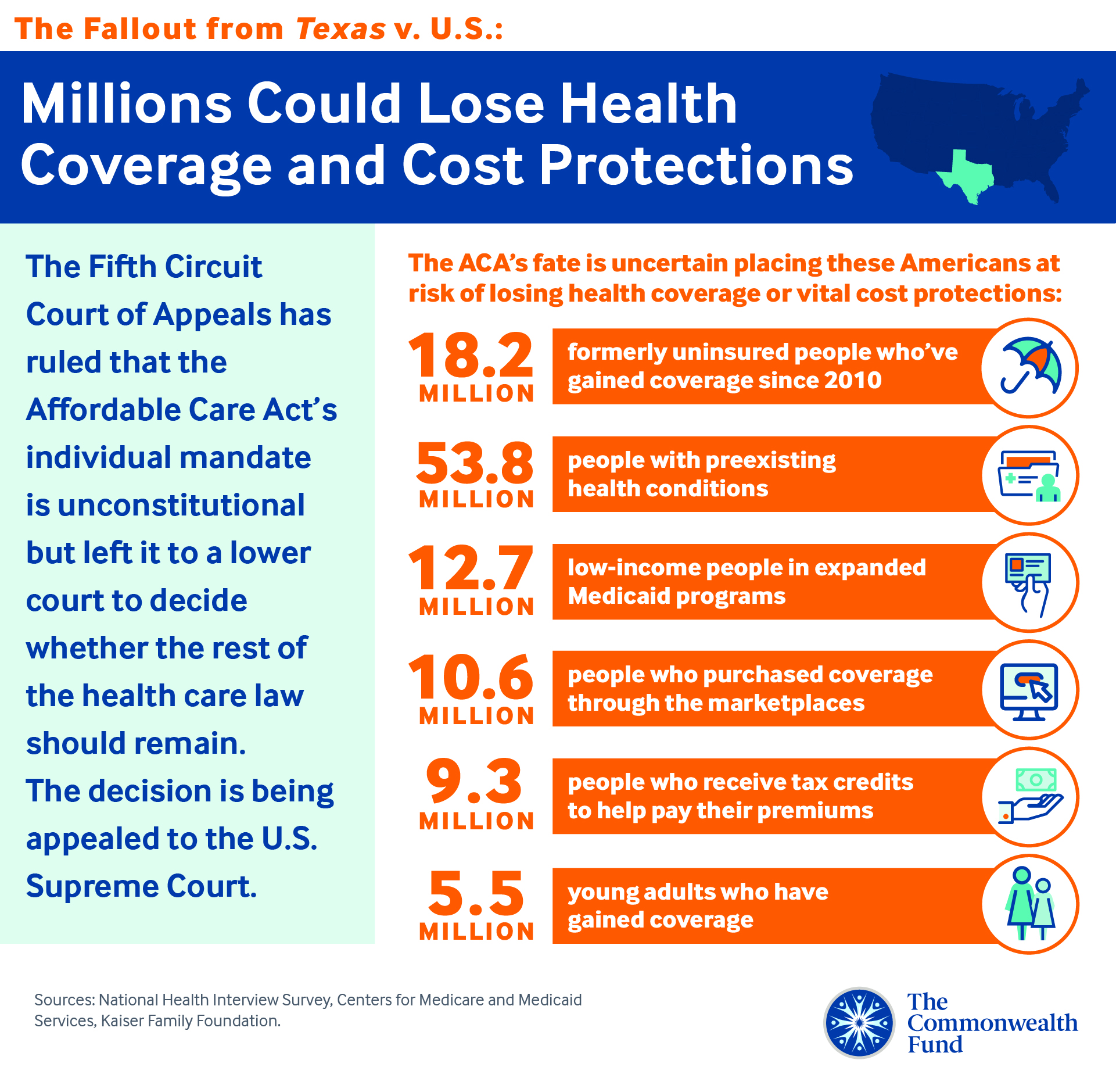
The Fallout from Texas v. U.S.:

Yesterday, a three-judge panel from the Fifth Circuit Court of Appeals struck down the Affordable Care Act (ACA)’s individual mandate. The judges agreed with a lower court decision issued in the case, Texas v. U.S., in December 2018 that the individual mandate is unconstitutional but, unlike the lower court, did not decide that the rest of the ACA is also unconstitutional. Instead, the judges remanded, or sent back, the decision to the same lower court judge to consider. California Attorney General Xavier Becerra, who is leading the 21 Democratic state attorneys general defending the law, along with the U.S. House of Representatives, immediately announced he would appeal the decision to the Supreme Court.

Whether the Supreme Court will decide to take the case now or wait for the decision of Judge O’Connor’s, of the lower court, is uncertain. If the Court decides to take the case now, they could expedite the briefing process and issue a decision in 2020. If it does not take the case now, a ruling will be delayed until after the 2020 presidential election.

No one knows how the Supreme Court will ultimately rule. But we do know that if the Court decides to strike down the ACA, the human toll will be immense and tragic. The law has granted unprecedented health security to millions:

  • 18.2 million formerly uninsured people have gained coverage since 2010
  • 53.8 million Americans with preexisting health conditions are now protected
  • 12.7 million low-income people are insured through expanded Medicaid
  • 10.6 million people have coverage through the ACA marketplaces, 9.3 million of whom receive tax credits to help them pay their premiums
  • 5.5 million young adults have gained coverage, many by staying on their parents’ plans
  • 45 million Medicare beneficiaries have much better drug coverage.

Such a decision will also trigger massive disruption throughout the U.S. health system. The health care industry represents nearly 20 percent of the nation’s economy; the ACA has touched every corner of it. The law restructured the individual and small-group health insurance markets, expanded and streamlined the Medicaid program, improved Medicare benefits, and reformed the way Medicare pays doctors, hospitals, and other providers. It was a catalyst for the movement toward value-based care and established a regulatory pathway for biosimilars — less expensive versions of biologic drugs. States have rewritten laws to incorporate the ACA’s provisions. Insurers, hospitals, physicians, and state and local governments have invested billions of dollars in adjusting to these changes.

The law’s popular preexisting health condition protections have made it possible for people with minor-to-serious health problems to apply for coverage in the same way healthier people have always done. These protections have given the estimated 53.8 million Americans with preexisting health conditions the peace of mind that they will never be denied health insurance because of their health.

More than 150 million people who get coverage through their employers now are eligible for free preventive care, and their children can stay on their policies to age 26.

The wide racial and income inequities in health insurance coverage that have been partly remedied by the ACA would return. Hospitals and providers, especially safety-net institutions, would struggle with mounting uncompensated care burdens and sicker and more costly patients who are not receiving the preventive care they need.

The ACA tore down financial barriers to health care for millions, many of whom were uninsured for most of their lives. It has demonstrably helped people get the health care they need in states across the country. Research indicates that Medicaid expansion has led to improved health status and lower mortality risk.

To date, neither the Trump administration, which has sided with the plaintiffs in the case, nor its Republican colleagues in Congress have offered a replacement plan in the event the law is struck down. The historic progress made by Americans, particularly those with middle and lower incomes and people of color, could unravel. Voters are already telling policymakers they are worried about their ability to afford health care. Yesterday’s decision and the uncertain path forward to the Supreme Court is certain to escalate those worries. With the nation entering the 2020 presidential election year, the Supreme Court may decide to take up the case this term.


Number of Americans with a primary care provider declined 2% over a decade, new study shows

https://www.fiercehealthcare.com/practices/moving-wrong-direction-fewer-americans-have-a-primary-care-provider-new-study-shows?mkt_tok=eyJpIjoiTTJOalpXTXdOV0ZoWkdGbCIsInQiOiJZMlwvUGpSNHhPVGp6ZkdVdkhmSXdza2hJcElGRTJiTDNjWGR0ZnFsOFc4K0Q1eExXR3ZBNWpsTVZ3cmVhRGlMZ1VaOTVyTUlWd2NWQmVPYlBMUkFkTzV0WGNjRWxuNHhuZUFUTVY0dDdsUlwvczdmd0VHVHBBb013b25LMEx5YzhXIn0%3D&mrkid=959610

social determinants

Despite the health benefits, fewer Americans have a primary care provider, according to a new study.

The number of patients in the U.S. who have a primary care provider declined by 2% in a little over a decade, according to the study published in JAMA Internal Medicine.

While that may not sound like much, that decline translates to millions of Americans who do not have primary care, the researchers said.

In the study, researchers from Harvard Medical School looked at primary care use from 2002 to 2015, which raises concerns given that primary care is associated with better health among patients.

“Primary care is the thread that runs through the fabric of all healthcare, and this study demonstrates we are potentially slowly unweaving that fabric,” said the lead author David M. Levine, M.D., a Harvard Medical School instructor in medicine at Brigham and Women’s Hospital in Boston, where he practices internal medicine and primary care, in an announcement about the study.

“America is already behind the curve when it comes to primary care; this shows we are moving in the wrong direction,” Levine said.

The study found that in 2002, 77% of adult Americans had an identified primary care physician, a level that dropped to 75% in 2015. In addition, the study found a particularly marked decline in primary care among younger Americans and those without complex medical issues.

Having a primary care provider decreased across the board for Americans in their 30s, 40s, and 50s. Among 30-year-olds, the number dropped from 71% to 64% from 2002 to 2015.

Among those with no complex conditions, having primary care declined in every decade of age through their 60s. The exception to the decline were less healthy patients. People with three or more chronic health conditions having a primary care physician remained relatively stable, the study found.

Patients who are male, Latino, black or Asian without insurance and lived in the South were much less likely to have a primary care doctor, the study found.

The researchers suggested several steps to stop the decline and increase the rates of Americans with primary care providers, including changes in the primary care payment system, a move toward value-based care and investments in new technology. They also called for creating incentives to encourage more physicians to choose primary care, particularly in rural areas, and increasing the number of Americans with health insurance.

“To improve Americans’ health, we should prioritize investments to reinvigorate the American primary care system,” said senior author Bruce E. Landon, M.D., professor of healthcare policy in the Blavatnik Institute at Harvard Medical School and professor of medicine at Beth Israel Deaconess Medical Center, where he practices internal medicine.

A study released earlier this year from the Patient-Centered Primary Care Collaborative found states that spend more on primary care have better patient outcomes, including fewer hospitalizations and emergency department visits. A separate study found a direct link between the number of primary care doctors and an increase in life expectancy.


Study: Costs from out-of-network billing at in-network hospitals top $40B

https://www.fiercehealthcare.com/hospitals-health-systems/study-finds-billions-costs-from-out-network-billing-for-care-delivered-at?mkt_tok=eyJpIjoiT0RRM1ltSTFaVGd5WmpSaiIsInQiOiJ1K01YRU9EcDFWZWNYYW5ES0JkMDZ3RisxZWdBTlRtSzJTTVwvdVVOMFgrNE1SXC90SjdLQk8rRW1kOXFralJ4SE4rbVwvVThIeFNTYUpqWmxCYTAwOWZyR1FcL0RcL0xVN21Rbkh5aVZlXC83allyU08yeWNZbXB1dHl6SjZia1BmTzNRVCJ9&mrkid=959610

surprise bill

The problem of large and unexpected surprise healthcare bills dominated health headlines in 2019.

Now, a new study to be published in the January print issue of Health Affairs put a figure on how much it’s costing when patients are unwittingly treated by out-of-network providers in in-network hospitals: $40 billion annually.

Led by Zack Cooper, a researcher in the Yale School of Public Health and the department of economics, the study found at in-network hospitals, nearly 12% of anesthesiology care, more than 12% of care involving a pathologist, 5.6% of claims for radiologists and 11.3% of cases involving an assistant surgeon were billed out of network.

“When physicians whom patients do not choose and cannot avoid can bill out of network for care delivered within in-network hospitals, it exposes patients to financial risk and undercuts the functioning of health care markets,” the authors wrote in the study. “The ability to bill out of network allows these specialists to negotiate artificially high in-network rates.

The researchers’ estimates show that if these specialists were not able to bill out of network, it would lower physician payments for privately insured patients by 13.4% and reduce total healthcare spending for people with employer-sponsored insurance by 3.4%. That works out to about $40 billion a year, they said.

The authors used 2015 data from a large commercial insurer for their analysis. The study was funded by the Laura and John Arnold Foundation and the Tobin Center for Economic Policy at Yale University.

Out-of-network billing is more prevalent at hospitals in concentrated hospital and insurance markets and at for-profit hospitals, the authors said.  

“Any policy addressing out-of-network billing must achieve two aims: protect patients from financial harm and introduce a competitively set price for physician services or identify the amount insurers must pay providers if a policyholder is treated by an out-of-network physician,” the authors said in a statement. “Our proposed policy solution—requiring hospitals to sell a package of facility and physician services—would protect patients, restore a competitively determined price for physician services, and lower commercial health spending.” 


Government funding bill deal will repeal key ACA taxes

https://www.axios.com/government-funding-bill-affordable-care-act-taxes-ce13c0af-15d8-4e54-8210-296afa68e9b0.html

U.S. Capitol building

Congress is expected to soon announce a deal to repeal the Affordable Care Act’s health insurance, medical device and “Cadillac” employer health plan taxes — and to raise the smoking age to 21, according to a senior House Democratic aide familiar with talks.

Why it matters: The decision is a colossal win for the health care industry.

  • If this wasn’t good enough news for the industry, the deal won’t address surprise medical bills — and it avoids prescription drug prices except for the CREATES Act, which helps generics get to market faster.
  • The taxes have been repeatedly delayed. And while the industry has pushed for their repeal for years, it hasn’t yet been successful.

Between the lines: Voters are decidedly not asking Washington to lift industry taxes while avoiding dealing with two of the most popular health care issues, but if that’s how this plays out, it’s a great indicator that the industry’s lobbying strength is as good as ever.

  • It’s also a good sign that cost control — the intention of the Cadillac tax, a 40% excise tax on the most generous employer plans — is still not very popular with lawmakers, even as health care costs continue to rise.
  • The tax was expected to raise $200 billion over 10 years.

The other side: The industry says that the ACA taxes end up getting passed along to patients.