66% of counties with most COVID-19 cases lack infectious disease physician

https://www.beckershospitalreview.com/infection-control/66-of-counties-with-most-covid-19-cases-lack-infectious-disease-physician.html?utm_medium=email

About 208 million Americans are living in counties with no or very few infectious disease physicians, and many of these areas have been hit hardest by COVID-19, according to a study published in Annals of Internal Medicine.

Researchers determined the density of infectious disease physicians in every U.S. county using 2017 Medicare Provider Utilization and Payment Data. They also used aggregated data from the CDC and local public health agencies to plot the rate of confirmed COVID-19 cases in each county as of May 12.

Four study findings:

1. Of the 3,142 total counties in the U.S., 79.5 percent did not have a single infectious disease physician.

2. Among 785 counties with the highest burden of COVID-19 cases, 66 percent did not have an infectious disease physician working in the county.

3. About 9.9 percent of counties had an infectious disease physician density below the national average of 1.76 physicians per 100,000 population.

4. Only 10.5 percent of counties had an infectious disease physician density above the national average.

“The deficits in our [infectious disease] physician workforce today have left us poorly prepared for the unprecedented demand ahead,” study authors said, highlighting telemedicine as a key strategy for expanding access to this speciality.

To view the full study, click here.


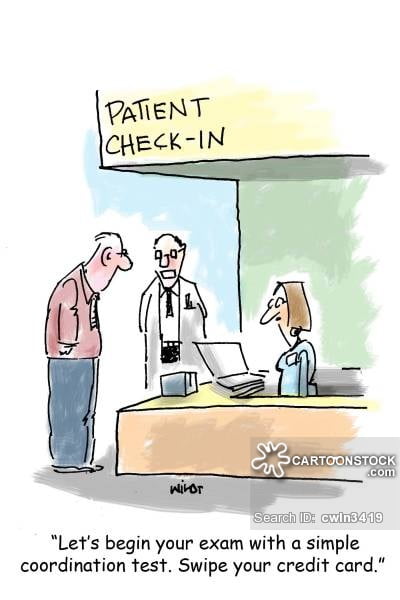
Cartoon – Let’s begin your exam with a simple coordination test

Difference Between Islamic Takaful and Conventional Insurance - ED ...

ICUs become a ‘delirium factory’ for Covid-19 patients

https://www.cnn.com/2020/06/01/health/brain-coronavirus-delirium-kaiser/index.html

ICUs Become A 'Delirium Factory' For COVID-19 Patients | Health ...

Doctors are fighting not only to save lives from Covid-19, but also to protect patients’ brains.

Although Covid-19 is best known for damaging the lungs, it also increases the risk of life-threatening brain injuries — from mental confusion to hallucinations, seizures, coma, stroke and paralysis. The virus may invade the brain, and it can starve the brain of oxygen by damaging the lungs. To fight the infection, the immune system sometimes overreacts, battering the brain and other organs it normally protects.
Yet the pandemic has severely limited the ability of doctors and nurses to prevent and treat neurological complications. The severity of the disease and the heightened risk of infection have forced medical teams to abandon many of the practices that help them protect patients from delirium, a common side effect of mechanical ventilators and intensive care.
And while Covid-19 increases the risk of strokes, the pandemic has made it harder to diagnose them.
When doctors suspect a stroke, they usually order a brain MRI — a sophisticated type of scan. But many patients hospitalized with Covid-19 are too sick or unstable to be wheeled across the hospital to a scanner, said Dr. Kevin Sheth, a professor of neurology and neurosurgery at the Yale School of Medicine.
Many doctors also hesitate to request MRIs for fear that patients will contaminate the scanner and infect other patients and staff members.
“Our hands are much more tied right now than before the pandemic,” said Dr. Sherry Chou, an associate professor of critical care medicine, neurology and neurosurgery at the University of Pittsburgh School of Medicine.
In many cases, doctors can’t even examine patients’ reflexes and coordination because patients are so heavily sedated.
“We may not know if they’ve had a stroke,” Sheth said.
study from Wuhan, China — where the first Covid-19 cases were detected — found 36% of patients had neurological symptoms, including headaches, changes in consciousness, strokes and lack of muscle coordination.
“Our hands are much more tied right now than before the pandemic,” said Dr. Sherry Chou, an associate professor of critical care medicine, neurology and neurosurgery at the University of Pittsburgh School of Medicine.
In many cases, doctors can’t even examine patients’ reflexes and coordination because patients are so heavily sedated.
“We may not know if they’ve had a stroke,” Sheth said.
smaller, French study observed such symptoms in 84% of patients, many of which persisted after people left the hospital.
Some hospitals are trying to get around these problems by using new technology to monitor and image the brain.
New York’s Northwell Health is using a mobile MRI machine for Covid patients, said Dr. Richard Temes, the health system’s director of neurocritical care. The scanner uses a low-field magnet, so it can be wheeled into hospital rooms and take pictures of the brain while patients are in bed.
Staffers at Northwell were also concerned about the infection risk from performing EEGs, tests that measure the brain’s electrical activity and help diagnose seizures, Temes said. Typically, technicians spend 30 to 40 minutes in close contact with patients in order to place electrodes around their skulls.
“Right now, we actually don’t know enough to say definitely how Covid-19 affects the brain and nervous system,” said Chou, who is leading an international study of neurological effects of the virus. “Until we can answer some of the most fundamental questions, it would be too early to speculate on treatments.”
To reduce the risk of infection, Northwell is using a headband covered in electrodes, which can be placed on patients in just a couple of minutes, he said.

The brain under attack

Answering those questions is complicated by the limited data from patient autopsies, said Lena Al-Harthi, a professor and the chair of the microbial pathogens and immunity department at Rush Medical College in Chicago.
But many neuropathologists are unwilling or unable to perform brain autopsies, Al-Harthi said.
That’s because performing autopsies on patients who died of Covid-19 carries special risks, such as the aerosolization of the virus during brain removal. Pathologists need specialized facilities and equipment to conduct an autopsy safely.
Some of the best-known symptoms of Covid-19 might be caused by the virus invading the brain, said Dr. Robert Stevens, an associate professor of anesthesiology and critical care medicine at Johns Hopkins University.
Authors of a recent study from Germany found the novel coronavirus in patients’ brains.
Research shows that the coronavirus may enter a cell through a molecular gateway known as the ACE-2 receptor. These receptors are found not only in the lung, but also other organs, including many parts of the brain.
In a recent study, Japanese researchers reported finding the novel coronavirus in the cerebrospinal fluid that surrounds the brain and spinal cord.
Some of the most surprising symptoms of Covid-19 ― the loss of the senses of smell and taste ― remain incompletely understood, but may be related to the brain, Stevens said.
A study from Europe published in May found that 87% of patients with mild or moderate Covid-19 lost their sense of smell. Patients’ loss of smell couldn’t be explained by inflammation or nasal congestion, the researchers said. Stevens said it’s possible that the coronavirus interacts with nerve pathways from the nose to the brain, potentially affecting systems involved with processing scent.
new study in JAMA provides additional evidence that the coronavirus invades the brain. Italian researchers found abnormalities in an MRI of the brain of a Covid-19 patient who lost her sense of smell.
Many coronavirus patients also develop “silent hypoxia,” in which they are unaware that their oxygen levels have plummeted dangerously low, Stevens added.
When hypoxia occurs, regulatory centers in the brain stem — which control respiration — signal to the diaphragm and the muscles of the chest wall to work harder and faster to get more oxygen into the body and force out more carbon dioxide, Stevens said. The lack of this response in some patients with Covid-19 could indicate the brain stem is impaired.
Scientists suspect the virus is infecting the brain stem, preventing it from sending these signals, Temes said.

Collateral damage

Well-intentioned efforts to save lives can also cause serious complications.
Many doctors put patients who are on mechanical ventilators into a deep sleep to prevent them from pulling out their breathing tubes, which would kill them, said Dr. Pratik Pandharipande, chief of anesthesiology and critical care medicine at Vanderbilt University School of Medicine in Nashville, Tennessee.
Both the disease itself and the use of sedatives can cause hallucinations, delirium and memory problems, said Dr. Jaspal Singh, a pulmonologist and critical care specialist at Atrium Health in Charlotte, North Carolina.
Many sedated patients experience terrifying hallucinations, which may return in recovery as nightmares and post-traumatic stress disorder.
Research shows 70% to 75% of patients on ventilators traditionally develop delirium. Delirious patients often “don’t realize they’re in the hospital,” Singh said. “They don’t recognize their family.”
In the French study in the New England Journal of Medicine, one-third of discharged Covid-19 patients suffered from “dysexecutive syndrome,” characterized by inattention, disorientation or poorly organized movements in response to commands.
Research shows that patients who develop delirium — which can be an early sign of brain injury — are more likely to die than others. Those who survive often endure lengthy hospitalizations and are more likely to develop a long-term disability.
Under normal circumstances, hospitals would invite family members into the ICU to reassure patients and keep them grounded, said Dr. Carla Sevin, director of the ICU Recovery Center, also at Vanderbilt.
Simply allowing a family member to hold a patient’s hand can help, according to Dr. Lee Fleisher, chair of an American Society of Anesthesiologists committee on brain health. Nurses normally spend considerable time each day orienting patients by talking to them, reminding them where they are and why they’re in the hospital.
“You can decrease the need for some of these drugs just by talking to patients and providing light touch and comfort,” Fleisher said.
These and certain innovative practices — such as helping patients to move around and get off a ventilator as soon as possible — can reduce the rate of delirium to 50%.
Hospitals have banned visitors, however, to avoid spreading the virus. That leaves Covid-19 patients to suffer alone, even though it’s well known that isolation increases the risk of delirium, Fleisher said.
Although many hospitals offer patients tablets or smartphones to allow them to videoconference with family, these devices provide limited comfort and companionship.
Doctors are also positioning patients with Covid-19 on their stomachs, rather than their backs, because a prone position seems to help clear the lungs and let patients breathe more comfortably.
But a prone position also can be uncomfortable, so that patients need more medication, Pandharipande said.
All of these factors make coronavirus patients extremely vulnerable to delirium. In a recent article in Critical Care, researchers said the intensive care unit has become a “delirium factory.”
“The way we’re having to care for patients right now is probably contributing to more mortality and bad outcomes than the virus itself,” said Dr. Sharon Inouye, a geriatrician at Harvard Medical School and Hebrew SeniorLife, a long-term care facility in Boston. “A lot of the things we’d like to do are just very difficult.”

Few U.S. adults say they’ve been diagnosed with coronavirus, but more than a quarter know someone who has

https://www.pewresearch.org/fact-tank/2020/05/26/few-u-s-adults-say-theyve-been-diagnosed-with-coronavirus-but-more-than-a-quarter-know-someone-who-has/?utm_source=Pew+Research+Center&utm_campaign=ef5ba73bf3-EMAIL_CAMPAIGN_2020_05_29_05_11&utm_medium=email&utm_term=0_3e953b9b70-ef5ba73bf3-400197657

28% of U.S. adults say they know someone diagnosed with COVID-19 ...

Relatively few Americans say they have been diagnosed with COVID-19 or tested positive for coronavirus antibodies, but many more believe they may have been infected or say they personally know someone who has been diagnosed.

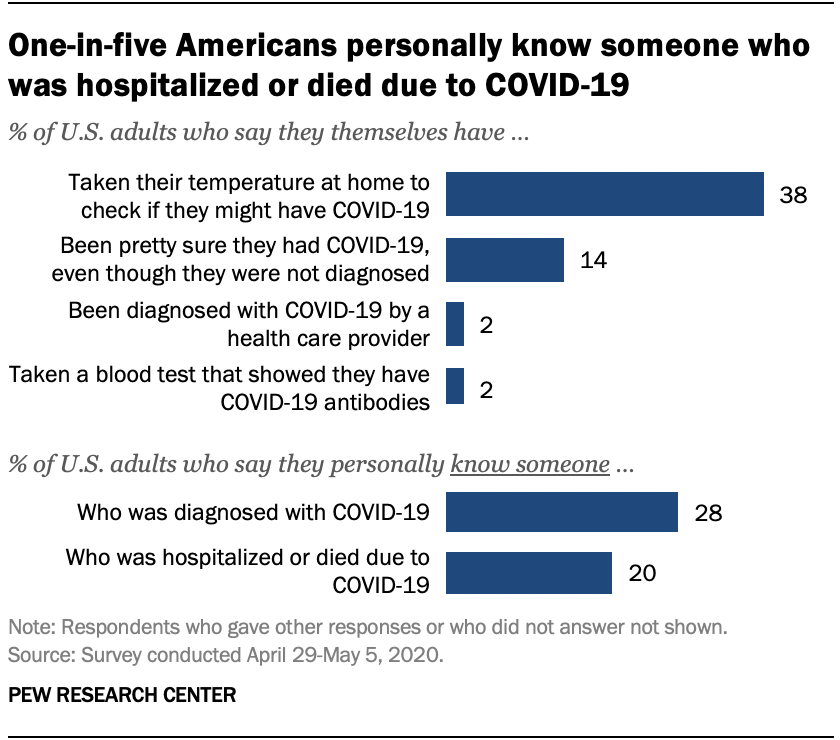
Only 2% of U.S. adults say they have been officially diagnosed with COVID-19 by a health care provider, according to a new Pew Research Center survey. And 2% say they have taken a blood test that showed they have COVID-19 antibodies, an indication that they previously had the coronavirus. But many more Americans (14%) say they are “pretty sure” they had COVID-19, despite not getting an official diagnosis. And nearly four-in-ten (38%) say they’ve taken their temperature to check if they might have the disease.

Although few Americans have been diagnosed with COVID-19 themselves, many more say they know someone with a positive diagnosis. More than one-in-four U.S. adults (28%) say they personally know someone who has been diagnosed by a health care provider as having COVID-19. A smaller share of Americans (20%) say they know someone who has been hospitalized or who has died as a result of having the coronavirus.

Some groups are more likely than others to report personal experiences with COVID-19. For instance, black adults are the most likely to personally know someone who has been hospitalized or died as a result of the disease. One-third of black Americans (34%) know someone who has been hospitalized or died, compared with 19% of Hispanics and 18% of white adults. Black Americans (32%) are also slightly more likely than Hispanic adults (26%) to know someone diagnosed with COVID-19. Public health studies have found black Americans are disproportionately dying or requiring hospitalization as a result of the coronavirus.

28% of U.S. adults say they know someone diagnosed with COVID-19 ...

Areas in the northeastern United States have recorded some of the highest rates of coronavirus cases and fatalities, and this is reflected in the Center’s survey. About four-in-ten adults living in the Northeast (42%) say they personally know someone diagnosed with COVID-19, significantly more than among adults living in any other region. People living in the Northeast (31%) are also the most likely to know someone who has been hospitalized or died as a result of the disease.

One aspect of personal risk for exposure to the coronavirus is whether someone is employed in a setting where they must have frequent contact with other people, such as at a grocery store, hospital or construction site. Given the potential for the spread of the coronavirus within households, risk to individuals is also higher if other members of the household are employed in similar settings. Among people who are currently employed full-time, 35% are working in a job with frequent public contact. Among those working part-time, almost half work (48%) in such a setting. For those living in a household with other adults, 35% report that at least one of those individuals is working in a job that requires frequent contact with other people.

Taken together, nearly four-in-ten Americans (38%) have this type of exposure – either currently working in a job that requires contact with others, living in a household with others whose jobs require contact, or both.

Hispanics (at 48%) are more likely than either blacks (38%) or whites (35%) to have this type of personal or household exposure. An earlier Center analysis of government data found Hispanic adults were slightly more likely to work in service-sector jobs that require customer interaction, and that are at higher risk of layoffs as a result of the virus. In fact, the current Center survey found Hispanics were among the most likely to have experienced pay cuts or job losses due to the coronavirus outbreak.

28% of U.S. adults say they know someone diagnosed with COVID-19 ...

Interpersonal exposure in the workplace is also more widespread among younger adults. And there is a 10 percentage point difference between upper- and lower-income Americans in exposure, with lower-income adults more likely to work in situations where they have to interact with the public, or to live with people who do.

Health experts warn that COVID-19 is particularly dangerous to people who have underlying medical conditions. In the survey, one-third of adults say they have such a condition. Among this group, nearly six-in-ten (58%) say that the coronavirus outbreak is a major threat to their personal health. Among those who do not report having an underlying medical condition, just 28% see the outbreak as a major threat to their health. Americans who have an underlying health condition are also more likely than those who do not to say they’ve taken their temperature to check if they might have COVID-19 (47% vs. 33% of those without a health condition).

Self-reports of an underlying health condition vary greatly by age. Among those ages 18 to 29, just 16% say they have a condition; this rises steadily with age to 56% among those 65 and older. Whites are a little more likely than blacks and Hispanics to report having a health condition, but both blacks (at 54%) and Hispanics (52%) are far more likely than whites (32%) to say that the coronavirus outbreak is “a major threat” to their health.


How South Korea prevented a coronavirus disaster—and why the battle isn’t over

https://www.nationalgeographic.com/science/2020/05/how-south-korea-prevented-coronavirus-disaster-why-battle-is-not-over/

How South Korea prevented a coronavirus disaster—and why the ...

The nation beat back COVID-19 with more than its large number of tests. Can it maintain this success?

The COVID-19 testing center at H Plus Yangji Hospital in southern Seoul doesn’t look like much from the outside. Resembling a mobile home, the temporary building sits in a parking lot near a loading ramp, propped up on one end by a wooden plank. Its walls are wrapped in red and white, and billboard-like signage proclaims that the hospital was named one of the 100 best in the Republic of Korea.

But inside is a gleaming bank of four booths with transparent plastic walls; rubber gloves embedded through them in a manner similar to a high-grade biosafety lab. When a person walks into a booth, they consult over an intercom with a doctor who remains outside. The doctor can swab their nose and throat using the gloves without ever coming into contact with the patient. The booths maintain negative air pressure, which sucks in any virus-carrying airborne droplets. After the test, a staff member in protective gear disinfects the booth, scrubbing the walls with a squeegee.

Hundreds of similar “walk-in” testing booths located all over the country have been one of the pillars of South Korea’s highly successful strategy to contain COVID-19, helping officials roll out rapid and extensive diagnostic testing.

The nation of 51 million people has also taken a big data approach to contact tracing, using credit card history and location data from cell phone carriers to retrace the movements of infected people. Surveys show most Korean citizens are OK with sacrificing digital privacy to stop an outbreak. At the same time, authorities have pushed an intense—but mostly voluntary—social distancing campaign, leaving most bars, restaurants, and movie theaters free to operate.

The viral scourge is far from over in South Korea—a recent outbreak connected to several nightclubs was reported with 102 cases as of May 12. Despite this, the country’s response could serve as a model for the rest of the world, but achieving this level of speedy success in the face of a pandemic was not easy.

Lessons from the past

A major factor shaping South Korea’s response was its ability to apply lessons learned during previous outbreaks, especially the country’s MERS coronavirus outbreak in 2015, which resulted in 186 cases and 38 deaths.

In the immediate aftermath, South Korea’s legislature created the legal foundation for a comprehensive strategy for contact tracing—whereby anyone who has interacted with an infected person is traced and placed in quarantine. Amendments explicitly authorized health authorities to request patients’ transaction history from credit card companies and location data from cell phone carriers—and to release the reconstructed movements in the form of anonymous “travel logs” so people could learn the times and places where they might have been exposed.

A huge push with contact tracing and testing managed to corral an early rise in cases that threatened to spiral out of control—hundreds were reported each day, peaking at 909 cases on February 29 with most associated with a religious sect in the city of Daegu. The strategy also managed to snuff out several subsequent coronavirus clusters at churches, computer gaming cafes, and a call center. By April 15, South Korea safely held a national election, in which 29 million people participated. Voters wore masks and gloves; polling centers took everyone’s temperature and separated anyone with a fever. No cases have been traced to the election.

While people in other countries may consider Korea’s data collection a violation of patient privacy, the measures have broad support from the South Korean public. In a March 4 poll led by the Seoul National University Graduate School of Public Health, 78 percent of 1,000 respondents agreed that human rights protections should be eased to strengthen virus containment efforts. Experience with past outbreaks also meant people were quick to stay at home and wear masks in public even before the government began issuing formal guidelines.

Crucially, South Korea had built up its diagnostic testing capabilities after the 2015 MERS outbreak. Unlike the U.S., which relied on testing kits developed by its Centers for Disease Control and Prevention (CDC) in Atlanta, South Korea enlisted the private sector. At a meeting in late January, officials urged local biotech companies to develop testing kits. Within a month, the nation was running more than 10,000 tests daily.

A recent boom in South Korea’s biotech scene, long predating the pandemic, helped with the ramp-up, says Thomas Shin, the CEO of TCM Biosciences, a company in Pangyo, south of Seoul. “During the last five years, there were many new bioscience companies,” says Shin. TCM was one of the companies that heeded the government’s call to develop kits, and it received approval from the country’s Ministry of Food and Drug Safety in April.

Shin says the decision wasn’t necessarily an easy one from a business perspective—new diseases are difficult to forecast, and if they’re snuffed out quickly, it can be hard to recoup the costs of initial development. But with South Korea’s close connections to the outbreak’s epicenter in China, Shin says TCM could see a similar situation developing rapidly on the home front—and projected a business opportunity in the global market. So far, the company has shipped kits worth roughly $2.6 million.

On April 30, the nation reported just four cases, all of them travelers arriving from abroad, marking the first day with zero local infections in two and a half months. As case numbers have continued to fall, the government has cautiously relaxed its guidelines, while signaling a shift to “everyday quarantine” measures, such as wearing masks and temperature checks at schools.

People’s attitudes have also relaxed, leading some officials to worry about complacency and a second wave of infections. The nightclub outbreak may heighten those fears, but the government has already responded aggressively, tracing and testing thousands of people in a matter of days.

Last mile is the toughest

Though testing companies were quick to respond to the demand, rolling out the kits presented difficulties. Through February, demand for tests was still outpacing supply, and there were only enough kits to distribute to a select number of hospitals.

Furthermore, hospitals struggled to administer the tests to potentially contagious patients safely and quickly—testing areas needed to be sanitized after each patient, long queues meant the virus could spread while people waited in line, and health workers were running low on protective gear. At Yangji Hospital, this also led to exhausted staff, says hospital director Sang Il Kim.

“Even when we did have kits, the waiting times were just too long for everybody to get tested, so they would have to go to other hospitals,” adds Yoona Chung, a doctor in the hospital’s surgery department.

According to Yangji’s data, the hospital was conducting roughly 10 tests a day by late February—but many more were being turned away due to the wait. Other hospitals in Korea started experimenting with drive-through testing centers, where patients could get tested without leaving their cars. But Yangji Hospital is near a subway station in a crowded neighborhood in southern Seoul; for many of its patients, cars aren’t an option.

So, Kim devised the walk-in booths, which went into pilot operation on March 10. Within days, the number of tests administered in a day had tripled. By the end of the month, the hospital could handle more than 90 patients a day. Hospitals elsewhere in Korea and around the world quickly adopted their own variations on the concept. A hospital in Busan had a similar idea independently but others have had help from Kim.

At Massachusetts General Hospital in Boston, hospital leadership saw news reports on Yangji’s booths and asked an in-house team to create a version, hoping to better protect their health workers and conserve precious protective gear. A bit of Googling and two phone calls later, hospital staff connected her with Kim via email.

“I remember it was 10 p.m., we’re all frustrated, up all night, trying to figure out how to make this work,” says Nour Al-Sultan, a business strategy analyst at the MGH Springboard Studio, the team of researchers and designers tasked with reverse engineering the booths. “I go to bed, and I wake up the next morning, and Dr. Kim is the one who answers all of my questions.”

MGH has now installed about eight booths at three hospitals in the Boston region. According to preliminary data, they’ve reduced the need for protective gowns, which are in short supply, by 96 percent, saving more than 500 gowns a week. The MGH team is now working with colleagues in Uganda to help them develop their own versions of the booths.

“The fact that he took the time to provide me with such generous insights is just a testament to this spirit of global collaboration against the pandemic,” Al-Sultan says.


100,000 Lives Lost to COVID-19. What Did They Teach Us?

https://www.propublica.org/article/100000-lives-lost-to-covid-19-what-did-they-teach-us?utm_source=pardot&utm_medium=email&utm_campaign=dailynewsletter&utm_content=feature

May 27 data: Four new Utah COVID-19 deaths as US count tops ...

Each person who has died of COVID-19 was somebody’s everything. Even as we mourn for those we knew, cry for those we loved and consider those who have died uncounted, the full tragedy of the pandemic hinges on one question: How do we stop the next 100,000?

The United States has now recorded 100,000 deaths due to the coronavirus.

It’s a moment to collectively grieve and reflect.

Even as we mourn for those we knew, cry for those we loved and consider also those who have died uncounted, I hope that we can also resolve to learn more, test better, hold our leaders accountable and better protect our citizens so we do not have to reach another grim milestone.

Through public records requests and other reporting, ProPublica has found example after example of delays, mistakes and missed opportunities. The CDC took weeks to fix its faulty test. In Seattle, 33,000 fans attended a soccer match, even after the top local health official said he wanted to end mass gatherings. Houston went ahead with a livestock show and rodeo that typically draws 2.5 million people, until evidence of community spread shut it down after eight days. Nebraska kept a meatpacking plant open that health officials wanted to shut down, and cases from the plant subsequently skyrocketed. And in New York, the epicenter of the pandemic, political infighting between Gov. Andrew Cuomo and Mayor Bill de Blasio hampered communication and slowed decision making at a time when speed was critical to stop the virus’ exponential spread.

COVID-19 has also laid bare many long-standing inequities and failings in America’s health care system. It is devastating, but not surprising, to learn that many of those who have been most harmed by the virus are also Americans who have long suffered from historical social injustices that left them particularly susceptible to the disease.

This massive loss of life wasn’t inevitable. It wasn’t simply unfortunate and regrettable. Even without a vaccine or cure, better mitigation measures could have prevented infections from happening in the first place; more testing capacity could have allowed patients to be identified and treated earlier.

The COVID-19 pandemic is not over, far from it.

At this moment, the questions we need to ask are: How do we prevent the next 100,000 deaths from happening? How do we better protect our most vulnerable in the coming months? Even while we mourn, how can we take action, so we do not repeat this horror all over again?

Here’s what we’ve learned so far.

Though we’ve long known about infection control problems in nursing homes, COVID-19 got in and ran roughshod.

From the first weeks of the coronavirus outbreak in the United States, when the virus tore through the Life Care Center in Kirkland, Washington, nursing homes and long-term care facilities have emerged as one of the deadliest settings. As of May 21, there have been around 35,000 deaths of staff and residents in nursing homes and long-term care facilities, according to the nonprofit Kaiser Family Foundation.

Yet the facilities have continued to struggle with basic infection control. Federal inspectors have found homes with insufficient staff and a lack of personal protective equipment. Others have failed to maintain social distancing among residents, according to inspection reports ProPublica reviewed. Desperate family members have had to become detectives and activists, one even going as far as staging a midnight rescue of her loved one as the virus spread through a Queens, New York, assisted living facility.

What now? The risk to the elderly will not decrease as time goes by — more than any other population, they will need the highest levels of protection until the pandemic is over. The CEO of the industry’s trade group told my colleague Charles Ornstein: “Just like hospitals, we have called for help. In our case, nobody has listened.” More can be done to protect our nursing home and long term care population. This means regular testing of both staff and residents, adequate protective gear and a realistic way to isolate residents who test positive.

Racial disparities in health care are pervasive in medicine, as they have been in COVID-19 deaths.

African Americans have contracted and died of the coronavirus at higher rates across the country. This is due to myriad factors, including more limited access to medical care as well as environmental, economic and political factors that put them at higher risk of chronic conditions. When ProPublica examined the first 100 recorded victims of the coronavirus in Chicago, we found that 70 were black. African Americans make up 30% of the city’s population.

What now? States should make sure that safety-net hospitals, which serve a large portion of low-income and uninsured patients regardless of their ability to pay, and hospitals in neighborhoods that serve predominantly black communities, are well-supplied and sufficiently staffed during the crisis. More can also be done to encourage African American patients to not delay seeking care, even when they have “innocent symptoms” like a cough or low-grade fever, especially when they suffer other health conditions like diabetes.

Racial disparities go beyond medicine, to other aspects of the pandemic. Data shows that black people are already being disproportionately arrested for social distancing violations, a measure that can undercut public health efforts and further raise the risk of infection, especially when enforcement includes time in a crowded jail.

Essential workers had little choice but to work during COVID-19, but adequate safeguards weren’t put in place to protect them.

We’ve known from the beginning there are some measures that help protect us from the virus, such as physical distancing. Yet millions of Americans haven’t been able to heed that advice, and have had no choice but to risk their health daily as they’ve gone to work shoulder-to-shoulder in meat-packing plants, rung up groceries while being forbidden to wear gloves, or delivered the mail. Those who are undocumented live with the additional fear of being caught by immigration authorities if they go to a hospital for testing or treatment.

What now? Research has shown that there’s a much higher risk of transmission in enclosed spaces than outdoors, so providing good ventilation, adequate physical distancing, and protective gear as appropriate for workers in indoor spaces is critical for safety. We also now know that patients are likely most infectious right before or at the time when symptoms start appearing, so if workplaces are generous about their sick leave policies, workers can err on the side of caution if they do feel unwell, and not have to choose between their livelihoods and their health. It’s also important to have adequate testing capacity, so infections can be caught before they turn into a large outbreak.

Frontline health care workers were not given adequate PPE and were sometimes fired for speaking up about it.

While health workers have not, thankfully, been dying at conspicuously higher rates, they continue to be susceptible to the virus due to their work. The national scramble for ventilators and personal protective equipment has exposed the just-in-time nature of hospitals’ inventories: Nurses across the country have had to work with expired N95 masks, or no masks at all. Health workers have been suspended, or put on unpaid leave, because they didn’t see eye to eye with their administrators on the amount of protective gear they needed to keep themselves safe while caring for patients.

First responders — EMTs, firefighters and paramedics — are often forgotten when it comes to funding, even though they are the first point of contact with sick patients. The lack of a coherent system nationwide meant that some first responders felt prepared, while others were begging for masks at local hospitals.

What now? As states reopen, it will be important to closely track hospital capacity, and if cases rise and threaten their medical systems’ ability to care for patients, governments will need to be ready to pause or even dial back reopening measures. It should go without saying that adequate protective gear is a must. I also hope that hospital administrators are thinking about mental health care for their staffs. Doctors and nurses have told us of the immense strain of caring for patients whom they don’t know how to save, while also worrying about getting sick themselves, or carrying the virus home to their loved ones. Even “heroes” need supplies and support.

What we still have to learn:

There continue to be questions on which data is lacking, such as the effects of the coronavirus on pregnant women. Without evidence-based research, pregnant women have been left to make decisions on their own, sometimes trying to limit their exposure against their employer’s wishes.

Similarly, there’s a paucity of data on children’s risk level and their role in transmission. While we can confidently say that it’s rare for children to get very ill if they do get infected, there’s not as much information on whether children are as infectious as adults. Answering that question would not just help parents make decisions (Can I let my kid go to day care when we live with Grandma?) but also help officials make evidence-based decisions on how and when to reopen schools.

There’s some research I don’t want to rush. Experts say the bar for evidence should be extremely high when it comes to a vaccine’s safety and benefit. It makes sense that we might be willing to use a therapeutic with less evidence on critically ill patients, knowing that without any intervention, they would soon die. A vaccine, however, is intended to be given to vast numbers of healthy people. So yes, we have to move urgently, but we must still take the time to gather robust data.

Our nation’s leaders have many choices to make in the coming weeks and months. I hope they will heed the advice of scientists, doctors and public health officials, and prioritize the protection of everyone from essential workers to people in prisons and homeless shelters who does not have the privilege of staying home for the duration of the pandemic.

The coronavirus is a wily adversary. We may ultimately defeat it with a vaccine or effective therapeutics. But what we’ve learned from the first 100,000 deaths is that we can save lives with the oldest mitigation tactics in the public health arsenal — and that being slow to act comes with a terrible cost.

I refuse to succumb to fatalism, to just accepting the ever higher death toll as inevitable. I want us to make it harder for this virus to take each precious life from us. And I believe we can.


Administration Killed Rule Designed To Protect Health Workers From Pandemic Like COVID-19

https://www.npr.org/2020/05/26/862018484/trump-team-killed-rule-designed-to-protect-health-workers-from-pandemic-like-cov?utm_source=Sailthru&utm_medium=email&utm_campaign=Issue:%202020-05-27%20Healthcare%20Dive%20%5Bissue:27567%5D&utm_term=Healthcare%20Dive

Trump Team Killed Rule Designed To Protect Health Workers From ...

When President Trump took office in 2017, his team stopped work on new federal regulations that would have forced the health care industry to prepare for an airborne infectious disease pandemic such as COVID-19. That decision is documented in federal records reviewed by NPR.

“If that rule had gone into effect, then every hospital, every nursing home would essentially have to have a plan where they made sure they had enough respirators and they were prepared for this sort of pandemic,” said David Michaels, who was head of the Occupational Safety and Health Administration until January 2017.

There are still no specific federal regulations protecting health care workers from deadly airborne pathogens such as influenza, tuberculosis or the coronavirus. This fact hit home during the last respiratory pandemic, the H1N1 outbreak in 2009. Thousands of Americans died and dozens of health care workers got sick. At least four nurses died.

Studies conducted after the H1N1 crisis found voluntary federal safety guidelines designed to limit the spread of airborne pathogens in medical facilities often weren’t being followed. There were also shortages of personal protective equipment.

“H1N1 made it very clear OSHA did not have adequate standards for airborne transmission and contact transmission, and so we began writing a standard to do that,” Michaels said.

HIV/AIDS rule set the standard for protecting workers

OSHA experts were confident new airborne infectious disease regulations would make hospitals and nursing homes safer when future pandemics hit. That’s because similar rules had already been created for bloodborne pathogens such as Ebola and hepatitis.

Those rules, implemented during the HIV/AIDS epidemic, forced the health care industry to adopt safety plans and buy more equipment designed to protect staff and patients.

But making a new infectious disease regulation, affecting much of the American health care system, is time-consuming and contentious. It requires lengthy consultation with scientists, doctors and other state and federal regulatory agencies as well as the nursing home and hospital industries that would be forced to implement the standard.

Federal records reviewed by NPR show OSHA went step by step through that process for six years, and by early 2016 the new infectious disease rule was ready. The Obama White House formally added it to a list of regulations scheduled to be implemented in 2017.

Then came the presidential election.

An emphasis on deregulation

In the spring of 2017, the Trump team formally stripped OSHA’s airborne infectious disease rule from the regulatory agenda. NPR could find no indication the new administration had specific policy concerns about the infectious disease rules.

Instead, the decision appeared to be part of a wider effort to cut regulations and bureaucratic oversight.

“Earlier this year we set a target of adding zero new regulatory costs onto the American economy,” Trump said in December 2017. “As a result, the never-ending growth of red tape in America has come to a sudden, screeching and beautiful halt.”

The impact on the federal effort to protect health care workers from diseases such as COVID-19 was immediate.

“The infectious disease standard was put on the back burner. Work stopped,” said Michaels, now a professor at George Washington University.

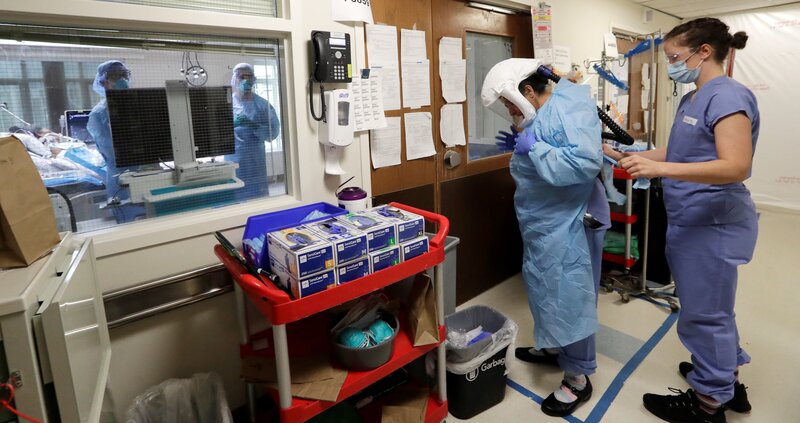
A medical worker is assisted into personal protective equipment on May 8 before stepping into a patient’s room in the COVID-19 intensive care unit at Harborview Medical Center in Seattle.

Elaine Thompson/AP

A deadly escalation of the H1N1 crisis

This spring, hospitals and nursing homes found themselves facing much of the same crisis they experienced during the H1N1 outbreak, with many facilities unprepared and unequipped. Only this time the scale was larger and deadlier.

The federal government reports that at least 43,000 front-line health care workers have gotten sick, many infected, while caring for COVID-19 patients in facilities where personal protective equipment was being rationed.

“Even just a few months ago, I couldn’t have imagined that I would have been on a Zoom call reading out the names of registered nurses who have died on the front lines of a pandemic,” said Bonnie Castillo, who heads the National Nurses United union.

“The memorial was not only about grief. It was also about anger.”

OSHA’s infectious disease rule debated in Washington

Castillo said Congress should immediately implement the infectious disease regulations shelved by the Trump administration as an emergency rule before a second wave of the coronavirus hits.

“Which obviously would mandate that employers have the highest level of PPE, not the lowest,” she said.

Democrats in the House of Representatives passed a bill in mid-May that would do so, but the Republican-controlled Senate has blocked the measure, and the White House still opposes the rules.

The Trump administration hasn’t responded to NPR’s repeated inquiries about the infectious disease rule. But in a briefing call with lawmakers this month, the current head of OSHA, Loren Sweatt, argued enough rules are already in place to protect workers.

“We have mandatory standards related to personal protective equipment and bloodborne pathogens and sanitation standards,” Sweatt said in a recording provided to NPR. “We have existing standards that can address this area.”

The hospital industry also opposes the new safety rules. Nancy Foster with the American Hospital Association said voluntary guidelines for airborne pandemics are adequate.

“You’re right; they’re not regulations, but they are the guidance that we want to follow,” Foster said. “They set forth the expectation for infection control, so in a sense they’re just like regulations.”

But the infectious disease standard would have required the health care industry to do far more. It sets out specific standards for planning and training. It would also have forced facilities to stockpile personal protective equipment to handle “surges” of sick patients such as the ones seen with COVID-19.

NPR also found the lack of fixed regulations allowed the Trump administration to relax worker safety guidelines. Federal agencies did so repeatedly this spring as COVID-19 spread and shortages of personal protective equipment worsened.

As a consequence, hospitals could say they were meeting federal guidelines while requiring doctors and nurses to reuse masks and protective gowns after exposure to sick patients.


How Jefferson and Franklin Helped End Smallpox in America

https://www.governing.com/context/How-Jefferson-and-Franklin-Helped-End-Smallpox-in-America.html

Drawing Lessons from a Government Protest in North Dakota

As the world eagerly awaits a vaccine for the coronavirus, 200 years ago a smallpox cure struggled to gain acceptance. This is how our founding fathers helped promote the medical breakthrough that saved countless lives.

The great scourge of Thomas Jefferson’s era (1743-1826) was smallpox. Historians have estimated that perhaps as many as 2 billion people have died of smallpox in recorded history. That’s a pretty arbitrary figure, but it certainly indicates how serious the problem was. Modern epidemiology has not only eliminated smallpox as a threat to civilization but has been engaged in a protracted debate about whether to snuff it out altogether once and for all, or to keep a tiny bit of it alive in a handful of tightly secured vials in case we need to study it in the face of other disease epidemics. It was officially declared eradicated in 1980.

For most of human history, you either got it or you didn’t and then you either survived it or you didn’t. George Washington was infected by smallpox in Barbados in 1751. He survived, and though he was slightly disfigured, he was thereafter immune to the disease. It is possible that this early brush with smallpox saved the American Revolution 20 years later. In 18th-century Europe, 400,000 people died annually of smallpox.

By the time Jefferson was born in 1743, there was an experimental inoculation procedure, but it was quite dangerous and therefore highly controversial. The idea was to give healthy individuals a very tiny amount of actual smallpox under quarantine and very carefully controlled conditions and simply hope that the person’s immune system would be able to fight it off. Survival would immunize that individual for life. The procedure required many weeks of quarantine, fasting, puking, and rest, followed by a very light diet through convalescence. John Adams wrote a fascinating account of his own inoculation in 1764. He was 28 years old.

Young Thomas Jefferson’s first journey out of his native Virginia was to Philadelphia in 1766 to be inoculated. He would have undertaken the procedure in Williamsburg or Norfolk had it been available. He made the long journey (eight to 10 days in either direction) because he wanted to protect himself from the disease and study the procedure at the same time for possible incorporation into his own community at Monticello. With his characteristic taciturnity about personal things, Jefferson did not leave us a detailed account of the medical procedure, which required prolonged isolation, personal discipline and a great deal of patience.

Inoculation was first introduced in Europe 40 years earlier. Lady Mary Wortley Montague (1689-1762) had spent time in Turkey as the wife of the British ambassador to the Ottoman Empire. There she had witnessed inoculation in the zenanas (segregated women’s quarters) she visited. She called the procedure “engrafting,” which she described in an important “Letter to a Friend” on April 1, 1717. Mrs. Montagu’s brother had died of smallpox four years earlier and she herself had survived a bout of smallpox in 1715, but with her famous beauty disfigured. She had her five-year-old son Edward inoculated in the British Embassy in Turkey.

Lady Mary Wortley Montagu in Ottoman Travel Dress. She was the first to introduce smallpox inoculation in Europe.

When she returned with her family to Britain, she became an outspoken advocate for the procedure. The English medical establishment decried inoculation and denounced Mary Montagu. Still, in 1721 when a smallpox epidemic broke out in England, she had her daughter inoculated in London. This was the first recorded use of the procedure in England. The medical establishment was slow to accept the efficacy of inoculation, which it regarded as an “oriental folk remedy.” It seemed counter-intuitive and just wrong-headed to give a healthy person a dose of smallpox to try to prevent her or him from getting it by accident. 

Franklin Learns About Inoculation the Hard Way

New England Puritan minister Cotton Mather (1663-1728) first promoted inoculation in America. In 1706, Reverend Mather purchased a black slave he named Onesimus (from the Epistle to Philemon). Ten years later, Onesimus told Mather he had been made immune to smallpox in Africa by having the pus of an infected person rubbed on an open wound on his arm. This is known as the variolation method. Mather interrogated other slaves to learn more, confirmed the story, and became an advocate for inoculation. He was subjected to the usual criticism and pushback. An explosive device was thrown through the window of his home. In this instance, racism joined fear as a means of discrediting the medical procedure. What possible wisdom could come from a slave?

The smallpox plague that disturbed Britain in 1721 found its way that same year to Boston. Now Mather and Dr. Zabdiel Boylston, the only physician in Boston who supported the technique, offered their inoculation services to anyone who would trust them. Of the 242 people Boylston inoculated, only six died, or one in 40. Of those who did not undergo the procedure, one in seven died.

America’s greatest exemplar of the Enlightenment, Benjamin Franklin, became a passionate advocate of the procedure after his first son Franky died of smallpox on Nov. 21, 1736, at the age of four. Because Franklin was known to be a friend to inoculation, rumors spread in Philadelphia that Franky had died from the procedure. To set the record straight, the grieving father wrote an article in the Pennsylvania Gazette on Dec. 30, 1736: He had “intended to get [Francis] inoculated as soon as he should have recovered sufficient strength from a flux with which he had been long afflicted.” Franklin assured the public that his son “received the distemper in the common way of infection.”

In 1774, Franklin, who was an indefatigable creator of associations, societies, clubs and public institutions, including volunteer fire departments and lending libraries, established the Society for Inoculating the Poor Gratis to help the poor people of Philadelphia have access to inoculation. In his famous autobiography, Franklin wrote: “In 1736 I lost one of my sons, a fine boy of four years old, by the smallpox taken in the common way. I long regretted bitterly and still regret that I had not given it to him by inoculation. This I mention for the sake of the parents who omit that operation, on the supposition that they should never forgive themselves if a child died under it.”

Edward Jenner and the Fight to Vaccinate

As a young man, the future English physician Edward Jenner (1749-1823) overheard an English milkmaid say, “I shall never have smallpox for I have had cowpox. I shall never have an ugly pockmarked face.” Many years later, remembering the incident, Jenner, now a doctor, interrogated other milkmaids and then experienced one of the most important “eureka” moments in history. Without understanding how germs work, with no knowledge of anything called a virus, Dr. Jenner realized that cowpox (also known as kinepox) must be closely related to smallpox, and that surviving it seemed to make individuals immune to the more deadly disease. He reckoned that cowpox and smallpox must share some essential epidemiological element and since cowpox was neither lethal nor usually disfiguring, careful use of cowpox material would represent a superior protection against smallpox than variolation, which was a more dangerous procedure.

On May 14, 1796, Jenner inoculated an eight-year-old boy named James Phipps with kinepox pus. Phipps developed mild fever and discomfort. Ten days later he felt fine. Two months after that, Dr. Jenner inoculated the boy again, but this time with serum from a fresh smallpox sore. No disease developed. The smallpox vaccine had been born. Our term “vaccination” dates from this episode. Vaccination comes from the Latin word for cow, “vacca.” Jenner called the cowpox serum “vaccinia.” The terminology reminds us that all western vaccination stems from this moment in 1796.

No good deed goes unpunished, apparently, not even one that changes the history of the planet. In Britain, Edward Jenner was subjected to the usual harassment and ridicule. The paper he submitted to the Royal Society of England was rejected by none other than Sir Joseph Banks, one of Britain’s premier naturalists, botanists, and patrons of science. It took many years and the vaccination experiments of other physicians and scientists before Jenner’s work was vindicated.

Eventually, Jenner received worldwide recognition for his discovery. Devoted like Jefferson to the philanthropic principles of the Enlightenment, Dr. Jenner not only made no effort to enrich himself but devoted so much of his time and energy to promoting vaccination that he endured periods of real poverty. Finally, in 1802, the British Parliament voted him a reward of £10,000. Five years later he received £20,000 more from Parliament.

The true vaccine found its way to America thanks to Dr. John Haygarth of Bath. He sent some of Jenner’s material to Benjamin Waterhouse, a professor of physics at Harvard University. Waterhouse, in turn sent serum and reports of the vaccine’s efficacy to Thomas Jefferson, now the third president of the United States.

Dr. Edward Jenner discovered the true smallpox vaccine in 1796.

Jefferson’s Scientific Approach to Vaccines

In the new world, inoculation had a very rough reception. When John Dalgleish and Archibald Campbell began inoculating individuals in Norfolk, Virginia, an angry mob burned down Campbell’s house. Similar incidents occurred in Salem and Marblehead, Mass. In Charleston, S.C., an inoculation control law of 1738 imposed a fine of £500 on anyone providing or receiving inoculation within two miles of the city. A similar law was passed in New York City in 1747.

The measures in New England were so draconian that Benjamin Waterhouse noted the paradox: “New England, the most democratical region on the face of the earth voluntarily submitted to more restrictions and abridgements of liberty, to secure themselves against that terrific scourge, than any absolute monarch could have enforced.” (This, strangely prescient, anticipates the current debate about liberty versus public health). It was in the middle colonies — Maryland, Pennsylvania, New Jersey — that inoculation was most tolerated in the second half of the 18th century. That’s why Jefferson made the long journey to Philadelphia to be inoculated in 1766.

Jefferson first became aware of the discovery of a true smallpox vaccine from the newspapers he read in Philadelphia and the new capitol in Washington, D.C. Then, on Dec. 1, 1800, just after Jefferson’s election to the presidency, Benjamin Waterhouse sent him his pamphlet on the vaccine with a lovely cover letter saying that he regarded Jefferson as “one of our most distinguished patriots and philosophers.” Jefferson responded immediately, thanking Waterhouse for the publication and declaring, with his usual grace, that “every friend of humanity must look with pleasure on this discovery, by which one evil the [more] is withdrawn from the condition of man: and contemplating the possibility that future improvements & discoveries, may still more & more lessen the catalogue of evils. in this line of proceeding you deserve well of your [country?] and I pray you to accept my portion of the tribute due you.”

The following June, Waterhouse sent Jefferson a long letter explaining how the vaccine must be administered, how the serum could be preserved over time, and how much the controversial procedure needed the public support of a man of Jefferson’s stature in the “republic of letters.” President Jefferson became known as a defender and promoter of vaccination. In fact, he even arranged for his protégé Meriwether Lewis to carry some of the serum with him up the Missouri River in 1804-05, instructing him to “carry with you some matter of the kine pox, inform those of them with whom you may be, of its efficacy as a preservative from the small pox; and instruct & encourage them in the use of it. This may be especially done wherever you may winter.” Unfortunately, by the time the Lewis and Clark Expedition reached their winter encampment in today’s North Dakota, the serum had become inert. Thus Jefferson’s philanthropic initiative to vaccinate the Native Americans of the American West was stillborn.

Then, on May 14, 1806, now in his second term, Jefferson wrote perhaps the greatest presidential fan letter of all time. He took time from his duties as president to write the following letter to Edward Jenner. I quote it in its entirety:

SIR,— I have received a copy of the evidence at large respecting the discovery of the vaccine inoculation which you have been pleased to send me, and for which I return you my thanks. Having been among the early converts, in this part of the globe, to its efficiency, I took an early part in recommending it to my countrymen. I avail myself of this occasion of rendering you a portion of the tribute of gratitude due to you from the whole human family. Medicine has never before produced any single improvement of such utility. Harvey’s discovery of the circulation of the blood was a beautiful addition to our knowledge of the animal economy, but on a review of the practice of medicine before and since that epoch, I do not see any great amelioration which has been derived from that discovery. You have erased from the calendar of human afflictions one of its greatest. Yours is the comfortable reflection that mankind can never forget that you have lived. Future nations will know by history only that the loathsome small-pox has existed and by you has been extirpated. Accept my fervent wishes for your health and happiness and assurances of the greatest respect and consideration.

Who would not have wished to receive this magnificent, selfless, public-spirited, and enlightened letter? Unfortunately, we do not know how or even if Dr. Jenner responded. Except in medical circles, Edward Jenner has been largely forgotten.


A deeper look at a new(ish) model of primary care delivery

https://mailchi.mp/f2774a4ad1ea/the-weekly-gist-may-22-2020?e=d1e747d2d8

Direct Primary Care: What Does it Mean for Independent and ...

Cometh the moment, cometh the care model. That’s one way of interpreting a new study commissioned by the Society of Actuaries, and performed by Milliman researchers, that evaluates the direct primary care (DPC) model. Often touted by advocates as a way to “cut out the middleman” and allow for greater patient-physician engagement, DPC is membership-model primary care, with a monthly or annual fee paid by the patient (or their employer) for unlimited access to a range of services for no additional out-of-pocket payment, and without billing insurance for care delivery.

In the study, Milliman reviewed existing literature, conducted a survey of nearly 200 DPC practices, and performed an in-depth analysis of one employer’s DPC offering. Their findings: higher physician satisfaction; smaller panel sizes (on average 445 patients per practice); and statistically significant decreases in overall demand for services (down 12.6 percent) and ED utilization (down 40.5 percent). All that for a monthly fee of between $65 and $85 per adult patient—resulting in a slight net increase in employer benefit costs (1.3 percent) but higher enrollee satisfaction.

The Milliman study is one of the first detailed analyses of the potential benefits of this newish care model, and the results suggest that there is promise for the approach. Critics rightly raise some doubts: could there could ever be enough physician supply to make this model work at national scale? And does the model encourage cherry-picking of more affluent, lower-utilizing patients, making the remaining risk pool more costly to cover?

But in a post-COVID world, with primary care doctors increasingly concerned about revenue stability, and employers looking to control spend (and searching for sweeteners to offset a potential shift to narrower referral networks), the model has the potential to play a greater role in future benefit design. Especially if coupled with a (potentially lower-cost) virtual-first approach, DPC could prove an attractive option for physicians and patients to move away from the fee-for-service, productivity-driven primary care model.