CFOs rank ‘retention, retention, retention’ as top priority for 2022: Deloitte

Gartner's 2022 Top Strategic Technology Trends. Old Problems. Old Trends.  New Names.

Dive Brief:

  • CFOs rank the challenge of attracting and retaining employees far above other internal risks for 2022, citing labor shortages and the difficulty of crafting a balance between remote and in-office work, Deloitte found in a quarterly survey.  
  • “The number of times CFOs cited talent/labor and related issues heavily outweighed other priorities for 2022,” Deloitte said Thursday in a report on the survey of Fortune 500 CFOs. “‘Retention, retention, retention’ was a resounding refrain, including through wages and incentives.”
  • Eighty-eight percent of the 130 respondents said they will use a hybrid work model next year, 92% will increase automation and 41% expect to shrink their companies’ real estate footprint, Deloitte said.

Dive Insight:

The slow return of workers from coronavirus lockdowns has led to labor shortages, competition for hires and an increase in wages.

Employees are switching jobs for higher pay at a near-record pace. The quits rate, or the number of workers who left their jobs as a percent of total employment, rose from 2.3% in January to 2.8% in October, the second-highest level in data going back to 2000, the U.S. Labor Department said. The quits rate hit a high of 3% in September.

Attracting and retaining employees vaulted to the No. 2 ranking of business risks for 2022 and the next decade, from No. 8 a year ago, according to a global survey of 1,453 C-suite executives and board members by Protiviti and NC State University. (Leading the list of risks for 2022 is the impact on business from pandemic-related government policy).

Companies are trying to hold on to workers, and attract hires, by raising pay. Private sector hourly wages rose 4.8% in November compared with 12 months before, according to the Labor Department.

Tight labor markets and the highest inflation in three decades have prompted companies to budget 3.9% wage increases for 2022 — the biggest jump since 2008, according to a survey by The Conference Board.

The proportion of small businesses that raised pay in October hit a 48-year high, with a net 44% increasing compensation and a net 32% planning to do so in the next three months, the National Federation of Independent Business said last month.

CFO respondents to the Deloitte survey said they plan to push up wages/salaries by 5.2%, a nine percentage point increase from their 4.3% forecast during the prior quarter.

“Talent/labor — and several related issues, including attrition, burnout and wage inflation — has become an even greater concern of CFOs this quarter, and the challenges to attract and retain talent could impinge on their organizations’ ability to execute their strategy on schedule,” Deloitte said.

The proportion of CFOs who feel optimistic about their companies’ financial prospects dropped to just under half from 66% over the same time frame.

“CFOs over the last several quarters have become a little more bearish,” Steve Gallucci, managing partner for Deloitte’s CFO program, said in an interview, citing the coronavirus, competition for talent, inflation and disruptions in supply chains.

CFOs have concluded that the pandemic will persist for some time and that they need to “build that organizational muscle to be more nimble, more agile,” he said.

At the same time, CFOs expect their companies’ year-over-year growth will outpace the increase in wages and salaries, estimating revenue and earnings next year will rise 7.8% and 9.6%, respectively, Deloitte said.

“We are seeing in many cases record earnings, record revenue numbers,” Gallucci said.

Describing their plans for capital in 2022, half of CFOs said that they will repurchase shares, 37% say they will take on new debt and 22% plan to “reduce or pay down a significant proportion of their bonds/debt,” Deloitte said.

CFOs view inflation as the most worrisome external risk, followed by supply chain bottlenecks and changes in government regulation, Deloitte said. The Nov. 8-22 survey was concluded before news of the outbreak of the omicron variant of COVID-19.
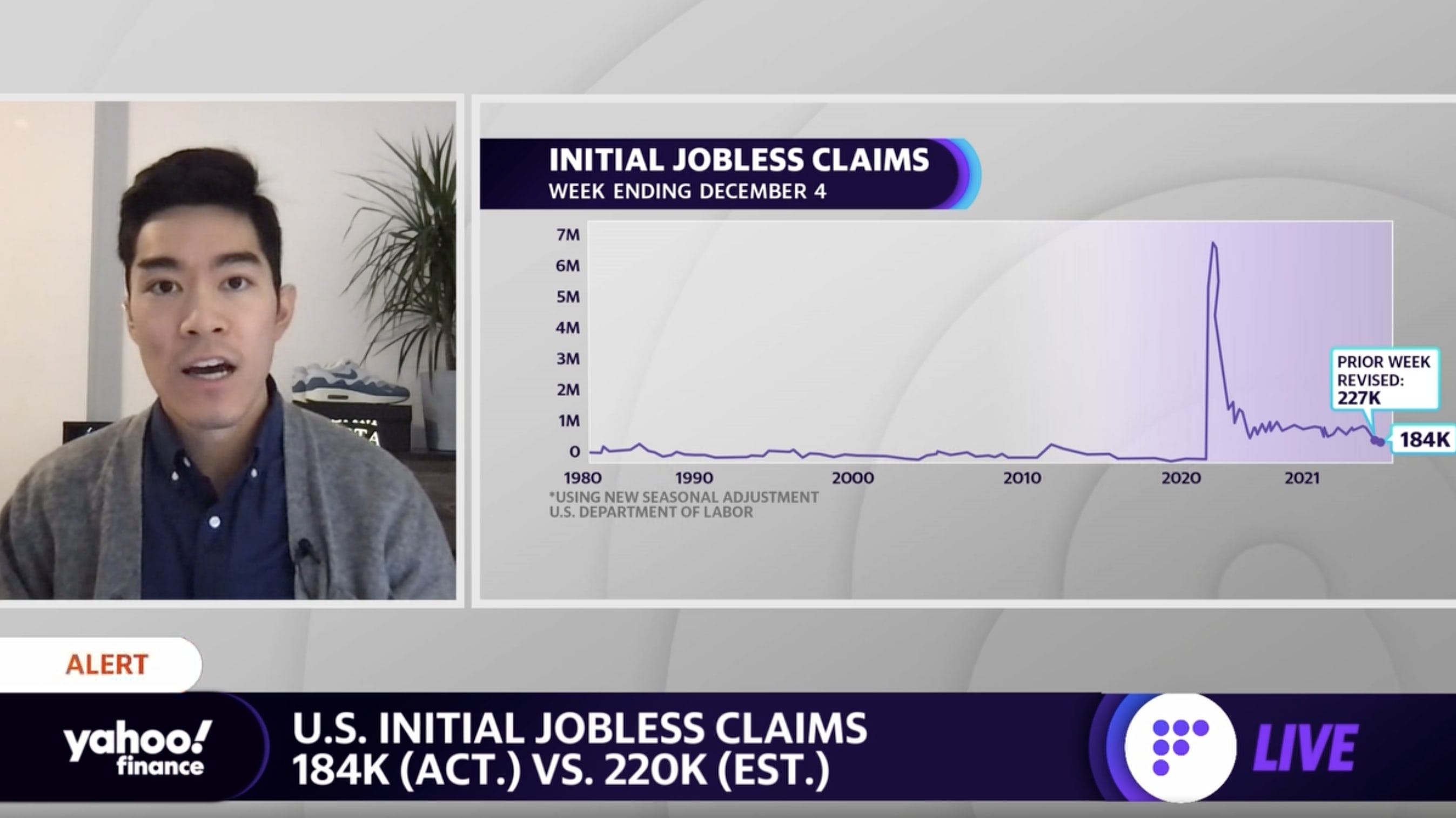
New jobless claims totaled 184,000 last week, reaching lowest since 1969

https://finance.yahoo.com/news/weekly-unemployment-claims-week-ended-dec-4-2021-192034644.html

Weekly U.S. jobless claims fell to 184,000, lowest level since 1969

New initial jobless claims improved much more than expected last week to reach the lowest level in more than five decades, further pointing to the tightness of the present labor market as many employers seek to retain workers. 

The Labor Department released its weekly jobless claims report on Thursday. Here were the main metrics from the print, compared to consensus estimates compiled by Bloomberg:

  • Initial unemployment claims, week ended Dec. 4: 184,000 vs. 220,000 expected and an upwardly revised 227,000 during prior week 
  • Continuing claims, week ended Nov. 27: 1.992 million vs. 1.910 million expected and a downwardly revised 1.954 million during prior week

Jobless claims decreased once more after a brief tick higher in late November. At 184,000, initial jobless claims were at their lowest level since Sept. 1969. 

“The consensus always looked a bit timid, in light of the behavior of unadjusted claims in the week after Thanksgiving in previous years when the holiday fell on the 25th, but the drop this time was much bigger than in those years, and bigger than implied by the recent trend,” Ian Shepherdson, chief economist for Pantheon Macroeconomics, wrote in an email Thursday morning. “A correction next week seems likely, but the trend in claims clearly is falling rapidly, reflecting the extreme tightness of the labor market and the rebound in GDP growth now underway.”

After more than a year-and-a-half of the COVID-19 pandemic in the U.S., jobless claims have begun to hover below even their pre-pandemic levels. New claims were averaging about 220,000 per week throughout 2019. At the height of the pandemic and stay-in-place restrictions, new claims had come in at more than 6.1 million during the week ended April 3, 2020. 

Continuing claims, which track the number of those still receiving unemployment benefits via regular state programs, have also come down sharply from pandemic-era highs, and held below 2 million last week. 

“Beyond weekly moves, the overall trend in filings remains downward and confirms that businesses facing labor shortages are holding onto workers,” wrote Rubeela Farooqi, chief U.S. economist for High Frequency Economics, in a note on Wednesday. 

Farooqi added, however, that “the decline in layoffs is not translating into faster job growth on a consistent basis, which was evident in a modest gain in non-farm payrolls in November.” 

“For now, labor supply remains constrained and will likely continue to see pandemic effects as the health backdrop and a lack of safe and affordable child care keeps people out of the workforce,” she added. 

Other recent data on the labor market have also affirmed these lingering pressures. The November jobs report released from the Labor Department last Friday reflected a smaller number of jobs returned than expected last month, with payrolls growing by the least since December 2020 at just 210,000. And the labor force participation rate came in at 61.8%, still coming in markedly below its pre-pandemic February 2020 level of 63.3%. 

And meanwhile, the Labor Department on Wednesday reported that job openings rose more than expected in October to top 11 million, coming in just marginally below July’s all-time high of nearly 11.1 million. The quits rate eased slightly to 2.8% from September’s record 3.0% rate. 

“There is a massive shortage of labor out there in the country that couldn’t come at a worst time now that employers need workers like they have never needed them before. This is a permanent upward demand shift in the economy that won’t be alleviated by companies offering greater incentives to their new hires,” Chris Rupkey, FWDBONDS chief economist, wrote in a note Wednesday. “Wage inflation will continue to keep inflation running hot as businesses fall all over themselves in a bidding war for talent.”

How much nurse pay is rising—and why

Travel Nurse Guaranteed Pay: The Truth - The Gypsy Nurse

Amid a nationwide staffing shortage, rising demand for nurses has led hospitals to increase salaries and other benefits to attract and retain workers, Melanie Evans reports for the Wall Street Journal.

Hospitals increase salaries, benefits to keep up with nursing demand

Hospitals across the country have been struggling amid staffing shortages, particularly of nurses, Evans reports. According to health care consultancy Premier, nurse turnover rates have increased to around 22% this year, up from the annual rate of about 18% in 2019.

“We are employing more nurses now than we ever have, and we also have more vacancies than we ever had,” said Greg Till, chief people officer at Providence Health & Services.

To retain their current nurses and attract new staff, many hospitals have increased their nurses’ salaries to remain competitive in the job market, Evans reports.

For example, HCA Healthcare, one of the largest hospital chains in the country, said it increased nurse pay this year to keep up with Covid-19 surges and compete with rivals also trying to fill vacant positions.

Similarly, Jefferson Health in May raised salaries for its nearly 10,000 nurses by 10% after the system discovered that rivals had increased their compensation. “The circumstances required it,” said Kate Fitzpatrick, Jefferson’s chief nurse executive.

In addition, Citizens Memorial Hospital in Bolivar, Mo., this month raised its nurses’ salaries by up to 5% after rivals in other nearby cities increased their workers’ wages. Sarah Hanak, Citizen Memorial’s CNO, said the hospital also increased the hourly wages of nurses working overnight shifts by around 15% to ensure sufficient staffing for those shifts.

“We were forced to,” Hanak said. “We absolutely have to stay competitive.”

Overall, the average annual salary for RNs, not including bonus pay, grew to $81,376, according to Premier—a 4% increase across the first nine months of the year. This is larger than the 3.3% increase in the average annual nurse salary for 2020 and the 2.6% increase in 2019, Evans writes.

In addition to salary increases, some organizations, such as Providence, are also offering other benefits to attract and retain nurses, such as more time off, greater schedule flexibility, and new career development opportunities. Many hospitals are also hiring new graduates to work in specialized roles in ORs and other areas, allowing them to advance their careers more quickly than they would have before.

Overall, this rising demand for nurses has allowed those entering the workforce to negotiate higher salaries, more flexible working hours, and other benefits, Evans writes.

“I think you get to write your ticket,” said Tessa Johnson, president of the North Dakota Nurses Association.

Nurse compensation increases were inevitable—here’s why

It was inevitable that we would get to this point: baseline nurse compensation on a clear upward trajectory. Inevitable because this boils down to laws of supply and demand. Amid a clear nursing shortage, organizations are being forced to raise baseline compensation to compete for increasingly scarce qualified nurses. This is true in nearly every market, even for those considered to be ‘destination employers.’

If anything, what’s most surprising in the data from Premier is the moderated increase of around 4%. From a worker’s perspective, that’s not even covering cost of living increases due to inflation. However, amid this new data, it’s important to keep two things in mind:

Two considerations for health care leaders

  1. New data only captures baseline compensation.Differentials—which organizations must standardize and expand across shifts, specialties, and even settings—plus overtime put baseline compensation much higher. Not to mention lucrative sign-on bonuses, that members tell us are increasingly table stakes in their markets. In general, we don’t recommend this type of incentive that does nothing for retention. You’re better off investing those resources in baseline compensation as well as beefing up your RN bonus plan to incentivize retention.
  2. There is a new floor for wages (and it’s only going up from here).

Open questions (and important indicators) we are assessing

  • What happens to wages for entry-level clinical roles? As the shortage of RNs persists, organizations will need to make a shift to team-based models of care, and those are only possible with a stable workforce of entry-level personnel. Right now, that part of the health care workforce is anything but stable. When you consider their work and their wages in comparison to out-of-industry players that pay the same or better, that’s a clear area where investment is required. 
  • Will the share of nurses working permanently with travel agencies return to pre-pandemic levels? That’s to say, what will those RNs who experienced the traveler lifestyle and pay value more moving forward: the flexibility and premium pay or stability of permanent employment? Even if this number stabilizes a couple percentage points above pre-pandemic levels, that will aggravate provider’s sense of shortage.

‘A triple whammy’: Why hospitals are struggling financially amid the delta surge

Hospitals were struggling before the pandemic. Now they face financial  disaster (opinion) - CNN

n addition to treating an influx of Covid-19 patients, many hospitals are struggling with what one administrator calls a “triple whammy” of financial burdens—stemming from plummeting revenue, higher labor costs, and reduced relief funds, Christopher Rowland reports for the Washington Post.

Hospitals in less-vaccinated areas face spiking labor costs

In areas with low vaccination rates, particularly in southern and rural communities, hospitals have been overwhelmed with Covid-19 patients, exacerbating labor shortages as workers burn out or leave for more lucrative positions, Rowland reports.

“The workforce issue is just dire,” Stacey Hughes, EVP of government relations and policy for the American Hospital Association (AHA), said. “The delta variant has wreaked significant havoc on hospitals and health systems.”

In Louisiana, Mary Ellen Pratt, CEO of St. James Parish Hospital, said many nurses quit due to the grueling conditions as Covid-19 cases spiked. “I didn’t have any extra money to incentivize my staff to pick up additional shifts,” she said. “This is coming out of bottom-line money I don’t have.”

Separately, Lisa Smithgall, SVP and chief nursing executive at Ballad Health, said the health system—which has 21 hospitals in eastern Tennessee and southwestern Virginia—has faced similar problems retaining staff amid Covid-19 surges.

“We knew we were at risk in our region because of where we live and because of our vaccination rate being so poor,” Smithgall said. “At one point, we were seeing four or five nurse resignations per week. They couldn’t do it again; they emotionally didn’t have it. They were so upset with our community.”

To fill in these growing gaps in their workforce, many hospitals have had to turn to costly contract workers, Rowland reports—a significant financial burden that further strains hospitals’ resources.

For example, Ballad Health went from hiring fewer than 75 contract nurses before the pandemic to 150 in August 2020 and 450 in August 2021. Moreover, according to Smithgall, contract nurses previously made double or triple what permanent staff nurses made, but now Ballad sometimes has to pay up to seven times as much for contract nurses as hospitals compete for workers to fill shifts.

Delayed elective surgeries deepen hospitals’ financial struggles

Many hospitals, including those in areas with high vaccination rates, have delayed elective surgeries, a crucial source of revenue, amid nationwide surges in Covid-19 cases, Rowland reports—further compounding financial struggles for many organizations.

On Aug. 26, Ballad Health postponed a long list of elective surgeries—including hernia repair, cardiac and interventional radiology procedures, joint replacements, and nonessential spine surgery—to preserve space in its hospitals and conserve workers. Ballad is now allowing elective surgeries again, but only for a limited number of procedures that do not require overnight stays.

Similarly, St. Charles Health System in Oregon postponed elective surgeries in August “while we responded to a surge that was significantly greater and much more sudden than the surge in 2020,” Matt Swafford, the health system’s VP and CFO, said.

According to Swafford, the health system lost $5 million a week through August and September, around $1 million of which was repayment of emergency advances on Medicare reimbursements from last year.

“I don’t think anybody saw this level of surge coming in 2021 after what we saw in 2020,” he said. “We’re just not equipped to be able to simultaneously respond to the urgent needs of the community [for more typical surgeries and care] at the same time that a third of our beds are occupied by highly infective Covid patients.”

Many hospitals likely to end the year at a deficit

Further compounding the issue, according to Moody’s Investors Service, is that the provider relief funds that previously made up 43% of operating cash flow at nonprofit and government-run hospitals in the United States are now dwindling down.

In addition, the latest portion of provider relief funds to be distributed must be based on expenses incurred by hospitals before March 31, 2021, which don’t account for months of the delta surge, Rowland reports.

Premier, a group purchasing and technology company serving more than 4,000 hospitals and health systems, analyzed payroll data of 650 hospitals and found that U.S. hospitals have spent a total of $24 billion a year during the pandemic to cover excess labor costs, primarily for overtime and contract nurses. This was an increase of 63% from October 2019 to July 2021, Rowland reports, with hospitals in the Upper Midwest and across the South seeing the largest increases.

“It’s going to leave them huge deficits that they are going to have to work out of for years to come,” Michael Alkire, Premier’s CEO, said.

Stark divide in industry outlook

Nearly three in five U.S. health care workers are optimistic about where the industry is headed, according to a new poll released today by Morning Consult.

Why it matters: Amid increasing concerns about burnout in health care and workforce shortages, the poll of more than 900 workers between Sept. 2–8 shows there is still a lot of optimism about the health care profession even as workers deal with stressful working conditions.

A common theme among the responses was the message that “working in healthcare is hard and it’s something that should only be done if you are completely committed to it.”

  • Responses ranged from one worker who said “it’s a great career,” to another who said young people should avoid the field “unless you have a death wish.”
  • The poll also found men were more likely than women to be optimistic about the future of the health care industry.

Labor Shortage extends beyond Nursing, beyond Hospitals

https://mailchi.mp/60a059924012/the-weekly-gist-september-10-2021?e=d1e747d2d8

How Could You Be Affected by the Healthcare Labor Shortage? - Right Way  Medical

The typical media coverage of the healthcare workforce crisis often focuses on the acute shortage of hospital-based nurses. For instance, the hospital forced to close a unit as nurses, burned out after 18 months of extra shifts taking care of COVID patients, leave for lower-stress, more predictable jobs in outpatient facilities or doctors’ offices.

But we’re hearing about a reverse trend in recent conversations with health system leaders. Instead of outpatient settings benefiting from an influx of nursing talent, ambulatory leaders report that nurses are now leaving for hospital or travel nursing positions that offer higher salaries and large sign-on bonuses. That’s forcing non-hospital settings to reduce operating room and endoscopy capacity.

Nor are shortages just in the nursing workforce. One system executive lamented that they had to cancel several non-emergent cardiac surgeries, not due to nurse staffing challenges; rather, they were short on surgical technicians. “Surgical techs aren’t leaving because of COVID,” the executive shared, “they’re leaving because the labor market is so strong, and they can make the same money doing something entirely different.” 

For lower-wage workers in particular, the old value proposition of working for a health system, centered around good benefits, continuing education, and a long-term career path, isn’t providing the boost it used to. Workers are willing to trade those for improved work-life balance, predictability, and the perception of a “safer” workplace.

Stabilizing the healthcare workforce will ultimately require providers to rethink job design, the allocation of talent across settings of care, and the integration of technology in workflow. And it will require re-anchoring the work in the mission of serving the community.

But in the short term, many health systems will find themselves having to pay more to retain key workers, including but not limited to hospital nurses, to maintain patient access to care. 
 

A bidding war for critical nursing talent

https://mailchi.mp/60a059924012/the-weekly-gist-september-10-2021?e=d1e747d2d8https://mailchi.mp/60a059924012/the-weekly-gist-september-10-2021?e=d1e747d2d8

As the pandemic rages on, hospitals across the country are experiencing significant labor shortages for critical clinical roles. In the graphic above, we highlight the shortage of nursing talent, perhaps the most sought-after role for which health systems are struggling to hire.

Even before the current COVID surge, many nurses reported feeling dissatisfied or feeling burned out. In a May 2021 survey, more than one in five nurses said they were considering leaving their current jobs, citing insufficient staffing, workload, and the emotional toll of the work. Many health systems are offering lucrative incentives, such as five-figure signing bonuses, to fill immediate critical care needs, and to address the growing backlog of patients returning for delayed care.

As more nurses quit or retire from their permanent positions, health systems are being forced to fill workforce gaps by luring temporary talent at much higher costs (now cresting $8K a week to fund a single travel nurse in some parts of the country). Travel nurse demand reached an all-time high in August, up almost 40 percent from the previous peak in December 2020. As they struggle to fill essential openings, hospital leaders must also focus on keeping the current nursing staff engaged—a challenge that only gets harder as staff nurses compare their salaries to those paid to the temporary colleagues working alongside them.