Healthcare groups call racism a ‘public health’ concern in wake of tensions over police brutality

https://www.fiercehealthcare.com/practices/healthcare-groups-denounce-systemic-racism-wake-tensions-over-police-brutality?mkt_tok=eyJpIjoiWmpobE5XVmlaRGd6T0dFdyIsInQiOiJsQmxnbVNxNVlISVNkczJIZkJXb3ZFZG9tVlpMblZ1XC9oVVB6SlRINzNhOXE4MWQzNk1cL3JTaDlcL2l0MGdhSnk0NUtqY1RzdThCN1wvZ1ZoVUxqOHJwZFJcL1wvK3FtS0o5NFwvSHA0WHhTUnhVNnY3bk5RNmhRQTdxYzYwclhYN3JTRW8ifQ%3D%3D&mrkid=959610

After days of protests across the world against police brutality toward minorities sparked by the killing of George Floyd in Minneapolis, healthcare groups are speaking out against the impact of “systemic racism” on public health.

“These ongoing protests give voice to deep-seated frustration and hurt and the very real need for systemic change. The killings of George Floyd last week, and Ahmaud Arbery and Breonna Taylor earlier this year, among others, are tragic reminders to all Americans of the inequities in our nation,” Rick Pollack, president and CEO of the American Hospital Association (AHA), said in a statement.

As places of healing, hospitals have an important role to play in the wellbeing of their communities. As we’ve seen in the pandemic, communities of color have been disproportionately affected, both in infection rates and economic impact,” Pollack said. “The AHA’s vision is of a society of healthy communities, where all individuals reach their highest potential for health … to achieve that vision, we must address racial, ethnic and cultural inequities, including those in health care, that are everyday realities for far too many individuals. While progress has been made, we have so much more work to do.”

The Society for Healthcare Epidemiology of America (SHEA) also decried the public health inequality highlighted by the dual crises.

“The violent interactions between law enforcement officers and the public, particularly people of color, combined with the disproportionate impact of COVID-19 on these same communities, puts in perspective the overall public health consequences of these actions and overall health inequity in the U.S.,” SHEA said in a statement. Association of American Medical Colleges (AAMC) executives called for health organizations to do more to address inequities. 

“Over the past three months, the coronavirus pandemic has laid bare the racial health inequities harming our black communities, exposing the structures, systems, and policies that create social and economic conditions that lead to health disparities, poor health outcomes, and lower life expectancy,” said David Skorton, M.D., AAMC president and CEO, and David Acosta, M.D., AAMC chief diversity and inclusion officer, in a statement.

“Now, the brutal and shocking deaths of George Floyd, Breonna Taylor, and Ahmaud Arbery have shaken our nation to its core and once again tragically demonstrated the everyday danger of being black in America,” they said. “Police brutality is a striking demonstration of the legacy racism has had in our society over decades.”

They called on health system leaders, faculty researchers and other healthcare staff to take a stronger role in speaking out against forms of racism, discrimination and bias. They also called for health leaders to educate themselves, partner with local agencies to dismantle structural racism and employ anti-racist training.


Rich vs. poor hospitals

https://www.axios.com/hospitals-coronavirus-inequality-segregation-f10c49eb-5ccc-4739-b2a9-254fd9a3d40e.html

Rich vs. poor hospitals | News Break

The inequalities in American health care extend right into the hospital: Cash-strapped safety-net hospitals treat more people of color, while wealthier facilities treat more white patients.

Why it matters: Safety-net hospitals lack the money, equipment and other resources of their more affluent counterparts, which makes providing critical care more difficult and exacerbates disparities in health outcomes.

The big picture: A majority of patients who go to safety-net hospitals are black or Hispanic; 40% are either on Medicaid or uninsured.

The other side: Wealthy hospitals, including many prominent academic medical centers, are “far less likely to serve or treat black and low-income patients even though those patients may live in their backyards,” said Arrianna Planey, an incoming health policy professor at the University of North Carolina.

  • An investigation by the Boston Globe in 2017 found black people in Boston “are less likely to get care at several of the city’s elite hospitals than if you are white.”
  • The Cleveland Clinic has expanded into a global icon for health care, but rarely cares for those in the black neighborhoods that surround its campus, Dan Diamond of Politico reported in 2017.

Between the lines: The way the federal government is bailing out hospitals for the revenues they’ve lost during coronavirus is exacerbating this inequality. More money is flowing to richer hospitals.

  • For example, the main hospital within University of Colorado Health has gotten $79.3 million from the government’s main “provider relief” fund — about the same amount as Cook County Health, Chicago’s public hospital system, which predominantly treats low-income black and Hispanic people. It has gotten $77.6 million from that pot.
  • The Colorado system, however, is sitting on billions of dollars in cash and investments that Chicago’s safety-net hospitals don’t have. Chicago has also seen a worse coronavirus outbreak.

The bottom line: Poor hospitals that treat minorities have had to rely on GoFundMe pages and beg for ventilators during the pandemic, while richer systems move ahead with new hospital construction plans.


Identifying “triple-threat” counties at higher risk of COVID outbreaks

https://mailchi.mp/9f24c0f1da9a/the-weekly-gist-june-5-2020?e=d1e747d2d8

“Superspreader facilities”—nursing homes, correctional facilities, and meatpacking plants—have become major COVID hotspots across the US. Many counties are dealing with a large outbreak in one type of tightly-packed facility or another.

Case in point: the outbreak at Cook County Jail in Chicago, which now accounts for a whopping 15.7 percent of all COVID cases in the state of Illinois. Some places, like Colorado’s Weld County, are managing outbreaks across all three types of superspreader facilities.

The graphic above highlights the nearly 260 counties that we’ve termed “triple-threat counties”: those which have all three types of superspreader facilities. The counties are mapped using our Gist Healthcare COVID-19 Risk Factor Index, which identifies particularly vulnerable populations using chronic disease, demographic, and acute care access variables.

The top 10 “triple-threat counties” by risk index score are all in more rural areas of the country with limited acute care access and more vulnerable populations—places where a COVID outbreak is likely to be particularly devastating. Seven of the 10 have a high percentage of African-American or Hispanic/Latino residents, groups with a an outsized burden of COVID-19 illness and death. These risk factors are intersectional; for example, food processing plants employ twice as many Hispanic workers as the national average, and a disproportionate share of long-term care workers are black.

[Click here for more information and interactive data from our analysis of the risk impact of these superspreader facilities.]


Providers show support amid unrest: #WhiteCoatsForBlackLives

https://www.healthcaredive.com/news/providers-show-support-amid-unrest-whitecoatsforblacklives/579020/

Dive Brief:

  • The American Hospital Association on Monday condemned what they called the “senseless killing of an unarmed black man in Minneapolis,” referring to George Floyd, who died more than a week ago after a police officer held his knee on Floyd’s neck for more than eight minutes. AHA said the group’s vision is a “society of healthy communities, where ALL individuals reach their highest potential for health.”
  • Medical societies, providers and other healthcare organizations weighed in to support peaceful protests, especially as the COVID-19 pandemic shines a light on racial inequities in access to healthcare and job security in America.
  • Health officials also expressed worry that the protest gatherings could further spread of the novel coronavirus. Minnesota Gov. Tim Walz said hospitals in the state could be overwhelmed. And some COVID-19 testing sites have been shut down for safety reasons, further exacerbating concerns.

Dive Insight:

Since protests and occasionally violent police confrontations in recent days were sparked by Floyd’s death, providers have taken to social media with notes of support and pictures of themselves taking a knee in their scrubs under the hashtag #WhiteCoatsForBlackLives.

The American Medical Association responded to ongoing unrest Friday, saying the harm of police violence is “elevated amidst the remarkable stress people are facing amidst the COVID-19 pandemic.”

Board Chair Jesse Ehrenfeld and Patrice Harris, AMA’s first African American woman to be president, continued: “This violence not only contributes to the distrust of law enforcement by marginalized communities but distrust in the larger structure of government including for our critically important public health infrastructure. The disparate racial impact of police violence against Black and Brown people and their communities is insidiously viral-like in its frequency, and also deeply demoralizing, irrespective of race/ethnicity, age, LGBTQ or gender.”

Other organizations weighed in, including CommonSpirit Health, the American Psychiatric Association, the American College of Physicians and several medical colleges.

The nascent research and data from the pandemic in the U.S. have shown people of color are more likely to die from COVID-19 than white people. The reasons behind that are myriad and complex, but many can be traced back to systemic inequality in social services and the healthcare system.

Payers, providers and other healthcare organizations have attempted to address these issues through programs targeting social determinants of health like stable housing, food security and access to transportation.

But despite these efforts over several years to recognize and document the disparities, they have persisted and in some cases widened, Samantha Artiga, director of the Disparities Policy Project at the Kaiser Family Foundation, noted in a blog post Monday.

Health disparities, including disparities related to COVID-19, are symptoms of broader underlying social and economic inequities that reflect structural and systemic barriers and biases across sectors,” she wrote.

Providers have waded into political issues affecting them before, including gun violence. Several organizations also objected to the Trump administration’s decision to cut ties with the World Health Organization in the midst of the pandemic.

The American Public Health Association in late 2018 called law enforcement violence a public health issue.


Few U.S. adults say they’ve been diagnosed with coronavirus, but more than a quarter know someone who has

https://www.pewresearch.org/fact-tank/2020/05/26/few-u-s-adults-say-theyve-been-diagnosed-with-coronavirus-but-more-than-a-quarter-know-someone-who-has/?utm_source=Pew+Research+Center&utm_campaign=ef5ba73bf3-EMAIL_CAMPAIGN_2020_05_29_05_11&utm_medium=email&utm_term=0_3e953b9b70-ef5ba73bf3-400197657

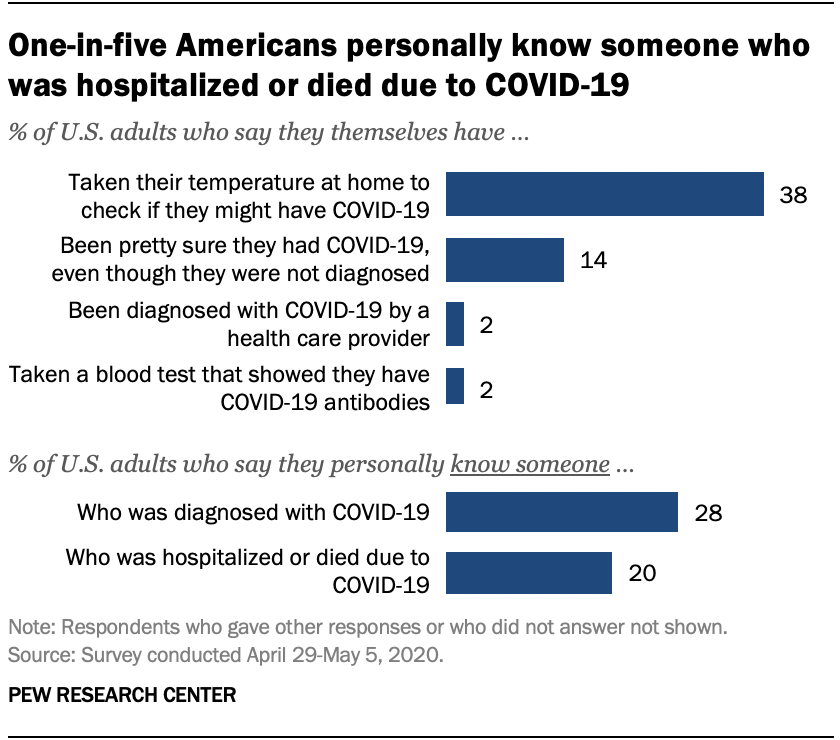
28% of U.S. adults say they know someone diagnosed with COVID-19 ...

Relatively few Americans say they have been diagnosed with COVID-19 or tested positive for coronavirus antibodies, but many more believe they may have been infected or say they personally know someone who has been diagnosed.

Only 2% of U.S. adults say they have been officially diagnosed with COVID-19 by a health care provider, according to a new Pew Research Center survey. And 2% say they have taken a blood test that showed they have COVID-19 antibodies, an indication that they previously had the coronavirus. But many more Americans (14%) say they are “pretty sure” they had COVID-19, despite not getting an official diagnosis. And nearly four-in-ten (38%) say they’ve taken their temperature to check if they might have the disease.

Although few Americans have been diagnosed with COVID-19 themselves, many more say they know someone with a positive diagnosis. More than one-in-four U.S. adults (28%) say they personally know someone who has been diagnosed by a health care provider as having COVID-19. A smaller share of Americans (20%) say they know someone who has been hospitalized or who has died as a result of having the coronavirus.

Some groups are more likely than others to report personal experiences with COVID-19. For instance, black adults are the most likely to personally know someone who has been hospitalized or died as a result of the disease. One-third of black Americans (34%) know someone who has been hospitalized or died, compared with 19% of Hispanics and 18% of white adults. Black Americans (32%) are also slightly more likely than Hispanic adults (26%) to know someone diagnosed with COVID-19. Public health studies have found black Americans are disproportionately dying or requiring hospitalization as a result of the coronavirus.

28% of U.S. adults say they know someone diagnosed with COVID-19 ...

Areas in the northeastern United States have recorded some of the highest rates of coronavirus cases and fatalities, and this is reflected in the Center’s survey. About four-in-ten adults living in the Northeast (42%) say they personally know someone diagnosed with COVID-19, significantly more than among adults living in any other region. People living in the Northeast (31%) are also the most likely to know someone who has been hospitalized or died as a result of the disease.

One aspect of personal risk for exposure to the coronavirus is whether someone is employed in a setting where they must have frequent contact with other people, such as at a grocery store, hospital or construction site. Given the potential for the spread of the coronavirus within households, risk to individuals is also higher if other members of the household are employed in similar settings. Among people who are currently employed full-time, 35% are working in a job with frequent public contact. Among those working part-time, almost half work (48%) in such a setting. For those living in a household with other adults, 35% report that at least one of those individuals is working in a job that requires frequent contact with other people.

Taken together, nearly four-in-ten Americans (38%) have this type of exposure – either currently working in a job that requires contact with others, living in a household with others whose jobs require contact, or both.

Hispanics (at 48%) are more likely than either blacks (38%) or whites (35%) to have this type of personal or household exposure. An earlier Center analysis of government data found Hispanic adults were slightly more likely to work in service-sector jobs that require customer interaction, and that are at higher risk of layoffs as a result of the virus. In fact, the current Center survey found Hispanics were among the most likely to have experienced pay cuts or job losses due to the coronavirus outbreak.

28% of U.S. adults say they know someone diagnosed with COVID-19 ...

Interpersonal exposure in the workplace is also more widespread among younger adults. And there is a 10 percentage point difference between upper- and lower-income Americans in exposure, with lower-income adults more likely to work in situations where they have to interact with the public, or to live with people who do.

Health experts warn that COVID-19 is particularly dangerous to people who have underlying medical conditions. In the survey, one-third of adults say they have such a condition. Among this group, nearly six-in-ten (58%) say that the coronavirus outbreak is a major threat to their personal health. Among those who do not report having an underlying medical condition, just 28% see the outbreak as a major threat to their health. Americans who have an underlying health condition are also more likely than those who do not to say they’ve taken their temperature to check if they might have COVID-19 (47% vs. 33% of those without a health condition).

Self-reports of an underlying health condition vary greatly by age. Among those ages 18 to 29, just 16% say they have a condition; this rises steadily with age to 56% among those 65 and older. Whites are a little more likely than blacks and Hispanics to report having a health condition, but both blacks (at 54%) and Hispanics (52%) are far more likely than whites (32%) to say that the coronavirus outbreak is “a major threat” to their health.


Health Equity Principles for State and Local Leaders in Responding to, Reopening and Recovering from COVID-19

https://www.rwjf.org/en/library/research/2020/05/health-equity-principles-for-state-and-local-leaders-in-responding-to-reopening-and-recovering-from-covid-19.html

Centering Health Equity in COVID-19 Response and Recovery Plans ...

Health equity means that everyone has a fair and just opportunity to be as healthy as possible. This requires removing obstacles to health such as poverty, discrimination, and their consequences, including powerlessness and lack of access to good jobs with fair pay, quality education and housing, safe environments, and health care.”

COVID-19 has unleashed a dual threat to health equity in the United States: a pandemic that has sickened millions and killed tens of thousands and counting, and an economic downturn that has resulted in tens of millions of people losing jobs—the highest numbers since the Great Depression. The COVID pandemic underscores that:

  • Our health is inextricably linked to that of our neighbors, family members, child- and adult-care providers, co-workers, school teachers, delivery service people, grocery store clerks, factory workers, and first responders, among others;
  • Our current health care, public health, and economic systems do not adequately or equitably protect our well-being as a nation; and
  • Every community is experiencing harm, though certain groups are suffering disproportionately, including people of color, workers with low incomes, and people living in places that were already struggling financially before the economic downturn.

For communities and their residents to recover fully and fairly, state and local leaders should consider the following health equity principles in designing and implementing their responses. These principles are not a detailed public health guide for responding to the pandemic or reopening the economy, but rather a compass that continually points leaders toward an equitable and lasting recovery.


Collect, analyze, and report data disaggregated by age, race, ethnicity, gender, disability, neighborhood, and other sociodemographic characteristics.

Pandemics and economic recessions exacerbate disparities that ultimately hurt us all. Therefore, state and local leaders cannot design equitable response and recovery strategies without monitoring COVID’s impacts among socially and economically marginalized groups.¹ Data disaggregation should follow best practices and extend not only to public health data on COVID cases, hospitalizations, and fatalities, but also to: measures of access to testing, treatment, personal protective equipment (PPE), and safe places to isolate when sick; receipt of social and economic supports; and the downstream consequences of COVID on well-being, ranging from housing instability to food insecurity.

Geographic identifiers would allow leaders and the public to understand the interplay between place and social factors, as counties with large black populations account for more than half of all COVID deaths, and rural communities and post-industrial cities generally fare worse in economic downturns. Legal mandates for data disaggregation are proliferating, but 11 states are still not reporting COVID deaths by race; 16 are not reporting by gender; and 26 are not reporting based on congregate living status (e.g., nursing homes, jails). Only three are reporting testing data by race and ethnicity.

While states and cities can do more, the federal government should also support data disaggregation through funding and national standards.

Include in decision-making the people most affected by health and economic challenges, and benchmark progress based on their outcomes.

Our communities are stronger, more stable, and more prosperous when every person, including the most disadvantaged residents, is healthy and financially secure. Throughout the response and recovery, state and local leaders should ask: Are we making sure that people facing the greatest risks have access to PPE, testing and treatment, stable housing, and a way to support their families? And, are we creating ways for residents—particularly those hardest hit—to meaningfully participate in and shape the government’s recovery strategy?

Accordingly, policymakers should create space for leaders from these communities to be at decision-making tables and should regularly consult with community-based organizations that can identify barriers to accessing health and social services, lift up grassroots solutions, and disseminate public health guidance in culturally and linguistically appropriate ways. For example, they could recommend trusted, accessible locations for new testing sites and advise on how to diversify the pool of contact tracers, who will be crucial to tamping down the spread of infection in reopened communities. They could also collaborate with government leaders to ensure that all people who are infected with coronavirus (or exposed to someone infected) have a safe, secure, and acceptable place to isolate or quarantine for 14 days. Key partners could include community health centers, small business associations, community organizing groups, and workers’ rights organizations, among others. Ultimately, state and local leaders should measure the success of their response based not only on total death counts and aggregate economic impacts but also on the health and social outcomes of the most marginalized.

Establish and empower teams dedicated to promoting racial equity in response and recovery efforts.

Race or ethnicity should not determine anyone’s opportunity for good health or social well-being, but, as COVID has shown, we are far from this goal. People of color are more likely to be front-line workers, to live in dense or overcrowded housing, to lack health insurance, and to experience chronic diseases linked to unhealthy environments and structural racism. Therefore, state and local leaders should empower dedicated teams to address COVID-related racial disparities, as several leaders, Republican and Democrat, have already done.

To be effective, these entities should: include leaders of color from community, corporate, academic, and philanthropic sectors; be integrated as key members of the broader public health and economic recovery efforts; and be accountable to the public. These teams should foster collaboration between state, local, and tribal governments to assist Native communities; anticipate and mitigate negative consequences of current response strategies, such as bias in enforcement of public health guidelines; address racial discrimination within the health care system; and ensure access to tailored mental health services for people of color and immigrants who are experiencing added trauma, stigma, and fear. Ultimately, resources matter. State and local leaders must ensure that critical health and social supports are distributed fairly, proportionate to need, and free of undue restrictions to meet the needs of all groups, including black, Latino, Asian, and Indigenous communities.


Proactively identify and address existing policy gaps while advocating for further federal support.

The Congressional response to COVID has been historic in its scope and speed, but significant gaps remain. Additional federal resources are needed for a broad range of health and social services, along with fiscal relief for states and communities facing historically large budget deficits due to COVID. Despite these challenges, state and local leaders must still find ways to take targeted policy actions. The following questions can help guide their response.

Who is left out?Inclusion of all populations will strengthen the public health response and lessen the pandemic’s economic fallout for all of society, but federal actions to date have not included all who have been severely harmed by the pandemic. As a result, many states and communities have sought to fill gaps in eviction protections and paid sick and caregiving leave. Others are extending support to undocumented immigrants and mixed-status families through public-private partnerships, faith-based charities, and community-led mutual aid systems. Vital health care providers, including safety net hospitals and Indian Health Service facilities, have also been disadvantaged and need targeted support.

Will protections last long enough?Many programs, such as expanded Medicaid funding, are tied to the federal declaration of a public health emergency, which will likely end before the economic crisis does. Other policies, like enhanced unemployment insurance and mortgage relief, are set to expire on arbitrary dates. And still others, such as stimulus checks, were one-time payments. Instead, policy extensions should be tied to the extent of COVID infection in a state or community (or its anticipated spread) and/or to broader economic measures such as unemployment. This is particularly important as communities will likely experience re-openings and closings over the next six to 12 months as COVID reemerges.

Have programs that meet urgent needs been fully and fairly implemented?Allexisting federal resources should be used in a time of great need. For example, additional states should adopt provisions that would allow families with school-age children to receive added Supplemental Nutrition Assistance Program (SNAP) benefits, and more communities need innovative solutions to provide meals to young children who relied on schools or child care providers for breakfast and lunch. States should also revise eligibility, enrollment, and recertification processes that deter Medicaid use by children, pregnant women, and lawfully residing immigrants.

Invest in strengthening public health, health care, and social infrastructure to foster resilience.

Health, public health, and social infrastructure are critical for recovery and for our survival of the next pandemic, severe weather event, or economic downturn. A comprehensive public health system is the first line of defense for rural, tribal, and urban communities. While a sizable federal reinvestment in public health is needed, states and communities must also reverse steady cuts to the public health workforce and laboratory and data systems.

Everyone in this country should have paid sick and family leave to care for themselves and loved ones; comprehensive health insurance to ensure access to care when sick and to protect against medical debt; and jobs and social supports that enable families to meet their basic needs and invest in the future. As millions are projected to lose employer-sponsored health insurance, Medicaid expansion becomes increasingly vital for its proven ability to boost health, reduce disparities, and provide a strong return on investment. In the longer term, policies such as earned income tax credits and wage increases for low-wage workers can help secure economic opportunity and health for all. Finally, states and communities should invest in affordable, accessible high-speed internet, which is crucial to ensuring that everyone—not just the most privileged among us—is informed, connected to schools and jobs, and engaged civically.

These principles can guide our nation toward an equitable response and recovery and help sow the seeds of long-term, transformative change. States and cities have begun imagining and, in some cases, advancing toward this vision, putting a down payment on a fair and just future in which health equity is a reality. Returning to the ways things were is not an option.

100,000 Lives Lost to COVID-19. What Did They Teach Us?

https://www.propublica.org/article/100000-lives-lost-to-covid-19-what-did-they-teach-us?utm_source=pardot&utm_medium=email&utm_campaign=dailynewsletter&utm_content=feature

May 27 data: Four new Utah COVID-19 deaths as US count tops ...

Each person who has died of COVID-19 was somebody’s everything. Even as we mourn for those we knew, cry for those we loved and consider those who have died uncounted, the full tragedy of the pandemic hinges on one question: How do we stop the next 100,000?

The United States has now recorded 100,000 deaths due to the coronavirus.

It’s a moment to collectively grieve and reflect.

Even as we mourn for those we knew, cry for those we loved and consider also those who have died uncounted, I hope that we can also resolve to learn more, test better, hold our leaders accountable and better protect our citizens so we do not have to reach another grim milestone.

Through public records requests and other reporting, ProPublica has found example after example of delays, mistakes and missed opportunities. The CDC took weeks to fix its faulty test. In Seattle, 33,000 fans attended a soccer match, even after the top local health official said he wanted to end mass gatherings. Houston went ahead with a livestock show and rodeo that typically draws 2.5 million people, until evidence of community spread shut it down after eight days. Nebraska kept a meatpacking plant open that health officials wanted to shut down, and cases from the plant subsequently skyrocketed. And in New York, the epicenter of the pandemic, political infighting between Gov. Andrew Cuomo and Mayor Bill de Blasio hampered communication and slowed decision making at a time when speed was critical to stop the virus’ exponential spread.

COVID-19 has also laid bare many long-standing inequities and failings in America’s health care system. It is devastating, but not surprising, to learn that many of those who have been most harmed by the virus are also Americans who have long suffered from historical social injustices that left them particularly susceptible to the disease.

This massive loss of life wasn’t inevitable. It wasn’t simply unfortunate and regrettable. Even without a vaccine or cure, better mitigation measures could have prevented infections from happening in the first place; more testing capacity could have allowed patients to be identified and treated earlier.

The COVID-19 pandemic is not over, far from it.

At this moment, the questions we need to ask are: How do we prevent the next 100,000 deaths from happening? How do we better protect our most vulnerable in the coming months? Even while we mourn, how can we take action, so we do not repeat this horror all over again?

Here’s what we’ve learned so far.

Though we’ve long known about infection control problems in nursing homes, COVID-19 got in and ran roughshod.

From the first weeks of the coronavirus outbreak in the United States, when the virus tore through the Life Care Center in Kirkland, Washington, nursing homes and long-term care facilities have emerged as one of the deadliest settings. As of May 21, there have been around 35,000 deaths of staff and residents in nursing homes and long-term care facilities, according to the nonprofit Kaiser Family Foundation.

Yet the facilities have continued to struggle with basic infection control. Federal inspectors have found homes with insufficient staff and a lack of personal protective equipment. Others have failed to maintain social distancing among residents, according to inspection reports ProPublica reviewed. Desperate family members have had to become detectives and activists, one even going as far as staging a midnight rescue of her loved one as the virus spread through a Queens, New York, assisted living facility.

What now? The risk to the elderly will not decrease as time goes by — more than any other population, they will need the highest levels of protection until the pandemic is over. The CEO of the industry’s trade group told my colleague Charles Ornstein: “Just like hospitals, we have called for help. In our case, nobody has listened.” More can be done to protect our nursing home and long term care population. This means regular testing of both staff and residents, adequate protective gear and a realistic way to isolate residents who test positive.

Racial disparities in health care are pervasive in medicine, as they have been in COVID-19 deaths.

African Americans have contracted and died of the coronavirus at higher rates across the country. This is due to myriad factors, including more limited access to medical care as well as environmental, economic and political factors that put them at higher risk of chronic conditions. When ProPublica examined the first 100 recorded victims of the coronavirus in Chicago, we found that 70 were black. African Americans make up 30% of the city’s population.

What now? States should make sure that safety-net hospitals, which serve a large portion of low-income and uninsured patients regardless of their ability to pay, and hospitals in neighborhoods that serve predominantly black communities, are well-supplied and sufficiently staffed during the crisis. More can also be done to encourage African American patients to not delay seeking care, even when they have “innocent symptoms” like a cough or low-grade fever, especially when they suffer other health conditions like diabetes.

Racial disparities go beyond medicine, to other aspects of the pandemic. Data shows that black people are already being disproportionately arrested for social distancing violations, a measure that can undercut public health efforts and further raise the risk of infection, especially when enforcement includes time in a crowded jail.

Essential workers had little choice but to work during COVID-19, but adequate safeguards weren’t put in place to protect them.

We’ve known from the beginning there are some measures that help protect us from the virus, such as physical distancing. Yet millions of Americans haven’t been able to heed that advice, and have had no choice but to risk their health daily as they’ve gone to work shoulder-to-shoulder in meat-packing plants, rung up groceries while being forbidden to wear gloves, or delivered the mail. Those who are undocumented live with the additional fear of being caught by immigration authorities if they go to a hospital for testing or treatment.

What now? Research has shown that there’s a much higher risk of transmission in enclosed spaces than outdoors, so providing good ventilation, adequate physical distancing, and protective gear as appropriate for workers in indoor spaces is critical for safety. We also now know that patients are likely most infectious right before or at the time when symptoms start appearing, so if workplaces are generous about their sick leave policies, workers can err on the side of caution if they do feel unwell, and not have to choose between their livelihoods and their health. It’s also important to have adequate testing capacity, so infections can be caught before they turn into a large outbreak.

Frontline health care workers were not given adequate PPE and were sometimes fired for speaking up about it.

While health workers have not, thankfully, been dying at conspicuously higher rates, they continue to be susceptible to the virus due to their work. The national scramble for ventilators and personal protective equipment has exposed the just-in-time nature of hospitals’ inventories: Nurses across the country have had to work with expired N95 masks, or no masks at all. Health workers have been suspended, or put on unpaid leave, because they didn’t see eye to eye with their administrators on the amount of protective gear they needed to keep themselves safe while caring for patients.

First responders — EMTs, firefighters and paramedics — are often forgotten when it comes to funding, even though they are the first point of contact with sick patients. The lack of a coherent system nationwide meant that some first responders felt prepared, while others were begging for masks at local hospitals.

What now? As states reopen, it will be important to closely track hospital capacity, and if cases rise and threaten their medical systems’ ability to care for patients, governments will need to be ready to pause or even dial back reopening measures. It should go without saying that adequate protective gear is a must. I also hope that hospital administrators are thinking about mental health care for their staffs. Doctors and nurses have told us of the immense strain of caring for patients whom they don’t know how to save, while also worrying about getting sick themselves, or carrying the virus home to their loved ones. Even “heroes” need supplies and support.

What we still have to learn:

There continue to be questions on which data is lacking, such as the effects of the coronavirus on pregnant women. Without evidence-based research, pregnant women have been left to make decisions on their own, sometimes trying to limit their exposure against their employer’s wishes.

Similarly, there’s a paucity of data on children’s risk level and their role in transmission. While we can confidently say that it’s rare for children to get very ill if they do get infected, there’s not as much information on whether children are as infectious as adults. Answering that question would not just help parents make decisions (Can I let my kid go to day care when we live with Grandma?) but also help officials make evidence-based decisions on how and when to reopen schools.

There’s some research I don’t want to rush. Experts say the bar for evidence should be extremely high when it comes to a vaccine’s safety and benefit. It makes sense that we might be willing to use a therapeutic with less evidence on critically ill patients, knowing that without any intervention, they would soon die. A vaccine, however, is intended to be given to vast numbers of healthy people. So yes, we have to move urgently, but we must still take the time to gather robust data.

Our nation’s leaders have many choices to make in the coming weeks and months. I hope they will heed the advice of scientists, doctors and public health officials, and prioritize the protection of everyone from essential workers to people in prisons and homeless shelters who does not have the privilege of staying home for the duration of the pandemic.

The coronavirus is a wily adversary. We may ultimately defeat it with a vaccine or effective therapeutics. But what we’ve learned from the first 100,000 deaths is that we can save lives with the oldest mitigation tactics in the public health arsenal — and that being slow to act comes with a terrible cost.

I refuse to succumb to fatalism, to just accepting the ever higher death toll as inevitable. I want us to make it harder for this virus to take each precious life from us. And I believe we can.


Perspective: The Pandemic Has Created a Food Insecurity Crisis. The Federal Response Has Been Swift, but Is it Enough?

https://altarum.org/news/pandemic-has-created-food-insecurity-crisis-federal-response-has-been-swift-it-enough?utm_source=Altarum+Updates&utm_campaign=05b6c1511b-EMAIL_CAMPAIGN_2020_05_20_07_13&utm_medium=email&utm_term=0_4220252dfe-05b6c1511b-347615961

The Pandemic Has Created a Food Insecurity Crisis. The Federal ...

Our ability to access nutritious food is a critical factor to our health and well-being, which is why it has been alarming to see images in recent weeks of cars lining up by the thousands at food banks across the country. Indeed, a university survey taken since the onset of the crises found nearly 4 in 10 Americans reported having moderate to high levels of food insecurity, compared to 11 percent of households who were food insecure in 2018, according to the USDA Economic Research Service.

In response, the federal government has given states administrative relief and funding through various Covid-19 response packages. USDA also has authorized temporary waivers that grant states greater flexibility to address the increased demands and to align with shelter-in-place and social-distancing orders.

USDA also created two new programs: the Pandemic EBT (P-EBT) and the Coronavirus Food Assistance Program (CFAP). P-EBT allows states to issue eligible households an EBT card, a type of debit card used to purchase food, with the value of the free school breakfast and lunch reimbursement rates for the number of weekdays that schools are closed due to Covid-19 (estimated to be around $5.70 per day).

As of the first week of May, 18 states have been approved to provide benefits through P-EBT and 20 additional states have submitted plans for approval. CFAP aims not only to assist families in accessing food but also ranchers and farmers who have an excess supply. Through CFAP, the USDA will procure an estimated $100 million per month of fresh fruits and vegetables and $300 million per month in dairy and meat products for food banks and other nonprofits providing food to Americans in need.

Are these measures enough? Let’s examine the changes, particularly the USDA waivers for the federal food assistance programs.

The Supplemental Nutrition Assistance Program (SNAP), formerly known as food stamps, provides financial support to supplement the food budget of needy families. USDA waivers that increased flexibility in the administration of SNAP include:

  • waived the requirements for in-person interviews during the SNAP enrollment process,
  • provided emergency supplementary benefits up to the maximum benefit a household can receive for up to two months,
  • removed the requirement for SNAP recipients to re-certify midway through their participation,
  • provided flexibility for jobless workers to remain eligible, and
  • expanded the SNAP online grocery purchase pilot from the original eight states adding an additional 12 states and the District of Columbia.

These efforts are a step in the right direction to ease family burdens, but the supplemental benefits and program flexibilities are time-limited by the federal public health emergency declaration for Covid-19. Also, the 40 percent of SNAP households who already receive the maximum benefit are excluded from the supplemental benefits. Especially as we are experience the sharpest increase in food costs in decades, we need to provide additional support to the lowest income SNAP recipients. To assist families during the longer economic recovery, advocates and policy experts are calling for the following expansions to ensure these benefits cover a larger share of the people who need them:

  • boost the benefit for households by 15 percent (an additional $25 per person per month),
  • increase the minimum benefit per month from $16 to $30, and
  • suspend implementation of all administrative rules that restrict access for millions of Americans.

The Supplemental Nutrition Program for Women Infants and Children (WIC), a public health nutrition program that provides nutrition education, breastfeeding support and nutritious foods to low-income pregnant women and mothers of small children, has been providing services remotely. USDA waivers that increased flexibility in the administration of WIC include:

  • waived requirements for the physical presence for certification,
  • waiver for deferment of measurements and blood tests,
  • ability to issue benefits remotely, and
  • food package substitutions.

That’s a good start and more can be done. The Center on Budget and Policy Priorities recommends temporarily extending WIC certification periods for infants to two years as well as extending WIC eligibility from age five to age six. The National WIC Association is also advocating for an increase in the Cash Value Benefit to enhance fruit and vegetable purchases by WIC families.

The National School Lunch Program (NSLP) and Breakfast Programs, Summer Food Service Program, and the Child and Adult Care Food Program (CACFP), which serve low-income school children, quickly revamped and developed innovative ways to distribute meals to families, often expanding their regular productions. USDA waivers that increased flexibility to help better serve families during the pandemic include:

  • ability to serve non-congregate meals,
  • allowing for pick-up and delivery of meals,
  • allowing modification in the meals components requirements,
  • waiving time elements and meal spacing requirements,
  • allowing virtual desk enrollment of new CACFP providers, and
  • waive requirement that afterschool meals and snacks be accompanied by educational activities.

CACFP provides meals to preschool-aged children in Child Care Centers and licensed child care family homes.  During the pandemic, most centers have been closed, while a majority of family homes remained open and provided services for essential workers.

According to Paula James, director of child health and nutrition at CocoKids in northern California, about 68 percent of the Contra Costa county’s family homes participating in CACFP remained open in April, and these waivers were helpful. Moving forward, she believes CACFP should continue the allowance of virtual enrollment and expand the use of that technology to regular monitoring site visits, specifically in rural areas or locations where safety could be a concern.  While the pandemic has provided the opportunity to test technological advances that could streamline program operations in the future, it also revealed some systemic weaknesses, including that CACFP has no centralized database system, which is needed at the state level and requires federal guidance. Lack of technology throughout the program was a hinderance to providing additional services to families during COVID-19.  “Continued use of technology into the future will be very important,” said James.

What more can be done? The federal government should extend COVID-19 related waivers for all nutrition programs until September 30, the date provided by congressional authority. While the public health restrictions may be lifting across the states, the economic fallout will likely be felt by families for many months to come.

In addition, states should leverage communication, technology, all federal supports, and evaluation to ensure they are successfully reaching as many in need as possible. This includes:

  • conducting a public information campaign to alert newly unemployed families in need about available food assistance programs and how to apply and access benefits;
  • utilizing technology solutions to provide remote program services and enrollment including mobile uploading of required documents;
  • taking advantage and apply for all available waiver options from the federal government; and
  • evaluating the revised work systems and if appropriate, take actions to allow for permanent program changes.

This week House Democrats passed the Health and Economic Recovery Omnibus Emergency Solutions (HEROES) Act, the fifth Covid-related legislative package, which includes a boost in funding for SNAP, WIC, and Child Nutrition Programs. The bill also provides support to local food banks and emergency food providers. Any bill that goes to the president should include these food access supports.

It is critical to strengthen federal food assistance programs and the social safety net while working to address the root causes of poverty to reduce health and social disparities. To learn how Altarum can assist your state in program assessment, planning, evaluation, training and analytic support for quality services, contact Tara Fowler, PhD, director of the Center for Healthy Women and Children, at tara.fowler@altarum.org.


Most consumers nervous about returning to care settings

https://mailchi.mp/aa7806a422dd/the-weekly-gist-may-8-2020?e=d1e747d2d8

As non-essential businesses begin to reopen, there’s no guarantee that merely opening the doors will make customers return. A recent Morning Consult poll provides an assessment of the impact of COVID-19 on consumer confidence: fewer than one in five US adults are currently comfortable doing (formerly) everyday activities like eating at a restaurant or going to a shopping mall.

The graphic below provides similar data for healthcare. Consumers’ willingness to visit healthcare providers in person for non-COVID care is only slightly better, at 21 percent. Which providers might see patients return most quickly?

Consumers say they are about twice as likely to visit their primary care doctor’s office than other healthcare facilities, including hospitals, specialists, and walk-in clinics. And when it comes to scheduling a routine in-office visit, nearly half say they will wait two to six months, with almost one in ten not comfortable going to a doctor’s office in person for a year or more.

Healthcare facilities face an uphill battle in bringing back patients—many of whom have ongoing chronic diseases that necessitate care now. Reaching patients through telemedicine and providing concrete messages about how they can safely see their doctor will be critical to staving off a tide of disease exacerbations that will mount as fear delays much-needed care.


Reopening with a wary eye on troubling virus trends

https://mailchi.mp/aa7806a422dd/the-weekly-gist-may-8-2020?e=d1e747d2d8

Apex man diaries 13-day struggle with cough, fever, wait for ...

With most states either reopening or planning to reopen shortly, the coronavirus showed few signs of loosening its grip on the US this week. Daily death totals continued to hover near 2,000, with more than 77,000 Americans having succumbed to COVID-19—a statistic that almost surely undercounts the true toll of the virus. While the situation continues to improve in “hot-spot” areas hit early like New York City and Detroit, the number of newly confirmed cases is still rising in other parts of the country, including in many of the states that have already begun to reopen.

In testimony before the House appropriations subcommittee on Wednesday, a senior infectious disease researcher from the Johns Hopkins Center for Health Security said that no state now reopening meets recommended benchmarks for declining cases, sufficient testing and contact tracing, and adequate protective equipment for healthcare workers.

The White House sent mixed signals this week in response to states’ efforts to reopen ahead of the gating criteria it set in its Opening Up America Again plan, delaying the release of detailed CDC guidelines designed help businesses returning to work, denying the validity of leaked internal projections showing the likelihood of increasing infections and deaths, and oscillating between sidelining, and then refocusing, its coronavirus task force.

However, there was some good news this week in the battle with coronavirus. There are now 108 candidate vaccines under investigation, with a handful in clinical trials. One, a messenger RNA-based vaccine developed by drug company Moderna, was approved by Food and Drug Administration (FDA) to enter Phase 2 trials on Thursday. Coronavirus testing, critical to the country’s ability to reopen safely, continued to ramp up as well, and the closely-watched “positivity rate” (an indicator of how widespread testing is—lower is better) fell nationwide.

After last week’s FDA emergency use authorization for Gilead Sciences’ promising antiviral drug remdesivir, the company began ramping up production, although frustration mounted after only about two dozen hospitals were chosen by the government to receive scarce existing supplies. Meanwhile, the federal government began to share data on which providers have received bailout money from CARES Act funding—relief sorely needed given the massive economic hit caused by the shutdown.

With the release of April unemployment numbers on Friday—showing a staggering 14.7 percent unemployment rate—the disastrous impact of the virus on the healthcare industry became more apparent. The sector lost 1.4M jobs last month, mostly on the ambulatory side. With each passing week, it becomes clearer that the recovery from the coronavirus’ assault on America will be lengthy, uneven, and difficult.