U.S. passes 4 million coronavirus cases as pace of new infections roughly doubles

https://www.washingtonpost.com/politics/us-passes-4-million-coronavirus-cases-as-pace-of-new-infections-roughly-doubles/2020/07/23/d0125192-cd02-11ea-b0e3-d55bda07d66a_story.html?utm_campaign=wp_main&utm_medium=social&utm_source=facebook&fbclid=IwAR3Ve5MnHiStJnPO_mzkc1c2sHE2EM6QOG-2HochFPBmJe6hnyvcmqEVQ4U

The United States on Thursday passed the grim milestone of 4 million confirmed coronavirus infections, and President Trump announced he was canceling the public celebration of his nomination for a second term, as institutions from schools to airlines to Major League Baseball wrestled with the consequences of a pandemic still far from under control.

The rapid spread of the virus this summer is striking, taking just 15 days to go from 3 million confirmed cases to 4 million. By comparison, the increase from 1 million cases to 2 million spanned 45 days from April 28 to June 11, and the leap to 3 million then took 27 days.

Trump’s cancellation of the in-person portion of the Republican National Convention planned for next month in Jacksonville, Fla., represented a remarkable reversal. He had insisted for months on a made-for-television spectacle that would have packed people close together in a state that is now an epicenter of the resurgent pandemic.

On Thursday, he conceded that was not going to work. “The timing for this event is not right,” Trump said during the latest of somber, solo White House briefings this week. “It’s just not right with what’s been happening.”

Florida reported 173 deaths on Thursday, its highest single-day count of new deaths, and also reported more than 10,200 new coronavirus cases.

In a scathing statement blaming the surge of new cases on Trump’s “failure to care,” presumptive Democratic nominee Joe Biden said the president “quit on this country and waved the white flag of surrender.”

Meanwhile, nearly every public health metric suggests America is badly losing its fight against the virus.

Positivity rates have reached alarming levels in numerous states, hospitalizations are soaring, and more than 1,100 new coronavirus deaths were reported across the United States on Wednesday, marking the first time since May 29 that the daily count exceeded that number, according to Washington Post tracking.

The rolling seven-day average of infections has doubled in less than a month, reaching more than 66,000 new cases per day Wednesday. The U.S. death toll now exceeds 141,000.

As a result, many businesses appear to be pulling back after their attempts to resume more normal operations proved premature, and an additional 1.4 million American workers filed for unemployment benefits last week. It was the first time since March that new claims rose. Another 980,000 new Pandemic Unemployment Assistance claims — the benefits offered to self-employed and gig workers — were also filed.

Congress, meanwhile, struggled to confront the crisis. Senate Republicans killed Trump’s payroll tax cut proposal on Thursday, widening an unusual rift with the White House over the cost and contents of the latest national coronavirus relief package.

Senate Majority Leader Mitch McConnell (R-Ky.) had planned to roll out a $1 trillion GOP bill Thursday morning, but that was canceled amid the intraparty conflicts.

Administration officials then floated a piecemeal approach, involving several different aid bills, but ran into opposition from lawmakers in both parties.

Trump’s briefing Thursday afternoon, his third of the week, reflected an effort to increase popular support for his management of the coronavirus outbreak, which even many of his allies have criticized. About 2 out of 3 Americans disapprove of Trump’s handling of the pandemic, a new poll found.

Trump dismissed or played down the risk of the virus for months after it had begun spreading in the United States and has been a self-described cheerleader for rapid reopening of businesses and schools shuttered to help slow its spread.

The survey of 1,057 adults in the United States, conducted by the Associated Press-NORC Center for Public Affairs Research, also showed that 3 out of 4 Americans, including a majority of Republicans, support mandatory face coverings when people are outside their own homes.

Democrats overwhelmingly favor mask mandates, at 89 percent. The majority of Republicans — 59 percent — also support them.

Ninety-five percent of Democrats and 75 percent of Republicans say they wear face coverings when leaving home. Overall, more Americans — 86 percent — are wearing masks compared with in May, when 73 percent were doing so.

Trump resisted wearing a mask in public until earlier this month, despite calls to set a good example from the top. He now calls it patriotic to wear a mask, though he still does not wear one consistently and says people should decide for themselves. Trump carries a black-cloth version in his pocket, which he says is sufficient for those instances when he is close to people who have not been screened for the virus.

Trump’s shift may reflect a growing consensus in favor of masks, although it is not clear that opposition to them has ebbed among some of the president’s strongest political supporters.

The business community is struggling, too. American Airlines and Southwest Airlines posted big quarterly losses between April and July in their earnings reports released Thursday, projecting that travel demand will not rebound anytime soon.

In American’s second quarter, revenue dropped more than 86 percent, to $1.6 billion, from nearly $12 billion a year ago, according to a Securities and Exchange Commission filing. The company posted a net loss of nearly $2.1 billion, attributing it to stay-at-home orders, border closures and travel restrictions.

“As a result, we have experienced an unprecedented decline in the demand for air travel, which has resulted in a material deterioration in our revenues,” the company said in the earnings report. “While the length and severity of the reduction in demand due to Covid-19 is uncertain, we expect our results of operations for the remainder of 2020 to be severely impacted.”

Southwest posted revenue of $1 billion in its second quarter, an almost 83 percent dip compared with a year ago. The company also posted a net loss of $915 million.

Trump also took a small step back from his insistence that schools should open on time this fall, conceding instead that some schools might need to delay in-person learning. Many school districts have already announced that decision.

Trump has been critical of guidance from the Centers for Disease Control and Prevention, saying it made it too tough for schools to reopen, and promised new guidelines would be issued. On Thursday, the CDC released several documents emphasizing the benefits of in-person school, in line with Trump’s messaging. Some of the guidance was written by White House officials rather than experts at the CDC, people familiar with the process said. They spoke on the condition of anonymity to discuss internal decision-making.

The new guidelines for school administrators mention precautions outlined in previous documents, but they appear to drop specific reference to keeping students six feet apart — something many schools find almost impossible to do if they are fully reopened. This document also suggests that schools consider closing only if there is “substantial, uncontrolled transmission” of the virus, and not necessarily even then.

Florida Gov. Ron DeSantis (R) echoed Trump in making a case for students to return to classrooms, despite the state’s teachers union suing over an order forcing schools to fully reopen. Meanwhile, a new poll showed that most parents would prefer to delay the start of in-person school.

During an appearance on “Fox & Friends,” DeSantis said that schoolchildren are “by far at the least risk for coronavirus, thankfully.”

“We also know they play the smallest role by far in transmission of the virus, and yet they’ve really been asked to shoulder the brunt of our control measures,” said DeSantis, a close Trump ally who had volunteered his state for the Republican convention next month.

DeSantis said that the “evidence-based decision” is for all parents to have the option of in-class instruction for their children if they choose. He said those who are not comfortable with sending their children back to school could continue distance learning.

The role children play in spreading the virus is still being studied, with experts saying that results are not definitive. A South Korean study found that children over the age of 10 were as likely to transmit the virus as adults, while those under 10 were less likely to spread it.

Deborah Birx, the White House coronavirus response coordinator, said Wednesday on Fox News that the United States is launching a study of its own, adding that the data “really needs to be confirmed here.”

Among the most visible American institutions searching for a path forward is the sports industry. Major League Baseball began a pandemic-shortened season on Thursday, playing in empty stadiums amid questions about whether the sport can make it through October without having to abort. It is as much a science experiment as a championship pursuit.

Players are prohibited from spitting or high-fiving. Foul balls that wind up in the stands will remain there.

Anthony S. Fauci, the nation’s leading infectious-disease expert, threw out the first pitch for the Washington Nationals home opener against the New York Yankees. Nationals star outfielder Juan Soto tested positive for the coronavirus on Thursday and missed the game.

Meanwhile, Japan marked a year’s delay of the Olympic Games on Thursday. Tokyo was to host the 2020 Summer Olympics starting Friday. A 15-minute ceremony in Tokyo’s newly built $1.4 billion Olympic Stadium started the countdown to the delayed games, now set to begin on July 23, 2021. The city also marked a new daily record in reported cases on Thursday, with 366.

poll this week by Japan’s Kyodo News Agency found that fewer than 1 in 4 people in Japan even want to host the games anymore. One-third of respondents said the games should be canceled, while 36 percent expressed interest in postponing them for more than a year.


‘The virus doesn’t care about excuses’: US faces terrifying autumn as Covid-19 surges

https://www.theguardian.com/world/2020/jul/18/us-coronavirus-fall-second-wave-autumn

The breathing space afforded by lockdowns in the spring has been squandered, with new cases running at five times the rate of the whole of Europe. Things will only get worse, experts warn.

In early June, the United States awoke from a months-long nightmare.

Coronavirus had brutalized the north-east, with New York City alone recording more than 20,000 deaths, the bodies piling up in refrigerated trucks. Thousands sheltered at home. Rice, flour and toilet paper ran out. Millions of jobs disappeared.

But then the national curve flattened, governors declared success and patrons returned to restaurants, bars and beaches. “We are winning the fight against the invisible enemy,” vice-president Mike Pence wrote in a 16 June op-ed, titled, “There isn’t a coronavirus ‘second wave’.”

Except, in truth, the nightmare was not over – the country was not awake – and a new wave of cases was gathering with terrifying force.

As Pence was writing, the virus was spreading across the American south and interior, finding thousands of untouched communities and infecting millions of new bodies. Except for the precipitous drop in New York cases, the curve was not flat at all. It was surging, in line with epidemiological predictions.

Now, four months into the pandemic, with test results delayed, contact tracing scarce, protective equipment dwindling and emergency rooms once again filling, the United States finds itself in a fight for its life: swamped by partisanship, mistrustful of science, engulfed in mask wars and led by a president whose incompetence is rivaled only by his indifference to Americans’ suffering.

With flu season on the horizon and Donald Trump demanding that millions of students return to school in the fall – not to mention a presidential election quickly approaching – the country appears at risk of being torn apart.

“I feel like it’s March all over again,” said William Hanage, a professor of epidemiology at the Harvard TH Chan School of Public Health. “There is no way in which a large number of cases of disease, and indeed a large number of deaths, are going to be avoided.”

The problem facing the United States is plain. New cases nationally are up a remarkable 50% over the last two weeks and the daily death toll is up 42% over the same period. Cases are on the rise in 40 out of 50 states, Washington DC and Puerto Rico. Last week America recorded more than 75,000 new cases daily – five times the rate of all Europe.

“We are unfortunately seeing more higher daily case numbers than we’ve ever seen, even exceeding pre-lockdown times,” said Jennifer Nuzzo, an epidemiologist at the Johns Hopkins Center for Health Security. “The number of new cases that occur each day in the US are greater than we’ve yet experienced. So this is obviously a very worrisome direction that we’re headed in.”

The mayor of Houston, Texas, proposed a “two-week shutdown” last week after cases in the state climbed by tens of thousands. The governor of California reclosed restaurants, churches and bars, while the governors of Louisiana, Alabama and Montana made mask-wearing in public compulsory.

“Today I am sounding the alarm,” Governor Kate Brown said. “We are at risk of Covid-19 getting out of control in Oregon.”

As dire as the current position seems, the months ahead look even worse. The country anticipates hundred of thousands of hospitalizations, if the annual averages hold, during the upcoming flu season. Those hospitalizations will further strain the capacity of overstretched clinics.

But a flu outbreak could also hamper the country’s ability to fight coronavirus in other ways. Because the two viruses have similar symptoms – fever, chills, diarrhea, fatigue – mistaken diagnoses could delay care for some patients until it’s too late, and make outbreaks harder to catch, one of the country’s top health officials has warned.

“I am worried,” Dr Robert Redfield, the director of the Centers for Disease Control (CDC), said last week. “I do think the fall and the winter of 2020 and 2021 are probably going to be one of the most difficult times that we have experienced in American public health because of … the co-occurrence of Covid and influenza.”

Other factors will be in play. A precipitous reopening of schools in the fall, as demanded by Trump and the education secretary, Betsy DeVos, without safety measures recommended by the CDC, could create new superspreader events, with unknown consequences for children.

“We would expect that to be throwing fuel on the fire,” said Hanage of blanket school reopenings. “So it’s going to be bad over the next month or so. You can pretty much expect it to be getting worse in the fall.”

The list of aggravating circumstances goes on and on. A federal unemployment assistance program that gave each claimant an extra $600 a week is set to expire at the end of July. A new coronavirus relief package is being held up in Congress by Republicans’ accusations that states are wasting money, and their insistence that any new legislation include liability protections for businesses that reopen during the pandemic.

Cable broadcasts and social media have been filled, meanwhile, with video clips of furious confrontations on sidewalks, in stores and streets over wearing facial masks. In Michigan, a sheriff’s deputy shot dead a man who had stabbed another man for challenging him about not wearing a mask at a convenience store. In Georgia, the Republican governor sued the Democratic mayor of Atlanta for issuing a city-wide mask mandate.

The partisan divide on masks is slowly closing as the outbreaks intensify. The share of Republicans saying they wear masks whenever they leave home rose 10 points to 45% in the first two weeks of July, while 78% of Democrats reported doing so, according to an Axios-Ipsos poll.

Another divide has proven tragically resilient. As hotspots have shifted south, the virus continues to affect Black and Latinx communities disproportionately. Members of those communities are three times as likely to become infected and twice as likely to die from the virus as white people, according to data from early July.

The raging virus has prompted speculation in some corners that the only way out for the United States is through some kind of “herd immunity” achieved by simply giving up. But that grossly underestimates the human tragedy such a scenario would involve, epidemiologists say, in the form of tens of millions of new cases and unknown thousands of deaths.

“I think that every single serology study that’s been done to date suggests that the vast majority of Americans have not yet been exposed to this virus,” Nuzzo said. “So we’re still very much in the early stages.

“Which is good, that’s actually really good news. I don’t want to strive for herd immunity, because that means the vast majority of us will get sick and that will mean many, many more deaths. The point is to slow the spread as much as possible, protect ourselves as much as possible, until we have other tools.”

But the ability of the US to take that basic step – to slow the spread, as dozens of other countries have done – is in perilous doubt. After half a year, the Trump administration has made no effort to establish a national protocol for testing, contact tracing and supported isolation – the same proven three-pronged strategy by which other countries control their outbreaks.

Critics say that instead, Trump has dithered and denied as the national death toll climbed to almost 140,000. The Democratic presidential candidate, Joe Biden, who is hoping to unseat Trump in November, blasted the president for refusing until recently to wear a mask in public.

“He wasted four months that Americans have been making sacrifices by stoking divisions and actively discouraging people from taking a very basic step to protect each other,” Biden said in a statement last weekend.

Meanwhile the White House has attacked Dr Anthony Fauci, the country’s foremost expert on infectious diseases whose refusal to lie to the public has enraged Trump, by publishing an op-ed signed by one of the president’s top aides titled “Anthony Fauci has been wrong about everything I have interacted with him on” and by releasing a file of opposition research to the Washington Post.

Trump claimed the number of cases was a function of unusually robust testing, though experts said that positivity rates of 20% in multiple states suggested that the United States is testing too little – and that in any case closing one’s eyes to the problem by testing less would not make it go away.

“We’ve done 45 million tests,” Trump said this week, padding the figure only slightly. “If we did half that number, you’d have half the cases, probably around that number. If we did another half of that, you’d have half the numbers. Everyone would be saying we’re doing well on cases.”

Such statements by Trump have encouraged unfavorable comparisons of the US pandemic response with those in countries such as Italy, which recorded just 169 new cases on Monday after a horrific spring, and South Korea, which has kept cases in the low double-digits since April.

But the United States could also look to many African countries for lessons in pandemic response, said Amanda McClelland, who runs a global epidemic prevention program at Resolve to Save Lives.

“We’ve seen some good success in countries like Ghana, who have really focused on contact tracing, and being able to follow up superspreading events,” said McClelland. “We see Ethiopia: they kept their borders open for a lot longer than other countries, but they have really aggressive testing and active case-finding to make sure that they’re not missing cases.

“I think what we’ve seen is that you need not just a strong health system but strong leadership and governance to be able to manage the outbreak, and we’ve seen countries that have all three do well.”

But in America, the large laboratories that process Covid-19 tests are unable to keep up with demand. Quest Diagnostics announced on Tuesday that the turnaround time for most non-emergency test results was at least seven days.

“We want patients and healthcare providers to know that we will not be in a position to reduce our turnaround times as long as cases of Covid-19 continue to increase dramatically,” the lab said.

“You can’t have unlimited lab capacity, and what we’ve done is allow, to some extent, cases to go beyond our capacity,” said McClelland. “We’re never going to be able to treat and track and trace uncontrolled transmission. This outbreak is just too infectious.”

Public health experts emphasize that the United States does not have to accept as its fate a cascade of tens of millions of new cases, and tens of thousands of deaths, in the months ahead. Focused leadership and individual resolve could yet help the country follow in the footsteps of other nations that have successfully faced serious outbreaks – and brought them under control.

But it is clear that the most vulnerable Americans, including the elderly and those with pre-existing conditions, face grave danger. Republicans have argued in recent weeks that while cases in the US have soared, death rates are not climbing so quickly, because the new cases are disproportionately affecting younger adults.

That is a false reassurance, health experts say, because deaths are a lagging indicator – cases necessarily rise before deaths do – and because large outbreaks among any demographic group speeds the virus’s ability to get inside nursing homes, care facilities and other places where residents are most vulnerable.

“If we don’t do anything to stop the virus, it’s going to be very difficult to prevent it from getting to people who will die,” said Nuzzo.

There is a question of whether the United States, for all its wealth and expertise – and its self-regard as an exceptional actor on the world stage – can summon the will to keep up the fight. People are tired of fighting the virus, and of fighting each other.

“I think unfortunately people are emotionally exhausted from having to think about and worry about this virus,” said Nuzzo. “They feel like they’ve already sacrificed a lot. So the worry that I have is, what willingness is there left, to do what it takes?”

It is as if the country is “treading water in the middle of the ocean”, Hanage said.

“People tend to be shuffling very quickly between denial and fatalism,” he said. “That’s really not helpful. There are a number of things that can be done.

“What I would hope is that this marks a point when the United States finally wakes up and realizes that this is a pandemic and starts taking it seriously.

“Folks tend to look at what has happened elsewhere and then they make up some kind of magical reason why it’s not going to happen to them.

“People keep making these excuses, and the virus doesn’t care about the excuses. The virus just keeps going. If you give it the opportunity, it will take it.”


Why COVID-19’s biggest impact on healthcare may not be until 2022

https://www.healthcaredive.com/news/why-covid-19s-biggest-impact-on-healthcare-may-not-be-until-2022/582129/

This perfect storm of a shift in payer mix, the impending insolvency of Medicare and the inability of states to absorb the growing costs of Medicaid represent a tsunami of challenges.

With COVID-19 there has been unprecedented stress placed upon the healthcare system. The human and financial toll of the current crisis has been extraordinary. Yet, little attention has been focused on the impact of this virus on the viability of our healthcare financing system.

Three significant shifts in healthcare financing are occurring as a result of the pandemic’s economic impact. First, as a result of job losses, there will be a shift in commercial insurance to government-funded insurance programs. Second, revenue for funding Medicare, based on payroll taxes, will be significantly decreased. Finally, states will have less tax revenue to pay for Medicaid, threatening the viability of this program as well.

More than 30 million Americans have filed for unemployment since the start of the COVID-19 pandemic. According to a recent report, about 27 million people may lose their employer-sponsored insurance. 

This will result in millions of people seeking coverage through Medicaid programs, the individual marketplace or simply becoming uninsured. Healthcare providers have relied upon margins from commercial insurance to offset costs from poorer reimbursing government funded programs and uncompensated care.

With more than 156 million Americans receiving employer sponsored insurance at the start of this year, and given recent projected job losses, providers may see a 17% shift in payer mix. The reliance on commercial insurance and cost shifting has become a necessary way for providers to financially sustain operations. 

With a 35% margin with commercial insurance compared to Medicare, a 17% shift in payer mix on a trillion dollar spend would result in a substantial reduction in financial resources available to hospitals.

Almost half of healthcare expenditures already come from government programs. Medicare, the largest of these programs, is principally supported by taxes on payroll and social security benefits. With COVID-related job losses there will be a corresponding reduction in payroll tax revenues to the Medicare system. Reports from the Congressional Research Service submitted to Congress in May, with data used prior to COVID-19, projected that Medicare would become insolvent in 2026.

Analyses performed show that there will be a gap in Medicare revenues during the next three years (from the pre-COVID projections) of close to $150 billion. The result is that Medicare will become insolvent as early as 2022. Even by applying more conservative projections, such as recovering all job losses by the end of 2020 and payroll tax revenue holding steady at pre-COVID levels, Medicare still becomes insolvent in 2023.

State revenues, too, will be under real pressure with reduced tax revenues resulting from the current economic downturn. Medicaid programs are supported in part by federal funds, but also from general funds from the state. 
On average, states are projecting about a 10% reduction in revenues in 2020, rising to almost a 25% reduction in 2021. Even without considering the growth in Medicaid enrollment hitting states, this reduced tax revenue will make sustaining current Medicaid program funding increasingly difficult.

This perfect storm of a shift in payer mix, the impending insolvency of Medicare by 2022 and the inability of states to absorb the growing costs of Medicaid represent a tsunami of challenges for the health system. Looking at this new reality, it is clear that our system for financing healthcare is severely broken and we must identify solutions to sustain access to medical care for our citizens.

This will be a challenge of a generation and we will need strength, courage and bold ideas to get through this. Pandemics have a way of changing a society’s political, economic and sociologic outlooks, and COVID-19 will be no different. 


New unemployment insurance claims rise for the first time since March

https://www.washingtonpost.com/business/2020/07/23/another-14-million-workers-filed-unemployment-benefits-last-week-pandemic-continues-weigh-labor-market/


Some 1.4 million workers filed for unemployment last week, the first increase in months, as the pandemic continues to weigh on the labor market

The number of new unemployment claims rose for the first time in months last week, to 1.4 million — a troubling sign for the labor market that’s weathering a new round of closures as the pandemic spreads.

For the week ending July 18, about 109,000 more jobless claims were filed compared to the week prior, according to the Department of Labor.

“What you’re seeing is that, as the economy slows, the pace of claims picks back up — which really puts at risk the monthly jobs report over the next few months,” said Joseph Brusuelas, the chief economist at RSM. “The July numbers are going to be tenuous, but it’s August that I’m worried about.”

The number of workers continually claiming unemployment insurance went down, however, a statistic that lags by a week, to 16.1 million workers for the week ending July 11, from 17.4 million for the week ending July 4.

In addition to the 1.4 million seeking unemployment nationwide last week, another 980,000 new Pandemic Unemployment Assistance claims were filed, the benefits offered to self-employed and gig workers.

The numbers come as millions of unemployed workers are about to exhaust stimulus payments from two federal benefits programs whose expiration economists have warned could have dire effects on the economy.

Brusuelas said the numbers are a sign that the burst of economic activity that marked the country’s reopening has waned, and that shrinking consumer demand remained a significant risk for businesses and the workers they employ across the country.

“We are going to see a much slower pace of growth the reset of the year,” he said. “While we still are retaining our call for a swoosh-shaped recovery, one has to acknowledge a w-shaped recovery is possible.”

The extra $600 a week in unemployment benefits that the federal government has offered to supplement more modest state unemployment benefits will end this week, as lawmakers wrangle over legislation that could extend it.

Including the new benefits available to gig workers and the self-employed, more than 53 million applications have been filed for some form of unemployment insurance during the pandemic.


How the coronavirus pandemic became Florida’s perfect storm

https://theconversation.com/how-the-coronavirus-pandemic-became-floridas-perfect-storm-142333

How the coronavirus pandemic became Florida's perfect storm

If there’s one state in the U.S. where you don’t want a pandemic, it’s Florida. Florida is an international crossroads, a magnet for tourists and retirees, and its population is older, sicker and more likely to be exposed to COVID-19 on the job than the country as a whole.

When the coronavirus struck, the conditions there made it a perfect storm.

Florida set a single-day record for new COVID-19 cases in early July, passing 15,000 and rivaling New York’s worst day at the height of the pandemic there. The state has become an epicenter for the spread, with over 300,000 confirmed cases. Its hospital capacity is under stress, and the death toll has been rising.

Despite these strains, Disney World reopened two theme parks on July 11, and Florida Gov. Ron DeSantis announced schools would reopen in August. The governor had shut down alcohol sales in bars in late June as case numbers skyrocketed, but he hasn’t made face masks mandatory or moved to shut down other businesses where the virus can easily spread.

As public health researchers, we have been studying how states respond to the pandemic. Florida stands out, both for its absence of statewide policies that could have stemmed the spread of COVID-19 and for some unique challenges that make those policies both more necessary and more difficult to implement than in many other states.

The challenges of economic pressures

Florida is one of nine states with no income tax on wages, so its tax base relies heavily on tourism and property in its high-density coastal areas. That puts more pressure on the government to keep businesses and social venues open longer and reopen them faster after shutdowns.

If you look closely at Florida’s economy, its vulnerabilities to the pandemic become evident.

The state depends on international trade, tourism and agriculture – sectors that rely heavily on lower-wage, often seasonal, workers. These workers can’t do their jobs from home, and they face financial barriers to getting tested, unless it’s provided through their employer or government testing sites. They also struggle with health care – Florida has a higher-than-average rate of people without health insurance, and it chose not to expand Medicaid.

In the tourism industry, even young, healthy employees typically at lower risk from COVID-19 can unknowingly spread the virus to visitors or vice versa. The tourism industry also encourages crowded bar and club scenes, where the governor has blamed young people for spreading the coronavirus.

The past few weeks have been emblematic of the economic battles facing a state that depends on tourism for both jobs and state revenues.

Even as the public health risks were quickly rising, businesses continued to open their doors. Major cruise lines planned to resume their itineraries in the fall. A note on the Universal Studios website read: “Exposure to COVID-19 is an inherent risk in any public location where people are present; we cannot guarantee you will not be exposed during your visit.”

Disney World reopened on July 11 with face mask requirements. Matt Stroshane via Disney

Reopening guidance has been largely ignored

The Governor’s Re-open Florida Taskforce issued guidelines in late April meant to lower the state’s coronavirus risk, but those guidelines have been largely ignored in practice.

No county in Florida has reduced cases or maintained the health care resources recommended by the task force. The data needed to fully assess progress are also questionable, given a recent scandal regarding the state data’s accuracy, availability and transparency.

Still, the coronavirus’s rapid surge in Florida is evident in the state-reported casesTesting lines are long, and almost 1 in 5 tests have been positive for COVID-19, suggesting the prevalence of infections is still increasing.

Florida’s patchwork of local rules also makes it hard to contain the virus’s spread.

With no statewide mask rules or plans to reverse reopeningother than for bars, communities and businesses have taken their own actions to implement public health precautions. The result is varying mask ordinances and restrictions on large gatherings in some cities but not those surrounding them. Though the Florida Department of Health has issued an advisory recommending face coverings, some local areas have voted down mask mandates.

More warning signs ahead

Late summer and fall will bring new challenges for Florida in terms of the virus’s spread and the state’s response to it.

That’s when Florida’s risk of hurricanes grows, and while Floridians are well-versed in hurricane preparedness, storm shelters aren’t designed for social distancing and will need careful plans for protecting nursing home residents. Storm cleanup could mean lots of people working in close proximity while protective gear is in short supply.

If Florida’s schools reopen fully, the risk of the virus rapidly spreading to teachers, parents and children who are more vulnerable is a real concern being weighed against the costs of keeping schools closed.

Colleges that reopen to classes and sporting events also raise the risk of spreading the virus in Florida communities. And the possible return of retirees who spend their winters in Florida would increase the high-risk population by late fall. One in five Florida residents is over age 65, giving the state one of the nation’s oldest populations – a risk factor, along with chronic illnesses, for severe symptoms with COVID-19.

Florida is also a battleground state for the upcoming presidential election, and that’s likely to mean campaign rallies and more close contact. The Republican National Convention was moved to Jacksonville after President Donald Trump complained that North Carolina might not let the GOP fill a Charlotte arena to capacity due to coronavirus restrictions. Florida organizers recently said they were considering holding parts of the convention outdoors.

The high number of cases being reported in Florida will lead to even more hospitalizations and fatalities in coming weeks and months. Without clear public health messages and precautions implemented and enforced across the state, the coronavirus forecast for the Sunshine State will remain stormy.


U.S. Coronavirus Pandemic Status: It’s about to get a lot worse

https://www.axios.com/coronavirus-pain-getting-worse-cd329f4c-9962-4f40-b401-7a7ac1a393cf.html

The pain of the coronavirus is about to get a lot worse - Axios

For months now, American workers, families and small businesses have been saying they can’t keep up their socially distanced lives for much longer. We’ve now arrived at “much longer” — and the pandemic isn’t going away anytime soon.

The big picture: The relief policies and stopgap measures that we cobbled together to get us through the toughest weeks worked for a while, but they’re starting to crumble just as cases are spiking in the majority of states.

Next week, the extra $600 per week in expanded unemployment benefits will expire. And there’s no indication that Congress has reached a consensus on extending this assistance or providing anything in its place.

  • But nearly half of the U.S. population is still jobless, and millions will remain jobless for the foreseeable future. There are 14 million more unemployed people than there are jobs, per the Economic Policy Institute.
  • Nearly a third of Americans missed a housing payment in July — and that was with the additional $600. Plus, most Americans have already spent the stimulus checks they received at the beginning of the pandemic.
  • “We should be very concerned about what’s going to happen in August and beyond” — starting with a spike in evictions, Mathieu Despard, who leads the Social Policy Institute at the Washington University in St. Louis, tells Axios.

Expect more furloughs and layoffs as more small businesses are pushed off the pandemic cliff.

  • By economists’ estimates, more than 100,000 small businesses have permanently closed since the pandemic began.
  • For those that are hanging on, loans from the Paycheck Protection Program (PPP) have not been enough, and the back and forth between re-opening and then closing again as states deal with new case waves has been devastating. In fact, rates of closure have started increasing, the New York Times reports, citing Yelp data.
  • The big firms aren’t immune either. Just last week, behemoths like United Airlines, Wells Fargo, Walgreens and Levi’s either cut jobs or told workers their jobs were at risk, Axios’ Dion Rabouin writes.

And the question of whether schools will reopen looms.

  • Since schools sent kids home in March, and most summer camps didn’t open their doors for the summer, working parents have been dealing with a child care crisis — attempting to do their jobs, care for their kids and homeschool all at once — and hoping that the stress will be temporary.
  • The situation is more dire for low-income families with kids who rely on school lunches or for single parents who are juggling work and parenting without any help.
  • Now the public heath crisis hasn’t abated, and school districts are running out of time to figure out what the fall will look like. Some, starting with Los Angeles, have already decided to go online.

The bottom line: “It’s the uncertainty that is anxiety-inducing,” says Despard. “If you give people a time horizon and say, ‘Look you have to get through these next 8 weeks of extreme shutdown,’ they’ll do it. Now it’s like, ‘How much longer?'”


U.S. Coronavirus Response: We blew it

https://www.axios.com/coronavirus-america-blew-it-b3d84ea3-78b3-4fe0-8dce-1c4ed0ec0a4c.html

We blew it: Why America still hasn't gotten the coronavirus under ...

America spent the spring building a bridge to August, spending trillions and shutting down major parts of society. The expanse was to be a bent coronavirus curve, and the other side some semblance of normal, where kids would go to school and their parents to work.

The bottom line: We blew it, building a pier instead.

There will be books written about America’s lost five months of 2020, but here’s what we know:

We blew testing. President Trump regularly brags and complains about the number of COVID-19 tests conducted in the U.S., but America hasn’t built the infrastructure necessary to process and trace the results.

  • Quest Diagnostics says its average turnaround time for a COVID-19 test has lengthened to “seven or more days” — thus decreasing the chance that asymptomatic or mildly symptomatic carriers will self-quarantine.
  • The testing delays also make it harder for public health officials to understand current conditions, let alone implement effective contact tracing.
  • Speaking of contact tracing, it remains a haphazard and uncoordinated process in many parts of the country.

We blew schools. Congress allocated $150 billion for state and local governments as part of the CARES Act, but that was aimed at maintaining status quo services in the face of plummeting tax revenue.

There was no money earmarked for schools to buy new safety equipment, nor to hire additional teachers who might be needed to staff smaller class sizes and hybrid learning days.

  • U.S. Education Secretary Betsy DeVos was not among the 27 officials included in the White House Coronavirus Task Force.
  • The administration insists that schools should reopen this fall because kids are less likely to get very sick from the virus, but it has not yet offered detailed plans to protect older teachers, at-risk family members, or students with pre-existing respiratory or immune conditions.
  • Silicon Valley provided some free services to schools, but there was no coordinated effort to create a streamlined virtual learning platform. There also continue to be millions of schoolkids without access to broadband and/or Internet-connected devices.

We blew economics. The CARES Act was bold and bipartisan, a massive stimulus to meet the moment.

  • It’s running out, without an extension plan not yet in place.
  • Expanded unemployment benefits expire in days. Many small businesses have already exhausted their Paycheck Protection Program loans, including some that reopened but have been forced to close again.
  • There has been no national effort to pause residential or commercial evictions, nor to give landlords breathing room on their mortgage payments.

We blew public health. There’s obviously a lot here, but just stick with face masks. Had we all been directed to wear them in March — and done so, even makeshift ones while manufacturing ramped up — you might not be reading this post.

We blew goodwill. Millions of Americans sheltered in place, pausing their social lives for the common good.

  • But many millions of other Americans didn’t. Some were essential workers. Some were deemed essential workers but really weren’t. Some just didn’t care, or didn’t believe the threat. Some ultimately decided that protesting centuries of racial injustice was a worthy trade-off.
  • All of this was complicated by mixed messages from federal and state leaders. Top of that list was President Trump, who claimed to adopt a wartime footing without clearly asking Americans to make sacrifices necessary to defeat the enemy.
  • Five months later, many of those who followed the “rules” are furious at what they perceive to be the selfishness of others.

The bottom line: America has gotten many things right since March, including the development of more effective hospital treatments for COVID-19 patients.

  • But we’re hitting daily infection records, daily deaths hover around 900, and many ICUs reports more patients than beds. It didn’t have to be this way.


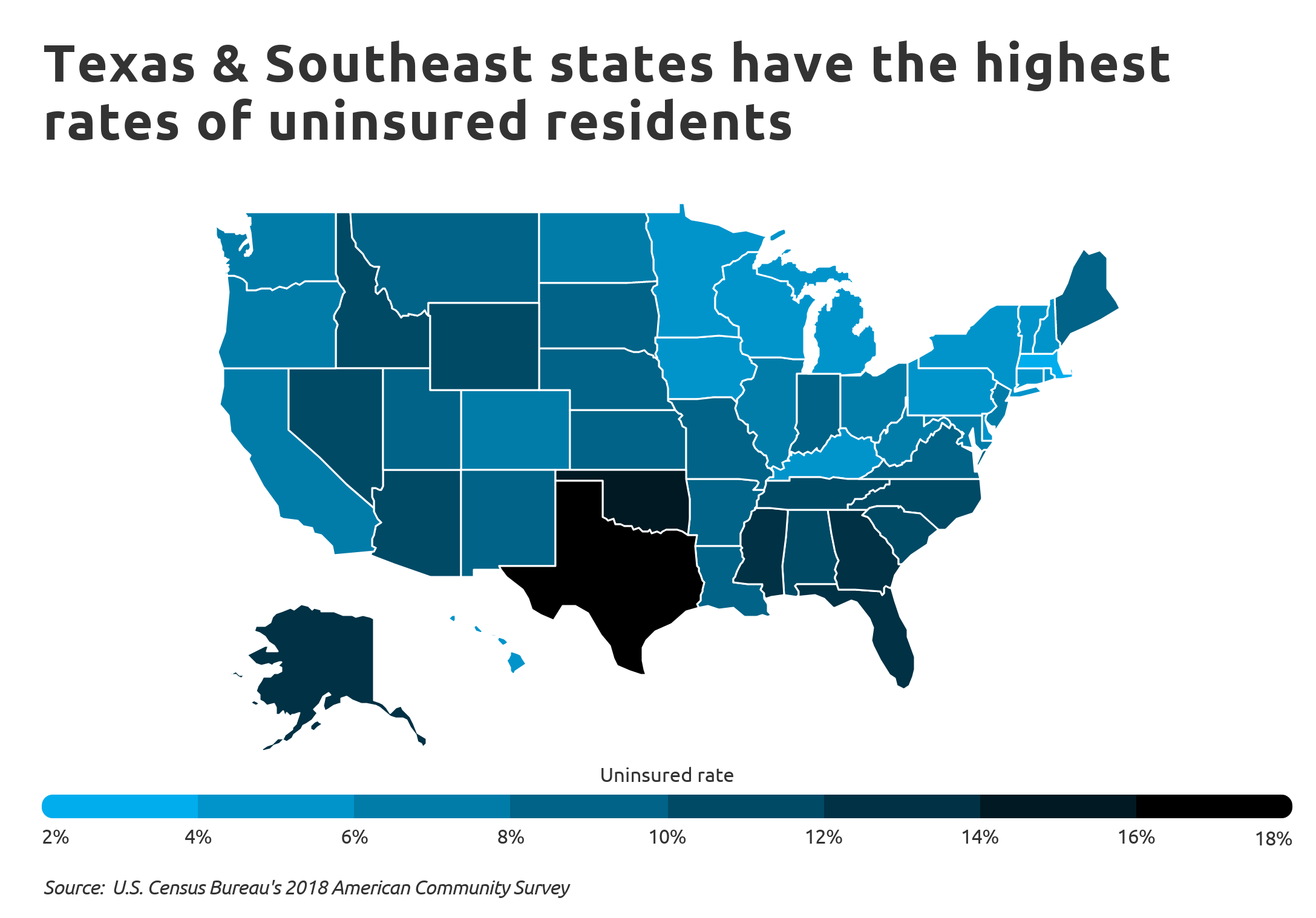
Texas has the highest uninsured rate in the U.S., with 29 percent of adults uninsured as of May

https://www.beckershospitalreview.com/rankings-and-ratings/states-ranked-by-uninsured-rates.html?utm_medium=email

COVID-19 Health: Rate of Uninsured Americans by City - Self

Texas has the highest uninsured rate in the U.S., with 29 percent of adults uninsured as of May, according to a report from Families USA. 

The report compared uninsured rates in 2018 to rates in May 2020 using data from the U.S. Bureau of Labor Statistics and the Urban Institute. Every state saw an increase in the number of uninsured, and the total number of uninsured in the U.S. climbed 21 percent.

The increase was due in part to layoffs tied to the COVID-19 pandemic in recent months. Nearly 5.4 million Americans lost health insurance coverage from February to May of this year due to job losses, according to the report.

Below is the total percentage of all uninsured adults in each state and the District of Columbia as of May. 

Texas: 29 percent

Florida: 25 percent

Oklahoma: 24 percent

Georgia: 23 percent

Mississippi: 22 percent

Nevada: 21 percent

North Carolina: 20 percent

South Carolina: 20 percent

Alabama: 19 percent

Tennessee: 19 percent

Idaho: 18 percent

Alaska: 17 percent

Arizona: 17 percent

Missouri: 17 percent

Wyoming: 17 percent

New Mexico: 16 percent

South Dakota: 16 percent

Arkansas: 15 percent

Kansas: 15 percent

Louisiana: 14 percent

Virginia: 14 percent

California: 13 percent

Colorado: 13 percent

Illinois: 13 percent

Indiana: 13 percent

Maine: 13 percent

Montana: 13 percent

New Jersey: 13 percent

Oregon: 13 percent

Utah: 13 percent

Michigan: 12 percent

Nebraska: 12 percent

Washington: 12 percent

West Virginia: 12 percent

Delaware: 11 percent

Maryland: 11 percent

New Hampshire: 11 percent

North Dakota: 11 percent

Ohio: 11 percent

Connecticut: 10 percent

Hawaii: 10 percent

Kentucky: 10 percent

New York: 10 percent

Pennsylvania: 10 percent

Wisconsin: 10 percent

Iowa: 9 percent

Rhode Island: 9 percent

Massachusetts: 8 percent

Minnesota: 8 percent

Vermont: 7 percent

District of Columbia: 6 percent


What happens if Covid-19 symptoms don’t go away? Doctors are trying to figure it out.

https://www.vox.com/2020/7/14/21324201/covid-19-long-term-effects-symptoms-treatment

Covid-19 long-term effects: People with persistent symptoms ...

People with long-term Covid-19 complications are meanwhile struggling to get care.

In late March, when Covid-19 was first surging, Jake Suett, a doctor of anesthesiology and intensive care medicine with the National Health Service in Norfolk, England, had seen plenty of patients with the disease — and intubated a few of them.

Then one day, he started to feel unwell, tired, with a sore throat. He pushed through it, continuing to work for five days until he developed a dry cough and fever. “Eventually, I got to the point where I was gasping for air literally doing nothing, lying on my bed.”

At the hospital, his chest X-rays and oxygen levels were normal — except he was gasping for air. After he was sent home, he continued to experience trouble breathing and developed severe cardiac-type chest pain.

Because of a shortage of Covid-19 tests, Suett wasn’t immediately tested; when he was able to get a test, 24 days after he got sick, it came back negative. PCR tests, which are most commonly used, can only detect acute infections, and because of testing shortages, not everyone has been able to get a test when they need one.

It’s now been 14 weeks since Suett’s presumed infection and he still has symptoms, including trouble concentrating, known as brain fog. (One recent study in Spain found that a majority of 841 hospitalized Covid-19 patients had neurological symptoms, including headaches and seizures.) “I don’t know what my future holds anymore,” Suett says.

Some doctors have dismissed some of his ongoing symptoms. One doctor suggested his intense breathing difficulties might be related to anxiety. “I found that really surprising,” Suett says. “As a doctor, I wanted to tell people, ‘Maybe we’re missing something here.’” He’s concerned not just for himself, but that many Covid-19 survivors with long-term symptoms aren’t being acknowledged or treated.

Suett says that even if the proportion of people who don’t eventually fully recover is small, there’s still a significant population who will need long-term care — and they’re having trouble getting it. “It’s a huge, unreported problem, and it’s crazy no one is shouting this from rooftops.”

In the US, a number of specialized centers are popping up at hospitals to help treat — and study — ongoing Covid-19 symptoms. The most successful draw on existing post-ICU protocols and a wide range of experts, from pulmonologists to psychiatrists. Yet even as care improves, patients are also running into familiar challenges in finding treatment: accessing and being able to pay for it.

What’s causing these long-term symptoms?

Scientists are still learning about the many ways the virus that causes Covid-19 impacts the body — both during initial infection and as symptoms persist.

One of the researchers studying them is Michael Peluso, a clinical fellow in infectious diseases at the University of California San Francisco, who is currently enrolling Covid-19 patients in San Francisco in a two-year study to study the disease’s long-term effects. The goal is to better understand what symptoms people are developing, how long they last, and eventually, the mechanisms that cause them. This could help scientists answer questions like how antibodies and immune cells called T-cells respond to the virus, and how different individuals might have different immune responses, leading to longer or shorter recovery times.

At the beginning of the Covid-19 pandemic, “the assumption was that people would get better, and then it was over,” Peluso says. “But we know from lots of other viral infections that there is almost always a subset of people who experience longer-term consequences.” He explains these can be due to damage to the body during the initial illness, the result of lingering viral infection, or because of complex immunological responses that occur after the initial disease.

“People sick enough to be hospitalized are likely to experience prolonged recovery, but with Covid-19, we’re seeing tremendous variability,” he says. It’s not necessarily just the sickest patients who experience long-term symptoms, but often people who weren’t even initially hospitalized.

That’s why long-term studies of large numbers of Covid-19 patients are so important, Peluso says. Once researchers can find what might be causing long-term symptoms, they can start targeting treatments to help people feel better. “I hope that a few months from now, we’ll have a sense if there is a biological target for managing some of these long-term symptoms.”

Lekshmi Santhosh, a physician lead and founder of the new post-Covid OPTIMAL Clinic at UCSF, says many of her patients are reporting the same kinds of problems. “The majority of patients have either persistent shortness of breath and/or fatigue for weeks to months,” she says.

Additionally, Timothy Henrich, a virologist and viral immunologist at UCSF who is also a principal investigator in the study, says that getting better at managing the initial illness may also help. “More effective acute treatments may also help reduce severity and duration of post-infectious symptoms.”

In the meantime, doctors can already help patients by treating some of their lingering symptoms. But the first step, Peluso explains, is not dismissing them. “It is important that patients know — and that doctors send the message — that they can help manage these symptoms, even if they are incompletely understood,” he says. “It sounds like many people may not be being told that.”

Long-term symptoms, long-term consequences

Even though we have a lot to learn about the specific damage Covid-19 can cause, doctors already know quite a bit about recovery from other viruses: namely, how complex and challenging a task long-term recovery from any serious infection can be for many patients.

Generally, it’s common for patients who have been hospitalized, intubated, or ventilated — as is common with severe Covid-19 — to have a long recovery. Being bed-bound can cause muscle weakness, known as deconditioning, which can result in prolonged shortness of breath. After a severe illness, many people also experience anxiety, depression, and PTSD.

A stay in the ICU not uncommonly leads to delirium, a serious mental disorder sometimes resulting in confused thinking, hallucinations, and reduced awareness of surroundings. But Covid-19 has created a “delirium factory,” says Santhosh at UCSF. This is because the illness has meant long hospital stays, interactions only with staff in full PPE, and the absence of family or other visitors.

Theodore Iwashyna, an ICU physician-scientist at the University of Michigan and VA Ann Arbor, is involved with the CAIRO Network, a group of 40 post-intensive care clinics on four continents. In general, after patients are discharged from ICUs, he says, “about half of people have some substantial new disability, and half will never get back to work. Maybe a third of people will have some degree of cognitive impairment. And a third have emotional problems.” And it’s common for them to have difficulty getting care for their ongoing symptoms after being discharged.

In working with Covid-19 patients, says Santhosh, she tells patients, “We believe you … and we are going to work on the mind and body together.”

Yet it’s currently impossible to predict who will have long-lasting symptoms from Covid-19. “People who are older and frailer with more comorbidities are more likely to have longer physical recovery. However, I’ve seen a lot of young people be really, really sick,” Santhosh says. “They will have a long tail of recovery too.”

Who can access care?

At the new OPTIMAL Clinic at UCSF, doctors are seeing patients who were hospitalized for Covid-19 at the UCSF health system, as well as taking referrals of other patients with persistent pulmonary symptoms. For ongoing cough and chest tightness, the clinic is providing inhalers, as well as pulmonary rehabilitation, including gradual aerobic exercise with oxygen monitoring. They’re also connecting patients with mental health resources.

“Normalizing those symptoms, as well as plugging people into mental health care, is really critical,” says Santhosh, who is also the physician lead and founder of the clinic. “I want people to know this is real. It’s not ‘in their heads.’”

Neeta Thakur, a pulmonary specialist at Zuckerberg San Francisco General Hospital and Trauma Center who has been providing care for Covid-19 patients in the ICU, just opened a similar outpatient clinic for post-Covid care. Thakur has also arranged a multidisciplinary approach, including occupational and physical therapy, as well as expedited referrals to neurology colleagues for rehabilitation for the muscles and nerves that can often be compressed when patients are prone for long periods in the ICU. But she’s most concerned by the cognitive impairments she’s seeing, especially as she’s dealing with a lot of younger patients.

These California centers join new post-Covid-19 clinics in major cities across the country, including Mount Sinai in New York and National Jewish Health Hospital in Denver. As more and more hospitals begin to focus on post-Covid care, Iwashyna suggests patients try to seek treatment where they were hospitalized, if possible, because of the difficulty in transferring sufficient medical records.

Santosh recommends that patients with persistent symptoms call their closest hospital, or nearest academic medical center’s pulmonary division, and ask if they can participate in any clinical trials. Many of the new clinics are enrolling patients in studies to try to better understand the long-term consequences of the disease. Fortunately, treatment associated with research is often free, and sometimes also offers financial incentives to participants.

But otherwise, one of the biggest challenges in post-Covid-19 treatment is — like so much of American health care — being able to pay for it.

Outside of clinical trials, cost can be a barrier to treatment. It can be tricky to get insurance to cover long-term care, Iwashyna notes. After being discharged from an ICU, he says, “Recovery depends on [patients’] social support, and how broke they are afterward.” Many struggle to cover the costs of treatment. “Our patient population is all underinsured,” says Thakur, noting that her hospital works with patients to try to help cover costs.

Lasting health impacts can also affect a person’s ability to go back to work. In Iwashyna’s experience, many patients quickly run through their guaranteed 12 weeks of leave under the Family Medical and Leave Act, which isn’t required to be paid. Eve Leckie, a 39-year-old ICU nurse in New Hampshire, came down with Covid-19 on March 15. Since then, Leckie has experienced symptom relapses and still can’t even get a drink of water without help.

“I’m typing this to you from my bed, because I’m too short of breath today to get out,” they say. “This could disable me for the rest of my life, and I have no idea how much that would cost, or at what point I will lose my insurance, since it’s dependent on my employment, and I’m incapable of working.” Leckie was the sole wage earner for their five children, and was facing eviction when their partner “essentially rescued us,” allowing them to move in.

These long-term burdens are not being felt equally. At Thakur’s hospital in San Francisco, “The population [admitted] here is younger and Latinx, a disparity which reflects who gets exposed,” she says. She worries that during the pandemic, “social and structural determinants of health will just widen disparities across the board.” People of color have been disproportionately affected by the virus, in part because they are less likely to be able to work from home.

Black people are also more likely to be hospitalized if they get Covid-19, both because of higher rates of preexisting conditions — which are the result of structural inequality — and because of lack of access to health care.

“If you are more likely to be exposed because of your job, and likely to seek care later because of fear of cost, or needing to work, you’re more likely to have severe disease,” Thakur says. “As a result, you’re more likely to have long-term consequences. Depending on what that looks like, your ability to work and economic opportunities will be hindered. It’s a very striking example of how social determinants of health can really impact someone over their lifetime.”

If policies don’t support people with persistent symptoms in getting the care they need, ongoing Covid-19 challenges will deepen what’s already a clear crisis of inequality.

Iwashyna explains that a lot of extended treatment for Covid-19 patients is “going to be about interactions with health care systems that are not well-designed. The correctable problems often involve helping people navigate a horribly fragmented health care system.

“We can fix that, but we’re not going to fix that tomorrow. These patients need help now.”


1.3 million Americans filed first-time unemployment claims last week

https://www.cnn.com/2020/07/16/economy/unemployment-benefits-coronavirus/index.html

1.3 million people filed for first-time unemployment last week

It’s still not easy to remain employed in the US, nearly four months after the coronavirus pandemic began upending the economy.

Another 1.3 million people filed first-time jobless claims on a seasonally adjusted basis for the week ending July 11, according to the Department of Labor. That’s down 10,000 from the prior week’s revised level.
On an unadjusted basis, more than 1.5 million people filed first-time claims, up almost 109,000 from the week before. The seasonal adjustments are traditionally used to smooth out the data, but that has tended to have the opposite effect during the pandemic.
Weekly first-time unemployment applications have been on the decline for more than three months since their peak in the last week of March. But last week’s drop was less than expected.
“Overall, filings remain high and are declining at a stubbornly slow pace,” said Rubeela Farooqi, chief US economist for High Frequency Economics, noting that the risk of mounting permanent job losses is high. “The pace could slow even further or reverse in coming weeks in response to a surge in virus cases and related closures of businesses.”
Continued claims, which count workers who have filed claims for at least two weeks in a row, stood at more than 17.3 million for the week ending July 4, down 422,000 from the prior week. These claims peaked in May at nearly 25 million.
In addition, about 928,500 million people in 47 states filed for first-time pandemic unemployment assistance last week, down almost 118,000 from the week before. And almost 14.3 million people claimed continued pandemic benefits across 48 states for the week ending June 27. That’s up nearly 406,000 from the prior week.
The pandemic program was created by Congress in March to respond to the coronavirus outbreak. It provides temporary benefits to workers who typically aren’t eligible for payments, including freelancers, independent contractors, the self-employed and certain people affected by the coronavirus. It expires at the end of the year.
Looking at all workers participating in an array of unemployment programs, just over 32 million Americans claimed jobless benefits the week ending June 27, down about 433,000 from the prior week.
That total includes those in the traditional and pandemic unemployment programs, as well as the pandemic emergency unemployment compensation program, which has nearly 936,500 filers. Lawmakers created it in March to provide those who have exhausted their benefits with an additional 13 weeks of payments. It also expires at the end of 2020.