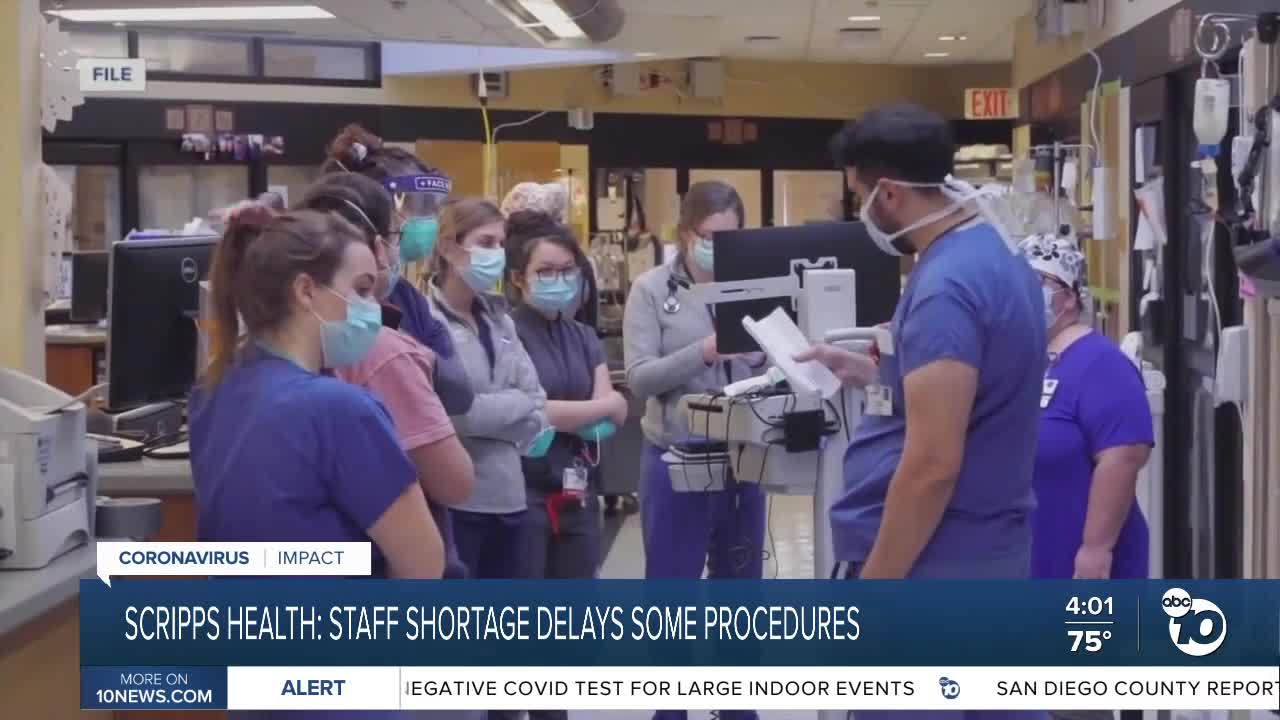
Scripps Health is temporarily postponing some medical procedures because of significant staffing shortages and a jump in COVID-19 cases, the San Diego, Calif.-based system said Aug. 20, according to CBS News 8.
Medical staff is deciding which procedures to delay based on clinical factors and emergency status, with time-sensitive care still being delivered, Scripps leaders said.
The health system said it is also considering temporarily consolidating some ambulatory care sites due to workforce shortages.
At present, Scripps said it is looking to fill 1,309 open positions. In August 2019, the system had just 832 openings. About 430 of the openings are for nursing positions, up from 220 open positions in 2019, according to the report.
At the same time, the health system is seeing its COVID-19 patient volume grow. Scripps has 173 patients admitted at its five hospitals, up from 13 patients on June 13.
“The COVID pandemic has taken a serious toll on healthcare workers across the nation, and many have decided to leave the field entirely for reasons such as fatigue and burnout,” said Scripps’ President and CEO Chris Van Gorder, according to CBS News 8. “We’re doing all we can to fill open positions and shifts, but options are currently limited across the board in healthcare, so we’re doing what’s necessary to ensure we have staff available for our most urgent cases.”
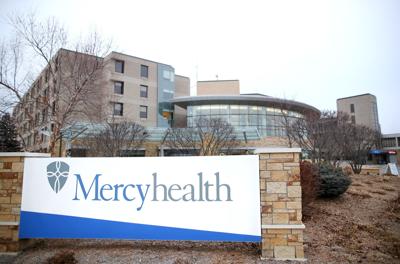
Janesville, Wis.-based Mercyhealth has fired a vice president in charge of marketing and public relations over an alleged kickback scheme with a vendor, the Janesville Gazette reported Aug.16, citing a letter from the health system’s CEO.
The vice president, Barb Bortner, was fired after health system leaders learned of a $3 million fraudulent invoice and kickback scheme that she was allegedly involved in, Mercyhealth President and CEO Javon Bea said in the letter obtained by the Gazette.
“Our patients and communities we serve expect us to conduct our business affairs with the highest degree of integrity. We are all deeply saddened and disappointed that a member of our team has betrayed that trust,” Mr. Bea wrote in the letter, according to the Rockford Register Star.
Mr. Bea said Mercyhealth officials suspect Ms. Bortner is responsible for fraudulent and “improper” arrangements with an unnamed vendor, and the alleged fraud was linked to the system’s marketing division. Mercyhealth is severing ties with the vendor believed to be involved, the Gazette reported.
The fraud does not appear to have impacted patient care, and the system is taking “all necessary steps to improve Mercyhealth procedures,” Mr. Bea wrote, according to the report.
On Wednesday, President Joe Biden unveiled a new plan requiring nursing homes to vaccinate their employees or lose federal funding. Industry members are concerned the mandate will exacerbate current staffing shortages and make it harder for facilities to care for their residents.
Biden ties employee vaccination to federal funding for nursing homes
Biden announced on Wednesday that nursing homes will have to require their workers be vaccinated against Covid-19 to receive Medicare and Medicaid funding, the New York Times reports.
CMS is expected to release an emergency rule covering this new requirement in September, according to Roll Call. Officials said the decision will affect more than 15,000 nursing homes with around 1.3 million workers across the country.
In a statement, CMS administrator Chiquita Brooks-LaSure said, “Keeping nursing home residents and staff safe is our priority. The data are clear that higher levels of staff vaccination are linked to fewer outbreaks among residents, many of whom are at an increased risk of infection, hospitalization, or death.”
As of Aug. 8, federal data showed that around 62% of all nursing home staff are currently vaccinated. But vaccination rates vary widely by state, with a high of 88% in some states and a low of 44% in others.
In addition, according to data from CMS, nationwide Covid-19 cases in nursing homes have increased from 319 cases on June 27 to 2,696 cases on Aug. 8. Since the beginning of the pandemic, federal data shows that around 134,000 nursing home residents and nearly 2,000 employees have died from Covid-19.
How will the vaccine mandate affect nursing homes?
According to Roll Call, divisions among nursing home staff about a vaccine mandate has some people in the industry—which has long suffered staffing shortages—concerned that even more workers will leave.
Lori Porter, CEO of the National Association of Health Care Assistants, said she is worried the industry could lose 20% to 30% of its workforce over the new vaccine requirement.
And Mark Parkinson, president and CEO of the American Health Care Association and National Center for Assisted Living, said a broader vaccine mandate for all health care organizations, instead of just nursing homes, is necessary to prevent further staffing shortages.
“Focusing only on nursing homes will cause vaccine hesitant workers to flee to other health care providers and leave many centers without adequate staff to care for residents,” Parkinson said. “It will make an already difficult workforce shortage even worse.”
Similarly, Katie Smith Sloan, president and CEO of LeadingAge, a nonprofit that represents more than 5,000 aging services providers, said the vaccine mandate should be extended to all health care workers in all settings. She also voiced concern that cutting funding to nursing homes will further hurt facilities that have struggled financially throughout the pandemic.
“Without Medicaid and Medicare funding, nursing homes cannot provide the quality care that our nation’s most vulnerable older adults need,” Smith Sloan said. “Our mission-driven nursing home members, who operate on narrow margins in the best of times, depend on those funds alone to care for their residents.”
Separately, David Grabowski, a professor of health care policy at Harvard Medical School, said funding cuts could put some nursing homes “in a precarious position” and that he believes there will be a “tremendous amount of pushback in the industry.”
Grabowski noted that while a national vaccine mandate could “level the playing field” for nursing homes looking for employees, they may still struggle to retain employees with jobs in other areas, such as retail or hotels, offering similar pay. “I think this is a good measure, but it needs to be paired with additional resources to help pay staff and make sure these are jobs they want to stay in,” he said. (Clason, Roll Call, 8/18; LaFraniere et al., New York Times, 8/18; Christ, Modern Healthcare, 8/18)
Advisory Board’s take
This is a bold step—but it’s the right thing to do. Here’s why.
Mandating vaccinations for staff in skilled nursing facilities (SNFs) is definitely a bold step—but ensuring all staff are vaccinated is unquestionably the right thing to do. As health care leaders, it is our responsibility to care for our patients, our staff, and our communities, and during this pandemic, vaccination is the best way to do that.
Nationally, staff working in post-acute and long-term care settings have been among the groups most hesitant to take a Covid-19 vaccine. The combination of the extremely vulnerable patient populations in those settings and the lack of voluntary vaccination was likely what motivated this move.
I don’t want to imply this will be easy. Many SNFs will struggle to achieve universal vaccination, and there is understandable fear associated with having to let go of staff in what is an extremely tight staffing environment.
However, in my view, the staffing implications will be less severe than many believe. In some ways, a national mandate actually makes it easier for providers, because individual staff members can’t simply go work for another facility in order to avoid getting their shot. And as more and more employers across the country begin to mandate vaccinations—a list that so far includes large employers like Walmart and Tyson Foods—staff members will have minimal opportunities for alternate work arrangements that do not require them to get the vaccine. For many staff, even those who have refused in the past, the elimination of other options that would allow them to remain unvaccinated may give them the push they need to get the vaccine.
Some staff will refuse and leave the industry. In the short term, this will increase pressure on already tight staffing. In the medium to long term, however, a fully vaccinated workforce is better for providers. It’s better for recruiting, because it attracts potential workers who want to be in a safer environment. It’s better for the existing workforce, who will likely need to take fewer sick days. And it’s better for the reputation of the industry. In our summer consumer survey, we found that 76% of respondents would be more likely to receive care at a skilled nursing facility if all of that facility’s staff were vaccinated. Staff vaccination helps build a level of community trust in the safety of the facility, which will be critical as SNFs seek to return to growth during and after the Covid-19 pandemic.
Check out our resources for building consumer confidence in post-acute and senior care during and beyond a crisis. For help with how to prepare your staff and residents for the vaccine rollout at your facility, review our guide for long-term care leaders.
As some states set Covid-19 hospitalization records, many overwhelmed hospitals are outsourcing patients on planes, helicopters, and ambulances to distant cities and states for treatment, Heather Hollingsworth and Jim Salter write for the Associated Press.
Transfers hundreds of miles away
As of last week, the number of Covid-19 patients in most hospitals remained below winter surge levels, Hollingsworth and Salter report. However, Florida, Arkansas, Oregon, Hawaii, Louisiana, and Mississippi recently set pandemic hospitalization records.
And unlike in the winter surge, many hospitals were already strained this summer due to patients catching up on previously deferred care, according to Hollingsworth and Salter.
“We are seeing Covid patients and we are seeing car accidents and we are seeing kids come in with normal seasonal viral infections. And we are seeing normal life come into the emergency department along with the extra surge of Covid patients, so it is causing that crisis,” said Mark Rosenberg, president of the American College of Emergency Physicians.
Amid the influx of patients, many of these overwhelmed hospitals are looking to neighboring cities and states for relief. For instance, in Arizona, a Covid-19 hotline is receiving calls from hospitals in Wyoming, Arkansas, Texas, and California in search of bed space, Hollingsworth and Salter report—although the hotline often cannot provide any help.
In Kansas, officials at the Wilson Medical Center in Kansas had to call 40 other facilities in several states seeking a bed for a Covid-19 patient before finally finding an available bed about 220 miles away. Across the state, according to Motient, a company contracting with Kansas to manage transfers, Covid-19 patients generally have to wait an average of 10 hours before being flown to another hospital location, which could be in Wisconsin, Illinois, Colorado, or Texas. “That is just the worst day that you can have in the emergency room as a provider,” Richard Watson, Motient’s founder, said, “to be taking care of a patient that you are totally helpless to give them what you know they need.”
Similarly, in Washington state, the 25-bed Prosser Memorial Hospital, doesn’t have an intensive care unit, so critically ill patients are being sent as far as eastern Idaho—600 miles away.
Staffing shortages, low vaccination rates add to the problem
Finding a hospital to take in patients has become more difficult due to recent staffing shortages, according to Robin Allaman, CNO at the Kearny County Hospital in Kansas.
“Most [hospitals] are saying it isn’t that they don’t have an open bed, it is that they don’t have nursing staff to care for them,” he said. Officials at his hospital called health systems in Nebraska, Oklahoma, and New Mexico before one in Colorado Springs, Colo.—200 miles away—agreed to take a recent patient.
Watson said these delayed transfers can have dire consequences for patients, especially those who need to see specialists, who often are available only in larger hospitals. “Imagine being with your grandma in the ER who is having a heart attack in western Kansas and you are saying, ‘Why can’t we find a bed for her?’ We are watching this happen right in front of us. ‘This is America. Why don’t we have hospital bed for her?’ Well, here we are,” he said.
And while experts had hoped that the vaccines would prevent hospitals from becoming overwhelmed again, Justin Lessler, a professor of epidemiology at Johns Hopkins University, said there hasn’t been the reduction in hospitalizations that officials had hoped for. That’s in part because the delta variant seems to be more severe, particularly in younger people, whose vaccination rates are lower.
Steve Edwards—CEO of CoxHealth, whose hospital in Springfield, Mo., is treating patients from as far away as Alabama—added, “Just imagine not having the support of your family near, to have that kind of anxiety if you have someone grow acutely ill.”
After a calmer start to the summer, the Delta variant is eroding consumer confidence as COVID-19 surges across many parts of the US once again. Using the latest data from Morning Consult’s Consumer Confidence Index, the graphic above shows the fluctuations in consumer confidence levels across the last year.
The most recent COVID surge has caused a five-point drop in confidence in the past month and, with cases still rising, we expect this trend to continue into the fall. Notably, with renewed masking guidance and increasing reports of breakthrough infections, confidence has dropped more among fully vaccinated individuals than among the unvaccinated.
Consumers’ comfort levels aren’t only dropping when it comes to daily activities, like grocery shopping or dining at a restaurant, but also with respect to healthcare. A recent survey from Jarrard Phillips Cate & Hancock finds that while consumers feel safer visiting healthcare settings in August 2021 than they did back in January, more than a third of consumers report the current COVID situation is making them less likely to seek non-emergency care, and 44 percent say they are more likely to pursue virtual care alternatives.
Health systems must be able to seamlessly “dial up” or “dial down” their virtual care capabilities in order to meet fluctuating consumer demand and avoid another wave of missed or deferred care.